NHRDN Workshop – 1 st  October’10 Presented by: P. Dwarakanath  Director – Group Human Capital  Max India Ltd. “ Strategic Thinking and Alignment”
The Current Operating Reality
A Look at the Current Landscape…. Economy Troubled Environment  Dynamic Business  Fiercely Competitive Market  Fluid Organization Structure  Fluctuating Industry  Apprehensive Future  Unpredictable People  Bewildered Irrespective of the market conditions, a war is always on…….  “ A war for finding, developing and retaining the right talent!!”
Business Challenges And Issues Globalization & Deregulation Mergers and Acquisitions Technological Advancement Intensifying demand for high-caliber talent Irreversible shift from Industrial Age to Information Age Change, Change and More Change
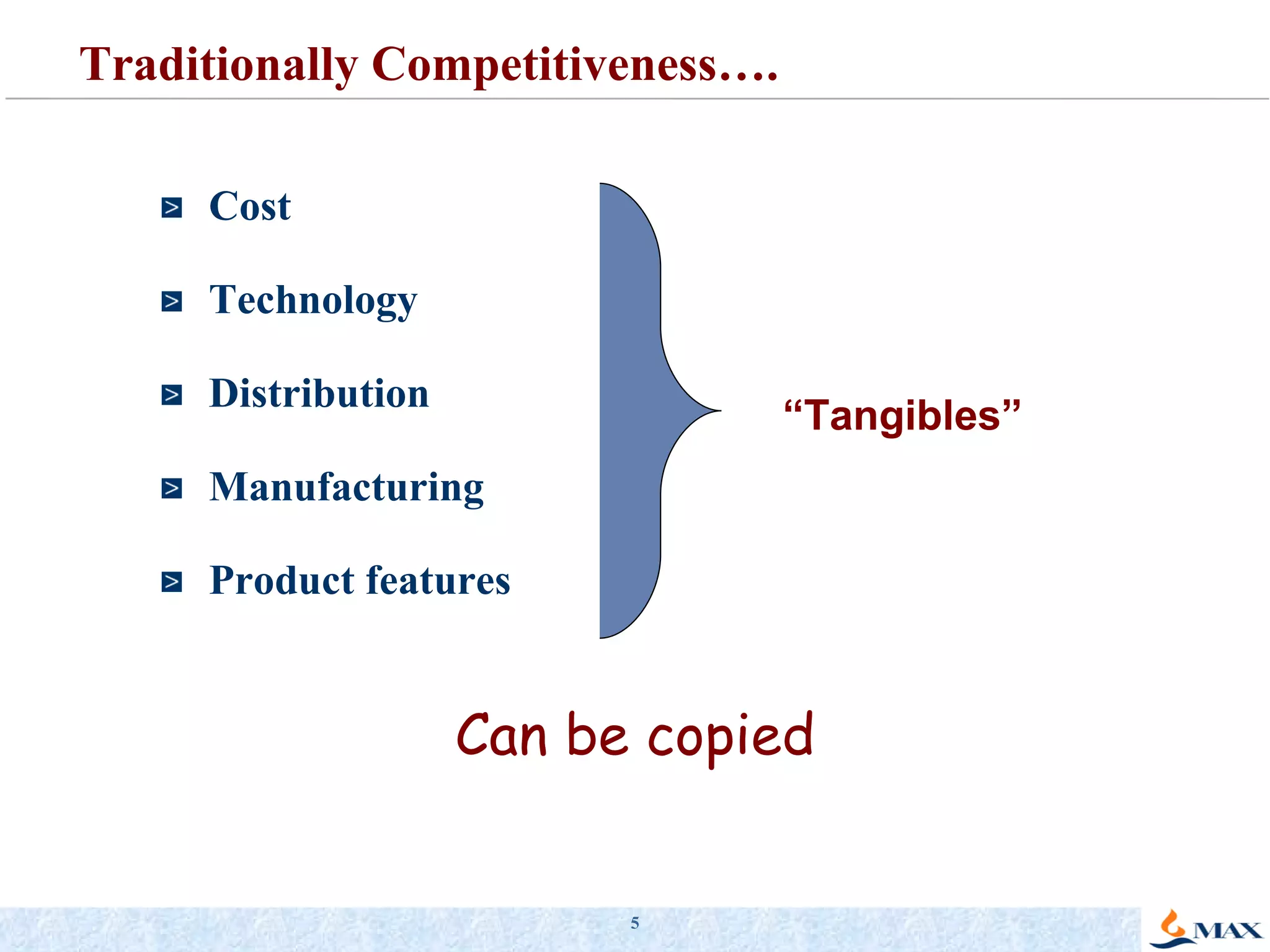
Traditionally Competitiveness….  Cost Technology Distribution Manufacturing Product features Can be copied “ Tangibles”
New Economy : Age of “Intangibles” Winning will spring from organizational Capabilities such as Speed Responsiveness Agility Learning Capacity Employee Competence Talent As A Source of Competitive Advantage
Today’s organizations need radical innovators Who are passionate about what they do,  Willing to rock the boat and make a big difference These people also need to understand the future   How to leap-frog established thinking How to grow markets, without losing sight of the values that built a business in the first place  How to keep the organization relevant to a very different future Talent Makes the Difference….
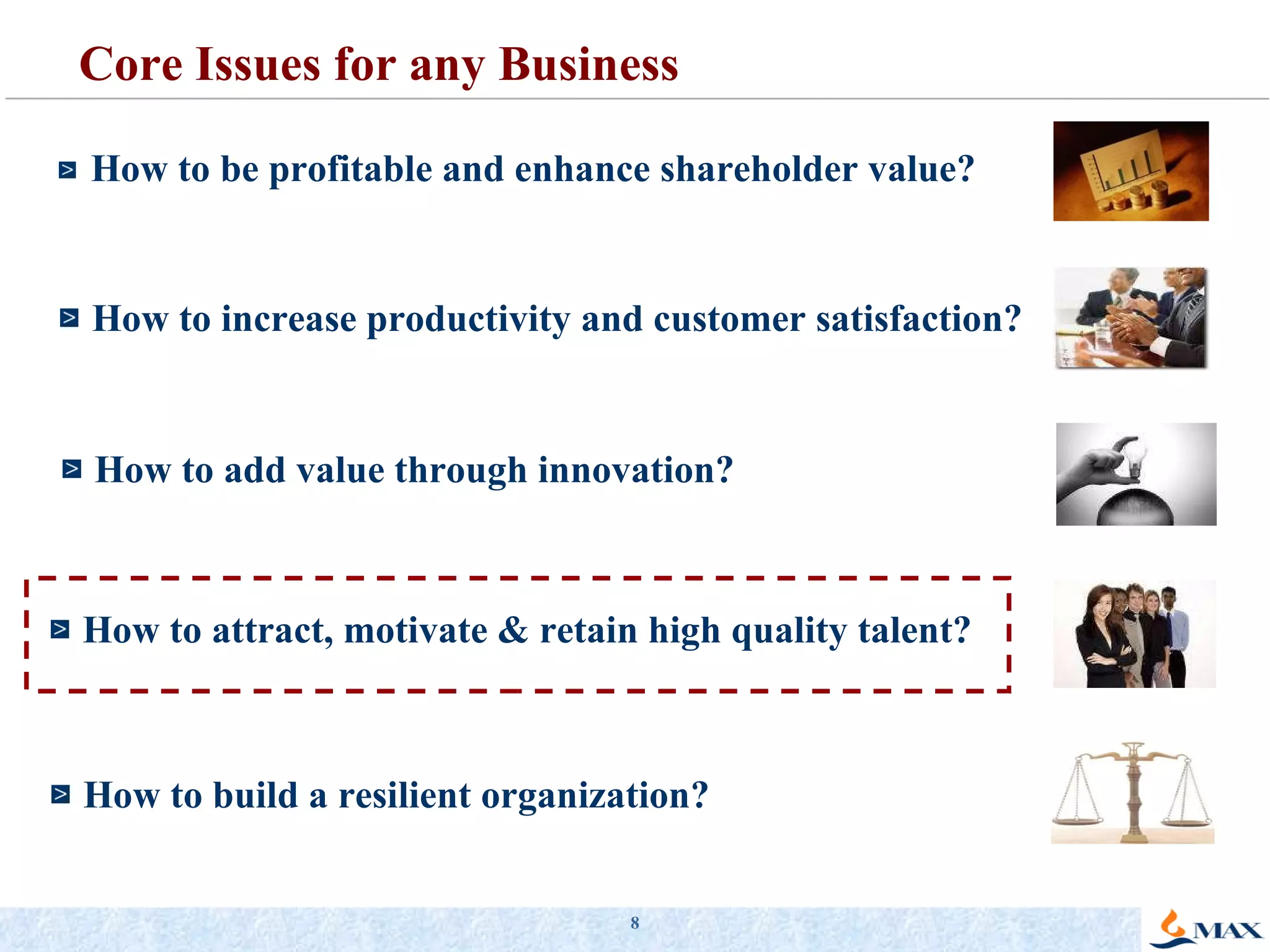
Core Issues for any Business How to be profitable and enhance shareholder value? How to increase productivity and customer satisfaction? How to add value through innovation? How to attract, motivate & retain high quality talent? How to build a resilient organization?
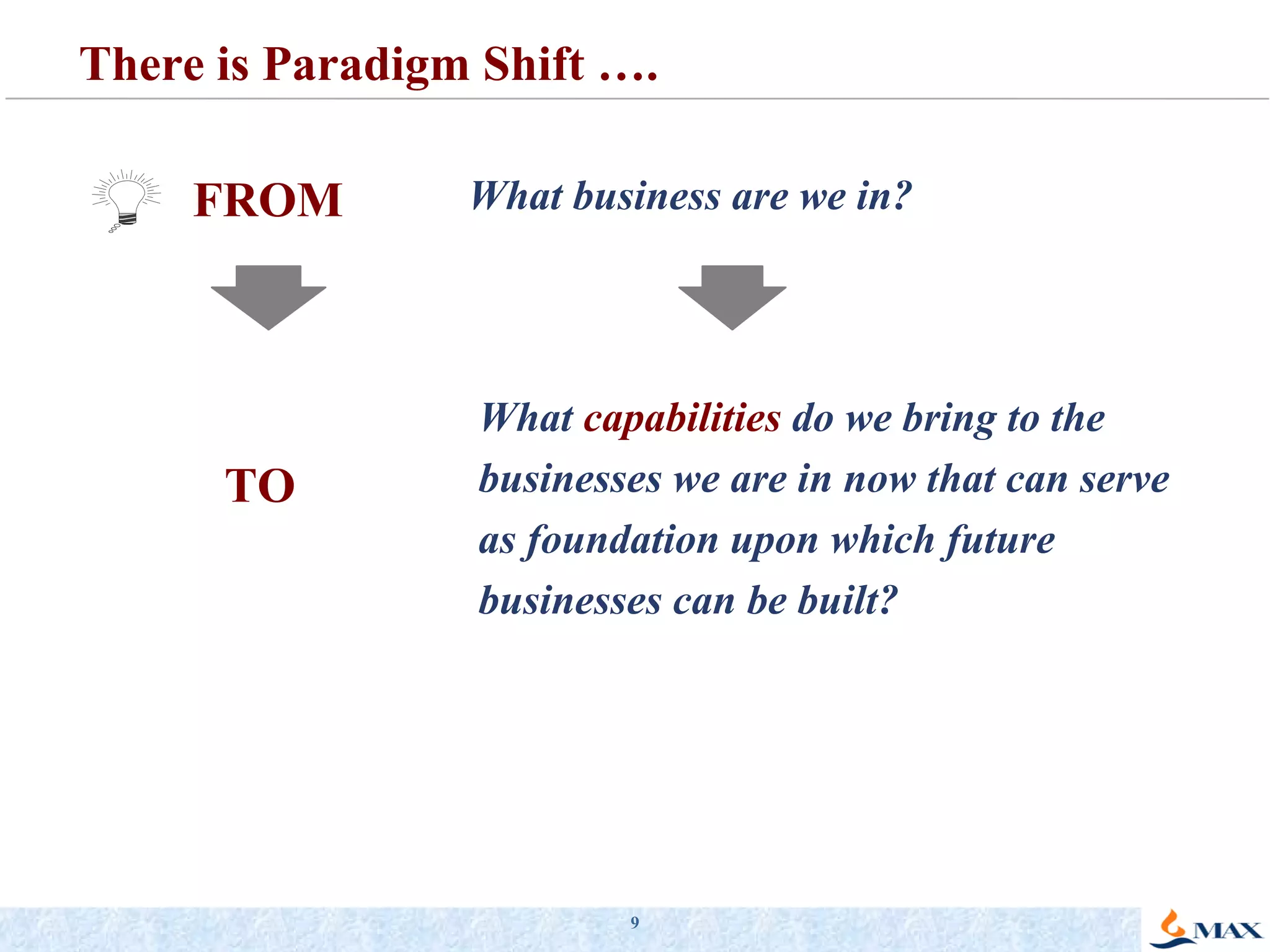
There is Paradigm Shift …. FROM What business are we in? TO What  capabilities  do we bring to the businesses we are in now that can serve as foundation upon which future businesses can be built?
… .Therefore, the Key HR Imperatives Identify desired  business capabilities and leadership competencies  to drive business success Assessing  level of preparedness  of the leadership team to lead the organization to success - Design assessment tools to determine current level of skill and capability of the leadership team Assessment of the management team and  skill gap analysis Prioritization of development initiatives and one to one feedback on  competency development Integration  of competency model into the performance management system Linkage of competencies to other  HR systems  for ongoing institutional strengthening
Strategic Thinking & Alignment
Strategic Thinking - Introduction
“ Strategic Thinking”  pertains to the ability to make directional  choices and balance between present and future. It takes a long term perspective into account Focuses on finding and developing unique opportunities to create value by enabling a provocative and creative dialogue among people who can affect a company’s direction It is the input to strategic planning — good strategic thinking uncovers potential opportunities for creating value and challenges assumptions about a company’s value proposition, so that when the plan is created, it targets these opportunities What is Strategic Thinking ? ……..  (1/2) Source: Centre for Applied Research
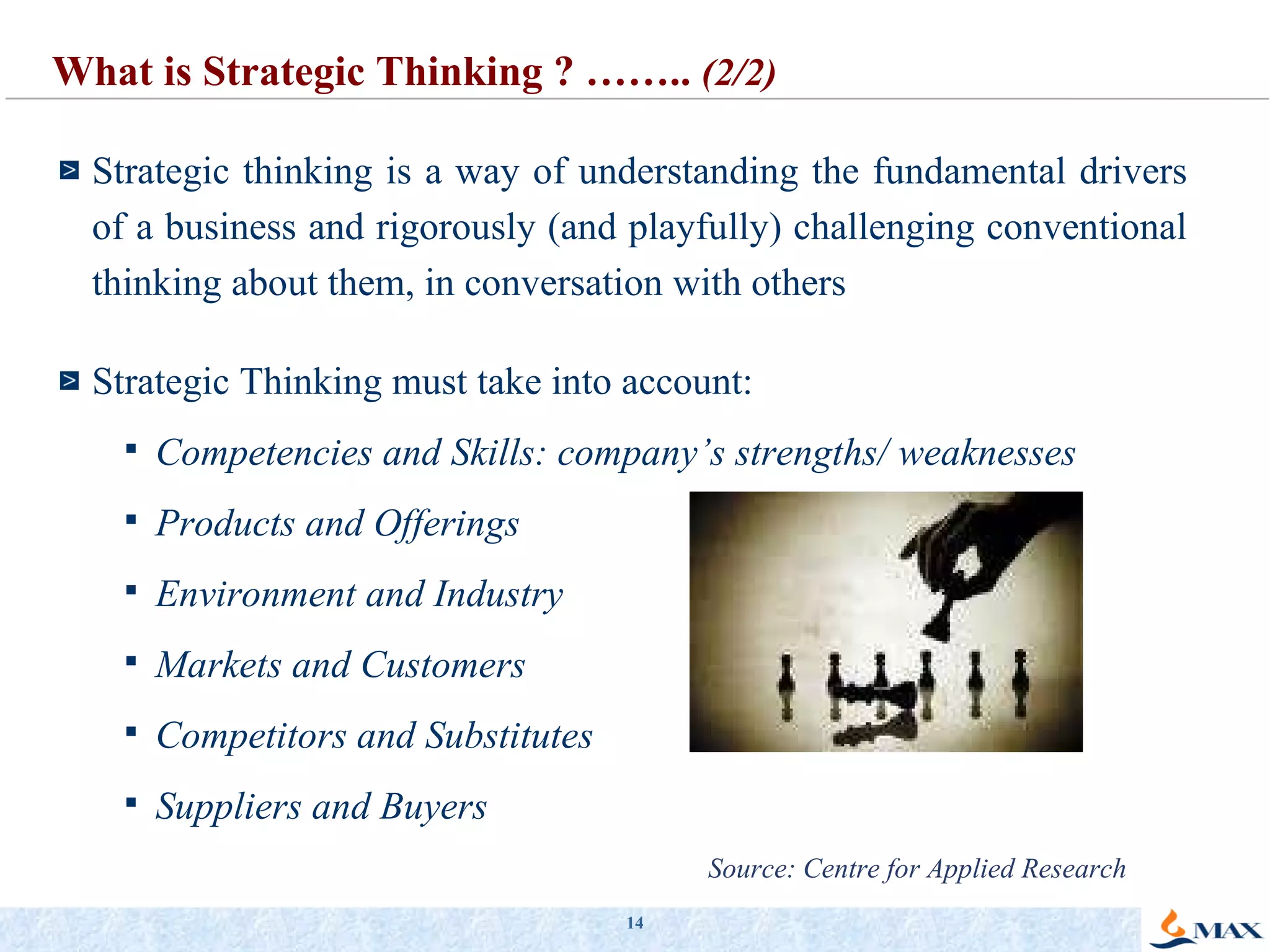
Strategic thinking is a way of understanding the fundamental drivers of a business and rigorously (and playfully) challenging conventional thinking about them, in conversation with others Strategic Thinking must take into account: Competencies and Skills: company’s strengths/ weaknesses Products and Offerings Environment and Industry Markets and Customers Competitors and Substitutes Suppliers and Buyers What is Strategic Thinking ? ……..  (2/2) Source: Centre for Applied Research
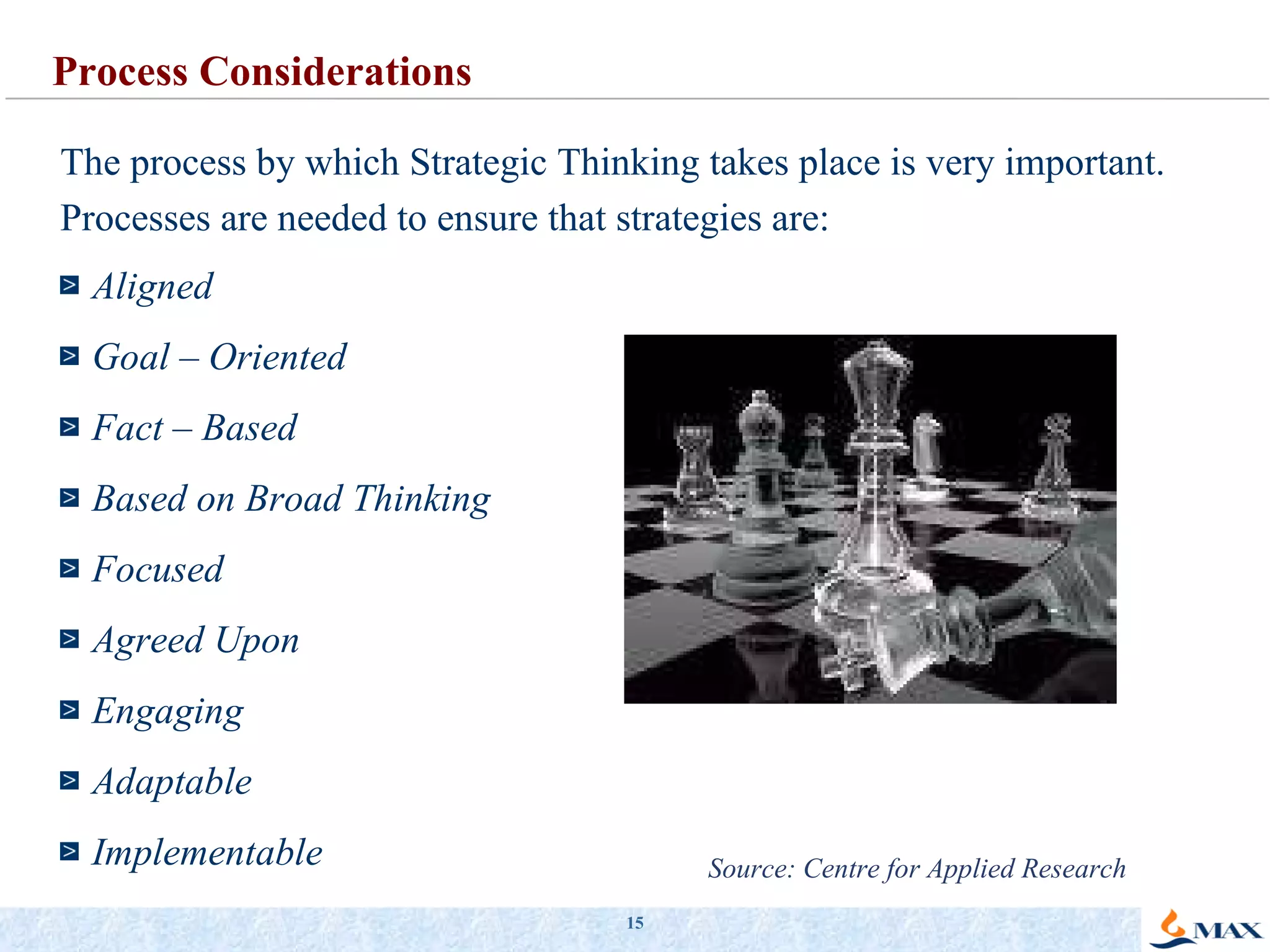
The process by which Strategic Thinking takes place is very important. Processes are needed to ensure that strategies are: Aligned Goal – Oriented Fact – Based Based on Broad Thinking Focused Agreed Upon Engaging Adaptable Implementable Process Considerations Source: Centre for Applied Research
SWOT Analysis
SWOT Analysis  is a strategic planning method used to evaluate the  S trengths,  W eaknesses,  O pportunities and  T hreats involved in a business venture. Strengths:  Attributes of the person or company that are helpful to achieving the objective(s).  Weaknesses:  Attributes of the person or company that are harmful to achieving the objective(s).  Opportunities:  External conditions that are helpful to achieving the objective(s).  Threats:  External conditions which could do damage to the objective(s).  The technique is credited to  Albert Humphrey,  a business and management consultant who specialized in organizational management and cultural change. SWOT Analysis  ……..  (1/3)
A SWOT analysis must first start with defining a desired end state or objective. It involves specifying the objective of the business venture and identifying the internal and external factors that are favorable and unfavorable to achieve that objective. These come from within the company's unique value chain.  SWOT analysis groups key pieces of information into two main categories: The internal factors – the strengths or weaknesses   internal to the organization The external factors – the opportunities and threats presented by the external environment to the organization SWOT Analysis  ……..  (2/3)
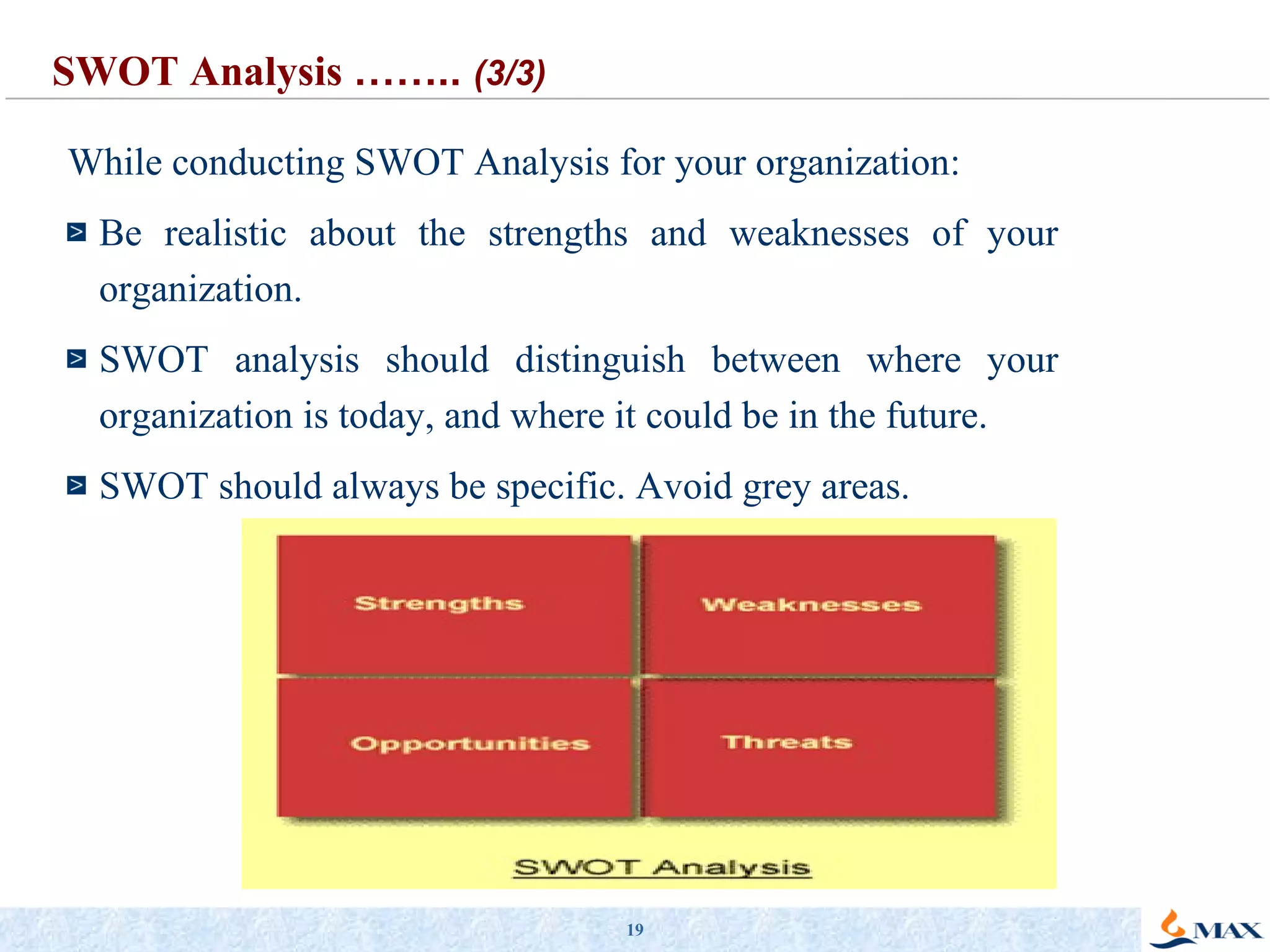
While conducting SWOT Analysis for your organization: Be realistic about the strengths and weaknesses of your organization. SWOT analysis should distinguish between where your organization is today, and where it could be in the future. SWOT should always be specific. Avoid grey areas. SWOT Analysis  ……..  (3/3)
Strategic Alignment
“ Y ou've got to think about 'big things' while you are doing small things, so that all the small things go in the right direction.” –  Alvin Toffler Strategic Alignment is the process of aligning Strategic Thinking with corporate vision, goals, objectives, and strategies. Strategic alignment is linking and configuring the strategic elements, key organization systems, processes and structure in such a way that their implementation achieves the organization's shared vision and results beyond expectations.  Strategic Alignment
Translate strategy into operational terms Link and align the organization around its strategy Make strategy everyone’s job Make strategy a continual process Executive team leadership to drive the change 5 Principles of a Strategy- focused organization
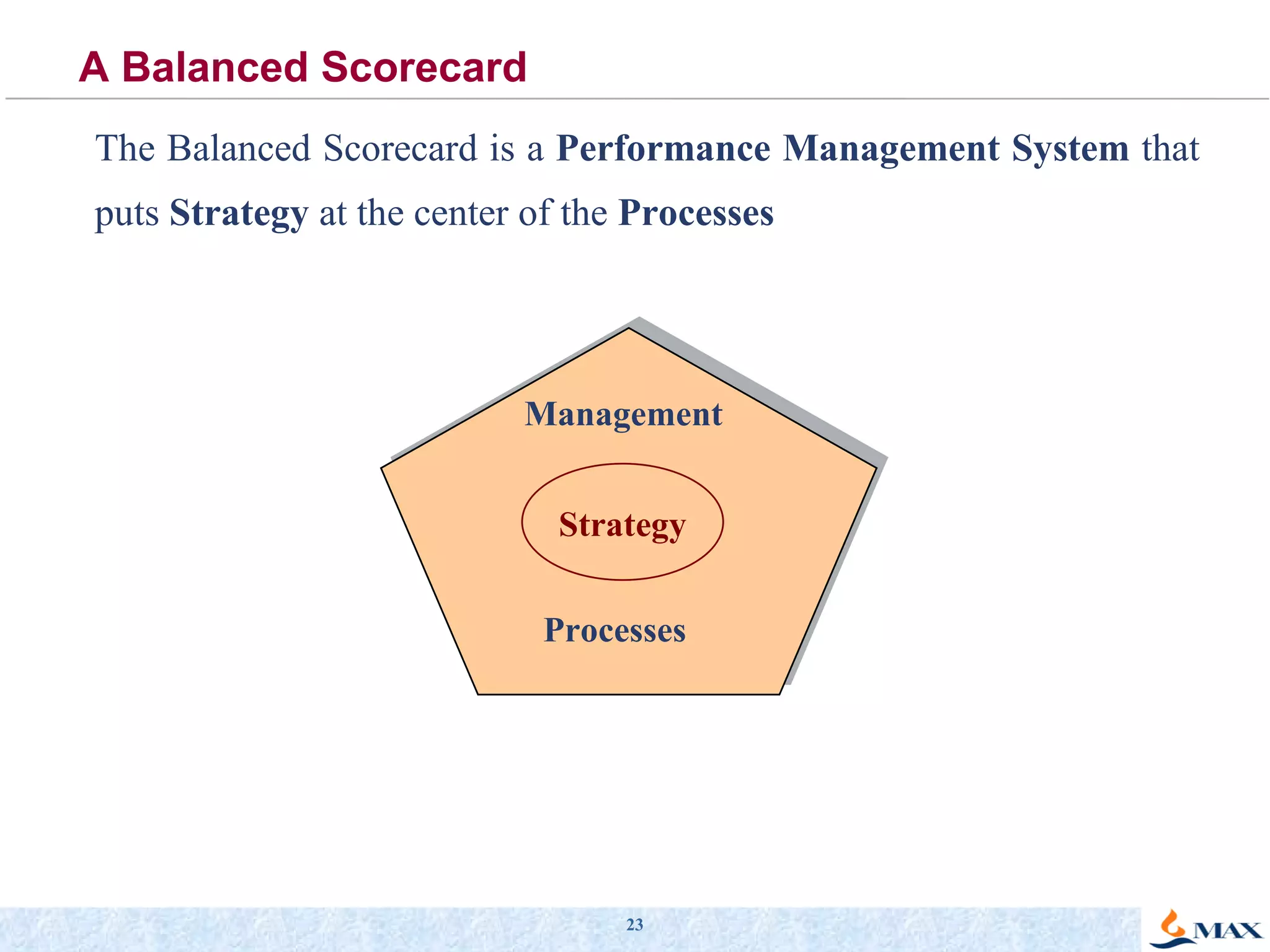
A Balanced Scorecard  The Balanced Scorecard is a  Performance Management System  that puts  Strategy  at the center of the  Processes Strategy Management  Processes
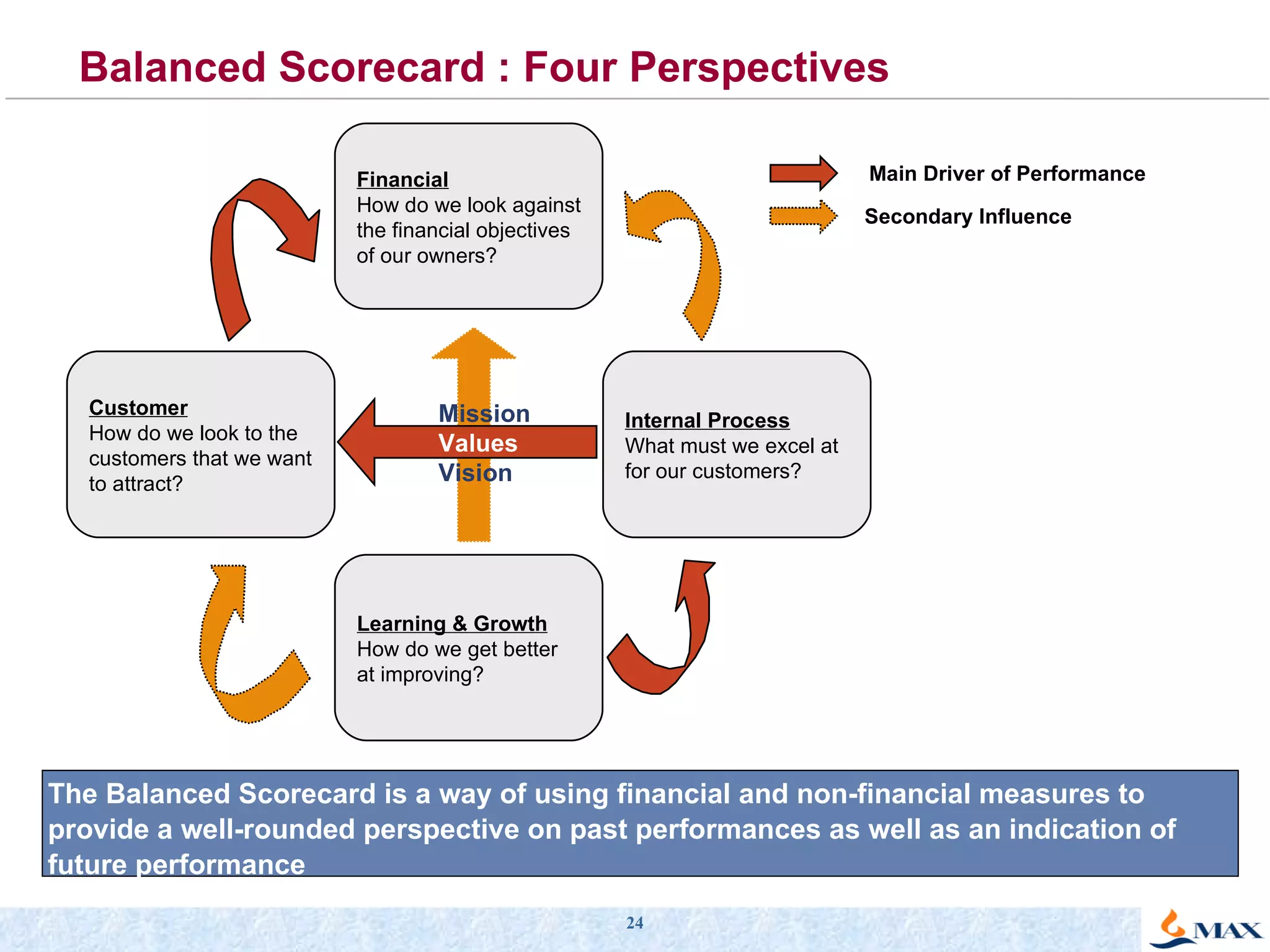
Balanced Scorecard : Four Perspectives  The Balanced Scorecard is a way of using financial and non-financial measures to provide a well-rounded perspective on past performances as well as an indication of future performance Financial How do we look against the financial objectives of our owners? Customer How do we look to the customers that we want to attract? Learning & Growth How do we get better at improving? Internal Process What must we excel at  for our customers? Main Driver of Performance Secondary Influence Mission Values Vision
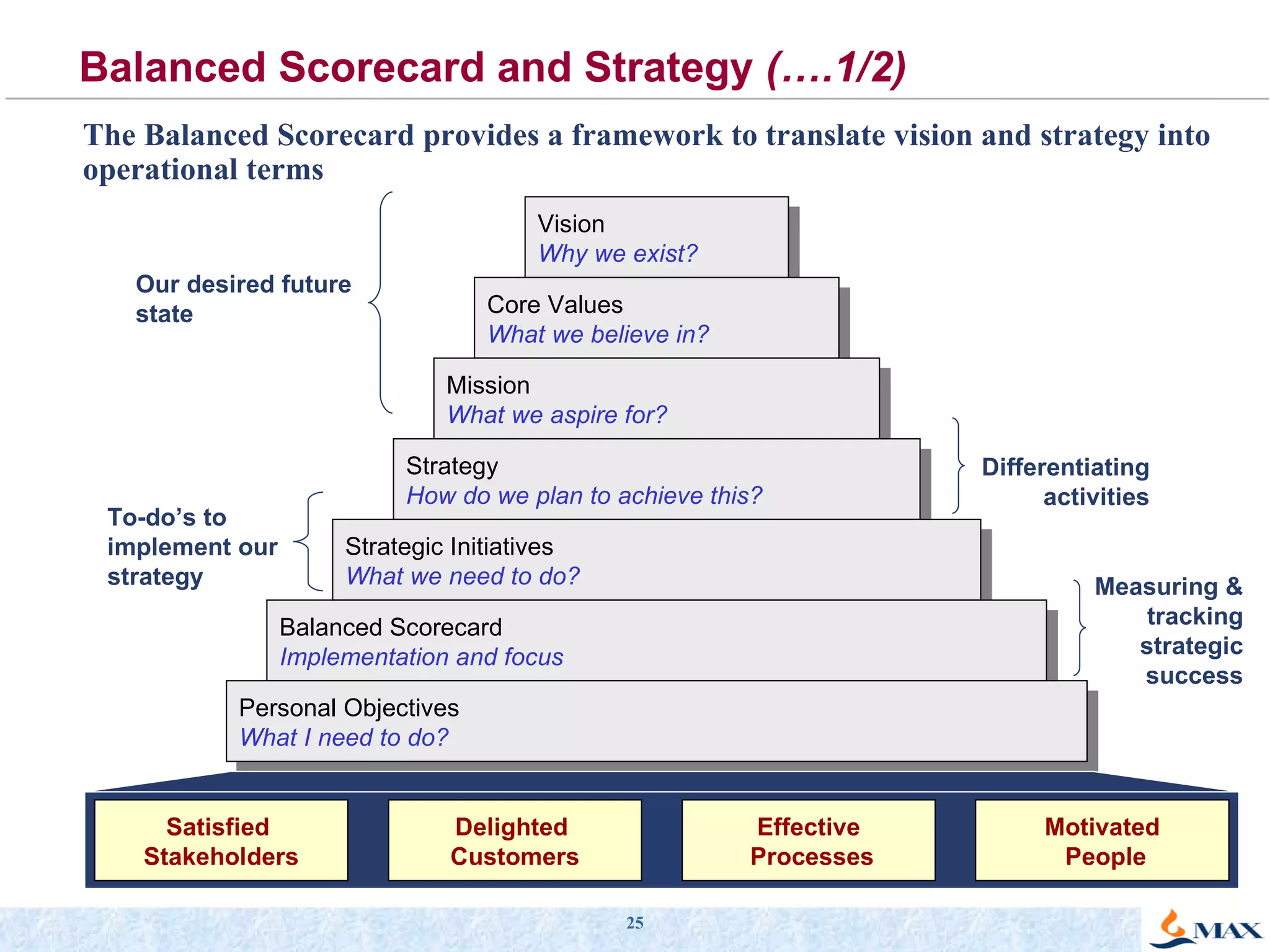
Balanced Scorecard and Strategy  (….1/2) Vision Why we exist? Core Values What we believe in? Mission What we aspire for? Strategy How do we plan to achieve this? Strategic Initiatives What we need to do? Balanced Scorecard Implementation and focus Personal Objectives What I need to do? Satisfied  Stakeholders Delighted  Customers Effective Processes Motivated People Our desired future state Differentiating activities To-do’s to implement our strategy Measuring & tracking strategic success The Balanced Scorecard provides a framework to translate vision and strategy into operational terms
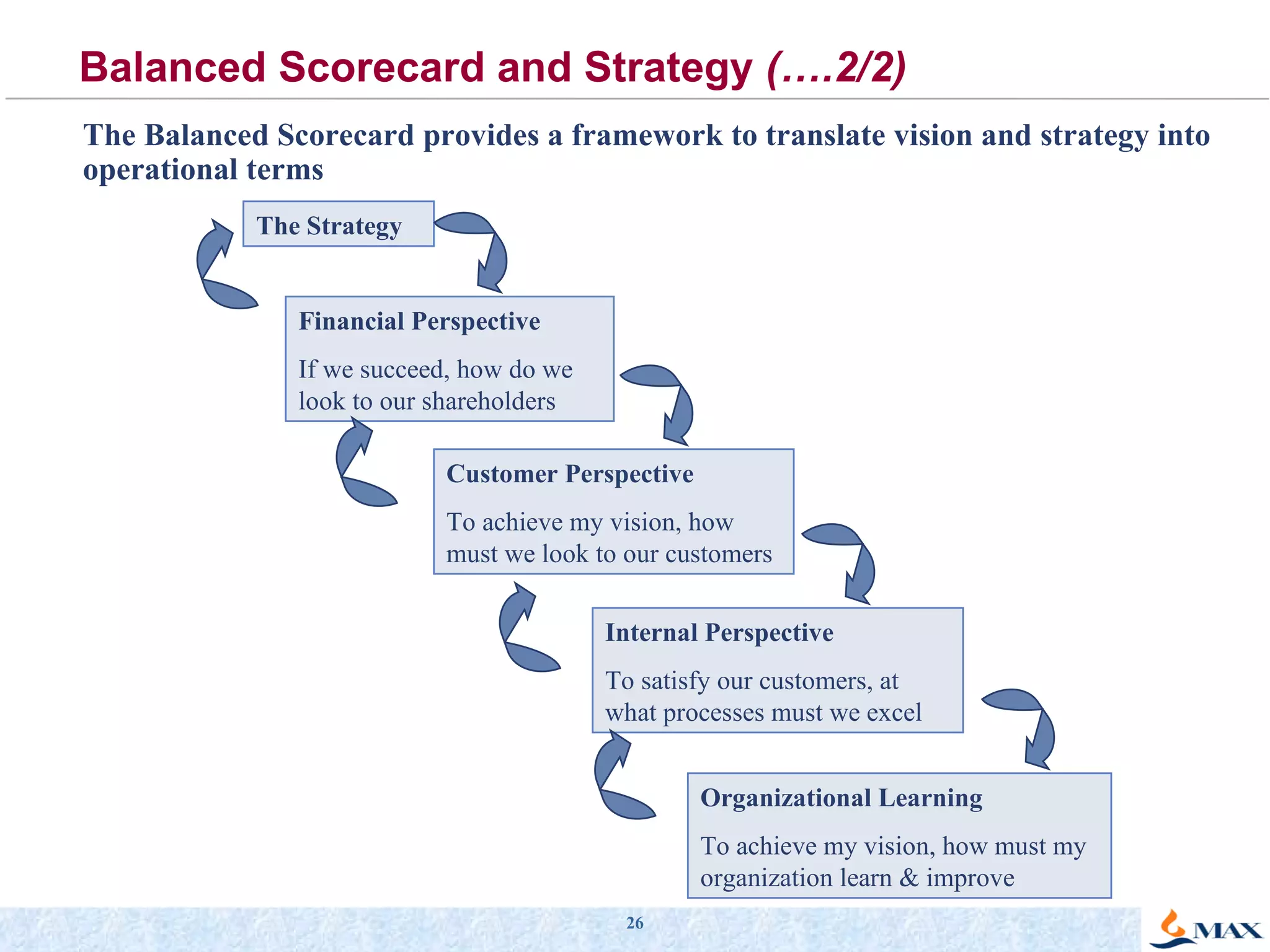
Balanced Scorecard and Strategy  (….2/2) The Strategy Financial Perspective If we succeed, how do we look to our shareholders Customer Perspective To achieve my vision, how must we look to our customers Internal Perspective To satisfy our customers, at what processes must we excel Organizational Learning To achieve my vision, how must my organization learn & improve The Balanced Scorecard provides a framework to translate vision and strategy into operational terms
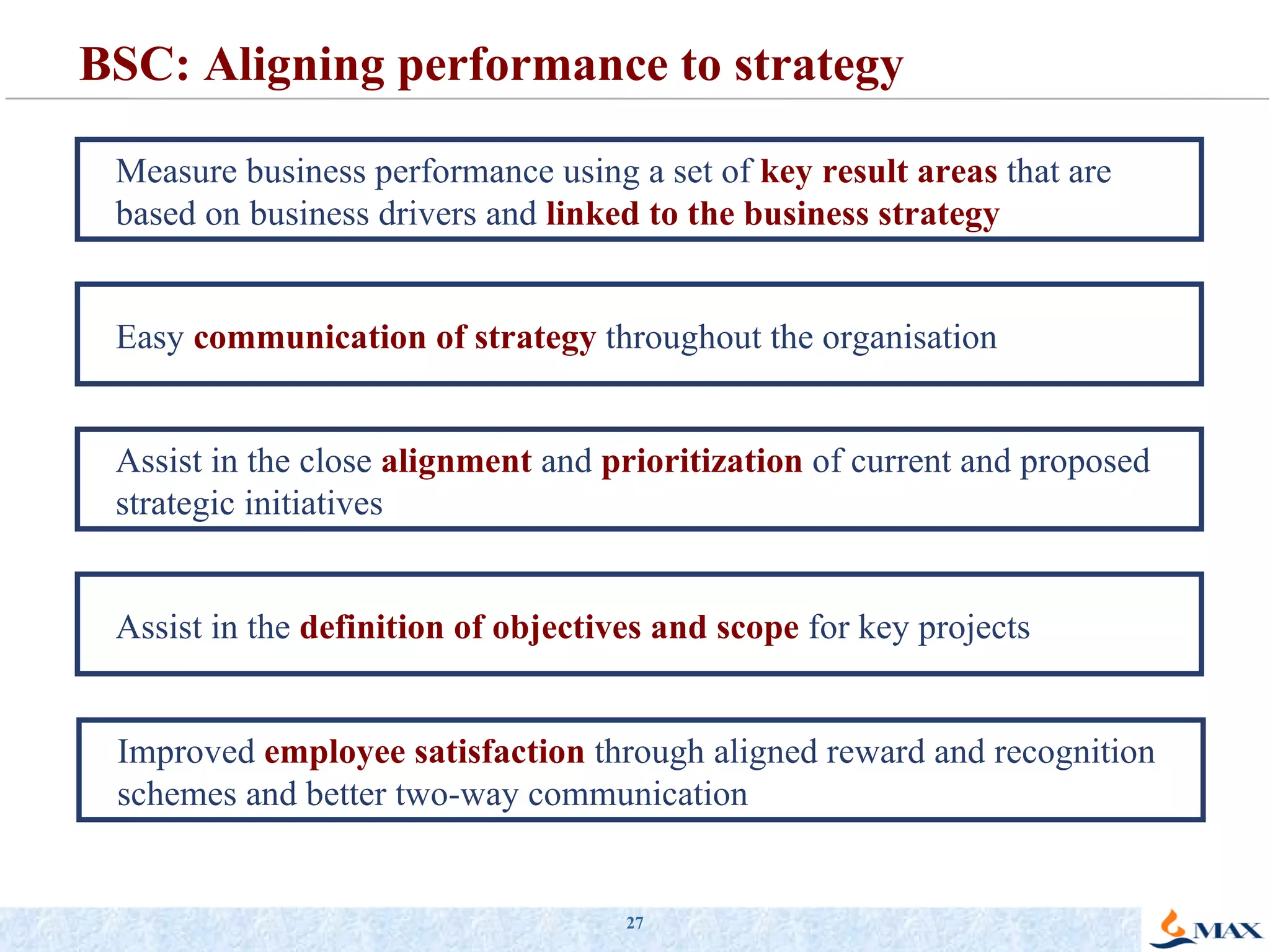
BSC: Aligning performance to strategy Measure business performance using a set of  key result areas  that are based on business drivers and  linked to the business strategy Easy  communication of strategy   throughout the organisation Assist in the close  alignment   and  prioritization  of current and proposed strategic initiatives Assist in the  definition of   objectives and scope   for key projects Improved  employee satisfaction   through aligned reward and recognition schemes and better two-way communication
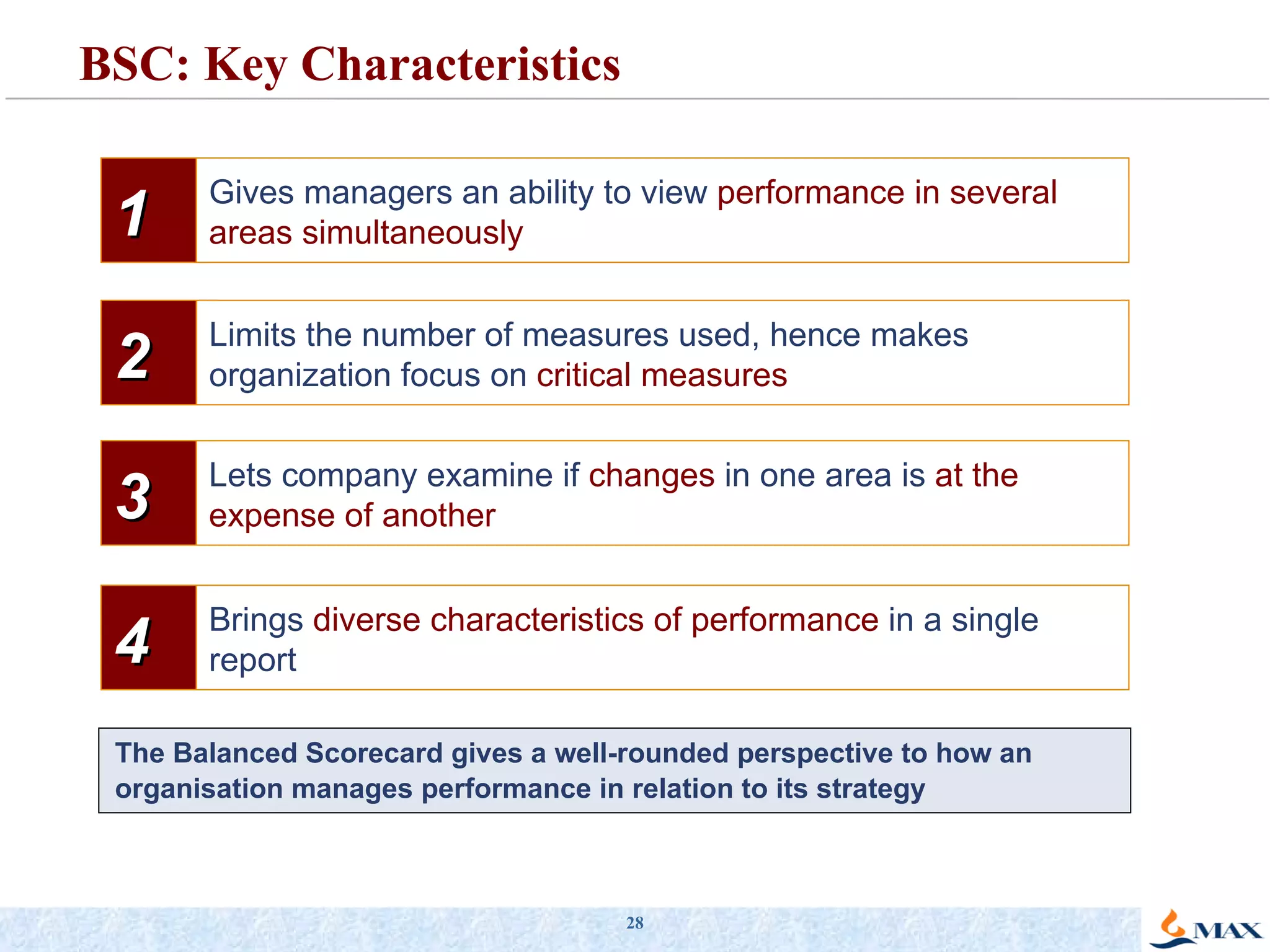
BSC: Key Characteristics The Balanced Scorecard gives a well-rounded perspective to how an organisation manages performance in relation to its strategy 1 Gives managers an ability to view  performance in several areas simultaneously 2 Limits the number of measures used, hence makes organization focus on  critical measures 3 Lets company examine if  changes  in one area is  at the expense of another 4 Brings  diverse characteristics of performance  in a single report
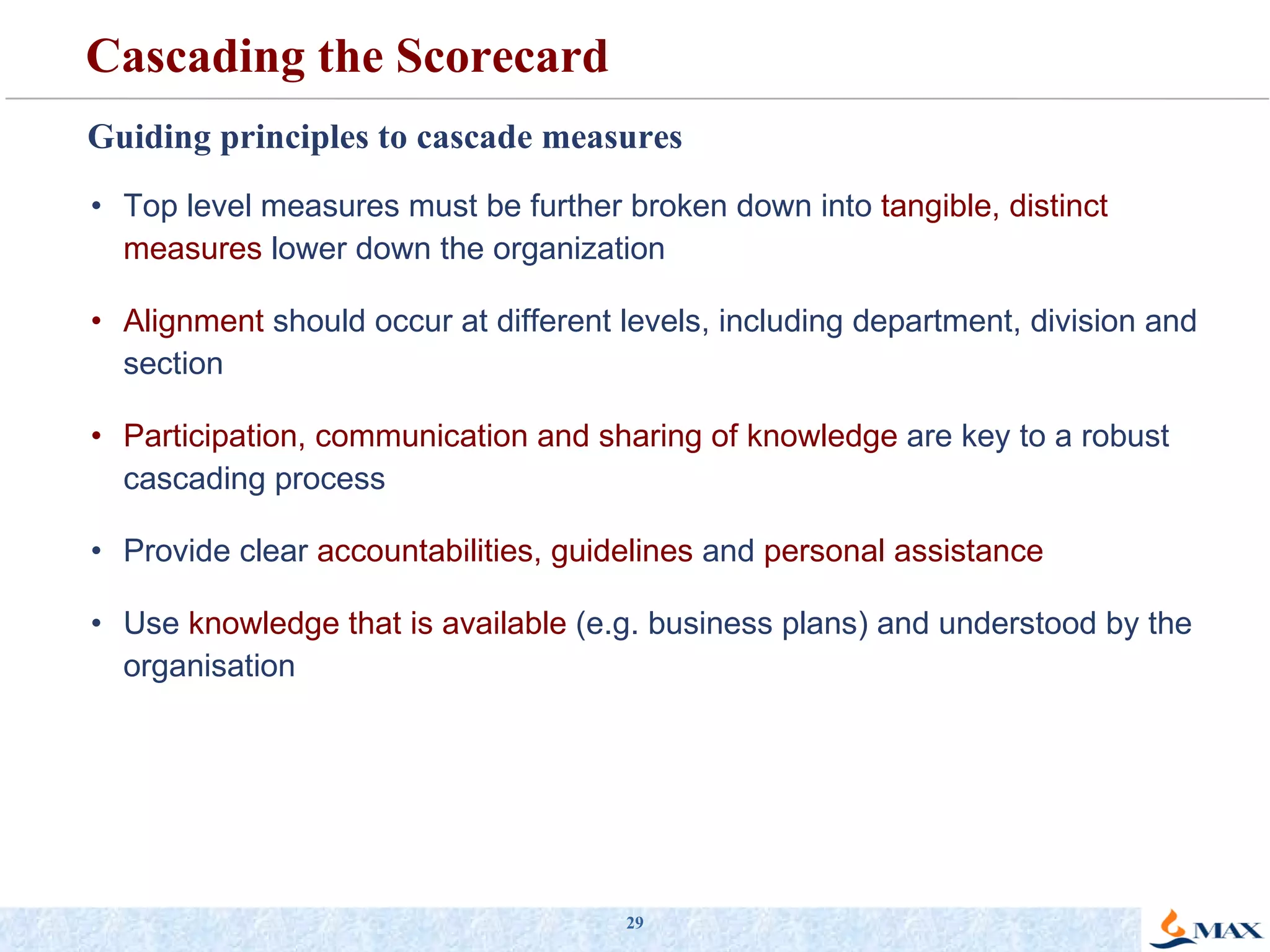
Guiding principles to cascade measures Top level measures must be further broken down into  tangible, distinct measures  lower down the organization Alignment  should occur at different levels, including department, division and section Participation, communication and sharing of knowledge  are key to a robust cascading process Provide clear  accountabilities, guidelines  and  personal assistance Use  knowledge that is available  (e.g. business plans) and understood by the organisation Cascading the Scorecard
HR Scorecard Aligning HR Strategy to Business
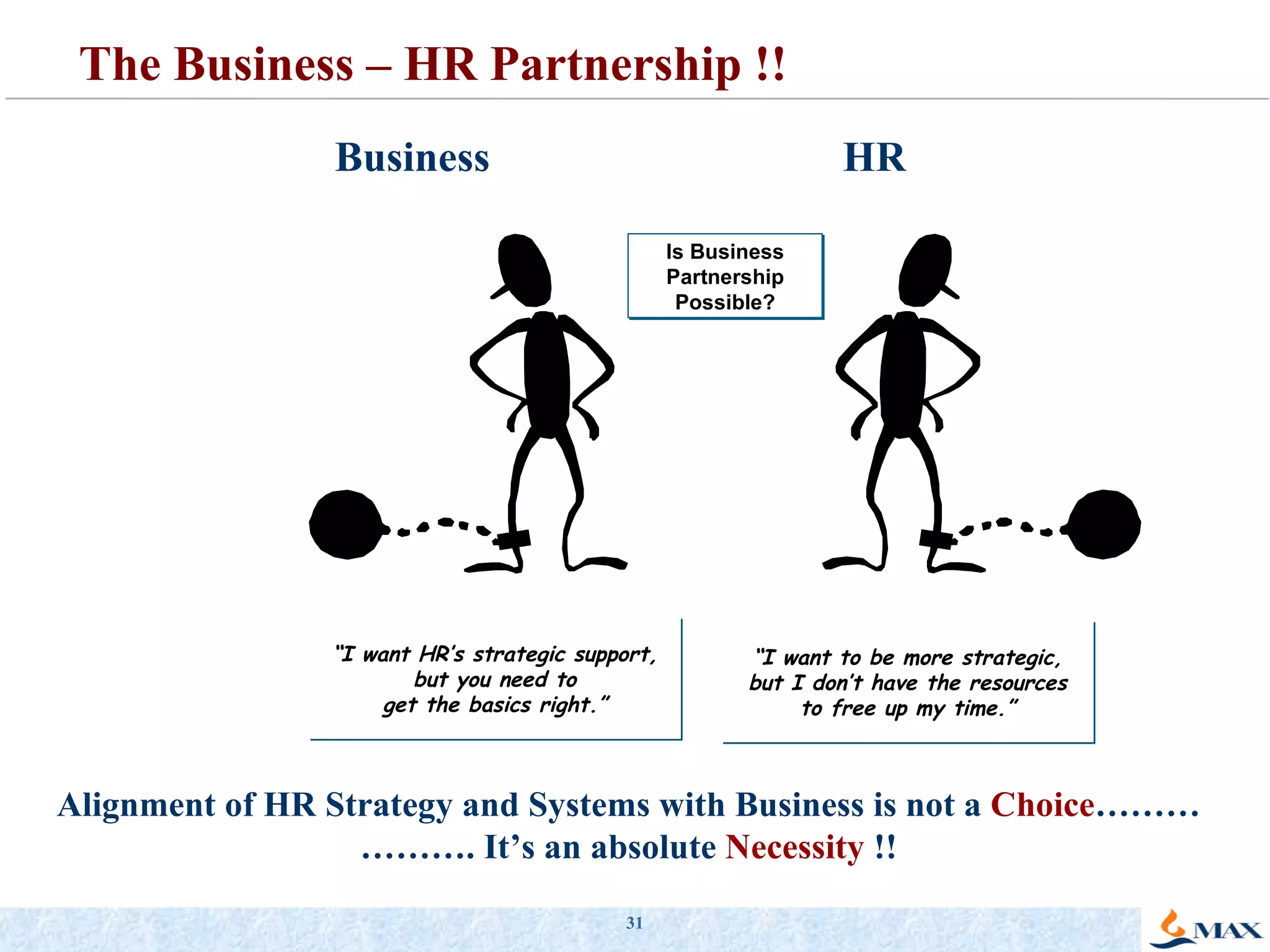
The Business – HR Partnership !! Business HR Alignment of HR Strategy and Systems with Business is not a  Choice ……… ……… . It’s an absolute  Necessity  !! “ I want HR’s strategic support, but you need to get the basics right.” “ I want to be more strategic, but I don’t have the resources to free up my time.” Is Business Partnership Possible?
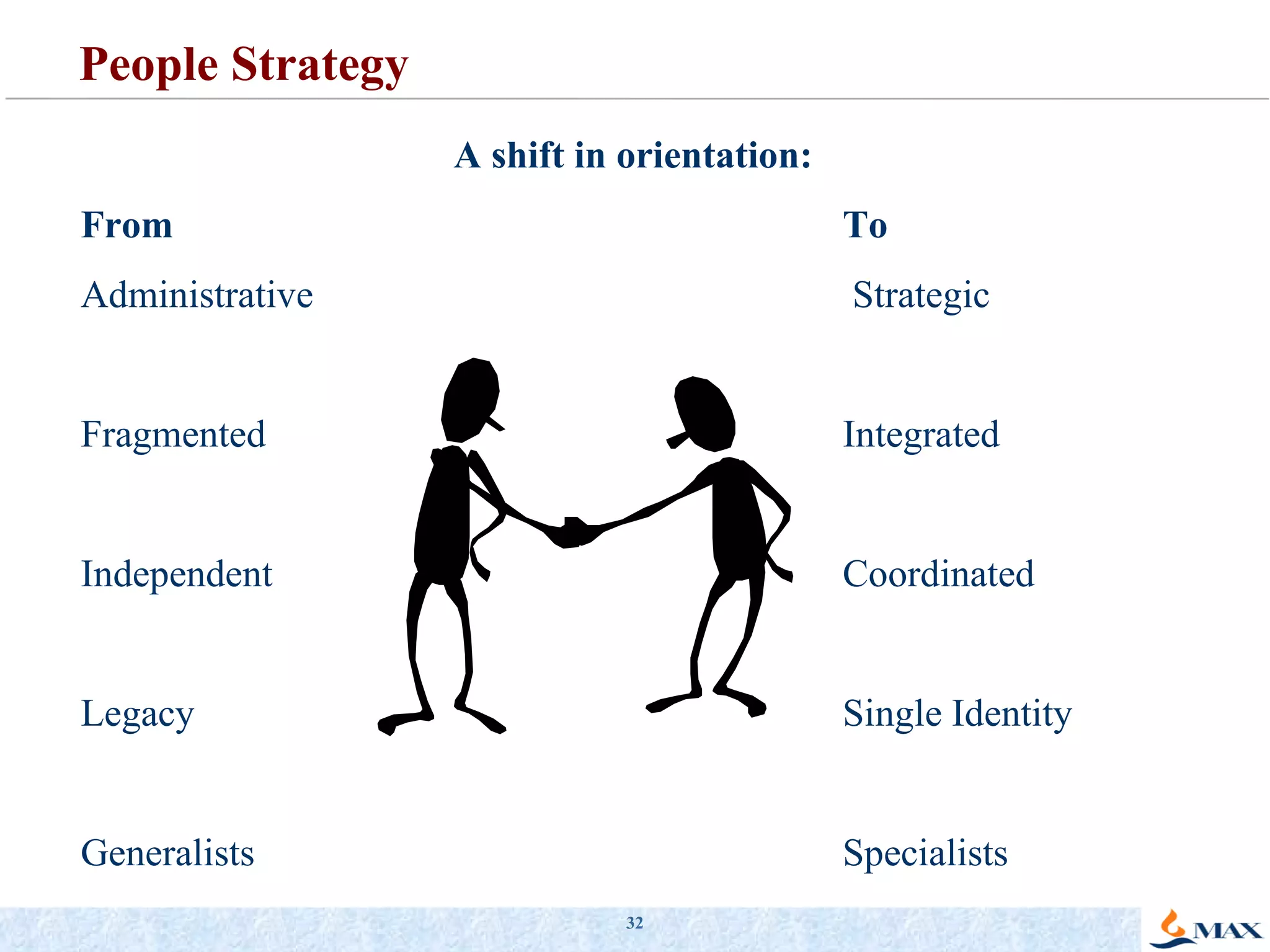
People Strategy A shift in orientation: From   To Administrative    Strategic Fragmented   Integrated Independent   Coordinated Legacy   Single Identity Generalists   Specialists Reflecting changes in XYZ’s business
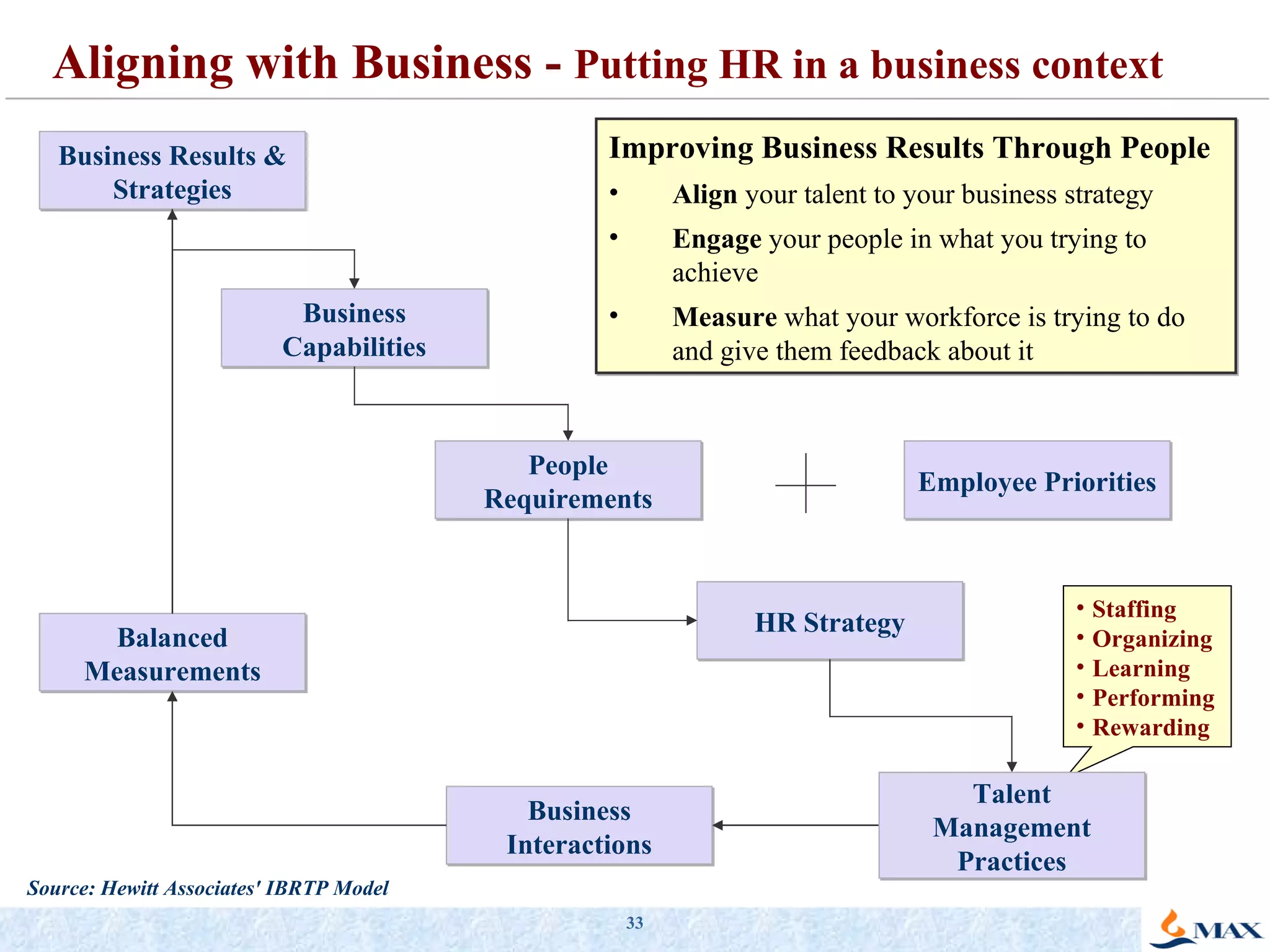
Aligning with Business -  Putting HR in a business context Business Results & Strategies Business Capabilities People Requirements Employee Priorities HR Strategy Business Interactions Balanced Measurements Improving Business Results Through People Align  your talent to your business strategy Engage  your people in what you trying to achieve Measure  what your workforce is trying to do and give them feedback about it Source: Hewitt Associates' IBRTP Model Staffing Organizing Learning Performing Rewarding Talent Management Practices
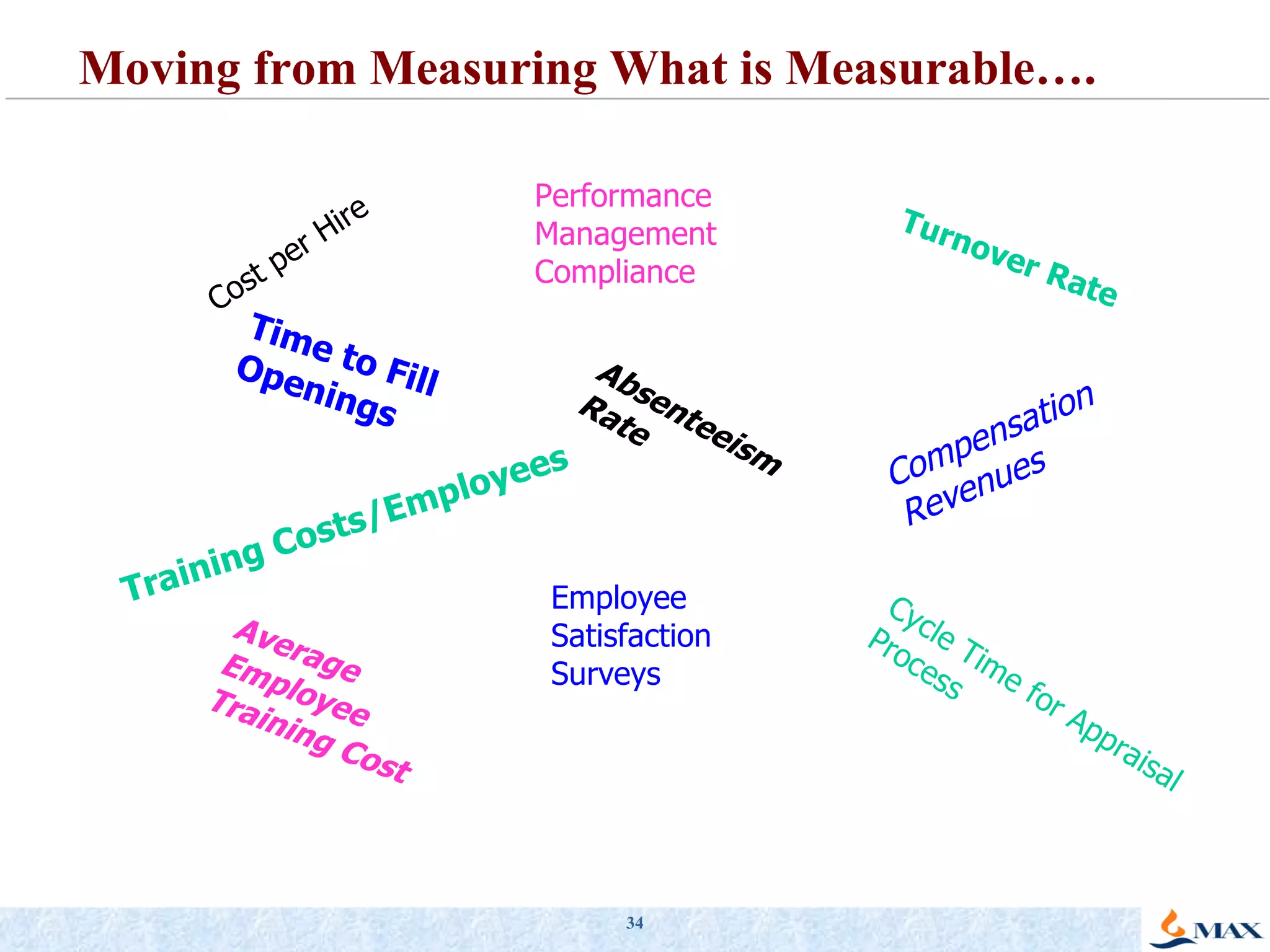
Performance Management Compliance Training Costs/Employees Employee Satisfaction Surveys Compensation Revenues Turnover   Rate Time to Fill Openings Cost per Hire Cycle Time for Appraisal Process Average Employee Training Cost Absenteeism Rate Moving from Measuring What is Measurable….
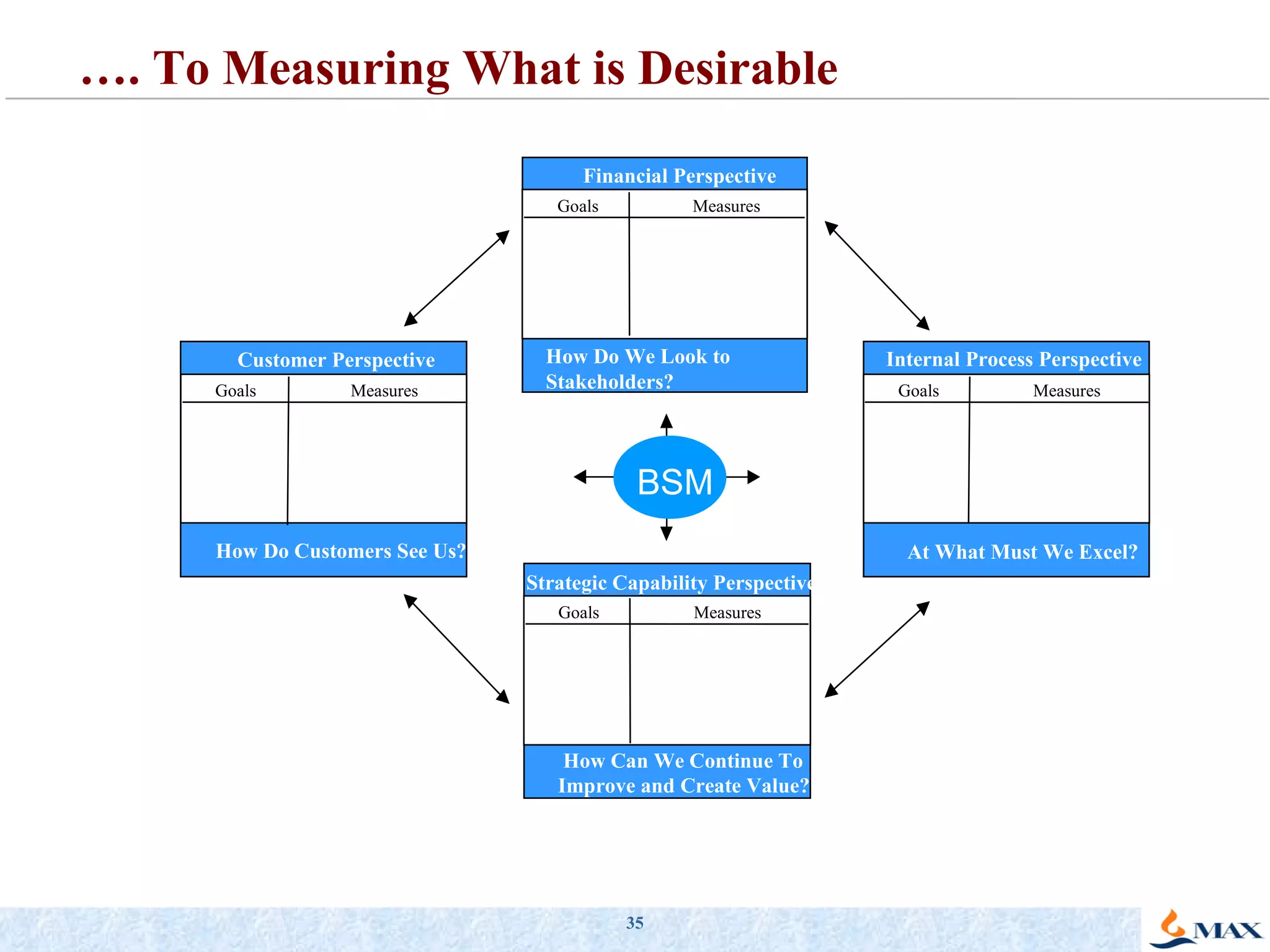
Financial Perspective How Do We Look to  Stakeholders? Goals Measures Internal Process Perspective At What Must We Excel? Goals Measures Strategic Capability Perspective How Can We Continue To Improve and Create Value? Goals Measures Customer Perspective How Do Customers See Us? Goals Measures BSM … . To Measuring What is Desirable
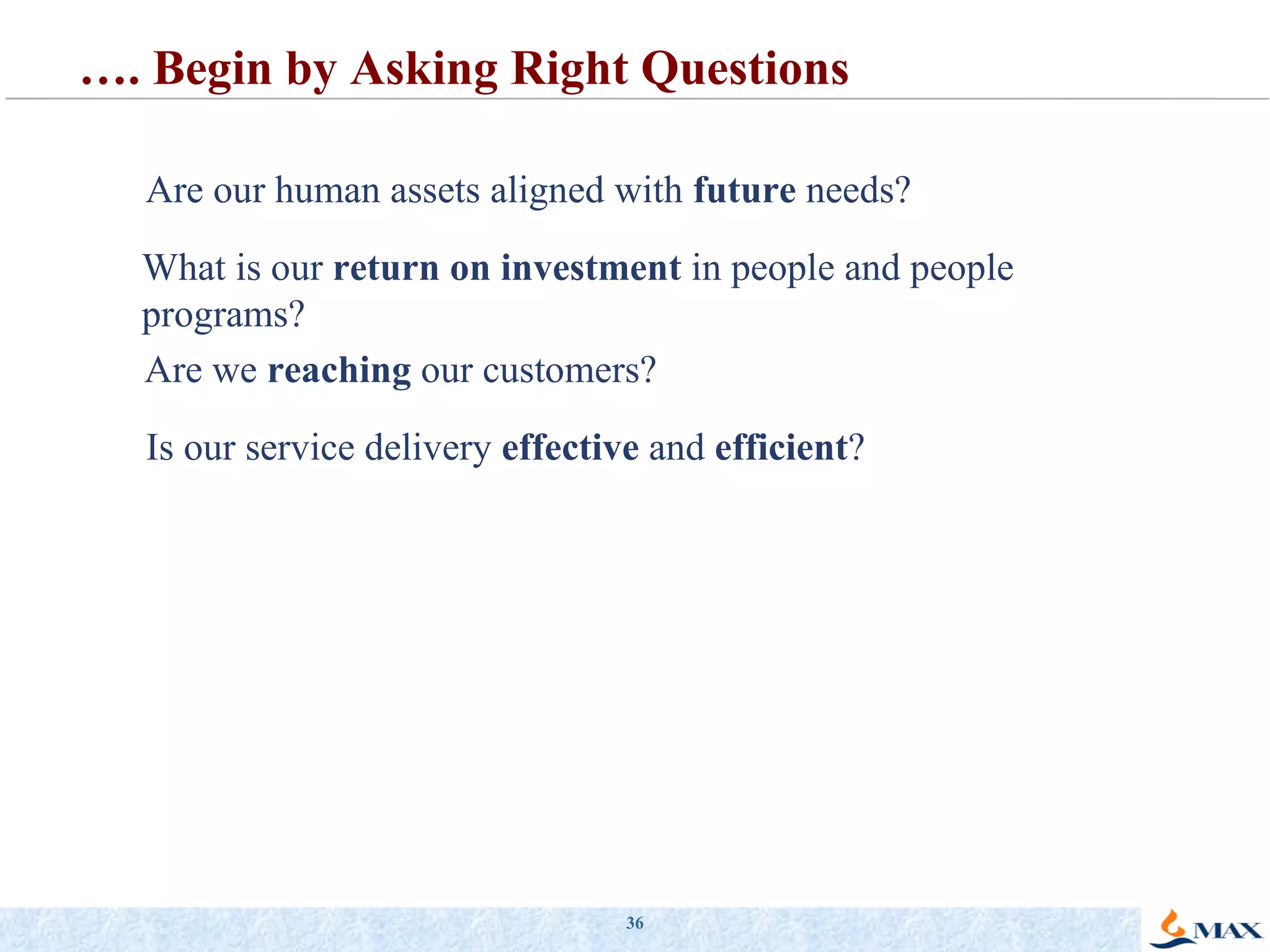
What is our  return on investment  in people and people programs? Is our service delivery  effective  and  efficient ? Are our human assets aligned with  future  needs? Are we  reaching  our customers? … . Begin by Asking Right Questions
Experience Sharing!!
The Max India Story
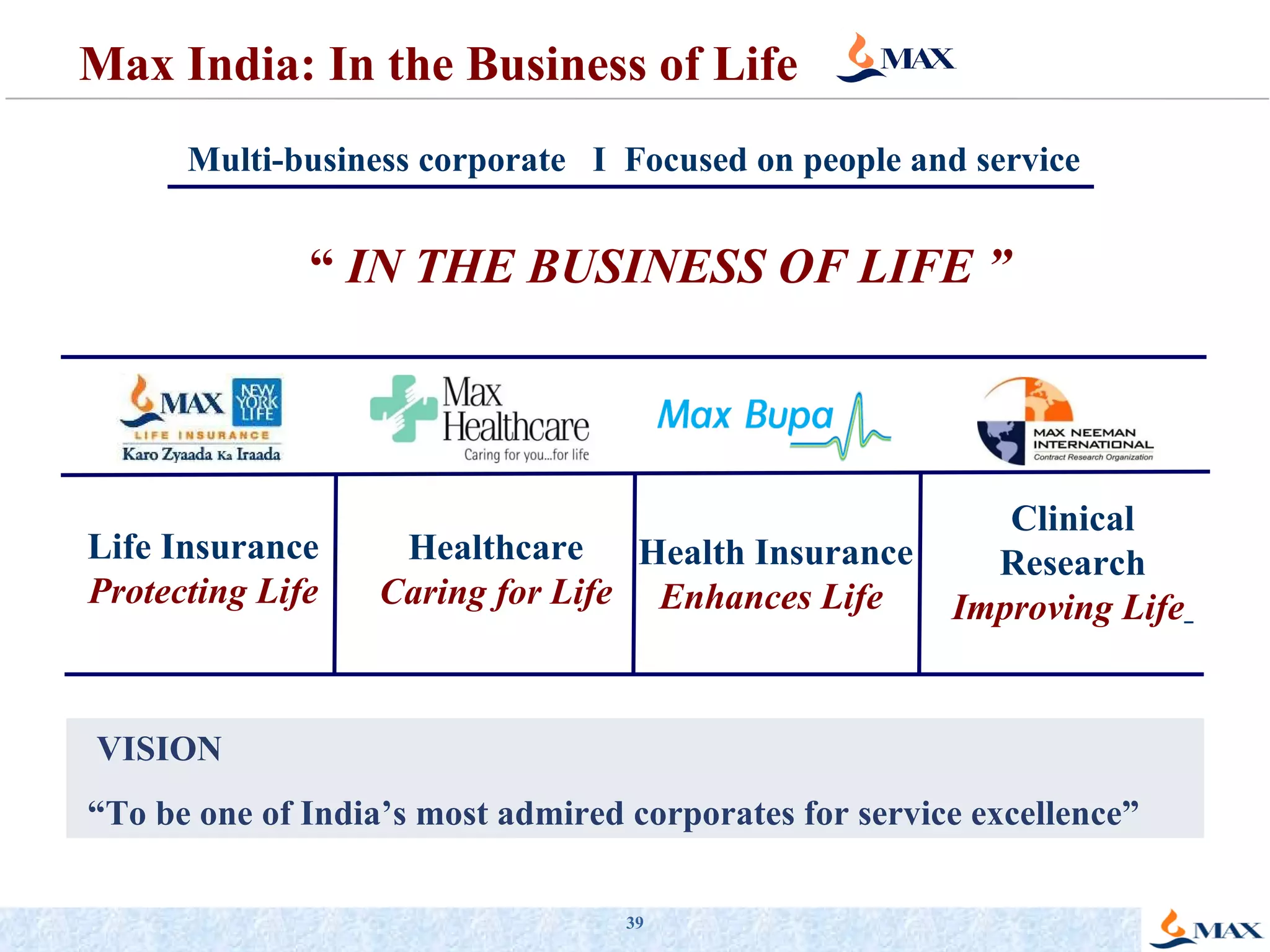
Max India: In the Business of Life VISION “ To be one of India’s most admired corporates for service excellence” Life Insurance Protecting Life Healthcare Caring for Life Clinical Research   Improving Life   Health Insurance Enhances Life   Multi-business corporate  I  Focused on people and service “  IN THE BUSINESS OF LIFE ”
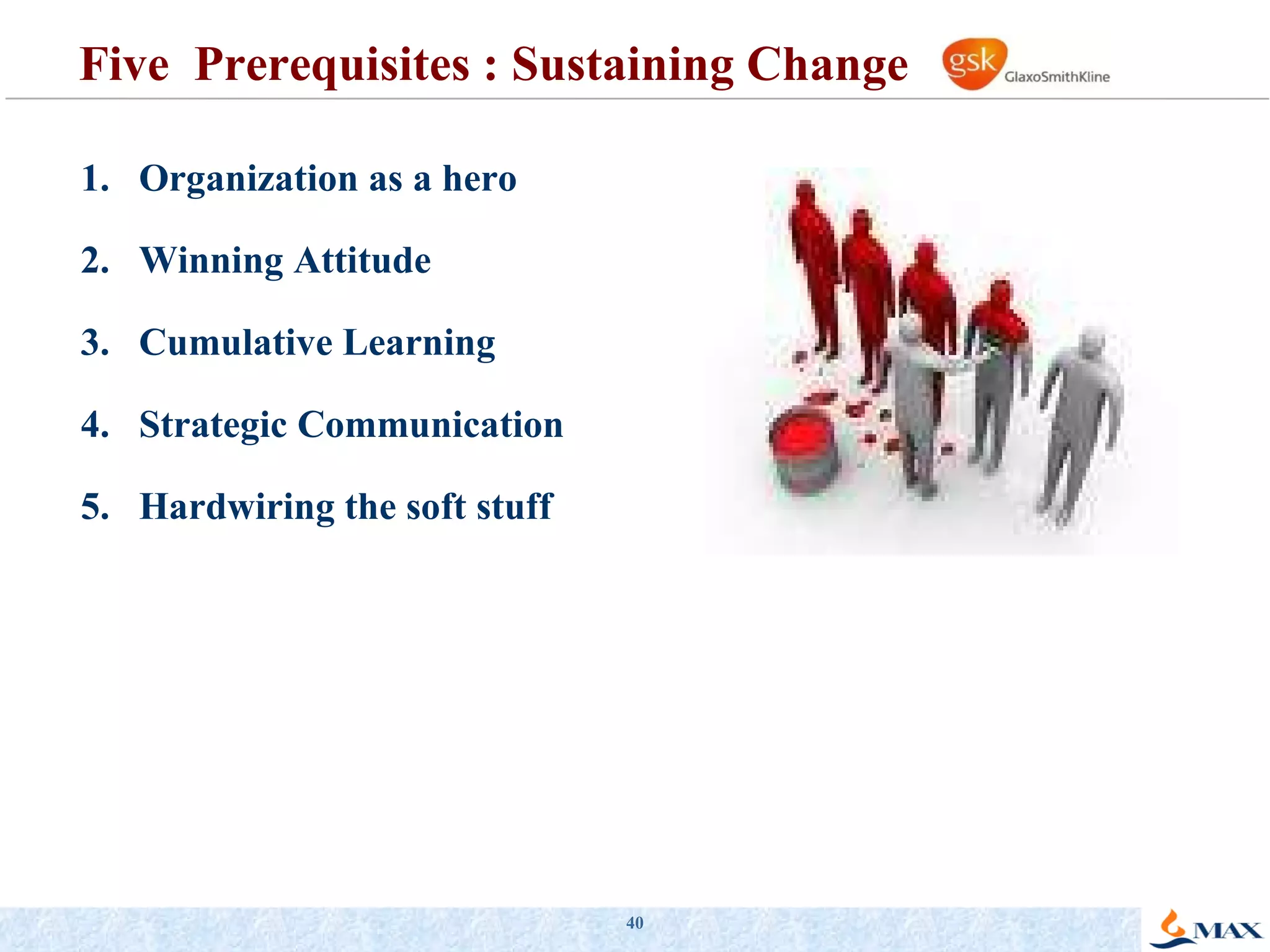
Five  Prerequisites : Sustaining Change Organization as a hero Winning Attitude Cumulative Learning Strategic Communication Hardwiring the soft stuff
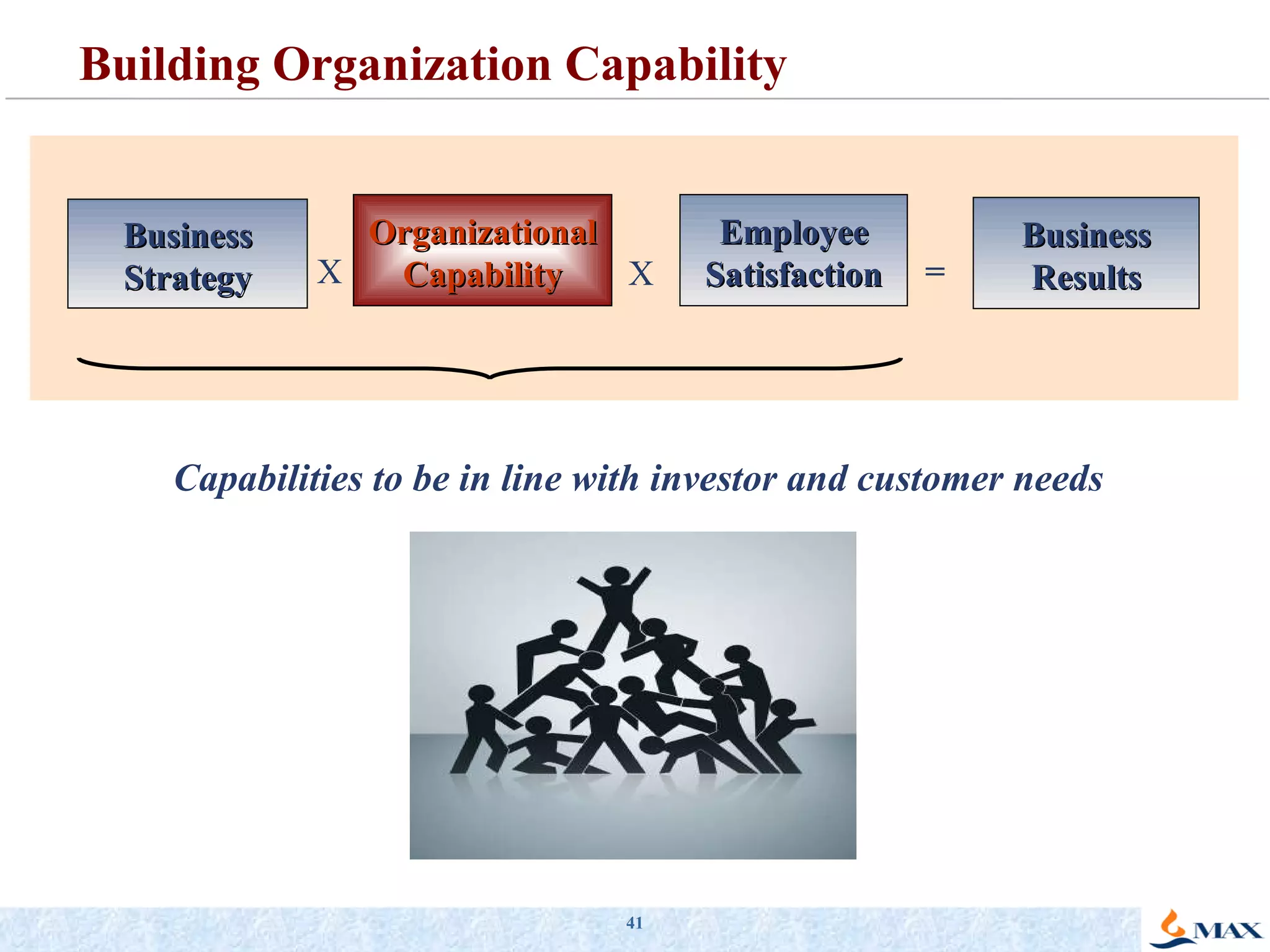
Building Organization Capability Business Strategy Business Results Organizational Capability Employee Satisfaction X X = Capabilities to be in line with investor and customer needs
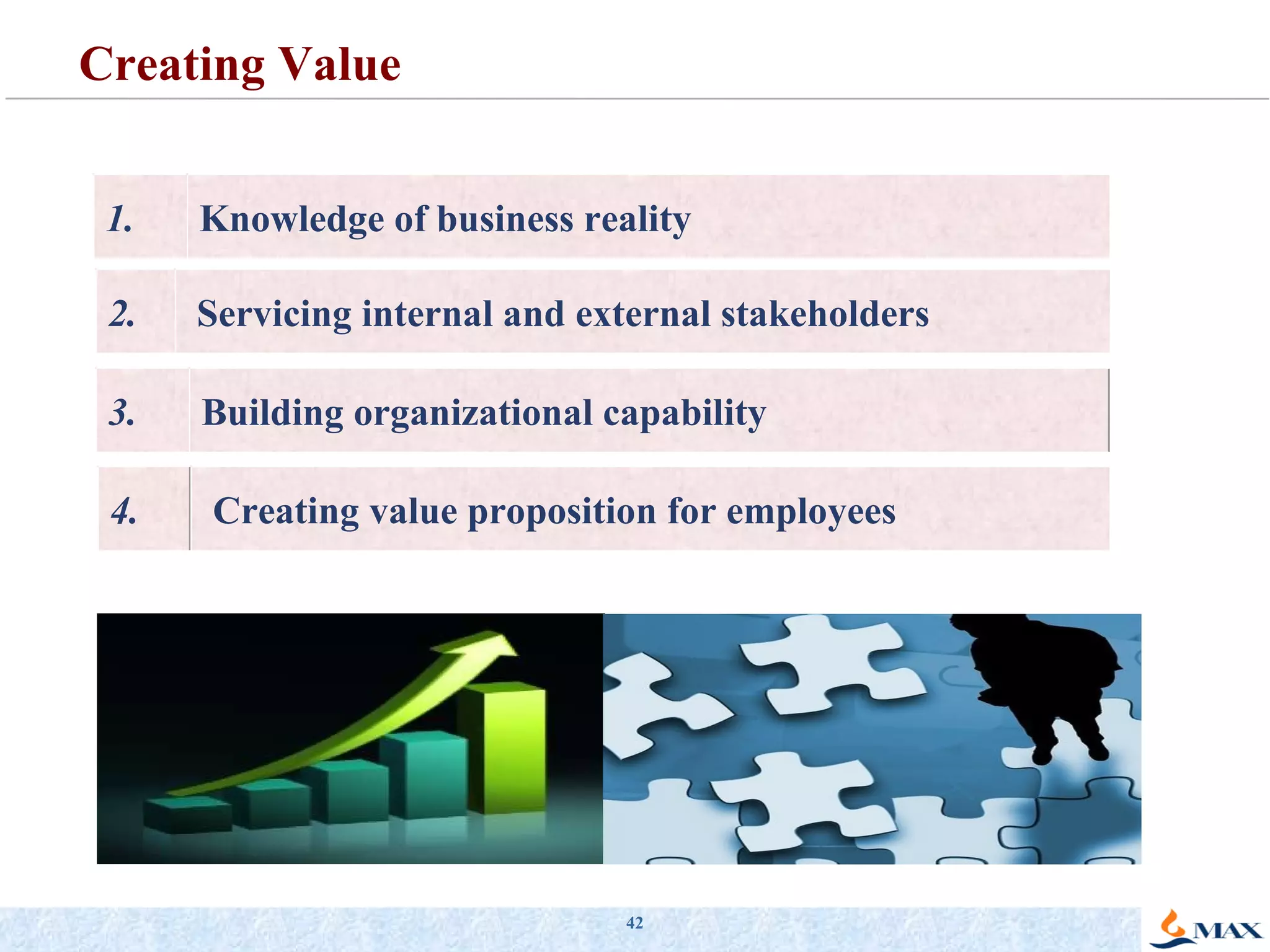
Creating Value  1. Knowledge of business reality 3. Building organizational capability 2. Servicing internal and external stakeholders 4. Creating value proposition for employees
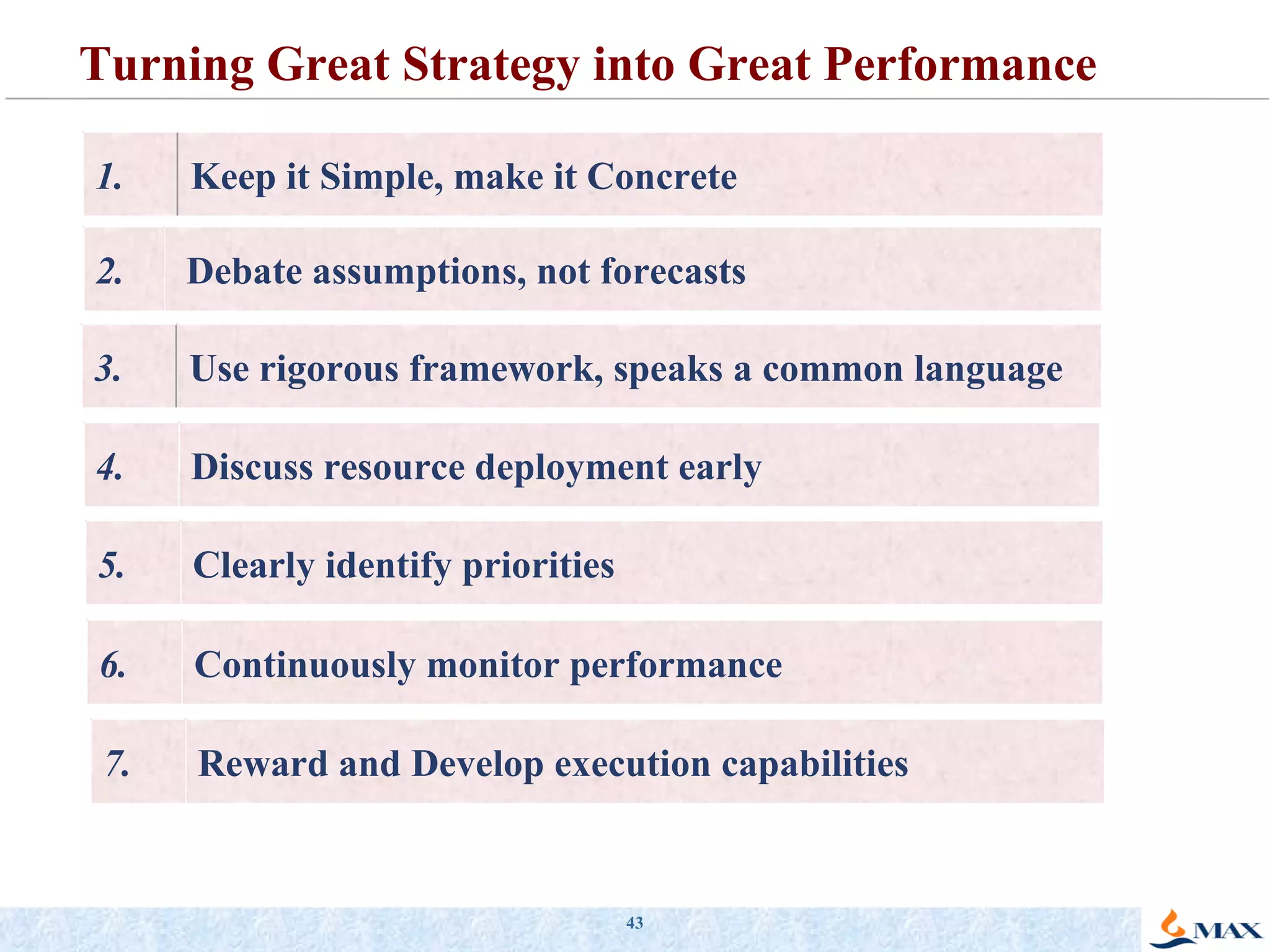
Turning Great Strategy into Great Performance 1. Keep it Simple, make it Concrete 3. Use rigorous framework, speaks a common language 2. Debate assumptions, not forecasts 4. Discuss resource deployment early 5. Clearly identify priorities 6. Continuously monitor performance 7. Reward and Develop execution capabilities
The GlaxoSmithKline Story
GSK Mission “ Our global quest is to improve the quality of human life by enabling people to do more, feel better and live longer”
GSK’s HR Mission Our quest is to facilitate a culture that enables the realisation of human potential  “ As a strategic business partner we strive to attract, retain and develop talent, champion change and manage performance to achieve our goals”
We undertake our quest with the  enthusiasm of entrepreneurs,  excited by the constant search for  innovation.  We value  performance  achieved with  integrity.  We will attain success as a world class global leader with each and every one of our  people  contributing with  passion  and an unmatched sense of  urgency. How we need to behave if we are to achieve our goal ?? GSK’s Spirit
Living the Spirit Performance with  Integrity Organisational and individual trustworthiness People with Passion People are enabled and motivated to do their best work Innovation and Entrepreneurship Competitive advantage through well-executed ingenuity Sense of Urgency A nimble, focused, resilient and fast-learning organisation
Living the Spirit  Everyone Committed, Everyone Contributing All employees have opportunity to make a meaningful contribution and to succeed based on merit Accountability for Achievement Clear expectations; focus on the critical few. Performance matters and will be rewarded Alignment with GSK Interests One team, in single-minded pursuit of our mission, reflecting a common spirit and integrated strategies Develop Self and Others A norm of career-long learning agility across the organisation
GSK’s Guiding Principles Put People First Be Obsessed about talent Pursue the Best, Weed out the Rest! Focus on Intangibles Create Opportunities to Lead Embrace Diversity Nurture a culture of innovation
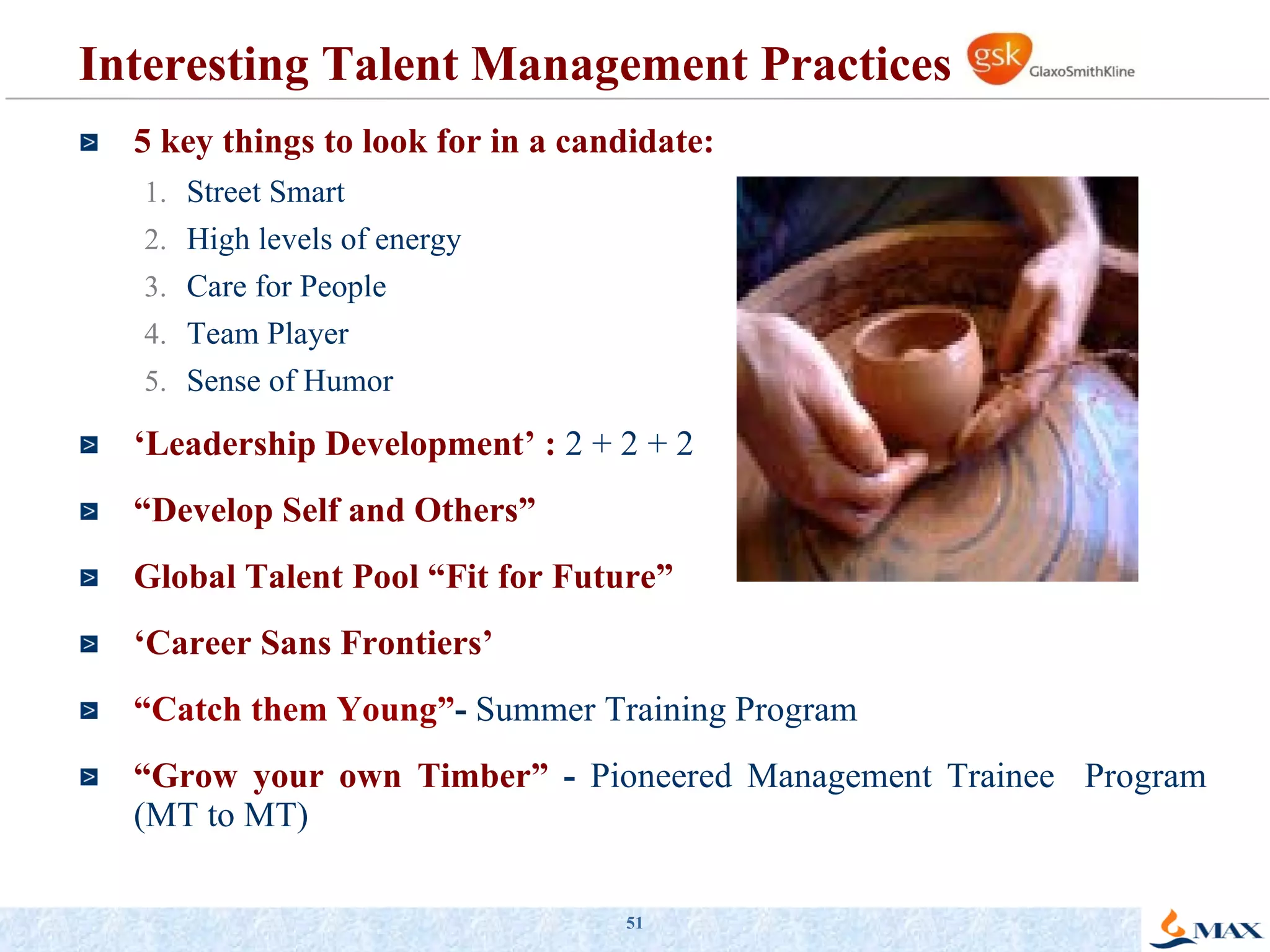
Interesting Talent Management Practices  5 key things to look for in a candidate: Street Smart High levels of energy Care for People Team Player Sense of Humor ‘ Leadership Development’ :   2 + 2 + 2 “ Develop Self and Others” Global Talent Pool “Fit for Future” ‘ Career Sans Frontiers’ “ Catch them Young” -  Summer Training Program   “ Grow your own Timber”   -  Pioneered Management Trainee  Program (MT to MT)
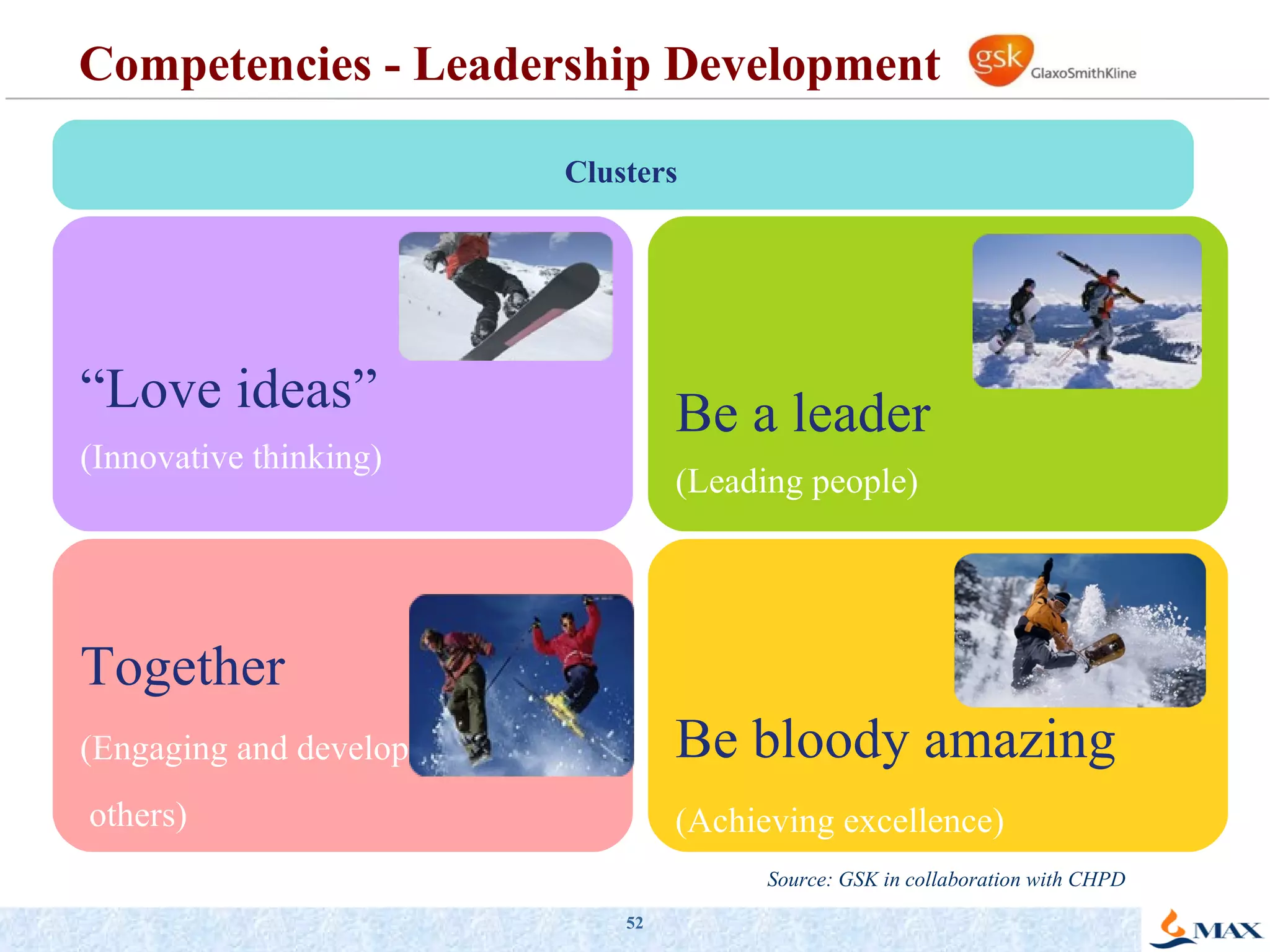
Competencies - Leadership Development  Clusters “ Love ideas” (Innovative thinking) Together (Engaging and developing others) Be a leader (Leading people) Be bloody amazing (Achieving excellence) Source: GSK in collaboration with CHPD
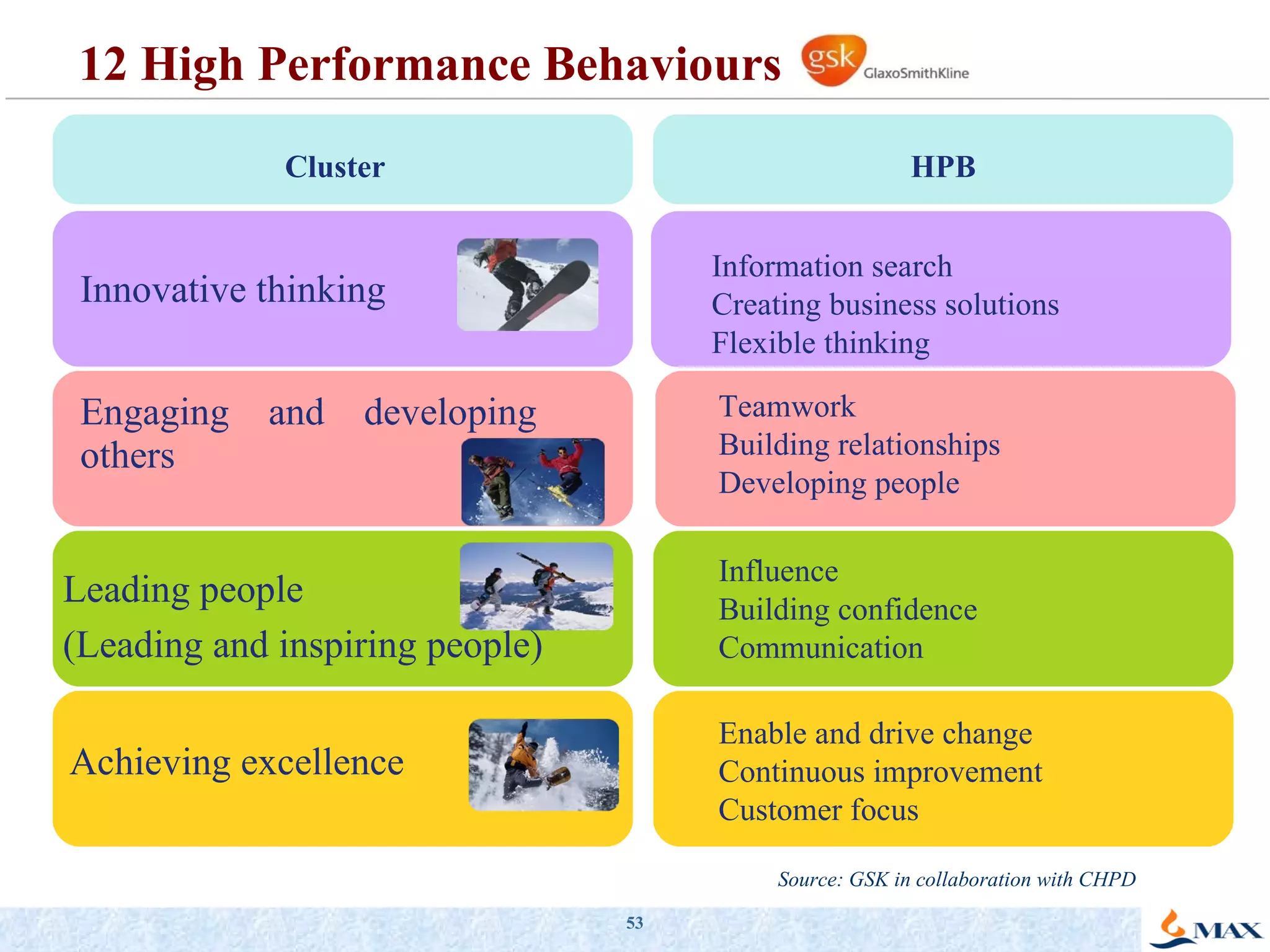
12 High Performance Behaviours Innovative thinking Information search Creating business solutions  Flexible thinking Engaging and developing others Leading people (Leading and inspiring people) Achieving excellence Teamwork Building relationships Developing people Influence  Building confidence Communication Enable and drive change Continuous improvement  Customer focus Cluster HPB Source: GSK in collaboration with CHPD
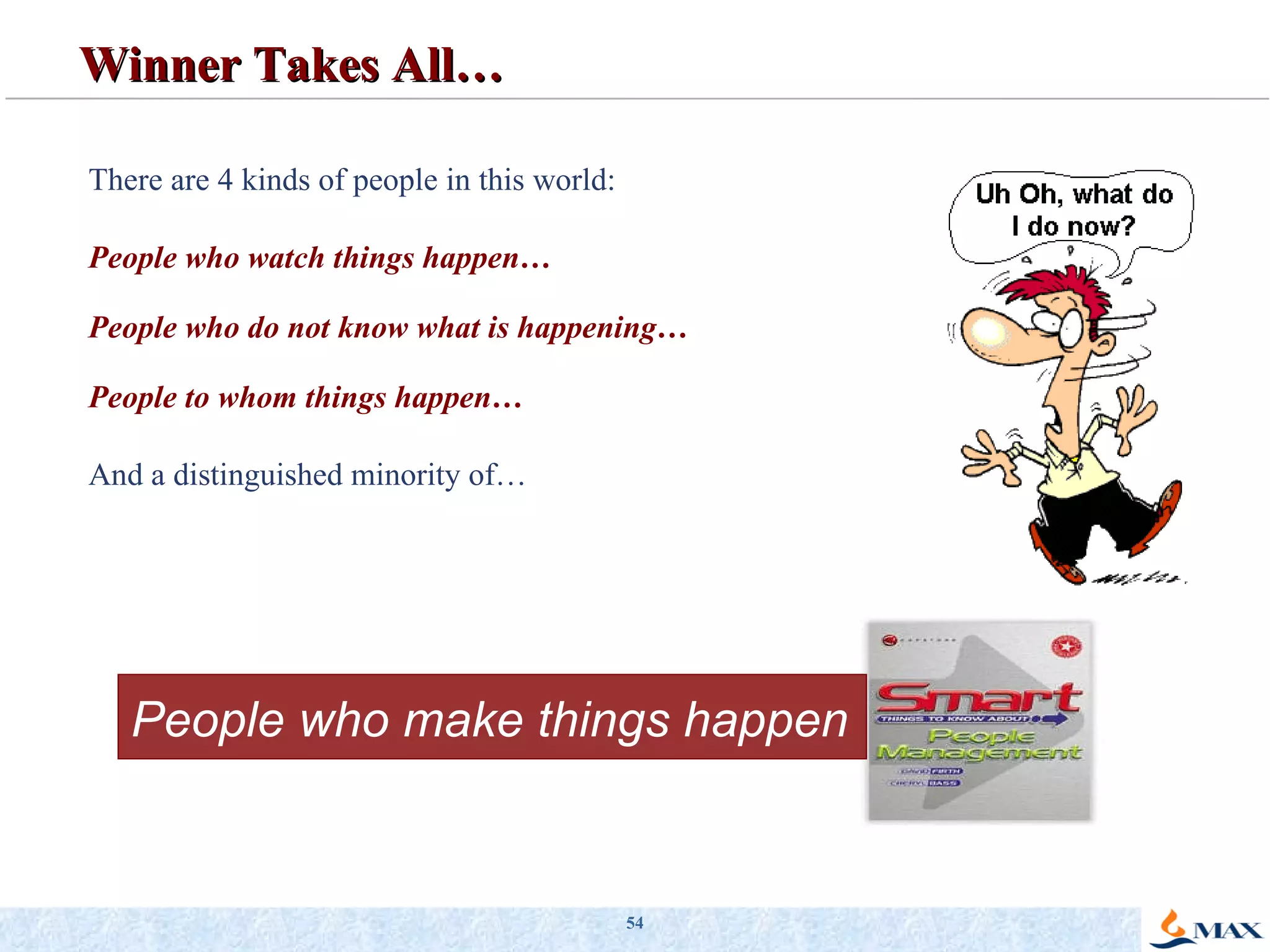
Winner Takes All… There are 4 kinds of people in this world: People who watch things happen… People who do not know what is happening… People to whom things happen… And a distinguished minority of… People who make things happen
Thank You

Strategic thinking and alignment 01.10.10

  • 1.
    NHRDN Workshop –1 st October’10 Presented by: P. Dwarakanath Director – Group Human Capital Max India Ltd. “ Strategic Thinking and Alignment”
  • 2.
  • 3.
    A Look atthe Current Landscape…. Economy Troubled Environment Dynamic Business Fiercely Competitive Market Fluid Organization Structure Fluctuating Industry Apprehensive Future Unpredictable People Bewildered Irrespective of the market conditions, a war is always on……. “ A war for finding, developing and retaining the right talent!!”
  • 4.
    Business Challenges AndIssues Globalization & Deregulation Mergers and Acquisitions Technological Advancement Intensifying demand for high-caliber talent Irreversible shift from Industrial Age to Information Age Change, Change and More Change
  • 5.
    Traditionally Competitiveness…. Cost Technology Distribution Manufacturing Product features Can be copied “ Tangibles”
  • 6.
    New Economy :Age of “Intangibles” Winning will spring from organizational Capabilities such as Speed Responsiveness Agility Learning Capacity Employee Competence Talent As A Source of Competitive Advantage
  • 7.
    Today’s organizations needradical innovators Who are passionate about what they do, Willing to rock the boat and make a big difference These people also need to understand the future How to leap-frog established thinking How to grow markets, without losing sight of the values that built a business in the first place How to keep the organization relevant to a very different future Talent Makes the Difference….
  • 8.
    Core Issues forany Business How to be profitable and enhance shareholder value? How to increase productivity and customer satisfaction? How to add value through innovation? How to attract, motivate & retain high quality talent? How to build a resilient organization?
  • 9.
    There is ParadigmShift …. FROM What business are we in? TO What capabilities do we bring to the businesses we are in now that can serve as foundation upon which future businesses can be built?
  • 10.
    … .Therefore, theKey HR Imperatives Identify desired business capabilities and leadership competencies to drive business success Assessing level of preparedness of the leadership team to lead the organization to success - Design assessment tools to determine current level of skill and capability of the leadership team Assessment of the management team and skill gap analysis Prioritization of development initiatives and one to one feedback on competency development Integration of competency model into the performance management system Linkage of competencies to other HR systems for ongoing institutional strengthening
  • 11.
  • 12.
  • 13.
    “ Strategic Thinking” pertains to the ability to make directional choices and balance between present and future. It takes a long term perspective into account Focuses on finding and developing unique opportunities to create value by enabling a provocative and creative dialogue among people who can affect a company’s direction It is the input to strategic planning — good strategic thinking uncovers potential opportunities for creating value and challenges assumptions about a company’s value proposition, so that when the plan is created, it targets these opportunities What is Strategic Thinking ? …….. (1/2) Source: Centre for Applied Research
  • 14.
    Strategic thinking isa way of understanding the fundamental drivers of a business and rigorously (and playfully) challenging conventional thinking about them, in conversation with others Strategic Thinking must take into account: Competencies and Skills: company’s strengths/ weaknesses Products and Offerings Environment and Industry Markets and Customers Competitors and Substitutes Suppliers and Buyers What is Strategic Thinking ? …….. (2/2) Source: Centre for Applied Research
  • 15.
    The process bywhich Strategic Thinking takes place is very important. Processes are needed to ensure that strategies are: Aligned Goal – Oriented Fact – Based Based on Broad Thinking Focused Agreed Upon Engaging Adaptable Implementable Process Considerations Source: Centre for Applied Research
  • 16.
  • 17.
    SWOT Analysis is a strategic planning method used to evaluate the S trengths, W eaknesses, O pportunities and T hreats involved in a business venture. Strengths: Attributes of the person or company that are helpful to achieving the objective(s). Weaknesses: Attributes of the person or company that are harmful to achieving the objective(s). Opportunities: External conditions that are helpful to achieving the objective(s). Threats: External conditions which could do damage to the objective(s). The technique is credited to Albert Humphrey, a business and management consultant who specialized in organizational management and cultural change. SWOT Analysis …….. (1/3)
  • 18.
    A SWOT analysismust first start with defining a desired end state or objective. It involves specifying the objective of the business venture and identifying the internal and external factors that are favorable and unfavorable to achieve that objective. These come from within the company's unique value chain. SWOT analysis groups key pieces of information into two main categories: The internal factors – the strengths or weaknesses internal to the organization The external factors – the opportunities and threats presented by the external environment to the organization SWOT Analysis …….. (2/3)
  • 19.
    While conducting SWOTAnalysis for your organization: Be realistic about the strengths and weaknesses of your organization. SWOT analysis should distinguish between where your organization is today, and where it could be in the future. SWOT should always be specific. Avoid grey areas. SWOT Analysis …….. (3/3)
  • 20.
  • 21.
    “ Y ou'vegot to think about 'big things' while you are doing small things, so that all the small things go in the right direction.” – Alvin Toffler Strategic Alignment is the process of aligning Strategic Thinking with corporate vision, goals, objectives, and strategies. Strategic alignment is linking and configuring the strategic elements, key organization systems, processes and structure in such a way that their implementation achieves the organization's shared vision and results beyond expectations. Strategic Alignment
  • 22.
    Translate strategy intooperational terms Link and align the organization around its strategy Make strategy everyone’s job Make strategy a continual process Executive team leadership to drive the change 5 Principles of a Strategy- focused organization
  • 23.
    A Balanced Scorecard The Balanced Scorecard is a Performance Management System that puts Strategy at the center of the Processes Strategy Management Processes
  • 24.
    Balanced Scorecard :Four Perspectives The Balanced Scorecard is a way of using financial and non-financial measures to provide a well-rounded perspective on past performances as well as an indication of future performance Financial How do we look against the financial objectives of our owners? Customer How do we look to the customers that we want to attract? Learning & Growth How do we get better at improving? Internal Process What must we excel at for our customers? Main Driver of Performance Secondary Influence Mission Values Vision
  • 25.
    Balanced Scorecard andStrategy (….1/2) Vision Why we exist? Core Values What we believe in? Mission What we aspire for? Strategy How do we plan to achieve this? Strategic Initiatives What we need to do? Balanced Scorecard Implementation and focus Personal Objectives What I need to do? Satisfied Stakeholders Delighted Customers Effective Processes Motivated People Our desired future state Differentiating activities To-do’s to implement our strategy Measuring & tracking strategic success The Balanced Scorecard provides a framework to translate vision and strategy into operational terms
  • 26.
    Balanced Scorecard andStrategy (….2/2) The Strategy Financial Perspective If we succeed, how do we look to our shareholders Customer Perspective To achieve my vision, how must we look to our customers Internal Perspective To satisfy our customers, at what processes must we excel Organizational Learning To achieve my vision, how must my organization learn & improve The Balanced Scorecard provides a framework to translate vision and strategy into operational terms
  • 27.
    BSC: Aligning performanceto strategy Measure business performance using a set of key result areas that are based on business drivers and linked to the business strategy Easy communication of strategy throughout the organisation Assist in the close alignment and prioritization of current and proposed strategic initiatives Assist in the definition of objectives and scope for key projects Improved employee satisfaction through aligned reward and recognition schemes and better two-way communication
  • 28.
    BSC: Key CharacteristicsThe Balanced Scorecard gives a well-rounded perspective to how an organisation manages performance in relation to its strategy 1 Gives managers an ability to view performance in several areas simultaneously 2 Limits the number of measures used, hence makes organization focus on critical measures 3 Lets company examine if changes in one area is at the expense of another 4 Brings diverse characteristics of performance in a single report
  • 29.
    Guiding principles tocascade measures Top level measures must be further broken down into tangible, distinct measures lower down the organization Alignment should occur at different levels, including department, division and section Participation, communication and sharing of knowledge are key to a robust cascading process Provide clear accountabilities, guidelines and personal assistance Use knowledge that is available (e.g. business plans) and understood by the organisation Cascading the Scorecard
  • 30.
    HR Scorecard AligningHR Strategy to Business
  • 31.
    The Business –HR Partnership !! Business HR Alignment of HR Strategy and Systems with Business is not a Choice ……… ……… . It’s an absolute Necessity !! “ I want HR’s strategic support, but you need to get the basics right.” “ I want to be more strategic, but I don’t have the resources to free up my time.” Is Business Partnership Possible?
  • 32.
    People Strategy Ashift in orientation: From To Administrative Strategic Fragmented Integrated Independent Coordinated Legacy Single Identity Generalists Specialists Reflecting changes in XYZ’s business
  • 33.
    Aligning with Business- Putting HR in a business context Business Results & Strategies Business Capabilities People Requirements Employee Priorities HR Strategy Business Interactions Balanced Measurements Improving Business Results Through People Align your talent to your business strategy Engage your people in what you trying to achieve Measure what your workforce is trying to do and give them feedback about it Source: Hewitt Associates' IBRTP Model Staffing Organizing Learning Performing Rewarding Talent Management Practices
  • 34.
    Performance Management ComplianceTraining Costs/Employees Employee Satisfaction Surveys Compensation Revenues Turnover Rate Time to Fill Openings Cost per Hire Cycle Time for Appraisal Process Average Employee Training Cost Absenteeism Rate Moving from Measuring What is Measurable….
  • 35.
    Financial Perspective HowDo We Look to Stakeholders? Goals Measures Internal Process Perspective At What Must We Excel? Goals Measures Strategic Capability Perspective How Can We Continue To Improve and Create Value? Goals Measures Customer Perspective How Do Customers See Us? Goals Measures BSM … . To Measuring What is Desirable
  • 36.
    What is our return on investment in people and people programs? Is our service delivery effective and efficient ? Are our human assets aligned with future needs? Are we reaching our customers? … . Begin by Asking Right Questions
  • 37.
  • 38.
  • 39.
    Max India: Inthe Business of Life VISION “ To be one of India’s most admired corporates for service excellence” Life Insurance Protecting Life Healthcare Caring for Life Clinical Research Improving Life Health Insurance Enhances Life Multi-business corporate I Focused on people and service “ IN THE BUSINESS OF LIFE ”
  • 40.
    Five Prerequisites: Sustaining Change Organization as a hero Winning Attitude Cumulative Learning Strategic Communication Hardwiring the soft stuff
  • 41.
    Building Organization CapabilityBusiness Strategy Business Results Organizational Capability Employee Satisfaction X X = Capabilities to be in line with investor and customer needs
  • 42.
    Creating Value 1. Knowledge of business reality 3. Building organizational capability 2. Servicing internal and external stakeholders 4. Creating value proposition for employees
  • 43.
    Turning Great Strategyinto Great Performance 1. Keep it Simple, make it Concrete 3. Use rigorous framework, speaks a common language 2. Debate assumptions, not forecasts 4. Discuss resource deployment early 5. Clearly identify priorities 6. Continuously monitor performance 7. Reward and Develop execution capabilities
  • 44.
  • 45.
    GSK Mission “Our global quest is to improve the quality of human life by enabling people to do more, feel better and live longer”
  • 46.
    GSK’s HR MissionOur quest is to facilitate a culture that enables the realisation of human potential “ As a strategic business partner we strive to attract, retain and develop talent, champion change and manage performance to achieve our goals”
  • 47.
    We undertake ourquest with the enthusiasm of entrepreneurs, excited by the constant search for innovation. We value performance achieved with integrity. We will attain success as a world class global leader with each and every one of our people contributing with passion and an unmatched sense of urgency. How we need to behave if we are to achieve our goal ?? GSK’s Spirit
  • 48.
    Living the SpiritPerformance with Integrity Organisational and individual trustworthiness People with Passion People are enabled and motivated to do their best work Innovation and Entrepreneurship Competitive advantage through well-executed ingenuity Sense of Urgency A nimble, focused, resilient and fast-learning organisation
  • 49.
    Living the Spirit Everyone Committed, Everyone Contributing All employees have opportunity to make a meaningful contribution and to succeed based on merit Accountability for Achievement Clear expectations; focus on the critical few. Performance matters and will be rewarded Alignment with GSK Interests One team, in single-minded pursuit of our mission, reflecting a common spirit and integrated strategies Develop Self and Others A norm of career-long learning agility across the organisation
  • 50.
    GSK’s Guiding PrinciplesPut People First Be Obsessed about talent Pursue the Best, Weed out the Rest! Focus on Intangibles Create Opportunities to Lead Embrace Diversity Nurture a culture of innovation
  • 51.
    Interesting Talent ManagementPractices 5 key things to look for in a candidate: Street Smart High levels of energy Care for People Team Player Sense of Humor ‘ Leadership Development’ : 2 + 2 + 2 “ Develop Self and Others” Global Talent Pool “Fit for Future” ‘ Career Sans Frontiers’ “ Catch them Young” - Summer Training Program “ Grow your own Timber” - Pioneered Management Trainee Program (MT to MT)
  • 52.
    Competencies - LeadershipDevelopment Clusters “ Love ideas” (Innovative thinking) Together (Engaging and developing others) Be a leader (Leading people) Be bloody amazing (Achieving excellence) Source: GSK in collaboration with CHPD
  • 53.
    12 High PerformanceBehaviours Innovative thinking Information search Creating business solutions Flexible thinking Engaging and developing others Leading people (Leading and inspiring people) Achieving excellence Teamwork Building relationships Developing people Influence Building confidence Communication Enable and drive change Continuous improvement Customer focus Cluster HPB Source: GSK in collaboration with CHPD
  • 54.
    Winner Takes All…There are 4 kinds of people in this world: People who watch things happen… People who do not know what is happening… People to whom things happen… And a distinguished minority of… People who make things happen
  • 55.