Editorial Board
First planning meeting
February 28th 2018
Author: Laura Connelly
A glossary of BIM terminology
By Lobster Pictures time lapse and monitoring
Introduction
Technology can be a minefield of terms and acronyms.
The platforms and technology related to BIM -
the acronym representing Building Information
Modelling (BIM) - are certainly no exception.
We're keen to avoid using words that require insider
knowledge to understand, so to help along the way, we've
collected the most common BIM terms you're likely to come
across in general usage and provided a clear explanation of
their meaning.
3D
Three dimensional drawings or models
4D
A 3D model that includes a measurement of time and/or
sequence
5D
A 4D model with added information regarding cost
6D
As for 5D, but with information to aid facilities management
after construction has finished and the lifecycle of the
building as it progresses
7D
All of the above levels, with the addition of data from sensors
BEP
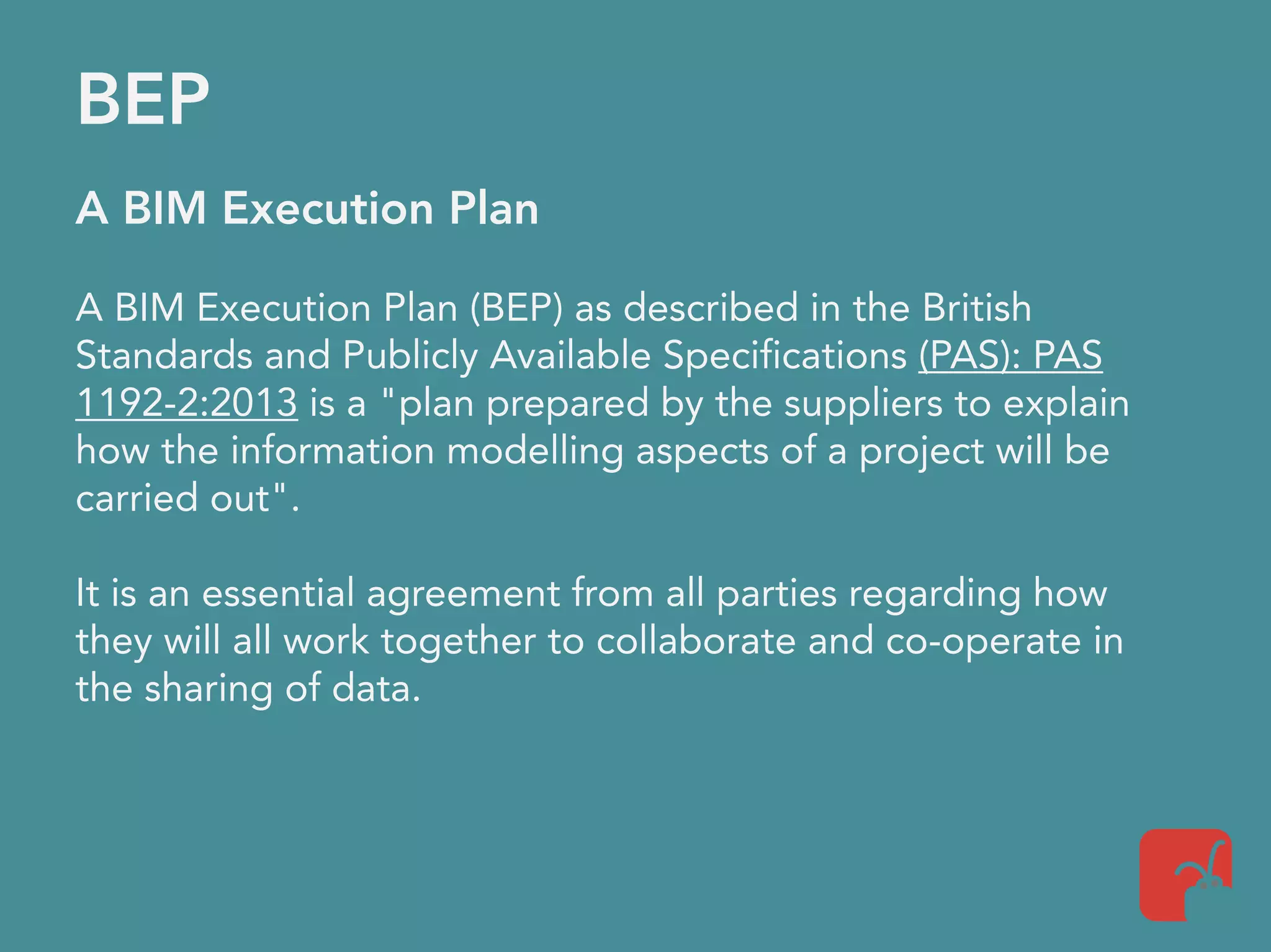
A BIM Execution Plan
A BIM Execution Plan (BEP) as described in the British
Standards and Publicly Available Specifications (PAS): PAS
1192-2:2013 is a "plan prepared by the suppliers to explain
how the information modelling aspects of a project will be
carried out".
It is an essential agreement from all parties regarding how
they will all work together to collaborate and co-operate in
the sharing of data.
BIM
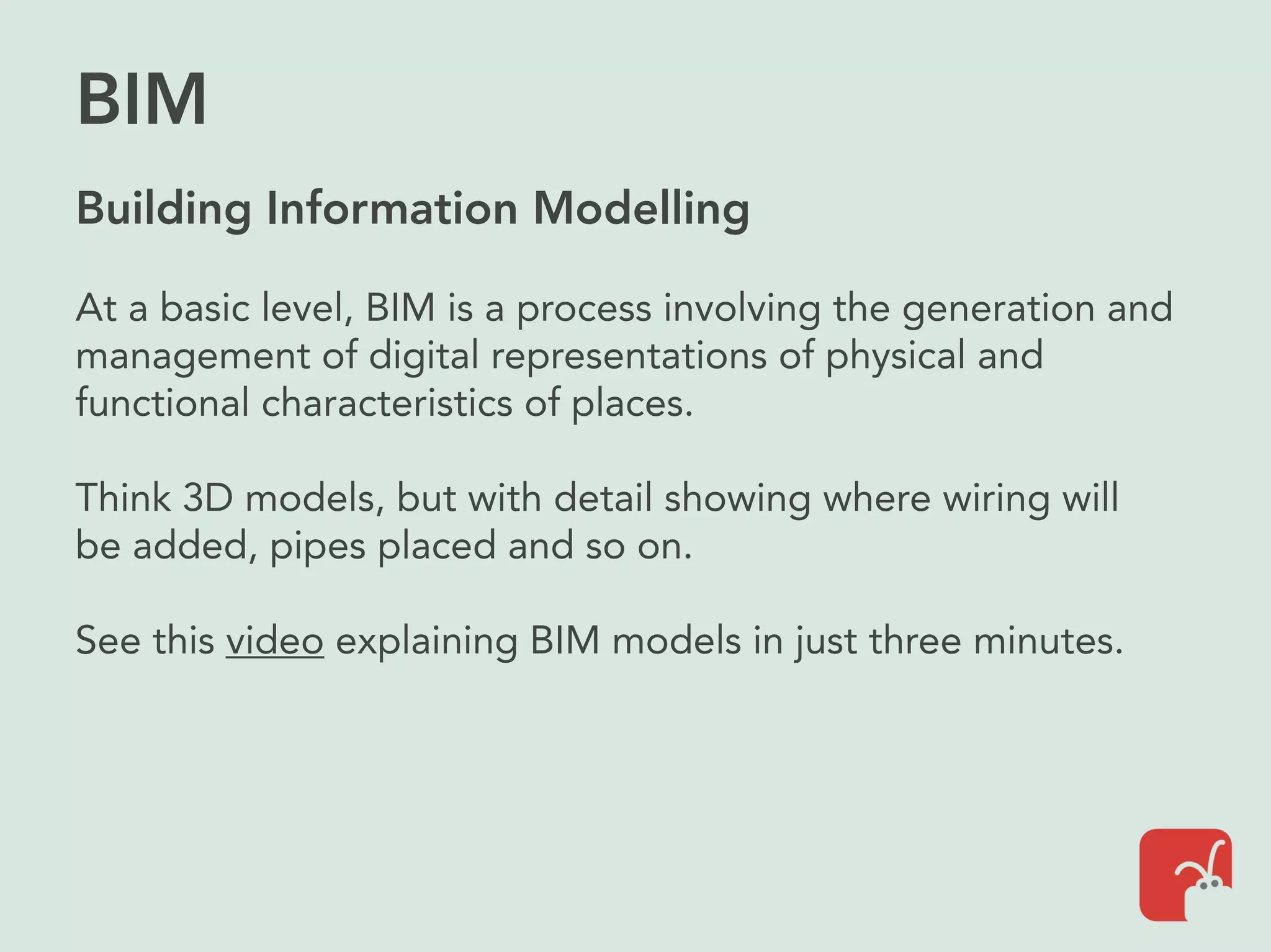
Building Information Modelling
At a basic level, BIM is a process involving the generation and
management of digital representations of physical and
functional characteristics of places.
Think 3D models, but with detail showing where wiring will
be added, pipes placed and so on.
See this video explaining BIM models in just three minutes.
BIM maturity
At the most basic, BIM can just be CAD (Computer Aided
Design) models.
At the most advanced; fully integrated, interoperable data
able to be collaborated on by all parties.
There are a number of definitions, but broadly speaking they
fit into the following groups:
BIM maturity: Level 0
Unmanaged 2D CAD drafting, with electronic exchange of
files, but no common standards or formats.
BIM maturity: Level 1
Managed 2D and 3D CAD files, containing models, objects,
co-ordinates and structures following an agreed standard and
able to be shared, but usually not collaborated on, via a
standardised Common Data Environment (CDE)
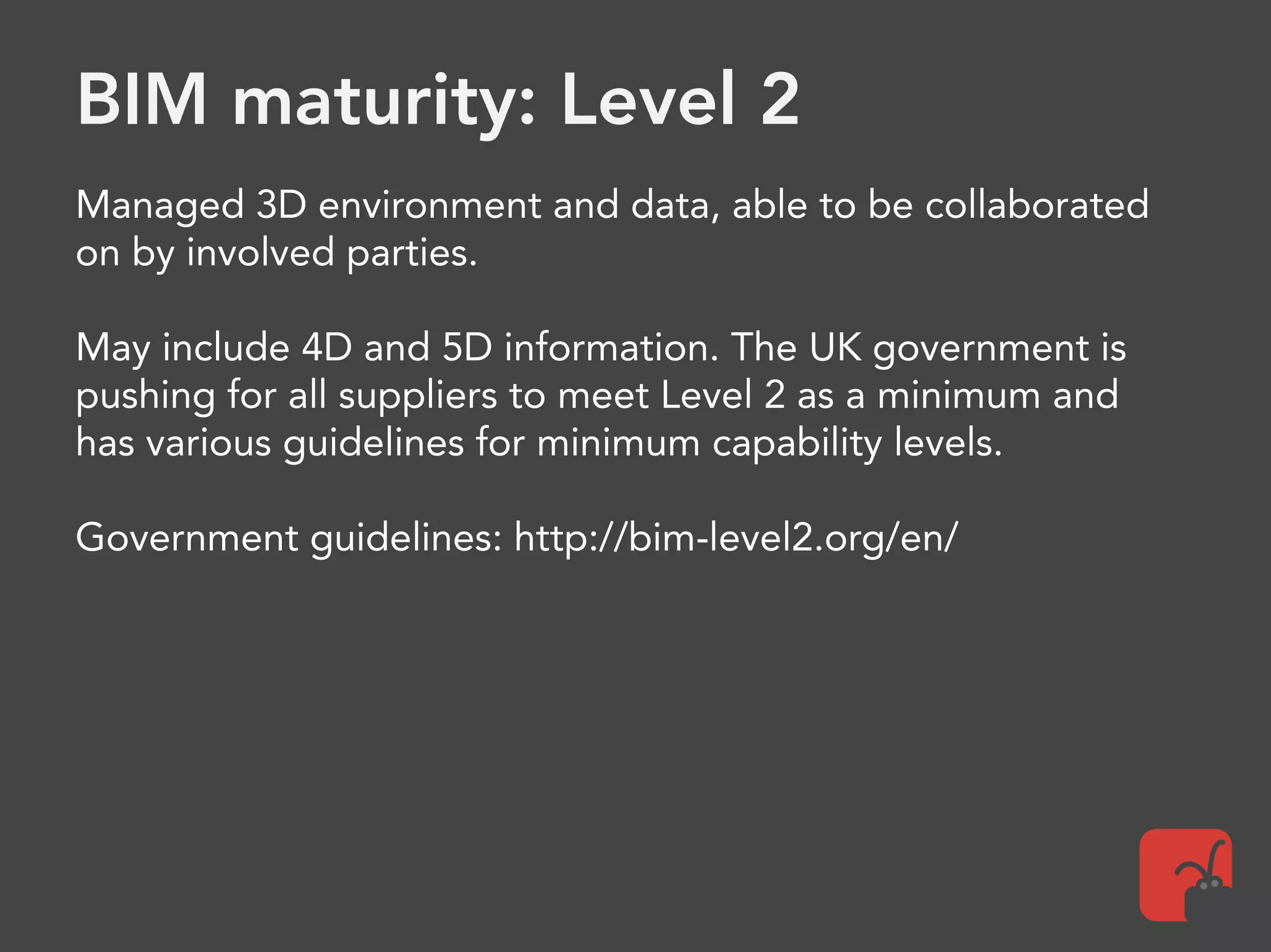
BIM maturity: Level 2
Managed 3D environment and data, able to be collaborated
on by involved parties.
May include 4D and 5D information. The UK government is
pushing for all suppliers to meet Level 2 as a minimum and
has various guidelines for minimum capability levels.
Government guidelines: http://bim-level2.org/en/
BIM maturity: Level 3
Still in its definition stages, it includes elements of all the
previous levels and adds further expectations for: Whole life
management of a building (including after its construction),
measurement via 'Internet of Things' and the ability to
integrate live with other BIM systems, allowing all systems to
exchange and act upon common data.
Level 3 may include 4D, 5D and 6D information.
A great article explaining the levels of BIM can be found
here: http://www.bimplus.co.uk/management/explaining-
levels-bim/
CAD
Computer Aided Design
CAD is a blanket term used to refer to anything designed
with the assistance of a computer, as opposed to being
created by hand (such as an architect's technical drawings).
CAD is often assumed to mean 3D (3 Dimensional) designs,
but includes 2D design.
CDE
Common Data Environment
A Common Data Environment (CDE) is a central location for
the storage of project information.
It could be as simple as a file dropbox, or a more advanced
extranet. The important thing is that all parties have access to
the files shared within it.
COBie
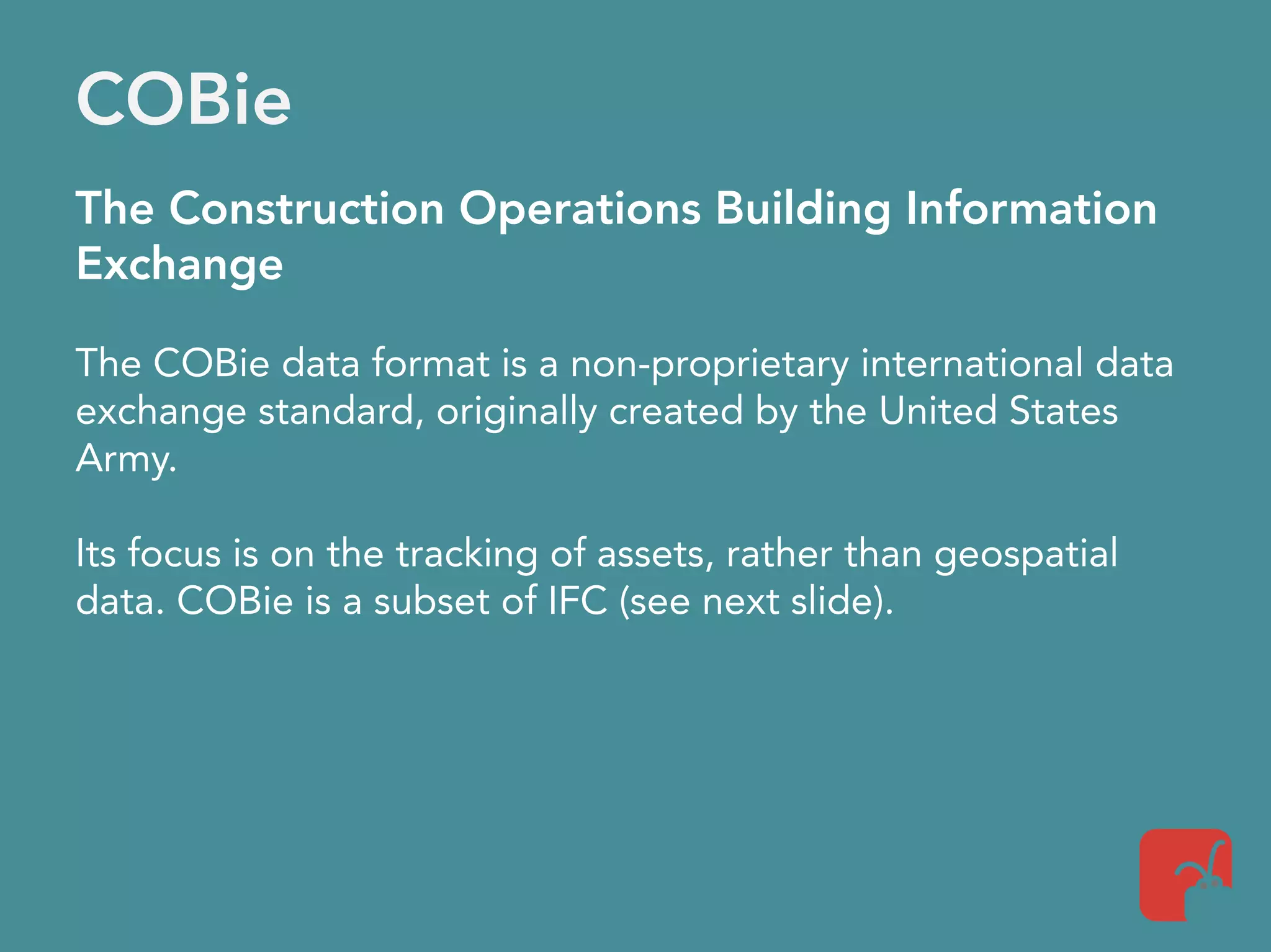
The Construction Operations Building Information
Exchange
The COBie data format is a non-proprietary international data
exchange standard, originally created by the United States
Army.
Its focus is on the tracking of assets, rather than geospatial
data. COBie is a subset of IFC (see next slide).
IFC
Industry Foundation Classes
The IFC specification in a non-proprietary data format
designed to describe, exchange and share information.
It was originally developed by a consortium formed
by Autodesk; a provider of popular CAD software. It is an
international standard: ISO/IS 16739.
LOD
Level of detail
The Level of Detail (LOD) describes the amount of
information provided in the model. It is a measure of the
refinement of data in a model.
In the UK, a LOD Level 1 model might contain only basic
block objects for a concept model, whereas a Level 7 model
will contain all accuracy information (geometry, location,
shape etc) regarding the as-built, completed facility. Different
services make use of the different levels of LOD and a Level 7
model is therefore not inherently 'better' than a Level 1.
PAS
Publicly Available Specifications
Shared public standards or specifications in rapid
development.
Developed in line with BSI guidelines, they are eventually
considered for full BSI adoption.
Parametric Modelling
A parametric model is a digital model created from
'parameters'; a collection of rules and algorithms that
influence the entire model.
Importantly in a parametric model, if one rule or dimension is
changed, then it influences the rest of the model.
For example, if the width of a wall is increased, so are the
corresponding dimensions of the floors, roofs and windows.
Uniclass
Unified classification system
Uniclass is a unified classification system for project
information structure, intended for all sectors of the UK
construction industry.
It is compliant with ISO 12006-2.
Its classification of items of all scales, via consistent classifying
tables, allows for the effective recording of items as disparate
as steel beams, brickwork and even time lapse cameras.
XML
Extensible Markup Language
XML is a language used to 'mark-up' a document in a
consistent format that is readable by both humans and
machines. At a very basic level, an XML document could look
like the following:
<breakfast>
<food>
<name>Bacon Sandwich</name>
<price>£2.75</price>
</food>
</breakfast>
The HTML language - used to create webpages - is one of
many available variants of XML.
Would you like to
know more?
Download our BIM Glossary as a
PDF here:
http://info.lobsterpictures.tv/bim-
glossary-of-terms-free-download
www.lobsterpictures.tv

A glossary of BIM terminology

  • 1.
    Editorial Board First planningmeeting February 28th 2018 Author: Laura Connelly A glossary of BIM terminology By Lobster Pictures time lapse and monitoring
  • 2.
    Introduction Technology can bea minefield of terms and acronyms. The platforms and technology related to BIM - the acronym representing Building Information Modelling (BIM) - are certainly no exception. We're keen to avoid using words that require insider knowledge to understand, so to help along the way, we've collected the most common BIM terms you're likely to come across in general usage and provided a clear explanation of their meaning.
  • 3.
    3D Three dimensional drawingsor models 4D A 3D model that includes a measurement of time and/or sequence 5D A 4D model with added information regarding cost
  • 4.
    6D As for 5D,but with information to aid facilities management after construction has finished and the lifecycle of the building as it progresses 7D All of the above levels, with the addition of data from sensors
  • 5.
    BEP A BIM ExecutionPlan A BIM Execution Plan (BEP) as described in the British Standards and Publicly Available Specifications (PAS): PAS 1192-2:2013 is a "plan prepared by the suppliers to explain how the information modelling aspects of a project will be carried out". It is an essential agreement from all parties regarding how they will all work together to collaborate and co-operate in the sharing of data.
  • 6.
    BIM Building Information Modelling Ata basic level, BIM is a process involving the generation and management of digital representations of physical and functional characteristics of places. Think 3D models, but with detail showing where wiring will be added, pipes placed and so on. See this video explaining BIM models in just three minutes.
  • 7.
    BIM maturity At themost basic, BIM can just be CAD (Computer Aided Design) models. At the most advanced; fully integrated, interoperable data able to be collaborated on by all parties. There are a number of definitions, but broadly speaking they fit into the following groups:
  • 8.
    BIM maturity: Level0 Unmanaged 2D CAD drafting, with electronic exchange of files, but no common standards or formats. BIM maturity: Level 1 Managed 2D and 3D CAD files, containing models, objects, co-ordinates and structures following an agreed standard and able to be shared, but usually not collaborated on, via a standardised Common Data Environment (CDE)
  • 9.
    BIM maturity: Level2 Managed 3D environment and data, able to be collaborated on by involved parties. May include 4D and 5D information. The UK government is pushing for all suppliers to meet Level 2 as a minimum and has various guidelines for minimum capability levels. Government guidelines: http://bim-level2.org/en/
  • 10.
    BIM maturity: Level3 Still in its definition stages, it includes elements of all the previous levels and adds further expectations for: Whole life management of a building (including after its construction), measurement via 'Internet of Things' and the ability to integrate live with other BIM systems, allowing all systems to exchange and act upon common data. Level 3 may include 4D, 5D and 6D information. A great article explaining the levels of BIM can be found here: http://www.bimplus.co.uk/management/explaining- levels-bim/
  • 11.
    CAD Computer Aided Design CADis a blanket term used to refer to anything designed with the assistance of a computer, as opposed to being created by hand (such as an architect's technical drawings). CAD is often assumed to mean 3D (3 Dimensional) designs, but includes 2D design.
  • 12.
    CDE Common Data Environment ACommon Data Environment (CDE) is a central location for the storage of project information. It could be as simple as a file dropbox, or a more advanced extranet. The important thing is that all parties have access to the files shared within it.
  • 13.
    COBie The Construction OperationsBuilding Information Exchange The COBie data format is a non-proprietary international data exchange standard, originally created by the United States Army. Its focus is on the tracking of assets, rather than geospatial data. COBie is a subset of IFC (see next slide).
  • 14.
    IFC Industry Foundation Classes TheIFC specification in a non-proprietary data format designed to describe, exchange and share information. It was originally developed by a consortium formed by Autodesk; a provider of popular CAD software. It is an international standard: ISO/IS 16739.
  • 15.
    LOD Level of detail TheLevel of Detail (LOD) describes the amount of information provided in the model. It is a measure of the refinement of data in a model. In the UK, a LOD Level 1 model might contain only basic block objects for a concept model, whereas a Level 7 model will contain all accuracy information (geometry, location, shape etc) regarding the as-built, completed facility. Different services make use of the different levels of LOD and a Level 7 model is therefore not inherently 'better' than a Level 1.
  • 16.
    PAS Publicly Available Specifications Sharedpublic standards or specifications in rapid development. Developed in line with BSI guidelines, they are eventually considered for full BSI adoption.
  • 17.
    Parametric Modelling A parametricmodel is a digital model created from 'parameters'; a collection of rules and algorithms that influence the entire model. Importantly in a parametric model, if one rule or dimension is changed, then it influences the rest of the model. For example, if the width of a wall is increased, so are the corresponding dimensions of the floors, roofs and windows.
  • 18.
    Uniclass Unified classification system Uniclassis a unified classification system for project information structure, intended for all sectors of the UK construction industry. It is compliant with ISO 12006-2. Its classification of items of all scales, via consistent classifying tables, allows for the effective recording of items as disparate as steel beams, brickwork and even time lapse cameras.
  • 19.
    XML Extensible Markup Language XMLis a language used to 'mark-up' a document in a consistent format that is readable by both humans and machines. At a very basic level, an XML document could look like the following: <breakfast> <food> <name>Bacon Sandwich</name> <price>£2.75</price> </food> </breakfast> The HTML language - used to create webpages - is one of many available variants of XML.
  • 20.
    Would you liketo know more? Download our BIM Glossary as a PDF here: http://info.lobsterpictures.tv/bim- glossary-of-terms-free-download www.lobsterpictures.tv