Business Sustainability in the
Building and Construction Industry
               Presentation Prepared for:
                 Environment Australia
     Cert IV in Business Sustainability Assessment


             Prepared by: Jessica Osborne
              www.joshdevelop.com.au
Building & Construction Industry
There are a number of unsustainable activities in the Building
and Construction Industry namely:

•   Tree Clearing
•   Product Solutions & Design
•   Council Costs Inflation with no end game
•   New Land Estate Design

The industry talks of ‘sustainability’ as a dirty word, either as a
fear based objective or simply as an unknown.

The lack of knowledge and information is preventing the
industry from moving forward. While there are examples of
excellent initiatives, the industry still has a long way to go.
FOR EXAMPLE
Builders & Developers
tend to think in What is the
smaller terms     best way to
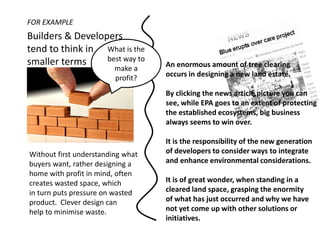
                         make a    An enormous amount of tree clearing
                         profit?   occurs in designing a new land estate.

                                   By clicking the news article picture you can
                                   see, while EPA goes to an extent of protecting
                                   the established ecosystems, big business
                                   always seems to win over.

                                   It is the responsibility of the new generation
Without first understanding what   of developers to consider ways to integrate
buyers want, rather designing a    and enhance environmental considerations.
home with profit in mind, often
creates wasted space, which        It is of great wonder, when standing in a
in turn puts pressure on wasted    cleared land space, grasping the enormity
product. Clever design can         of what has just occurred and why we have
help to minimise waste.            not yet come up with other solutions or
                                   initiatives.
Councils impact by using the building and construction industry as a fundraising activity.

The inflationary costs of tax and contributions in a land development, gives no
incentive for a developer to think outside the box. Council requirements continue
to put emphasis on ‘cost’ as a development tool rather than innovative solutions to
reduce costs and enhance innovative development.


Only up until recently for example, councils and developers would not approve a design
of a home if it did not meet a set of aesthetics (ie: gabled or skillion roof, dark coloured
paint etc). It was on the introduction of the Building and Other Legislation Amendment
Act 2009 , that allows a home to be built within reason, as a function for sustainable
design rather than aesthetics .


While it is developers social responsibility to continue to revolutionise the current
playing fields, it is also the Councils role to foster this and support innovation.
Current climates would suggest somewhat of a stand off between both
parties in this regard.
Legislation
• Building and Other Legislation Amendment Bill 2009 - The “ban the
  banners” policy aims to stop bodies corporate and developers from
  restricting the use of sustainable building elements and features.

• Sustainable Planning Act 2009 – managing the effects of development on
  the environment and ensuring delivers sustainable outcomes.

• Environmental Protection Act 1994 - protect Queensland’s environment
  while allowing for development that improves the total quality of life, both
  now and in the future, in a way that maintains the ecological processes on
  which life depends (ecologically sustainable development).

• Building Act 1975 – regulates building development approvals, water
  catchment, sustainable functions
Builder Best Practice / Initiative            Developer Best Practice / Initiative


                                              All homes within The Ecovillage include
InsulLiving was conceived and constructed     complete water autonomy and energy
as the next phase in the journey towards      self-sufficiency. Smart design and top
zero energy housing. A revolutionary          energy rating assist the homes to be
building system, builds 34% faster, reduces   comforable all year round with low
trades and materials, simplifies design       environmental impact. The estate has
and construction, improves energy             grid connected solar power, edible
efficiencies and savings. (click picture to   landscapes, permaculture, waste minimisation
Link)                                         and recycling. (click picture to link)
Moving Forward

- While most builders are ‘stuck in their ways’ there are a
  chosen few who are pioneering new technologies as
  shown on last slide. This must continue .
- Councils should see the benefit in treating each
  development as a closed loop system, giving back
  contribution costs to the developer, who is now
  responsible for these aspects (ie: parks, water, sewerage
  & electricity).
- Environmental Responsibility means taking the dollar
  figure out of the equation. Design land estates to
  incorporate the existing environment rather than see it as
  an objection.
- Any environmental feature withdrawn, such as tree
  clearing must be replaced in other areas. If 6000 trees
  are knocked down then they must be replanted and
  replenished elsewhere.
Benefits & Barriers
- Builders may experience trial and error phases in
finding new building systems that work. In order to
support new products/technologies, government
funding needs to open up and recognise ‘building
construction’ to promote the transformation of priority
Industries.

- In doing so, the cost of building goes down and we increase our economical future. Home
Buyer activity will flourish and perhaps the housing sector ‘correction’ lies in lowering build
cost with new tech rather than ‘valuation’.

- Government departments are over compartmentalised and moving forward tends to
happen at a snails pace. In order for it move quicker, the sooner they can let go of financial
realisation and pass this responsibility on to the developer, the developer is then forced to
enact efficient methodology or closed loop systems. Council’s role then inherits back to
a local level, enhancing knowledge and initiatives to communities, leveraging through these
new systems.
Improving Environmental Outcomes
While we find a lacklustre of initiatives
within the land development industry, and
recent council reports that infrastructure
subsidy will no longer be available after
(any extensions or) Dec 2011, implementation
of sustainable features on new and existing buildings still flourish with
incentives such as:

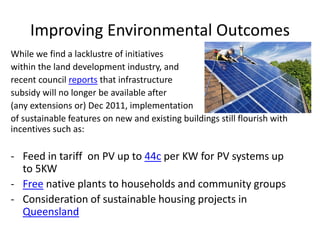
- Feed in tariff on PV up to 44c per KW for PV systems up
  to 5KW
- Free native plants to households and community groups
- Consideration of sustainable housing projects in
  Queensland
In Summary
With the increased noise on being green continues, sifting out the junk is not a
task for the faint hearted.

Numerous schemes and programs are currently available through local and state
councils, however a shift in focus is required. Reminding governments that an
ecological sustainable development is not the way in which an economic paper is
handed down from one to another. At some point natural environmental
processes need to be enhanced both for stability in the market place and to
protect our future.

Control mechanisms are currently focused through financial gains. Let’s dilute
this focus and encompass:
- environmental abilities through technologies that give back,
- educate builders & support next generation of builders to create sustainable
    homes and
- fund and recognise trial and error processes both for builders and developers,

The environment will actually support this process, if we work with it, not against
it.

Building & Construction Industry

  • 1.
    Business Sustainability inthe Building and Construction Industry Presentation Prepared for: Environment Australia Cert IV in Business Sustainability Assessment Prepared by: Jessica Osborne www.joshdevelop.com.au
  • 2.
    Building & ConstructionIndustry There are a number of unsustainable activities in the Building and Construction Industry namely: • Tree Clearing • Product Solutions & Design • Council Costs Inflation with no end game • New Land Estate Design The industry talks of ‘sustainability’ as a dirty word, either as a fear based objective or simply as an unknown. The lack of knowledge and information is preventing the industry from moving forward. While there are examples of excellent initiatives, the industry still has a long way to go.
  • 3.
    FOR EXAMPLE Builders &Developers tend to think in What is the smaller terms best way to make a An enormous amount of tree clearing profit? occurs in designing a new land estate. By clicking the news article picture you can see, while EPA goes to an extent of protecting the established ecosystems, big business always seems to win over. It is the responsibility of the new generation Without first understanding what of developers to consider ways to integrate buyers want, rather designing a and enhance environmental considerations. home with profit in mind, often creates wasted space, which It is of great wonder, when standing in a in turn puts pressure on wasted cleared land space, grasping the enormity product. Clever design can of what has just occurred and why we have help to minimise waste. not yet come up with other solutions or initiatives.
  • 4.
    Councils impact byusing the building and construction industry as a fundraising activity. The inflationary costs of tax and contributions in a land development, gives no incentive for a developer to think outside the box. Council requirements continue to put emphasis on ‘cost’ as a development tool rather than innovative solutions to reduce costs and enhance innovative development. Only up until recently for example, councils and developers would not approve a design of a home if it did not meet a set of aesthetics (ie: gabled or skillion roof, dark coloured paint etc). It was on the introduction of the Building and Other Legislation Amendment Act 2009 , that allows a home to be built within reason, as a function for sustainable design rather than aesthetics . While it is developers social responsibility to continue to revolutionise the current playing fields, it is also the Councils role to foster this and support innovation. Current climates would suggest somewhat of a stand off between both parties in this regard.
  • 5.
    Legislation • Building andOther Legislation Amendment Bill 2009 - The “ban the banners” policy aims to stop bodies corporate and developers from restricting the use of sustainable building elements and features. • Sustainable Planning Act 2009 – managing the effects of development on the environment and ensuring delivers sustainable outcomes. • Environmental Protection Act 1994 - protect Queensland’s environment while allowing for development that improves the total quality of life, both now and in the future, in a way that maintains the ecological processes on which life depends (ecologically sustainable development). • Building Act 1975 – regulates building development approvals, water catchment, sustainable functions
  • 6.
    Builder Best Practice/ Initiative Developer Best Practice / Initiative All homes within The Ecovillage include InsulLiving was conceived and constructed complete water autonomy and energy as the next phase in the journey towards self-sufficiency. Smart design and top zero energy housing. A revolutionary energy rating assist the homes to be building system, builds 34% faster, reduces comforable all year round with low trades and materials, simplifies design environmental impact. The estate has and construction, improves energy grid connected solar power, edible efficiencies and savings. (click picture to landscapes, permaculture, waste minimisation Link) and recycling. (click picture to link)
  • 7.
    Moving Forward - Whilemost builders are ‘stuck in their ways’ there are a chosen few who are pioneering new technologies as shown on last slide. This must continue . - Councils should see the benefit in treating each development as a closed loop system, giving back contribution costs to the developer, who is now responsible for these aspects (ie: parks, water, sewerage & electricity). - Environmental Responsibility means taking the dollar figure out of the equation. Design land estates to incorporate the existing environment rather than see it as an objection. - Any environmental feature withdrawn, such as tree clearing must be replaced in other areas. If 6000 trees are knocked down then they must be replanted and replenished elsewhere.
  • 8.
    Benefits & Barriers -Builders may experience trial and error phases in finding new building systems that work. In order to support new products/technologies, government funding needs to open up and recognise ‘building construction’ to promote the transformation of priority Industries. - In doing so, the cost of building goes down and we increase our economical future. Home Buyer activity will flourish and perhaps the housing sector ‘correction’ lies in lowering build cost with new tech rather than ‘valuation’. - Government departments are over compartmentalised and moving forward tends to happen at a snails pace. In order for it move quicker, the sooner they can let go of financial realisation and pass this responsibility on to the developer, the developer is then forced to enact efficient methodology or closed loop systems. Council’s role then inherits back to a local level, enhancing knowledge and initiatives to communities, leveraging through these new systems.
  • 9.
    Improving Environmental Outcomes Whilewe find a lacklustre of initiatives within the land development industry, and recent council reports that infrastructure subsidy will no longer be available after (any extensions or) Dec 2011, implementation of sustainable features on new and existing buildings still flourish with incentives such as: - Feed in tariff on PV up to 44c per KW for PV systems up to 5KW - Free native plants to households and community groups - Consideration of sustainable housing projects in Queensland
  • 10.
    In Summary With theincreased noise on being green continues, sifting out the junk is not a task for the faint hearted. Numerous schemes and programs are currently available through local and state councils, however a shift in focus is required. Reminding governments that an ecological sustainable development is not the way in which an economic paper is handed down from one to another. At some point natural environmental processes need to be enhanced both for stability in the market place and to protect our future. Control mechanisms are currently focused through financial gains. Let’s dilute this focus and encompass: - environmental abilities through technologies that give back, - educate builders & support next generation of builders to create sustainable homes and - fund and recognise trial and error processes both for builders and developers, The environment will actually support this process, if we work with it, not against it.