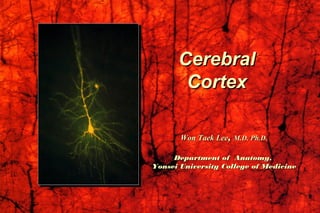
CerebralCerebral
CortexCortex
Won Taek LeeWon Taek Lee,, M.D. Ph.DM.D. Ph.D..
Department of Anatomy,Department of Anatomy,
Yonsei University College of MedicineYonsei University College of Medicine
 The layer of gray matter coveringThe layer of gray matter covering
the entire surface of cerebral hemispherethe entire surface of cerebral hemisphere
 Migration of neurons from inner mantle layer ofMigration of neurons from inner mantle layer of
neural tubeneural tube
 Accommodates enormous number of neuronsAccommodates enormous number of neurons
-- Large surface areaLarge surface area accommodatesaccommodates
more neurons than deep nucleimore neurons than deep nuclei
-- Gyri and sulciGyri and sulci also increase surface areaalso increase surface area
-- Laminar organizationLaminar organization also accommodatesalso accommodates
enormous number of neuronsenormous number of neurons
Cerebral CortexCerebral Cortex
Numerical DataNumerical Data
 Total surface areaTotal surface area: 2200 cm: 2200 cm22
(2.5 ft(2.5 ft22
))
about 1/3 ------ surface areaabout 1/3 ------ surface area
about 2/3 ------ hidden in the sulciabout 2/3 ------ hidden in the sulci
 ThicknessThickness: 1.5 mm (V I) - 4.5 mm (M I): 1.5 mm (V I) - 4.5 mm (M I)
Generally, thickest over the crest of the convolutionGenerally, thickest over the crest of the convolution
and, thinnest in the depth of sulciand, thinnest in the depth of sulci
 WeightWeight: 600 gm (40 % of total brain weight): 600 gm (40 % of total brain weight)
180 gm --------- neurons180 gm --------- neurons
420 gm --------- glial cells420 gm --------- glial cells
CerebralCerebral CortexCortex
Numerical DataNumerical Data
 Number of neuronal cells in cerebral cortexNumber of neuronal cells in cerebral cortex
neurons -----------neurons ----------- 10-15 billion10-15 billion
glial cells ----------glial cells ---------- 50 billion50 billion
 Estimation of number of cortical neuronsEstimation of number of cortical neurons
von Economo and Koskinas (1925)von Economo and Koskinas (1925) 14.0 billion14.0 billion
Shariff (1953)Shariff (1953) 6.9 billion6.9 billion
Sholl (1956)Sholl (1956) 5.0 billion5.0 billion
Pakkenberg (1966)Pakkenberg (1966) 2.6 billion2.6 billion
CerebralCerebral CortexCortex
Subdivision of Cerebral CortexSubdivision of Cerebral Cortex
AllocortexAllocortex
Archicortex (Archipallium)Archicortex (Archipallium)
Palaeocortex (Paleopallium)Palaeocortex (Paleopallium)
IsocortexIsocortex
Neocortex (Neopallium)Neocortex (Neopallium)
cf. mesocortex, juxtallocortex, mesallocortexcf. mesocortex, juxtallocortex, mesallocortex
IsocortexIsocortex –– typicaltypical 66 layered cortexlayered cortex
I.I. Molecular LayerMolecular Layer
II.II. External Granular LayerExternal Granular Layer
III.III. External Pyramidal LayerExternal Pyramidal Layer
IV.IV. Internal Granular LayerInternal Granular Layer
V.V. Internal Pyramidal LayerInternal Pyramidal Layer
VI. Polymorphic LayerVI. Polymorphic Layer
Histological OrganizationHistological Organization
Cellular ElementsCellular Elements
1.1. Pyramidal CellPyramidal Cell -- output neuronoutput neuron
giant pyramidal cell of Betzgiant pyramidal cell of Betz
2. Fusiform Cell ---2. Fusiform Cell --- modified pyramidal cellmodified pyramidal cell
3.3. Granular (Stellate) CellGranular (Stellate) Cell
basket cell, double bouquet cell, bipolar cell,basket cell, double bouquet cell, bipolar cell,
chandlier cell, neurogliform cellchandlier cell, neurogliform cell
4. Horizontal Cell of Cajal (Retzius-Cajal cell)4. Horizontal Cell of Cajal (Retzius-Cajal cell)
5. Cells of Martinotti5. Cells of Martinotti
CerebralCerebral CortexCortex
1. Pyramidal Cell1. Pyramidal Cell
2. Fusiform Cell2. Fusiform Cell
3. Granular (Stellate) Cell3. Granular (Stellate) Cell
4. basket cell4. basket cell
5. double bouquet cell5. double bouquet cell
6. chandlier cell6. chandlier cell
7. neurogliform cell7. neurogliform cell
8. Horizontal Cell of Cajal8. Horizontal Cell of Cajal
9. Cells of Martinotti9. Cells of Martinotti
a: axona: axon
CerebralCerebral CortexCortex
I.I. Molecular LayerMolecular Layer
II.II. External Granular LayerExternal Granular Layer
III.III. External Pyramidal LayerExternal Pyramidal Layer
Line of Kaes-BechterewLine of Kaes-Bechterew
IV.IV. Internal Granular LayerInternal Granular Layer
Outer band of BaillargerOuter band of Baillarger
- Line of Gennari- Line of Gennari in area 17in area 17
V.V. Internal Pyramidal LayerInternal Pyramidal Layer
Giant pyramidal cell of BetzGiant pyramidal cell of Betz
Inner Band of BaillargerInner Band of Baillarger
VI.VI. Polymorphic LayerPolymorphic Layer
GolgiGolgi NisslNissl WeigertWeigert
1. corticocortical fiber1. corticocortical fiber
association fiberassociation fiber
commissural fibercommissural fiber
2. thalamocortical fiber2. thalamocortical fiber - specific and non-specific- specific and non-specific
3. extrathalamic subcortical fiber3. extrathalamic subcortical fiber
cholinergic fiber - acetylcholinecholinergic fiber - acetylcholine
basal nucleus of Meynertbasal nucleus of Meynert
mesolimbic dopaminergic fiber - dopaminemesolimbic dopaminergic fiber - dopamine
ventral tegmental areaventral tegmental area
serotonergic fiber – serotonine - raphe nucleiserotonergic fiber – serotonine - raphe nuclei
norepinephrinergic fiber - norepinephrinenorepinephrinergic fiber - norepinephrine
nucleus locus ceruleusnucleus locus ceruleus
Cortical Afferent FiberCortical Afferent Fiber
1. association fiber1. association fiber
2. commissural fiber2. commissural fiber
3. specific3. specific
thalamocortical fiberthalamocortical fiber
4. non-specific4. non-specific
thalamocortical fiberthalamocortical fiber
1. Corticofugal Fiber - Projection Fiber1. Corticofugal Fiber - Projection Fiber
corticostriate fibercorticostriate fiber
corticothalamic fibercorticothalamic fiber
corticorubral fibercorticorubral fiber
corticotectal fibercorticotectal fiber
corticopontine fibercorticopontine fiber
cortico-olivary fibercortico-olivary fiber
corticobulbar fibercorticobulbar fiber
corticospinal fibercorticospinal fiber
2. Corticocortical Fiber2. Corticocortical Fiber
Association fiberAssociation fiber
Commissural fiberCommissural fiber
Cortical Efferent FiberCortical Efferent Fiber
5.5. association fiberassociation fiber
6.6. commissural fibercommissural fiber
7.7. corticostriate fibercorticostriate fiber
8.8. corticorubral fibercorticorubral fiber
corticopontine fibercorticopontine fiber
corticobulbar fibercorticobulbar fiber
9.9. corticospinal fibercorticospinal fiber
corticotectal fibercorticotectal fiber
10.10. corticothalamic fibercorticothalamic fiber
Cortical Efferent FiberCortical Efferent Fiber
A.A. pyramidal neuronpyramidal neuron
B. excitatoryB. excitatory
granular cellgranular cell
C.C. inhibitoryinhibitory
granular cellgranular cell
1.1. afferentafferent fiberfiber
2.2. efferent fiberefferent fiber
3.3. corticothalamic fibercorticothalamic fiber
Columnar Cortical Unit and Cortical CircuitaryColumnar Cortical Unit and Cortical Circuitary
A.A. Homotypical isocortexHomotypical isocortex
-------------- association cortexassociation cortex
B. Heterotypical isocortexB. Heterotypical isocortex
1. granular cortex1. granular cortex
------ primary sensory cortexprimary sensory cortex
V I (17), S I (3), A I (41)V I (17), S I (3), A I (41)
2. agranular cortex2. agranular cortex
------ motor cortexmotor cortex
M I (4), PM (6)M I (4), PM (6)
Regional Variation of Cortical LaminationRegional Variation of Cortical Lamination
Von Economo’s classification of cortical typesVon Economo’s classification of cortical types
1. agranular, 2. frontal, 3. parietal, 4. polar, 5. granular1. agranular, 2. frontal, 3. parietal, 4. polar, 5. granular
 Phrenology of Gall and SpurzheimPhrenology of Gall and Spurzheim
 Clinical evidencesClinical evidences
Broca’s area (1861)Broca’s area (1861)
Jacksonian epilepsy (1864)Jacksonian epilepsy (1864)
 Experimental evidencesExperimental evidences
Fritsch and Hitzig (1870) --- motor cortexFritsch and Hitzig (1870) --- motor cortex
von Gudden (1870) ---- visual cortexvon Gudden (1870) ---- visual cortex
Ferrier (1873) ---- auditory cortexFerrier (1873) ---- auditory cortex
Functional Localization of Cerebral CortexFunctional Localization of Cerebral Cortex
Albertus MagnusAlbertus Magnus
(1206-1280)(1206-1280)
Phrenology of Gall (1758-1828)Phrenology of Gall (1758-1828)
and Spurzheim (1776-1832)and Spurzheim (1776-1832)
PET (positron emission tomography) scanPET (positron emission tomography) scan
 based on cytoarchitectonic studiesbased on cytoarchitectonic studies
 Campbell (1905) --------Campbell (1905) -------- about 20 areasabout 20 areas
 Brodmann (1909) ------Brodmann (1909) ------ 47 areas47 areas
- most popular- most popular
 Vogt and Vogt (1919) -Vogt and Vogt (1919) - over 200 areasover 200 areas
 von Economo (1929) --von Economo (1929) -- 109 areas109 areas
Morphological Classification of Cortical AreasMorphological Classification of Cortical Areas
Brodmann’s cytoarchitectorial map (Lateral surface)Brodmann’s cytoarchitectorial map (Lateral surface)
Sensory areaSensory area
primary sensory areaprimary sensory area
secondary sensory areasecondary sensory area
Motor areaMotor area
primary motor areaprimary motor area
secondary motor areasecondary motor area
supplementary motor areasupplementary motor area
Association areaAssociation area
parietal, occipital and temporal cortexparietal, occipital and temporal cortex
- conceptual elaboration of sensory data- conceptual elaboration of sensory data
prefrontal (frontal) cortexprefrontal (frontal) cortex
- judgement, foresight- judgement, foresight
Functional Localization of Cerebral CortexFunctional Localization of Cerebral Cortex
Somesthetic Area (Somesthesia)Somesthetic Area (Somesthesia) S I, S IIS I, S II
Visual Area (vision)Visual Area (vision) V I, V IIV I, V II
Auditory Area (Hearing)Auditory Area (Hearing) A I, A IIA I, A II
Vestibular Area (Equilibrium)Vestibular Area (Equilibrium)
Gustatory Area (Taste)Gustatory Area (Taste)
Olfactory Area (Smell)Olfactory Area (Smell)
Sensory AreasSensory Areas
S IS I ----- 3, 1, 2 (postcentral gyrus)----- 3, 1, 2 (postcentral gyrus)
afferernts: ventrobasal complex (VPLc, VPM)afferernts: ventrobasal complex (VPLc, VPM)
discrimination of position and intensity of sensationdiscrimination of position and intensity of sensation
S IIS II ---- superior bank of lateral fissure---- superior bank of lateral fissure
no clinical disordersno clinical disorders
Somesthetic Association CortexSomesthetic Association Cortex
------- 5, 7 (parietal lobule, precuneus)------- 5, 7 (parietal lobule, precuneus)
afferents: S I, LP of thalamusafferents: S I, LP of thalamus
integration of geneal sensation with past experienceintegration of geneal sensation with past experience
tactile agnosia, astereognosistactile agnosia, astereognosis
Somesthetic AreaSomesthetic Area
Sensory HomunculusSensory Homunculus
ThalmocorticalThalmocortical
connectionconnection
(VPLc(VPLc →→ S I)S I)
Central regionCentral region
--- cutaneous (3b, 1)--- cutaneous (3b, 1)
Peripheral regionPeripheral region
--- deep (3a, 2)--- deep (3a, 2)
PrimaryPrimary
SomestheticSomesthetic
AreaArea
SecondarySecondary
SomestheticSomesthetic
Area (SII)Area (SII)
superior bank ofsuperior bank of
lateral fissurelateral fissure
V I -----V I ----- 17 (striate cortex - line of Gennari)17 (striate cortex - line of Gennari)
greatly thickened outer band of Baillargergreatly thickened outer band of Baillarger
heterotypical isocortexheterotypical isocortex
afferent: LGd of thalamusafferent: LGd of thalamus
visual field defect:visual field defect:
homonymous quadranopsia and macular sparinghomonymous quadranopsia and macular sparing
V II ----V II ---- 18, 19 (visual association area)18, 19 (visual association area)
afferents: V I, pulvinar of thalamusafferents: V I, pulvinar of thalamus
integration of vision with past experienceintegration of vision with past experience
visual agnosiavisual agnosia
cf. occipital eye fieldcf. occipital eye field
Visual CortexVisual Cortex
VisualVisual
AreasAreas
V4V4
(color)(color) FaceFace
recognitionrecognition
PerceivePerceive
Facial ExpressionFacial Expression
VisualVisual
associationassociation
areasareas
A I -----A I ----- 41, 42 (trannsverse temporal gyrus of Heschl)41, 42 (trannsverse temporal gyrus of Heschl)
heterotypical isocortexheterotypical isocortex
afferents: MGv of thalamus - core projectionafferents: MGv of thalamus - core projection
slight diminution in auditory acuityslight diminution in auditory acuity
A II ----A II ---- 22 (Wernike's area of original connotaion)22 (Wernike's area of original connotaion)
not well-definednot well-defined
afferents: non-laminar part (MGm, MGd) – belt projectionafferents: non-laminar part (MGm, MGd) – belt projection
A IA I
auditory agnosia - sensory aphasiaauditory agnosia - sensory aphasia
Auditory CortexAuditory Cortex
AuditoryAuditory
AreasAreas
PlanumPlanum
temporaletemporale
AuditoryAuditory
AreasAreas
A I -----A I ----- 41, 4241, 42
A II ----A II ---- 2222
Vestibular AreaVestibular Area
Area 3a and 2v of S IArea 3a and 2v of S I
afferents: VPLoafferents: VPLo
[superior temporal gyrus anterior to A I][superior temporal gyrus anterior to A I]
Gustatory AreaGustatory Area
Area 43 (inferior end of postcentral gyrus)Area 43 (inferior end of postcentral gyrus)
afferents: VPMpcafferents: VPMpc
Olfactory AreaOlfactory Area
Piriform Lobe - Limbic SystemPiriform Lobe - Limbic System
Other Primary Sensory AreasOther Primary Sensory Areas
primary Motor Area (M I)primary Motor Area (M I)
Premotor Area (PM)Premotor Area (PM)
Supplementary Motor Area (SMA)Supplementary Motor Area (SMA)
Frontal Eye FieldFrontal Eye Field
Motor AreasMotor Areas
Motor HomunculusMotor Homunculus
M I ------- 4M I ------- 4
precentral gyrus of lateral surfaceprecentral gyrus of lateral surface
anterior part of paracentral lobuleanterior part of paracentral lobule
heterotypical agranular cortexheterotypical agranular cortex
giant pyramidal cell of Betzgiant pyramidal cell of Betz
afferents: premotor area, SMA, S Iafferents: premotor area, SMA, S I
VLc, VPLo of thalamusVLc, VPLo of thalamus
Motor HomunculusMotor Homunculus
Upper Motor Neuron (UMN) syndromeUpper Motor Neuron (UMN) syndrome
Primary Motor AreaPrimary Motor Area
Premotor Area (PM) ------Premotor Area (PM) ------ lateral surface of 6lateral surface of 6
afferents: VLc, VPLo of thalamus from cerebellumafferents: VLc, VPLo of thalamus from cerebellum
Supplementary Motor Area (SMA)Supplementary Motor Area (SMA)
---------------------------------------------------- medial surface of 6medial surface of 6
afferents: VLo, Vapc of thalamus from basal gangliaafferents: VLo, Vapc of thalamus from basal ganglia
Frontal Eye Field ----------Frontal Eye Field ---------- 88
voluntary tracking movementvoluntary tracking movement
Other Motor AreasOther Motor Areas
Brodman’s Map of Motor and Sensory AreasBrodman’s Map of Motor and Sensory Areas
Language Areas ----- 22, 39, 40, 44, 45Language Areas ----- 22, 39, 40, 44, 45
Posterior Parietal Association AreaPosterior Parietal Association Area
------------ 5, 75, 7 (39, 40)(39, 40)
body imagebody image
Temporal Association AreaTemporal Association Area
------------ 20, 21, 37,20, 21, 37, 3838 (22)(22)
multisensory integration, conceptual ideationmultisensory integration, conceptual ideation
Prefrontal Association AreaPrefrontal Association Area
---------- 9, 10, 11, 12, 46, 479, 10, 11, 12, 46, 47 (44, 45)(44, 45)
judgement, foresight, personalityjudgement, foresight, personality
Association AreasAssociation Areas
Order of Cortical MaturationOrder of Cortical Maturation
11
2233
33
33
22
11
11
 AgnosiaAgnosia
Tactile agnosiaTactile agnosia
Visual agnosiaVisual agnosia
AlexiaAlexia
Auditory agnosiaAuditory agnosia
 ApraxiaApraxia
 AphasiaAphasia
Wernicke’s (receptive) aphasiaWernicke’s (receptive) aphasia
Broca’s (Motor) aphasiaBroca’s (Motor) aphasia
conduction aphasiaconduction aphasia
global aphasiaglobal aphasia
Disorders of Association CortexDisorders of Association Cortex
ApraxiaApraxia
The inability to execute a voluntary motor movement despiteThe inability to execute a voluntary motor movement despite
being able to demonstrate normal muscle function.being able to demonstrate normal muscle function.
Sensory Language Area (Wernike's area) ----Sensory Language Area (Wernike's area) ---- 22, 39, 4022, 39, 40
ReceptiveReceptive AphasiaAphasia -- area 22area 22
defect in comprehension, good spontaneous speechdefect in comprehension, good spontaneous speech
AnomicAnomic AphasiaAphasia -- word finding difficultyword finding difficulty
JargonJargon aphasiaaphasia -- fluent, but unintelligiable jargonfluent, but unintelligiable jargon
39 (supramarginal gyrus), 40 (angular gyrus)39 (supramarginal gyrus), 40 (angular gyrus)
Superior Longitudinal FasciculusSuperior Longitudinal Fasciculus
ConductionConduction AphasiaAphasia
good comprehension, good spontaneous speechgood comprehension, good spontaneous speech
poor repetition, poor responsepoor repetition, poor response
Motor Language Area (Broca’s area) --- 44, 45Motor Language Area (Broca’s area) --- 44, 45
MotorMotor ApahsiaApahsia
good comprehension, no speechgood comprehension, no speech
Language AreasLanguage Areas
Language Areas (Geschwind Model)Language Areas (Geschwind Model)
Photograph of the brainPhotograph of the brain
of Paul Broca’s patientof Paul Broca’s patient
called “Tan” (real namecalled “Tan” (real name
is Leborgne).is Leborgne).
Broca’s AreaBroca’s Area
Pars triangularis andPars triangularis and
pars opercularis of thepars opercularis of the
inferior frontal gyrus ofinferior frontal gyrus of
dominant hemisphere.dominant hemisphere.
Paul Broca (1824-1880)Paul Broca (1824-1880) Carl Wernicke (1848-1905)Carl Wernicke (1848-1905)
PET (positron emission tomography) scanPET (positron emission tomography) scan
Composite radioisotope brain scanComposite radioisotope brain scan
Cerebral Dominance (Lateralization, Asymmetry)Cerebral Dominance (Lateralization, Asymmetry)
Dominant HemisphereDominant Hemisphere
LanguageLanguage
–– speech, writingspeech, writing
CalculationCalculation
Non-dominant HemisphereNon-dominant Hemisphere
Spatial Perception (3D subject)Spatial Perception (3D subject)
SingingSinging
Playing musical instrumentPlaying musical instrument
LanguageLanguage
SpeechSpeech
WritingWriting
CalculationCalculation
3D perception3D perception
SingingSinging
Playing MusicalPlaying Musical
instrumentinstrument
Roger SperryRoger Sperry
(1913-1994)(1913-1994)
1981 Nobel1981 Nobel
LaureateLaureate
Split BrainSplit Brain
CommissuratomyCommissuratomy
(split corpus callosum)(split corpus callosum)
Two minds in one brain?Two minds in one brain?
 Frontal Granular CortexFrontal Granular Cortex
Lateral Prefrontal Association AreaLateral Prefrontal Association Area
------------ 9, 10, 469, 10, 46
judgement, foresight, problem solvingjudgement, foresight, problem solving
Orbitofrontal CortexOrbitofrontal Cortex
------------ 11, 12, 4711, 12, 47
emotion, olfaction, personalityemotion, olfaction, personality
 Case ofCase of Phineas GagePhineas Gage
 Prefrontal Leucotomy ofPrefrontal Leucotomy of MonizMoniz andand FreemanFreeman
Prefrontal Association AreasPrefrontal Association Areas
Phineas GagePhineas Gage
(1823-1861, accident in 1848)(1823-1861, accident in 1848)
Phineas Gage’s lesion reconstructedPhineas Gage’s lesion reconstructed
(H. Damasio and R. Frank, 1992)(H. Damasio and R. Frank, 1992)
Prefrontal LeucotomyPrefrontal Leucotomy
(Frontal Lobotomy)(Frontal Lobotomy)
Antonio Egas MonizAntonio Egas Moniz
Conceptual Framework of Cerebral FunctionConceptual Framework of Cerebral Function

Cbr cortex

  • 1.
    CerebralCerebral CortexCortex Won Taek LeeWonTaek Lee,, M.D. Ph.DM.D. Ph.D.. Department of Anatomy,Department of Anatomy, Yonsei University College of MedicineYonsei University College of Medicine
  • 2.
     The layerof gray matter coveringThe layer of gray matter covering the entire surface of cerebral hemispherethe entire surface of cerebral hemisphere  Migration of neurons from inner mantle layer ofMigration of neurons from inner mantle layer of neural tubeneural tube  Accommodates enormous number of neuronsAccommodates enormous number of neurons -- Large surface areaLarge surface area accommodatesaccommodates more neurons than deep nucleimore neurons than deep nuclei -- Gyri and sulciGyri and sulci also increase surface areaalso increase surface area -- Laminar organizationLaminar organization also accommodatesalso accommodates enormous number of neuronsenormous number of neurons Cerebral CortexCerebral Cortex
  • 3.
    Numerical DataNumerical Data Total surface areaTotal surface area: 2200 cm: 2200 cm22 (2.5 ft(2.5 ft22 )) about 1/3 ------ surface areaabout 1/3 ------ surface area about 2/3 ------ hidden in the sulciabout 2/3 ------ hidden in the sulci  ThicknessThickness: 1.5 mm (V I) - 4.5 mm (M I): 1.5 mm (V I) - 4.5 mm (M I) Generally, thickest over the crest of the convolutionGenerally, thickest over the crest of the convolution and, thinnest in the depth of sulciand, thinnest in the depth of sulci  WeightWeight: 600 gm (40 % of total brain weight): 600 gm (40 % of total brain weight) 180 gm --------- neurons180 gm --------- neurons 420 gm --------- glial cells420 gm --------- glial cells CerebralCerebral CortexCortex
  • 4.
    Numerical DataNumerical Data Number of neuronal cells in cerebral cortexNumber of neuronal cells in cerebral cortex neurons -----------neurons ----------- 10-15 billion10-15 billion glial cells ----------glial cells ---------- 50 billion50 billion  Estimation of number of cortical neuronsEstimation of number of cortical neurons von Economo and Koskinas (1925)von Economo and Koskinas (1925) 14.0 billion14.0 billion Shariff (1953)Shariff (1953) 6.9 billion6.9 billion Sholl (1956)Sholl (1956) 5.0 billion5.0 billion Pakkenberg (1966)Pakkenberg (1966) 2.6 billion2.6 billion CerebralCerebral CortexCortex
  • 5.
    Subdivision of CerebralCortexSubdivision of Cerebral Cortex AllocortexAllocortex Archicortex (Archipallium)Archicortex (Archipallium) Palaeocortex (Paleopallium)Palaeocortex (Paleopallium) IsocortexIsocortex Neocortex (Neopallium)Neocortex (Neopallium) cf. mesocortex, juxtallocortex, mesallocortexcf. mesocortex, juxtallocortex, mesallocortex
  • 6.
    IsocortexIsocortex –– typicaltypical66 layered cortexlayered cortex I.I. Molecular LayerMolecular Layer II.II. External Granular LayerExternal Granular Layer III.III. External Pyramidal LayerExternal Pyramidal Layer IV.IV. Internal Granular LayerInternal Granular Layer V.V. Internal Pyramidal LayerInternal Pyramidal Layer VI. Polymorphic LayerVI. Polymorphic Layer
  • 7.
    Histological OrganizationHistological Organization CellularElementsCellular Elements 1.1. Pyramidal CellPyramidal Cell -- output neuronoutput neuron giant pyramidal cell of Betzgiant pyramidal cell of Betz 2. Fusiform Cell ---2. Fusiform Cell --- modified pyramidal cellmodified pyramidal cell 3.3. Granular (Stellate) CellGranular (Stellate) Cell basket cell, double bouquet cell, bipolar cell,basket cell, double bouquet cell, bipolar cell, chandlier cell, neurogliform cellchandlier cell, neurogliform cell 4. Horizontal Cell of Cajal (Retzius-Cajal cell)4. Horizontal Cell of Cajal (Retzius-Cajal cell) 5. Cells of Martinotti5. Cells of Martinotti CerebralCerebral CortexCortex
  • 8.
    1. Pyramidal Cell1.Pyramidal Cell 2. Fusiform Cell2. Fusiform Cell 3. Granular (Stellate) Cell3. Granular (Stellate) Cell 4. basket cell4. basket cell 5. double bouquet cell5. double bouquet cell 6. chandlier cell6. chandlier cell 7. neurogliform cell7. neurogliform cell 8. Horizontal Cell of Cajal8. Horizontal Cell of Cajal 9. Cells of Martinotti9. Cells of Martinotti a: axona: axon CerebralCerebral CortexCortex
  • 9.
    I.I. Molecular LayerMolecularLayer II.II. External Granular LayerExternal Granular Layer III.III. External Pyramidal LayerExternal Pyramidal Layer Line of Kaes-BechterewLine of Kaes-Bechterew IV.IV. Internal Granular LayerInternal Granular Layer Outer band of BaillargerOuter band of Baillarger - Line of Gennari- Line of Gennari in area 17in area 17 V.V. Internal Pyramidal LayerInternal Pyramidal Layer Giant pyramidal cell of BetzGiant pyramidal cell of Betz Inner Band of BaillargerInner Band of Baillarger VI.VI. Polymorphic LayerPolymorphic Layer GolgiGolgi NisslNissl WeigertWeigert
  • 10.
    1. corticocortical fiber1.corticocortical fiber association fiberassociation fiber commissural fibercommissural fiber 2. thalamocortical fiber2. thalamocortical fiber - specific and non-specific- specific and non-specific 3. extrathalamic subcortical fiber3. extrathalamic subcortical fiber cholinergic fiber - acetylcholinecholinergic fiber - acetylcholine basal nucleus of Meynertbasal nucleus of Meynert mesolimbic dopaminergic fiber - dopaminemesolimbic dopaminergic fiber - dopamine ventral tegmental areaventral tegmental area serotonergic fiber – serotonine - raphe nucleiserotonergic fiber – serotonine - raphe nuclei norepinephrinergic fiber - norepinephrinenorepinephrinergic fiber - norepinephrine nucleus locus ceruleusnucleus locus ceruleus Cortical Afferent FiberCortical Afferent Fiber
  • 11.
    Cortical Afferent FiberCorticalAfferent Fiber 1. association fiber1. association fiber 2. commissural fiber2. commissural fiber 3. specific3. specific thalamocortical fiberthalamocortical fiber 4. non-specific4. non-specific thalamocortical fiberthalamocortical fiber
  • 12.
    1. Corticofugal Fiber- Projection Fiber1. Corticofugal Fiber - Projection Fiber corticostriate fibercorticostriate fiber corticothalamic fibercorticothalamic fiber corticorubral fibercorticorubral fiber corticotectal fibercorticotectal fiber corticopontine fibercorticopontine fiber cortico-olivary fibercortico-olivary fiber corticobulbar fibercorticobulbar fiber corticospinal fibercorticospinal fiber 2. Corticocortical Fiber2. Corticocortical Fiber Association fiberAssociation fiber Commissural fiberCommissural fiber Cortical Efferent FiberCortical Efferent Fiber
  • 13.
    5.5. association fiberassociationfiber 6.6. commissural fibercommissural fiber 7.7. corticostriate fibercorticostriate fiber 8.8. corticorubral fibercorticorubral fiber corticopontine fibercorticopontine fiber corticobulbar fibercorticobulbar fiber 9.9. corticospinal fibercorticospinal fiber corticotectal fibercorticotectal fiber 10.10. corticothalamic fibercorticothalamic fiber Cortical Efferent FiberCortical Efferent Fiber
  • 14.
    A.A. pyramidal neuronpyramidalneuron B. excitatoryB. excitatory granular cellgranular cell C.C. inhibitoryinhibitory granular cellgranular cell 1.1. afferentafferent fiberfiber 2.2. efferent fiberefferent fiber 3.3. corticothalamic fibercorticothalamic fiber Columnar Cortical Unit and Cortical CircuitaryColumnar Cortical Unit and Cortical Circuitary
  • 15.
    A.A. Homotypical isocortexHomotypicalisocortex -------------- association cortexassociation cortex B. Heterotypical isocortexB. Heterotypical isocortex 1. granular cortex1. granular cortex ------ primary sensory cortexprimary sensory cortex V I (17), S I (3), A I (41)V I (17), S I (3), A I (41) 2. agranular cortex2. agranular cortex ------ motor cortexmotor cortex M I (4), PM (6)M I (4), PM (6) Regional Variation of Cortical LaminationRegional Variation of Cortical Lamination
  • 16.
    Von Economo’s classificationof cortical typesVon Economo’s classification of cortical types 1. agranular, 2. frontal, 3. parietal, 4. polar, 5. granular1. agranular, 2. frontal, 3. parietal, 4. polar, 5. granular
  • 17.
    1. agranular, 2.frontal, 3. parietal, 4. polar, 5. granular1. agranular, 2. frontal, 3. parietal, 4. polar, 5. granular
  • 18.
     Phrenology ofGall and SpurzheimPhrenology of Gall and Spurzheim  Clinical evidencesClinical evidences Broca’s area (1861)Broca’s area (1861) Jacksonian epilepsy (1864)Jacksonian epilepsy (1864)  Experimental evidencesExperimental evidences Fritsch and Hitzig (1870) --- motor cortexFritsch and Hitzig (1870) --- motor cortex von Gudden (1870) ---- visual cortexvon Gudden (1870) ---- visual cortex Ferrier (1873) ---- auditory cortexFerrier (1873) ---- auditory cortex Functional Localization of Cerebral CortexFunctional Localization of Cerebral Cortex
  • 19.
    Albertus MagnusAlbertus Magnus (1206-1280)(1206-1280) Phrenologyof Gall (1758-1828)Phrenology of Gall (1758-1828) and Spurzheim (1776-1832)and Spurzheim (1776-1832)
  • 20.
    PET (positron emissiontomography) scanPET (positron emission tomography) scan
  • 21.
     based oncytoarchitectonic studiesbased on cytoarchitectonic studies  Campbell (1905) --------Campbell (1905) -------- about 20 areasabout 20 areas  Brodmann (1909) ------Brodmann (1909) ------ 47 areas47 areas - most popular- most popular  Vogt and Vogt (1919) -Vogt and Vogt (1919) - over 200 areasover 200 areas  von Economo (1929) --von Economo (1929) -- 109 areas109 areas Morphological Classification of Cortical AreasMorphological Classification of Cortical Areas
  • 22.
    Brodmann’s cytoarchitectorial map(Lateral surface)Brodmann’s cytoarchitectorial map (Lateral surface)
  • 23.
    Brodmann’s cytoarchitectorial map(Lateral surface)Brodmann’s cytoarchitectorial map (Lateral surface)
  • 24.
    Sensory areaSensory area primarysensory areaprimary sensory area secondary sensory areasecondary sensory area Motor areaMotor area primary motor areaprimary motor area secondary motor areasecondary motor area supplementary motor areasupplementary motor area Association areaAssociation area parietal, occipital and temporal cortexparietal, occipital and temporal cortex - conceptual elaboration of sensory data- conceptual elaboration of sensory data prefrontal (frontal) cortexprefrontal (frontal) cortex - judgement, foresight- judgement, foresight Functional Localization of Cerebral CortexFunctional Localization of Cerebral Cortex
  • 25.
    Somesthetic Area (Somesthesia)SomestheticArea (Somesthesia) S I, S IIS I, S II Visual Area (vision)Visual Area (vision) V I, V IIV I, V II Auditory Area (Hearing)Auditory Area (Hearing) A I, A IIA I, A II Vestibular Area (Equilibrium)Vestibular Area (Equilibrium) Gustatory Area (Taste)Gustatory Area (Taste) Olfactory Area (Smell)Olfactory Area (Smell) Sensory AreasSensory Areas
  • 26.
    S IS I----- 3, 1, 2 (postcentral gyrus)----- 3, 1, 2 (postcentral gyrus) afferernts: ventrobasal complex (VPLc, VPM)afferernts: ventrobasal complex (VPLc, VPM) discrimination of position and intensity of sensationdiscrimination of position and intensity of sensation S IIS II ---- superior bank of lateral fissure---- superior bank of lateral fissure no clinical disordersno clinical disorders Somesthetic Association CortexSomesthetic Association Cortex ------- 5, 7 (parietal lobule, precuneus)------- 5, 7 (parietal lobule, precuneus) afferents: S I, LP of thalamusafferents: S I, LP of thalamus integration of geneal sensation with past experienceintegration of geneal sensation with past experience tactile agnosia, astereognosistactile agnosia, astereognosis Somesthetic AreaSomesthetic Area
  • 27.
  • 28.
    ThalmocorticalThalmocortical connectionconnection (VPLc(VPLc →→ SI)S I) Central regionCentral region --- cutaneous (3b, 1)--- cutaneous (3b, 1) Peripheral regionPeripheral region --- deep (3a, 2)--- deep (3a, 2) PrimaryPrimary SomestheticSomesthetic AreaArea
  • 29.
    SecondarySecondary SomestheticSomesthetic Area (SII)Area (SII) superiorbank ofsuperior bank of lateral fissurelateral fissure
  • 30.
    V I -----VI ----- 17 (striate cortex - line of Gennari)17 (striate cortex - line of Gennari) greatly thickened outer band of Baillargergreatly thickened outer band of Baillarger heterotypical isocortexheterotypical isocortex afferent: LGd of thalamusafferent: LGd of thalamus visual field defect:visual field defect: homonymous quadranopsia and macular sparinghomonymous quadranopsia and macular sparing V II ----V II ---- 18, 19 (visual association area)18, 19 (visual association area) afferents: V I, pulvinar of thalamusafferents: V I, pulvinar of thalamus integration of vision with past experienceintegration of vision with past experience visual agnosiavisual agnosia cf. occipital eye fieldcf. occipital eye field Visual CortexVisual Cortex
  • 31.
  • 32.
  • 33.
    A I -----AI ----- 41, 42 (trannsverse temporal gyrus of Heschl)41, 42 (trannsverse temporal gyrus of Heschl) heterotypical isocortexheterotypical isocortex afferents: MGv of thalamus - core projectionafferents: MGv of thalamus - core projection slight diminution in auditory acuityslight diminution in auditory acuity A II ----A II ---- 22 (Wernike's area of original connotaion)22 (Wernike's area of original connotaion) not well-definednot well-defined afferents: non-laminar part (MGm, MGd) – belt projectionafferents: non-laminar part (MGm, MGd) – belt projection A IA I auditory agnosia - sensory aphasiaauditory agnosia - sensory aphasia Auditory CortexAuditory Cortex
  • 34.
  • 35.
    AuditoryAuditory AreasAreas A I -----AI ----- 41, 4241, 42 A II ----A II ---- 2222
  • 36.
    Vestibular AreaVestibular Area Area3a and 2v of S IArea 3a and 2v of S I afferents: VPLoafferents: VPLo [superior temporal gyrus anterior to A I][superior temporal gyrus anterior to A I] Gustatory AreaGustatory Area Area 43 (inferior end of postcentral gyrus)Area 43 (inferior end of postcentral gyrus) afferents: VPMpcafferents: VPMpc Olfactory AreaOlfactory Area Piriform Lobe - Limbic SystemPiriform Lobe - Limbic System Other Primary Sensory AreasOther Primary Sensory Areas
  • 38.
    primary Motor Area(M I)primary Motor Area (M I) Premotor Area (PM)Premotor Area (PM) Supplementary Motor Area (SMA)Supplementary Motor Area (SMA) Frontal Eye FieldFrontal Eye Field Motor AreasMotor Areas
  • 39.
  • 40.
    M I -------4M I ------- 4 precentral gyrus of lateral surfaceprecentral gyrus of lateral surface anterior part of paracentral lobuleanterior part of paracentral lobule heterotypical agranular cortexheterotypical agranular cortex giant pyramidal cell of Betzgiant pyramidal cell of Betz afferents: premotor area, SMA, S Iafferents: premotor area, SMA, S I VLc, VPLo of thalamusVLc, VPLo of thalamus Motor HomunculusMotor Homunculus Upper Motor Neuron (UMN) syndromeUpper Motor Neuron (UMN) syndrome Primary Motor AreaPrimary Motor Area
  • 41.
    Premotor Area (PM)------Premotor Area (PM) ------ lateral surface of 6lateral surface of 6 afferents: VLc, VPLo of thalamus from cerebellumafferents: VLc, VPLo of thalamus from cerebellum Supplementary Motor Area (SMA)Supplementary Motor Area (SMA) ---------------------------------------------------- medial surface of 6medial surface of 6 afferents: VLo, Vapc of thalamus from basal gangliaafferents: VLo, Vapc of thalamus from basal ganglia Frontal Eye Field ----------Frontal Eye Field ---------- 88 voluntary tracking movementvoluntary tracking movement Other Motor AreasOther Motor Areas
  • 42.
    Brodman’s Map ofMotor and Sensory AreasBrodman’s Map of Motor and Sensory Areas
  • 43.
    Language Areas -----22, 39, 40, 44, 45Language Areas ----- 22, 39, 40, 44, 45 Posterior Parietal Association AreaPosterior Parietal Association Area ------------ 5, 75, 7 (39, 40)(39, 40) body imagebody image Temporal Association AreaTemporal Association Area ------------ 20, 21, 37,20, 21, 37, 3838 (22)(22) multisensory integration, conceptual ideationmultisensory integration, conceptual ideation Prefrontal Association AreaPrefrontal Association Area ---------- 9, 10, 11, 12, 46, 479, 10, 11, 12, 46, 47 (44, 45)(44, 45) judgement, foresight, personalityjudgement, foresight, personality Association AreasAssociation Areas
  • 44.
    Order of CorticalMaturationOrder of Cortical Maturation 11 2233 33 33 22 11 11
  • 45.
     AgnosiaAgnosia Tactile agnosiaTactileagnosia Visual agnosiaVisual agnosia AlexiaAlexia Auditory agnosiaAuditory agnosia  ApraxiaApraxia  AphasiaAphasia Wernicke’s (receptive) aphasiaWernicke’s (receptive) aphasia Broca’s (Motor) aphasiaBroca’s (Motor) aphasia conduction aphasiaconduction aphasia global aphasiaglobal aphasia Disorders of Association CortexDisorders of Association Cortex
  • 46.
    ApraxiaApraxia The inability toexecute a voluntary motor movement despiteThe inability to execute a voluntary motor movement despite being able to demonstrate normal muscle function.being able to demonstrate normal muscle function.
  • 47.
    Sensory Language Area(Wernike's area) ----Sensory Language Area (Wernike's area) ---- 22, 39, 4022, 39, 40 ReceptiveReceptive AphasiaAphasia -- area 22area 22 defect in comprehension, good spontaneous speechdefect in comprehension, good spontaneous speech AnomicAnomic AphasiaAphasia -- word finding difficultyword finding difficulty JargonJargon aphasiaaphasia -- fluent, but unintelligiable jargonfluent, but unintelligiable jargon 39 (supramarginal gyrus), 40 (angular gyrus)39 (supramarginal gyrus), 40 (angular gyrus) Superior Longitudinal FasciculusSuperior Longitudinal Fasciculus ConductionConduction AphasiaAphasia good comprehension, good spontaneous speechgood comprehension, good spontaneous speech poor repetition, poor responsepoor repetition, poor response Motor Language Area (Broca’s area) --- 44, 45Motor Language Area (Broca’s area) --- 44, 45 MotorMotor ApahsiaApahsia good comprehension, no speechgood comprehension, no speech Language AreasLanguage Areas
  • 48.
    Language Areas (GeschwindModel)Language Areas (Geschwind Model)
  • 49.
    Photograph of thebrainPhotograph of the brain of Paul Broca’s patientof Paul Broca’s patient called “Tan” (real namecalled “Tan” (real name is Leborgne).is Leborgne). Broca’s AreaBroca’s Area Pars triangularis andPars triangularis and pars opercularis of thepars opercularis of the inferior frontal gyrus ofinferior frontal gyrus of dominant hemisphere.dominant hemisphere.
  • 50.
    Paul Broca (1824-1880)PaulBroca (1824-1880) Carl Wernicke (1848-1905)Carl Wernicke (1848-1905)
  • 51.
    PET (positron emissiontomography) scanPET (positron emission tomography) scan
  • 52.
    Composite radioisotope brainscanComposite radioisotope brain scan
  • 53.
    Cerebral Dominance (Lateralization,Asymmetry)Cerebral Dominance (Lateralization, Asymmetry) Dominant HemisphereDominant Hemisphere LanguageLanguage –– speech, writingspeech, writing CalculationCalculation Non-dominant HemisphereNon-dominant Hemisphere Spatial Perception (3D subject)Spatial Perception (3D subject) SingingSinging Playing musical instrumentPlaying musical instrument
  • 54.
  • 55.
    Roger SperryRoger Sperry (1913-1994)(1913-1994) 1981Nobel1981 Nobel LaureateLaureate Split BrainSplit Brain CommissuratomyCommissuratomy (split corpus callosum)(split corpus callosum) Two minds in one brain?Two minds in one brain?
  • 56.
     Frontal GranularCortexFrontal Granular Cortex Lateral Prefrontal Association AreaLateral Prefrontal Association Area ------------ 9, 10, 469, 10, 46 judgement, foresight, problem solvingjudgement, foresight, problem solving Orbitofrontal CortexOrbitofrontal Cortex ------------ 11, 12, 4711, 12, 47 emotion, olfaction, personalityemotion, olfaction, personality  Case ofCase of Phineas GagePhineas Gage  Prefrontal Leucotomy ofPrefrontal Leucotomy of MonizMoniz andand FreemanFreeman Prefrontal Association AreasPrefrontal Association Areas
  • 57.
    Phineas GagePhineas Gage (1823-1861,accident in 1848)(1823-1861, accident in 1848)
  • 58.
    Phineas Gage’s lesionreconstructedPhineas Gage’s lesion reconstructed (H. Damasio and R. Frank, 1992)(H. Damasio and R. Frank, 1992)
  • 59.
    Prefrontal LeucotomyPrefrontal Leucotomy (FrontalLobotomy)(Frontal Lobotomy) Antonio Egas MonizAntonio Egas Moniz
  • 60.
    Conceptual Framework ofCerebral FunctionConceptual Framework of Cerebral Function