A Radiological Approach to
Craniosynostosis
felice.d’arco@gosh.nhs.uk
Summary
 Normal Cranial Development: Anatomy &
Genetic
 Imaging Technique: How to do 3D CT, when
to do MRI, why do NOT do Plain Film
 Imaging Patterns of Craniosynosinostosis:
Pre- and Post-surgical
 Associated Complications
 Pitfalls
Normal Cranial
Development
Anatomy & Genetic
Single-Suture Synostosis
- Defective dural-mesenchymal signaling issues
- Thought to Be Idiopathic  BUT genetic causes are increasingly being
identified
- Minimal Complications/Associated Brain Abnormalities
Multi-Suture Synostosis
- Genetic Factors  Single Gene or Chromosomal Abnormalities
- Iatrogenic Factors  teratogens, early post-natal shunting of hydrocephalus,
early craniofacial irradiation for tumor control
- Metabolic Diseases  Mucopolysaccharidoses, I-Cell disease (extremely
rare!!)
Delay in sutural fusion
- Hypothyrodism
- Cleido-cranial dysostosis (RUNX2 mutation)
- Zelweger Syndrome (peroxisomal disorder )
Blaser et al. Pediatr Radiol 2015
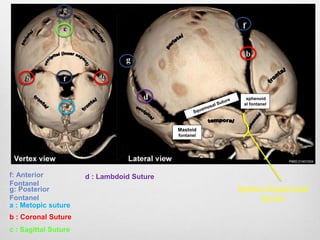
f: Anterior
Fontanel
g: Posterior
Fontanel
b : Coronal Suture
c : Sagittal Suture
d : Lambdoid Suture
sphenoid
al fontanel
Mastoid
fontanel
Spheno-Squamosal
Suture
a : Metopic suture
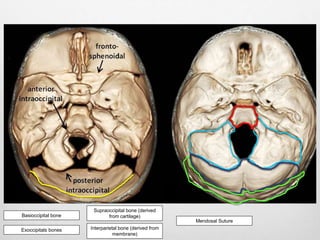
Basioccipital bone
Exoccipitals bones
Supraoccipital bone (derived
from cartilage)
Interparietal bone (derived from
membrane)
Mendosal Suture
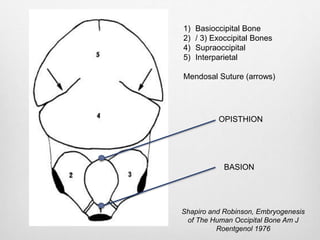
Shapiro and Robinson, Embryogenesis
of The Human Occipital Bone Am J
Roentgenol 1976
1) Basioccipital Bone
2) / 3) Exoccipital Bones
4) Supraoccipital
5) Interparietal
Mendosal Suture (arrows)
OPISTHION
BASION
Genetic of Craniosynostosis
 Suture form at the site of meeting bone fronts
 Interdigitating fingers of bone project into the suture
 Multiple genes govern this process through
osteoblast differentiation, apoptosis, osteogenesis
etc…
 Some genes are suture specific (e.g. TWIST1 along
the frontal and parietal edge) some are not.
 Genes Involved in Syndromic Craniosynostosis :
FGFR1-3, TWIST1, MSX2, RAB23
 Some single-suture non-syndromic synostoses have
been found to have genetic causes (Sagittal:
WDR35, BBS9, BMP2; FREM1, Cr9p del: Metopic)
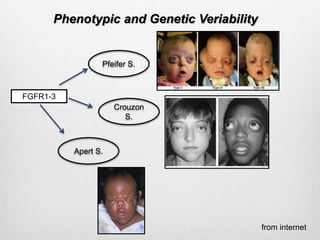
Phenotypic and Genetic Veriability
FGFR1-3
Pfeifer S.
Crouzon
S.
Apert S.
from internet
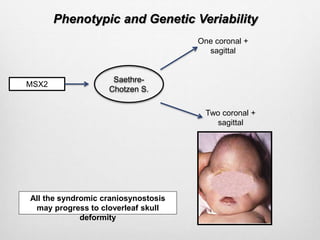
Phenotypic and Genetic Veriability
MSX2
Saethre-
Chotzen S.
One coronal +
sagittal
Two coronal +
sagittal
All the syndromic craniosynostosis
may progress to cloverleaf skull
deformity
Imaging technique
 Clinical Observation: 93% concordance with
3D CT
 Radiography: Not Longer Indicated
 CT  low dose with 3D reformats
 MRI  Brain Abnormalities (in complex
syndromic craniosynostoses)
 CTV and MRV  sinovenous thrombosis (in
complex syndromic craniosynostoses)
3D CT
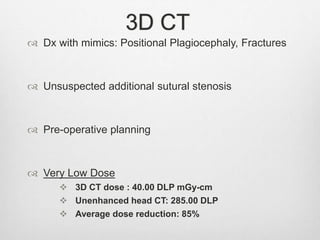
 Dx with mimics: Positional Plagiocephaly, Fractures
 Unsuspected additional sutural stenosis
 Pre-operative planning
 Very Low Dose
 3D CT dose : 40.00 DLP mGy-cm
 Unenhanced head CT: 285.00 DLP
 Average dose reduction: 85%
How to Scan a 3D Head CT
Branson HM 2011
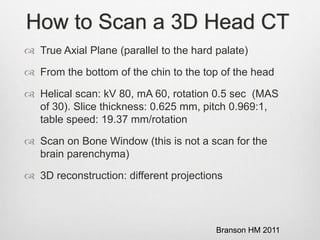
 True Axial Plane (parallel to the hard palate)
 From the bottom of the chin to the top of the head
 Helical scan: kV 80, mA 60, rotation 0.5 sec (MAS
of 30). Slice thickness: 0.625 mm, pitch 0.969:1,
table speed: 19.37 mm/rotation
 Scan on Bone Window (this is not a scan for the
brain parenchyma)
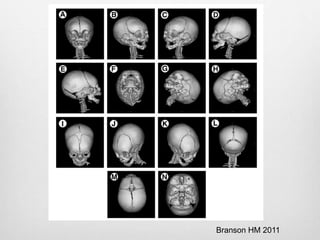
 3D reconstruction: different projections
Branson HM 2011
How to Report a 3D Head CT
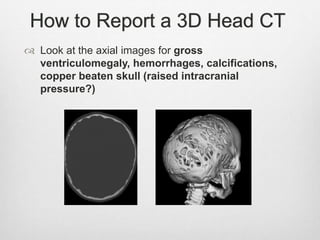
 Look at the axial images for gross
ventriculomegaly, hemorrhages, calcifications,
copper beaten skull (raised intracranial
pressure?)
How to Report a 3D Head CT
 Document Head Shape (brachycephaly,
scaphocephaly, turricephaly)
 Look for orbit and facial bone symmetry
 Individually look at each suture: ? Absence ?
Ridging ?Sclerosis ? Partial Fusion
 Skull Base and CVJ
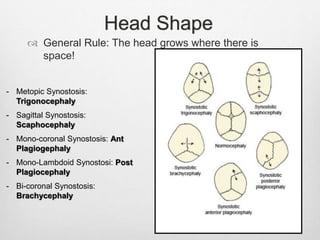
Head Shape
 General Rule: The head grows where there is
space!
- Metopic Synostosis:
Trigonocephaly
- Sagittal Synostosis:
Scaphocephaly
- Mono-coronal Synostosis: Ant
Plagiogephaly
- Mono-Lambdoid Synostosi: Post
Plagiocephaly
- Bi-coronal Synostosis:
Brachycephaly
Specific Imaging Patterns
in Craniosynostoses
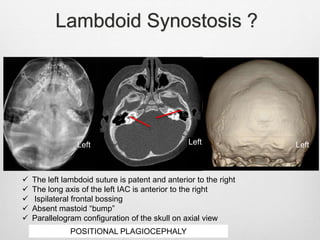
Lambdoid Synostosis ?
 The left lambdoid suture is patent and anterior to the right
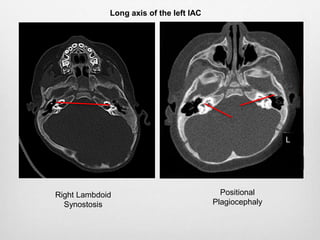
 The long axis of the left IAC is anterior to the right
 Ispilateral frontal bossing
 Absent mastoid “bump”
 Parallelogram configuration of the skull on axial view
Left LeftLeft
POSITIONAL PLAGIOCEPHALY
Positional Plagiocephaly
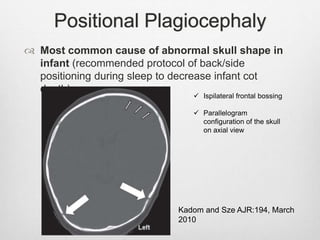
 Most common cause of abnormal skull shape in
infant (recommended protocol of back/side
positioning during sleep to decrease infant cot
death)
Kadom and Sze AJR:194, March
2010
 Ispilateral frontal bossing
 Parallelogram
configuration of the skull
on axial view
Lambdoid Synostosis
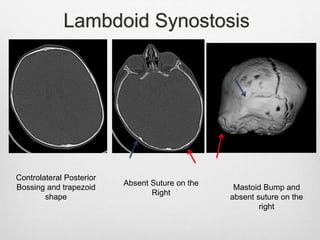
Controlateral Posterior
Bossing and trapezoid
shape
Absent Suture on the
Right
Mastoid Bump and
absent suture on the
right
L
Long axis of the left IAC
Positional
Plagiocephaly
Right Lambdoid
Synostosis
Lambdoid Synostosis
 Unilateral Lambdoid Synostosis is rare  5 % of
isolated non-syndromal craniosynostosis
 Bilateral Non-Syndromic is extremely rare 
marker of underlying Rhomboencephalosynapsis
(suggest MRI)
 Bilateral Syndromic  Apert and Pfeiffer
Syndromes
Blaser et al. Pediatr Radiol 2015
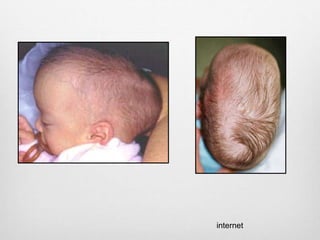
Sagittal Synostosis
 Most common craniosynostosis (40-60%)
 Scaphocephaly
 Familial cases with AD transmission (6)
 Males ++ (role of androgens in sutural
osteogenesis)
 Multiple Births / Uterine malformations ++
(intrauterine head constraint)
Abnormal Skull Shape Pediatr Radiol 2008 38 (suppl 3):488-496
internet
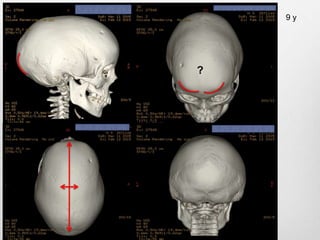
9 y
?
Age of Fusion
 Metopic Suture: 3 months – 2 years
 Lambdoid, Sagittal and Coronal : 40 years
 Squamosal: 40 to 70 years
 Fontanelle:
 Posterior: 2-3 months
 Sphenoidal: 6 months
 Mastoid: 6-18 months
 Anterior: 1-3 years
Fused vs Narrowed Sutures
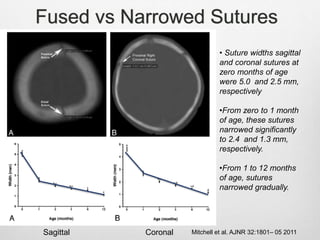
Sagittal Coronal Mitchell et al. AJNR 32:1801– 05 2011
• Suture widths sagittal
and coronal sutures at
zero months of age
were 5.0 and 2.5 mm,
respectively
•From zero to 1 month
of age, these sutures
narrowed significantly
to 2.4 and 1.3 mm,
respectively.
•From 1 to 12 months
of age, sutures
narrowed gradually.
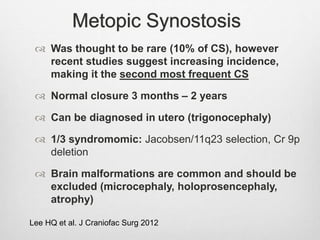
Metopic Synostosis
 Was thought to be rare (10% of CS), however
recent studies suggest increasing incidence,
making it the second most frequent CS
 Normal closure 3 months – 2 years
 Can be diagnosed in utero (trigonocephaly)
 1/3 syndromomic: Jacobsen/11q23 selection, Cr 9p
deletion
 Brain malformations are common and should be
excluded (microcephaly, holoprosencephaly,
atrophy)
Lee HQ et al. J Craniofac Surg 2012
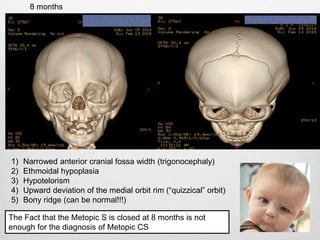
1) Narrowed anterior cranial fossa width (trigonocephaly)
2) Ethmoidal hypoplasia
3) Hypotelorism
4) Upward deviation of the medial orbit rim (“quizzical” orbit)
5) Bony ridge (can be normal!!!)
8 months
The Fact that the Metopic S is closed at 8 months is not
enough for the diagnosis of Metopic CS
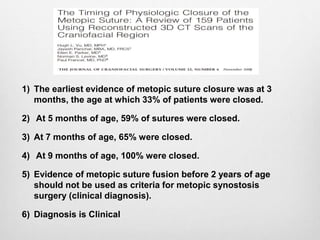
1) The earliest evidence of metopic suture closure was at 3
months, the age at which 33% of patients were closed.
2) At 5 months of age, 59% of sutures were closed.
3) At 7 months of age, 65% were closed.
4) At 9 months of age, 100% were closed.
5) Evidence of metopic suture fusion before 2 years of age
should not be used as criteria for metopic synostosis
surgery (clinical diagnosis).
6) Diagnosis is Clinical
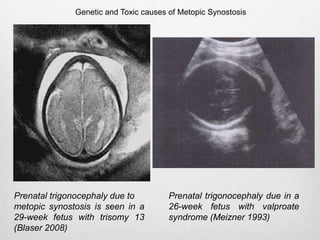
Prenatal trigonocephaly due to
metopic synostosis is seen in a
29-week fetus with trisomy 13
(Blaser 2008)
Prenatal trigonocephaly due in a
26-week fetus with valproate
syndrome (Meizner 1993)
Genetic and Toxic causes of Metopic Synostosis
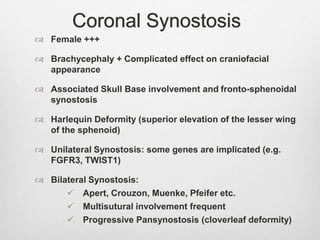
Coronal Synostosis
 Female +++
 Brachycephaly + Complicated effect on craniofacial
appearance
 Associated Skull Base involvement and fronto-sphenoidal
synostosis
 Harlequin Deformity (superior elevation of the lesser wing
of the sphenoid)
 Unilateral Synostosis: some genes are implicated (e.g.
FGFR3, TWIST1)
 Bilateral Synostosis:
 Apert, Crouzon, Muenke, Pfeifer etc.
 Multisutural involvement frequent
 Progressive Pansynostosis (cloverleaf deformity)
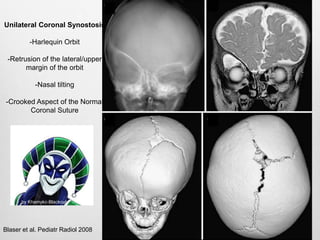
Blaser et al. Pediatr Radiol 2008
Unilateral Coronal Synostosis
-Harlequin Orbit
-Retrusion of the lateral/upper
margin of the orbit
-Nasal tilting
-Crooked Aspect of the Normal
Coronal Suture
by Khamykc-Blackout
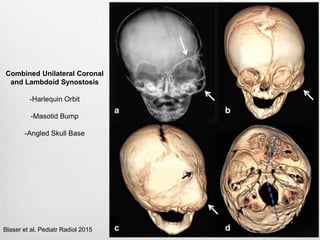
Combined Unilateral Coronal
and Lambdoid Synostosis
-Harlequin Orbit
-Masotid Bump
-Angled Skull Base
Blaser et al. Pediatr Radiol 2015
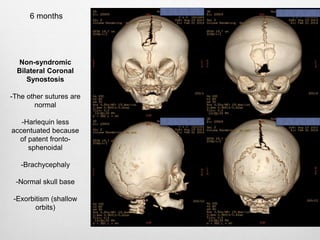
Non-syndromic
Bilateral Coronal
Synostosis
-The other sutures are
normal
-Harlequin less
accentuated because
of patent fronto-
sphenoidal
-Brachycephaly
-Normal skull base
-Exorbitism (shallow
orbits)
6 months
Syndromic Craniosynostosis
 TRIAD: Bicoronal Synostosis + FGFR mutations +
Associated Extremity Malformations
 Often other synostoses are associated (++ skull base) 
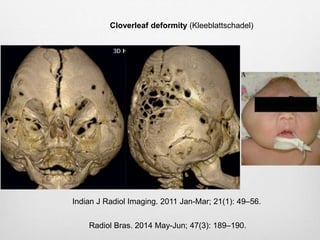
Occasionally progression to pansynostosis and cloverleaf skull
deformity
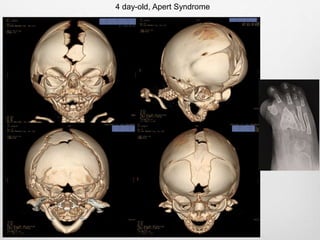
 APERT: FGFR2 mut + hands/feet syndactyly + bilateral coronal
craniosynostosis + involvement of posterior fossa sutures
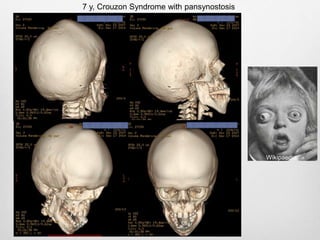
 CROUZON: FGFR2/3 mut + ear malformations + short
humerus/femur + hypoplastic maxilla + bilateral coronal
craniosynostosis + involvement of posterior fossa sutures
 PFEIFER: FGFR1/2 mut + broad first digit of hands and feet
+dental problems + hearing loss + bilateral coronal
craniosynostosis + involvement of posterior fossa sutures
 Known association with brain abnormalities (MRI brain!)
4 day-old, Apert Syndrome
7 y, Crouzon Syndrome with pansynostosis
Wikipaedia
Indian J Radiol Imaging. 2011 Jan-Mar; 21(1): 49–56.
Radiol Bras. 2014 May-Jun; 47(3): 189–190.
Cloverleaf deformity (Kleeblattschadel)
Other Patterns
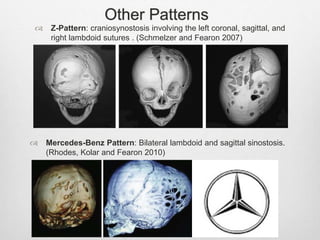
 Z-Pattern: craniosynostosis involving the left coronal, sagittal, and
right lambdoid sutures . (Schmelzer and Fearon 2007)
 Mercedes-Benz Pattern: Bilateral lambdoid and sagittal sinostosis.
(Rhodes, Kolar and Fearon 2010)
Post-operative Imaging of
Craniosynostosis
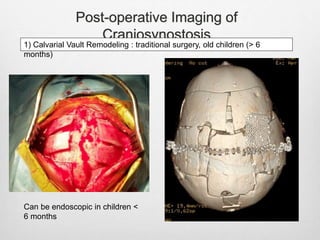
1) Calvarial Vault Remodeling : traditional surgery, old children (> 6
months)
Can be endoscopic in children <
6 months
Post-operative Imaging of
Craniosynostosis
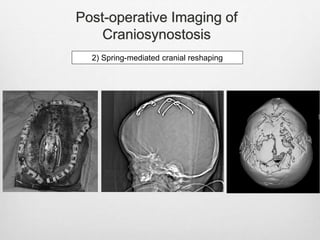
2) Spring-mediated cranial reshaping
Complications
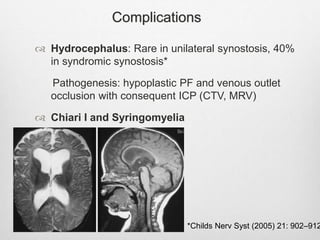
 Hydrocephalus: Rare in unilateral synostosis, 40%
in syndromic synostosis*
Pathogenesis: hypoplastic PF and venous outlet
occlusion with consequent ICP (CTV, MRV)
 Chiari I and Syringomyelia
*Childs Nerv Syst (2005) 21: 902–912
Pediatr Radiol 2008, 38:S488-
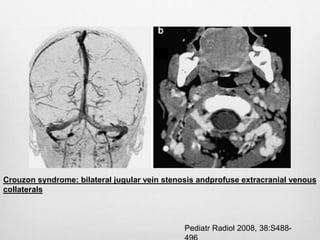
Crouzon syndrome: bilateral jugular vein stenosis andprofuse extracranial venous
collaterals
Complications: Post-Operative
 Hemorrhage
 CSF leaks
 Sinovenous damage
 Thrombosis
 Restenosis (15-89% but only few cases require
reoperation for ICP)
Associated Brain Abnormalities
 Metopic Synostosis: Microcephaly,
Holoprosencephaly, Atrophy (Faro 2006)
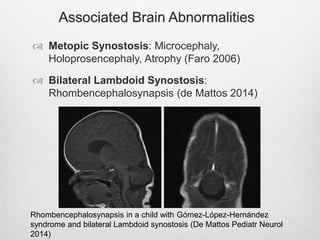
 Bilateral Lambdoid Synostosis:
Rhombencephalosynapsis (de Mattos 2014)
Rhombencephalosynapsis in a child with Gómez-López-Hernández
syndrome and bilateral Lambdoid synostosis (De Mattos Pediatr Neurol
2014)
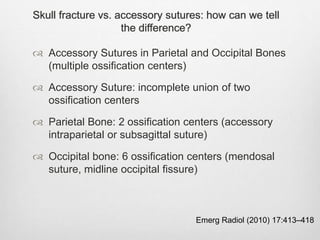
Skull fracture vs. accessory sutures: how can we tell
the difference?
Emerg Radiol (2010) 17:413–418
 Accessory Sutures in Parietal and Occipital Bones
(multiple ossification centers)
 Accessory Suture: incomplete union of two
ossification centers
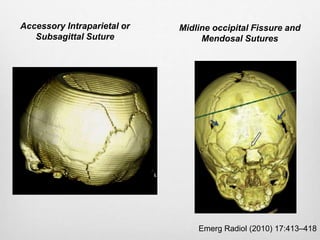
 Parietal Bone: 2 ossification centers (accessory
intraparietal or subsagittal suture)
 Occipital bone: 6 ossification centers (mendosal
suture, midline occipital fissure)
Emerg Radiol (2010) 17:413–418
Accessory Intraparietal or
Subsagittal Suture
Midline occipital Fissure and
Mendosal Sutures
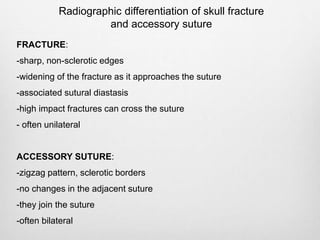
Radiographic differentiation of skull fracture
and accessory suture
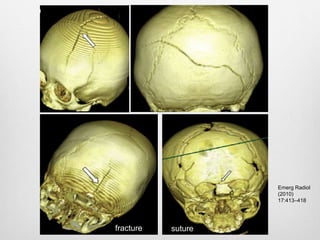
FRACTURE:
-sharp, non-sclerotic edges
-widening of the fracture as it approaches the suture
-associated sutural diastasis
-high impact fractures can cross the suture
- often unilateral
ACCESSORY SUTURE:
-zigzag pattern, sclerotic borders
-no changes in the adjacent suture
-they join the suture
-often bilateral
fracture suture
Emerg Radiol
(2010)
17:413–418
Conclusion
 Knowledge of normal anatomy and
embriology is critical in the radiological
evaluation of craniosynostosis and DDX
between accessory sutures and fractures
 Low dose CT with 3D reformats is the Gold
Standard
 In case of multiple craniosynostosis
(bicoronal +++) suggest syndromic condition
and MRI/CTV for associated complications
A Radiological Approach to Craniosynostosis

A Radiological Approach to Craniosynostosis

  • 1.
    A Radiological Approachto Craniosynostosis felice.d’arco@gosh.nhs.uk
  • 2.
    Summary  Normal CranialDevelopment: Anatomy & Genetic  Imaging Technique: How to do 3D CT, when to do MRI, why do NOT do Plain Film  Imaging Patterns of Craniosynosinostosis: Pre- and Post-surgical  Associated Complications  Pitfalls
  • 3.
  • 4.
    Single-Suture Synostosis - Defectivedural-mesenchymal signaling issues - Thought to Be Idiopathic  BUT genetic causes are increasingly being identified - Minimal Complications/Associated Brain Abnormalities Multi-Suture Synostosis - Genetic Factors  Single Gene or Chromosomal Abnormalities - Iatrogenic Factors  teratogens, early post-natal shunting of hydrocephalus, early craniofacial irradiation for tumor control - Metabolic Diseases  Mucopolysaccharidoses, I-Cell disease (extremely rare!!) Delay in sutural fusion - Hypothyrodism - Cleido-cranial dysostosis (RUNX2 mutation) - Zelweger Syndrome (peroxisomal disorder ) Blaser et al. Pediatr Radiol 2015
  • 5.
    f: Anterior Fontanel g: Posterior Fontanel b: Coronal Suture c : Sagittal Suture d : Lambdoid Suture sphenoid al fontanel Mastoid fontanel Spheno-Squamosal Suture a : Metopic suture
  • 6.
    Basioccipital bone Exoccipitals bones Supraoccipitalbone (derived from cartilage) Interparietal bone (derived from membrane) Mendosal Suture
  • 7.
    Shapiro and Robinson,Embryogenesis of The Human Occipital Bone Am J Roentgenol 1976 1) Basioccipital Bone 2) / 3) Exoccipital Bones 4) Supraoccipital 5) Interparietal Mendosal Suture (arrows) OPISTHION BASION
  • 8.
    Genetic of Craniosynostosis Suture form at the site of meeting bone fronts  Interdigitating fingers of bone project into the suture  Multiple genes govern this process through osteoblast differentiation, apoptosis, osteogenesis etc…  Some genes are suture specific (e.g. TWIST1 along the frontal and parietal edge) some are not.  Genes Involved in Syndromic Craniosynostosis : FGFR1-3, TWIST1, MSX2, RAB23  Some single-suture non-syndromic synostoses have been found to have genetic causes (Sagittal: WDR35, BBS9, BMP2; FREM1, Cr9p del: Metopic)
  • 9.
    Phenotypic and GeneticVeriability FGFR1-3 Pfeifer S. Crouzon S. Apert S. from internet
  • 10.
    Phenotypic and GeneticVeriability MSX2 Saethre- Chotzen S. One coronal + sagittal Two coronal + sagittal All the syndromic craniosynostosis may progress to cloverleaf skull deformity
  • 11.
    Imaging technique  ClinicalObservation: 93% concordance with 3D CT  Radiography: Not Longer Indicated  CT  low dose with 3D reformats  MRI  Brain Abnormalities (in complex syndromic craniosynostoses)  CTV and MRV  sinovenous thrombosis (in complex syndromic craniosynostoses)
  • 12.
    3D CT  Dxwith mimics: Positional Plagiocephaly, Fractures  Unsuspected additional sutural stenosis  Pre-operative planning  Very Low Dose  3D CT dose : 40.00 DLP mGy-cm  Unenhanced head CT: 285.00 DLP  Average dose reduction: 85%
  • 13.
    How to Scana 3D Head CT Branson HM 2011  True Axial Plane (parallel to the hard palate)  From the bottom of the chin to the top of the head  Helical scan: kV 80, mA 60, rotation 0.5 sec (MAS of 30). Slice thickness: 0.625 mm, pitch 0.969:1, table speed: 19.37 mm/rotation  Scan on Bone Window (this is not a scan for the brain parenchyma)  3D reconstruction: different projections
  • 14.
  • 15.
    How to Reporta 3D Head CT  Look at the axial images for gross ventriculomegaly, hemorrhages, calcifications, copper beaten skull (raised intracranial pressure?)
  • 16.
    How to Reporta 3D Head CT  Document Head Shape (brachycephaly, scaphocephaly, turricephaly)  Look for orbit and facial bone symmetry  Individually look at each suture: ? Absence ? Ridging ?Sclerosis ? Partial Fusion  Skull Base and CVJ
  • 17.
    Head Shape  GeneralRule: The head grows where there is space! - Metopic Synostosis: Trigonocephaly - Sagittal Synostosis: Scaphocephaly - Mono-coronal Synostosis: Ant Plagiogephaly - Mono-Lambdoid Synostosi: Post Plagiocephaly - Bi-coronal Synostosis: Brachycephaly
  • 18.
  • 19.
    Lambdoid Synostosis ? The left lambdoid suture is patent and anterior to the right  The long axis of the left IAC is anterior to the right  Ispilateral frontal bossing  Absent mastoid “bump”  Parallelogram configuration of the skull on axial view Left LeftLeft POSITIONAL PLAGIOCEPHALY
  • 20.
    Positional Plagiocephaly  Mostcommon cause of abnormal skull shape in infant (recommended protocol of back/side positioning during sleep to decrease infant cot death) Kadom and Sze AJR:194, March 2010  Ispilateral frontal bossing  Parallelogram configuration of the skull on axial view
  • 21.
    Lambdoid Synostosis Controlateral Posterior Bossingand trapezoid shape Absent Suture on the Right Mastoid Bump and absent suture on the right
  • 22.
    L Long axis ofthe left IAC Positional Plagiocephaly Right Lambdoid Synostosis
  • 23.
    Lambdoid Synostosis  UnilateralLambdoid Synostosis is rare  5 % of isolated non-syndromal craniosynostosis  Bilateral Non-Syndromic is extremely rare  marker of underlying Rhomboencephalosynapsis (suggest MRI)  Bilateral Syndromic  Apert and Pfeiffer Syndromes Blaser et al. Pediatr Radiol 2015
  • 24.
    Sagittal Synostosis  Mostcommon craniosynostosis (40-60%)  Scaphocephaly  Familial cases with AD transmission (6)  Males ++ (role of androgens in sutural osteogenesis)  Multiple Births / Uterine malformations ++ (intrauterine head constraint) Abnormal Skull Shape Pediatr Radiol 2008 38 (suppl 3):488-496
  • 25.
  • 26.
  • 27.
    Age of Fusion Metopic Suture: 3 months – 2 years  Lambdoid, Sagittal and Coronal : 40 years  Squamosal: 40 to 70 years  Fontanelle:  Posterior: 2-3 months  Sphenoidal: 6 months  Mastoid: 6-18 months  Anterior: 1-3 years
  • 28.
    Fused vs NarrowedSutures Sagittal Coronal Mitchell et al. AJNR 32:1801– 05 2011 • Suture widths sagittal and coronal sutures at zero months of age were 5.0 and 2.5 mm, respectively •From zero to 1 month of age, these sutures narrowed significantly to 2.4 and 1.3 mm, respectively. •From 1 to 12 months of age, sutures narrowed gradually.
  • 29.
    Metopic Synostosis  Wasthought to be rare (10% of CS), however recent studies suggest increasing incidence, making it the second most frequent CS  Normal closure 3 months – 2 years  Can be diagnosed in utero (trigonocephaly)  1/3 syndromomic: Jacobsen/11q23 selection, Cr 9p deletion  Brain malformations are common and should be excluded (microcephaly, holoprosencephaly, atrophy) Lee HQ et al. J Craniofac Surg 2012
  • 30.
    1) Narrowed anteriorcranial fossa width (trigonocephaly) 2) Ethmoidal hypoplasia 3) Hypotelorism 4) Upward deviation of the medial orbit rim (“quizzical” orbit) 5) Bony ridge (can be normal!!!) 8 months The Fact that the Metopic S is closed at 8 months is not enough for the diagnosis of Metopic CS
  • 31.
    1) The earliestevidence of metopic suture closure was at 3 months, the age at which 33% of patients were closed. 2) At 5 months of age, 59% of sutures were closed. 3) At 7 months of age, 65% were closed. 4) At 9 months of age, 100% were closed. 5) Evidence of metopic suture fusion before 2 years of age should not be used as criteria for metopic synostosis surgery (clinical diagnosis). 6) Diagnosis is Clinical
  • 32.
    Prenatal trigonocephaly dueto metopic synostosis is seen in a 29-week fetus with trisomy 13 (Blaser 2008) Prenatal trigonocephaly due in a 26-week fetus with valproate syndrome (Meizner 1993) Genetic and Toxic causes of Metopic Synostosis
  • 33.
    Coronal Synostosis  Female+++  Brachycephaly + Complicated effect on craniofacial appearance  Associated Skull Base involvement and fronto-sphenoidal synostosis  Harlequin Deformity (superior elevation of the lesser wing of the sphenoid)  Unilateral Synostosis: some genes are implicated (e.g. FGFR3, TWIST1)  Bilateral Synostosis:  Apert, Crouzon, Muenke, Pfeifer etc.  Multisutural involvement frequent  Progressive Pansynostosis (cloverleaf deformity)
  • 34.
    Blaser et al.Pediatr Radiol 2008 Unilateral Coronal Synostosis -Harlequin Orbit -Retrusion of the lateral/upper margin of the orbit -Nasal tilting -Crooked Aspect of the Normal Coronal Suture by Khamykc-Blackout
  • 35.
    Combined Unilateral Coronal andLambdoid Synostosis -Harlequin Orbit -Masotid Bump -Angled Skull Base Blaser et al. Pediatr Radiol 2015
  • 36.
    Non-syndromic Bilateral Coronal Synostosis -The othersutures are normal -Harlequin less accentuated because of patent fronto- sphenoidal -Brachycephaly -Normal skull base -Exorbitism (shallow orbits) 6 months
  • 37.
    Syndromic Craniosynostosis  TRIAD:Bicoronal Synostosis + FGFR mutations + Associated Extremity Malformations  Often other synostoses are associated (++ skull base)  Occasionally progression to pansynostosis and cloverleaf skull deformity  APERT: FGFR2 mut + hands/feet syndactyly + bilateral coronal craniosynostosis + involvement of posterior fossa sutures  CROUZON: FGFR2/3 mut + ear malformations + short humerus/femur + hypoplastic maxilla + bilateral coronal craniosynostosis + involvement of posterior fossa sutures  PFEIFER: FGFR1/2 mut + broad first digit of hands and feet +dental problems + hearing loss + bilateral coronal craniosynostosis + involvement of posterior fossa sutures  Known association with brain abnormalities (MRI brain!)
  • 38.
  • 39.
    7 y, CrouzonSyndrome with pansynostosis Wikipaedia
  • 40.
    Indian J RadiolImaging. 2011 Jan-Mar; 21(1): 49–56. Radiol Bras. 2014 May-Jun; 47(3): 189–190. Cloverleaf deformity (Kleeblattschadel)
  • 41.
    Other Patterns  Z-Pattern:craniosynostosis involving the left coronal, sagittal, and right lambdoid sutures . (Schmelzer and Fearon 2007)  Mercedes-Benz Pattern: Bilateral lambdoid and sagittal sinostosis. (Rhodes, Kolar and Fearon 2010)
  • 42.
    Post-operative Imaging of Craniosynostosis 1)Calvarial Vault Remodeling : traditional surgery, old children (> 6 months) Can be endoscopic in children < 6 months
  • 43.
    Post-operative Imaging of Craniosynostosis 2)Spring-mediated cranial reshaping
  • 44.
    Complications  Hydrocephalus: Rarein unilateral synostosis, 40% in syndromic synostosis* Pathogenesis: hypoplastic PF and venous outlet occlusion with consequent ICP (CTV, MRV)  Chiari I and Syringomyelia *Childs Nerv Syst (2005) 21: 902–912
  • 45.
    Pediatr Radiol 2008,38:S488- Crouzon syndrome: bilateral jugular vein stenosis andprofuse extracranial venous collaterals
  • 46.
    Complications: Post-Operative  Hemorrhage CSF leaks  Sinovenous damage  Thrombosis  Restenosis (15-89% but only few cases require reoperation for ICP)
  • 47.
    Associated Brain Abnormalities Metopic Synostosis: Microcephaly, Holoprosencephaly, Atrophy (Faro 2006)  Bilateral Lambdoid Synostosis: Rhombencephalosynapsis (de Mattos 2014) Rhombencephalosynapsis in a child with Gómez-López-Hernández syndrome and bilateral Lambdoid synostosis (De Mattos Pediatr Neurol 2014)
  • 48.
    Skull fracture vs.accessory sutures: how can we tell the difference? Emerg Radiol (2010) 17:413–418  Accessory Sutures in Parietal and Occipital Bones (multiple ossification centers)  Accessory Suture: incomplete union of two ossification centers  Parietal Bone: 2 ossification centers (accessory intraparietal or subsagittal suture)  Occipital bone: 6 ossification centers (mendosal suture, midline occipital fissure)
  • 49.
    Emerg Radiol (2010)17:413–418 Accessory Intraparietal or Subsagittal Suture Midline occipital Fissure and Mendosal Sutures
  • 50.
    Radiographic differentiation ofskull fracture and accessory suture FRACTURE: -sharp, non-sclerotic edges -widening of the fracture as it approaches the suture -associated sutural diastasis -high impact fractures can cross the suture - often unilateral ACCESSORY SUTURE: -zigzag pattern, sclerotic borders -no changes in the adjacent suture -they join the suture -often bilateral
  • 51.
  • 52.
    Conclusion  Knowledge ofnormal anatomy and embriology is critical in the radiological evaluation of craniosynostosis and DDX between accessory sutures and fractures  Low dose CT with 3D reformats is the Gold Standard  In case of multiple craniosynostosis (bicoronal +++) suggest syndromic condition and MRI/CTV for associated complications

Editor's Notes

  • #5 Inclusion-cell (I-cell) disease, also referred to as mucolipidosis II (ML II),[1][2] is part of the lysosomal storage disease family
  • #6 Anatomy
  • #8 The knowledge of the embriology of the Occipital Bone is critical in order to do not mis-diagnose fractures
  • #10 Same genes…different syndroms …different phenotype for every syndrome
  • #11 Cloverleaf skull: Trilobar skull configuration when viewed from the front or behind. All that means that the DIAGNOSIS IS FIRST CLINICAL
  • #12 Radiography: abnormal skull shape give
  • #13 If the diagnosis is clinical why CT. DLP: TOTAL RADIATION EXPOSURE FOR THE WHOLE SERIE OF IMAGES
  • #14 About the point 2 : the last scan should include be air!! To be sure that the vertex is included Beam pitch is defined as table distance traveled in one 360° gantry rotation divided by total thickness of all simultaneously acquired slices 
  • #15 These are the 14 projections proposed to a complete assessment of the sutures
  • #16 Neurosurgeons teach us that copper beaten skull doesn’t mean that there is ICP but only that the brain gyri have no space to grow and this lead to gyral impressions on the inner table of the skull
  • #18 Once again often the clinicians do the diagnosis
  • #24 The first point means that WHEN THERE IS A POSTERIOR UNILATERAL PLAGIOCEPHALY A RADIOLOGIST SHOULD THINK FIRST TO A POSITIONAL PLAGIOCEPHALY. The second point means that when the radiologist makes a diagnosis of bilateral non syndromic Lambd Craniosynostosis a Brain MRI should be suggested!!
  • #25 The fact that males and multiple births are involved in increased frequency of sutures is important to understand the pathogenesis.
  • #26 Easy clinical Diagnosis of schaphocephaly
  • #27 This is an old patient 9 years The sagittal suture is fused the others are closed but not fused (frontal bossing due to the growth along the metopic s and occipital elongation due to the growth along the lambdoid sturues , the skull is narrowed and the vertex is flat) BUT what do you see a part from the obvious: The other sutures are closed because the pt is 9 yo BUT NOT FUSED, metopic suture is fused but at this age is normal!! -what about the metopic suture? Is pathological fusion or not ?
  • #30 Origin of metopic suture: mesenchyme populated by neural crest cells
  • #31 These are the radiological features of the trigonocephaly Nell’immagine si vede che c’è il bony ridge e che la fossa anteriore è piccola, inoltre “quizzical appearance” (foto)
  • #32 Searching in literature there is some disagreement on age of fusion of the metopic (from birth to 2 years). This paper reviewed 159 pts.
  • #33 Genetic and Toxic causes Examples of prenatal diangosis of trigonocephaly, important association withteratogenic drugs such as Valproate
  • #34 1) In case of Harlequin Deformity there is associated PATENT IPSILATERAL FRONTOSPHENOIDAL SUTURE 2) Only one with female preponderance, which is due to the expression of themutation P250R in FGFR3 mutation (typical Muenke syndrome) 3) TWIST 1 is also implicated in the sagittal and metopic synostoses confirming variable expressivity 4) Another name for cloverleaf deformity is KLEEBLATTSCHADEL
  • #35 Crooked Aspect of the normal coronal suture is due to the abnormal growth of the skull perpendicular to the unfused coronal suture
  • #38 Other syndromic CS: MUENKE, SAETHRE-CHOTZEN, BALLER-GEROLD, JECKSON-WEISS
  • #39 Bicoronal suture synostosis, normal posterior fossa sutures + exorbitism + widening of sagittal and metopic, distal phalangeal fusion
  • #42 This is just to show the variability, from the same guy who is very keen in findings strange CS patterns.All these patters have genetic and phenotipical variability
  • #43 This is for sagittal synostosis: craniotomies around the fused suture Note: operation is mainly for esthetic reasons or ICP but this is rare
  • #44 In Sweden (1997) .
  • #45 The involvement of the PF explains why such complications are more frequent in syndromic CS
  • #48 Gómez-López-Hernández syndrome is a rare genetic disease characterized by scalp alopecia with trigeminal anesthesia, brachycephaly or turribrachycephaly, midface retrusion, and rhombencephalosynapsis.
  • #49 Pitfalls…
  • #50 Note: mendosal suture fuses around 4 years
  • #52 Upper left: widening of the fracture close to the suture Upper right: fracture crossing the suture Extension of the midline occipital fissure more than 2 cm is pathological.
  • #54 I hope I was more clear than that!