CEREBRUM
DR.SREEKALA.C.NAIR
B.SC, BHMS, M.SC
MEDICAL ANATOMY
CEREBRUM
• The cerebrum is the largest part of the human brain
• It has two lateral halves called cerebral hemispheres
• The two cerebral hemispheres are incompletely separated by
a median cleft called longitudinal cerebral fissure
• The cleft is complete in the front and behind and in the
middle it extends downwards up to the corpus callosum
• Corpus callosum is the large mass of the white fibres joining
the two cerebral across the median plane
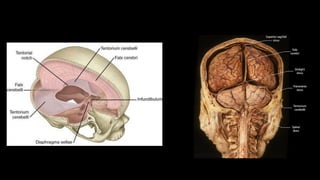
Longitudinal cerebral fissure is
occupied by the following structures
1. Falx cerebri
2. Fold of arachnoid that follows the surface of falx cerebri
3. Pia matter covering the medial surface of falx cerebri
4. Anterior cerebral arteries and veins
Cerebral hemisphere
1. An outer layer of grey matter called cerebral cortex
2. An inner mass of white matter
3. Large masses of grey matter embedded in the basal part of
the white matter called basal ganglia
4. A cavity within it called lateral ventricle
External features
1. Poles
2. Surfaces
3. Borders
4. Sulci
5. Gyri
poles
1. Frontal pole
2. Occipital pole
3. Temporal pole
surfaces
• Three surfaces
1. Superolateral
2. Medial
3. Inferior
a) Orbital part – small/anterior
b) Tentorial surface – large/posterior
Borders
• Superomedial border – separates the superolateral surface
from the medial surface
• Superciliary border is at the junction of superolateral and
orbital surfaces
• Inferolateral border separates the superolateral surface from
the tentorial surface
Borders
• The medial orbital border separates the medial surface from
the orbital surface
• Inferomedial /hippocampal border surrounds the cerebral
peduncle
• The medial occipital border separates the medial surface
from the tentorial surface
Sulci and gyri
• the cerebral cortex is highly extensive in mam so to
accommodate it within the rigid cranial cavity the surface of
the cerebral hemisphere becomes folded and produce
numerous convolutions separated by fissures
• These convolutions and fissures are termed as gyri and sulci
Main cerebral sulci
1. Lateral
2. Central
3. Parieto-occipital
4. Calcarine sulci
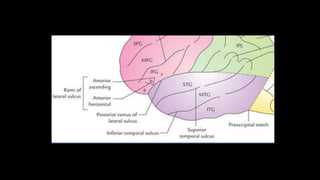
Lateral sulcus (of
sylvius)
• Lateral sulcus has a stem and three rami
• The stem of the sulcus begins as a deep cleft on the inferior
surface of the cerebral hemisphere at the anterior perforated
substance
• When it reaches the superolateral surface it divides into 3
rami:
1. Anterior horizontal
2. Anterior ascending
3. Posterior
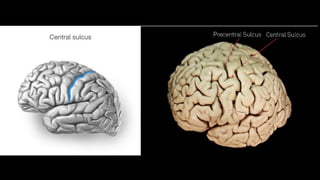
Central sulcus
(of Rolando)
• Central sulcus begins by cutting the superomedial border of
the hemisphere 1cm behind the midpoint between the frontal
and occipital poles
• The central sulcus forms the boundary between the motor
area of cerebral hemisphere in front and the sensory area
behind
Calacrine sulcus
• It is present on the medial surface of the cerebral hemisphere
Parieto-occipital sulcus
• It is present on the medial surface of the hemisphere
Lobes of the cerebral
hemisphere
• The superolateral surface is divided into 4 lobes
• Frontal
• Parietal
• Temporal
• Occipital
• Superolateral surface is divided into 4 lobes by three sulci
• Central
• Lateral
• Parieto – occipital
• And two imaginary lines
Insula/island of reil
• It is also called the central lobe of the cerebrum
• Insula is the submerged portion of the cerebral cortex in the
floor of the lateral sulcus
• It can be only seen when the lips of the lateral sulcus are
widely pulled apart
• It is triangular in shape and surrounded all around by a sulcus
– circular sulcus except anteroinferiorly at its apex called
limen insulae
Insula/island of reil
• The insula is divided into two regions –anterior and posterior by a
central sulcus
• The anterior region presents 3-4 short gyri called gyri brevia
• Posterior region presents 1-2 long gyri called gyri longa
• The insula is hidden from the surface by the overgrown cortical
areas of frontal , parietal and temporal lobes
• These areas are termed as frontal , frontoparital and temporal
opercula
• The superior surface of the temporal operculum presents anterior
and posterior transverse temporal gyri
• The middle cerebral artery and deep middle cerebral vein lie on
the surface of the insula
Sulci and gyri on the superolateral
surface of the cerebral hemisphere
• In the frontal lobe
The prefrontal sulcus
• The area between the central and precentral sulci is called
precentral gyrus
Anterior to the precentral sulcus there are two sulci called
superior and inferior frontal sulci
• These divide the frontal lobe into suprerior , middle and
inferior frontal gyri
Sulci and gyri on the superolateral
surface of the cerebral hemisphere
• In frontal lobe
• The anterior and ascending rami of lateral sulcus divide the
inferior frontal gyrus into 3 parts
• The part below the anterior ramus is called pars orbitalis
• The part between anterior and ascending rami is the pars
triangularis
• The upper part posterior to the ascending ramus – pars
opercularis
Sulci gyri in parietal
lobe
• Postcentral sulcus
• The area between the postcentral and central sulci is called
postcentral gyrus
• The rest of the parietal lobe is divided into a superior and
inferior parietal lobules by an intra-parietal sulcus
Sulci gyri in parietal lobe
• The posterior ramus of lateral sulcus and the posterior ends of
the superior and inferior temporal sulci extends into the
inferior parietal lobule and divide it into 3 parts
1. Supramarginal gyrus – surrounds the posterior ramus of the
lateral sulcus
2. Angular gyrus – surrounds the superior temporal sulcus
3. Temporo-occipitalis – surrounds the inferior temporal
sulcus
Sulci gyri in temporal
lobe
1. Superior temporal sulcus
2. Inferior temporal sulcus
• These divide the temporal lobe into superior , middle and
inferior temporal gyri
• The superior surface of superior temporal gyrus presents two
transverse temporal gyri.
• The anterior transverse temporal gyrus also called
HESCHL’S GYRUS forms the primary auditory areas of the
cortex
Sulci gyri in the occipital
lobe
• Occipital lobe posses three short sulci
1. Lateral occipital sulcus runs horizontally and divides the
lobe into superior and inferior occipital gyri
2. Transverse occipital
3. Lunate sulcus is C shaped sulcus
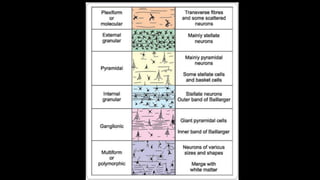
Cerebral cortex
• Cerebral cortex is an intricate blend of nerve cells and fibres
,neuroglia and blood vessels
• Microscopically the cortex consists of six layers or laminae
lying parallel to the surface
• Molecular (plexiform) layer
1. External granular layer
2. External pyramidal layer
3. Internal granular layer
4. Internal pyramidal (ganglionic) layer
5. Multiform layer (layer of polymorphic cells)
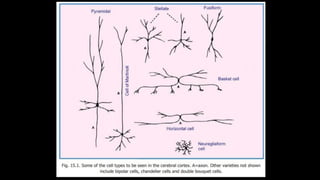
Types of neurons in the
cerebral cortex
1. Pyramidal cells
2. Stellate/granule cells
3. Horizontal cells of Cajal
4. Cells of Martinotti
5. Fusiform cells
Types of neurons in
cerebral cortex
1. Pyramidal cells
• They are pyramidal in shape with their apices directed
towards the surface. The axon arise from the base of the cell
body and dendrites arise from its apex and basal angles. The
axons enter the white matter as projection fibres
2. Stellate/granule cells
• They have star shaped body and are smaller than the
pyramidal cells. They have short axons and many dendrites
• Koniocortex – in certain areas of cerebral cortex these cell
are so numerous they resemble a cloud of dust particle.
Types of neurons in cerebral
cortex
3. Fusiform cells
• They have a fusiform cell body .they are concentrated in the
deep cortical layers
4. The horizontal cells of Cajal
• They are fusiform and present horizontally. They are found in
the most superficial layer of the cortex
5. Cells of Martinotti are small multipolar cells that are present
throughout the layers of cerebral cortex
Layers of cerebral cortex
1. Molecular layer – it is made up of predominantly of nerve
fibres and a few horizontal cells of Cajal
2. External granular layer is made up of mainly densely
packed stellate cells
3. External pyramidal cells is made up of small and medium
sized pyramidal cells
Layers of cerebral cortex
4. Internal granular layer –it is made up of stellate cells. In the
middle of this layer there is a band of horizontally arranged
white fibres called white stria or external band of
Baillarger.The white stria is the most marked in the visual
cortex – so it is also called striate cortex
5. Internal pyramidal layer- It is made up of large pyramidal
cells (of betz).the basal part of this layer contains a thin band
of horizontally arranged fibres called inner band of Baillarger .
6. Multiform layer – it is made up of cells of multiple forms.
This layer fuses with the white matter.
Functional areas of the
cerebral cortex
• Brodmann has divided the cerebral cortex into 47 areas.
• Types of cortical areas:
1. Motor area
2. Sensory area
3. Association areas
Functional area in the
frontal lobe
Primary motor area(area 4 of brodmann)
• Location
• Precentral gyrus on superolateral surface
• Anterior part of the paracentral lobule on the medial surface
• It contains large number of pyramidal cells including the
large pyramidal cells of Betz
Functional area in the frontal
lobe
Primary motor area(area 4 of brodmann)
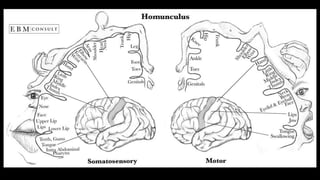
Representation of the body
• The body is represented upside down (inverted homunculus) in the
primary motor area.
• The sequence of representation of body parts from above downwards is
leg , thigh , trunk , upper limb , face , larynx , lips , jaws ,tongue and
pharynx
• The area of the cortex representing a part of the body is not proportional
to its size of that part , but to the skill movements performed by that
part. Thus the movements of the hand , lips, tongue and larynx are
represented by relatively larger areas of the cortex
Functional area in the frontal
lobe
• Functions
1. It controls the voluntary movements of the opposite side of
the body
2. It also controls the acts of micturition and defecation
• Applied anatomy
1. A lesion of this area gives rise to upper motor neuron type
of paralysis on the opposite side if the body
Premotor area(area 6 of
brodmann)
• Location
• Anterior to the primary motor area and Extends on to the
medial surface of the hemisphere.
• It is responsible for performance of voluntary motor activity
• Lesion of premotor area produce difficulty in the
performance of skilled movements
Supplementary motor
area
• It is located in the medial frontal gyrus
• The body is represented from before backwards in craniocaudal
order
• Stimulation of this area produces – assumption of posture –
turning the head , assuming position of trunk and lower limb etc.
• Lesion of supplementary area produce bilateral flexor Hypotonia
with no paralysis
Frontal eye field (area 8 of
brodmann)
• Location
• Posterior part of the middle frontal gyrus
• The frontal eye field controls voluntary scanning movements of
the eyes and is independent of the visual stimuli
• The frontal eye field is connected to the visual area of occipital
cortex by association fibres
• Lesion of frontal eye field of one hemisphere cause the two eyes
to deviate to the side of lesion and in ability to turn the eyes to the
opposite sides
Motor speech area
• Motor speech area of Broca is located in the pars triangularis
(area450 and pars opercularis (area 44) of the inferior gyrus of
frontal lobe of the left hemisphere(dominant) in most of the
individuals and 30% cases it is present in the right hemisphere
(left handed persons).
• Function
• It is essential for production of expressive speech
• If the motor speech area is damaged the individual will suffer
from motor aphasia
Prefrontal area
• The part of the frontal lobe rostral to the motor and premotor
area is referred to as prefrontal area
• This area is concerned with individuals personality
• It is also concerned with depth of emotions , social , moral
and ethical awareness , concentration ,orientation and
foresightedness .
• Bilateral destruction of this area results in change in
personality of the individual
• He/she depicts inappropriate social behavior e.g. use of
obscene language , urinating in public ,becomes careless
about his/her dress and appearance.
Functional areas of parietal
lobe
Primary sensory area
3, 1 and 2 of brodmann)
• Location
• The primary sensory is located in the postcentral gyrus and
posterior wall of the central sulcus
• Representation of body
• The body is represented upside down similar to the motor
area
Primary sensory area
• Function
• It is concerned with perception of exteroceptive (pain, light
touch and temperature) and proprioceptive sensation from
opposite half of the body
• Applied anatomy
• The lesion of primary sensory area lead to loss of
appreciation of extroceptive and proprioceptive sensations in
the opposite half of the body
Secondary area
• It is located in the upper lip of the posterior ramus of the
lateral sulcus
• This area relates more to the pain perception
• Ablation of this area may relieve intractable pain
Sensory association
• This occupies the superior parietal lobule
• It is concerned with perception of shape , size , roughness and texture of
the objects
• Thus it enables the individual to recognize the object placed in his/her
hand with out seeing them
• Such ability is reffered to as sterognosis
Lesion of this area results in inability to recognize an object by its feel.
This condition is called tactile agnosia or astereognosis
Sensory speech area of wernicke
• Location
• Brodmann’s area 22,39 and 40
• Posterior part of the superior temporal gyrus (broadmann area
22) of the dominant cerebral hemisphere
• Parts of the inferior parietal lobule including the
supramarginal and angular gyri corresponding to
BRODMANN AREAS 40 and 39.
Sensory speech area of wernicke
• Functions
1. Understanding the written and spoken languages i.e. it is
concerned with the understanding and inter-presentation of
language through visual and auditory input
2. Essential for constant availability of learned word patterns
3. Essential for the process of learning such as reading ,
writing and computing
Sensory speech area of wernicke
• Applied anatomy
• If the sensory speech area is damaged the affected individual
will suffer from receptive or sensory aphasia
• Other defects seen in sensory aphasia are :
• Alexia – disability in reading
• Agraphia – disability in writing
• Acalculia – disability in computing
• Anomia – inability in recognition of names of objects
Functional areas in
temporal lobe
Primary auditory area
brodmann areas 41 and 42
• It occupies the anterior transverse temporal gyrus (Heschl’s
gyrus)
• This area is concerned with reception of isolated impressions
of loudness , quality and pitch of the sound
• Unilateral lesions of the primary auditory area results in
slight loss of hearing but loss will be greater in opposite ear.
• Bilateral lesions of the primary auditory areas cause complete
cortical deafness
Secondary auditory area/auditory
association area
(brodmann’s area 22)
• It is situated on the lateral surface of the superior temporal
gyrus slightly posterior to the primary auditory area which it
surrounds
• This area is necessary for the interpretation of the sound
heard
• The lesion of secondary auditory area result in an inability to
interpret the meaning of the sounds heard and patient may
experience word deafness (auditory verbal agnosia)
Functional areas in
occipital lobe
Primary visual area /striate area
brodmann’s area 17
• It is situated in the walls and floor of the posterior part of the
calcarine sulcus and extends around the occipital pole on to
the superolateral surface of the hemisphere
• The most marked structural feature of the visual cortex is the
presence of white stria (visual stria of gennari) hence the
name striate area
• It is concerned with reception and perception of isolated
visual impression like colour , size , form ,motion
,illumination and transparency
Primary visual area /striate area
brodmann’s area 17
• Applied anatomy
• Lesions in the primary visual area result in the loss of vision
in the opposite visual field
• The unilateral lesions of superior wall of postcalacrine sulcus
result in inferior quadrantic hemianopia
• Lesion involving inferior wall of postcalacarine sulcus result
in superior quadrantic hemianopia
• Causes
• Vascular accidents
• Tumours
• Injuries from gunshot wounds
Secondary visual area/visual
association area
(brodmann’s areas 18 and 19)
• The secondary visual area surrounds the primary visual area
• It is responsible for recognition of the objects seen
• Lesions of secondary visual area result in loss of ability to
recognize (visual agnosia) seen in opposite field of vision
Other functional areas in
cerebral cortex
• Taste area(gustatory area) – located in the inferior part of the
parietal lobe
• Vestibular area – located in the part of the postcentral gyrus
which is concerned with the sensation of the face
• Olfactory area (brodmann area 28) – located in the anterior
part of the parahippocampal gyrus and uncus
Cerebrum

Cerebrum

  • 1.
  • 2.
    CEREBRUM • The cerebrumis the largest part of the human brain • It has two lateral halves called cerebral hemispheres • The two cerebral hemispheres are incompletely separated by a median cleft called longitudinal cerebral fissure • The cleft is complete in the front and behind and in the middle it extends downwards up to the corpus callosum • Corpus callosum is the large mass of the white fibres joining the two cerebral across the median plane
  • 5.
    Longitudinal cerebral fissureis occupied by the following structures 1. Falx cerebri 2. Fold of arachnoid that follows the surface of falx cerebri 3. Pia matter covering the medial surface of falx cerebri 4. Anterior cerebral arteries and veins
  • 7.
    Cerebral hemisphere 1. Anouter layer of grey matter called cerebral cortex 2. An inner mass of white matter 3. Large masses of grey matter embedded in the basal part of the white matter called basal ganglia 4. A cavity within it called lateral ventricle
  • 10.
    External features 1. Poles 2.Surfaces 3. Borders 4. Sulci 5. Gyri
  • 11.
    poles 1. Frontal pole 2.Occipital pole 3. Temporal pole
  • 12.
    surfaces • Three surfaces 1.Superolateral 2. Medial 3. Inferior a) Orbital part – small/anterior b) Tentorial surface – large/posterior
  • 14.
    Borders • Superomedial border– separates the superolateral surface from the medial surface • Superciliary border is at the junction of superolateral and orbital surfaces • Inferolateral border separates the superolateral surface from the tentorial surface
  • 15.
    Borders • The medialorbital border separates the medial surface from the orbital surface • Inferomedial /hippocampal border surrounds the cerebral peduncle • The medial occipital border separates the medial surface from the tentorial surface
  • 17.
    Sulci and gyri •the cerebral cortex is highly extensive in mam so to accommodate it within the rigid cranial cavity the surface of the cerebral hemisphere becomes folded and produce numerous convolutions separated by fissures • These convolutions and fissures are termed as gyri and sulci
  • 19.
    Main cerebral sulci 1.Lateral 2. Central 3. Parieto-occipital 4. Calcarine sulci
  • 20.
    Lateral sulcus (of sylvius) •Lateral sulcus has a stem and three rami • The stem of the sulcus begins as a deep cleft on the inferior surface of the cerebral hemisphere at the anterior perforated substance • When it reaches the superolateral surface it divides into 3 rami: 1. Anterior horizontal 2. Anterior ascending 3. Posterior
  • 22.
    Central sulcus (of Rolando) •Central sulcus begins by cutting the superomedial border of the hemisphere 1cm behind the midpoint between the frontal and occipital poles • The central sulcus forms the boundary between the motor area of cerebral hemisphere in front and the sensory area behind
  • 24.
    Calacrine sulcus • Itis present on the medial surface of the cerebral hemisphere
  • 26.
    Parieto-occipital sulcus • Itis present on the medial surface of the hemisphere
  • 27.
    Lobes of thecerebral hemisphere • The superolateral surface is divided into 4 lobes • Frontal • Parietal • Temporal • Occipital • Superolateral surface is divided into 4 lobes by three sulci • Central • Lateral • Parieto – occipital • And two imaginary lines
  • 29.
    Insula/island of reil •It is also called the central lobe of the cerebrum • Insula is the submerged portion of the cerebral cortex in the floor of the lateral sulcus • It can be only seen when the lips of the lateral sulcus are widely pulled apart • It is triangular in shape and surrounded all around by a sulcus – circular sulcus except anteroinferiorly at its apex called limen insulae
  • 32.
    Insula/island of reil •The insula is divided into two regions –anterior and posterior by a central sulcus • The anterior region presents 3-4 short gyri called gyri brevia • Posterior region presents 1-2 long gyri called gyri longa • The insula is hidden from the surface by the overgrown cortical areas of frontal , parietal and temporal lobes • These areas are termed as frontal , frontoparital and temporal opercula • The superior surface of the temporal operculum presents anterior and posterior transverse temporal gyri • The middle cerebral artery and deep middle cerebral vein lie on the surface of the insula
  • 34.
    Sulci and gyrion the superolateral surface of the cerebral hemisphere • In the frontal lobe The prefrontal sulcus • The area between the central and precentral sulci is called precentral gyrus Anterior to the precentral sulcus there are two sulci called superior and inferior frontal sulci • These divide the frontal lobe into suprerior , middle and inferior frontal gyri
  • 36.
    Sulci and gyrion the superolateral surface of the cerebral hemisphere • In frontal lobe • The anterior and ascending rami of lateral sulcus divide the inferior frontal gyrus into 3 parts • The part below the anterior ramus is called pars orbitalis • The part between anterior and ascending rami is the pars triangularis • The upper part posterior to the ascending ramus – pars opercularis
  • 38.
    Sulci gyri inparietal lobe • Postcentral sulcus • The area between the postcentral and central sulci is called postcentral gyrus • The rest of the parietal lobe is divided into a superior and inferior parietal lobules by an intra-parietal sulcus
  • 40.
    Sulci gyri inparietal lobe • The posterior ramus of lateral sulcus and the posterior ends of the superior and inferior temporal sulci extends into the inferior parietal lobule and divide it into 3 parts 1. Supramarginal gyrus – surrounds the posterior ramus of the lateral sulcus 2. Angular gyrus – surrounds the superior temporal sulcus 3. Temporo-occipitalis – surrounds the inferior temporal sulcus
  • 43.
    Sulci gyri intemporal lobe 1. Superior temporal sulcus 2. Inferior temporal sulcus • These divide the temporal lobe into superior , middle and inferior temporal gyri • The superior surface of superior temporal gyrus presents two transverse temporal gyri. • The anterior transverse temporal gyrus also called HESCHL’S GYRUS forms the primary auditory areas of the cortex
  • 45.
    Sulci gyri inthe occipital lobe • Occipital lobe posses three short sulci 1. Lateral occipital sulcus runs horizontally and divides the lobe into superior and inferior occipital gyri 2. Transverse occipital 3. Lunate sulcus is C shaped sulcus
  • 54.
    Cerebral cortex • Cerebralcortex is an intricate blend of nerve cells and fibres ,neuroglia and blood vessels • Microscopically the cortex consists of six layers or laminae lying parallel to the surface • Molecular (plexiform) layer 1. External granular layer 2. External pyramidal layer 3. Internal granular layer 4. Internal pyramidal (ganglionic) layer 5. Multiform layer (layer of polymorphic cells)
  • 55.
    Types of neuronsin the cerebral cortex 1. Pyramidal cells 2. Stellate/granule cells 3. Horizontal cells of Cajal 4. Cells of Martinotti 5. Fusiform cells
  • 57.
    Types of neuronsin cerebral cortex 1. Pyramidal cells • They are pyramidal in shape with their apices directed towards the surface. The axon arise from the base of the cell body and dendrites arise from its apex and basal angles. The axons enter the white matter as projection fibres 2. Stellate/granule cells • They have star shaped body and are smaller than the pyramidal cells. They have short axons and many dendrites • Koniocortex – in certain areas of cerebral cortex these cell are so numerous they resemble a cloud of dust particle.
  • 58.
    Types of neuronsin cerebral cortex 3. Fusiform cells • They have a fusiform cell body .they are concentrated in the deep cortical layers 4. The horizontal cells of Cajal • They are fusiform and present horizontally. They are found in the most superficial layer of the cortex 5. Cells of Martinotti are small multipolar cells that are present throughout the layers of cerebral cortex
  • 59.
    Layers of cerebralcortex 1. Molecular layer – it is made up of predominantly of nerve fibres and a few horizontal cells of Cajal 2. External granular layer is made up of mainly densely packed stellate cells 3. External pyramidal cells is made up of small and medium sized pyramidal cells
  • 60.
    Layers of cerebralcortex 4. Internal granular layer –it is made up of stellate cells. In the middle of this layer there is a band of horizontally arranged white fibres called white stria or external band of Baillarger.The white stria is the most marked in the visual cortex – so it is also called striate cortex 5. Internal pyramidal layer- It is made up of large pyramidal cells (of betz).the basal part of this layer contains a thin band of horizontally arranged fibres called inner band of Baillarger . 6. Multiform layer – it is made up of cells of multiple forms. This layer fuses with the white matter.
  • 62.
    Functional areas ofthe cerebral cortex • Brodmann has divided the cerebral cortex into 47 areas. • Types of cortical areas: 1. Motor area 2. Sensory area 3. Association areas
  • 64.
    Functional area inthe frontal lobe Primary motor area(area 4 of brodmann) • Location • Precentral gyrus on superolateral surface • Anterior part of the paracentral lobule on the medial surface • It contains large number of pyramidal cells including the large pyramidal cells of Betz
  • 65.
    Functional area inthe frontal lobe Primary motor area(area 4 of brodmann) Representation of the body • The body is represented upside down (inverted homunculus) in the primary motor area. • The sequence of representation of body parts from above downwards is leg , thigh , trunk , upper limb , face , larynx , lips , jaws ,tongue and pharynx • The area of the cortex representing a part of the body is not proportional to its size of that part , but to the skill movements performed by that part. Thus the movements of the hand , lips, tongue and larynx are represented by relatively larger areas of the cortex
  • 67.
    Functional area inthe frontal lobe • Functions 1. It controls the voluntary movements of the opposite side of the body 2. It also controls the acts of micturition and defecation • Applied anatomy 1. A lesion of this area gives rise to upper motor neuron type of paralysis on the opposite side if the body
  • 68.
    Premotor area(area 6of brodmann) • Location • Anterior to the primary motor area and Extends on to the medial surface of the hemisphere. • It is responsible for performance of voluntary motor activity • Lesion of premotor area produce difficulty in the performance of skilled movements
  • 70.
    Supplementary motor area • Itis located in the medial frontal gyrus • The body is represented from before backwards in craniocaudal order • Stimulation of this area produces – assumption of posture – turning the head , assuming position of trunk and lower limb etc. • Lesion of supplementary area produce bilateral flexor Hypotonia with no paralysis
  • 71.
    Frontal eye field(area 8 of brodmann) • Location • Posterior part of the middle frontal gyrus • The frontal eye field controls voluntary scanning movements of the eyes and is independent of the visual stimuli • The frontal eye field is connected to the visual area of occipital cortex by association fibres • Lesion of frontal eye field of one hemisphere cause the two eyes to deviate to the side of lesion and in ability to turn the eyes to the opposite sides
  • 72.
    Motor speech area •Motor speech area of Broca is located in the pars triangularis (area450 and pars opercularis (area 44) of the inferior gyrus of frontal lobe of the left hemisphere(dominant) in most of the individuals and 30% cases it is present in the right hemisphere (left handed persons). • Function • It is essential for production of expressive speech • If the motor speech area is damaged the individual will suffer from motor aphasia
  • 73.
    Prefrontal area • Thepart of the frontal lobe rostral to the motor and premotor area is referred to as prefrontal area • This area is concerned with individuals personality • It is also concerned with depth of emotions , social , moral and ethical awareness , concentration ,orientation and foresightedness . • Bilateral destruction of this area results in change in personality of the individual • He/she depicts inappropriate social behavior e.g. use of obscene language , urinating in public ,becomes careless about his/her dress and appearance.
  • 74.
    Functional areas ofparietal lobe
  • 75.
    Primary sensory area 3,1 and 2 of brodmann) • Location • The primary sensory is located in the postcentral gyrus and posterior wall of the central sulcus • Representation of body • The body is represented upside down similar to the motor area
  • 77.
    Primary sensory area •Function • It is concerned with perception of exteroceptive (pain, light touch and temperature) and proprioceptive sensation from opposite half of the body • Applied anatomy • The lesion of primary sensory area lead to loss of appreciation of extroceptive and proprioceptive sensations in the opposite half of the body
  • 78.
    Secondary area • Itis located in the upper lip of the posterior ramus of the lateral sulcus • This area relates more to the pain perception • Ablation of this area may relieve intractable pain
  • 79.
    Sensory association • Thisoccupies the superior parietal lobule • It is concerned with perception of shape , size , roughness and texture of the objects • Thus it enables the individual to recognize the object placed in his/her hand with out seeing them • Such ability is reffered to as sterognosis Lesion of this area results in inability to recognize an object by its feel. This condition is called tactile agnosia or astereognosis
  • 80.
    Sensory speech areaof wernicke • Location • Brodmann’s area 22,39 and 40 • Posterior part of the superior temporal gyrus (broadmann area 22) of the dominant cerebral hemisphere • Parts of the inferior parietal lobule including the supramarginal and angular gyri corresponding to BRODMANN AREAS 40 and 39.
  • 81.
    Sensory speech areaof wernicke • Functions 1. Understanding the written and spoken languages i.e. it is concerned with the understanding and inter-presentation of language through visual and auditory input 2. Essential for constant availability of learned word patterns 3. Essential for the process of learning such as reading , writing and computing
  • 82.
    Sensory speech areaof wernicke • Applied anatomy • If the sensory speech area is damaged the affected individual will suffer from receptive or sensory aphasia • Other defects seen in sensory aphasia are : • Alexia – disability in reading • Agraphia – disability in writing • Acalculia – disability in computing • Anomia – inability in recognition of names of objects
  • 83.
  • 84.
    Primary auditory area brodmannareas 41 and 42 • It occupies the anterior transverse temporal gyrus (Heschl’s gyrus) • This area is concerned with reception of isolated impressions of loudness , quality and pitch of the sound • Unilateral lesions of the primary auditory area results in slight loss of hearing but loss will be greater in opposite ear. • Bilateral lesions of the primary auditory areas cause complete cortical deafness
  • 85.
    Secondary auditory area/auditory associationarea (brodmann’s area 22) • It is situated on the lateral surface of the superior temporal gyrus slightly posterior to the primary auditory area which it surrounds • This area is necessary for the interpretation of the sound heard • The lesion of secondary auditory area result in an inability to interpret the meaning of the sounds heard and patient may experience word deafness (auditory verbal agnosia)
  • 86.
  • 87.
    Primary visual area/striate area brodmann’s area 17 • It is situated in the walls and floor of the posterior part of the calcarine sulcus and extends around the occipital pole on to the superolateral surface of the hemisphere • The most marked structural feature of the visual cortex is the presence of white stria (visual stria of gennari) hence the name striate area • It is concerned with reception and perception of isolated visual impression like colour , size , form ,motion ,illumination and transparency
  • 88.
    Primary visual area/striate area brodmann’s area 17 • Applied anatomy • Lesions in the primary visual area result in the loss of vision in the opposite visual field • The unilateral lesions of superior wall of postcalacrine sulcus result in inferior quadrantic hemianopia • Lesion involving inferior wall of postcalacarine sulcus result in superior quadrantic hemianopia • Causes • Vascular accidents • Tumours • Injuries from gunshot wounds
  • 89.
    Secondary visual area/visual associationarea (brodmann’s areas 18 and 19) • The secondary visual area surrounds the primary visual area • It is responsible for recognition of the objects seen • Lesions of secondary visual area result in loss of ability to recognize (visual agnosia) seen in opposite field of vision
  • 90.
    Other functional areasin cerebral cortex • Taste area(gustatory area) – located in the inferior part of the parietal lobe • Vestibular area – located in the part of the postcentral gyrus which is concerned with the sensation of the face • Olfactory area (brodmann area 28) – located in the anterior part of the parahippocampal gyrus and uncus