Jeanna S.
Menu
      Points of Constructivism
      Theorists
 John Dewey
 Classroom Implications
 How does Constructivism affect
  teaching?
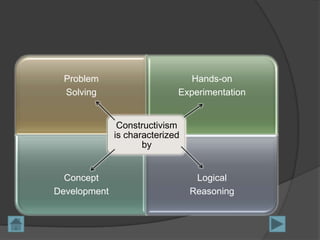
Problem                       Hands-on
  Solving                    Experimentation


               Constructivism
              is characterized
                     by


  Concept                         Logical
Development                      Reasoning
Authentic                      Engaged/Active
     Learning                          Learning


                  Constructivism
                 is characterized
                        by


 Whole Language                       Socially
Approach to Literacy                 Constructed
Leaders of Constructivism


                                http://educationupdate.com/
http://webspace.ship.edu/cgb    archives/2005/Nov/html/col-
oer/piaget.html                 jeromebutler.html


Jean Piaget                    Jerome Bruner
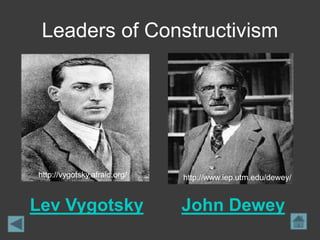
Leaders of Constructivism


http://vygotsky.afraid.org/   http://www.iep.utm.edu/dewey/


Lev Vygotsky                  John Dewey
Progressive
            Education


            John
Educator                  Philosopher
           Dewey


           Psychologist
Social
         Critic


World    John        Philanthropist
Peace
        Dewey


         Political
         Activist
Teachers must…
   Scaffold
   Construct knowledge through experiments
   Not give answers, but allow students to
    think for themselves
   Help students rethink their ideas by asking
    questions they wouldn’t think of on their
    own
   Immerse students in a language rich
    environment
Students must…
 Experiment- hands-on
 Encounter:
 Problem Based Learning
 Anchored Instruction
 Cognitive apprenticeship
     Scaffolding
Constructivism is important in
         my teaching
 Constructivism,  Cognitive, and
  Behavioral Learning Theories are
  all very important
 Constructivism will be how my
  students will acquire and retain
  knowledge
Constructivism is important in
         my teaching
 As a teacher, I must understand how
  children gain meaningful and productive
  knowledge that can be applied to new
  situations
 I cannot transmit knowledge to my
  students directly
 Information must be mentally acted
  on, manipulated and transformed in
  order to have meaning for the learner

Jeanna strickland constructivism

  • 1.
  • 2.
    Menu  Points of Constructivism  Theorists  John Dewey  Classroom Implications  How does Constructivism affect teaching?
  • 3.
    Problem Hands-on Solving Experimentation Constructivism is characterized by Concept Logical Development Reasoning
  • 4.
    Authentic Engaged/Active Learning Learning Constructivism is characterized by Whole Language Socially Approach to Literacy Constructed
  • 5.
    Leaders of Constructivism http://educationupdate.com/ http://webspace.ship.edu/cgb archives/2005/Nov/html/col- oer/piaget.html jeromebutler.html Jean Piaget Jerome Bruner
  • 6.
    Leaders of Constructivism http://vygotsky.afraid.org/ http://www.iep.utm.edu/dewey/ Lev Vygotsky John Dewey
  • 7.
    Progressive Education John Educator Philosopher Dewey Psychologist
  • 8.
    Social Critic World John Philanthropist Peace Dewey Political Activist
  • 9.
    Teachers must…  Scaffold  Construct knowledge through experiments  Not give answers, but allow students to think for themselves  Help students rethink their ideas by asking questions they wouldn’t think of on their own  Immerse students in a language rich environment
  • 10.
    Students must…  Experiment-hands-on  Encounter:  Problem Based Learning  Anchored Instruction  Cognitive apprenticeship  Scaffolding
  • 11.
    Constructivism is importantin my teaching  Constructivism, Cognitive, and Behavioral Learning Theories are all very important  Constructivism will be how my students will acquire and retain knowledge
  • 12.
    Constructivism is importantin my teaching  As a teacher, I must understand how children gain meaningful and productive knowledge that can be applied to new situations  I cannot transmit knowledge to my students directly  Information must be mentally acted on, manipulated and transformed in order to have meaning for the learner