Walls

Enclosure and structure
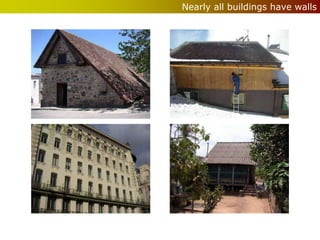
Nearly all buildings have walls
What to walls do?


• Provide enclosure
  – Separation of interior from exterior
  – Control of access
  – Control of daylight and ventilation
  – Temperature control
• Structure
  – Walls may support floors and roofs as
    well as themselves
  – Walls can brace other walls
Types of walls


• Almost endless variations: timber,
  glass, fabric, stone, mud…
• In domestic English construction two
  types dominate
  – Masonry
     • Brick, stone or concrete blocks, bedded and
       cemented with a mortar in a cellular structure
  – Timber framed
     • Softwood framework braced by sheet coverings
       such as plywood or wafer board and protected
       form the weather by an external barrier
Masonry walls


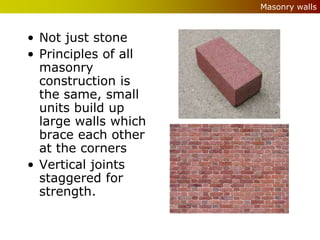
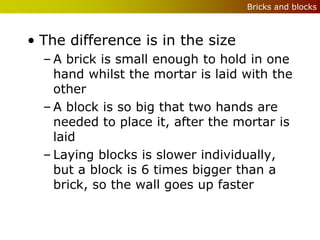
• Not just stone
• Principles of all
  masonry
  construction is
  the same, small
  units build up
  large walls which
  brace each other
  at the corners
• Vertical joints
  staggered for
  strength.
Bricks and blocks


• The difference is in the size
  – A brick is small enough to hold in one
    hand whilst the mortar is laid with the
    other
  – A block is so big that two hands are
    needed to place it, after the mortar is
    laid
  – Laying blocks is slower individually,
    but a block is 6 times bigger than a
    brick, so the wall goes up faster
Bricks and blocks


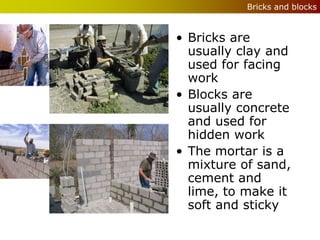
• Bricks are
  usually clay and
  used for facing
  work
• Blocks are
  usually concrete
  and used for
  hidden work
• The mortar is a
  mixture of sand,
  cement and
  lime, to make it
  soft and sticky
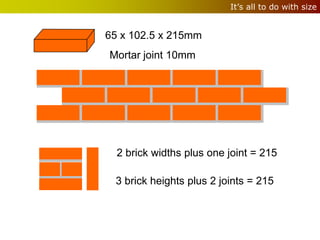
It’s all to do with size


65 x 102.5 x 215mm
Mortar joint 10mm


  2 brick widths plus one joint = 215

 3 brick heights plus 2 joints = 215
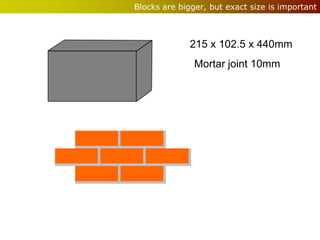
Blocks are bigger, but exact size is important


              215 x 102.5 x 440mm
               Mortar joint 10mm
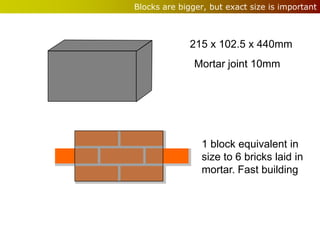
Blocks are bigger, but exact size is important


              215 x 102.5 x 440mm
               Mortar joint 10mm


                 1 block equivalent in
                 size to 6 bricks laid in
                 mortar. Fast building
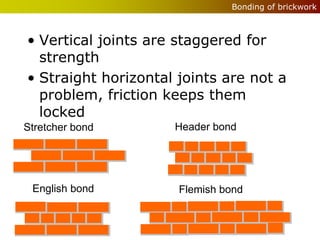
Bonding of brickwork


• Vertical joints are staggered for
  strength
• Straight horizontal joints are not a
  problem, friction keeps them
  locked
Stretcher bond       Header bond


 English bond         Flemish bond
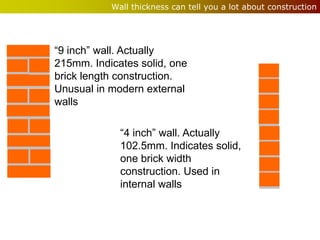
Wall thickness can tell you a lot about construction


“9 inch” wall. Actually
215mm. Indicates solid, one
brick length construction.
Unusual in modern external
walls

             “4 inch” wall. Actually
             102.5mm. Indicates solid,
             one brick width
             construction. Used in
             internal walls
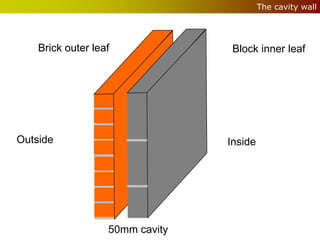
The cavity wall


    Brick outer leaf              Block inner leaf


Outside                          Inside


                   50mm cavity
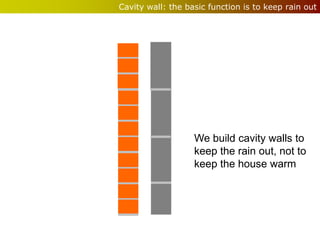
Cavity wall: the basic function is to keep rain out


                   We build cavity walls to
                   keep the rain out, not to
                   keep the house warm
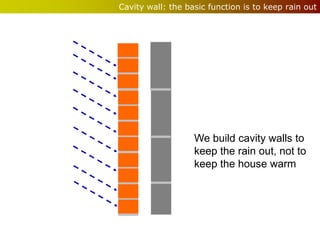
Cavity wall: the basic function is to keep rain out


                   We build cavity walls to
                   keep the rain out, not to
                   keep the house warm
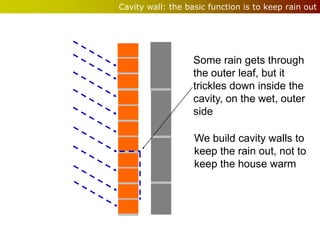
Cavity wall: the basic function is to keep rain out


                   Some rain gets through
                   the outer leaf, but it
                   trickles down inside the
                   cavity, on the wet, outer
                   side

                   We build cavity walls to
                   keep the rain out, not to
                   keep the house warm
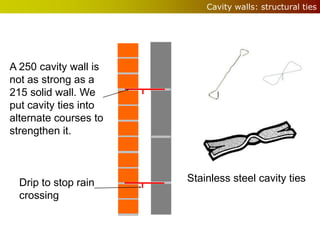
Cavity walls: structural ties


A 250 cavity wall is
not as strong as a
215 solid wall. We
put cavity ties into
alternate courses to
strengthen it.


  Drip to stop rain    Stainless steel cavity ties
  crossing
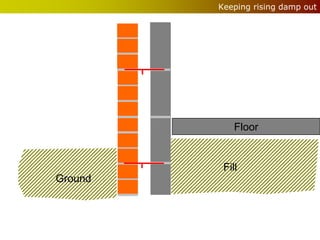
Keeping rising damp out


             Floor


          Fill
Ground
Keeping rising damp out


Damp proof course
DPC
Sheet plastic, lead,
modified
bituminous felt


                           Floor
    Min 150mm


                        Fill
         Ground
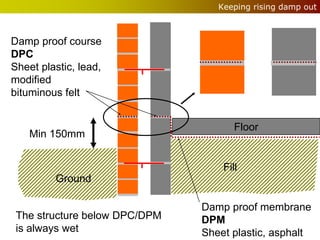
Keeping rising damp out


Damp proof course
DPC
Sheet plastic, lead,
modified
bituminous felt


                                      Floor
    Min 150mm


                                   Fill
         Ground

                               Damp proof membrane
 The structure below DPC/DPM   DPM
 is always wet                 Sheet plastic, asphalt
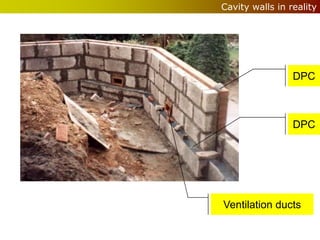
Cavity walls in reality


                 DPC


                 DPC


Ventilation ducts
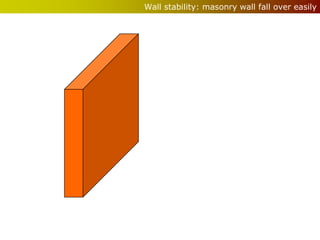
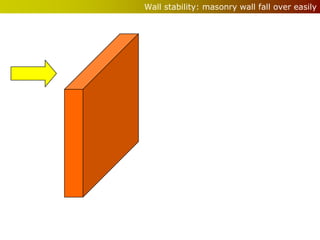
Wall stability: masonry wall fall over easily


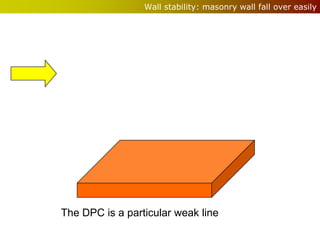
The DPC is a particular weak line
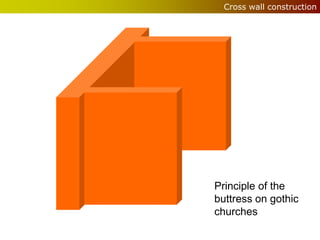
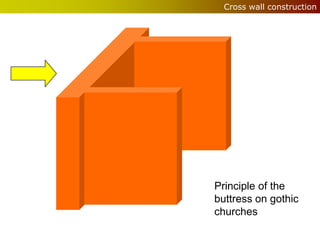
Cross wall construction


Principle of the
buttress on gothic
churches
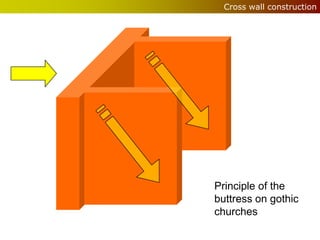
Cross wall construction


Principle of the
buttress on gothic
churches
Cross wall construction


Principle of the
buttress on gothic
churches
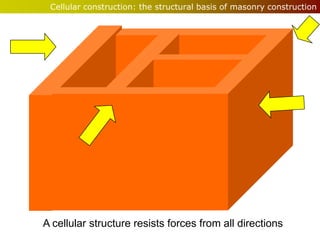
Cellular construction: the structural basis of masonry construction


A cellular structure resists forces from all directions
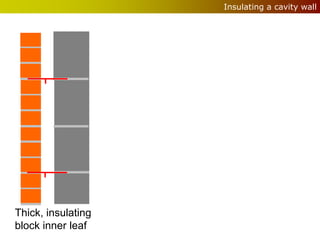
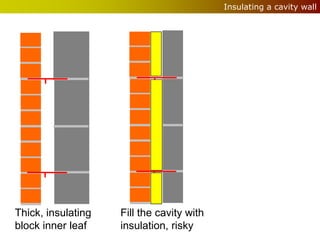
Insulating a cavity wall


Thick, insulating
block inner leaf
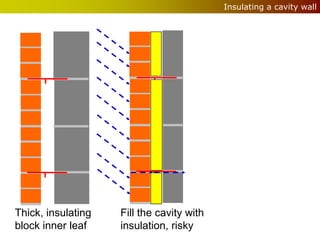
Insulating a cavity wall


Thick, insulating   Fill the cavity with
block inner leaf    insulation, risky
Insulating a cavity wall


Thick, insulating   Fill the cavity with
block inner leaf    insulation, risky
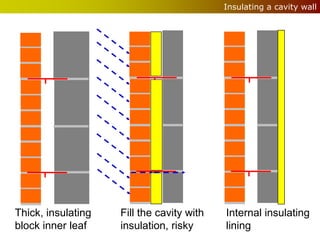
Insulating a cavity wall


Thick, insulating   Fill the cavity with   Internal insulating
block inner leaf    insulation, risky      lining
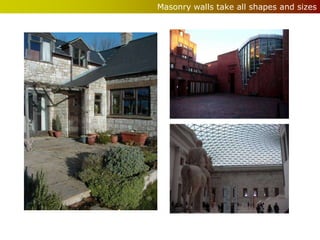
Masonry walls take all shapes and sizes

Cavity walls

  • 1.
  • 2.
  • 3.
    What to wallsdo? • Provide enclosure – Separation of interior from exterior – Control of access – Control of daylight and ventilation – Temperature control • Structure – Walls may support floors and roofs as well as themselves – Walls can brace other walls
  • 4.
    Types of walls •Almost endless variations: timber, glass, fabric, stone, mud… • In domestic English construction two types dominate – Masonry • Brick, stone or concrete blocks, bedded and cemented with a mortar in a cellular structure – Timber framed • Softwood framework braced by sheet coverings such as plywood or wafer board and protected form the weather by an external barrier
  • 5.
    Masonry walls • Notjust stone • Principles of all masonry construction is the same, small units build up large walls which brace each other at the corners • Vertical joints staggered for strength.
  • 6.
    Bricks and blocks •The difference is in the size – A brick is small enough to hold in one hand whilst the mortar is laid with the other – A block is so big that two hands are needed to place it, after the mortar is laid – Laying blocks is slower individually, but a block is 6 times bigger than a brick, so the wall goes up faster
  • 7.
    Bricks and blocks •Bricks are usually clay and used for facing work • Blocks are usually concrete and used for hidden work • The mortar is a mixture of sand, cement and lime, to make it soft and sticky
  • 8.
    It’s all todo with size 65 x 102.5 x 215mm Mortar joint 10mm 2 brick widths plus one joint = 215 3 brick heights plus 2 joints = 215
  • 9.
    Blocks are bigger,but exact size is important 215 x 102.5 x 440mm Mortar joint 10mm
  • 10.
    Blocks are bigger,but exact size is important 215 x 102.5 x 440mm Mortar joint 10mm 1 block equivalent in size to 6 bricks laid in mortar. Fast building
  • 11.
    Bonding of brickwork •Vertical joints are staggered for strength • Straight horizontal joints are not a problem, friction keeps them locked Stretcher bond Header bond English bond Flemish bond
  • 12.
    Wall thickness cantell you a lot about construction “9 inch” wall. Actually 215mm. Indicates solid, one brick length construction. Unusual in modern external walls “4 inch” wall. Actually 102.5mm. Indicates solid, one brick width construction. Used in internal walls
  • 13.
    The cavity wall Brick outer leaf Block inner leaf Outside Inside 50mm cavity
  • 14.
    Cavity wall: thebasic function is to keep rain out We build cavity walls to keep the rain out, not to keep the house warm
  • 15.
    Cavity wall: thebasic function is to keep rain out We build cavity walls to keep the rain out, not to keep the house warm
  • 16.
    Cavity wall: thebasic function is to keep rain out Some rain gets through the outer leaf, but it trickles down inside the cavity, on the wet, outer side We build cavity walls to keep the rain out, not to keep the house warm
  • 17.
    Cavity walls: structuralties A 250 cavity wall is not as strong as a 215 solid wall. We put cavity ties into alternate courses to strengthen it. Drip to stop rain Stainless steel cavity ties crossing
  • 18.
    Keeping rising dampout Floor Fill Ground
  • 19.
    Keeping rising dampout Damp proof course DPC Sheet plastic, lead, modified bituminous felt Floor Min 150mm Fill Ground
  • 20.
    Keeping rising dampout Damp proof course DPC Sheet plastic, lead, modified bituminous felt Floor Min 150mm Fill Ground Damp proof membrane The structure below DPC/DPM DPM is always wet Sheet plastic, asphalt
  • 21.
    Cavity walls inreality DPC DPC Ventilation ducts
  • 22.
    Wall stability: masonrywall fall over easily
  • 23.
    Wall stability: masonrywall fall over easily
  • 24.
    Wall stability: masonrywall fall over easily The DPC is a particular weak line
  • 25.
    Cross wall construction Principleof the buttress on gothic churches
  • 26.
    Cross wall construction Principleof the buttress on gothic churches
  • 27.
    Cross wall construction Principleof the buttress on gothic churches
  • 28.
    Cellular construction: thestructural basis of masonry construction A cellular structure resists forces from all directions
  • 29.
    Insulating a cavitywall Thick, insulating block inner leaf
  • 30.
    Insulating a cavitywall Thick, insulating Fill the cavity with block inner leaf insulation, risky
  • 31.
    Insulating a cavitywall Thick, insulating Fill the cavity with block inner leaf insulation, risky
  • 32.
    Insulating a cavitywall Thick, insulating Fill the cavity with Internal insulating block inner leaf insulation, risky lining
  • 33.
    Masonry walls takeall shapes and sizes