ORBITAL IMAGING VI
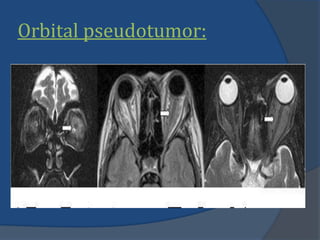
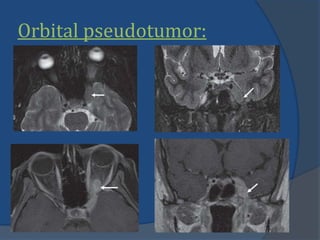
Orbital pseudotumor:
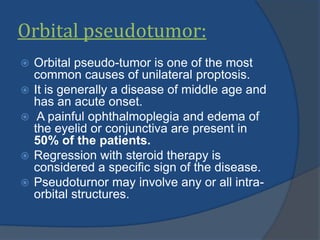
 Orbital pseudo-tumor is one of the most
common causes of unilateral proptosis.
 It is generally a disease of middle age and
has an acute onset.
 A painful ophthalmoplegia and edema of
the eyelid or conjunctiva are present in
50% of the patients.
 Regression with steroid therapy is
considered a specific sign of the disease.
 Pseudoturnor may involve any or all intra-
orbital structures.
Orbital pseudotumor:
 Non-granulomatous orbital inflammatory
process.
 The second most common cause of
exophthalmos.
 Infiltrative or mass like soft tissue seen
invading any orbital structure.
 irregular margins and extends across multiple
compartments.
 May mimic neoplasm or aggressive infection.
 May extend intra-cranially.
Orbital pseudotumor:
 Categorized by areas of involvement:
A- Myositic pattern:
* Most common pattern.
* Involving any muscle and mutiple muscle on 50%.
* Involving tendinous insertion with tubular
configuration.
B- Lacrimal pattern:
* 2nd most common type.
* Diffuse oblong enlargement, particularly antero-
posterior dimension.
Orbital pseudotumor:
C- Anterior (eye and retrobulbar fat) pattern:
*3rd most common type.
* Variable involvement of retro-bulbar fat and nerve.
*Uveal-scleral form shows thickened sclera and shaggy
enhancement.
* Peri-neuritic form shows irregular nerve sheath
thickening and enhancement.
D- Diffuse (intra-conal- multi compartement) pattern:
*Overlap with anterior and other pattern.
*Frequently tume-factive and mass like appearance.
Orbital pseudotumor:
E- Apical (apex, intra cranial) pattern:
* Less common, involves orbital apex with posterior
extension through fissure.
* Tolosa-Hunt syndrome considered intra-cranial
variant with extension through cavernous sinus.
Orbital pseudotumor:
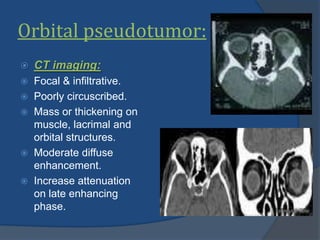
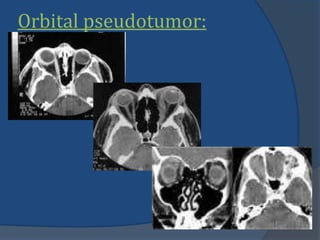
 CT imaging:
 Focal & infiltrative.
 Poorly circuscribed.
 Mass or thickening on
muscle, lacrimal and
orbital structures.
 Moderate diffuse
enhancement.
 Increase attenuation
on late enhancing
phase.
Orbital pseudotumor:
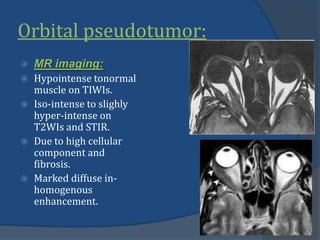
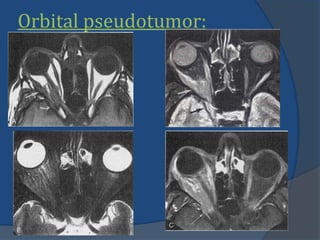
 MR imaging:
 Hypointense tonormal
muscle on TIWIs.
 Iso-intense to slighly
hyper-intense on
T2WIs and STIR.
 Due to high cellular
component and
fibrosis.
 Marked diffuse in-
homogenous
enhancement.
Orbital pseudotumor:
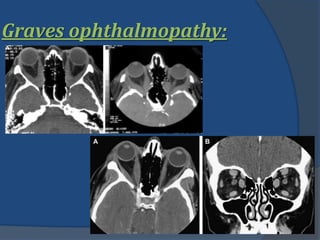
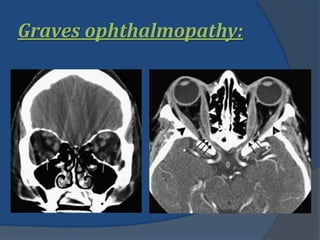
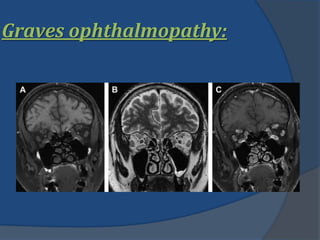
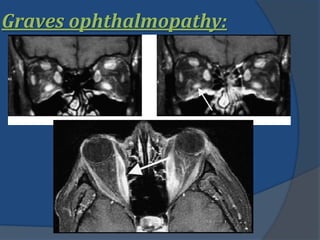
Graves ophthalmopathy:
 Is the most common cause of exophthalmos in
adults.
 Graves ophthalmopathy usually occurs 5 years
after the onset of thyroid disease.
 Autoimmune inflammation condition associated
with thyroid dys-function.
 Classically spindle-shaped enlargement of the
extra-ocular muscles is observed, with sparing of
the tendinous insertion.
 The inferior, medial, superior, and lateral rectus
muscles (listed in order of decreasing frequency of
involvement) may be involved.
Graves ophthalmopathy:
 These findings are usually bilateral (90%)and
symmetric (70%).
 Isolted muscle involvement on 5%, particularly
superior rectus.
 Additional imaging findings include increased
orbital fat, lacrimal gland enlargement, eyelid
edema, stretching of the optic nerve, and tenting of
the posterior globe.
 Treatment is primarily conservative, with radiation
therapy reserved for reduction of tension on the
optic nerve.
Graves ophthalmopathy:
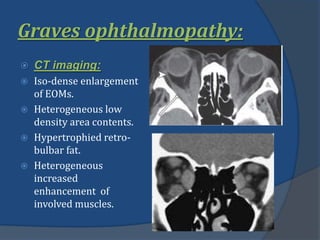
 CT imaging:
 Iso-dense enlargement
of EOMs.
 Heterogeneous low
density area contents.
 Hypertrophied retro-
bulbar fat.
 Heterogeneous
increased
enhancement of
involved muscles.
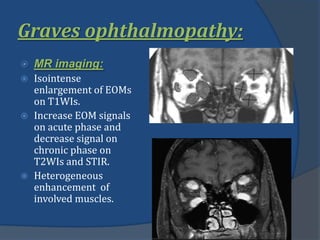
Graves ophthalmopathy:
 MR imaging:
 Isointense
enlargement of EOMs
on T1WIs.
 Increase EOM signals
on acute phase and
decrease signal on
chronic phase on
T2WIs and STIR.
 Heterogeneous
enhancement of
involved muscles.
Graves ophthalmopathy:
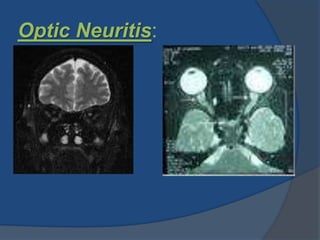
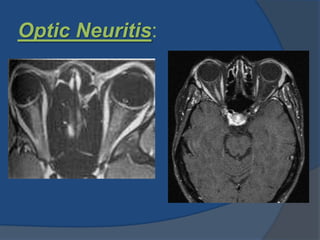
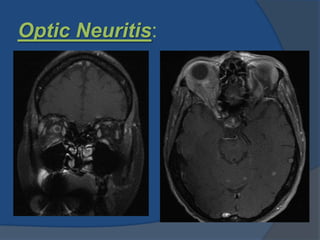
Optic Neuritis:
 Two type of acute ON :
A- MS associated ON.
B- Idiopathic isolated mono-symptomativ ON.
*Diffuse only enlargement of optic nerve with central or
peripheral enhancing pattern.
*Unilateral on 70%.
*segments of nerve involvement:
a- Anterior intra-orbital.45%.
b- Mid intra-orbital 60%.
c- Intra-canalicular 35%.
d- Pre-chiasmatic and chiasma 7%.
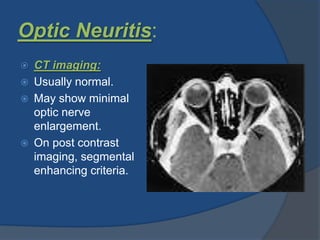
Optic Neuritis:
 CT imaging:
 Usually normal.
 May show minimal
optic nerve
enlargement.
 On post contrast
imaging, segmental
enhancing criteria.
Optic Neuritis:
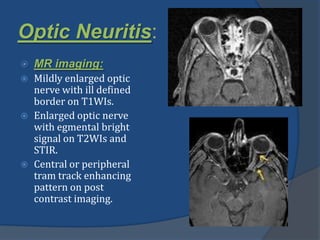
 MR imaging:
 Mildly enlarged optic
nerve with ill defined
border on T1WIs.
 Enlarged optic nerve
with egmental bright
signal on T2WIs and
STIR.
 Central or peripheral
tram track enhancing
pattern on post
contrast imaging.
Optic Neuritis:
Optic Neuritis:
Optic Neuritis:
Lympho-proliferative lesions of
the orbit:
 LPLO spectrum including benign and malignant
tumors:
A- Lymphoidal hyperplasia 10-40%:
* Reactive or hyperplasia.
B- Lymphoma (NHL) 60-90%.
* Homogenus enhancing mass lesion any where on the
orbit.
* Lobulated well defined margins.
*May be have infiltrative presentation pattern or
associated inflammatory changes.
Lympho-proliferative lesions
of the orbit:
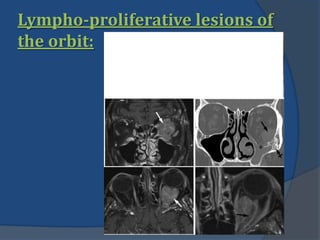
 Locations:
A-Anterior extra-conal orbital space, centered on
superior temporal quadrant.
B- Lacrimal gland.
C- Diffuse infiltrative pattern with intra-conal
component and peri-neural involvement.
D- Intra-cranial extension with predilection for
pituitary stalk.
* Bilateral presentation in 25%.
* Multifocal within orbital region in less than 5%.
Lympho-proliferative lesions
of the orbit:
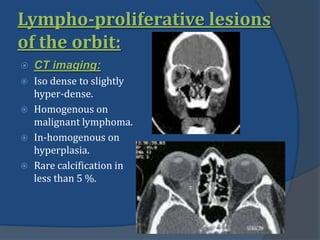
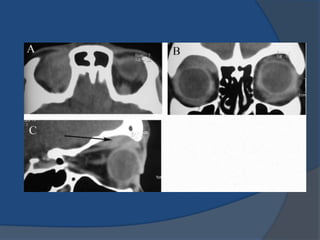
 CT imaging:
 Iso dense to slightly
hyper-dense.
 Homogenous on
malignant lymphoma.
 In-homogenous on
hyperplasia.
 Rare calcification in
less than 5 %.
Lympho-proliferative lesions
of the orbit:
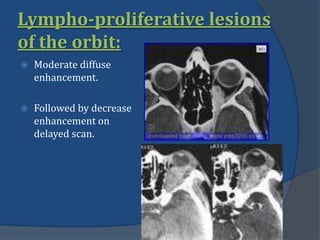
 Moderate diffuse
enhancement.
 Followed by decrease
enhancement on
delayed scan.
Lympho-proliferative lesions of
the orbit:
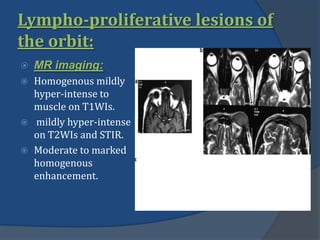
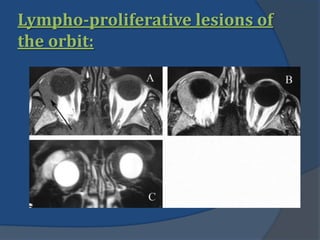
 MR imaging:
 Homogenous mildly
hyper-intense to
muscle on T1WIs.
 mildly hyper-intense
on T2WIs and STIR.
 Moderate to marked
homogenous
enhancement.
Lympho-proliferative lesions of
the orbit:
Lympho-proliferative lesions of
the orbit:
THANKS FOR YOU

Orbital imaging vi

  • 1.
  • 3.
    Orbital pseudotumor:  Orbitalpseudo-tumor is one of the most common causes of unilateral proptosis.  It is generally a disease of middle age and has an acute onset.  A painful ophthalmoplegia and edema of the eyelid or conjunctiva are present in 50% of the patients.  Regression with steroid therapy is considered a specific sign of the disease.  Pseudoturnor may involve any or all intra- orbital structures.
  • 4.
    Orbital pseudotumor:  Non-granulomatousorbital inflammatory process.  The second most common cause of exophthalmos.  Infiltrative or mass like soft tissue seen invading any orbital structure.  irregular margins and extends across multiple compartments.  May mimic neoplasm or aggressive infection.  May extend intra-cranially.
  • 5.
    Orbital pseudotumor:  Categorizedby areas of involvement: A- Myositic pattern: * Most common pattern. * Involving any muscle and mutiple muscle on 50%. * Involving tendinous insertion with tubular configuration. B- Lacrimal pattern: * 2nd most common type. * Diffuse oblong enlargement, particularly antero- posterior dimension.
  • 6.
    Orbital pseudotumor: C- Anterior(eye and retrobulbar fat) pattern: *3rd most common type. * Variable involvement of retro-bulbar fat and nerve. *Uveal-scleral form shows thickened sclera and shaggy enhancement. * Peri-neuritic form shows irregular nerve sheath thickening and enhancement. D- Diffuse (intra-conal- multi compartement) pattern: *Overlap with anterior and other pattern. *Frequently tume-factive and mass like appearance.
  • 7.
    Orbital pseudotumor: E- Apical(apex, intra cranial) pattern: * Less common, involves orbital apex with posterior extension through fissure. * Tolosa-Hunt syndrome considered intra-cranial variant with extension through cavernous sinus.
  • 8.
    Orbital pseudotumor:  CTimaging:  Focal & infiltrative.  Poorly circuscribed.  Mass or thickening on muscle, lacrimal and orbital structures.  Moderate diffuse enhancement.  Increase attenuation on late enhancing phase.
  • 9.
  • 10.
    Orbital pseudotumor:  MRimaging:  Hypointense tonormal muscle on TIWIs.  Iso-intense to slighly hyper-intense on T2WIs and STIR.  Due to high cellular component and fibrosis.  Marked diffuse in- homogenous enhancement.
  • 11.
  • 12.
  • 13.
  • 14.
    Graves ophthalmopathy:  Isthe most common cause of exophthalmos in adults.  Graves ophthalmopathy usually occurs 5 years after the onset of thyroid disease.  Autoimmune inflammation condition associated with thyroid dys-function.  Classically spindle-shaped enlargement of the extra-ocular muscles is observed, with sparing of the tendinous insertion.  The inferior, medial, superior, and lateral rectus muscles (listed in order of decreasing frequency of involvement) may be involved.
  • 15.
    Graves ophthalmopathy:  Thesefindings are usually bilateral (90%)and symmetric (70%).  Isolted muscle involvement on 5%, particularly superior rectus.  Additional imaging findings include increased orbital fat, lacrimal gland enlargement, eyelid edema, stretching of the optic nerve, and tenting of the posterior globe.  Treatment is primarily conservative, with radiation therapy reserved for reduction of tension on the optic nerve.
  • 16.
    Graves ophthalmopathy:  CTimaging:  Iso-dense enlargement of EOMs.  Heterogeneous low density area contents.  Hypertrophied retro- bulbar fat.  Heterogeneous increased enhancement of involved muscles.
  • 17.
  • 18.
  • 19.
    Graves ophthalmopathy:  MRimaging:  Isointense enlargement of EOMs on T1WIs.  Increase EOM signals on acute phase and decrease signal on chronic phase on T2WIs and STIR.  Heterogeneous enhancement of involved muscles.
  • 20.
  • 21.
  • 22.
    Optic Neuritis:  Twotype of acute ON : A- MS associated ON. B- Idiopathic isolated mono-symptomativ ON. *Diffuse only enlargement of optic nerve with central or peripheral enhancing pattern. *Unilateral on 70%. *segments of nerve involvement: a- Anterior intra-orbital.45%. b- Mid intra-orbital 60%. c- Intra-canalicular 35%. d- Pre-chiasmatic and chiasma 7%.
  • 23.
    Optic Neuritis:  CTimaging:  Usually normal.  May show minimal optic nerve enlargement.  On post contrast imaging, segmental enhancing criteria.
  • 24.
    Optic Neuritis:  MRimaging:  Mildly enlarged optic nerve with ill defined border on T1WIs.  Enlarged optic nerve with egmental bright signal on T2WIs and STIR.  Central or peripheral tram track enhancing pattern on post contrast imaging.
  • 25.
  • 26.
  • 27.
  • 28.
    Lympho-proliferative lesions of theorbit:  LPLO spectrum including benign and malignant tumors: A- Lymphoidal hyperplasia 10-40%: * Reactive or hyperplasia. B- Lymphoma (NHL) 60-90%. * Homogenus enhancing mass lesion any where on the orbit. * Lobulated well defined margins. *May be have infiltrative presentation pattern or associated inflammatory changes.
  • 29.
    Lympho-proliferative lesions of theorbit:  Locations: A-Anterior extra-conal orbital space, centered on superior temporal quadrant. B- Lacrimal gland. C- Diffuse infiltrative pattern with intra-conal component and peri-neural involvement. D- Intra-cranial extension with predilection for pituitary stalk. * Bilateral presentation in 25%. * Multifocal within orbital region in less than 5%.
  • 30.
    Lympho-proliferative lesions of theorbit:  CT imaging:  Iso dense to slightly hyper-dense.  Homogenous on malignant lymphoma.  In-homogenous on hyperplasia.  Rare calcification in less than 5 %.
  • 31.
    Lympho-proliferative lesions of theorbit:  Moderate diffuse enhancement.  Followed by decrease enhancement on delayed scan.
  • 33.
    Lympho-proliferative lesions of theorbit:  MR imaging:  Homogenous mildly hyper-intense to muscle on T1WIs.  mildly hyper-intense on T2WIs and STIR.  Moderate to marked homogenous enhancement.
  • 34.
  • 35.
  • 36.