2
Pipe Lines
CATHODIC
PROTECTION
S
CATHODIC PROTECTIONS
Systems Requiring Cathodic Protection (CP)Systems Requiring Cathodic Protection (CP)
• Natural gas distribution systemNatural gas distribution system
• Fuel distribution systemFuel distribution system
• Potable water distribution systemPotable water distribution system
• Compressed air distribution systemCompressed air distribution system
• Underground fuel storage tanks and ground level tank bottomsUnderground fuel storage tanks and ground level tank bottoms
• Offshore platforms, floating and sub-sea structuresOffshore platforms, floating and sub-sea structures
• Jetties and harbor structureJetties and harbor structure
Cathodic Protections
Types of Cathodic Protection SystemTypes of Cathodic Protection System
• Galvanic system (Sacrificial anode system)Galvanic system (Sacrificial anode system)
- Galvanic system (Sacrificial anode system)- Galvanic system (Sacrificial anode system)
- Sacrificial anodes- Sacrificial anodes
- A conductor connecting the anode to the structure or direct welding to the structure- A conductor connecting the anode to the structure or direct welding to the structure
- Secure and minimum resistance connections between conductor and structure- Secure and minimum resistance connections between conductor and structure
- Secure and minimum resistance connections between conductor and anode- Secure and minimum resistance connections between conductor and anode
• Impressed-current systemImpressed-current system
- Secure and minimum resistance connections between power source and structure.- Secure and minimum resistance connections between power source and structure.
- Secure and minimum resistance connections between power source and anode.- Secure and minimum resistance connections between power source and anode.
Cathodic Protections
Corrosion ProcessCorrosion Process
•The corrosion of metals is an electrochemical processThe corrosion of metals is an electrochemical process
•CorrosionCorrosion is the degradation of a metal by its chemical combination with a nonmetal such asis the degradation of a metal by its chemical combination with a nonmetal such as
oxygen, sulfur and the like.oxygen, sulfur and the like.
Cathodic Protections
Corrosion ProcessCorrosion Process
Most metals corrode on contact withMost metals corrode on contact with
•Water (and moisture in the air),Water (and moisture in the air),
•Acids,Acids,
• Bases,Bases,
• Salts,Salts,
• Oils,Oils,
• Aggressive metal polishes, and Other solid and liquid chemicalsAggressive metal polishes, and Other solid and liquid chemicals
Cathodic Protections
Corrosion ProcessCorrosion Process
Metals also corrode when exposed to gaseous materials likeMetals also corrode when exposed to gaseous materials like
• Acid vapors,Acid vapors,
• Formaldehyde gas,Formaldehyde gas,
• Ammonia gas,Ammonia gas,
• Sulfur containing gasesSulfur containing gases
Cathodic Protections
Corrosion CellCorrosion Cell
Four parts constitute what is called the ‘Four parts constitute what is called the ‘corrosion cell’corrosion cell’..
• Anode,Anode,
• Cathode,Cathode,
• Electrolyte,Electrolyte,
• Metallic pathMetallic path
Cathodic Protections
Corrosion CellCorrosion Cell
AnodeAnode
• Location where corrosion occursLocation where corrosion occurs
• Positive electrode in an electrolytic cellPositive electrode in an electrolytic cell
• Point in a corrosion cell where electricity is passed by chemical means from the surface ofPoint in a corrosion cell where electricity is passed by chemical means from the surface of
the metal to the electrolytethe metal to the electrolyte
• Chemical reaction is an oxidation reactionChemical reaction is an oxidation reaction
• Metal loosing an electron and combining with another element, usually oxygenMetal loosing an electron and combining with another element, usually oxygen
% Design
Pressure
Cathodic Protections
Corrosion CellCorrosion Cell
CathodeCathode
• Location where protection occursLocation where protection occurs
• Negative electrode in an electrolytic cellNegative electrode in an electrolytic cell
• Point in a corrosion cell where electricity is passed by chemical means from thePoint in a corrosion cell where electricity is passed by chemical means from the
electrolyte to the surface of the metalelectrolyte to the surface of the metal
• Chemical reaction is a reduction reactionChemical reaction is a reduction reaction
• The metal passing electrons to the electrolyteThe metal passing electrons to the electrolyte
Cathodic Protections
Corrosion CellCorrosion Cell
ElectrolyteElectrolyte
• Third part of the corrosion cell is the electrolyteThird part of the corrosion cell is the electrolyte
• Location where ions flowLocation where ions flow
• Electrolyte is any material in contact with both the anode and the cathode which willElectrolyte is any material in contact with both the anode and the cathode which will
allow ions to migrateallow ions to migrate
• The part of a corrosion cell which allows oxidation and reduction reactions to occurThe part of a corrosion cell which allows oxidation and reduction reactions to occur
• Can be any soil or liquid adjacent to and in contact with the anode and cathodeCan be any soil or liquid adjacent to and in contact with the anode and cathode
Cathodic Protections
Corrosion CellCorrosion Cell
Metallic PathMetallic Path
•Completes the circuit and allows the electrons to flowCompletes the circuit and allows the electrons to flow
•Can be any conductor which allows electrons to flow from the anode to the cathodeCan be any conductor which allows electrons to flow from the anode to the cathode
•Electron flow must be present for electrochemical corrosion to occurElectron flow must be present for electrochemical corrosion to occur
• In the case of a tank or pipeline, this can be the tank or pipe itself, or it can be aIn the case of a tank or pipeline, this can be the tank or pipe itself, or it can be a
metallic bond to different metallic structuremetallic bond to different metallic structure
Cathodic Protections
Corrosion CellCorrosion Cell
• The electrode which is more electrically active, or more negative in voltage, undergoes theThe electrode which is more electrically active, or more negative in voltage, undergoes the
corrosion, so by definition is thecorrosion, so by definition is the anodeanode
• The electrode which is more noble (less negative in potential), passes electrons to theThe electrode which is more noble (less negative in potential), passes electrons to the
electrolyte (reduction reactions) and by definition is theelectrolyte (reduction reactions) and by definition is the cathodecathode and does not undergoand does not undergo
corrosion (oxidation reactions).corrosion (oxidation reactions).
Potential and its MeasurementPotential and its Measurement
Cathodic Protections
CorrosionCorrosion
FACTORS AFFECTING THE RATE OF CORROSIONFACTORS AFFECTING THE RATE OF CORROSION
Cathodic Protections
1.1. Electrical effectsElectrical effects
2.2. Chemical effectsChemical effects
3.3. Relative size of the anodic and cathodic areaRelative size of the anodic and cathodic area
• Electrical effectsElectrical effects
• Potential DifferencePotential Difference
• Resistivity of the ElectrolyteResistivity of the Electrolyte
• Contact ResistanceContact Resistance
• Coating of the StructureCoating of the Structure
• Polarization of the StructurePolarization of the Structure
• Amount of Current FlowAmount of Current Flow
Cathodic Protections
1.1. Chemical effectsChemical effects
• TemperatureTemperature
• Ion concentrationIon concentration
• Electron concentrationElectron concentration
• pH of the electrolytepH of the electrolyte
• Coating of the structureCoating of the structure
• Polarization of the structurePolarization of the structure
Effects of CorrosionEffects of Corrosion
Cathodic Protections
• Loss of commodityLoss of commodity
• Property damage including fireProperty damage including fire
• Expensive repairsExpensive repairs
• Contamination of water suppliesContamination of water supplies
• Loss of livestockLoss of livestock
• Deterioration of public relationsDeterioration of public relations
Cathodic Protections
Means Used to Prevent or Control CorrosionMeans Used to Prevent or Control Corrosion
• Coating, paintingCoating, painting
•Application of oil or tar, pitch, gypsum, white lead , red leadApplication of oil or tar, pitch, gypsum, white lead , red lead
• GalvanizingGalvanizing
• Sacrificial alloys of magnesium and aluminumSacrificial alloys of magnesium and aluminum
•Cathodic protectionCathodic protection
Cathodic Protection (CP)Cathodic Protection (CP)
Cathodic Protections
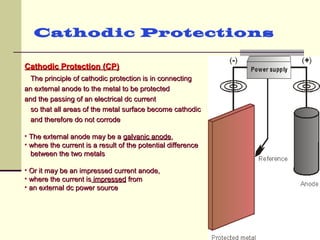
The principle of cathodic protection is in connectingThe principle of cathodic protection is in connecting
an external anode to the metal to be protectedan external anode to the metal to be protected
and the passing of an electrical dc currentand the passing of an electrical dc current
so that all areas of the metal surface become cathodicso that all areas of the metal surface become cathodic
and therefore do not corrodeand therefore do not corrode
• The external anode may be aThe external anode may be a galvanic anodegalvanic anode,,
• where the current is a result of the potential differencewhere the current is a result of the potential difference
between the two metalsbetween the two metals
• Or it may be an impressed current anode,Or it may be an impressed current anode,
• where the current iswhere the current is impressedimpressed fromfrom
• an external dc power sourcean external dc power source
Cathodic Protections
Cathodic Protection (CP)Cathodic Protection (CP)
• CP is applied simply by maintaining a dc circuit and its effectiveness may be monitoredCP is applied simply by maintaining a dc circuit and its effectiveness may be monitored
continuouslycontinuously
• Commonly applied to a coated structure to provide corrosion control to areas where theCommonly applied to a coated structure to provide corrosion control to areas where the
coating may be damagedcoating may be damaged
• May be applied to existing structures to prolong their lifeMay be applied to existing structures to prolong their life
• Its main use is to protect steel structures buried in soil or immersed in waterIts main use is to protect steel structures buried in soil or immersed in water
• Cannot be used to prevent atmospheric corrosion on metalsCannot be used to prevent atmospheric corrosion on metals
• Two basic ways:Two basic ways:
1.1. By Sacrificial Anode (or Galvanic Anode) Cathodic ProtectionBy Sacrificial Anode (or Galvanic Anode) Cathodic Protection
2.2. By Impressed Current Cathodic ProtectionBy Impressed Current Cathodic Protection
Cathodic Protections
Cathodic Protection (CP)Cathodic Protection (CP)
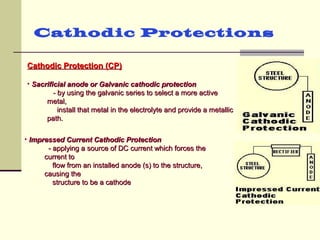
• Sacrificial anode or Galvanic cathodic protectionSacrificial anode or Galvanic cathodic protection
- by using the galvanic series to select a more active- by using the galvanic series to select a more active
metal,metal,
install that metal in the electrolyte and provide a metallicinstall that metal in the electrolyte and provide a metallic
path.path.
• Impressed Current Cathodic ProtectionImpressed Current Cathodic Protection
- applying a source of DC current which forces the- applying a source of DC current which forces the
current tocurrent to
flow from an installed anode (s) to the structure,flow from an installed anode (s) to the structure,
causing thecausing the
structure to be a cathodestructure to be a cathode
• The current required for cathodic protection depends upon the metal being protectedThe current required for cathodic protection depends upon the metal being protected
and the environmentand the environment
• The potentials required to determine adequate protection (criteria) are establishedThe potentials required to determine adequate protection (criteria) are established
• To achieve these protective potentials, current must flow from the anode to the structureTo achieve these protective potentials, current must flow from the anode to the structure
being protectedbeing protected
• The amount of current required to protect a given structure is proportional to the area ofThe amount of current required to protect a given structure is proportional to the area of
the structure which is exposed to the electrolytethe structure which is exposed to the electrolyte
• For coated structures, the amount of current required is much lower than for bareFor coated structures, the amount of current required is much lower than for bare
structures, as only those areas where the coating has been damaged or hasstructures, as only those areas where the coating has been damaged or has
deteriorated require or will receive currentdeteriorated require or will receive current
• Current requirements for coated structures are best determined by actual testing after theCurrent requirements for coated structures are best determined by actual testing after the
structure is installedstructure is installed
Cathodic Protections
Cathodic Protection (CP)Cathodic Protection (CP)
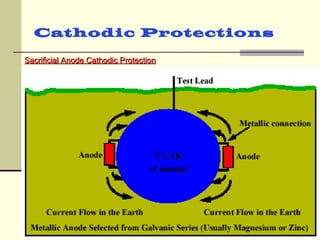
Sacrificial Anode Cathodic ProtectionSacrificial Anode Cathodic Protection
 A galvanic cathodic protection system consists ofA galvanic cathodic protection system consists of sacrificial anodes , wiring orsacrificial anodes , wiring or
conductor connecting the anode to the structure and inspection stationconductor connecting the anode to the structure and inspection station installed nearinstalled near
the surface of the groundthe surface of the ground
 The current required for cathodic protection is supplied by the corrosion of an activeThe current required for cathodic protection is supplied by the corrosion of an active
metal.metal.
 Galvanic systems have limited life spansThe current required for cathodic protectionGalvanic systems have limited life spansThe current required for cathodic protection
is supplied by the corrosion of an active metalis supplied by the corrosion of an active metal
 Anode efficiency , which accounts for the anode’s self corrosion rate and theAnode efficiency , which accounts for the anode’s self corrosion rate and the
corrosion rate for the amount of cathodic protection current.corrosion rate for the amount of cathodic protection current.
 The simplest systems consist of an anode fabricated from an active metal such asThe simplest systems consist of an anode fabricated from an active metal such as
zinc which is directly connected to the structure in an area where it will be exposedzinc which is directly connected to the structure in an area where it will be exposed
to the same environment as the structure being protectedto the same environment as the structure being protected
Cathodic Protections
Sacrificial Anode Cathodic ProtectionSacrificial Anode Cathodic Protection
Cathodic Protections
Application of Galvanic Cathodic ProtectionApplication of Galvanic Cathodic Protection
 Limited by the small potential difference (normally less than 1 volt DC) which canLimited by the small potential difference (normally less than 1 volt DC) which can
be obtainedbe obtained
 Economical use onEconomical use on small or well-coated structures in low resistivity electrolytessmall or well-coated structures in low resistivity electrolytes
 The electrolyte resistivity determines the amount of current which the limitedThe electrolyte resistivity determines the amount of current which the limited
voltage will supplyvoltage will supply
 The amount of metal exposed to the electrolyte determines the amount ofThe amount of metal exposed to the electrolyte determines the amount of
current requiredcurrent required
 Commonly used as galvanic anodesCommonly used as galvanic anodes
- Magnesium- Magnesium
- Zinc- Zinc
- Aluminum alloy- Aluminum alloy
Application of Galvanic Cathodic ProtectionApplication of Galvanic Cathodic Protection
Cathodic Protections
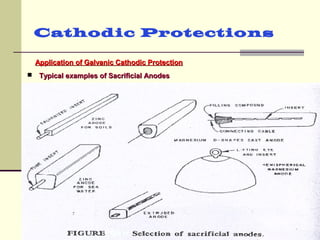
 Typical examples of Sacrificial AnodesTypical examples of Sacrificial Anodes

Cathodic protection

  • 2.
  • 3.
    CATHODIC PROTECTIONS Systems RequiringCathodic Protection (CP)Systems Requiring Cathodic Protection (CP) • Natural gas distribution systemNatural gas distribution system • Fuel distribution systemFuel distribution system • Potable water distribution systemPotable water distribution system • Compressed air distribution systemCompressed air distribution system • Underground fuel storage tanks and ground level tank bottomsUnderground fuel storage tanks and ground level tank bottoms • Offshore platforms, floating and sub-sea structuresOffshore platforms, floating and sub-sea structures • Jetties and harbor structureJetties and harbor structure
  • 4.
    Cathodic Protections Types ofCathodic Protection SystemTypes of Cathodic Protection System • Galvanic system (Sacrificial anode system)Galvanic system (Sacrificial anode system) - Galvanic system (Sacrificial anode system)- Galvanic system (Sacrificial anode system) - Sacrificial anodes- Sacrificial anodes - A conductor connecting the anode to the structure or direct welding to the structure- A conductor connecting the anode to the structure or direct welding to the structure - Secure and minimum resistance connections between conductor and structure- Secure and minimum resistance connections between conductor and structure - Secure and minimum resistance connections between conductor and anode- Secure and minimum resistance connections between conductor and anode • Impressed-current systemImpressed-current system - Secure and minimum resistance connections between power source and structure.- Secure and minimum resistance connections between power source and structure. - Secure and minimum resistance connections between power source and anode.- Secure and minimum resistance connections between power source and anode.
  • 5.
    Cathodic Protections Corrosion ProcessCorrosionProcess •The corrosion of metals is an electrochemical processThe corrosion of metals is an electrochemical process •CorrosionCorrosion is the degradation of a metal by its chemical combination with a nonmetal such asis the degradation of a metal by its chemical combination with a nonmetal such as oxygen, sulfur and the like.oxygen, sulfur and the like.
  • 6.
    Cathodic Protections Corrosion ProcessCorrosionProcess Most metals corrode on contact withMost metals corrode on contact with •Water (and moisture in the air),Water (and moisture in the air), •Acids,Acids, • Bases,Bases, • Salts,Salts, • Oils,Oils, • Aggressive metal polishes, and Other solid and liquid chemicalsAggressive metal polishes, and Other solid and liquid chemicals
  • 7.
    Cathodic Protections Corrosion ProcessCorrosionProcess Metals also corrode when exposed to gaseous materials likeMetals also corrode when exposed to gaseous materials like • Acid vapors,Acid vapors, • Formaldehyde gas,Formaldehyde gas, • Ammonia gas,Ammonia gas, • Sulfur containing gasesSulfur containing gases
  • 8.
    Cathodic Protections Corrosion CellCorrosionCell Four parts constitute what is called the ‘Four parts constitute what is called the ‘corrosion cell’corrosion cell’.. • Anode,Anode, • Cathode,Cathode, • Electrolyte,Electrolyte, • Metallic pathMetallic path
  • 9.
    Cathodic Protections Corrosion CellCorrosionCell AnodeAnode • Location where corrosion occursLocation where corrosion occurs • Positive electrode in an electrolytic cellPositive electrode in an electrolytic cell • Point in a corrosion cell where electricity is passed by chemical means from the surface ofPoint in a corrosion cell where electricity is passed by chemical means from the surface of the metal to the electrolytethe metal to the electrolyte • Chemical reaction is an oxidation reactionChemical reaction is an oxidation reaction • Metal loosing an electron and combining with another element, usually oxygenMetal loosing an electron and combining with another element, usually oxygen
  • 10.
    % Design Pressure Cathodic Protections CorrosionCellCorrosion Cell CathodeCathode • Location where protection occursLocation where protection occurs • Negative electrode in an electrolytic cellNegative electrode in an electrolytic cell • Point in a corrosion cell where electricity is passed by chemical means from thePoint in a corrosion cell where electricity is passed by chemical means from the electrolyte to the surface of the metalelectrolyte to the surface of the metal • Chemical reaction is a reduction reactionChemical reaction is a reduction reaction • The metal passing electrons to the electrolyteThe metal passing electrons to the electrolyte
  • 11.
    Cathodic Protections Corrosion CellCorrosionCell ElectrolyteElectrolyte • Third part of the corrosion cell is the electrolyteThird part of the corrosion cell is the electrolyte • Location where ions flowLocation where ions flow • Electrolyte is any material in contact with both the anode and the cathode which willElectrolyte is any material in contact with both the anode and the cathode which will allow ions to migrateallow ions to migrate • The part of a corrosion cell which allows oxidation and reduction reactions to occurThe part of a corrosion cell which allows oxidation and reduction reactions to occur • Can be any soil or liquid adjacent to and in contact with the anode and cathodeCan be any soil or liquid adjacent to and in contact with the anode and cathode
  • 12.
    Cathodic Protections Corrosion CellCorrosionCell Metallic PathMetallic Path •Completes the circuit and allows the electrons to flowCompletes the circuit and allows the electrons to flow •Can be any conductor which allows electrons to flow from the anode to the cathodeCan be any conductor which allows electrons to flow from the anode to the cathode •Electron flow must be present for electrochemical corrosion to occurElectron flow must be present for electrochemical corrosion to occur • In the case of a tank or pipeline, this can be the tank or pipe itself, or it can be aIn the case of a tank or pipeline, this can be the tank or pipe itself, or it can be a metallic bond to different metallic structuremetallic bond to different metallic structure
  • 13.
    Cathodic Protections Corrosion CellCorrosionCell • The electrode which is more electrically active, or more negative in voltage, undergoes theThe electrode which is more electrically active, or more negative in voltage, undergoes the corrosion, so by definition is thecorrosion, so by definition is the anodeanode • The electrode which is more noble (less negative in potential), passes electrons to theThe electrode which is more noble (less negative in potential), passes electrons to the electrolyte (reduction reactions) and by definition is theelectrolyte (reduction reactions) and by definition is the cathodecathode and does not undergoand does not undergo corrosion (oxidation reactions).corrosion (oxidation reactions). Potential and its MeasurementPotential and its Measurement
  • 14.
  • 15.
    FACTORS AFFECTING THERATE OF CORROSIONFACTORS AFFECTING THE RATE OF CORROSION Cathodic Protections 1.1. Electrical effectsElectrical effects 2.2. Chemical effectsChemical effects 3.3. Relative size of the anodic and cathodic areaRelative size of the anodic and cathodic area • Electrical effectsElectrical effects • Potential DifferencePotential Difference • Resistivity of the ElectrolyteResistivity of the Electrolyte • Contact ResistanceContact Resistance • Coating of the StructureCoating of the Structure • Polarization of the StructurePolarization of the Structure • Amount of Current FlowAmount of Current Flow
  • 16.
    Cathodic Protections 1.1. ChemicaleffectsChemical effects • TemperatureTemperature • Ion concentrationIon concentration • Electron concentrationElectron concentration • pH of the electrolytepH of the electrolyte • Coating of the structureCoating of the structure • Polarization of the structurePolarization of the structure
  • 17.
    Effects of CorrosionEffectsof Corrosion Cathodic Protections • Loss of commodityLoss of commodity • Property damage including fireProperty damage including fire • Expensive repairsExpensive repairs • Contamination of water suppliesContamination of water supplies • Loss of livestockLoss of livestock • Deterioration of public relationsDeterioration of public relations
  • 18.
    Cathodic Protections Means Usedto Prevent or Control CorrosionMeans Used to Prevent or Control Corrosion • Coating, paintingCoating, painting •Application of oil or tar, pitch, gypsum, white lead , red leadApplication of oil or tar, pitch, gypsum, white lead , red lead • GalvanizingGalvanizing • Sacrificial alloys of magnesium and aluminumSacrificial alloys of magnesium and aluminum •Cathodic protectionCathodic protection
  • 19.
    Cathodic Protection (CP)CathodicProtection (CP) Cathodic Protections The principle of cathodic protection is in connectingThe principle of cathodic protection is in connecting an external anode to the metal to be protectedan external anode to the metal to be protected and the passing of an electrical dc currentand the passing of an electrical dc current so that all areas of the metal surface become cathodicso that all areas of the metal surface become cathodic and therefore do not corrodeand therefore do not corrode • The external anode may be aThe external anode may be a galvanic anodegalvanic anode,, • where the current is a result of the potential differencewhere the current is a result of the potential difference between the two metalsbetween the two metals • Or it may be an impressed current anode,Or it may be an impressed current anode, • where the current iswhere the current is impressedimpressed fromfrom • an external dc power sourcean external dc power source
  • 20.
    Cathodic Protections Cathodic Protection(CP)Cathodic Protection (CP) • CP is applied simply by maintaining a dc circuit and its effectiveness may be monitoredCP is applied simply by maintaining a dc circuit and its effectiveness may be monitored continuouslycontinuously • Commonly applied to a coated structure to provide corrosion control to areas where theCommonly applied to a coated structure to provide corrosion control to areas where the coating may be damagedcoating may be damaged • May be applied to existing structures to prolong their lifeMay be applied to existing structures to prolong their life • Its main use is to protect steel structures buried in soil or immersed in waterIts main use is to protect steel structures buried in soil or immersed in water • Cannot be used to prevent atmospheric corrosion on metalsCannot be used to prevent atmospheric corrosion on metals • Two basic ways:Two basic ways: 1.1. By Sacrificial Anode (or Galvanic Anode) Cathodic ProtectionBy Sacrificial Anode (or Galvanic Anode) Cathodic Protection 2.2. By Impressed Current Cathodic ProtectionBy Impressed Current Cathodic Protection
  • 21.
    Cathodic Protections Cathodic Protection(CP)Cathodic Protection (CP) • Sacrificial anode or Galvanic cathodic protectionSacrificial anode or Galvanic cathodic protection - by using the galvanic series to select a more active- by using the galvanic series to select a more active metal,metal, install that metal in the electrolyte and provide a metallicinstall that metal in the electrolyte and provide a metallic path.path. • Impressed Current Cathodic ProtectionImpressed Current Cathodic Protection - applying a source of DC current which forces the- applying a source of DC current which forces the current tocurrent to flow from an installed anode (s) to the structure,flow from an installed anode (s) to the structure, causing thecausing the structure to be a cathodestructure to be a cathode
  • 22.
    • The currentrequired for cathodic protection depends upon the metal being protectedThe current required for cathodic protection depends upon the metal being protected and the environmentand the environment • The potentials required to determine adequate protection (criteria) are establishedThe potentials required to determine adequate protection (criteria) are established • To achieve these protective potentials, current must flow from the anode to the structureTo achieve these protective potentials, current must flow from the anode to the structure being protectedbeing protected • The amount of current required to protect a given structure is proportional to the area ofThe amount of current required to protect a given structure is proportional to the area of the structure which is exposed to the electrolytethe structure which is exposed to the electrolyte • For coated structures, the amount of current required is much lower than for bareFor coated structures, the amount of current required is much lower than for bare structures, as only those areas where the coating has been damaged or hasstructures, as only those areas where the coating has been damaged or has deteriorated require or will receive currentdeteriorated require or will receive current • Current requirements for coated structures are best determined by actual testing after theCurrent requirements for coated structures are best determined by actual testing after the structure is installedstructure is installed Cathodic Protections Cathodic Protection (CP)Cathodic Protection (CP)
  • 23.
    Sacrificial Anode CathodicProtectionSacrificial Anode Cathodic Protection  A galvanic cathodic protection system consists ofA galvanic cathodic protection system consists of sacrificial anodes , wiring orsacrificial anodes , wiring or conductor connecting the anode to the structure and inspection stationconductor connecting the anode to the structure and inspection station installed nearinstalled near the surface of the groundthe surface of the ground  The current required for cathodic protection is supplied by the corrosion of an activeThe current required for cathodic protection is supplied by the corrosion of an active metal.metal.  Galvanic systems have limited life spansThe current required for cathodic protectionGalvanic systems have limited life spansThe current required for cathodic protection is supplied by the corrosion of an active metalis supplied by the corrosion of an active metal  Anode efficiency , which accounts for the anode’s self corrosion rate and theAnode efficiency , which accounts for the anode’s self corrosion rate and the corrosion rate for the amount of cathodic protection current.corrosion rate for the amount of cathodic protection current.  The simplest systems consist of an anode fabricated from an active metal such asThe simplest systems consist of an anode fabricated from an active metal such as zinc which is directly connected to the structure in an area where it will be exposedzinc which is directly connected to the structure in an area where it will be exposed to the same environment as the structure being protectedto the same environment as the structure being protected Cathodic Protections
  • 24.
    Cathodic Protections Sacrificial AnodeCathodic ProtectionSacrificial Anode Cathodic Protection
  • 25.
    Cathodic Protections Application ofGalvanic Cathodic ProtectionApplication of Galvanic Cathodic Protection  Limited by the small potential difference (normally less than 1 volt DC) which canLimited by the small potential difference (normally less than 1 volt DC) which can be obtainedbe obtained  Economical use onEconomical use on small or well-coated structures in low resistivity electrolytessmall or well-coated structures in low resistivity electrolytes  The electrolyte resistivity determines the amount of current which the limitedThe electrolyte resistivity determines the amount of current which the limited voltage will supplyvoltage will supply  The amount of metal exposed to the electrolyte determines the amount ofThe amount of metal exposed to the electrolyte determines the amount of current requiredcurrent required  Commonly used as galvanic anodesCommonly used as galvanic anodes - Magnesium- Magnesium - Zinc- Zinc - Aluminum alloy- Aluminum alloy
  • 26.
    Application of GalvanicCathodic ProtectionApplication of Galvanic Cathodic Protection Cathodic Protections  Typical examples of Sacrificial AnodesTypical examples of Sacrificial Anodes

Editor's Notes

  • #3 Pipeline Operations and Integrity Management For EP operators Session of the P-142 Course. Session Objectives: Appreciate the differences between pipelines and facility piping Understand the risks pipelines are exposed to Develop a basic understanding of pipeline pigging Basic understanding of: Leak Detection Systems Control Systems Intelligent Pigging Appreciate what pipeline integrity management entails At the end of this session the achievements should be checked against these objectives. The following topics will be discussed: Background on pipelines Risks to pipeline integrity Pipeline operations Pigging and Intelligent Pigging Leak Detection Emergency Response Pipeline integrity management
  • #5 Barlow’s equation is used for the primary calculation of the required wall thickness of a pipeline or a piece of piping or even a vessel. In its simplest form the equation expresses equilibrium of a set of half-shells: Internal pressure tries to force the half-shells apart The force is: p * D Stress in the steel keeps the half-shells together The resulting force is: 2 * t * stress PTO
  • #7 Introducing SMYS (see next page), a design factor f and a corrosion allowance tc, the equation can be re-written as: t = ( p * D ) / ( 2 * f * SMYS ) + tc Design factors commonly used for pipeline design are: Oil pipelines cross-country0.72 Oil pipeline in-station0.6 The application is defined in ANSI/ASME B 31.4 Gas pipelines, depending on location class0.3, 0.4, 0.5, 0.6, 0.72, 0.8 Location classes are defined in ANSI/ASME B 31.8
  • #8 Linepipe Grades Linepipe for pipelines is available in various strength grades, according to the API grading system. The various grades and the corresponding SMYS values are given in the table. Old oilfield units are the easy way to remember, as the strength of X42 corresponds with 42,000 psi. SMYS means Specified Minimum Yield Strength. It is not the failure stress, but the stress at which yield starts (or can be measured). SMYS is defined as the stress at 0.5% total strain or 0.2% permanent (plastic) strain. In pipeline design we stay quite far away from this limit. Actual failure only occurs at UTS (Ultimate Tensile Strength). For pipelines the most commonly used grade is X60. This is commonly specified as API-5L X60. For facility piping, the most commonly used grade is Grade B, which is hardly ever used for pipelines. The very high grades, X90, X100, etc. are still in an experimental phase.
  • #9 The picture shows the code breaks around a pig trap (launcher or receiver). The code breaks are indicated around the valves. Please note that the pipeline code, B31.4 or B31.8 includes the trap and the first valve off the line and off the trap.
  • #10 Differences between pipelines and facilities piping Pipelines are in the Public Domain. I.e. pipelines are not located in an area which you have fully under control. The public has access and can be exposed to hazards. Pipelines have internal and external interfaces. I.e. they are often connecting with other operators, other facilities, etc. Many different organisations can have influence on the operation, maintenance, etc. Pipelines are not directly accessible for condition monitoring. Contrary to most facility piping, pipelines are buried and as such only accessible after extensive work. Digging a bellhole can be relatively cheap (PDO, desert) or very expensive (UK, farm land). Pipelines operate at high stresses. (typically 2 * those of piping). Typically (very) long pipelines need the pressure for the fluid to get to the other end. In piping systems it is usually the incoming pressure that determines the operating pressure. See also next slide.
  • #11 Please note that in pipelines an Incidental Pressure is allowed of 10% above the Design Pressure or Maximum Allowable Operating Pressure. The MAIP is to cater e.g. for surge.