CATHARANTHUS ROSEUS
BIOTECHNOLOGY
FOR
IMPROVING
ALKALOIDS YIEID
SEMINAR PRESENTED BY
P.HANUMANTHA RAO
H.T NO:1007-14-517-008
DATE:-30/12/2015
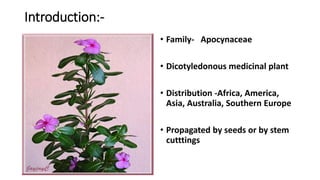
Introduction:-
• Family- Apocynaceae
• Dicotyledonous medicinal plant
• Distribution -Africa, America,
Asia, Australia, Southern Europe
• Propagated by seeds or by stem
cutttings
MEDICINE SOURCES:-
• C. roseus- studied extensively for its remarkable anticancer
constituents i.e; Vincristine & vinblastine
• Other compounds- ajmalicine and serpentine used for hypertension
and related cardiac disorders
• LOW yield(V.cristine, V.blastine)
• These compounds is expensive
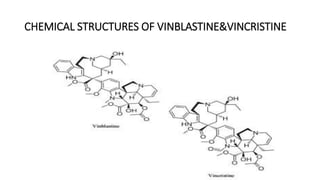
CHEMICAL STRUCTURES OF VINBLASTINE&VINCRISTINE
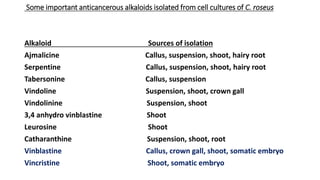
Some important anticancerous alkaloids isolated from cell cultures of C. roseus
Alkaloid Sources of isolation
Ajmalicine Callus, suspension, shoot, hairy root
Serpentine Callus, suspension, shoot, hairy root
Tabersonine Callus, suspension
Vindoline Suspension, shoot, crown gall
Vindolinine Suspension, shoot
3,4 anhydro vinblastine Shoot
Leurosine Shoot
Catharanthine Suspension, shoot, root
Vinblastine Callus, crown gall, shoot, somatic embryo
Vincristine Shoot, somatic embryo
OBJECTIVE:-
In this seminar, the current development of secondary
metabolite synthesis in C. roseus involving biotechnology
has been discussed the various basic factors that
influence yield.
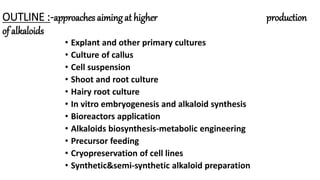
OUTLINE :-approaches aiming at higher production
of alkaloids
• Explant and other primary cultures
• Culture of callus
• Cell suspension
• Shoot and root culture
• Hairy root culture
• In vitro embryogenesis and alkaloid synthesis
• Bioreactors application
• Alkaloids biosynthesis-metabolic engineering
• Precursor feeding
• Cryopreservation of cell lines
• Synthetic&semi-synthetic alkaloid preparation
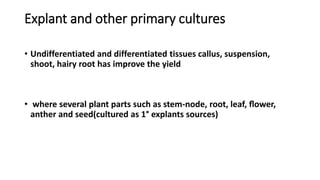
Explant and other primary cultures
• Undifferentiated and differentiated tissues callus, suspension,
shoot, hairy root has improve the yield
• where several plant parts such as stem-node, root, leaf, flower,
anther and seed(cultured as 1° explants sources)
Culture of callus
• Is an undifferentiated tissue
• Callus is a good source of 2° Metabolites & natural products
Cell suspension
• The cell suspension has often been used for alkaloid synthesis studies
in C. roseus as the extraction of alkaloids is far more simple, it also
uptake precursors and other nutrients more rapidly that favours
enhanced accumulation of alkaloids.
Shoot and root culture
• A high accumulation of ajmalicine in multiple shoot cultures of C.
roseus in MS medium high concentration of IAA (11.42 µM) and a
low (2.22 µM) concentration of BA.
• Vindoline synthesis in multiple shoot culture were detected.
• Leaves and flowers of two different C. roseus (pink flower and
white flower) were variable amounts of vincristine and vinblastine
were detected.
• Yield variation is also observed in callus
Hairy root culture
• Higher concentration of ajmalicine and catharanthine was found in
genetically transformed hairy root cultures.
• vindoline and catharanthine producing hairy roots were thin and
slow in growth.
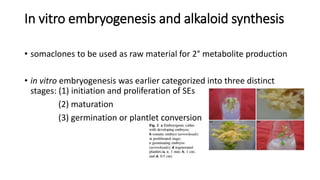
In vitro embryogenesis and alkaloid synthesis
• somaclones to be used as raw material for 2° metabolite production
• in vitro embryogenesis was earlier categorized into three distinct
stages: (1) initiation and proliferation of SEs
(2) maturation
(3) germination or plantlet conversion
Culture conditions:-
• Medium composition
• Effect of PGRs
• Temperature
• pH
• Influence of light
• Oxygenation
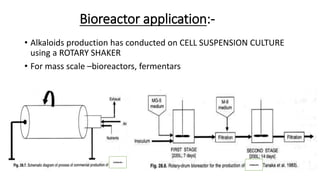
Bioreactor application:-
• Alkaloids production has conducted on CELL SUSPENSION CULTURE
using a ROTARY SHAKER
• For mass scale –bioreactors, fermentars
vinblastin
vinblastin
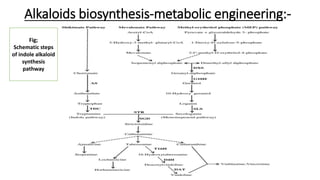
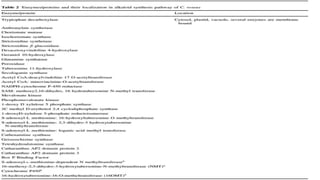
Alkaloids biosynthesis-metabolic engineering:-
Fig;
Schematic steps
of indole alkaloid
synthesis
pathway
Precursor feeding:-
• precursors enhanced secondary metabolites synthesis
• These compounds used as precursors L-tryptophan, loganin, loganic
acid, secologanin
• The amino acids added to culture media for enhanced production of
indole template based alkaloids
Biotransformation:-
• Catharanthus, biotransformation used for the synthesis of Vinblastine
• Use two precursor compounds Catharathine and Vindoline
• The AVLB(3’4’-anhydrovinblastine) biotransformed to produce
vincristine- antitumour activity
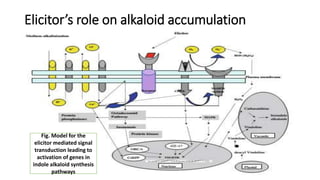
Elicitor’s role on alkaloid accumulation
Fig. Model for the
elicitor mediated signal
transduction leading to
activation of genes in
indole alkaloid synthesis
pathways
Cryopreservation of cell lines:-
• Superior cell-lines capable of high production of secondary
metabolites require screening and preserving
• To maintain secondary metabolite synthesis for long term using
different pre-treatments, cryo-protectants, cooling and thawing
processes.
• C. roseus LD50/ h13 cell lines were preserved for over 6 months
in the presence of sorbitol and 5 % DMSO
Synthetic- and semi synthetic alkaloid preparation:-
• Vinblastine was produced semi synthetically by
incubating the two monomers catharanthine &
vindoline
CONCLUSION:-
• Catharanthus roseus has been investigated clinically as it is an
important medicinal plant with immense anticancerous potentiality
• A treasure of information about the biosynthetic pathways, the
genes, the enzymes and other factors’ role has now been known.
• Studies clearly indicate that the synthetic pathway is very long and
branched.
• The presence of important key steps are therefore many that may
complex the entire process of metabolic engineering, targeting to
synthesize enhanced level of yield.
ACKNOWLDGEMENTS:-
• I would like to thanks sincerely to HOD Dept of Genetics
• I would like to thanks sincerely to BOS Dept of Genetics
• I would like to thanks sincerely to Guide Dept of Genetics
• And I would like to thanks our faculty
BIBILOGRAPHY:-
• References :-
Abdul Mujib et al.,(2012) Catharanthus roseus alkaloids: application of
biotechnology for improving yield. Review paper
Azra Ataei-Azim et al.,(2008) High in vitro production of ant-canceric
indole alkaloids from periwinkle (Catharanthus roseus) tissue culture.
1Biological Department, Islamic Azad University of Saveh Branch, Iran
♦WEBSITES:-
Wikipedia.com
CATHARANTHUS ROSEUS