 True gums are formed from the
disintegration of internal plant tissues,
mostly from the decomposition of cellulose
in a process called gummosis.
 Chemically, Gums contain high amounts of
sugar and are closely allied to the pectins.
They are colloidal and soluble in water,
either dissolving entirely or swelling, but
they are insoluble in alcohol and ether.
 They exude naturally from the stems or in
response to wounding of the plant.
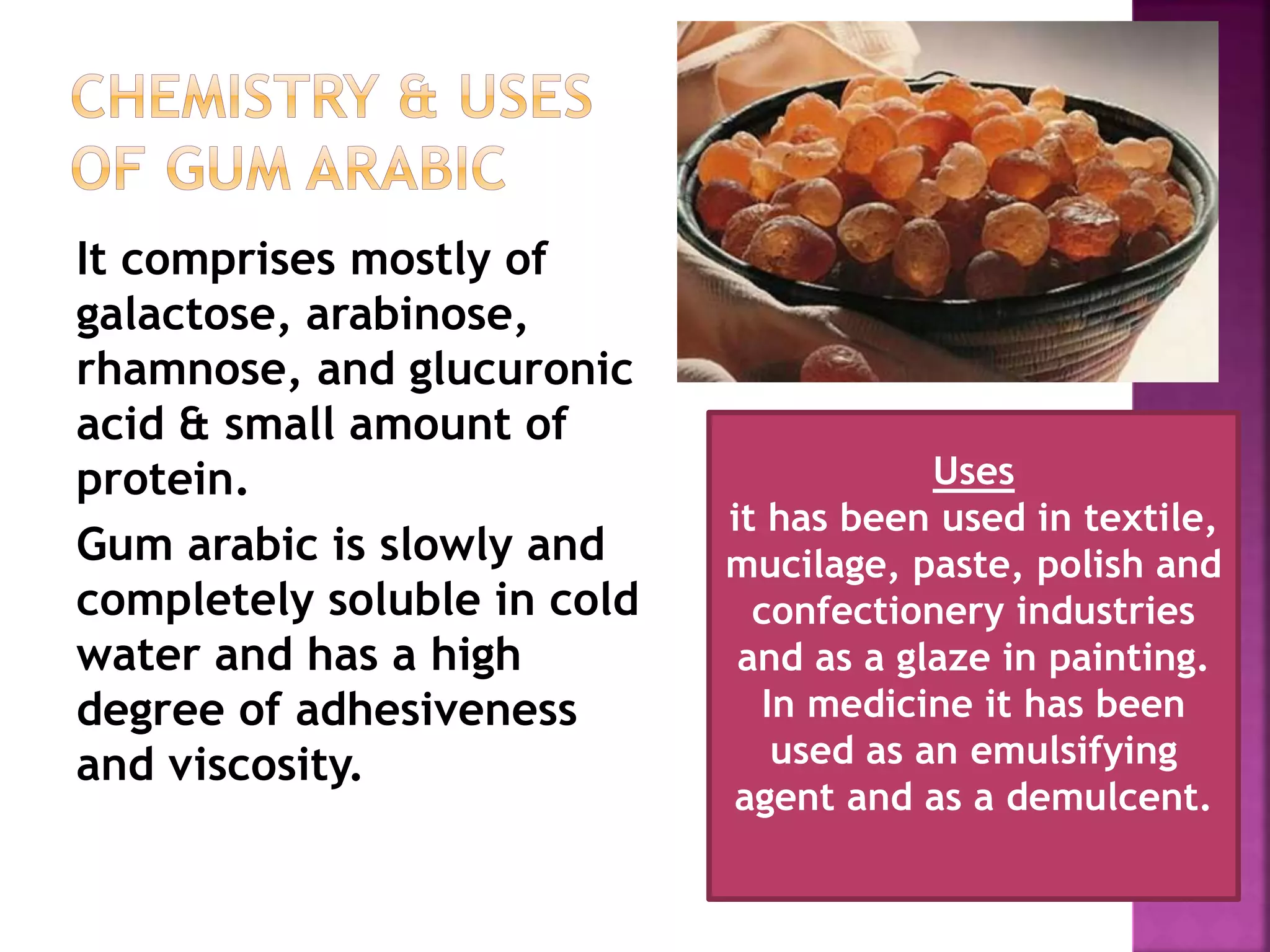
A dried gummy exudate
obtained from Acacia
senegal and related
acacias.
These are small native
trees of arid northern
Africa.
1. The trees are tapped between February
and May when the fruits are ripe.
2. Transverse incisions are made with a
small ax and thin strips of the outer bark
are torn off.
3. The gum slowly exudes as a viscous
liquid, collects in a drop and hardens.
4. After 3-8 weeks these “tears” are
collected.
5. The sun bleaches them, and the
impurities are removed before
marketing.
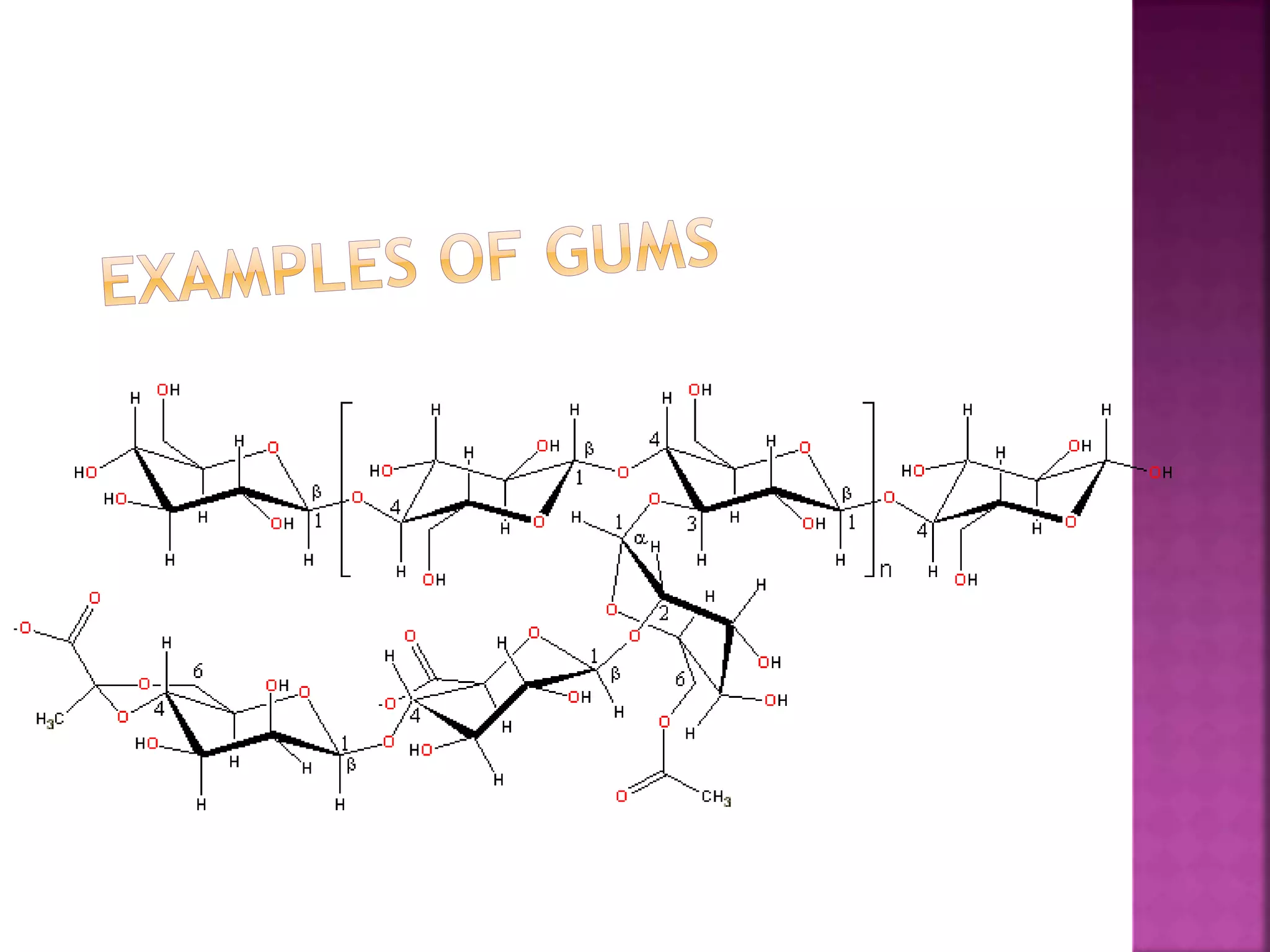
It comprises mostly of
galactose, arabinose,
rhamnose, and glucuronic
acid & small amount of
protein.
Gum arabic is slowly and
completely soluble in cold
water and has a high
degree of adhesiveness
and viscosity.
Uses
it has been used in textile,
mucilage, paste, polish and
confectionery industries
and as a glaze in painting.
In medicine it has been
used as an emulsifying
agent and as a demulcent.
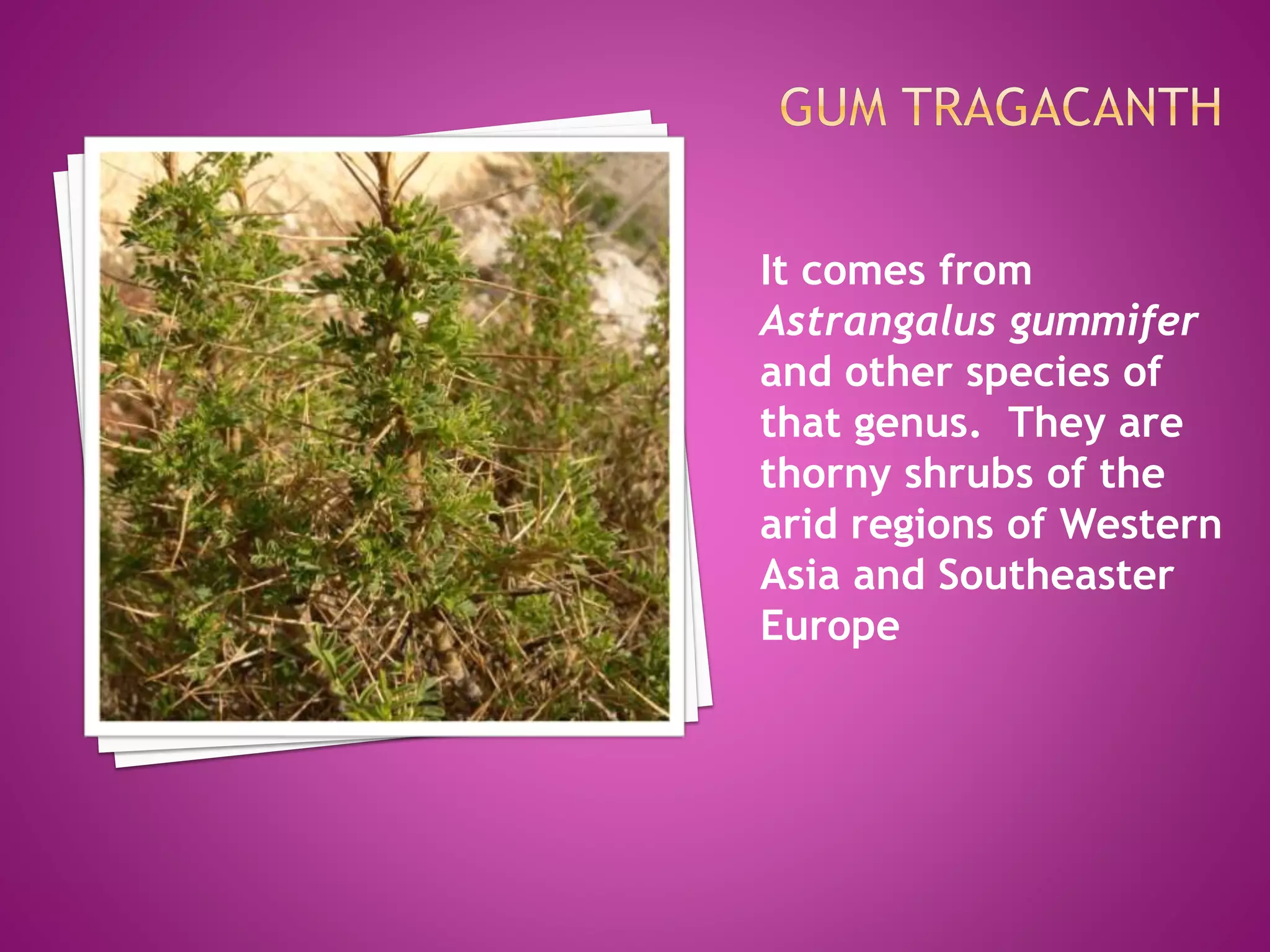
It comes from
Astrangalus gummifer
and other species of
that genus. They are
thorny shrubs of the
arid regions of Western
Asia and Southeaster
Europe
 This is formed by a transformation of the
pith and medullary-ray cells into a
mucilaginous substance that exudes
naturally or after the bark has been
punctured or excised.
 The gum is allowed to dry on the bark
before it is collected.
 It reaches the market in one of three
forms: tears, which are the dried natural
exudate; vermiform gum, which consists of
narrow twisted coils or strings; and flakes,
which are ribbonlike pieces.
Gum tragacanth has
been used in calico
printing and for other
industrial purposes. It
is one of the oldest
drugs and was known
since 300 B.C. In
modern medicine it
has served as an
adhesive agent for pills
and troches and for
the suspension of
insoluble powders.
It is obtained from
Sterculia urens, a
large tree in central
India.
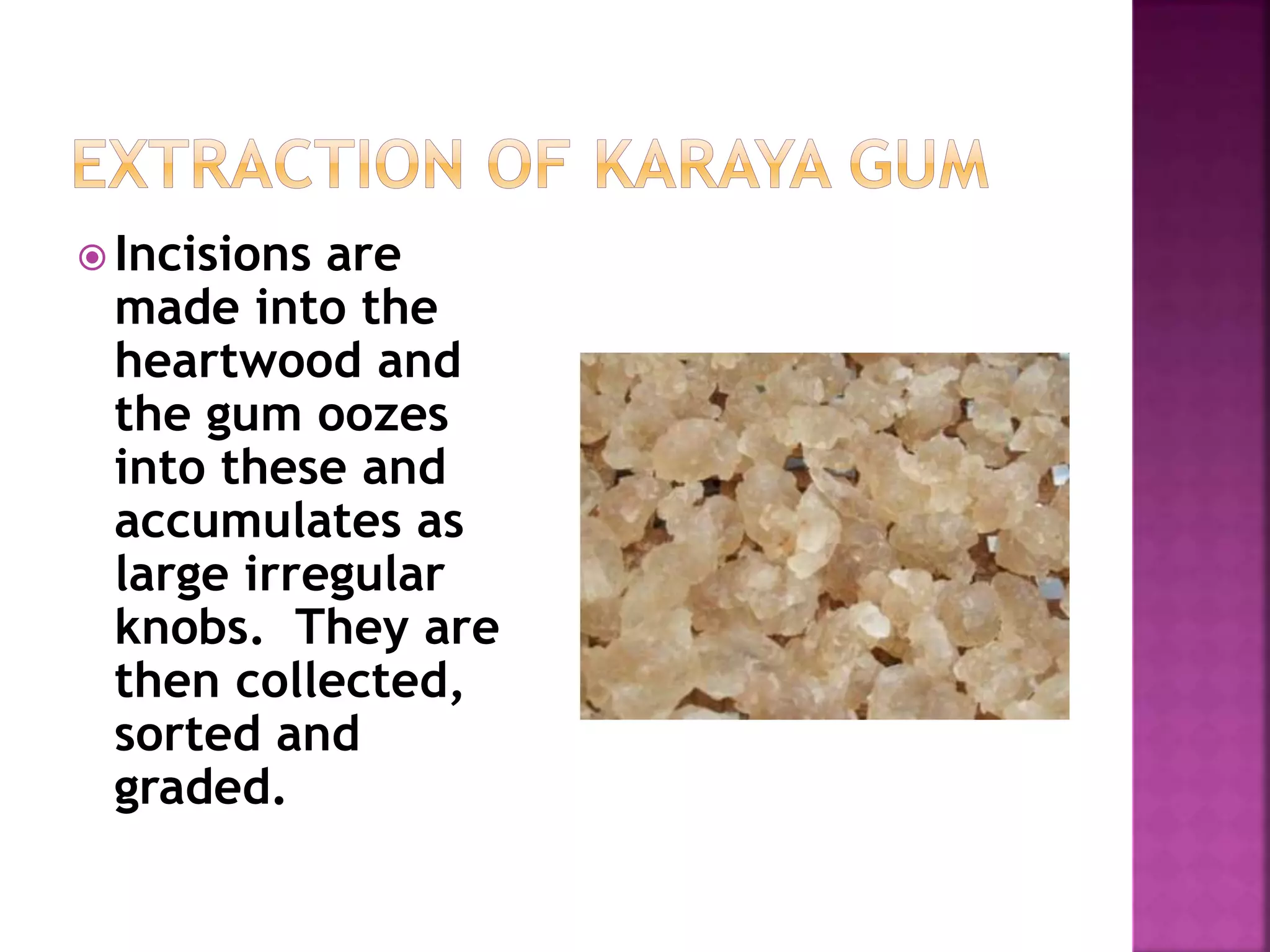
 Incisions are
made into the
heartwood and
the gum oozes
into these and
accumulates as
large irregular
knobs. They are
then collected,
sorted and
graded.
 Chemistry:
Gum karaya is an
acid polysaccharide
composed of the
sugars galactose,
rhamnose and
galacturonic acid.
 Uses:
It is used in the
textile, cosmetic,
cigar, past and ice
cream industries.
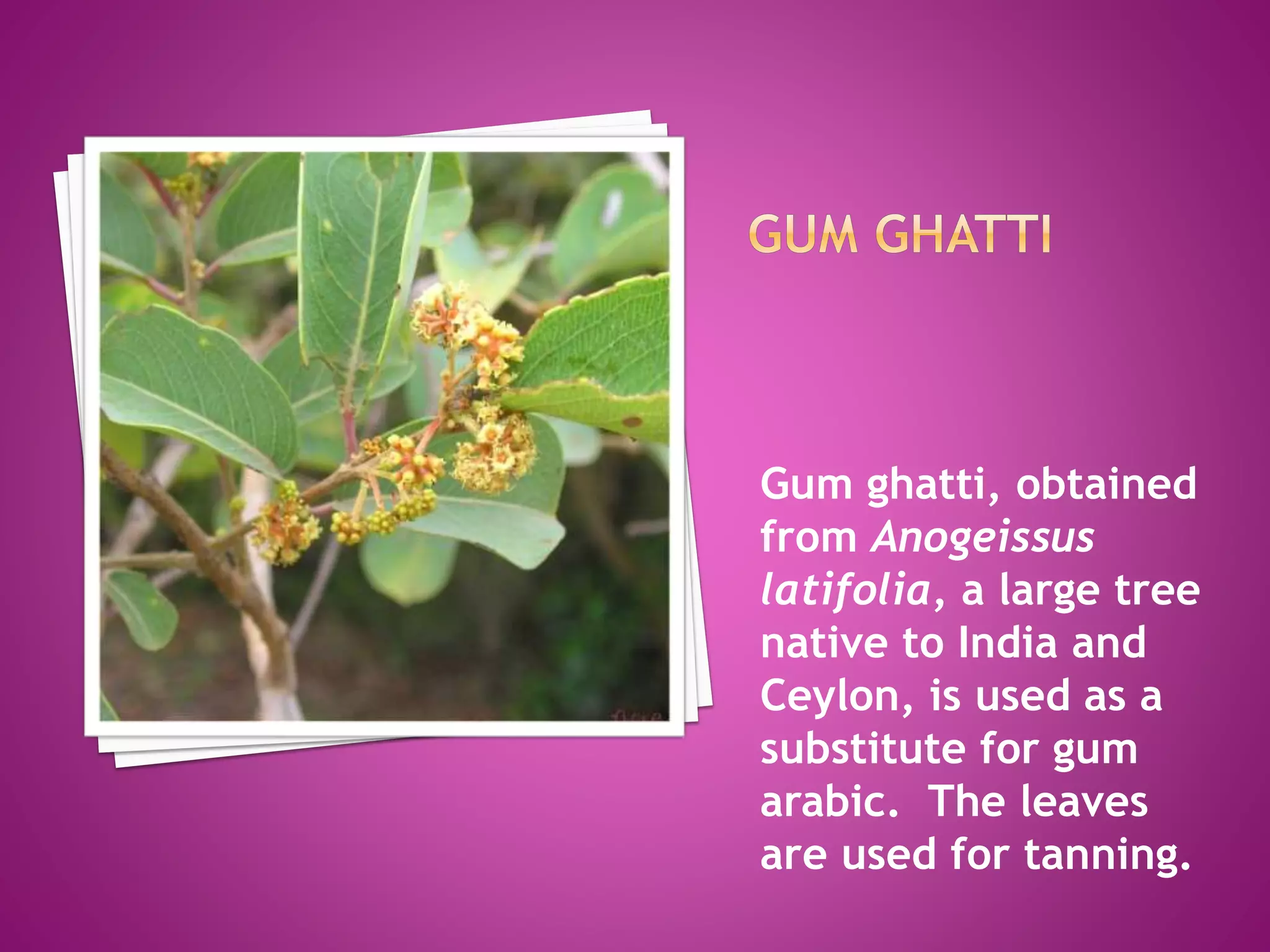
Gum ghatti, obtained
from Anogeissus
latifolia, a large tree
native to India and
Ceylon, is used as a
substitute for gum
arabic. The leaves
are used for tanning.
• Feronia limonia and Cochlospermum religiosum in India, Burma
and Java yield gums that are also used in place of gum arabic.
Cycas gum
• The Asiatic Cycas ciccinalis is the source of cycas gum.
Carob
• The carob, Ceratonia siliqua, produces tragasol, a mucilaginous
hemi cellulose occurring in the pods.
Mesquite
gum
• Mesquite gum in North America is obtained fro Posopis
juliflora, P. glandulosa and other species
Cherry gum
• cherry gum is found in various species of Prunus.
 Gums are especially common in plants of
dry regions. They are used primarily as
adhesives, and are also used in printing
and finishing textiles, as a sizing for paper,
in the paint and candy industries and as
drugs. Three important commercial plant
gums are gum arabic, gum tragacanth and
karaya gum.
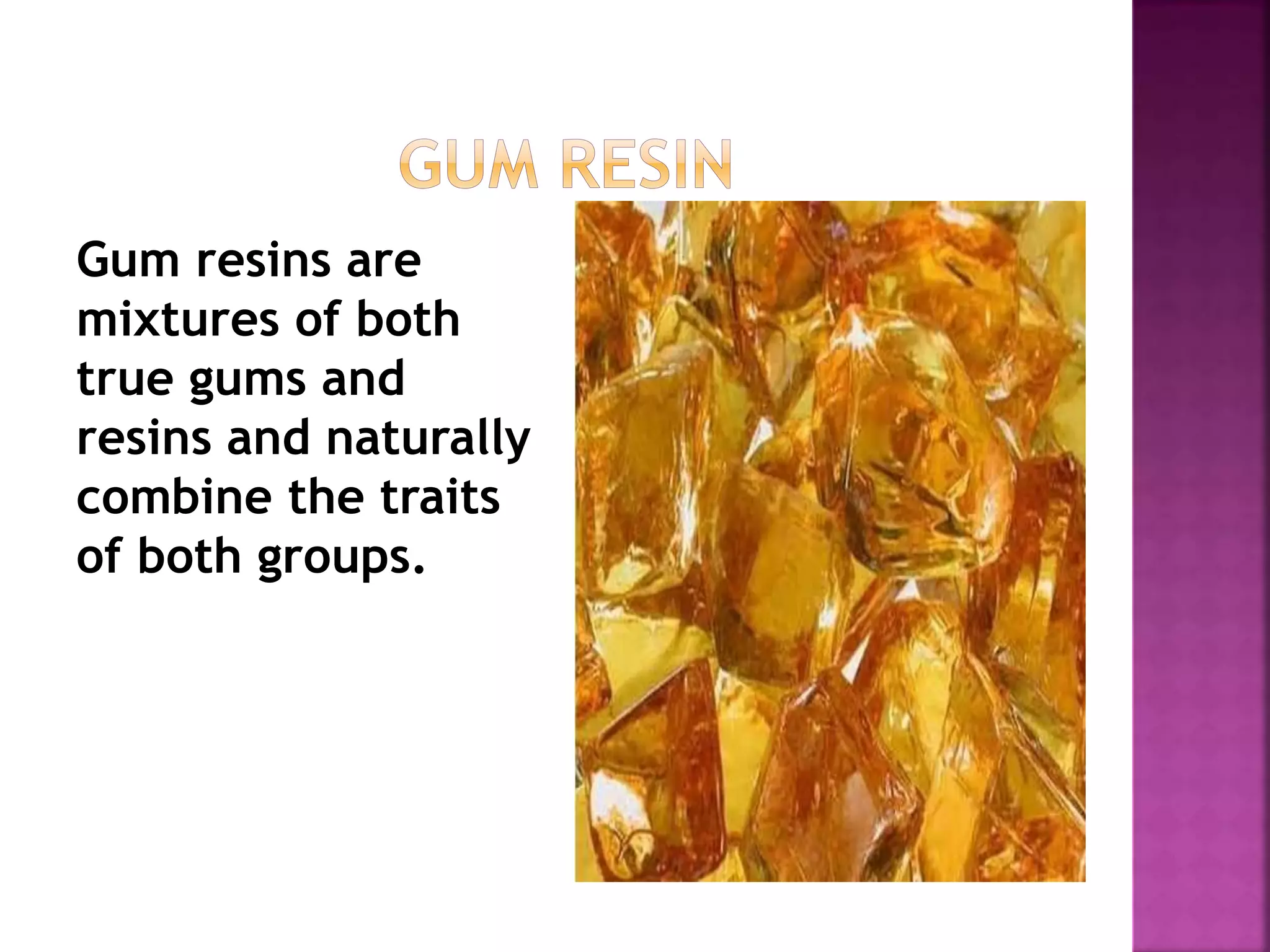
Gum resins are
mixtures of both
true gums and
resins and naturally
combine the traits
of both groups.
 Gum resins occur naturally as milky
exudates and collect in the form of tears or
irregular masses.
 They often contain small amounts of
essential oils and traces of coloring
material.
 Injuring or tapping the plants also produces
them. They are mostly from plants of dry,
arid regions, especially species of the
Umbelliferae and Burseraceae.
Dorema ammonniacum, a
tall, stout naked, hollow-
stemmed perennial found
in the deserts of Iran,
southern Siberia and other
parts of Western Asia.
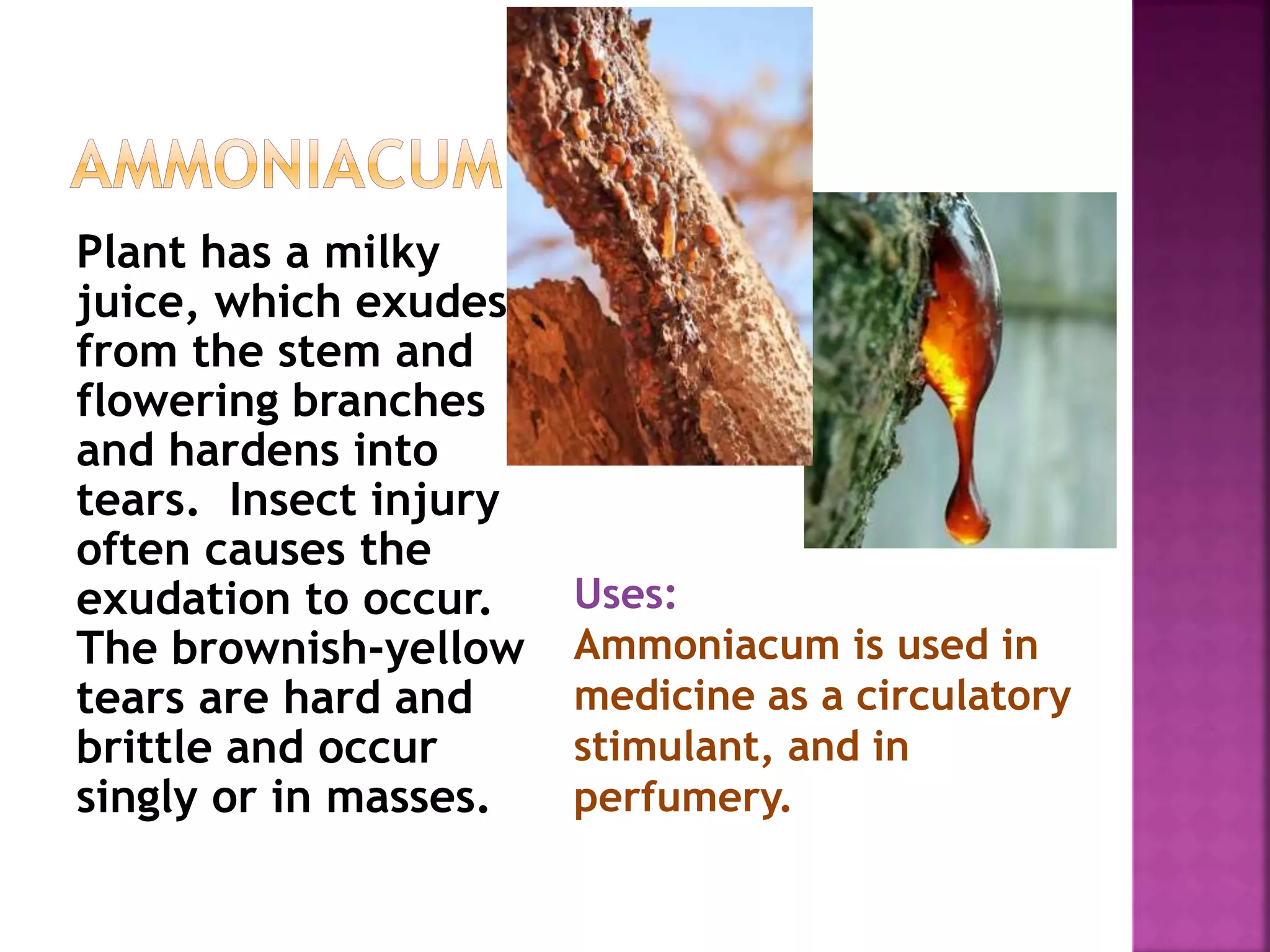
Plant has a milky
juice, which exudes
from the stem and
flowering branches
and hardens into
tears. Insect injury
often causes the
exudation to occur.
The brownish-yellow
tears are hard and
brittle and occur
singly or in masses.
Uses:
Ammoniacum is used in
medicine as a circulatory
stimulant, and in
perfumery.
This is derived from
Ferula assafoetida and
allied species, stout
perennial herbs of Iran
and Afghanistan.
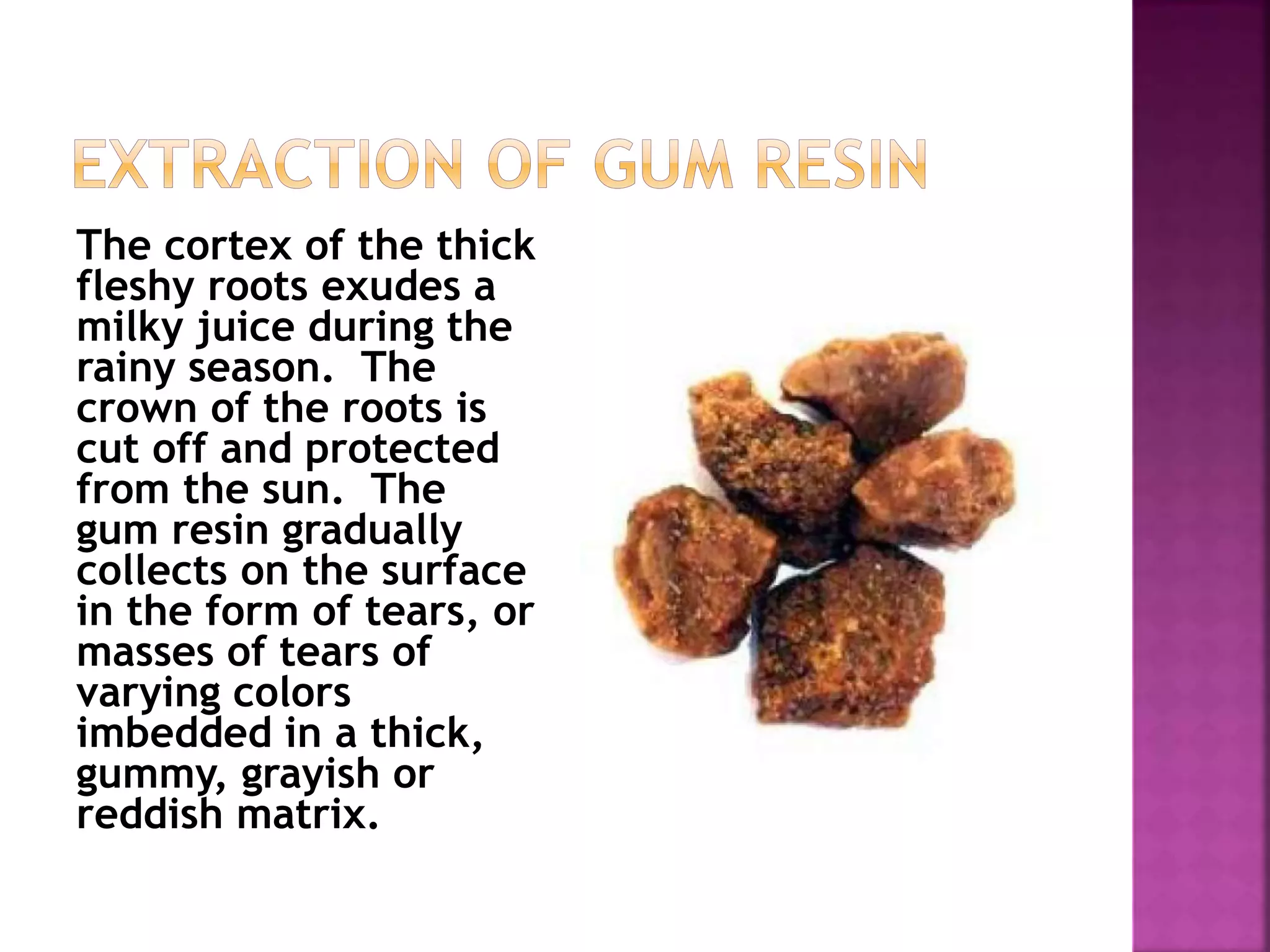
The cortex of the thick
fleshy roots exudes a
milky juice during the
rainy season. The
crown of the roots is
cut off and protected
from the sun. The
gum resin gradually
collects on the surface
in the form of tears, or
masses of tears of
varying colors
imbedded in a thick,
gummy, grayish or
reddish matrix.
Asafetida has a powerful and foul odor and
a bitter acrid taste, due to sulfur compounds
present in the essential oil. Despite this it
has been used throughout the East for
flavoring sauces, curries and other foods,
and as a drug. In Europe and America is used
in perfumes and for flavoring only when
exceedingly dilute and after certain
impurities have been removed. Asafetida
has may valuable medicinal properties and is
used in the treatment of coughs, asthma,
and other nervous disorders and as an aid to
digestion and metabolism.
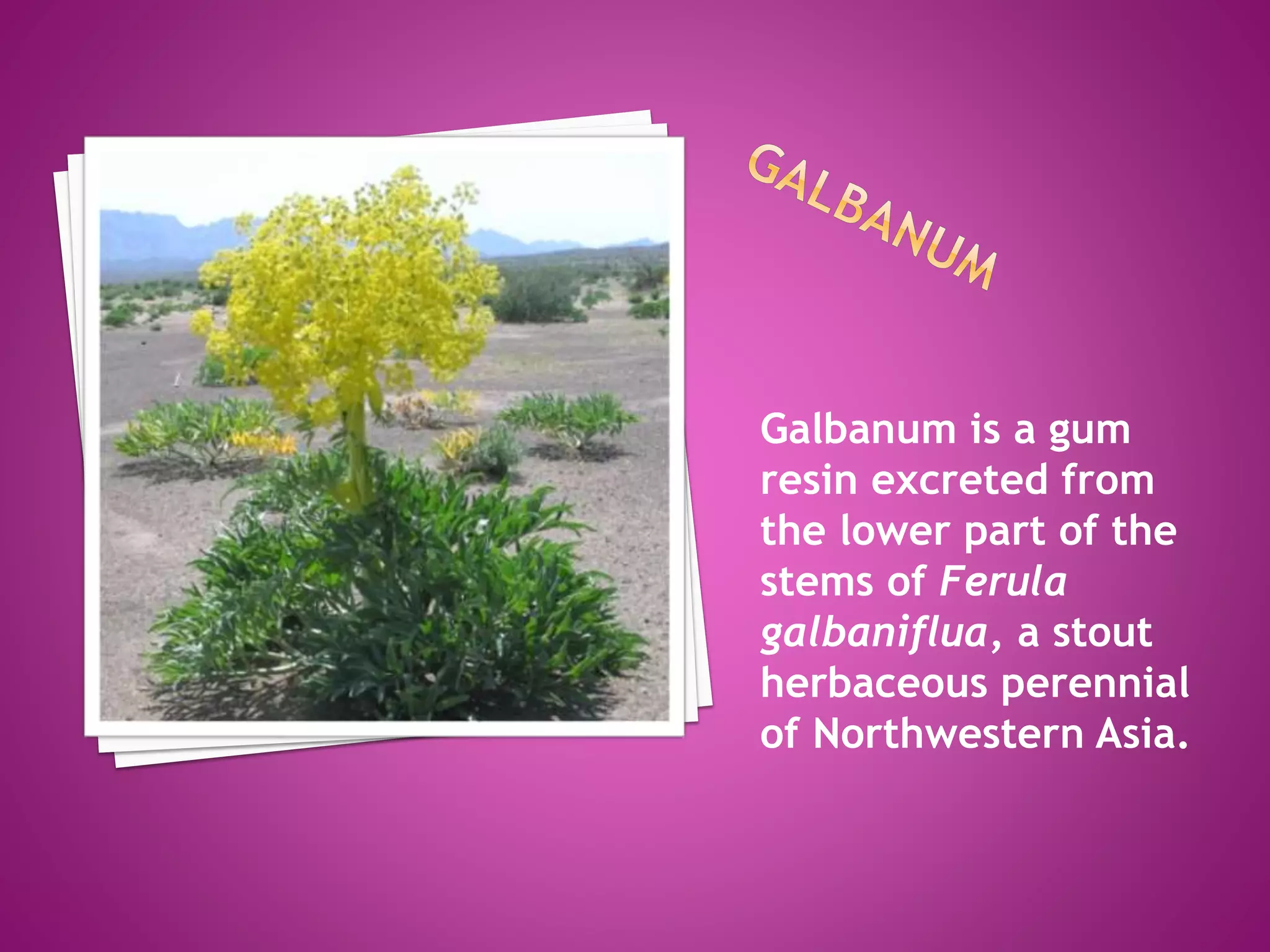
Galbanum is a gum
resin excreted from
the lower part of the
stems of Ferula
galbaniflua, a stout
herbaceous perennial
of Northwestern Asia.
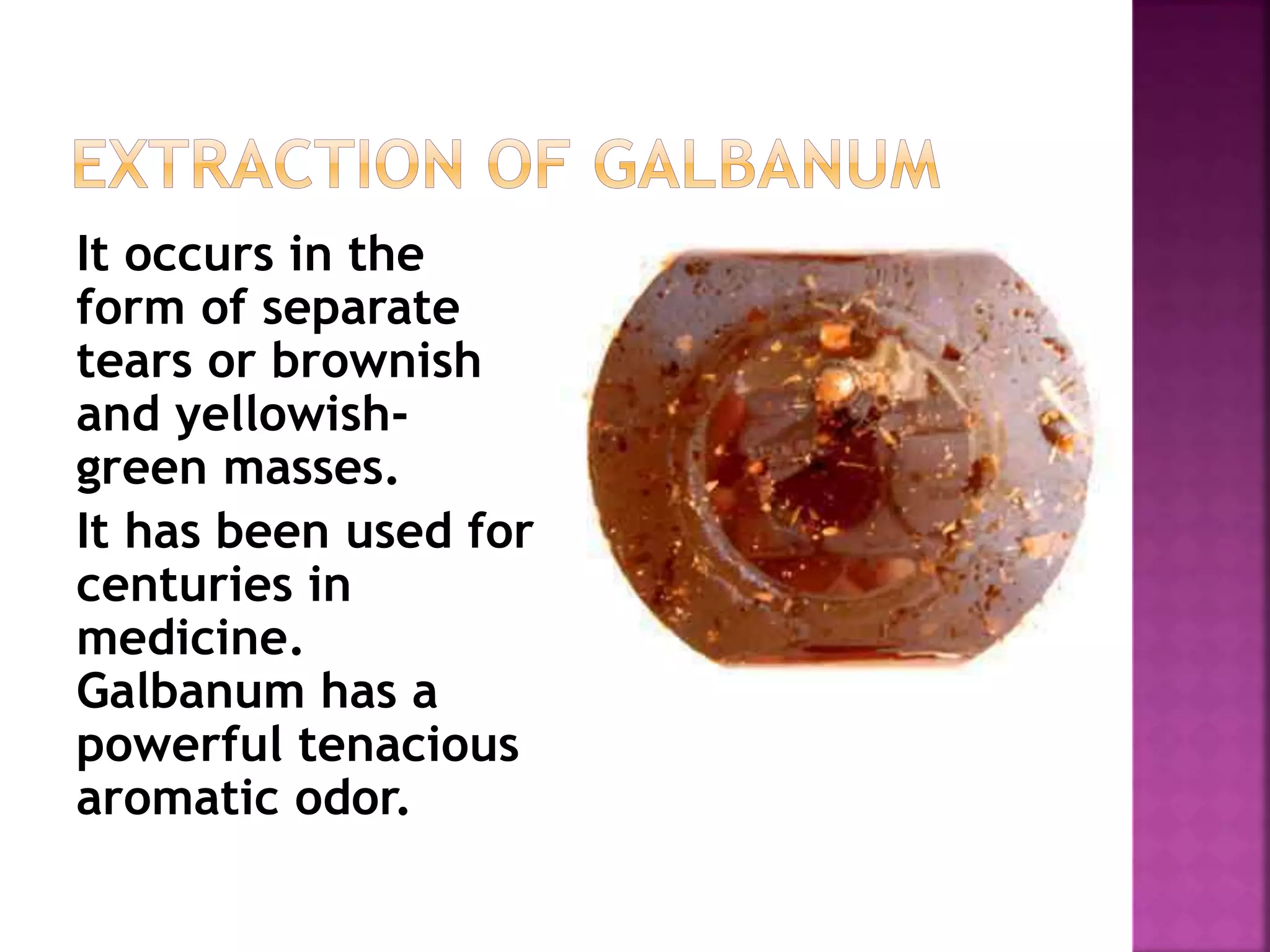
It occurs in the
form of separate
tears or brownish
and yellowish-
green masses.
It has been used for
centuries in
medicine.
Galbanum has a
powerful tenacious
aromatic odor.
Herabol Myrrh is derived
from Commiphora myrrha,
a large shrub or small tree
of Ethiopia.
The gum resin oozes
naturally from the stems or
as a result of wounding.
The pale-yellow liquid
gradually solidifies and
becomes brown or even
black in color.
Herabol myrrh is used in
perfume manufacture and
for medicinal purposes as a
tonic, stimulant, and
antiseptic and is often a
constituent of
mouthwashes and
dentifrices.
 Bisabol Myrrh or
Sweet Myrrh is from
Commiphora
erythraea, and
Arabian species of
similar appearance.
This is the myrrh of
antiquity and has
been used for
centuries in incense,
perfumes and
embalming. It is one
of the constituents
of Chinese joss
sticks.
This is also known as
Olibanum and is obtained
from Boswellia carteri
and related Asiatic and
African species.
The clear yellow resin
exudes from incisions
made in the bark and
hardens as small yellow
grains.
It is used in perfumes,
because of its excellent
fixative properties, face
powders, pastilles and
fumigating powders.
 These gum resins have
been of much less
importance.
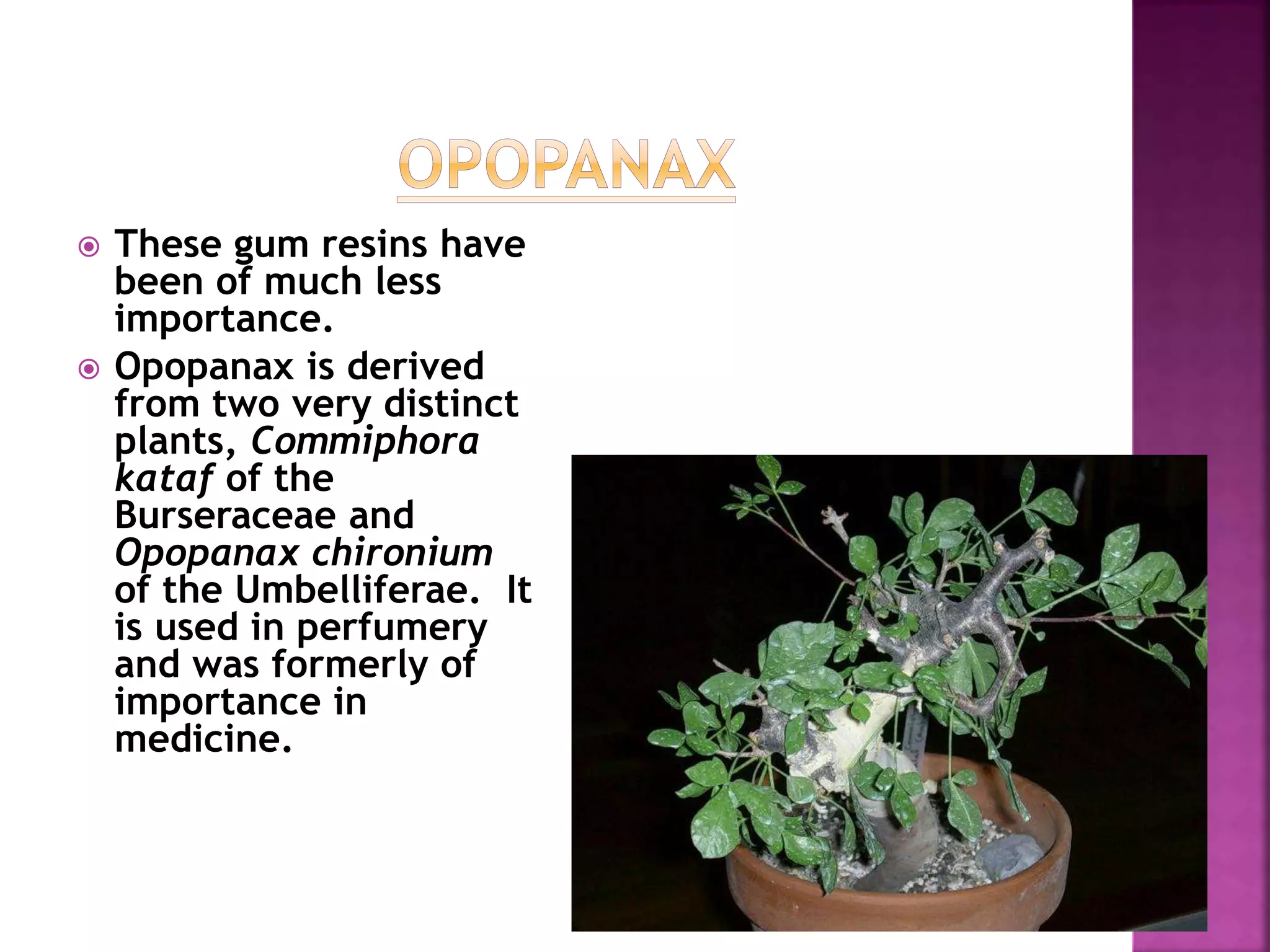
 Opopanax is derived
from two very distinct
plants, Commiphora
kataf of the
Burseraceae and
Opopanax chironium
of the Umbelliferae. It
is used in perfumery
and was formerly of
importance in
medicine.
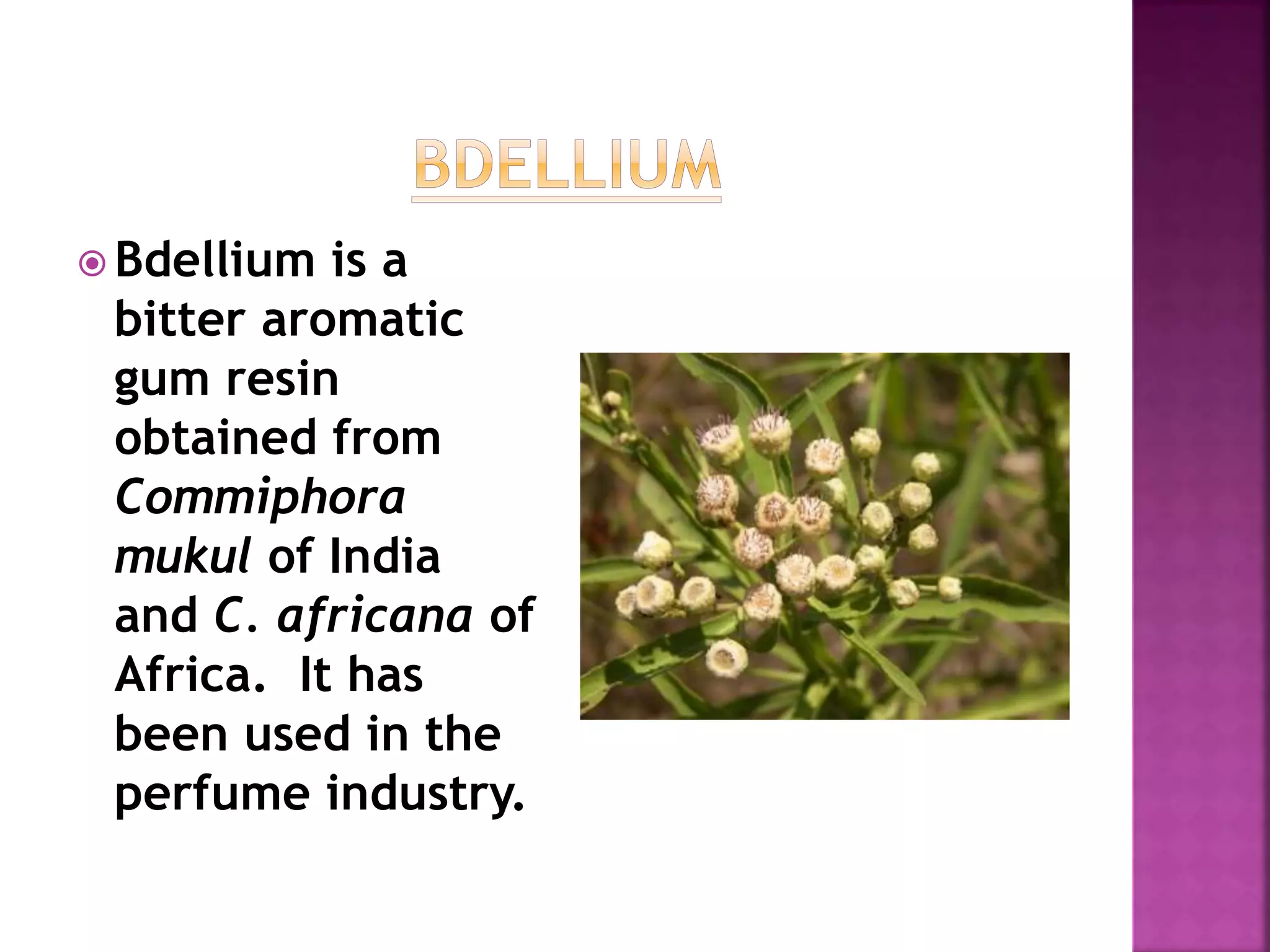
 Bdellium is a
bitter aromatic
gum resin
obtained from
Commiphora
mukul of India
and C. africana of
Africa. It has
been used in the
perfume industry.
Gum resins in plants

Gum resins in plants

  • 2.
     True gumsare formed from the disintegration of internal plant tissues, mostly from the decomposition of cellulose in a process called gummosis.  Chemically, Gums contain high amounts of sugar and are closely allied to the pectins. They are colloidal and soluble in water, either dissolving entirely or swelling, but they are insoluble in alcohol and ether.  They exude naturally from the stems or in response to wounding of the plant.
  • 4.
    A dried gummyexudate obtained from Acacia senegal and related acacias. These are small native trees of arid northern Africa.
  • 5.
    1. The treesare tapped between February and May when the fruits are ripe. 2. Transverse incisions are made with a small ax and thin strips of the outer bark are torn off. 3. The gum slowly exudes as a viscous liquid, collects in a drop and hardens. 4. After 3-8 weeks these “tears” are collected. 5. The sun bleaches them, and the impurities are removed before marketing.
  • 6.
    It comprises mostlyof galactose, arabinose, rhamnose, and glucuronic acid & small amount of protein. Gum arabic is slowly and completely soluble in cold water and has a high degree of adhesiveness and viscosity. Uses it has been used in textile, mucilage, paste, polish and confectionery industries and as a glaze in painting. In medicine it has been used as an emulsifying agent and as a demulcent.
  • 7.
    It comes from Astrangalusgummifer and other species of that genus. They are thorny shrubs of the arid regions of Western Asia and Southeaster Europe
  • 8.
     This isformed by a transformation of the pith and medullary-ray cells into a mucilaginous substance that exudes naturally or after the bark has been punctured or excised.  The gum is allowed to dry on the bark before it is collected.  It reaches the market in one of three forms: tears, which are the dried natural exudate; vermiform gum, which consists of narrow twisted coils or strings; and flakes, which are ribbonlike pieces.
  • 9.
    Gum tragacanth has beenused in calico printing and for other industrial purposes. It is one of the oldest drugs and was known since 300 B.C. In modern medicine it has served as an adhesive agent for pills and troches and for the suspension of insoluble powders.
  • 10.
    It is obtainedfrom Sterculia urens, a large tree in central India.
  • 11.
     Incisions are madeinto the heartwood and the gum oozes into these and accumulates as large irregular knobs. They are then collected, sorted and graded.
  • 12.
     Chemistry: Gum karayais an acid polysaccharide composed of the sugars galactose, rhamnose and galacturonic acid.  Uses: It is used in the textile, cosmetic, cigar, past and ice cream industries.
  • 13.
    Gum ghatti, obtained fromAnogeissus latifolia, a large tree native to India and Ceylon, is used as a substitute for gum arabic. The leaves are used for tanning.
  • 14.
    • Feronia limoniaand Cochlospermum religiosum in India, Burma and Java yield gums that are also used in place of gum arabic. Cycas gum • The Asiatic Cycas ciccinalis is the source of cycas gum. Carob • The carob, Ceratonia siliqua, produces tragasol, a mucilaginous hemi cellulose occurring in the pods. Mesquite gum • Mesquite gum in North America is obtained fro Posopis juliflora, P. glandulosa and other species Cherry gum • cherry gum is found in various species of Prunus.
  • 15.
     Gums areespecially common in plants of dry regions. They are used primarily as adhesives, and are also used in printing and finishing textiles, as a sizing for paper, in the paint and candy industries and as drugs. Three important commercial plant gums are gum arabic, gum tragacanth and karaya gum.
  • 16.
    Gum resins are mixturesof both true gums and resins and naturally combine the traits of both groups.
  • 17.
     Gum resinsoccur naturally as milky exudates and collect in the form of tears or irregular masses.  They often contain small amounts of essential oils and traces of coloring material.  Injuring or tapping the plants also produces them. They are mostly from plants of dry, arid regions, especially species of the Umbelliferae and Burseraceae.
  • 19.
    Dorema ammonniacum, a tall,stout naked, hollow- stemmed perennial found in the deserts of Iran, southern Siberia and other parts of Western Asia.
  • 20.
    Plant has amilky juice, which exudes from the stem and flowering branches and hardens into tears. Insect injury often causes the exudation to occur. The brownish-yellow tears are hard and brittle and occur singly or in masses. Uses: Ammoniacum is used in medicine as a circulatory stimulant, and in perfumery.
  • 21.
    This is derivedfrom Ferula assafoetida and allied species, stout perennial herbs of Iran and Afghanistan.
  • 22.
    The cortex ofthe thick fleshy roots exudes a milky juice during the rainy season. The crown of the roots is cut off and protected from the sun. The gum resin gradually collects on the surface in the form of tears, or masses of tears of varying colors imbedded in a thick, gummy, grayish or reddish matrix.
  • 23.
    Asafetida has apowerful and foul odor and a bitter acrid taste, due to sulfur compounds present in the essential oil. Despite this it has been used throughout the East for flavoring sauces, curries and other foods, and as a drug. In Europe and America is used in perfumes and for flavoring only when exceedingly dilute and after certain impurities have been removed. Asafetida has may valuable medicinal properties and is used in the treatment of coughs, asthma, and other nervous disorders and as an aid to digestion and metabolism.
  • 24.
    Galbanum is agum resin excreted from the lower part of the stems of Ferula galbaniflua, a stout herbaceous perennial of Northwestern Asia.
  • 25.
    It occurs inthe form of separate tears or brownish and yellowish- green masses. It has been used for centuries in medicine. Galbanum has a powerful tenacious aromatic odor.
  • 26.
    Herabol Myrrh isderived from Commiphora myrrha, a large shrub or small tree of Ethiopia. The gum resin oozes naturally from the stems or as a result of wounding. The pale-yellow liquid gradually solidifies and becomes brown or even black in color. Herabol myrrh is used in perfume manufacture and for medicinal purposes as a tonic, stimulant, and antiseptic and is often a constituent of mouthwashes and dentifrices.
  • 27.
     Bisabol Myrrhor Sweet Myrrh is from Commiphora erythraea, and Arabian species of similar appearance. This is the myrrh of antiquity and has been used for centuries in incense, perfumes and embalming. It is one of the constituents of Chinese joss sticks.
  • 28.
    This is alsoknown as Olibanum and is obtained from Boswellia carteri and related Asiatic and African species. The clear yellow resin exudes from incisions made in the bark and hardens as small yellow grains. It is used in perfumes, because of its excellent fixative properties, face powders, pastilles and fumigating powders.
  • 29.
     These gumresins have been of much less importance.  Opopanax is derived from two very distinct plants, Commiphora kataf of the Burseraceae and Opopanax chironium of the Umbelliferae. It is used in perfumery and was formerly of importance in medicine.
  • 30.
     Bdellium isa bitter aromatic gum resin obtained from Commiphora mukul of India and C. africana of Africa. It has been used in the perfume industry.