ASHWAGANDHA
GUIDED BY:-
Prof. S.P. Singh
Dr.Akhilendra Verma
PRESENTED BY:-
Dharmendra Kumar
R 12011
ASHWAGANDHA
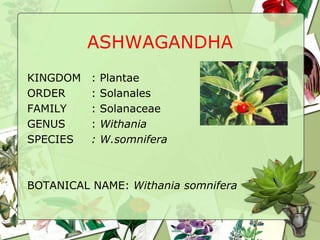
KINGDOM : Plantae
ORDER : Solanales
FAMILY : Solanaceae
GENUS : Withania
SPECIES : W.somnifera
BOTANICAL NAME: Withania somnifera
Withania somnifera, also known as
ashwagandha, Indian ginseng, poison
gooseberry, or winter cherry, is a plant in the
Solanaceae or nightshade family. Several
other species in the genus Withania are
morphologically similar. It is used as a herb in
Ayurvedic medicine.
DESCRIPTION
It grows as a short shrub (35–75 cm) with a
central stem from which branches extend
radially in a star pattern (stellate) and
covered with a dense matte of wooly hairs
(tomentose). The flowers are small and
green, while the ripe fruit is orange-red and
has milk-coagulating properties. The plant's
long, brown, tuberous roots are used for
medicinal purposes.
ETYMOLOGY
Ashwagandha in Sanskrit means "horse's
smell" (ashwa- horse, gandha- smell),
probably originating from the odour of its root
which resembles that of a sweaty horse.
The species name somnifera means "sleep-
inducing" in Latin.
CULTIVATION
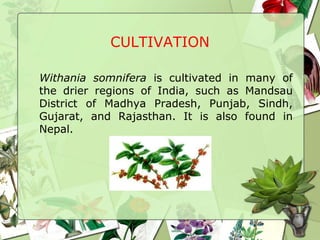
Withania somnifera is cultivated in many of
the drier regions of India, such as Mandsau
District of Madhya Pradesh, Punjab, Sindh,
Gujarat, and Rajasthan. It is also found in
Nepal.
CLIMATIC CONDITIONS FOR
GROWTH
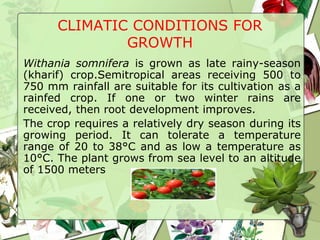
Withania somnifera is grown as late rainy-season
(kharif) crop.Semitropical areas receiving 500 to
750 mm rainfall are suitable for its cultivation as a
rainfed crop. If one or two winter rains are
received, then root development improves.
The crop requires a relatively dry season during its
growing period. It can tolerate a temperature
range of 20 to 38°C and as low a temperature as
10°C. The plant grows from sea level to an altitude
of 1500 meters
PATHOLOGY
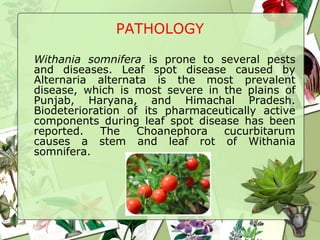
Withania somnifera is prone to several pests
and diseases. Leaf spot disease caused by
Alternaria alternata is the most prevalent
disease, which is most severe in the plains of
Punjab, Haryana, and Himachal Pradesh.
Biodeterioration of its pharmaceutically active
components during leaf spot disease has been
reported. The Choanephora cucurbitarum
causes a stem and leaf rot of Withania
somnifera.
CULINARY USE
The berries can be used as a substitute for
rennet, to coagulate milk in cheese-making .
CHEMICAL CONSTITUENTS
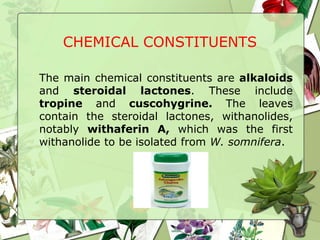
The main chemical constituents are alkaloids
and steroidal lactones. These include
tropine and cuscohygrine. The leaves
contain the steroidal lactones, withanolides,
notably withaferin A, which was the first
withanolide to be isolated from W. somnifera.
TRADITIONAL MEDICINAL USES
• In Ayurveda, the berries and leaves of W.
somnifera are locally applied to tumors,
tubercular glands, carbuncles, and ulcers.
• The roots of W. somnifera are used to prepare
the herbal remedy ashwagandha, which has
been traditionally used to treat various
symptoms and conditions.
• Ashwagandha taken in a particular supplement
(Articulin-F) along with other ingredients
might improve arthritis symptoms.
…
• ashwagandha combined with deep breathing
and a specific diet might reduce symptoms of
anxiety
• ashwagandha might reduce cholesterol levels
in patients with high cholesterol.
• ashwagandha might improve sperm quality,
but not sperm count, in infertile men.
• ashwagandha may improve attention and
impulse control in children with ADHD.
…
SIDE EFFECTS
• Large doses of ashwagandha might cause
stomach upset, diarrhea & vomiting.
• Ashwagandha can irritate the gastro-intestinal
(GI) tract. Don’t use ashwagandha if you have
a stomach ulcer.
• Ashwagandha may slow down the central
nervous system.
• Ashwagandha might decrease blood pressure.
THANK
YOU

Aswagandha

  • 1.
    ASHWAGANDHA GUIDED BY:- Prof. S.P.Singh Dr.Akhilendra Verma PRESENTED BY:- Dharmendra Kumar R 12011
  • 2.
    ASHWAGANDHA KINGDOM : Plantae ORDER: Solanales FAMILY : Solanaceae GENUS : Withania SPECIES : W.somnifera BOTANICAL NAME: Withania somnifera
  • 3.
    Withania somnifera, alsoknown as ashwagandha, Indian ginseng, poison gooseberry, or winter cherry, is a plant in the Solanaceae or nightshade family. Several other species in the genus Withania are morphologically similar. It is used as a herb in Ayurvedic medicine.
  • 4.
    DESCRIPTION It grows asa short shrub (35–75 cm) with a central stem from which branches extend radially in a star pattern (stellate) and covered with a dense matte of wooly hairs (tomentose). The flowers are small and green, while the ripe fruit is orange-red and has milk-coagulating properties. The plant's long, brown, tuberous roots are used for medicinal purposes.
  • 5.
    ETYMOLOGY Ashwagandha in Sanskritmeans "horse's smell" (ashwa- horse, gandha- smell), probably originating from the odour of its root which resembles that of a sweaty horse. The species name somnifera means "sleep- inducing" in Latin.
  • 6.
    CULTIVATION Withania somnifera iscultivated in many of the drier regions of India, such as Mandsau District of Madhya Pradesh, Punjab, Sindh, Gujarat, and Rajasthan. It is also found in Nepal.
  • 7.
    CLIMATIC CONDITIONS FOR GROWTH Withaniasomnifera is grown as late rainy-season (kharif) crop.Semitropical areas receiving 500 to 750 mm rainfall are suitable for its cultivation as a rainfed crop. If one or two winter rains are received, then root development improves. The crop requires a relatively dry season during its growing period. It can tolerate a temperature range of 20 to 38°C and as low a temperature as 10°C. The plant grows from sea level to an altitude of 1500 meters
  • 8.
    PATHOLOGY Withania somnifera isprone to several pests and diseases. Leaf spot disease caused by Alternaria alternata is the most prevalent disease, which is most severe in the plains of Punjab, Haryana, and Himachal Pradesh. Biodeterioration of its pharmaceutically active components during leaf spot disease has been reported. The Choanephora cucurbitarum causes a stem and leaf rot of Withania somnifera.
  • 9.
    CULINARY USE The berriescan be used as a substitute for rennet, to coagulate milk in cheese-making .
  • 10.
    CHEMICAL CONSTITUENTS The mainchemical constituents are alkaloids and steroidal lactones. These include tropine and cuscohygrine. The leaves contain the steroidal lactones, withanolides, notably withaferin A, which was the first withanolide to be isolated from W. somnifera.
  • 11.
    TRADITIONAL MEDICINAL USES •In Ayurveda, the berries and leaves of W. somnifera are locally applied to tumors, tubercular glands, carbuncles, and ulcers. • The roots of W. somnifera are used to prepare the herbal remedy ashwagandha, which has been traditionally used to treat various symptoms and conditions. • Ashwagandha taken in a particular supplement (Articulin-F) along with other ingredients might improve arthritis symptoms. …
  • 12.
    • ashwagandha combinedwith deep breathing and a specific diet might reduce symptoms of anxiety • ashwagandha might reduce cholesterol levels in patients with high cholesterol. • ashwagandha might improve sperm quality, but not sperm count, in infertile men. • ashwagandha may improve attention and impulse control in children with ADHD. …
  • 13.
    SIDE EFFECTS • Largedoses of ashwagandha might cause stomach upset, diarrhea & vomiting. • Ashwagandha can irritate the gastro-intestinal (GI) tract. Don’t use ashwagandha if you have a stomach ulcer. • Ashwagandha may slow down the central nervous system. • Ashwagandha might decrease blood pressure.
  • 14.