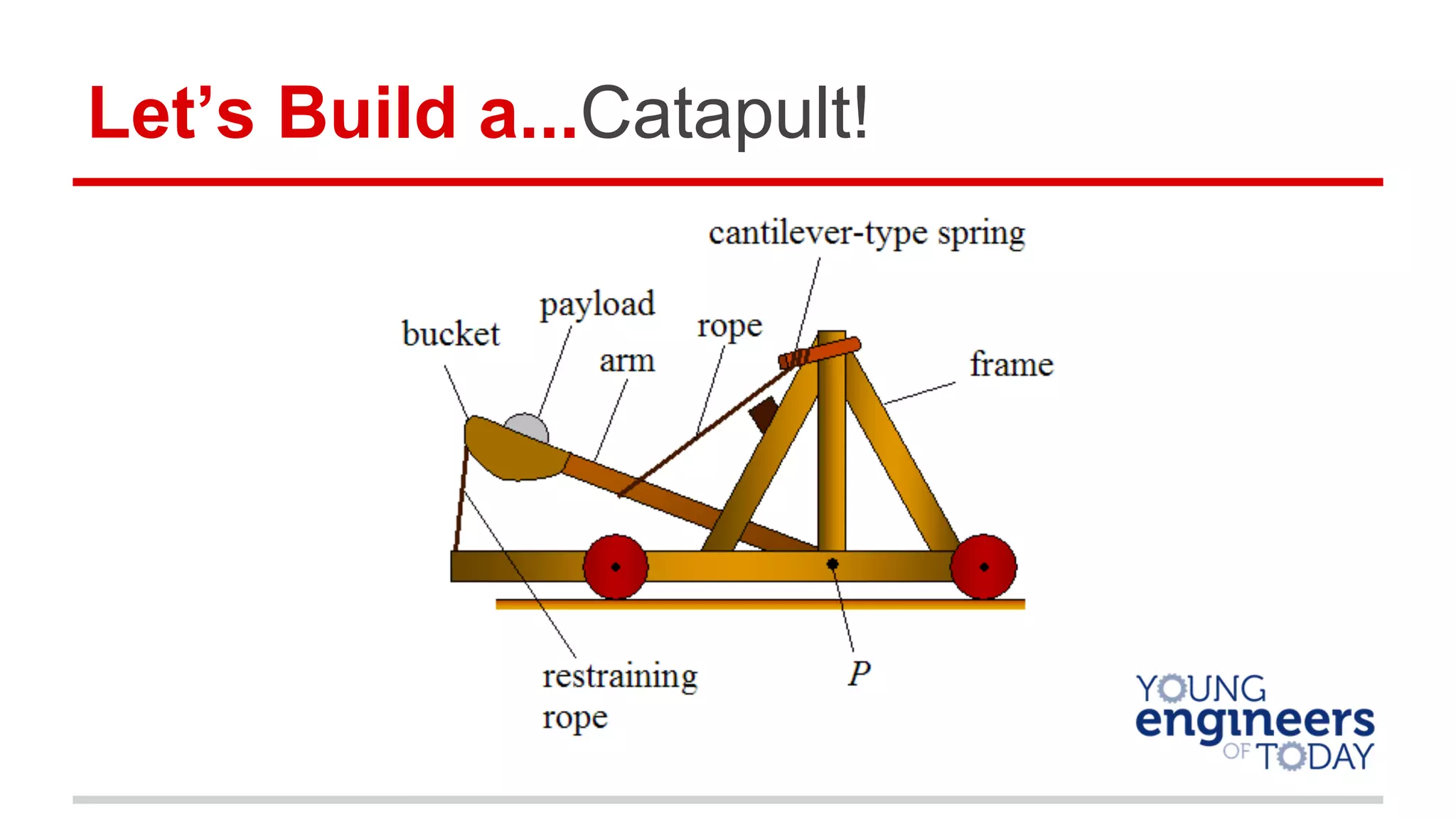
Let’s Build a...Catapult!
Need a blank piece of paper
So what's a catapult?
The goal of a catapult is to fling a mass into the
air - mainly to inflict damage.
What is a Catapult?
● A catapult is a mechanical device used to store potential
energy, then release it as kinetic energy as it throws a
projectile a great distance.This is done without the aid of
explosives.
● The word 'Catapult' comes from the two Greek words:
kata: downward and pultos: a small circular battle shield.
● Katapultos (Catapult) then means “shield piercer”
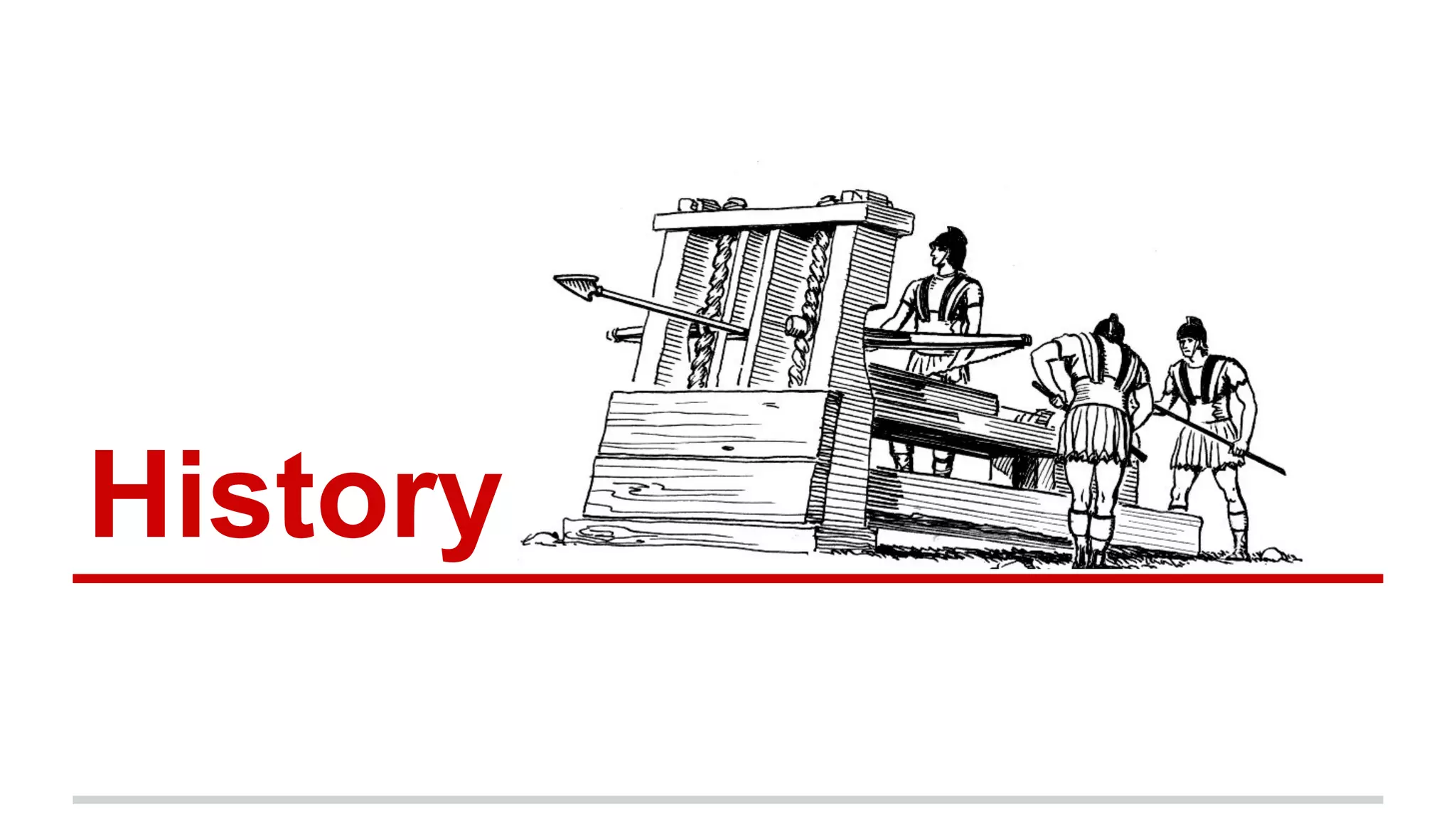
History
History of Catapults
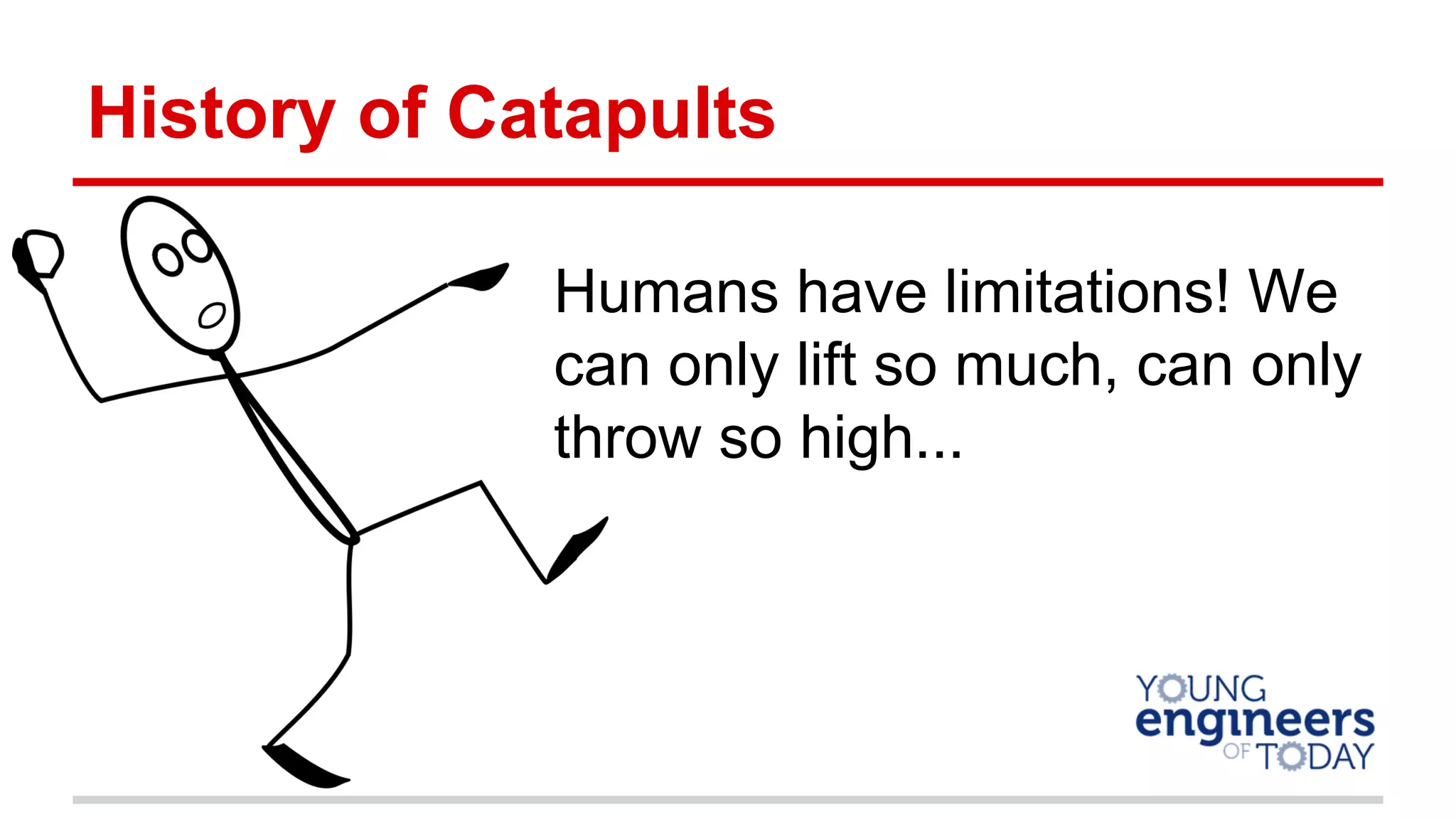
Humans have limitations! We
can only lift so much, can only
throw so high...
History of Catapults
By increasing the energy stored in projectiles,
you can increase the amount of damage they
will inflict.
History of Catapults
War has always been a motivating force in
development of new technologies.
This helped engineering advance in many
areas, not just weaponry.
History of Catapults
Engineers researched ways to increase these
forms of energy storage in weapons in order
to increase their damage.
History of the catapult
In 399 BC Dionysius of Syracuse created a
think tank to design and build weapons for his
campaign against Carthage.
The goal was to overcome limitations of the
basic bow and arrow - how could they increase
the energy stored?
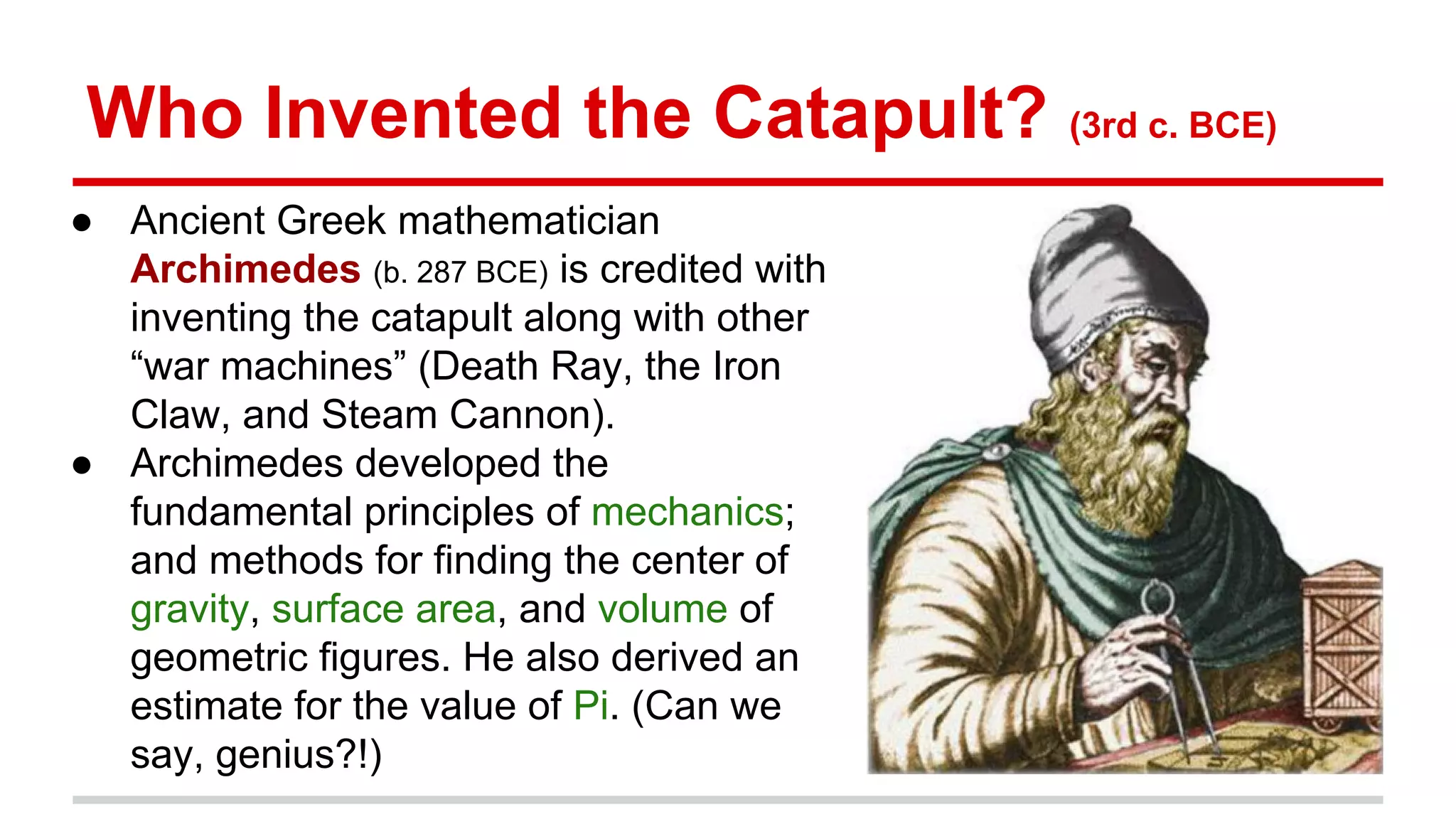
Who Invented the Catapult? (3rd c. BCE)
● Ancient Greek mathematician
Archimedes (b. 287 BCE) is credited with
inventing the catapult along with other
“war machines” (Death Ray, the Iron
Claw, and Steam Cannon).
● Archimedes developed the
fundamental principles of mechanics;
and methods for finding the center of
gravity, surface area, and volume of
geometric figures. He also derived an
estimate for the value of Pi. (Can we
say, genius?!)
Catapult Development
● War has always been a motivating force in development
of new technologies.
● An interesting thing about catapults is that they
developed over time from smaller weapons.
● The Catapult is a derivative and direct result of the Bow.
● The catapult is the end result of the desire to make
weapons that are bigger, more powerful, and can
hurl bigger objects longer distances.
Types of Catapults
Catapults can be split into three categories:
● Traditional Catapult
● Ballista
● Trebuchet
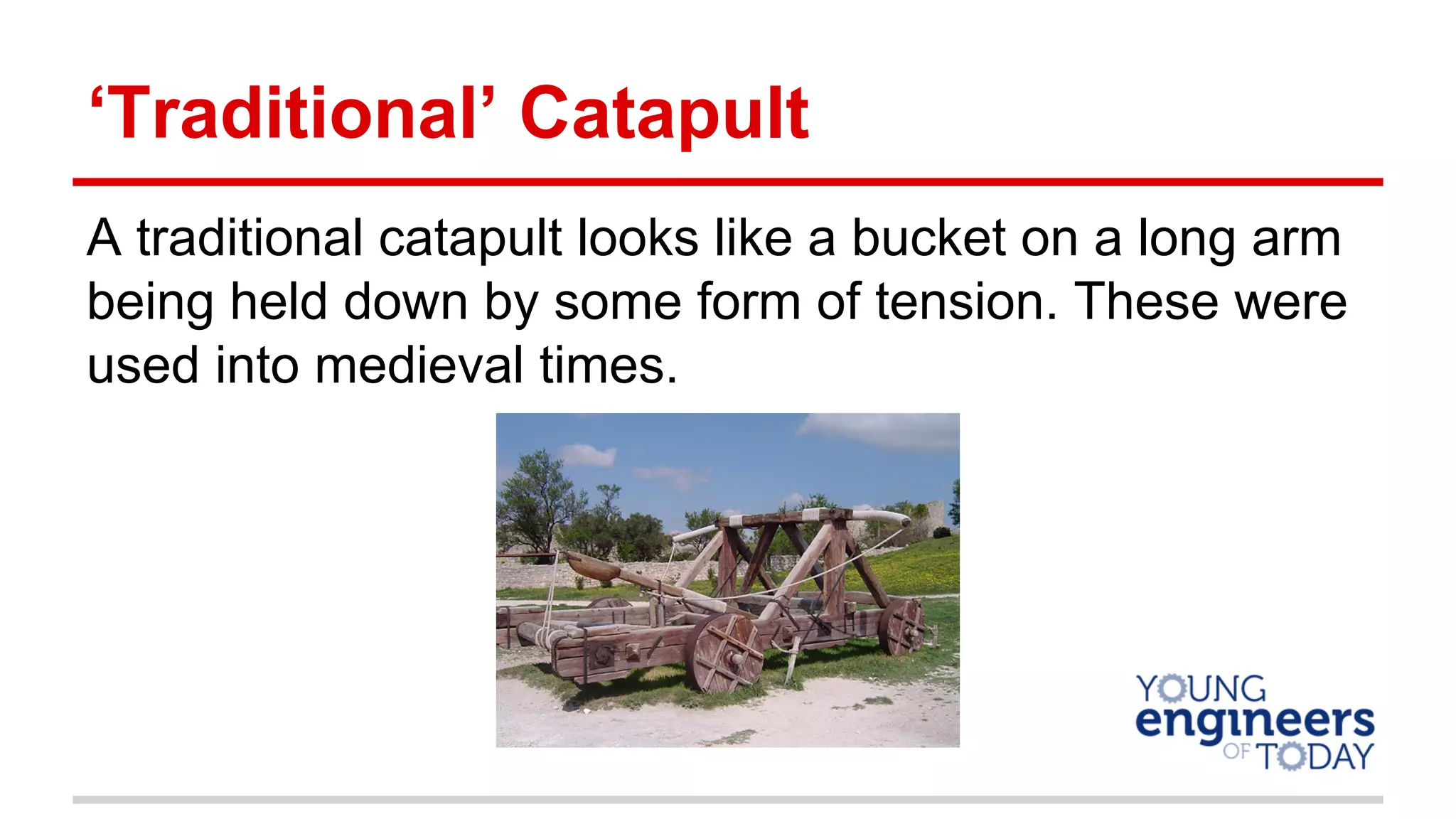
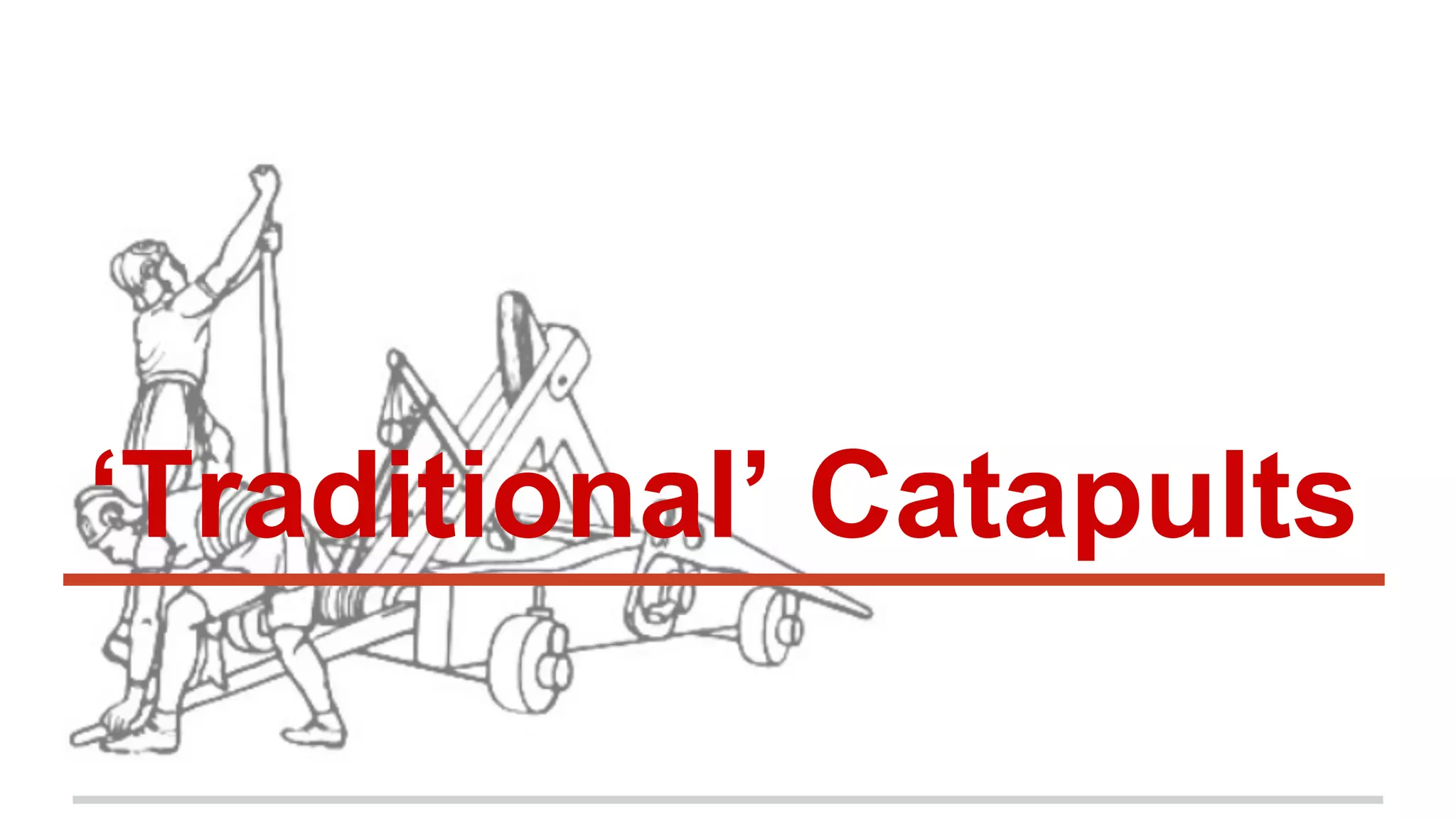
‘Traditional’ Catapult
A traditional catapult looks like a bucket on a long arm
being held down by some form of tension. These were
used into medieval times.
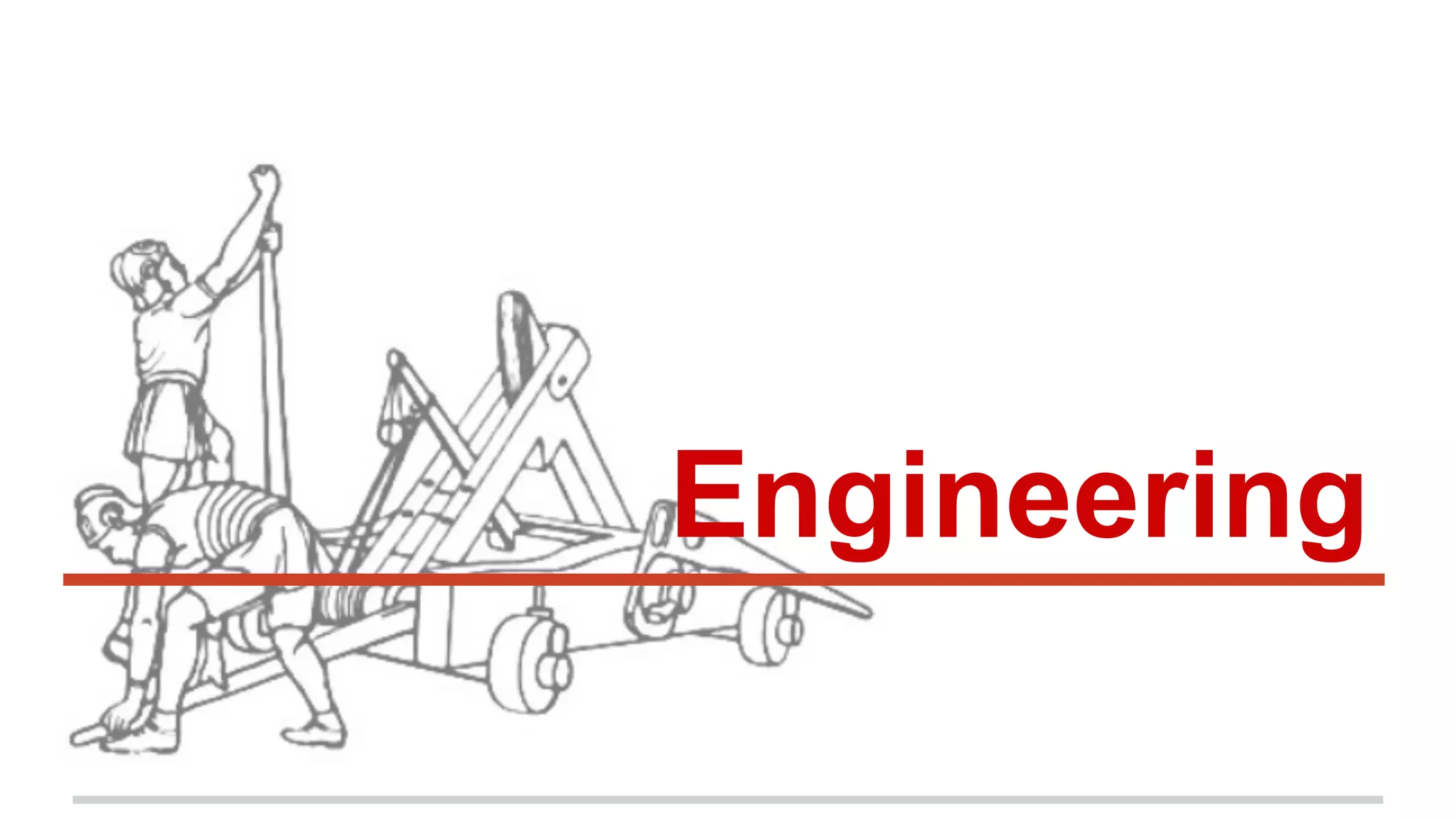
Engineering
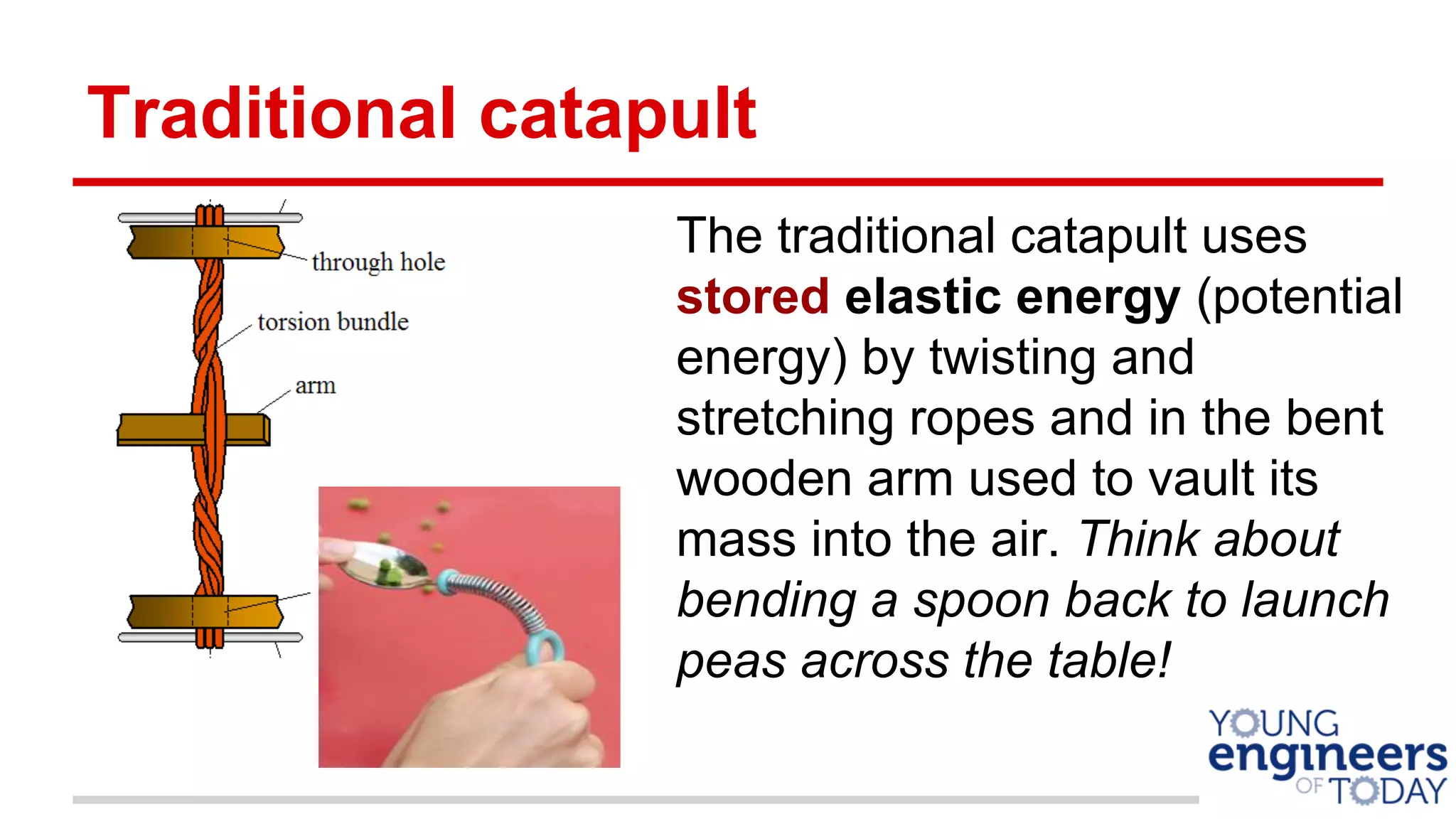
Traditional catapult
The traditional catapult uses
stored elastic energy (potential
energy) by twisting and
stretching ropes and in the bent
wooden arm used to vault its
mass into the air. Think about
bending a spoon back to launch
peas across the table!
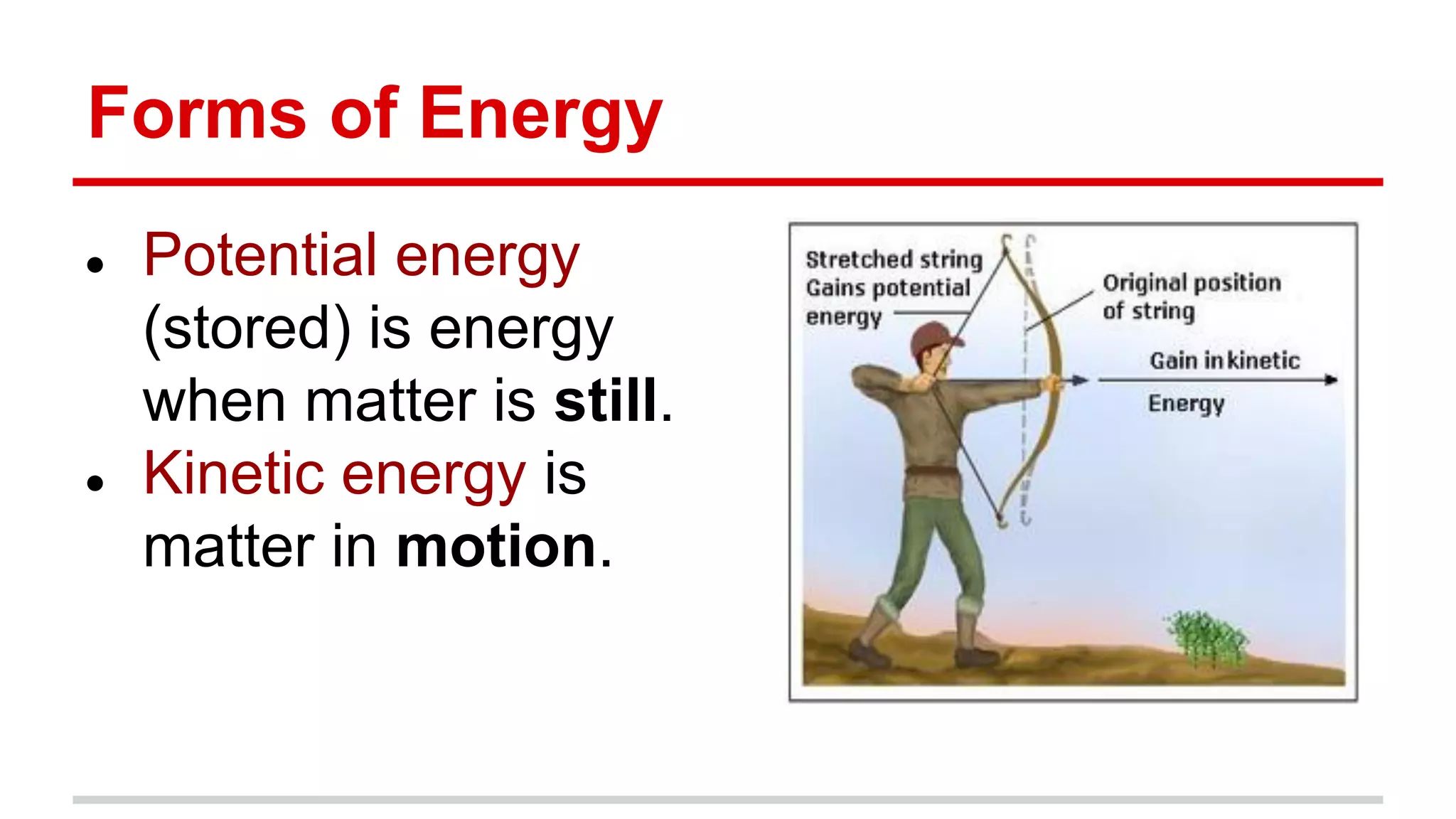
Forms of Energy
● Potential energy
(stored) is energy
when matter is still.
● Kinetic energy is
matter in motion.
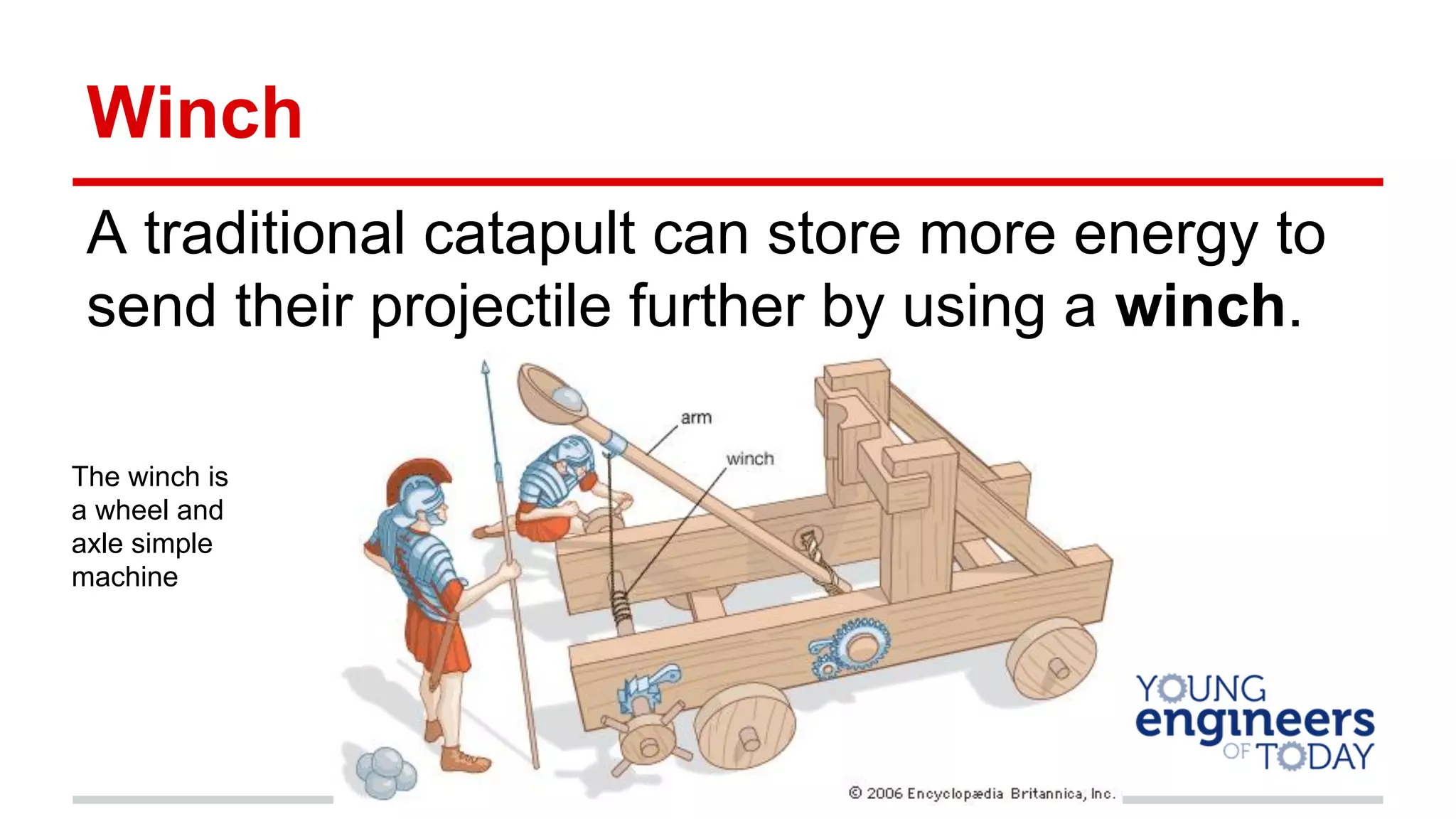
Winch
A traditional catapult can store more energy to
send their projectile further by using a winch.
The winch is
a wheel and
axle simple
machine
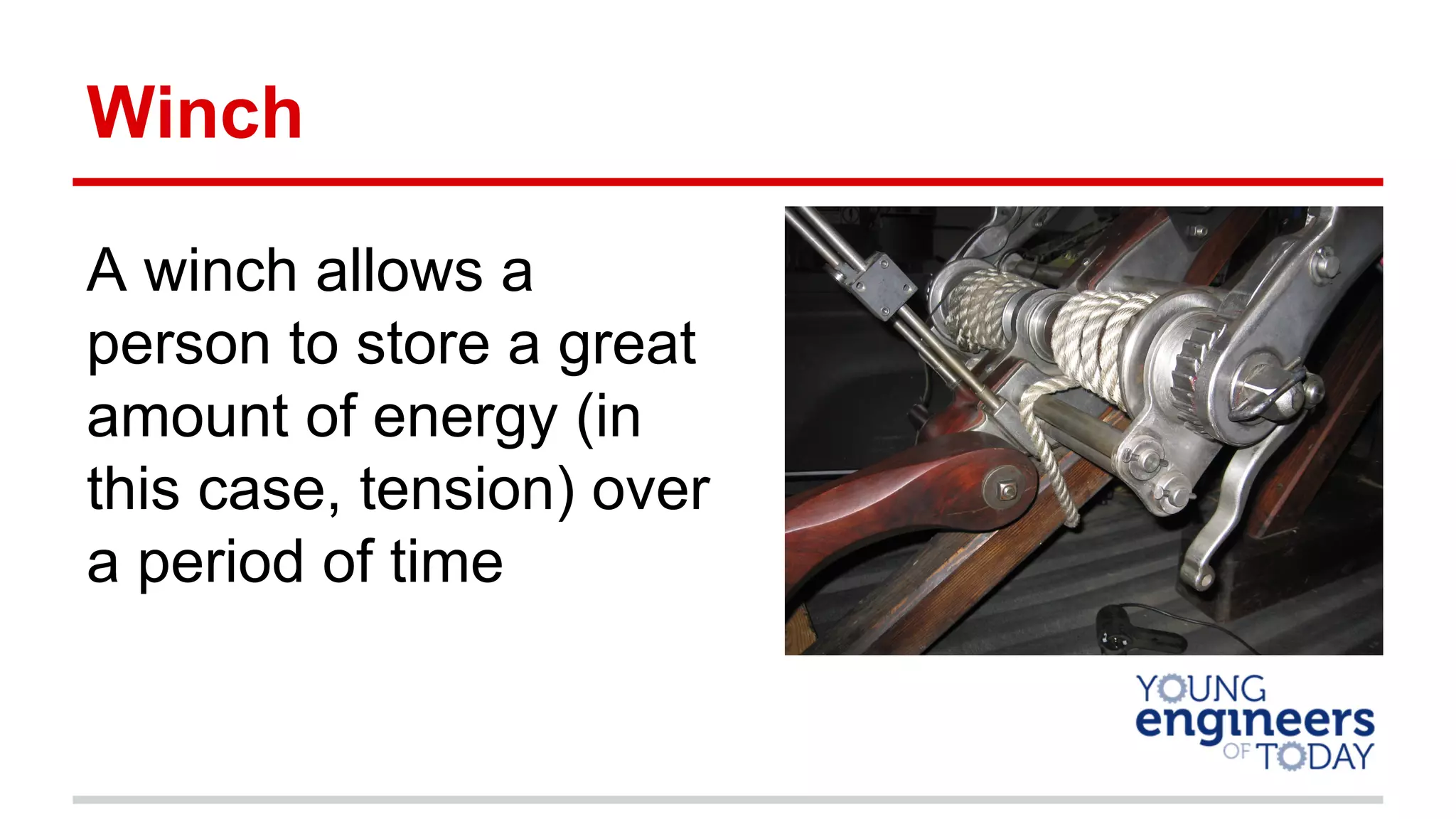
Winch
A winch allows a
person to store a great
amount of energy (in
this case, tension) over
a period of time
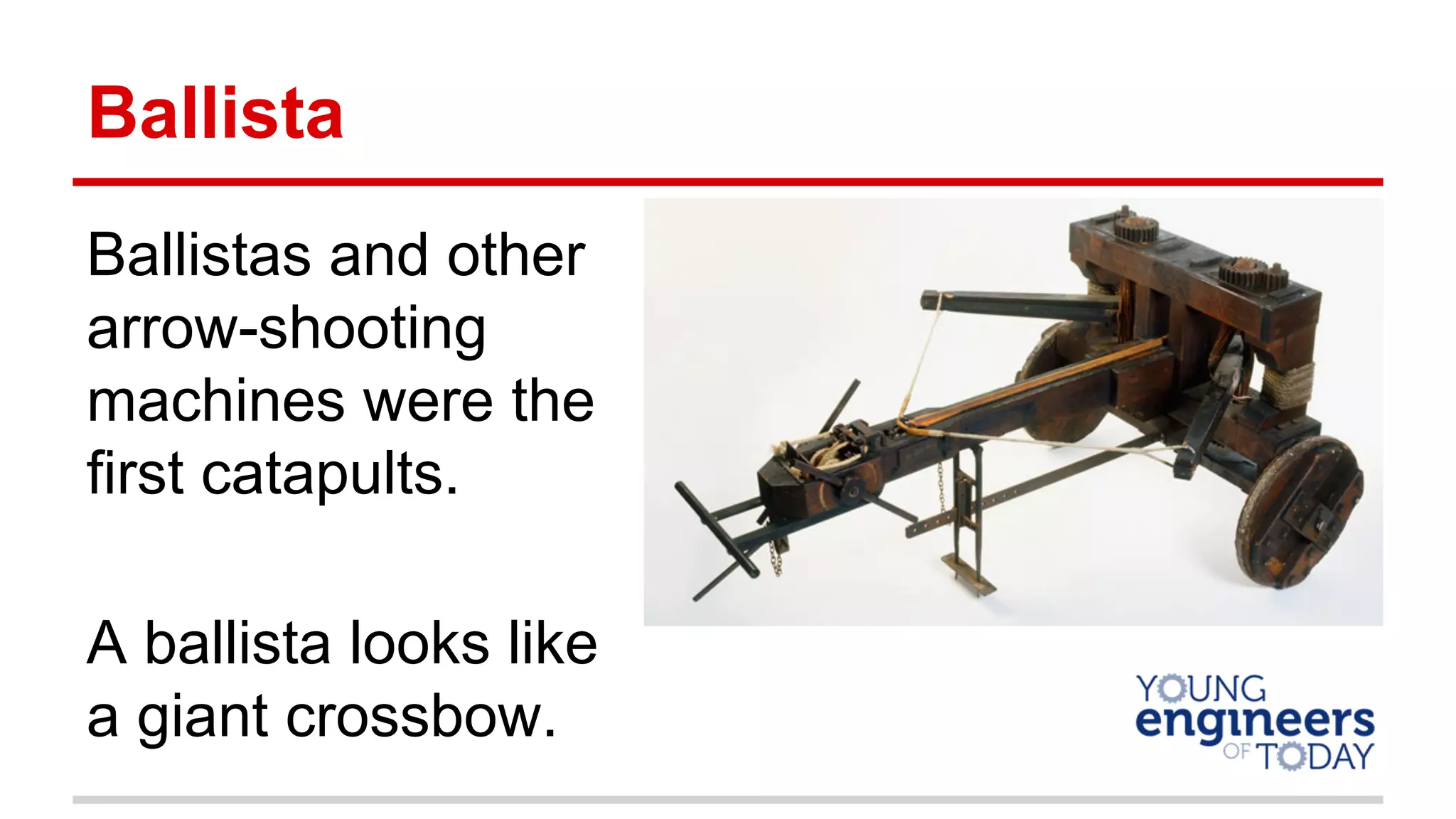
Ballista
Ballistas and other
arrow-shooting
machines were the
first catapults.
A ballista looks like
a giant crossbow.
So to increase the potential energy...
● Heft the projectile higher off the ground
● Make the projectile heavier
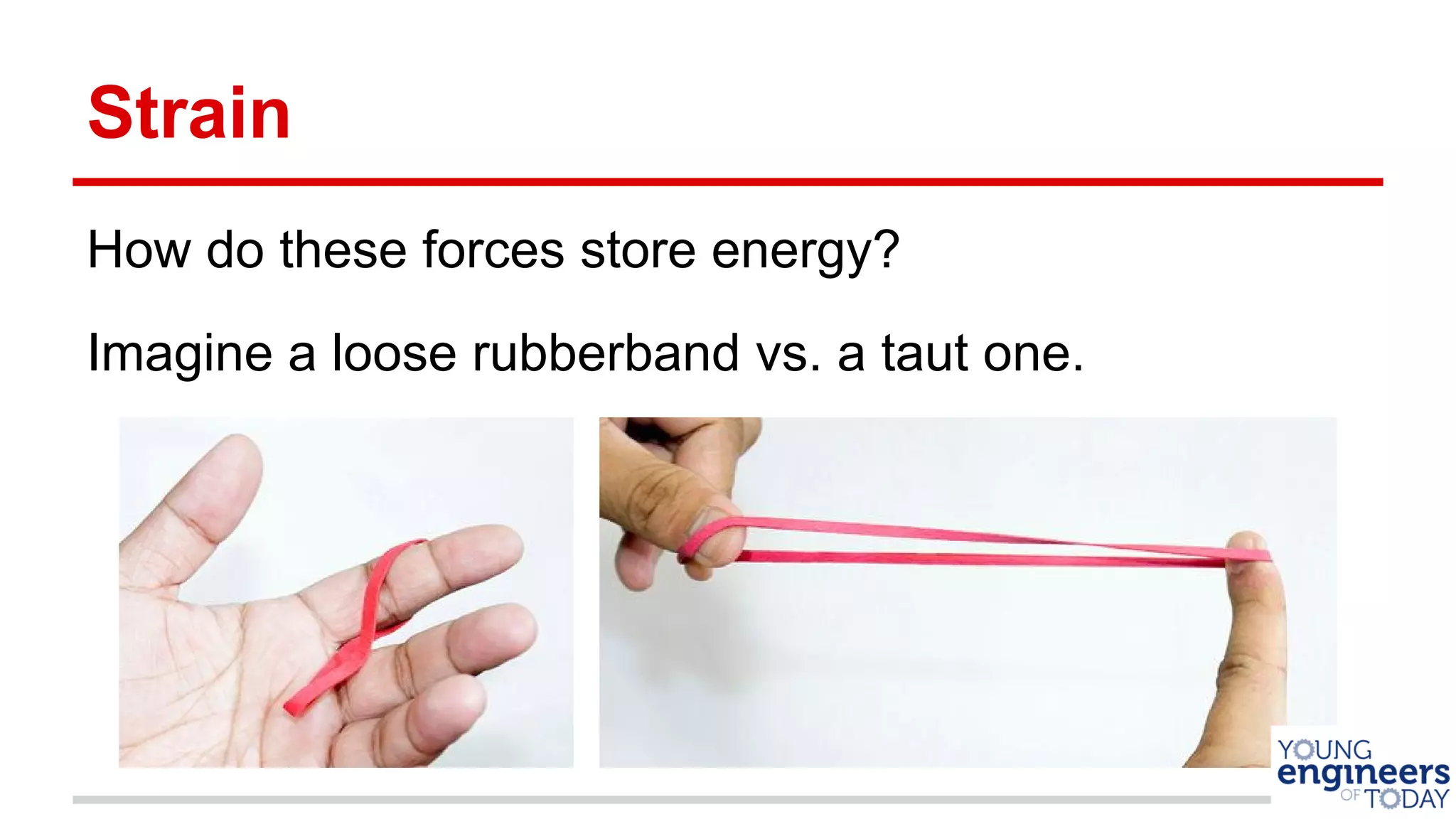
Strain
How do these forces store energy?
Imagine a loose rubberband vs. a taut one.
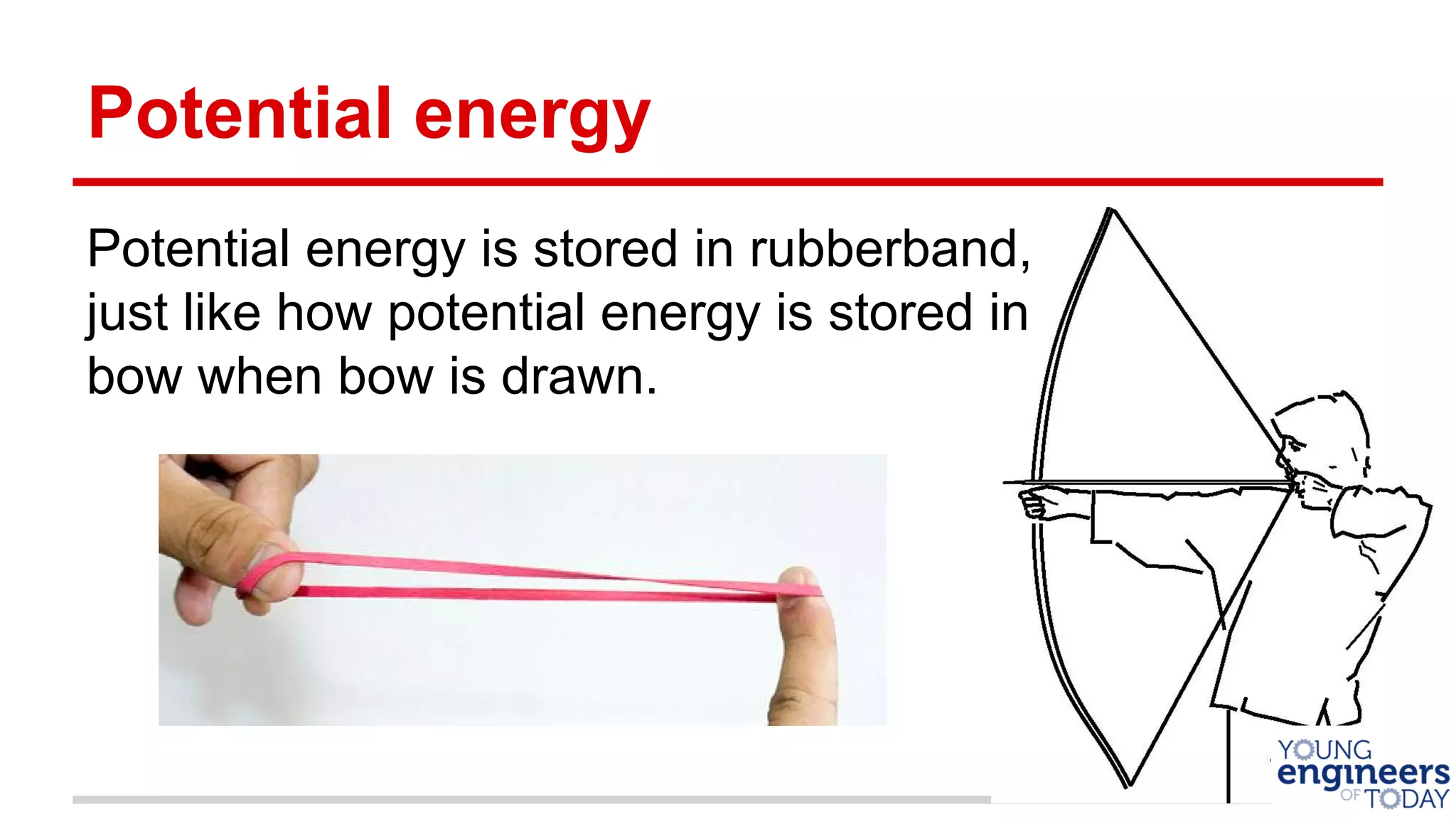
Potential energy
Potential energy is stored in rubberband,
just like how potential energy is stored in
bow when bow is drawn.
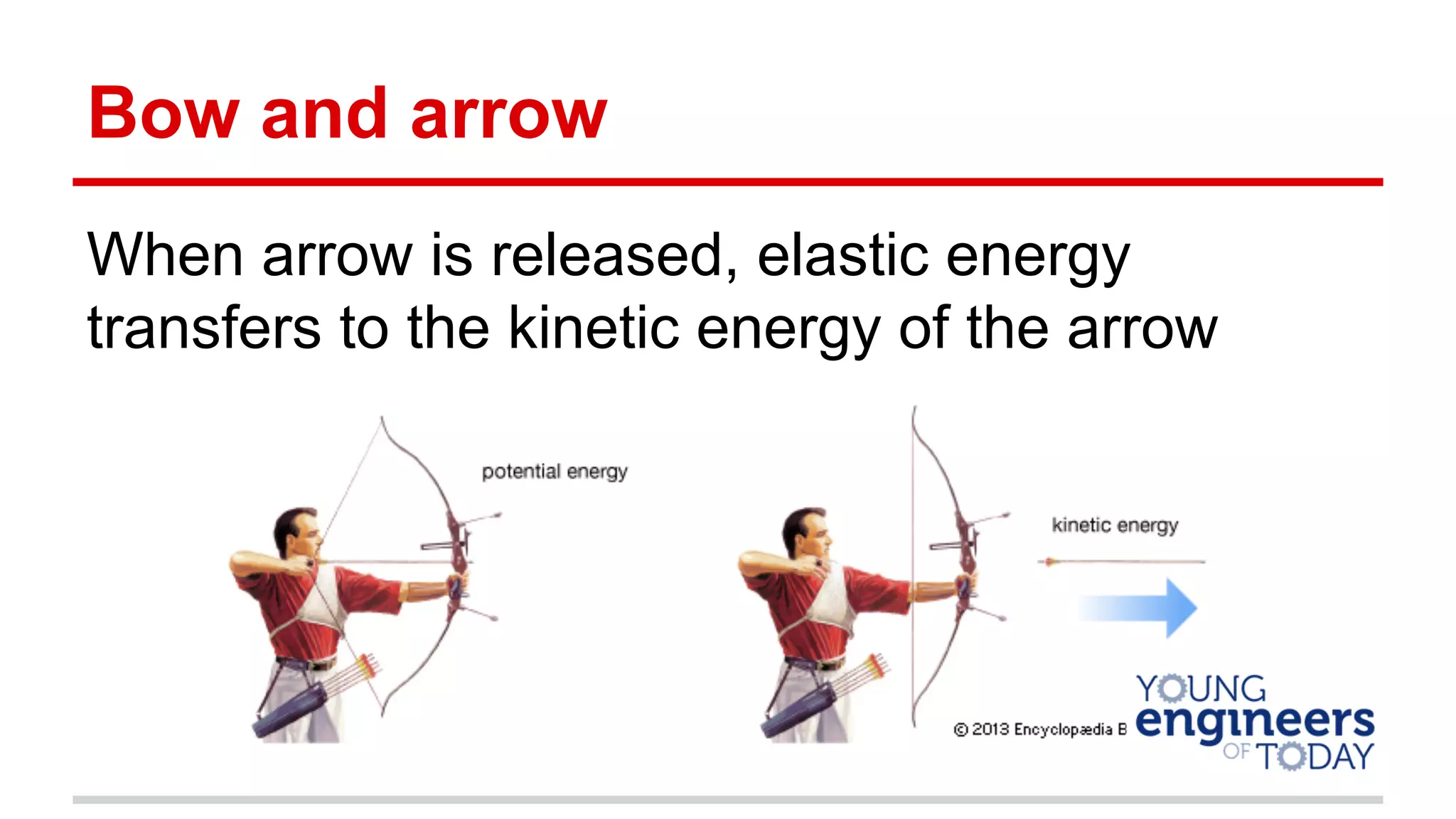
Bow and arrow
As you pull the string of a bow, your arm does
work.
The energy that it takes you to pull that string is
stored in the bow as tension.
Bow and arrow
When arrow is released, elastic energy
transfers to the kinetic energy of the arrow
Compound bow
Bow makers discovered they could strengthen
the bow even more if they combined:
● Wood
● Animal horn
● & Animal sinew
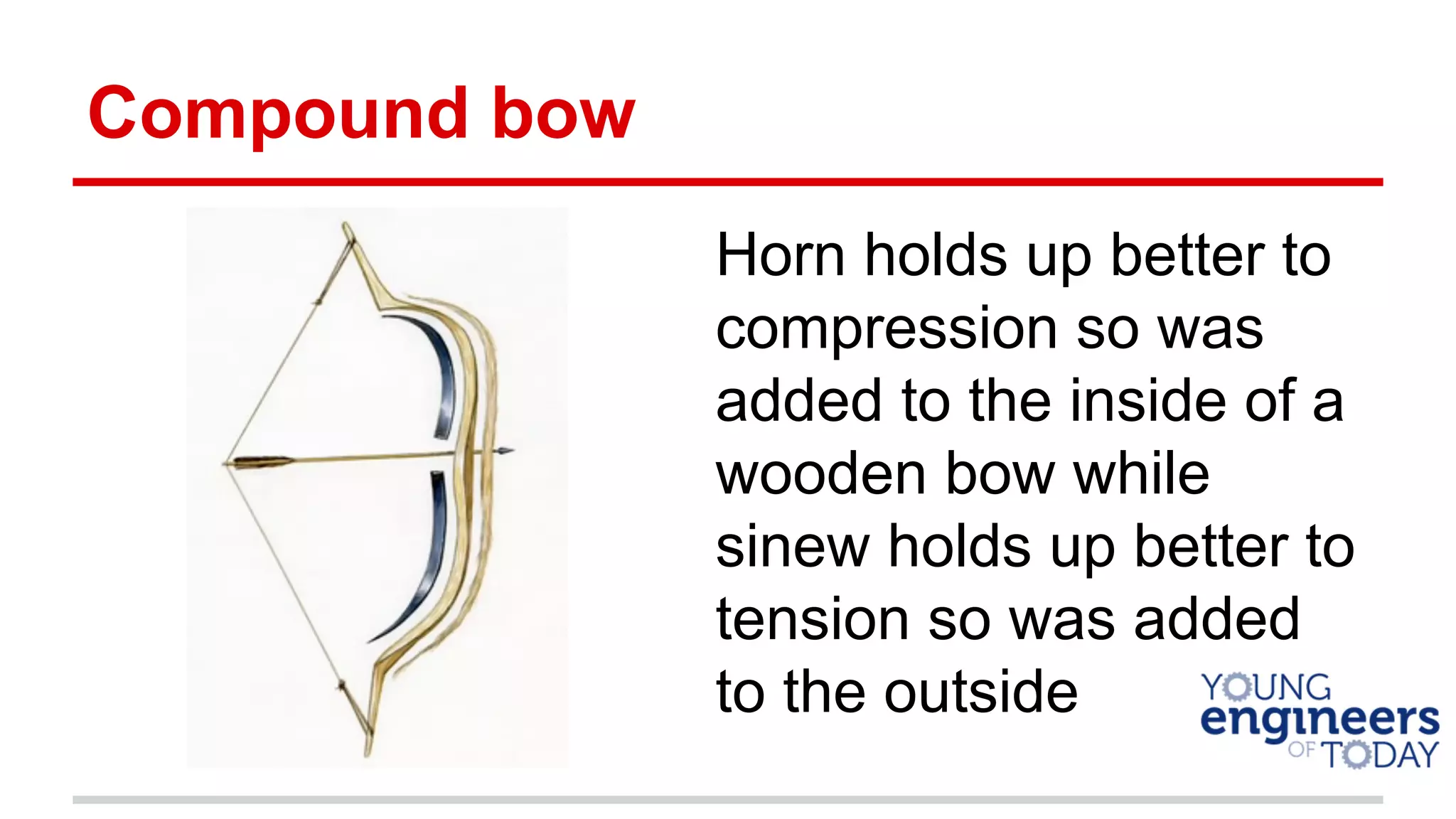
Compound bow
Horn holds up better to
compression so was
added to the inside of a
wooden bow while
sinew holds up better to
tension so was added
to the outside
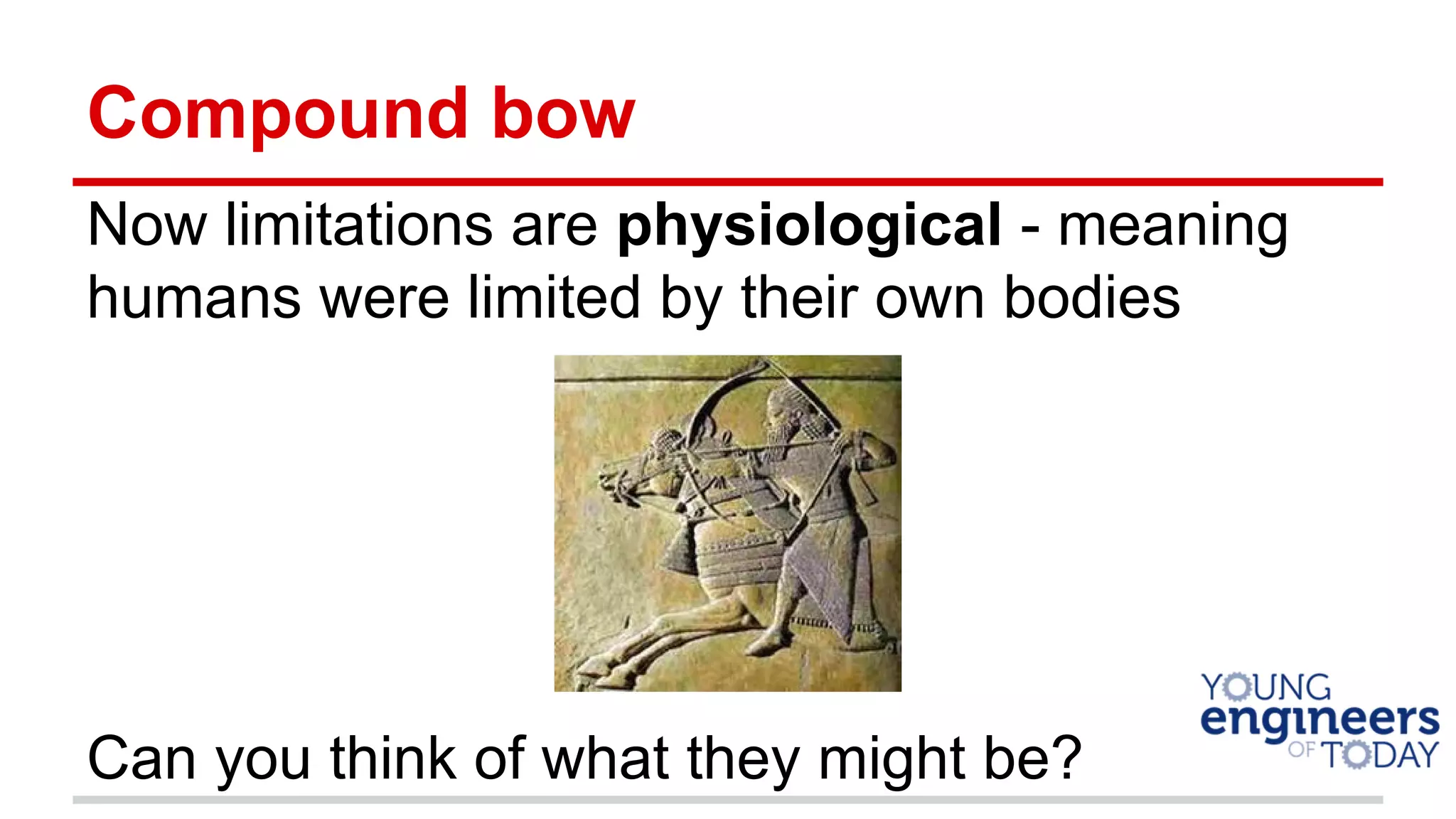
Compound bow
Now limitations are physiological - meaning
humans were limited by their own bodies
Can you think of what they might be?
Compound bow
● Length of an archer’s arms
● Strength of arm, chest, & shoulder muscles
● Strength and dexterity of fingers
Compound bow
Because of these limitations, the best possible
bow required 45 pounds to pull with a 28 inch
draw range.
Back to the think tank...
So how was the group going to advance bow
and arrow technology?
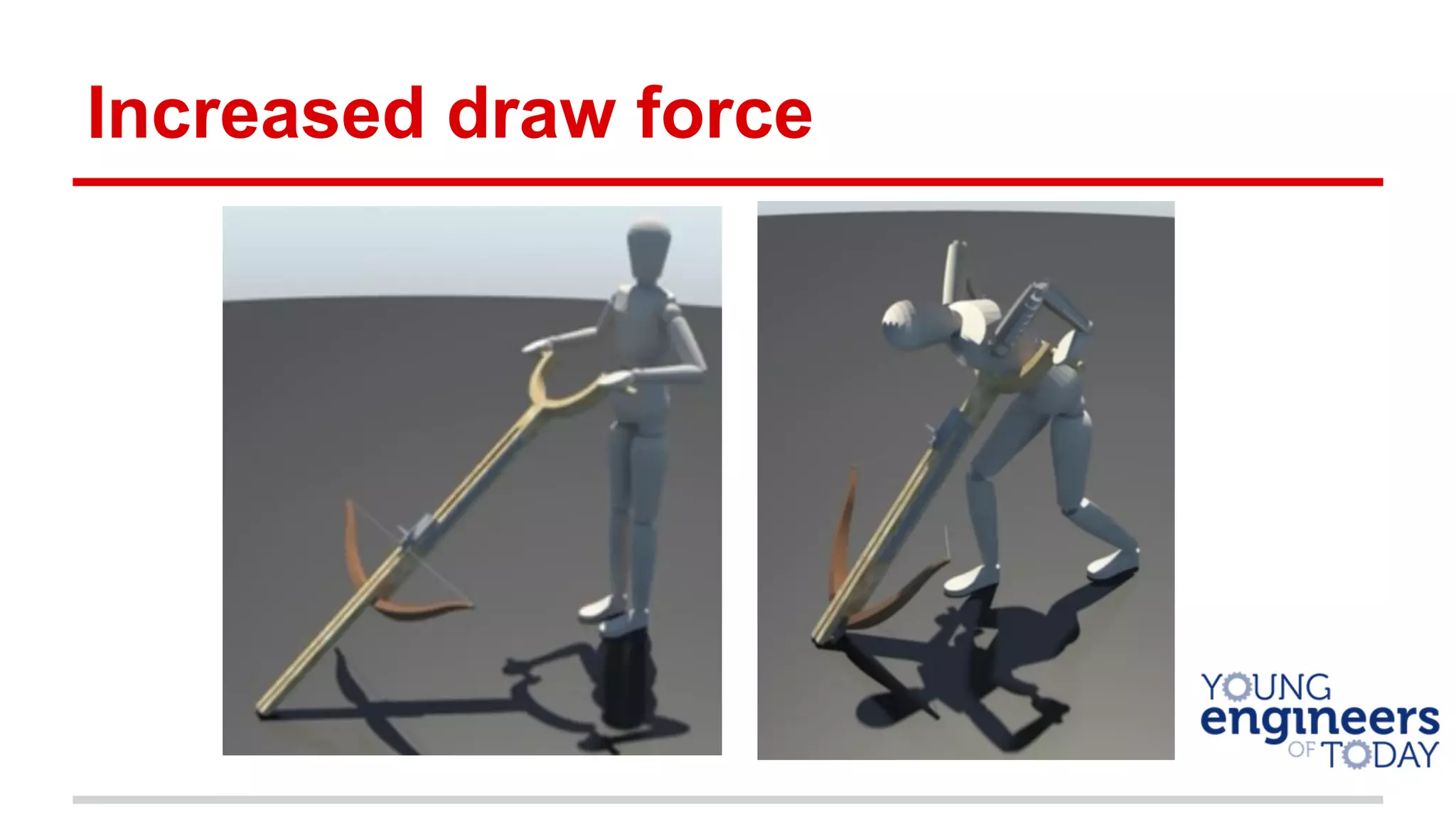
Their first solution was the gastraphetes or
“belly bow”
Gastraphetes
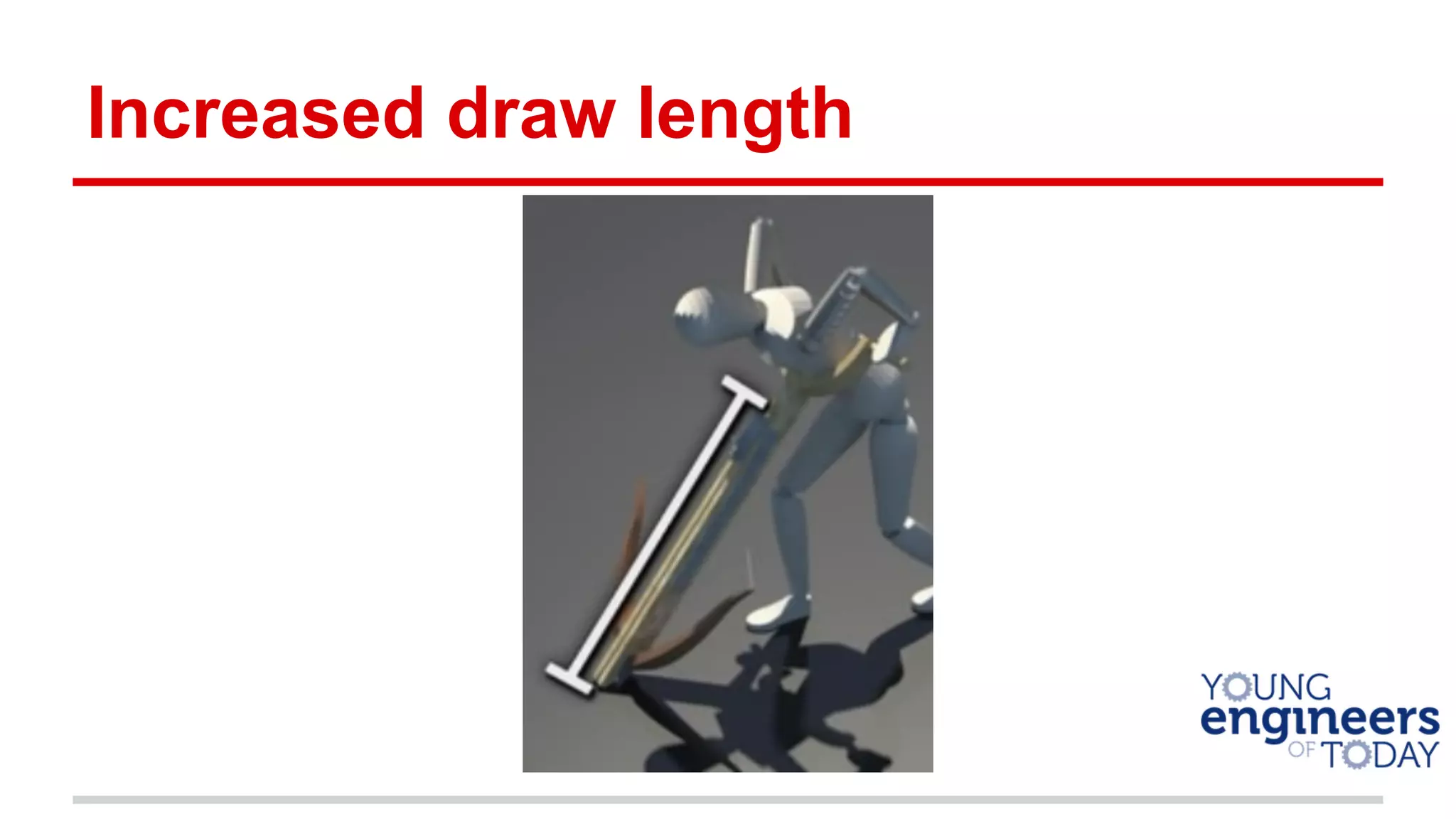
Increased draw force
Increased draw length
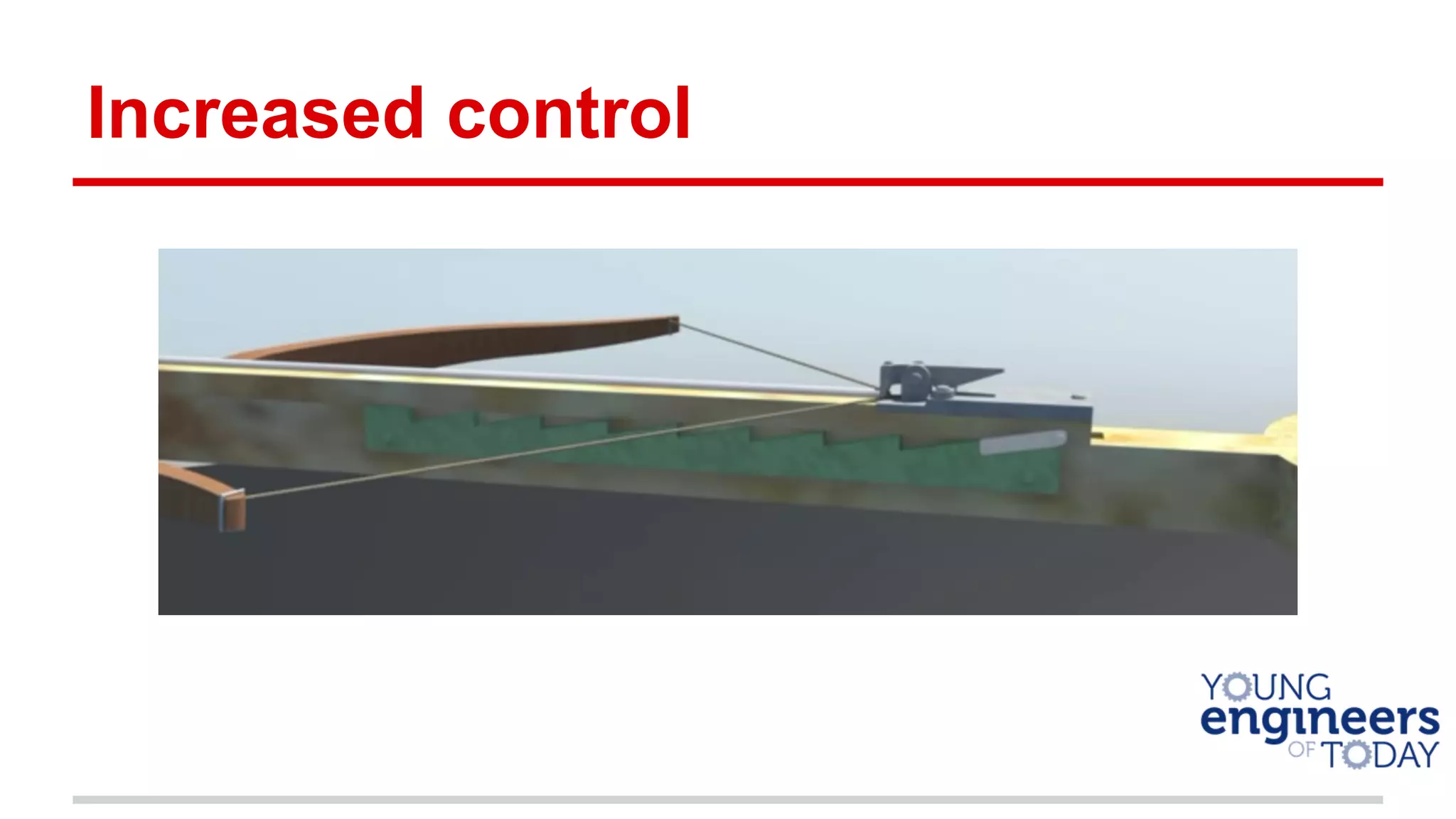
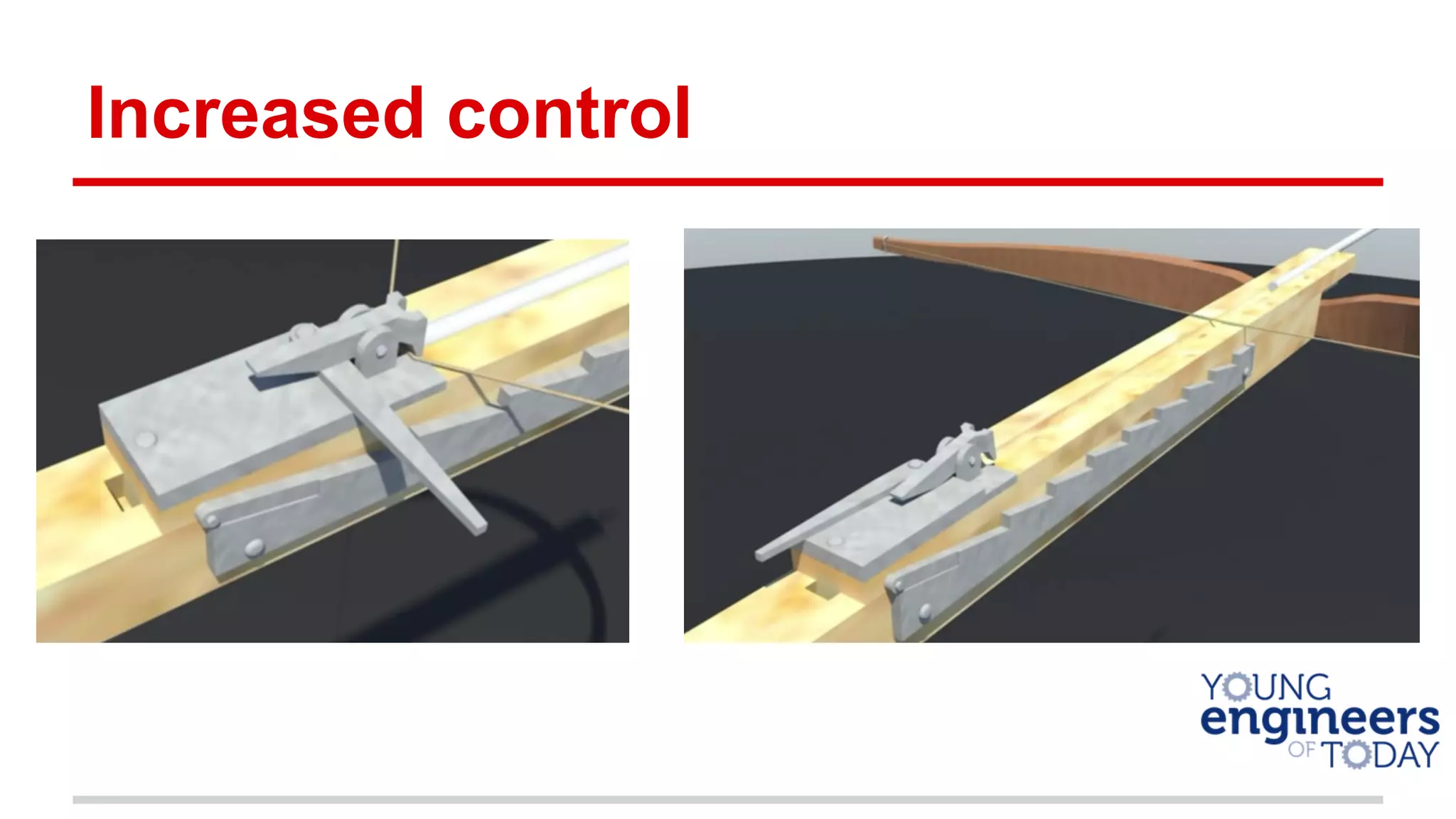
Increased control
Increased control
Advancement and Progress
Weapon makers continued improving the
gastraphetes.
What did they do to make it better?
Advancement and Progress
Made it BIGGER of course!
This development led to technological
advancements that made the first true catapult
possible.
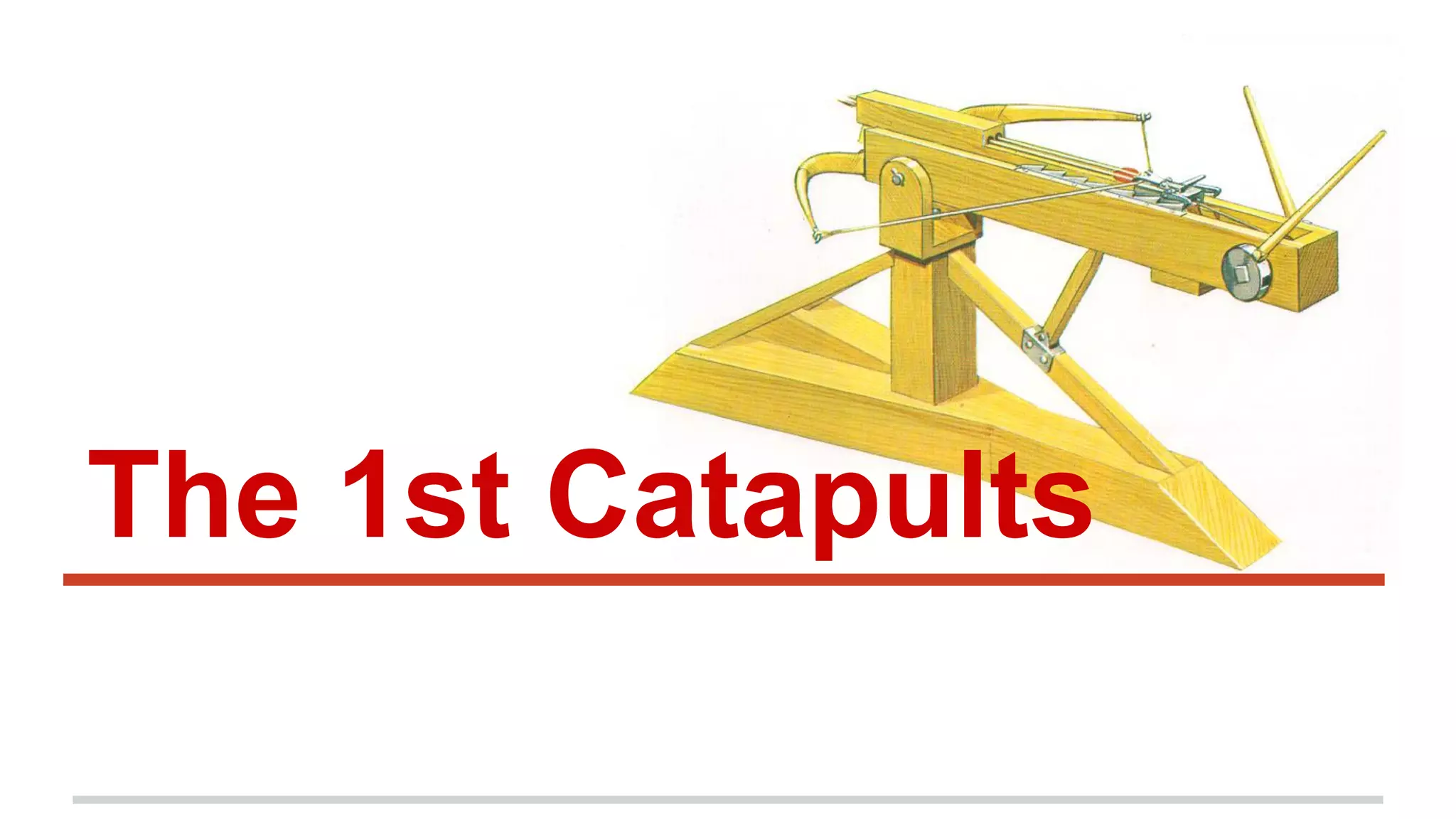
The 1st Catapults
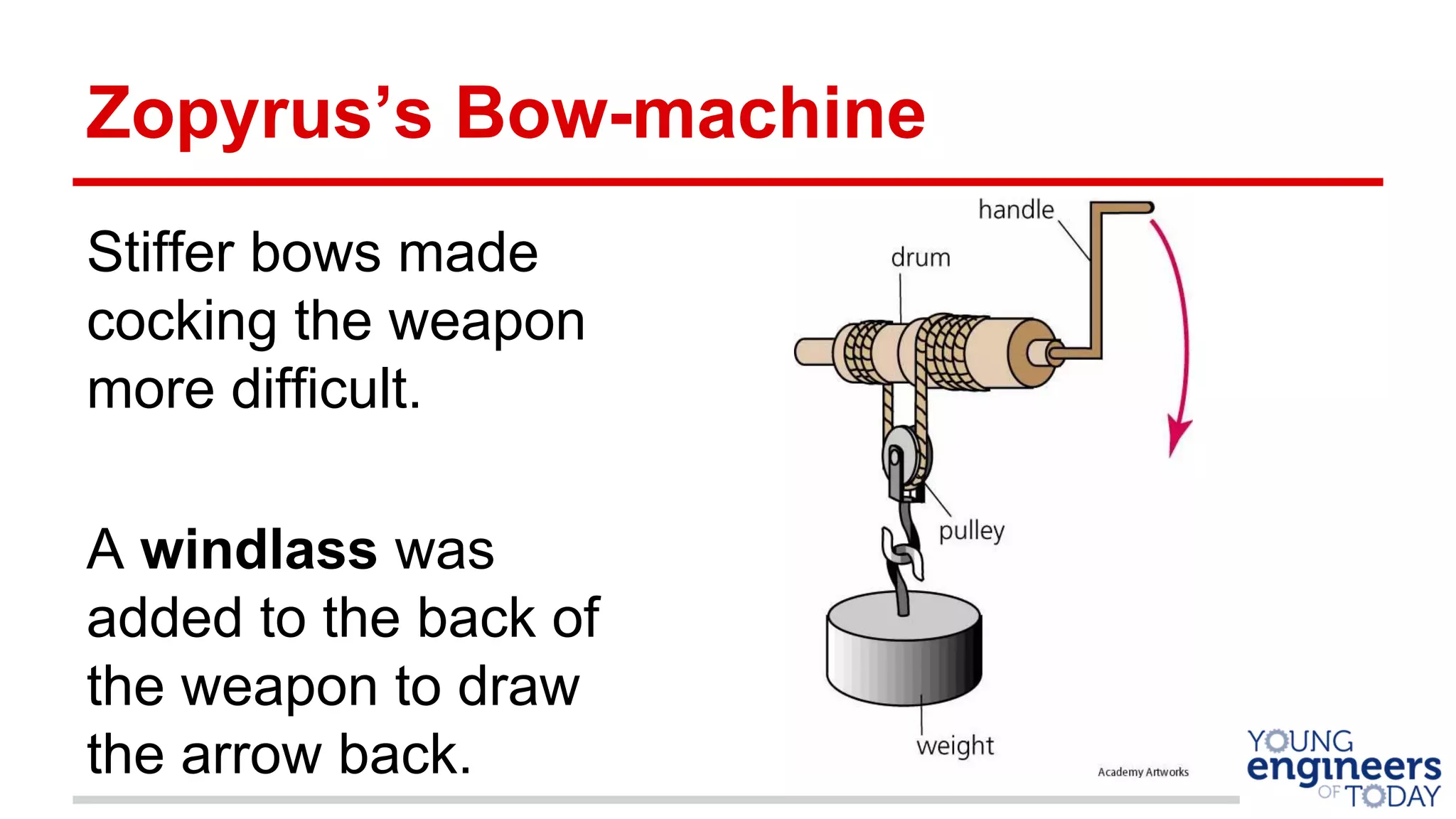
Zopyrus’s Bow-machine
Stiffer bows made
cocking the weapon
more difficult.
A windlass was
added to the back of
the weapon to draw
the arrow back.
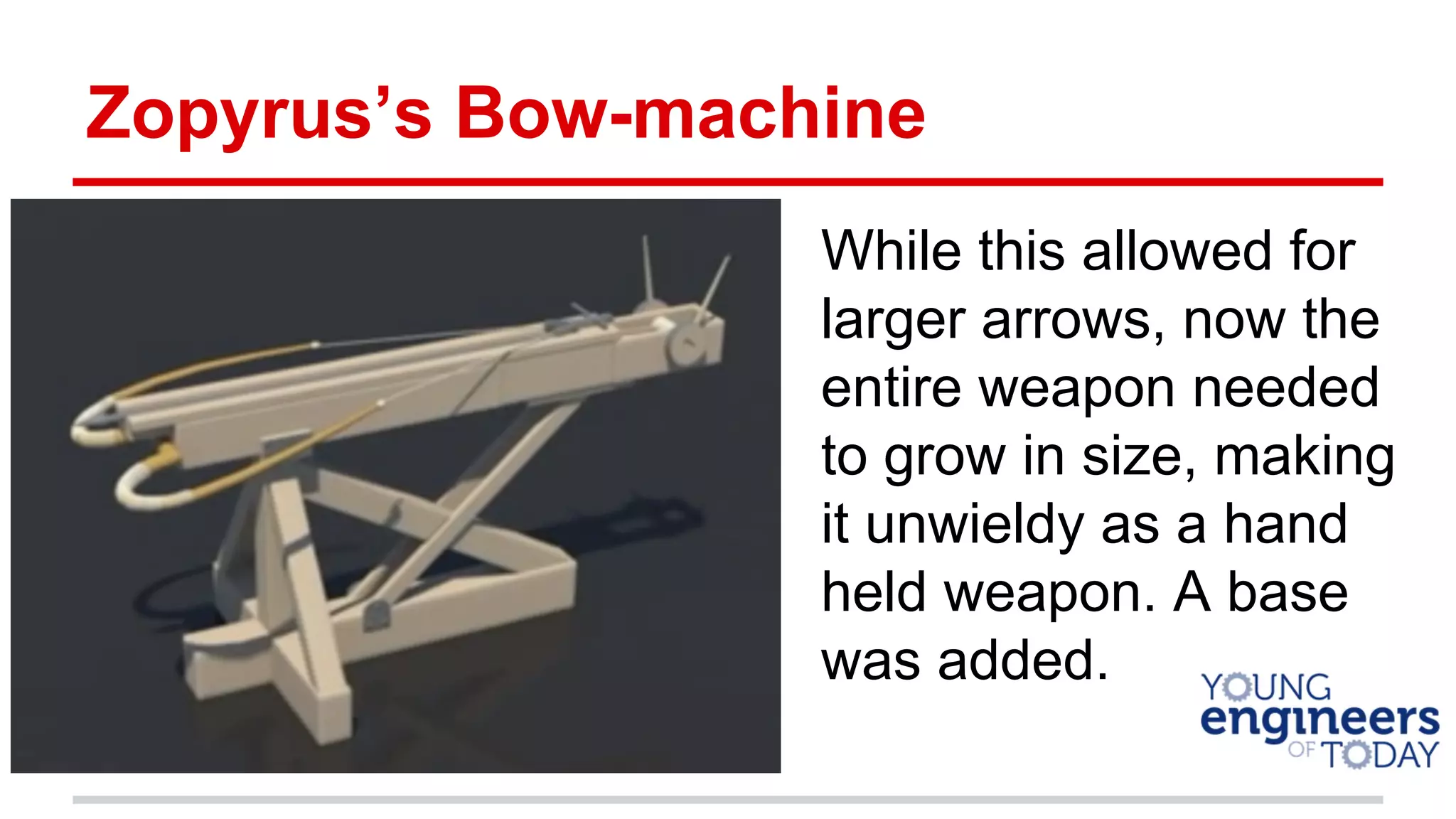
Zopyrus’s Bow-machine
While this allowed for
larger arrows, now the
entire weapon needed
to grow in size, making
it unwieldy as a hand
held weapon. A base
was added.
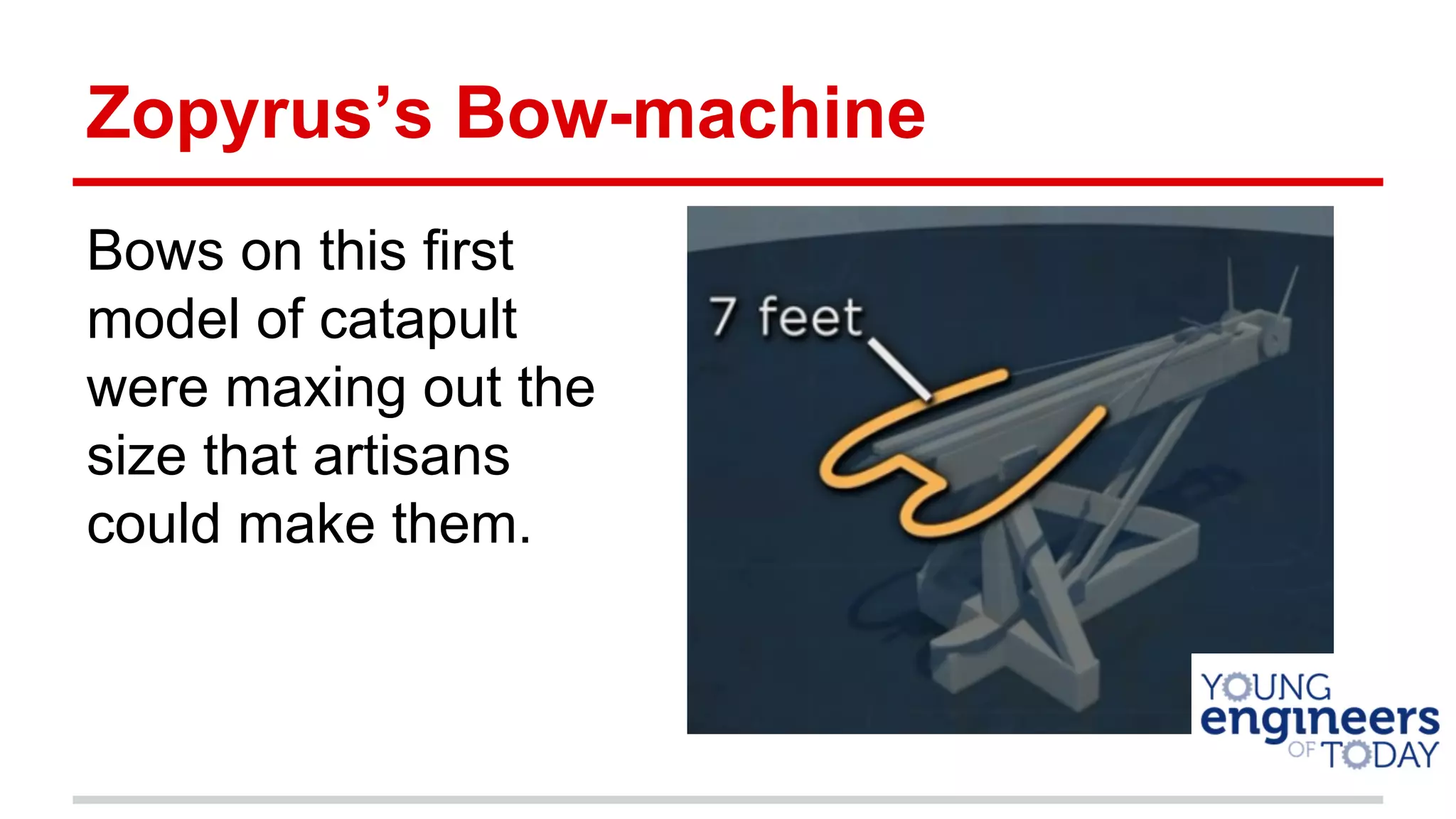
Zopyrus’s Bow-machine
Bows on this first
model of catapult
were maxing out the
size that artisans
could make them.
Catapult development
Composite bow temporarily meets its limits.
Developers must now turn to fundamentally different
ways of storing elastic energy.
This path led to the Torsion Catapult.
Torsion Catapult
Torsion catapult development occurs over a series of
discoveries and advancements, starting in mid 4th
century B.C.E.
By end of that century we have the arrow shooting
weapon called the euthyntone and the stone
throwing weapon called the palintone.
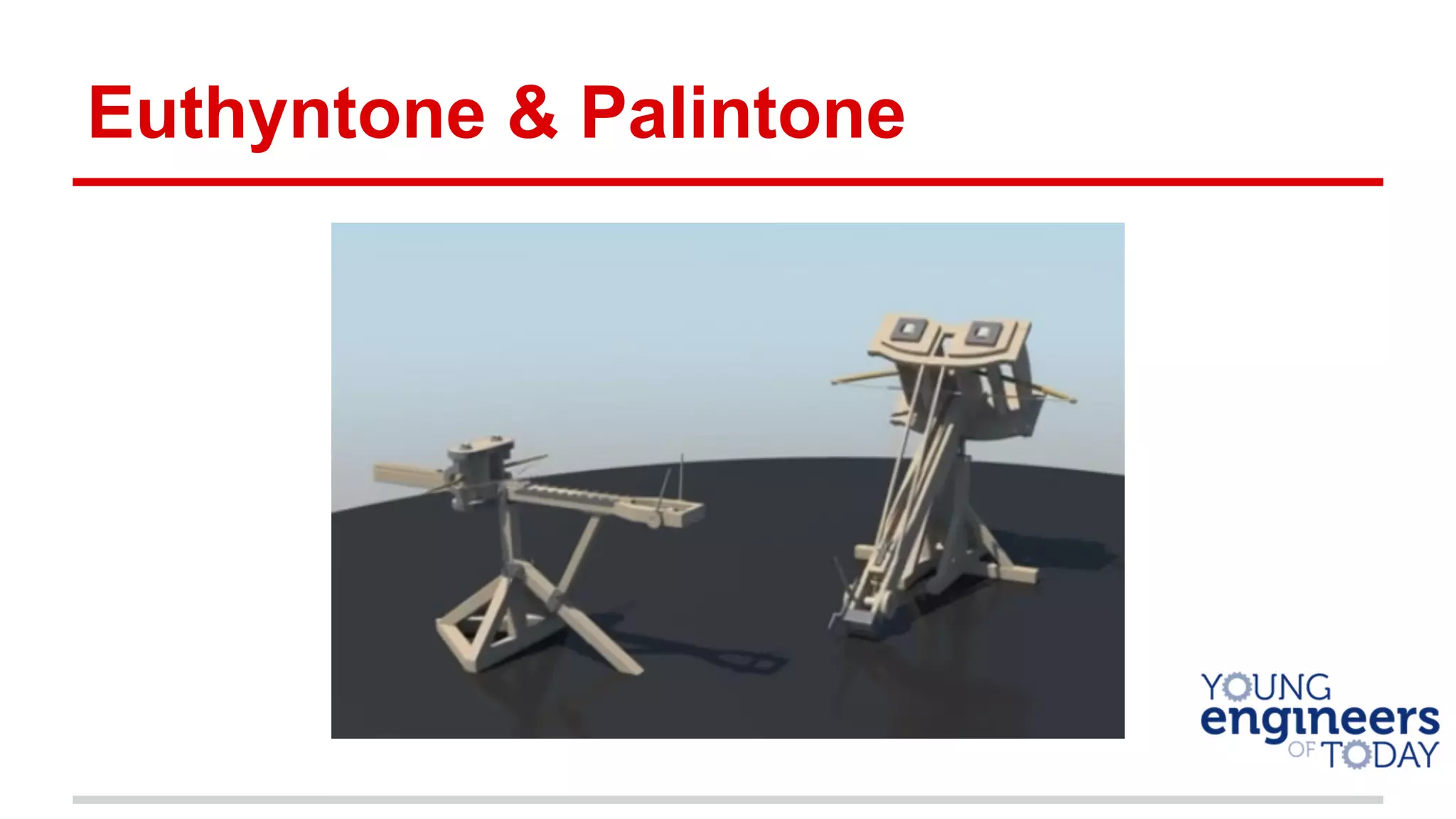
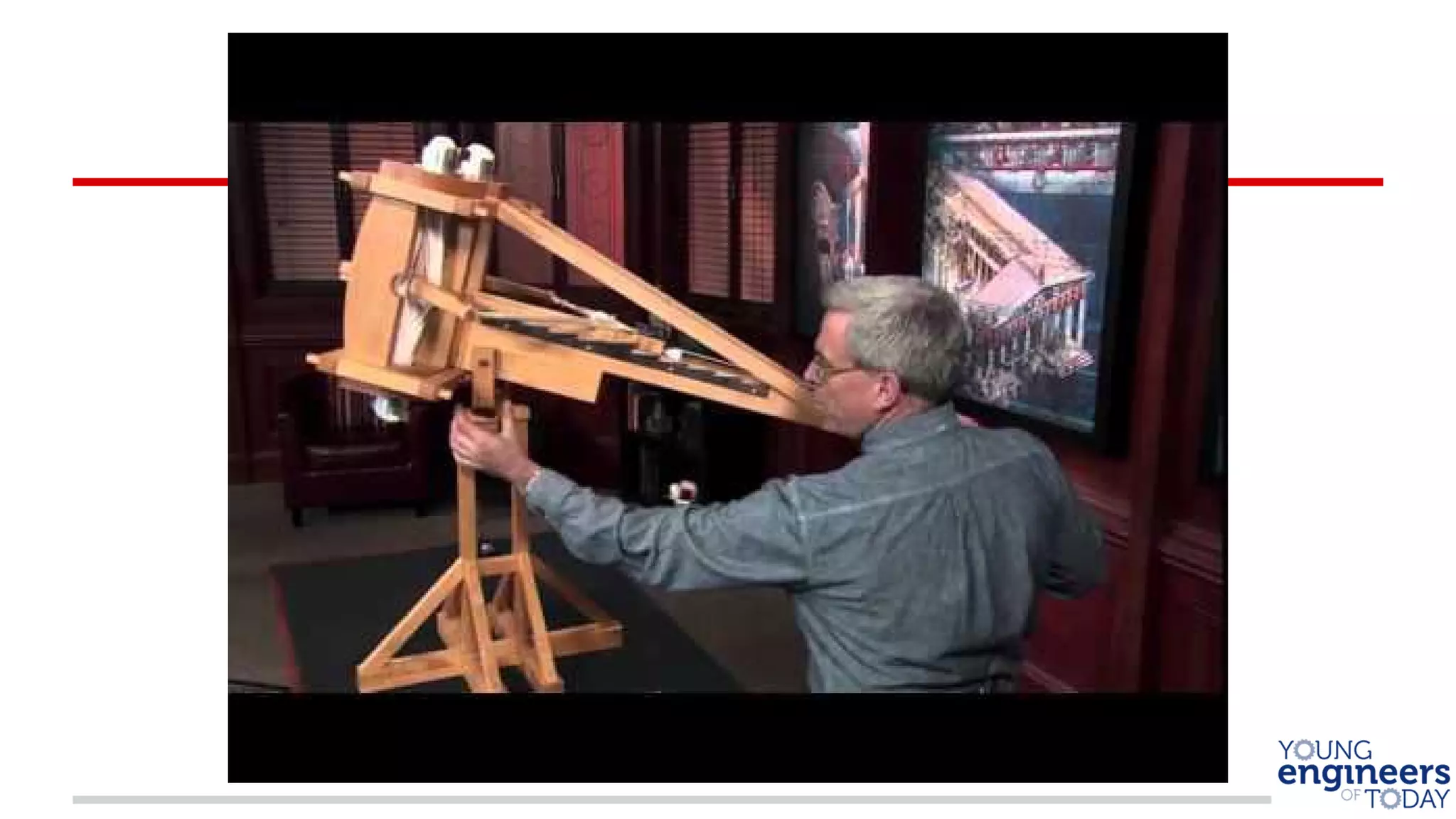
Euthyntone & Palintone
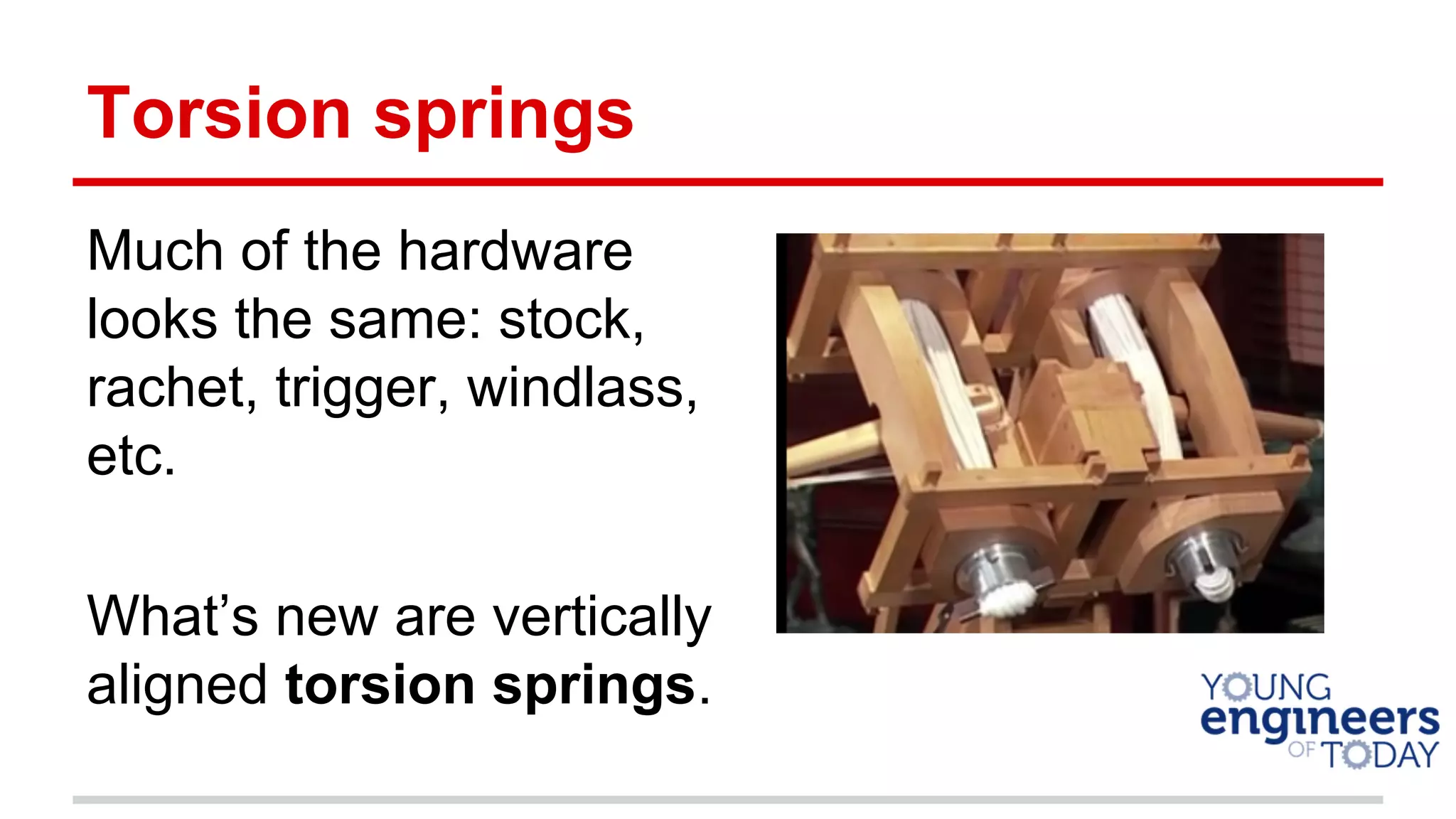
Torsion springs
Much of the hardware
looks the same: stock,
rachet, trigger, windlass,
etc.
What’s new are vertically
aligned torsion springs.
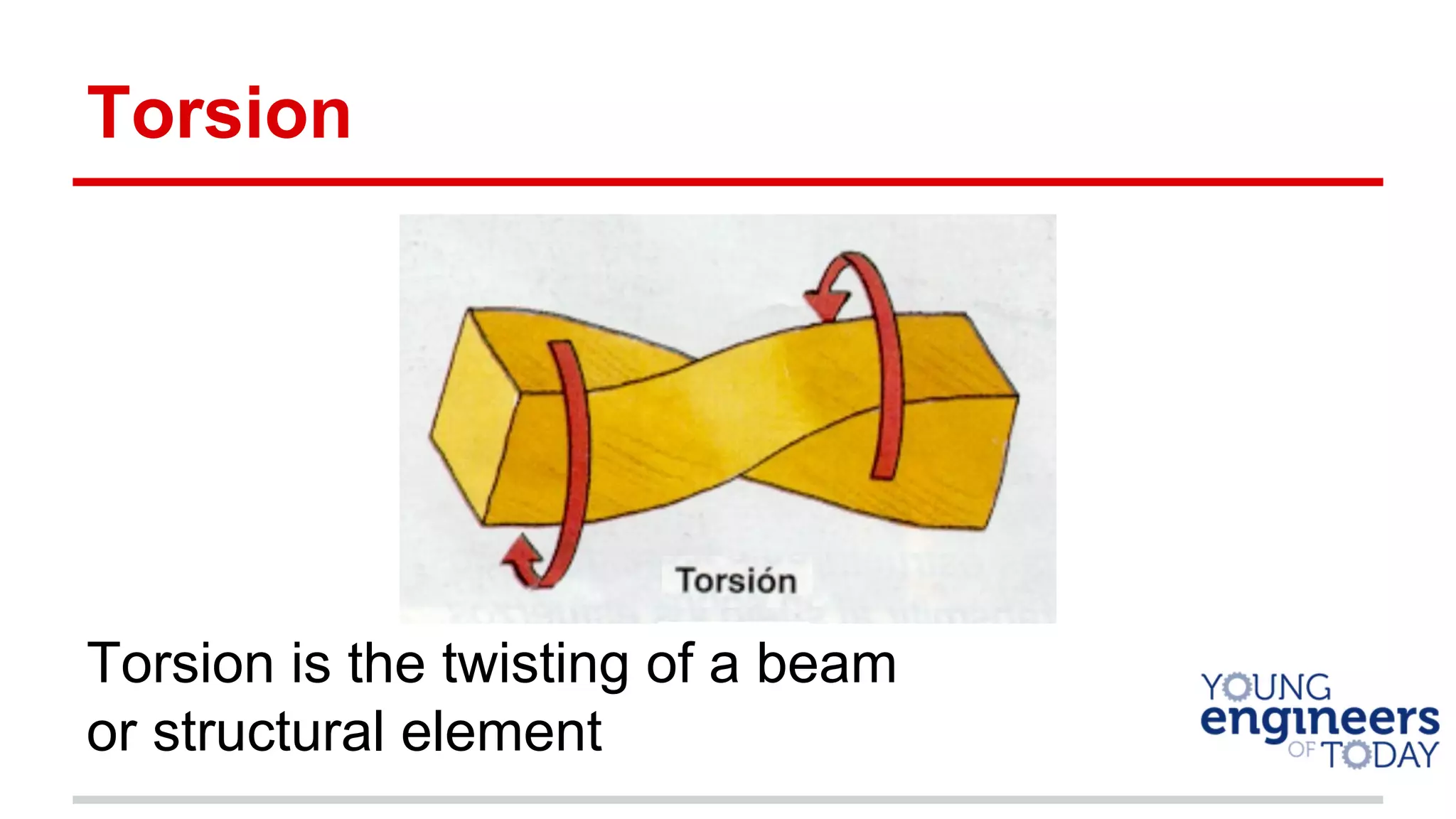
Torsion
Torsion is the twisting of a beam
or structural element
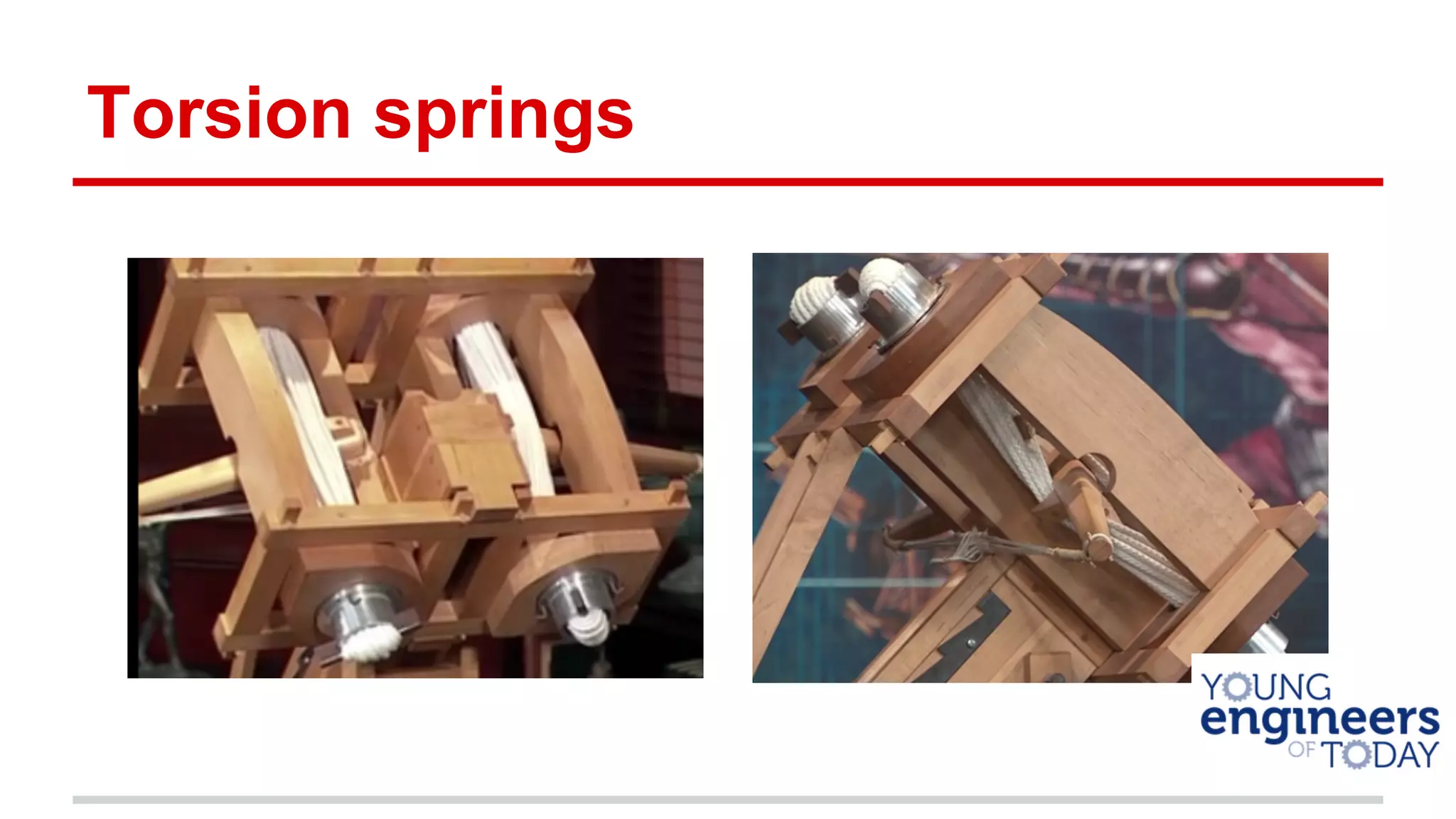
Torsion springs
Torsion springs in a palintone consisted of bundles of
rope with a wooden arm thrust through the center.
What material do you think was used for this rope?
Think back to when we talked about materials that could
withstand compression or tension.
Torsion springs
How powerful were they?
Reports of arrow shooters that could
shoot 200 yards and Roman ballistas that
could throw 200 lb stone balls 400 yards.
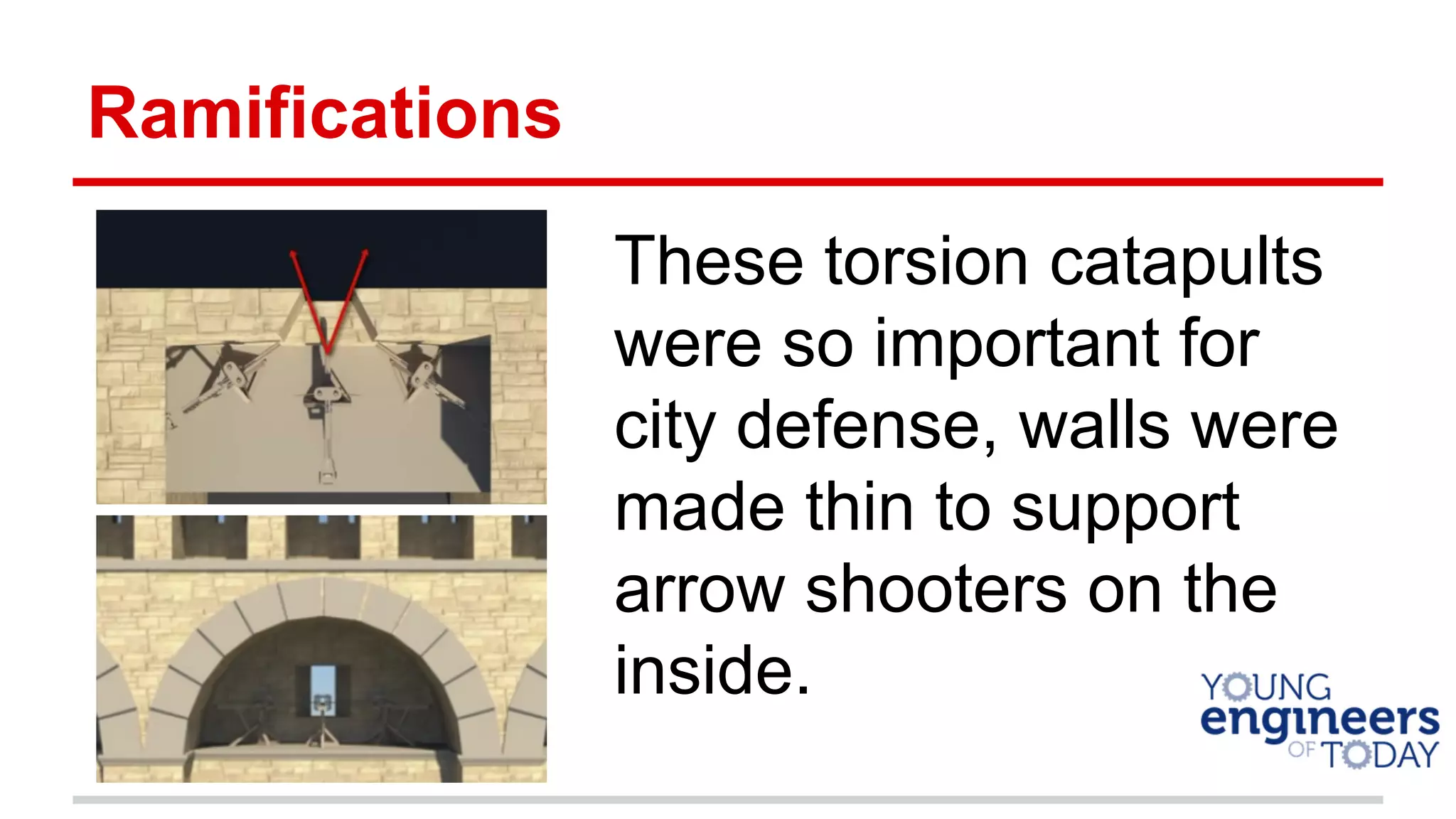
Ramifications
These torsion catapults
were so important for
city defense, walls were
made thin to support
arrow shooters on the
inside.
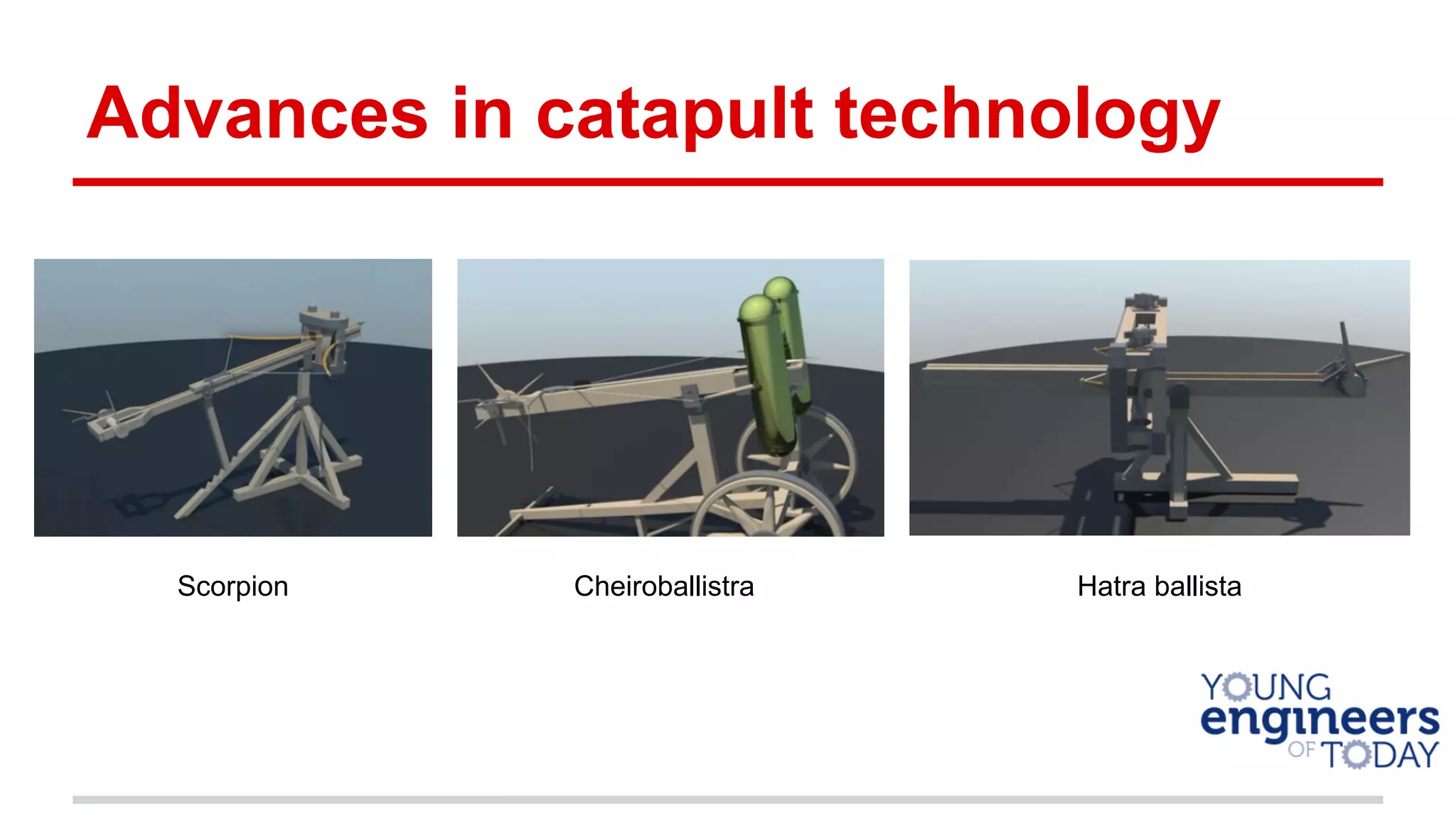
Advances in catapult technology
Scorpion Cheiroballistra Hatra ballista
‘Traditional’ Catapults
56
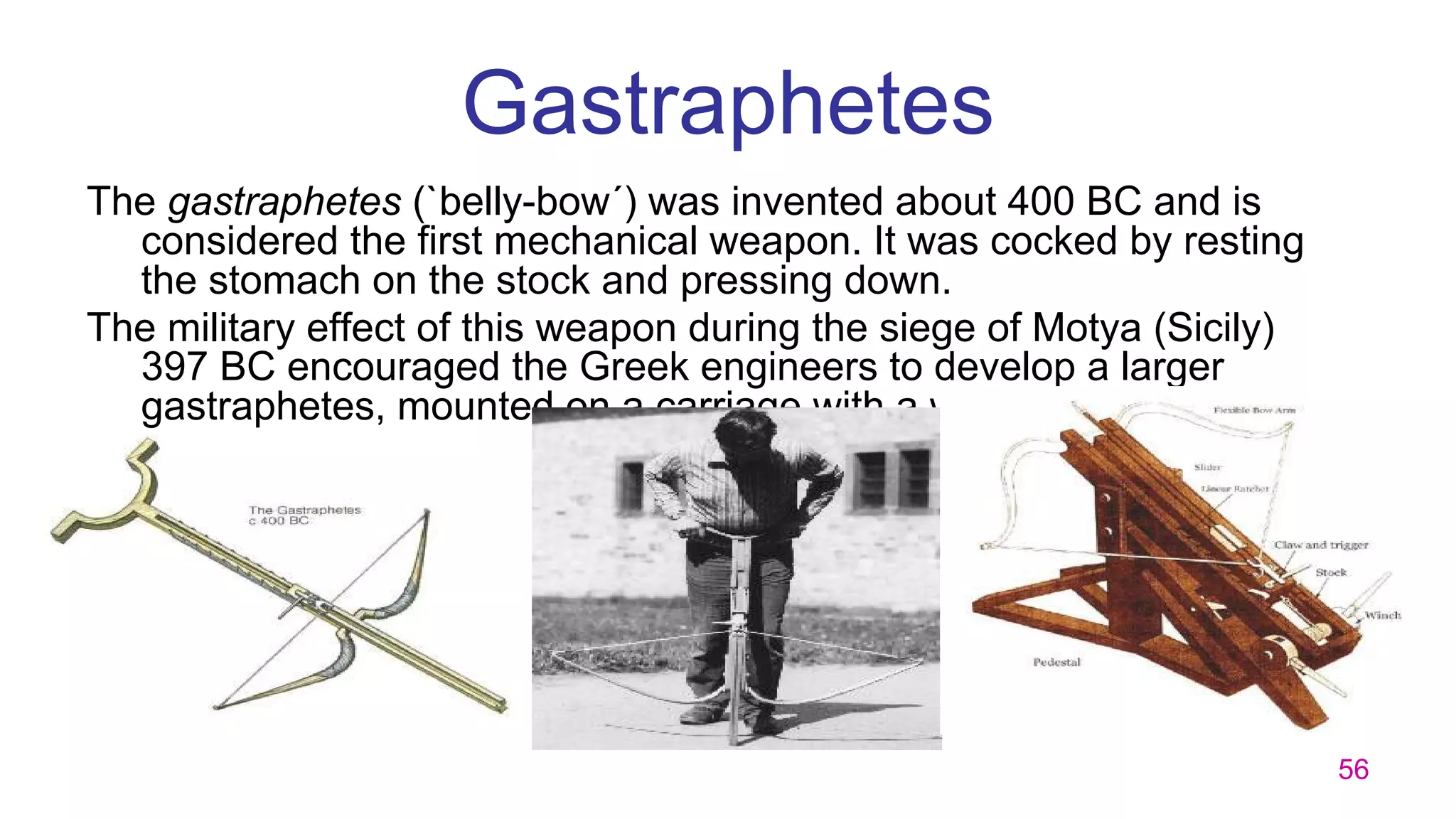
Gastraphetes
The gastraphetes (`belly-bow´) was invented about 400 BC and is
considered the first mechanical weapon. It was cocked by resting
the stomach on the stock and pressing down.
The military effect of this weapon during the siege of Motya (Sicily)
397 BC encouraged the Greek engineers to develop a larger
gastraphetes, mounted on a carriage with a windlass to cock it.
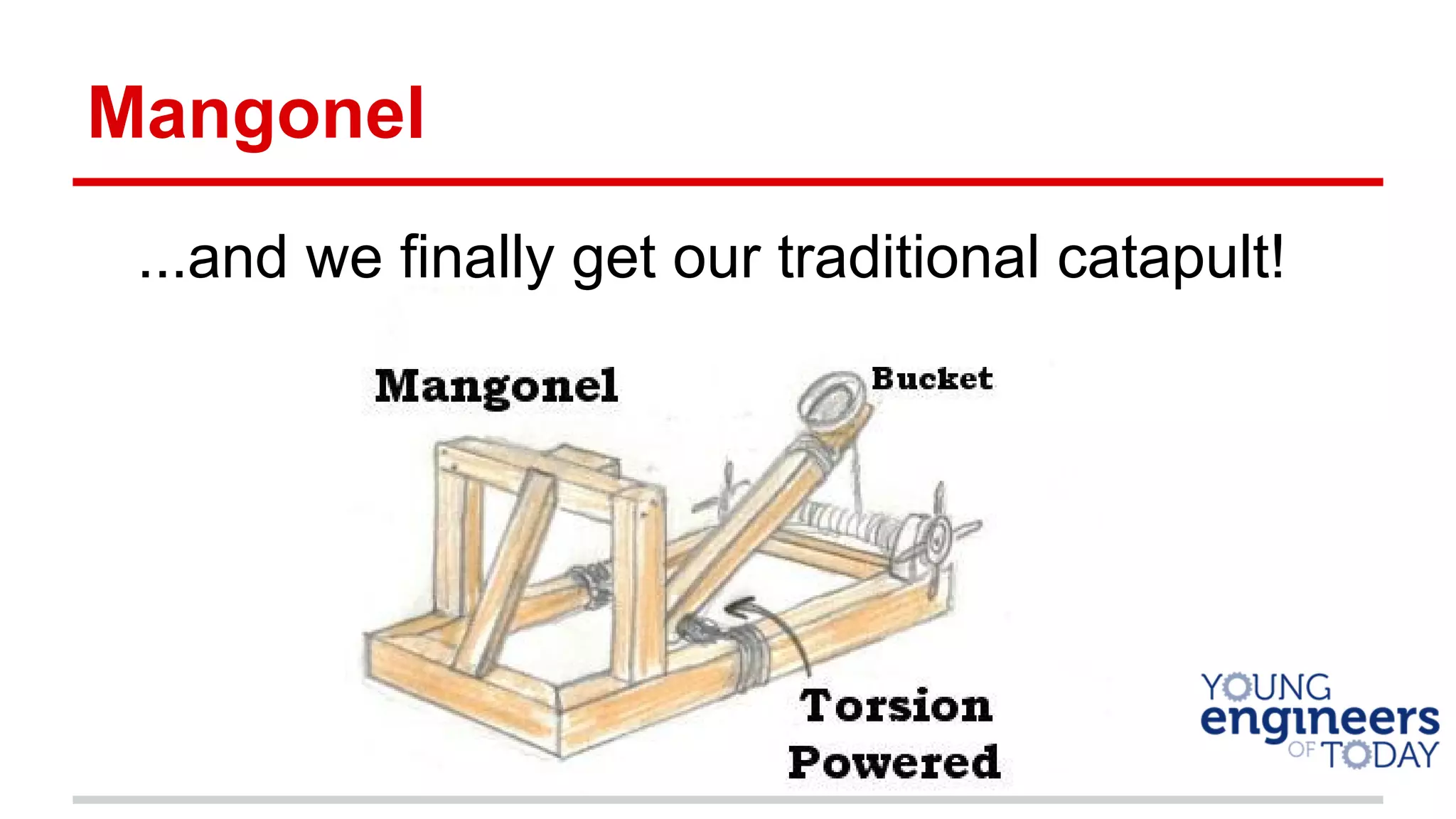
Mangonel
...and we finally get our traditional catapult!
58
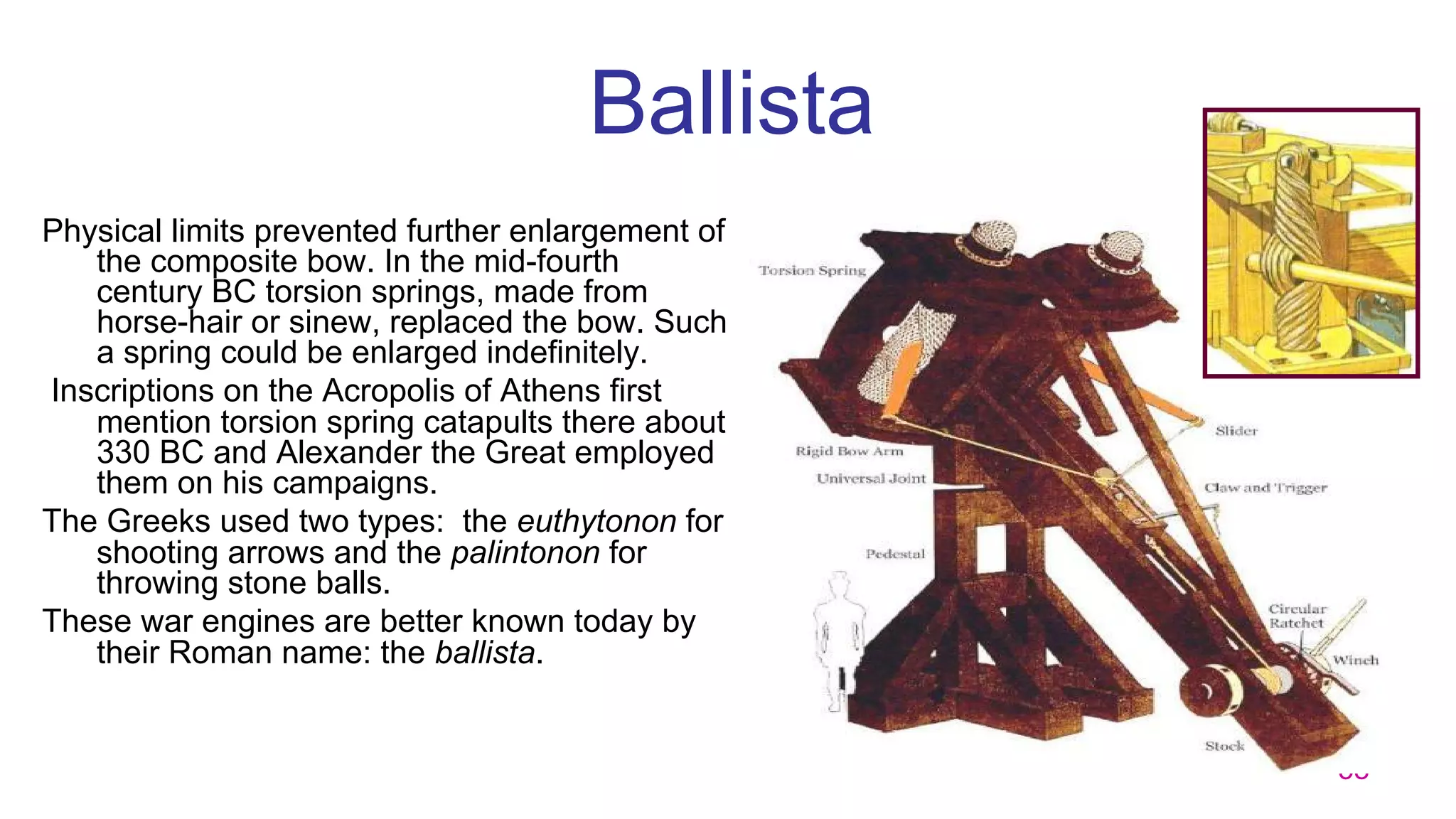
Ballista
Physical limits prevented further enlargement of
the composite bow. In the mid-fourth
century BC torsion springs, made from
horse-hair or sinew, replaced the bow. Such
a spring could be enlarged indefinitely.
Inscriptions on the Acropolis of Athens first
mention torsion spring catapults there about
330 BC and Alexander the Great employed
them on his campaigns.
The Greeks used two types: the euthytonon for
shooting arrows and the palintonon for
throwing stone balls.
These war engines are better known today by
their Roman name: the ballista.
59
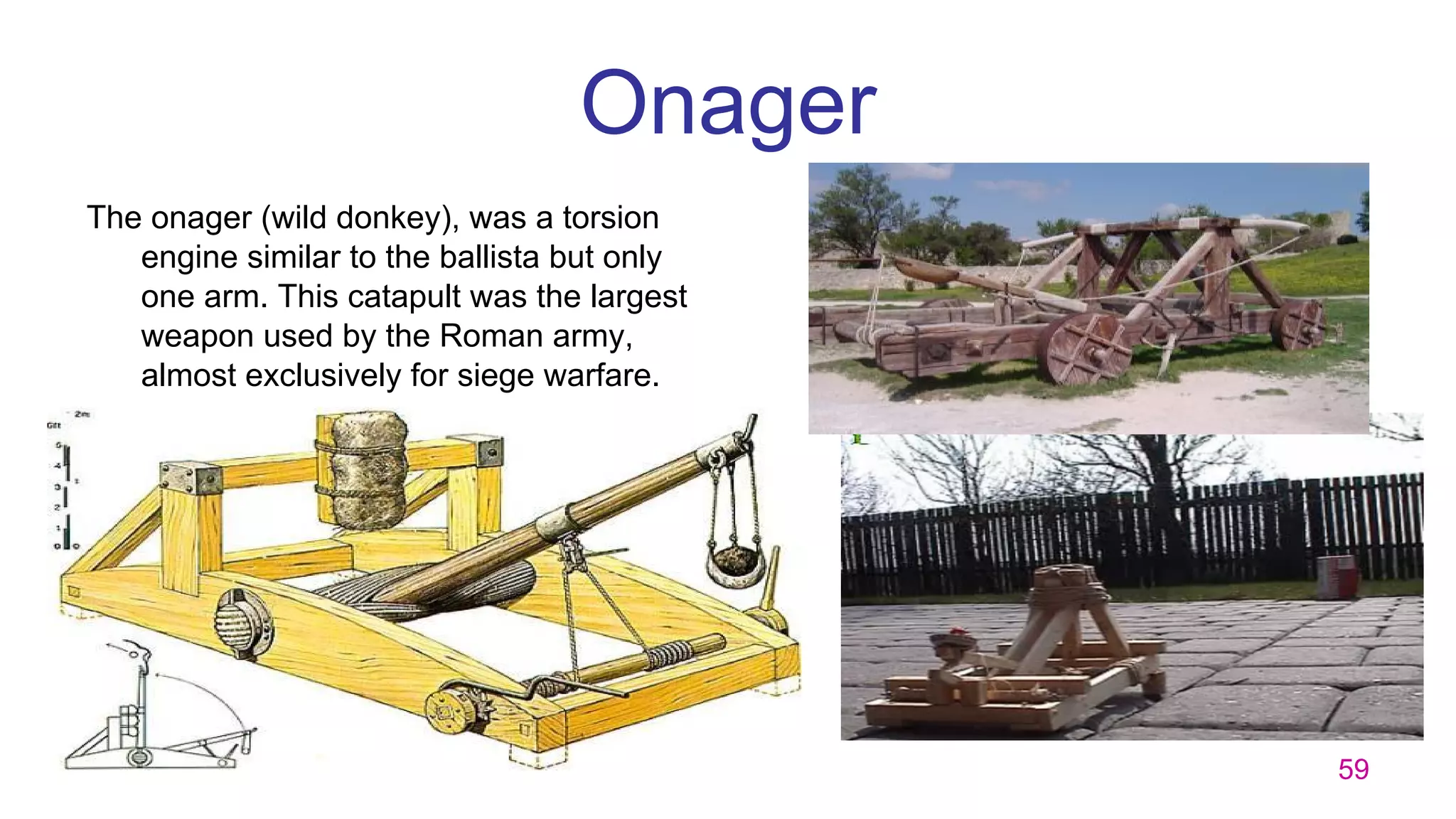
Onager
The onager (wild donkey), was a torsion
engine similar to the ballista but only
one arm. This catapult was the largest
weapon used by the Roman army,
almost exclusively for siege warfare.
60
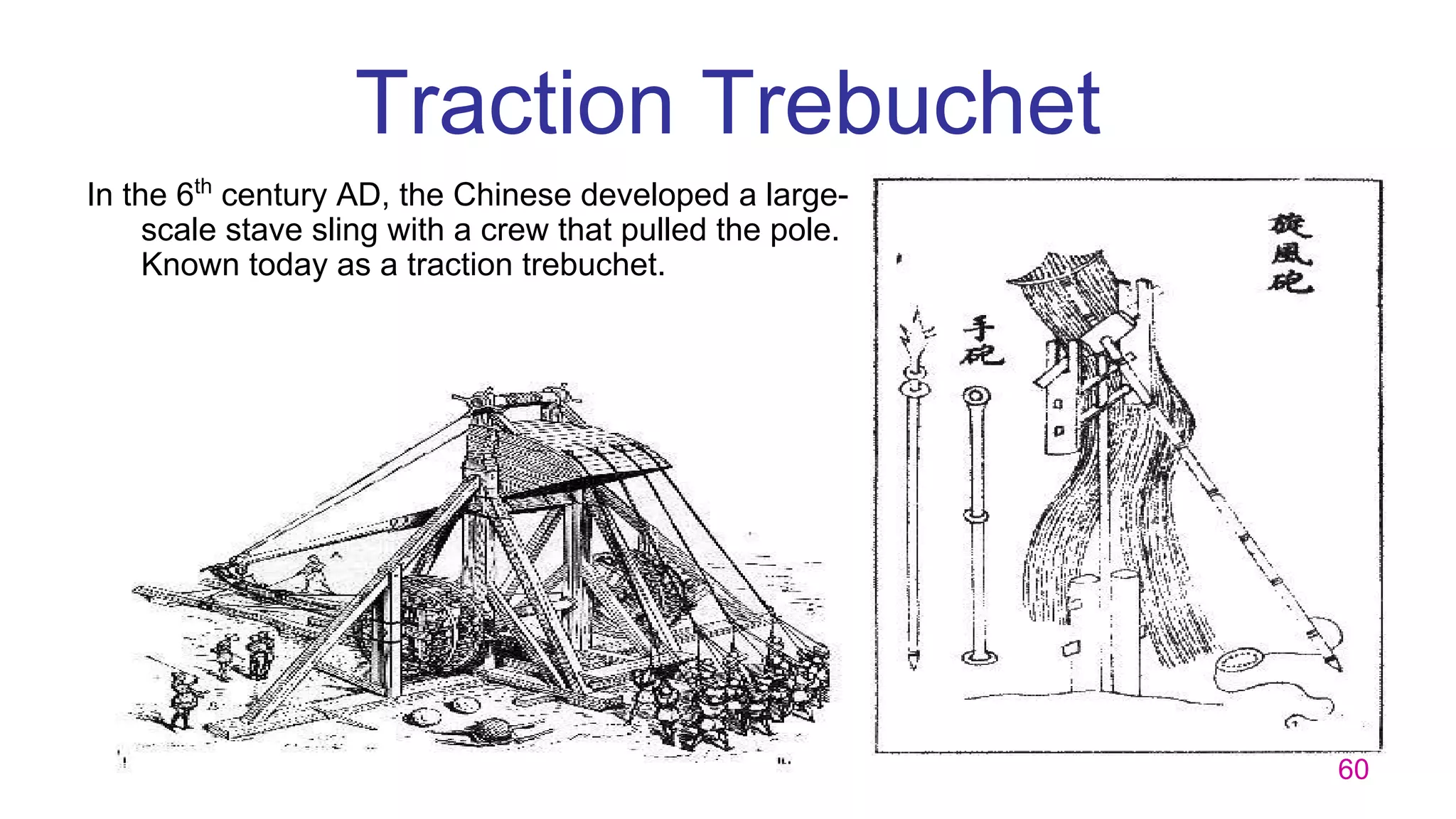
Traction Trebuchet
In the 6th
century AD, the Chinese developed a large-
scale stave sling with a crew that pulled the pole.
Known today as a traction trebuchet.
61
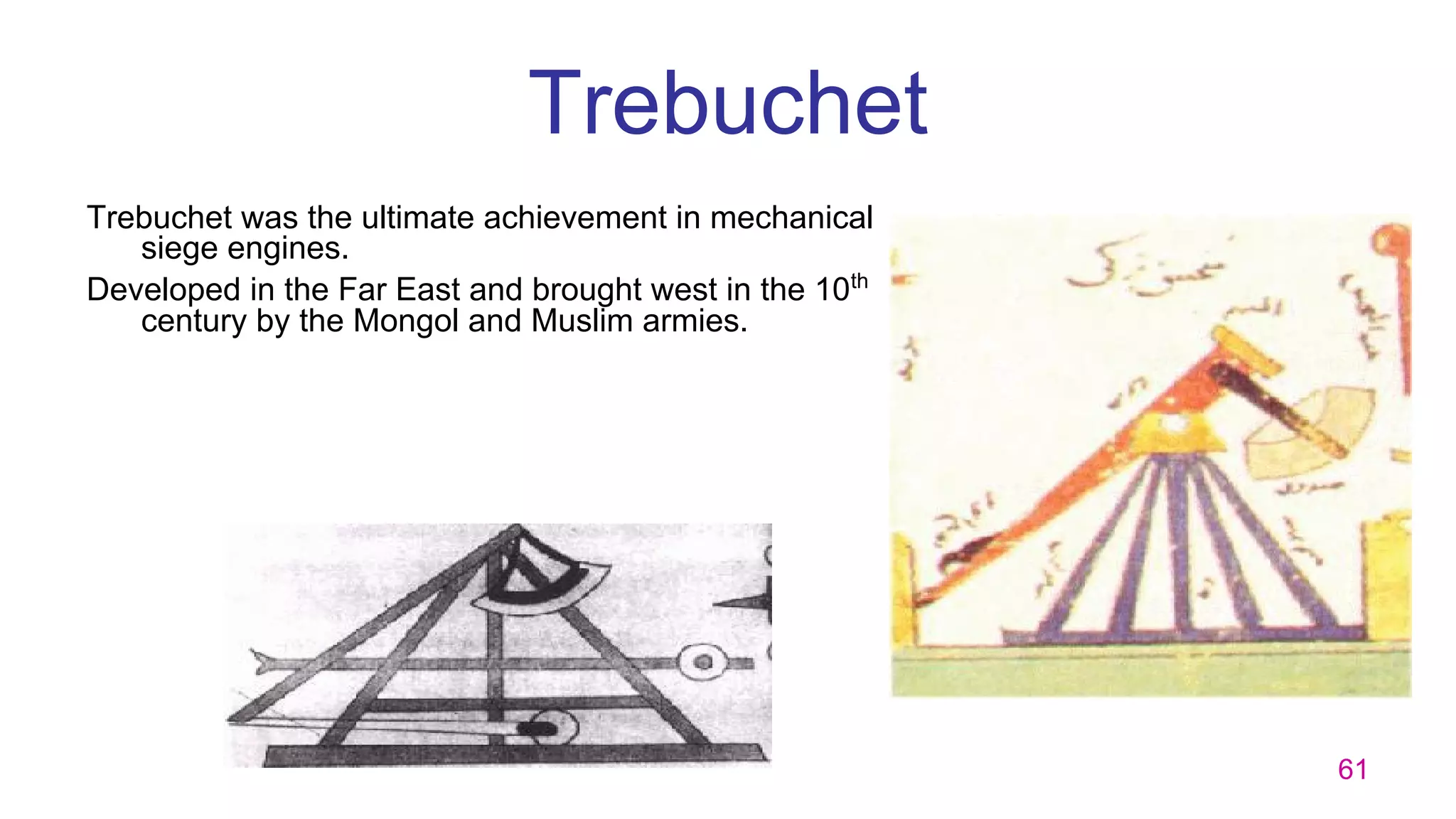
Trebuchet
Trebuchet was the ultimate achievement in mechanical
siege engines.
Developed in the Far East and brought west in the 10th
century by the Mongol and Muslim armies.
62
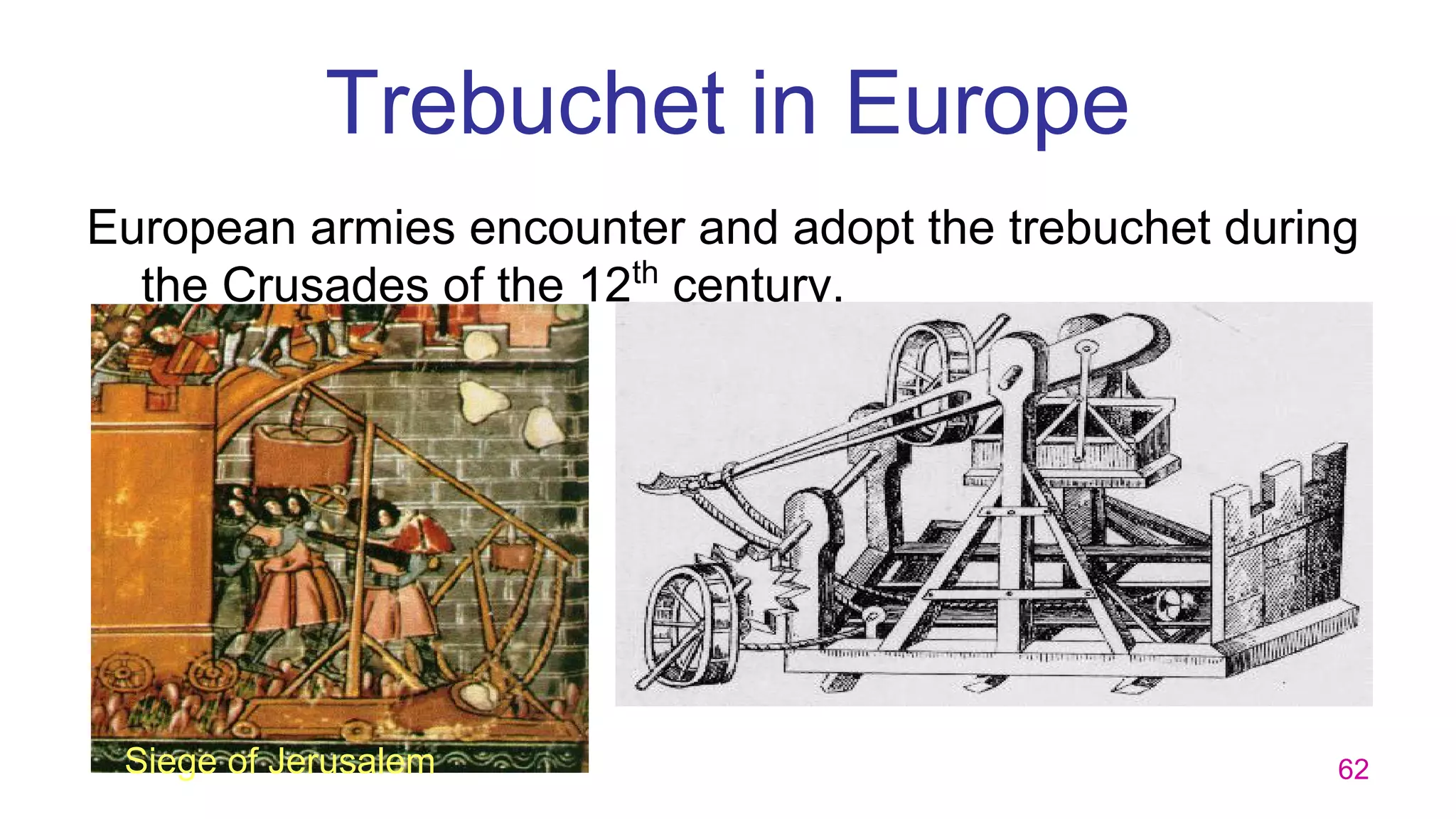
Trebuchet in Europe
European armies encounter and adopt the trebuchet during
the Crusades of the 12th
century.
Siege of Jerusalem
63
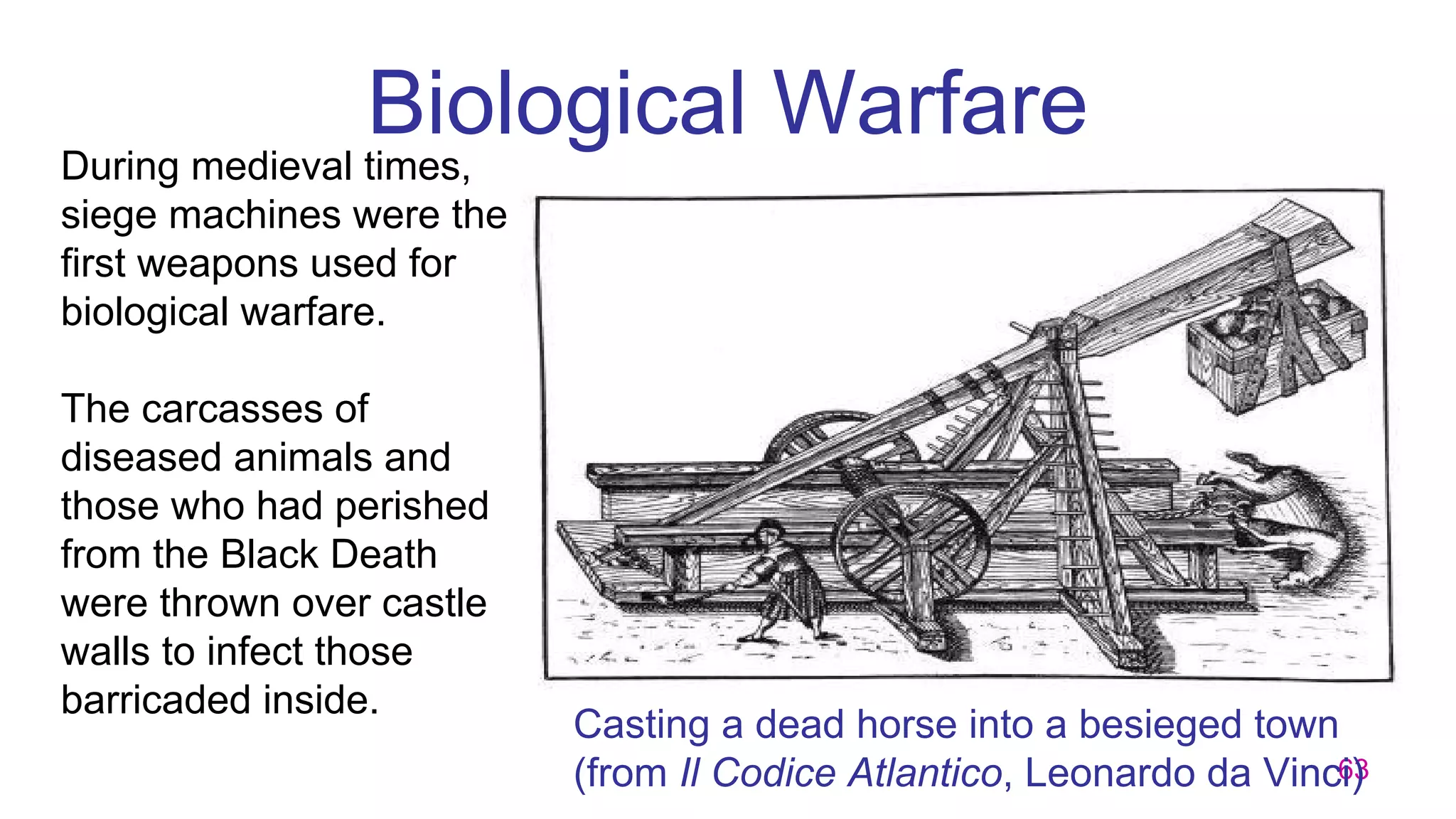
Biological Warfare
Casting a dead horse into a besieged town
(from Il Codice Atlantico, Leonardo da Vinci)
During medieval times,
siege machines were the
first weapons used for
biological warfare.
The carcasses of
diseased animals and
those who had perished
from the Black Death
were thrown over castle
walls to infect those
barricaded inside.
64
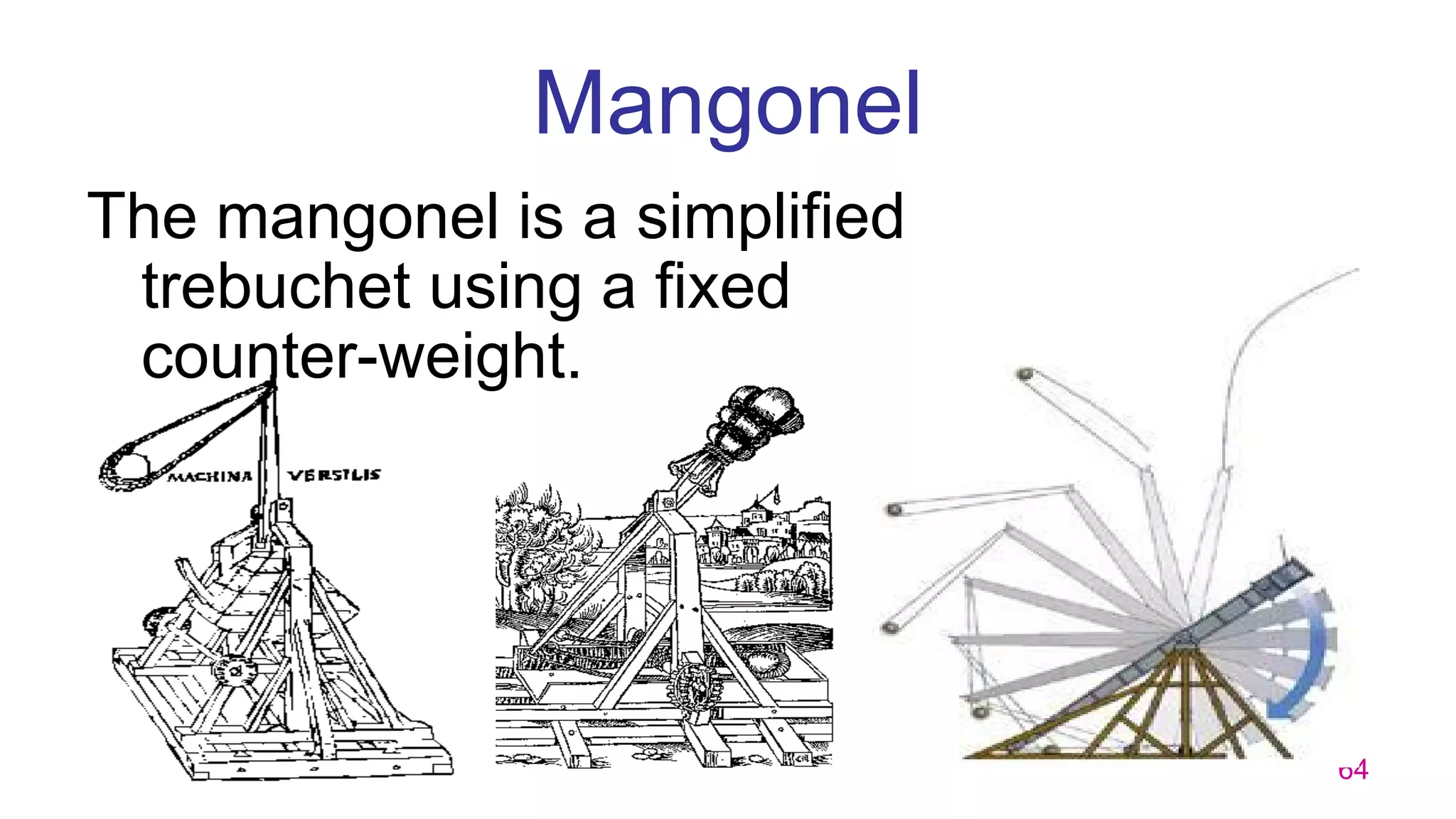
Mangonel
The mangonel is a simplified
trebuchet using a fixed
counter-weight.
65
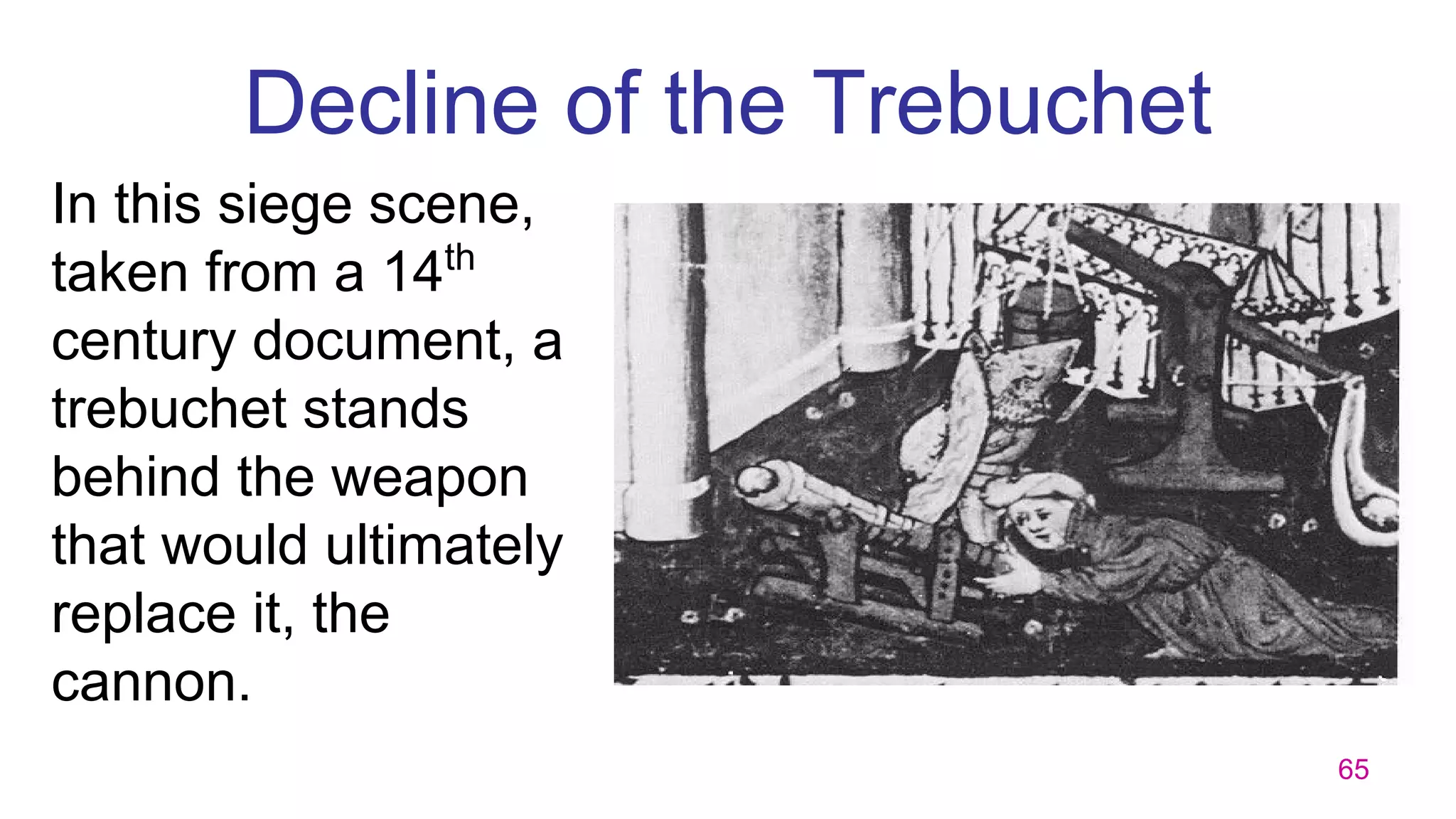
Decline of the Trebuchet
In this siege scene,
taken from a 14th
century document, a
trebuchet stands
behind the weapon
that would ultimately
replace it, the
cannon.
66
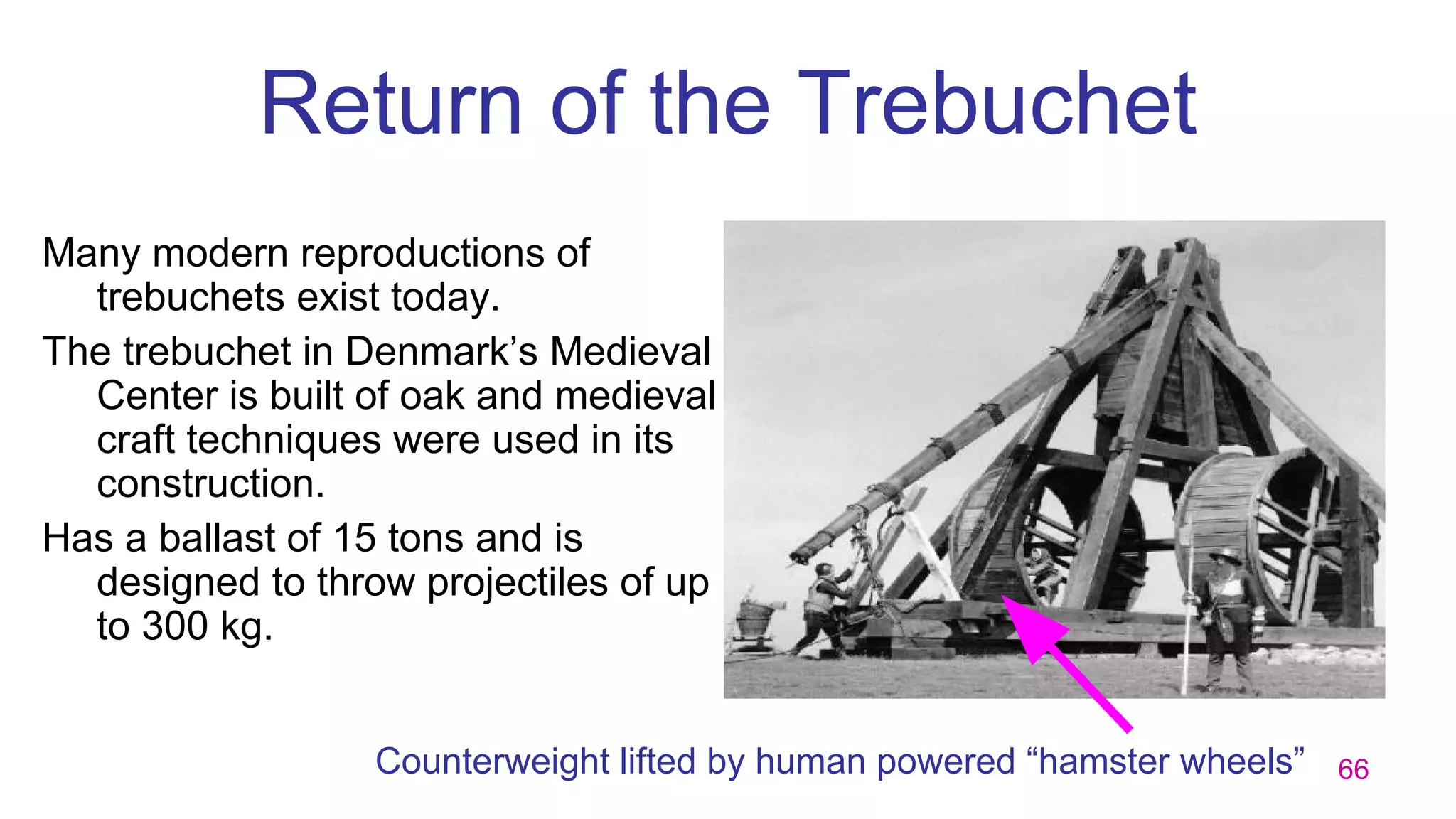
Return of the Trebuchet
Many modern reproductions of
trebuchets exist today.
The trebuchet in Denmark’s Medieval
Center is built of oak and medieval
craft techniques were used in its
construction.
Has a ballast of 15 tons and is
designed to throw projectiles of up
to 300 kg.
Counterweight lifted by human powered “hamster wheels”
67
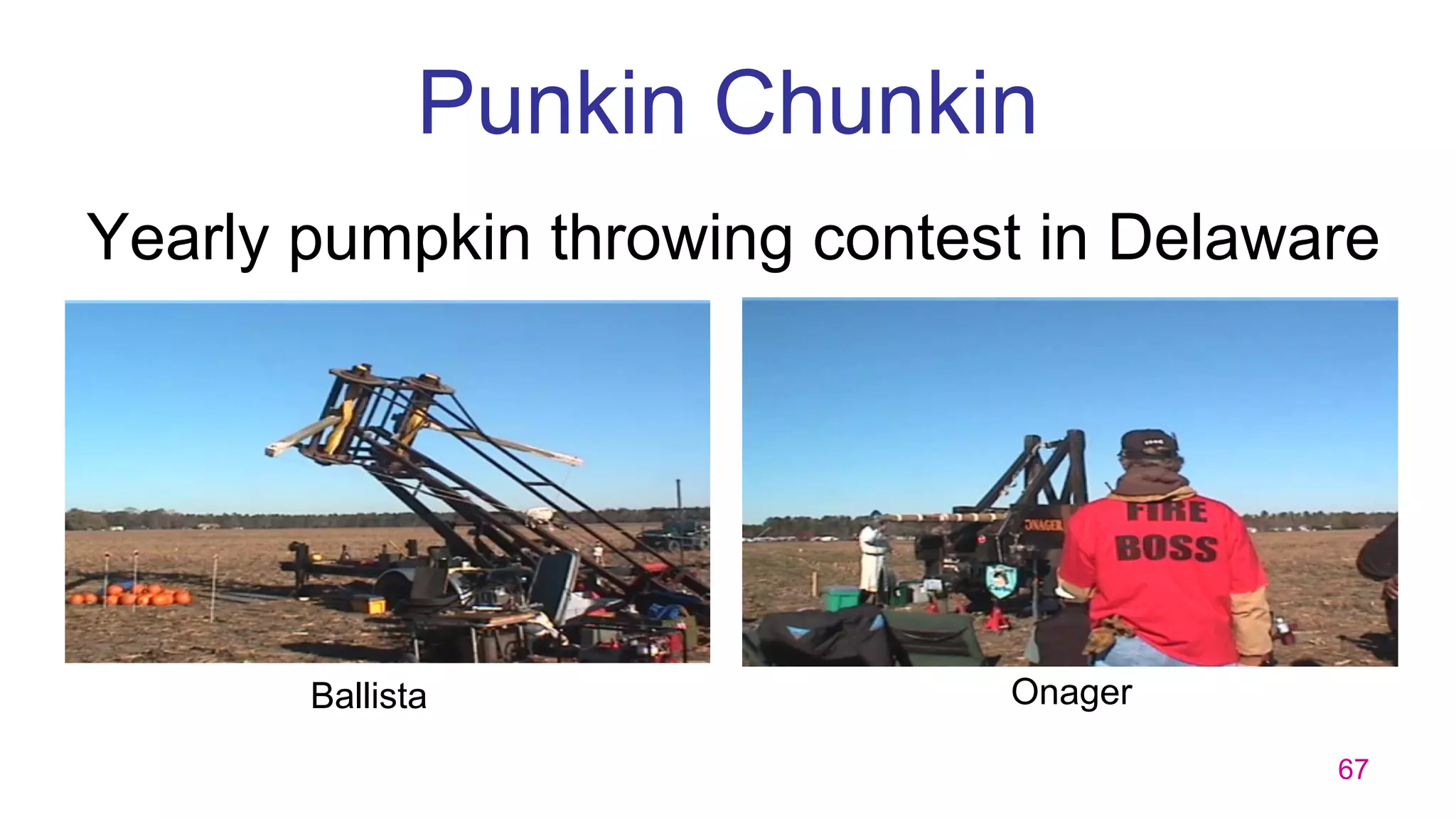
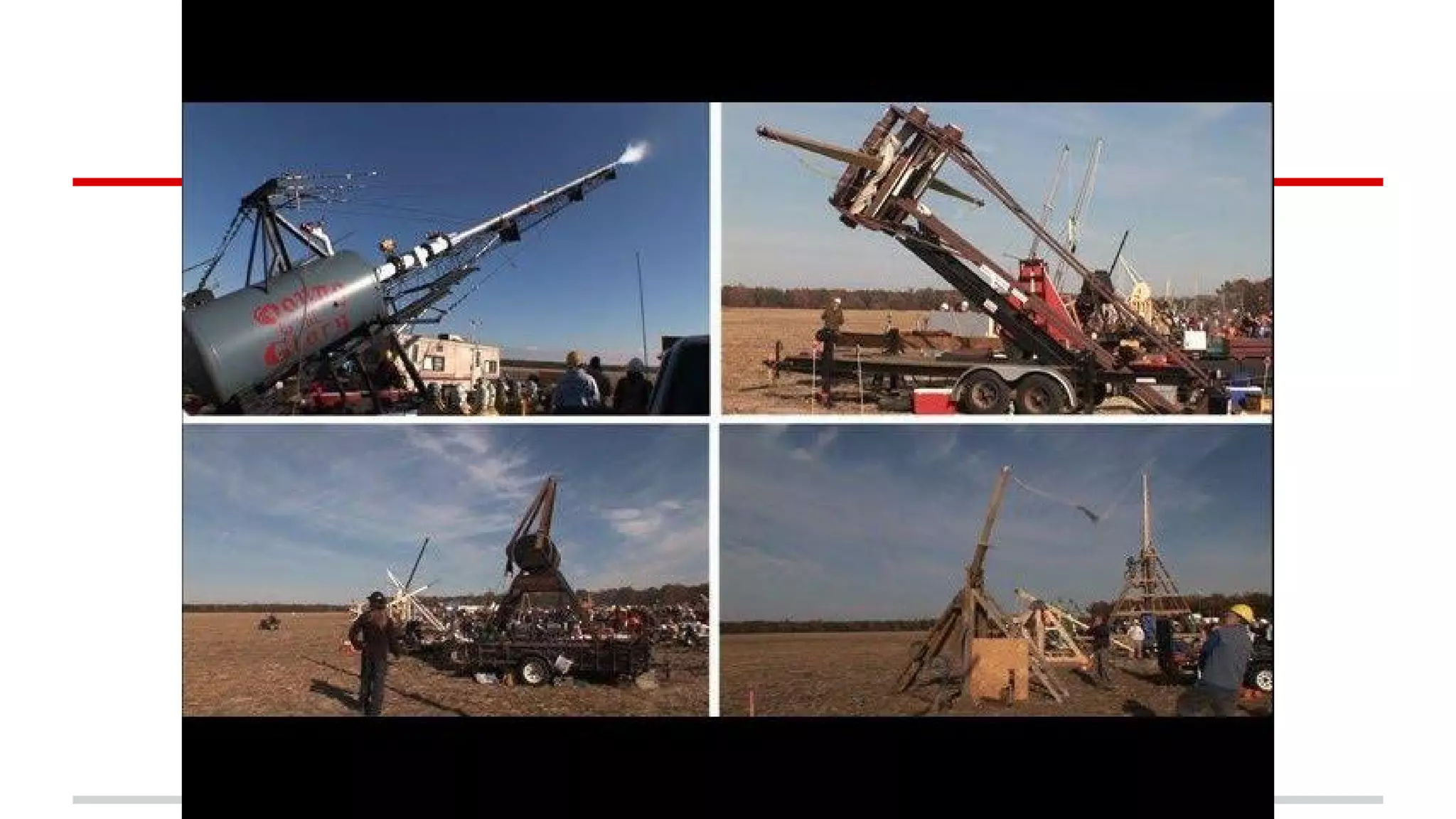
Punkin Chunkin
Yearly pumpkin throwing contest in Delaware
Ballista
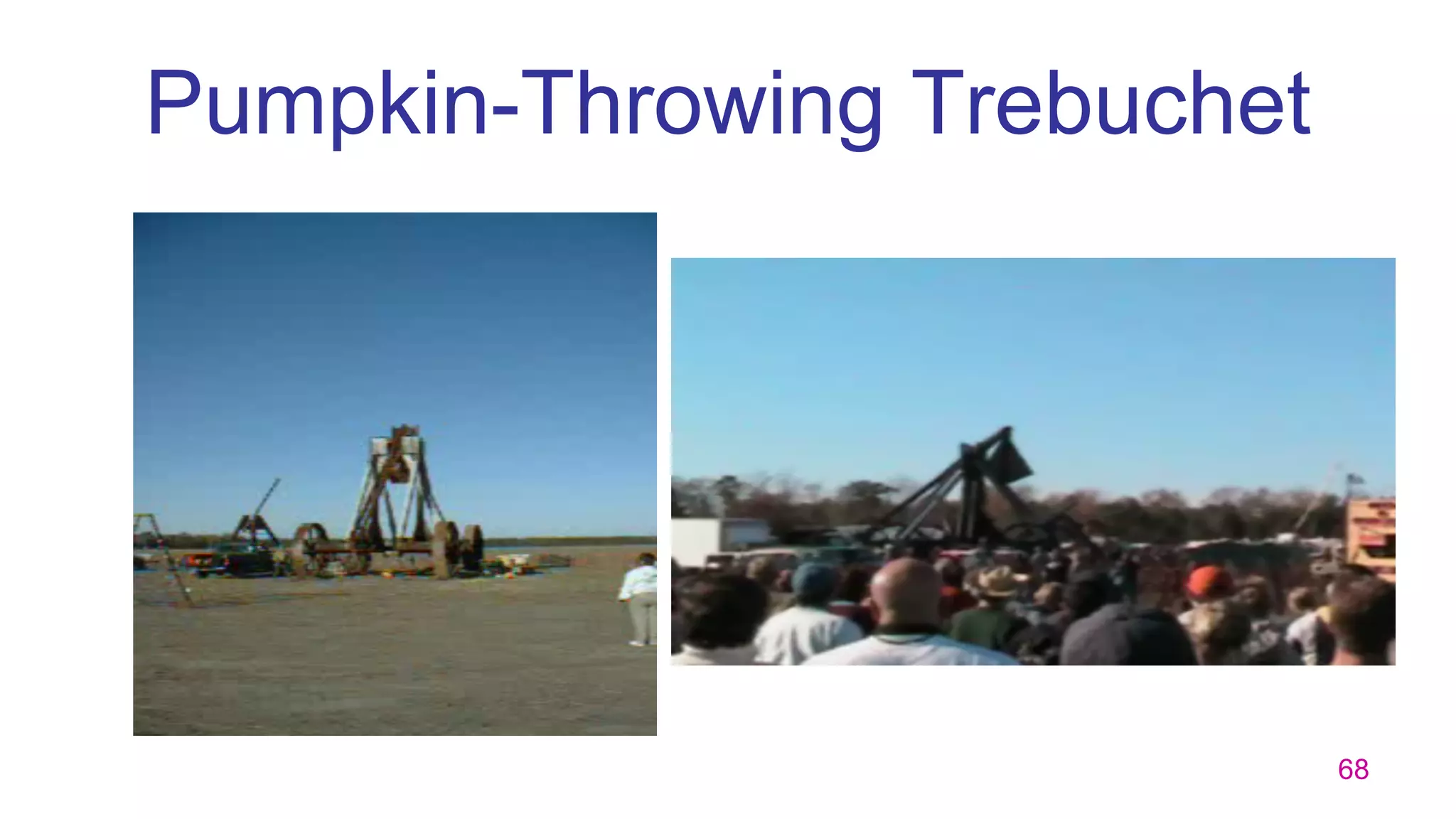
Trebuchet
Onager
68
Pumpkin-Throwing Trebuchet
Sketch designs
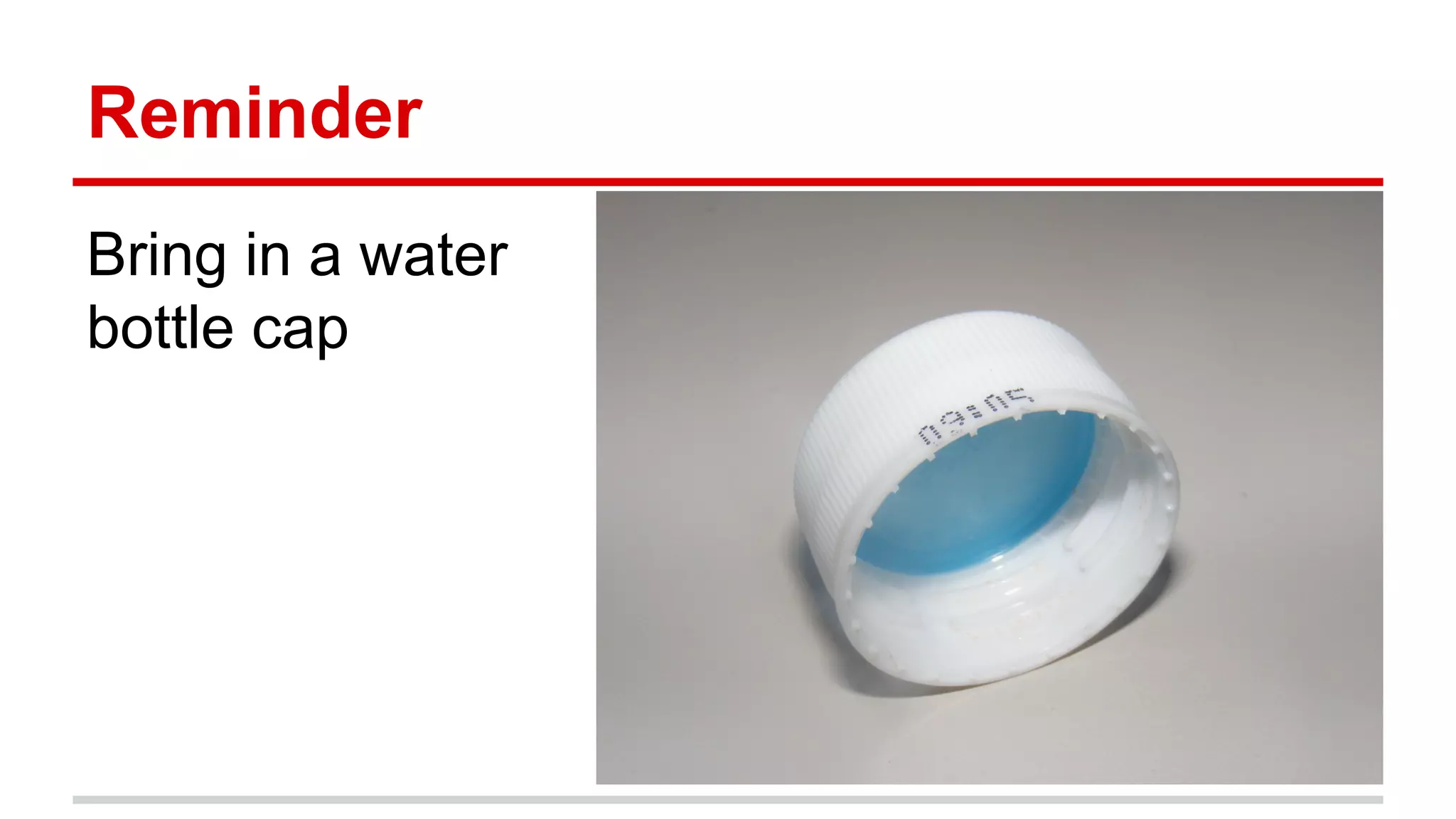
Reminder
Bring in a water
bottle cap
1. NEVER launch at people, animals, or things of value
2. ONLY use these with supervision!
3. Ask for help using potentially harmful tools, like a
knife, hot glue gun, wire cutter, or electric drill
4. Anyone aiming at others, doing stupid thing will be
done!
WARNING
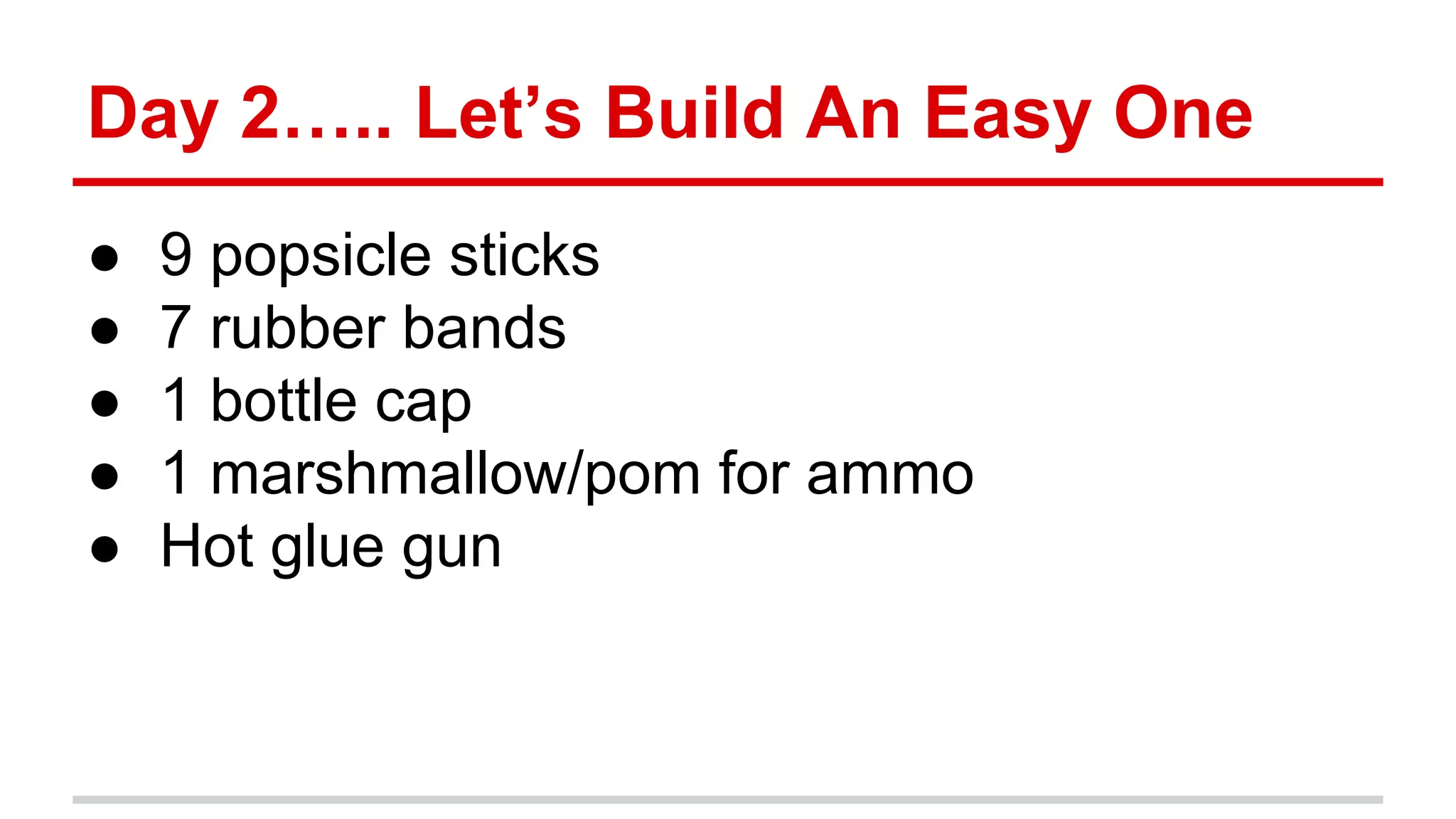
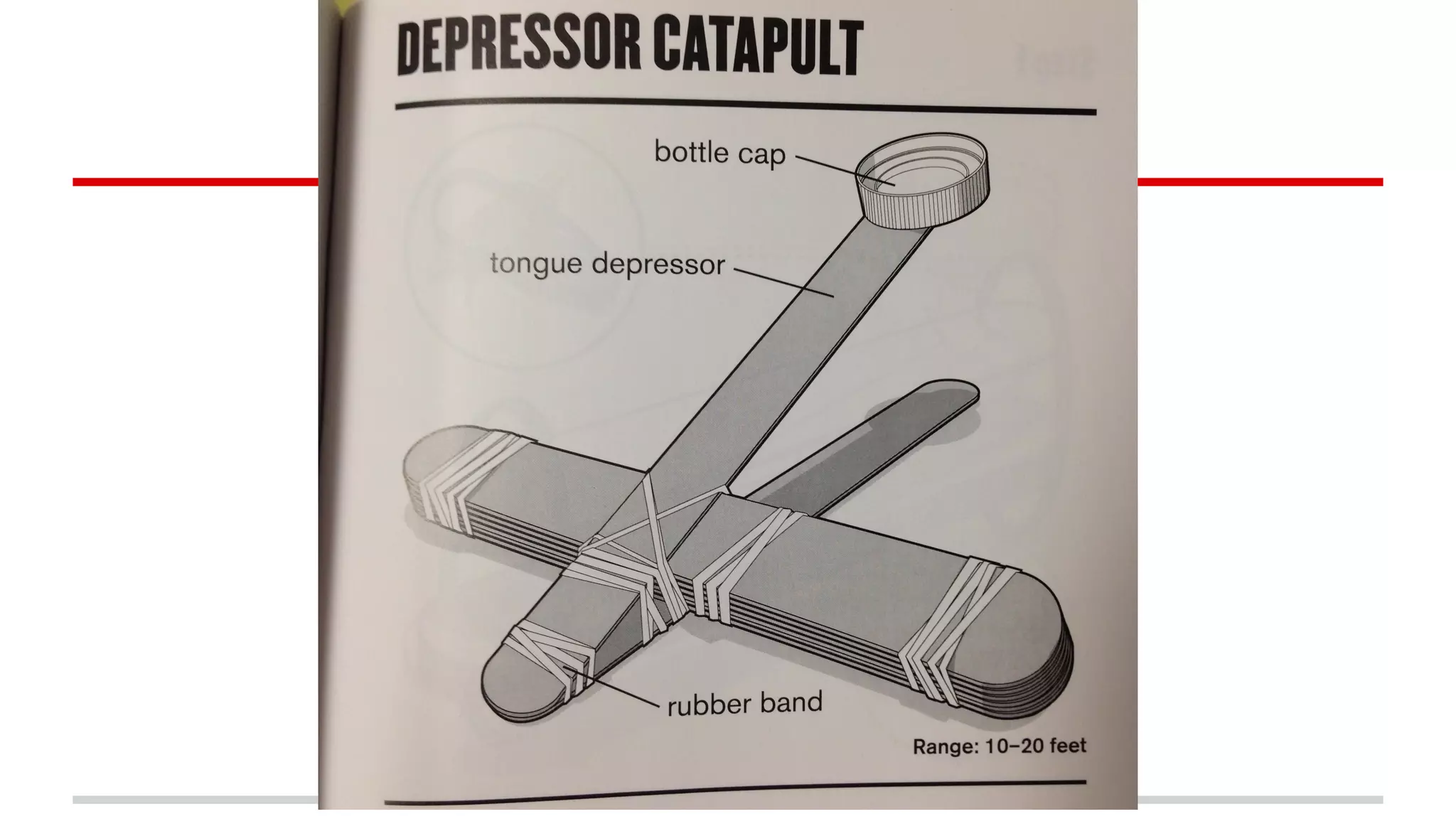
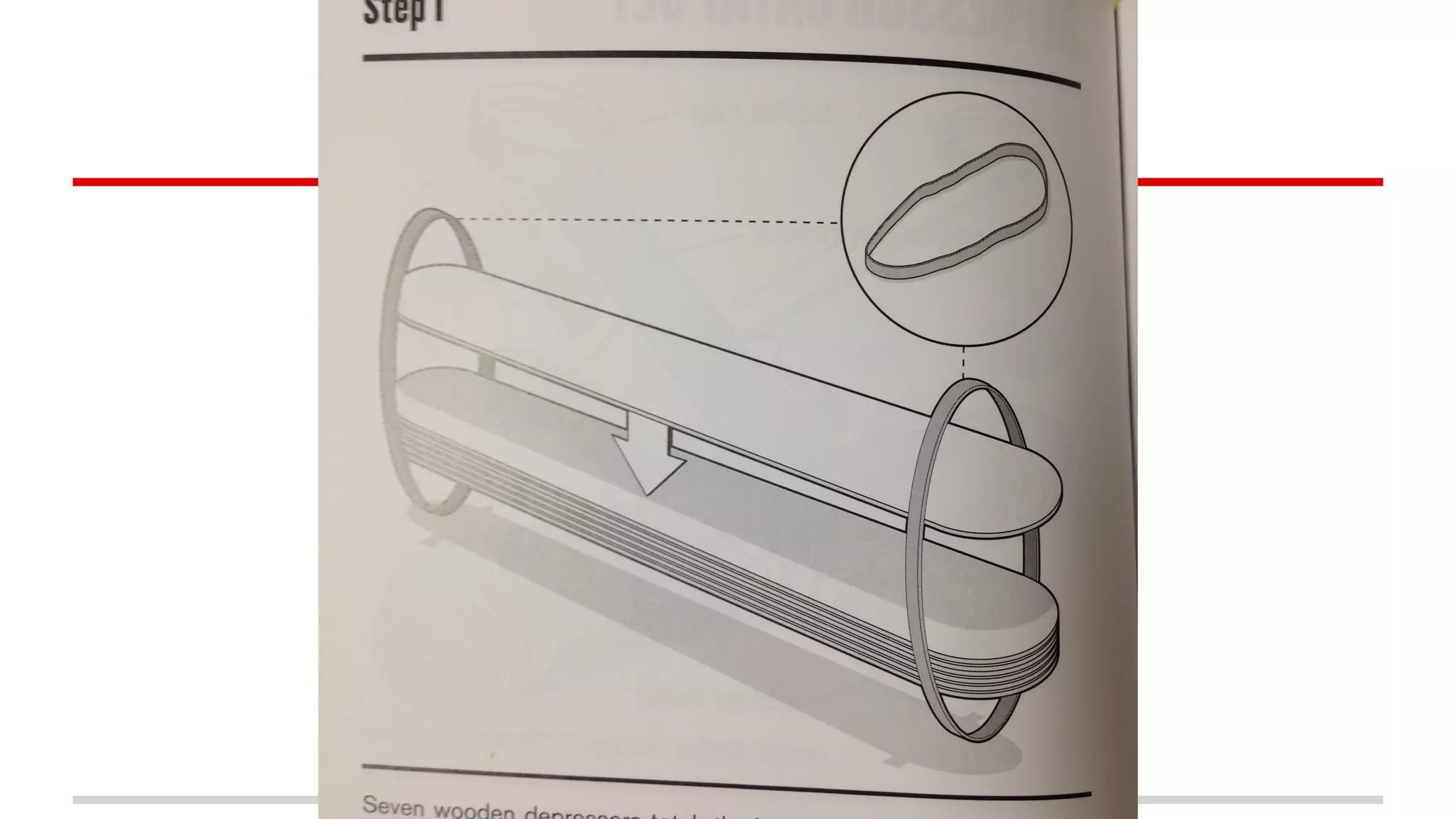
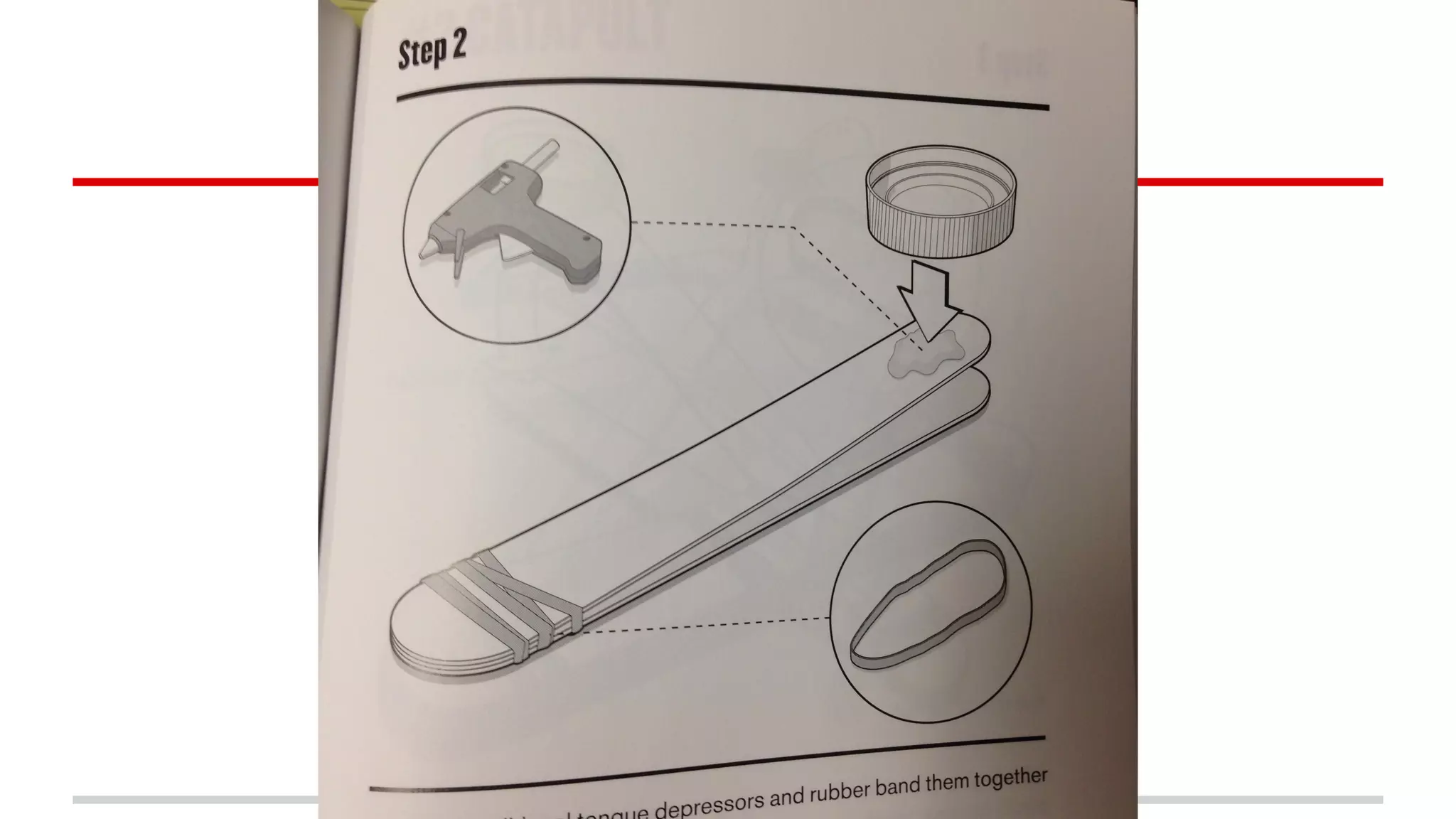
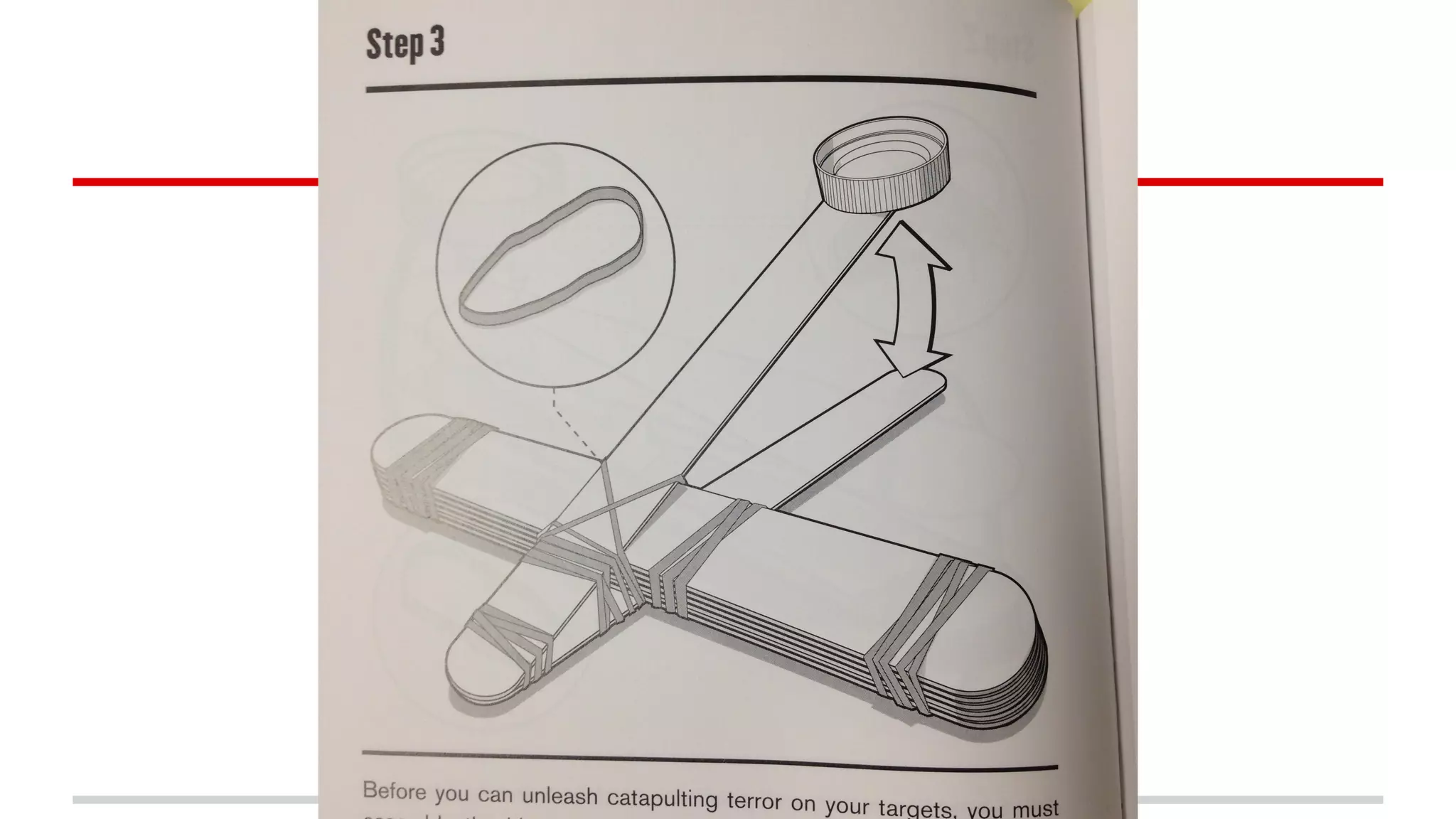
Day 2….. Let’s Build An Easy One
● 9 popsicle sticks
● 7 rubber bands
● 1 bottle cap
● 1 marshmallow/pom for ammo
● Hot glue gun
What other version can you make?
Restrictions
● Must fit within 8 x 8 inch square
● Use only what you need
● If you don’t plan on keeping item please
leave behind to be recycled
● Respectful of space and materials
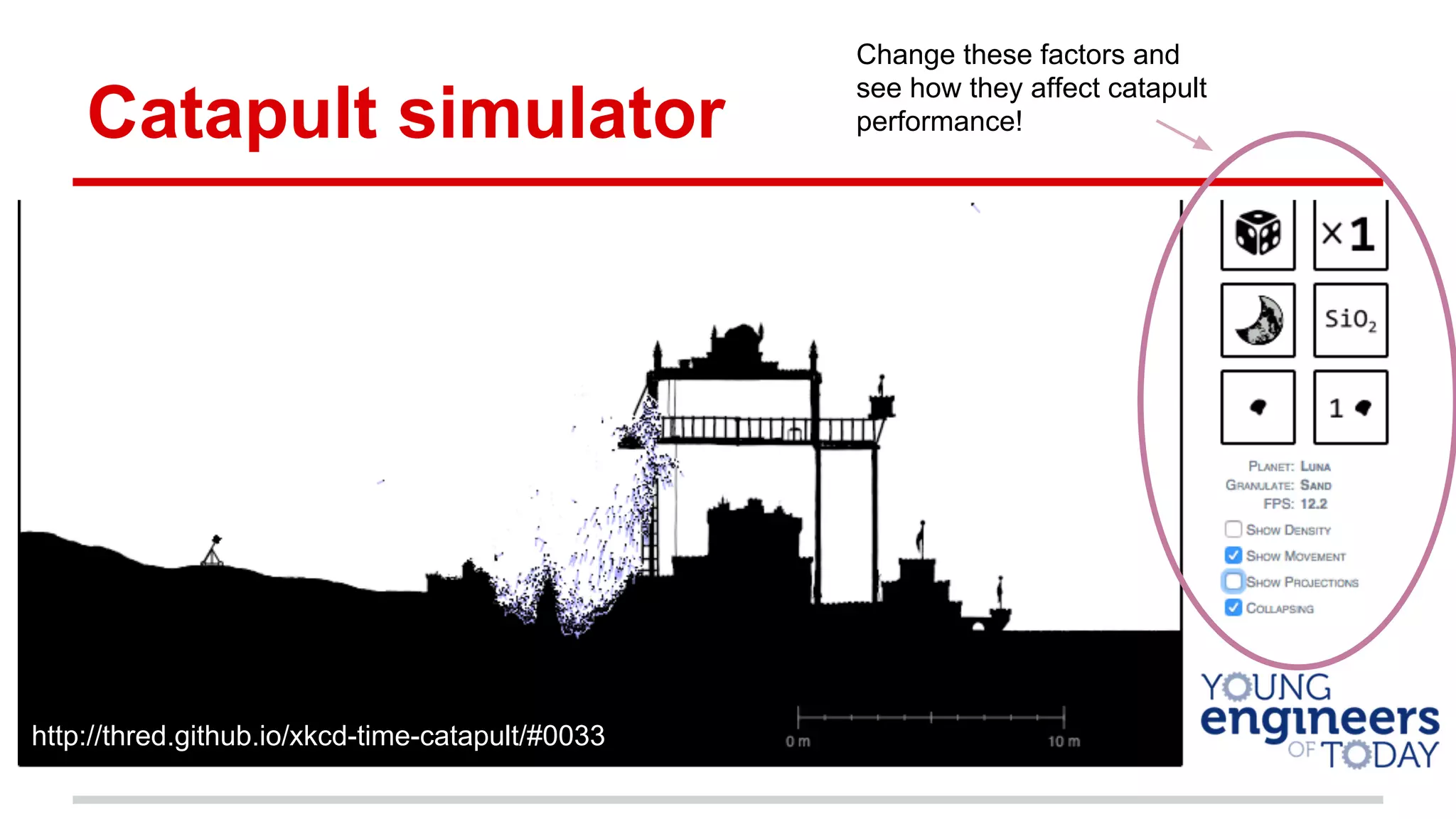
Catapult simulator
http://thred.github.io/xkcd-time-catapult/#0033
Change these factors and
see how they affect catapult
performance!

6th Grade Social Studies Ancient Engineering

  • 2.
  • 3.
    Need a blankpiece of paper
  • 4.
    So what's acatapult? The goal of a catapult is to fling a mass into the air - mainly to inflict damage.
  • 5.
    What is aCatapult? ● A catapult is a mechanical device used to store potential energy, then release it as kinetic energy as it throws a projectile a great distance.This is done without the aid of explosives. ● The word 'Catapult' comes from the two Greek words: kata: downward and pultos: a small circular battle shield. ● Katapultos (Catapult) then means “shield piercer”
  • 6.
  • 7.
    History of Catapults Humanshave limitations! We can only lift so much, can only throw so high...
  • 8.
    History of Catapults Byincreasing the energy stored in projectiles, you can increase the amount of damage they will inflict.
  • 9.
    History of Catapults Warhas always been a motivating force in development of new technologies. This helped engineering advance in many areas, not just weaponry.
  • 10.
    History of Catapults Engineersresearched ways to increase these forms of energy storage in weapons in order to increase their damage.
  • 11.
    History of thecatapult In 399 BC Dionysius of Syracuse created a think tank to design and build weapons for his campaign against Carthage. The goal was to overcome limitations of the basic bow and arrow - how could they increase the energy stored?
  • 12.
    Who Invented theCatapult? (3rd c. BCE) ● Ancient Greek mathematician Archimedes (b. 287 BCE) is credited with inventing the catapult along with other “war machines” (Death Ray, the Iron Claw, and Steam Cannon). ● Archimedes developed the fundamental principles of mechanics; and methods for finding the center of gravity, surface area, and volume of geometric figures. He also derived an estimate for the value of Pi. (Can we say, genius?!)
  • 13.
    Catapult Development ● Warhas always been a motivating force in development of new technologies. ● An interesting thing about catapults is that they developed over time from smaller weapons. ● The Catapult is a derivative and direct result of the Bow. ● The catapult is the end result of the desire to make weapons that are bigger, more powerful, and can hurl bigger objects longer distances.
  • 14.
    Types of Catapults Catapultscan be split into three categories: ● Traditional Catapult ● Ballista ● Trebuchet
  • 15.
    ‘Traditional’ Catapult A traditionalcatapult looks like a bucket on a long arm being held down by some form of tension. These were used into medieval times.
  • 16.
  • 17.
    Traditional catapult The traditionalcatapult uses stored elastic energy (potential energy) by twisting and stretching ropes and in the bent wooden arm used to vault its mass into the air. Think about bending a spoon back to launch peas across the table!
  • 18.
    Forms of Energy ●Potential energy (stored) is energy when matter is still. ● Kinetic energy is matter in motion.
  • 19.
    Winch A traditional catapultcan store more energy to send their projectile further by using a winch. The winch is a wheel and axle simple machine
  • 20.
    Winch A winch allowsa person to store a great amount of energy (in this case, tension) over a period of time
  • 21.
    Ballista Ballistas and other arrow-shooting machineswere the first catapults. A ballista looks like a giant crossbow.
  • 22.
    So to increasethe potential energy... ● Heft the projectile higher off the ground ● Make the projectile heavier
  • 23.
    Strain How do theseforces store energy? Imagine a loose rubberband vs. a taut one.
  • 24.
    Potential energy Potential energyis stored in rubberband, just like how potential energy is stored in bow when bow is drawn.
  • 25.
    Bow and arrow Asyou pull the string of a bow, your arm does work. The energy that it takes you to pull that string is stored in the bow as tension.
  • 26.
    Bow and arrow Whenarrow is released, elastic energy transfers to the kinetic energy of the arrow
  • 27.
    Compound bow Bow makersdiscovered they could strengthen the bow even more if they combined: ● Wood ● Animal horn ● & Animal sinew
  • 28.
    Compound bow Horn holdsup better to compression so was added to the inside of a wooden bow while sinew holds up better to tension so was added to the outside
  • 29.
    Compound bow Now limitationsare physiological - meaning humans were limited by their own bodies Can you think of what they might be?
  • 30.
    Compound bow ● Lengthof an archer’s arms ● Strength of arm, chest, & shoulder muscles ● Strength and dexterity of fingers
  • 31.
    Compound bow Because ofthese limitations, the best possible bow required 45 pounds to pull with a 28 inch draw range.
  • 32.
    Back to thethink tank... So how was the group going to advance bow and arrow technology? Their first solution was the gastraphetes or “belly bow”
  • 33.
  • 34.
  • 35.
  • 36.
  • 37.
  • 38.
    Advancement and Progress Weaponmakers continued improving the gastraphetes. What did they do to make it better?
  • 39.
    Advancement and Progress Madeit BIGGER of course! This development led to technological advancements that made the first true catapult possible.
  • 40.
  • 41.
    Zopyrus’s Bow-machine Stiffer bowsmade cocking the weapon more difficult. A windlass was added to the back of the weapon to draw the arrow back.
  • 42.
    Zopyrus’s Bow-machine While thisallowed for larger arrows, now the entire weapon needed to grow in size, making it unwieldy as a hand held weapon. A base was added.
  • 43.
    Zopyrus’s Bow-machine Bows onthis first model of catapult were maxing out the size that artisans could make them.
  • 44.
    Catapult development Composite bowtemporarily meets its limits. Developers must now turn to fundamentally different ways of storing elastic energy. This path led to the Torsion Catapult.
  • 45.
    Torsion Catapult Torsion catapultdevelopment occurs over a series of discoveries and advancements, starting in mid 4th century B.C.E. By end of that century we have the arrow shooting weapon called the euthyntone and the stone throwing weapon called the palintone.
  • 46.
  • 47.
    Torsion springs Much ofthe hardware looks the same: stock, rachet, trigger, windlass, etc. What’s new are vertically aligned torsion springs.
  • 48.
    Torsion Torsion is thetwisting of a beam or structural element
  • 49.
    Torsion springs Torsion springsin a palintone consisted of bundles of rope with a wooden arm thrust through the center. What material do you think was used for this rope? Think back to when we talked about materials that could withstand compression or tension.
  • 50.
  • 52.
    How powerful werethey? Reports of arrow shooters that could shoot 200 yards and Roman ballistas that could throw 200 lb stone balls 400 yards.
  • 53.
    Ramifications These torsion catapults wereso important for city defense, walls were made thin to support arrow shooters on the inside.
  • 54.
    Advances in catapulttechnology Scorpion Cheiroballistra Hatra ballista
  • 55.
  • 56.
    56 Gastraphetes The gastraphetes (`belly-bow´)was invented about 400 BC and is considered the first mechanical weapon. It was cocked by resting the stomach on the stock and pressing down. The military effect of this weapon during the siege of Motya (Sicily) 397 BC encouraged the Greek engineers to develop a larger gastraphetes, mounted on a carriage with a windlass to cock it.
  • 57.
    Mangonel ...and we finallyget our traditional catapult!
  • 58.
    58 Ballista Physical limits preventedfurther enlargement of the composite bow. In the mid-fourth century BC torsion springs, made from horse-hair or sinew, replaced the bow. Such a spring could be enlarged indefinitely. Inscriptions on the Acropolis of Athens first mention torsion spring catapults there about 330 BC and Alexander the Great employed them on his campaigns. The Greeks used two types: the euthytonon for shooting arrows and the palintonon for throwing stone balls. These war engines are better known today by their Roman name: the ballista.
  • 59.
    59 Onager The onager (wilddonkey), was a torsion engine similar to the ballista but only one arm. This catapult was the largest weapon used by the Roman army, almost exclusively for siege warfare.
  • 60.
    60 Traction Trebuchet In the6th century AD, the Chinese developed a large- scale stave sling with a crew that pulled the pole. Known today as a traction trebuchet.
  • 61.
    61 Trebuchet Trebuchet was theultimate achievement in mechanical siege engines. Developed in the Far East and brought west in the 10th century by the Mongol and Muslim armies.
  • 62.
    62 Trebuchet in Europe Europeanarmies encounter and adopt the trebuchet during the Crusades of the 12th century. Siege of Jerusalem
  • 63.
    63 Biological Warfare Casting adead horse into a besieged town (from Il Codice Atlantico, Leonardo da Vinci) During medieval times, siege machines were the first weapons used for biological warfare. The carcasses of diseased animals and those who had perished from the Black Death were thrown over castle walls to infect those barricaded inside.
  • 64.
    64 Mangonel The mangonel isa simplified trebuchet using a fixed counter-weight.
  • 65.
    65 Decline of theTrebuchet In this siege scene, taken from a 14th century document, a trebuchet stands behind the weapon that would ultimately replace it, the cannon.
  • 66.
    66 Return of theTrebuchet Many modern reproductions of trebuchets exist today. The trebuchet in Denmark’s Medieval Center is built of oak and medieval craft techniques were used in its construction. Has a ballast of 15 tons and is designed to throw projectiles of up to 300 kg. Counterweight lifted by human powered “hamster wheels”
  • 67.
    67 Punkin Chunkin Yearly pumpkinthrowing contest in Delaware Ballista Trebuchet Onager
  • 68.
  • 69.
  • 70.
    Reminder Bring in awater bottle cap
  • 74.
    1. NEVER launchat people, animals, or things of value 2. ONLY use these with supervision! 3. Ask for help using potentially harmful tools, like a knife, hot glue gun, wire cutter, or electric drill 4. Anyone aiming at others, doing stupid thing will be done! WARNING
  • 75.
    Day 2….. Let’sBuild An Easy One ● 9 popsicle sticks ● 7 rubber bands ● 1 bottle cap ● 1 marshmallow/pom for ammo ● Hot glue gun
  • 80.
    What other versioncan you make? Restrictions ● Must fit within 8 x 8 inch square ● Use only what you need ● If you don’t plan on keeping item please leave behind to be recycled ● Respectful of space and materials
  • 81.
    Catapult simulator http://thred.github.io/xkcd-time-catapult/#0033 Change thesefactors and see how they affect catapult performance!