The Medieval MilitaryEngineer Peter Purton
download
https://ebookbell.com/product/the-medieval-military-engineer-
peter-purton-10624762
Explore and download more ebooks at ebookbell.com
2.
Here are somerecommended products that we believe you will be
interested in. You can click the link to download.
The Medieval Military Engineer From The Roman Empire To The Sixteenth
Century Peter Purton
https://ebookbell.com/product/the-medieval-military-engineer-from-the-
roman-empire-to-the-sixteenth-century-peter-purton-50902260
The Medieval Military Engineer Peter Purton
https://ebookbell.com/product/the-medieval-military-engineer-peter-
purton-59406996
Systems Engineering To Improve Traumatic Brain Injury Care In The
Military Health System Workshop Summary Workshop Steering Commitee On
Systems Engineering Health Care Tools And Technologies To Maximize The
Effectiveness Of Medical Mission Support To Dod
https://ebookbell.com/product/systems-engineering-to-improve-
traumatic-brain-injury-care-in-the-military-health-system-workshop-
summary-workshop-steering-commitee-on-systems-engineering-health-care-
tools-and-technologies-to-maximize-the-effectiveness-of-medical-
mission-support-to-dod-2200598
The Medieval Military Orders 11201314 2013 Nicholas Morton
https://ebookbell.com/product/the-medieval-military-
orders-11201314-2013-nicholas-morton-10795638
3.
The Medieval MilitaryOrders Nicholas Morton
https://ebookbell.com/product/the-medieval-military-orders-nicholas-
morton-59420738
The Medieval Way Of War Studies In Medieval Military History In Honor
Of Bernard S Bachrach Bachrach
https://ebookbell.com/product/the-medieval-way-of-war-studies-in-
medieval-military-history-in-honor-of-bernard-s-bachrach-
bachrach-21995608
Shipping The Medieval Military English Maritime Logistics In The
Fourteenth Century New Craig L Lambert
https://ebookbell.com/product/shipping-the-medieval-military-english-
maritime-logistics-in-the-fourteenth-century-new-craig-l-
lambert-23673608
Shipping The Medieval Military English Maritime Logistics In The
Fourteenth Century Craig Lambert Craig L Lambert
https://ebookbell.com/product/shipping-the-medieval-military-english-
maritime-logistics-in-the-fourteenth-century-craig-lambert-craig-l-
lambert-34361646
Journal Of Medieval Military History Volume Vii The Age Of The Hundred
Years War Clifford J Rogers
https://ebookbell.com/product/journal-of-medieval-military-history-
volume-vii-the-age-of-the-hundred-years-war-clifford-j-rogers-51055690
7.
The Medieval MilitaryEngineer
The results of medieval engineering still surround us - cathedrals, castles, stone bridges,
irrigation systems. However, the siege artillery, siege towers, temporary bridges, earthwork
emplacements and underground mines used for war have left little trace behind them; and
there is even less of the engineers themselves: the people behind the military engineering
achievements. The evidence for this neglected group is studied here.
The author begins by considering the evolution of military technology across centuries, and
the impact of new technologies in the context of the economic and social developments which
made them possible. He looks at how military engineers obtained their skills, and the possible
link with scholastic scientific awareness. With the increased survival of government records
from the middle ages, engineers acquire names and individuals can be identified. And the
fifteenth century - the age of polymaths such as Leonardo da Vinci - saw a new type of literate
military engineer, part of a recognized profession, but with its roots in a thousand years of
historical development.
Peter Purton, D Phil (Oxon), FSA, has written extensively on medieval fortifications and siege
warfare; his publications include the comprehensive two-volume history of the medieval siege
(Boydell, 2010).
8.
Armour and Weapons
ISSN1746-9449
Series Editors
Kelly DeVries
Robert W. Jones
Robert C. Woosnam-Savage
Throughout history armour and weapons have been not merely the preserve of the warrior in
battles and warfare, but potent symbols in their own right (the sword of chivalry, the heraldic
shield) representing the hunt and hall as well as the battlefield. This series aims to provide a
forum for critical studies of all aspects of arms and armour and their technologies, from the
end of the Roman Empire to the dawn of the modern world; both new research and works of
synthesis are encouraged.
New proposals for the series are welcomed; they should be sent to the publisher at the address
below.
Boydell & Brewer Limited, PO Box 9, Woodbridge, Suffolk IP12 3DF, UK
Also in this series:
The Artillery of the Dukes of Burgundy, 1363–1477,
Robert Douglas Smith and Kelly DeVries
‘The Furie of the Ordnance’: Artillery in the English Civil Wars, Stephen Bull
Jousting in Medieval and Renaissance Iberia, Noel Fallows
The Art of Swordsmanship by Hans Lecküchner, translated by Jeffrey L. Forgeng
The Book of Horsemanship by Duarte I of Portugal,
translated by Jeffrey L. Forgeng
Pietro Monte’s Collectanea: The Arms, Armour and Fighting Techniques of a Fifteenth-Century
Soldier, translated by Jeffrey L. Forgeng
11.
Contents
List of figures
Acknowledgements
Preface
Abbreviations
1Military Engineers in the Middle Ages
2 Late Antiquity and the Early “Middle Ages”: Were the “Dark Ages” Really Dark?
3 Anonymous but Effective: The Engineers and Technicians of the Ninth to Eleventh
Centuries
4 The Engineer Recognised
5 Engineers in Demand: Innovation and Development in the Thirteenth Century
6 Old and New Technology and its Operators in the Fourteenth and Early Fifteenth
Centuries
7 Polymaths and Specialists in the Fifteenth Century
Postscript: from Medieval to (Early) Modern in the Sixteenth Century
Appendix: Military Engineers and Miners in the Pipe Rolls of the English Exchequer
Glossary
Bibliography of Primary Sources
Bibliography of Secondary Sources
Index
12.
Figures
While many ofthe illustrations refer to particular points in the text, others have been chosen
to illuminate aspects of the book more generally.
1 Trajan’s column. ‘Roman soldiers cross a bridge of boats.’
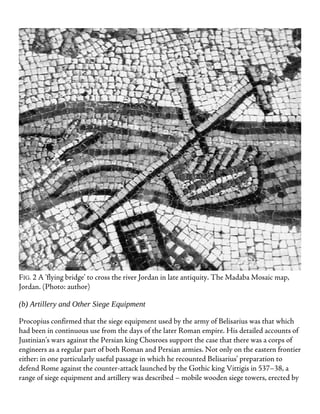
2 ‘Flying ferry’ – The Madaba mosaic map.
3 A petrary or mangonel. Maciejowski Bible.
4 A reconstructed petrary or mangonel, Mauvezin castle.
5 Raising water from a well – reconstruction of sixth-century saqiya
at Qasr’Amra.
6 (a) Descent into the countermine
8 Timberwork in a fifteenth-century barn at Harmondsworth,
Middlesex.
9 Treadwheel-operated crane at height.
10 Orford castle, Suffolk.
11 Gearing on a twelfth-century water mill.
12 Multiple arrow loops at Dover castle, Kent.
13 Soldiers sapping a tower.
14 Forest of Dean miner.
15 Castel del Monte, Puglia, Italy.
16 Trebuchet: Villard de Honnecourt.
17 Counterweight engine: from al-Tarsūsī.
18 Springald and trebuchet, The Romance of Alexander.
19 Rochester castle, Kent.
20 Pont Valentré at Cahors
21 Trebuchet: Konrad Kyeser, Bellifortis.
22 Early gun (reconstruction).
23 The Newport ship. Painting, Final resting place by David Jordan.
24 Newport ship – clinker planking, nails, caulking.
25 Medieval crane in a tower, Gdánsk.
13.
26 Small fifteenth-centuryhand guns.
27 Bombard, Istanbul.
28 Taccola’s De rebus militaribus – gunpowder mine.
29 Salses (Pyrénées Orientales).
30 Navarrenx (Pyrénées Atlantiques).
The author and publishers are grateful to all the institutions and individuals listed for
permission to reproduce the materials in which they hold copyright. Every effort has been
made to trace the copyright holders; apologies are offered for any omission, and the publishers
will be pleased to add any necessary acknowledgement in subsequent editions.
14.
M
Acknowledgements
ANY PEOPLE HAVEHELPED me with specific references, answers to questions or general
advice. With apologies for any omissions, I wish to thank (in alphabetical order) Bas
Aarts, Renaud Beffeyte, Oliver Creighton, Richard Dunn, Richard Eales, Michael Fulton, Bob
Higham, Christof Krauskopf, Pamela Marshall, Derek Renn, Jiri Varhanik, Peter Vemming,
Olaf Wagener and Bill Woodburn. An early outline of the contents was given as a paper at
Château Gaillard 2012 and I am grateful to have been invited to present it there. Rainer
Atzbach’s invitation to address the “Castles at War” conference in Nyborg helped me
crystallise thoughts about the history of medieval military mining, and Chas Hollwey made
possible a visit to the Clearwell iron mines in the Forest of Dean. Chas, and Jeremy
Cunnington, made possible a visit to see medieval building techniques reconstructed at
Guédelon in Burgundy. Richard Eales, Pamela Marshall and Denys Pringle have organised
study tours that greatly helped me to understand medieval castles and town defences, and
many members of the Castle Studies Group have contributed directly or indirectly. Finally,
the anonymous referees made numerous suggestions which have saved me from errors and
greatly improved this book, for which I am deeply grateful. As always, the author is
responsible for all errors that remain.
PETER PURTON, 2017
15.
W
Preface
E ARE SURROUNDEDBY and sometimes still use structures dating from the middle ages.
Scholarship has recreated its political, economic, social and military history.
Specialists debate the finer details of medieval science, education and technology. The
architecture of cathedrals, monasteries, churches and castles is painstakingly examined and re-
examined and their functions are explored in both academic conferences and the popular
media. But there are fewer studies of the people responsible for these works. And even fewer of
military engineers – who may well have been involved in both the construction and the
destruction of military fortifications.
I began to ponder this even while completing my History of the Early and Late Medieval
Siege. The names of engineers at war kept appearing in contemporary accounts, increasingly as
more records survived. Evidently, by the time of the renaissance in Europe, a body of expertise
existed that rulers called upon to fulfil their engineering needs, and some of those experts’
names are well known today (if the number of exhibitions devoted to Leonardo da Vinci is any
guide). It is also clear that engineering continued to be undertaken across the world even when
there is no surviving record of it. But what had happened before?
I was at first anxious that it would not be possible to attempt this history because of a lack
of evidence. Closer study suggested that, especially for the early centuries, it was necessary to
offer rather more in the way of hypothesis than a historian ought to be happy with, and to read
back from later reports into earlier times, something that also involved making unprovable
assumptions. Nonetheless, there was sufficient to show that this king or that prince had
successfully bridged a great river, or had built engines against a hostile fortress, or had laid out
and defended a camp, or had diverted a river, and thus to identify that to have done so
required having access to a degree of engineering skill that it was highly unlikely the rulers
themselves possessed. That the necessary technical skills also existed can be confirmed from
evidence in other fields: planning, layout and construction of buildings, hydraulic engineering
(canals, dams, irrigation) or shipbuilding, all areas where archaeology has added immensely to
knowledge of the past. Craftsmen built ships, houses or watermills with evident skill.
Although it can rarely be shown that the people who did the one also did the other, it can be
demonstrated that craftsmen (anonymous) were mobilised for military campaigns.
16.
This book isnot about technology (although it does touch on some important debates
about military technology), science or architecture. It is about the people who did the military
engineering. It touches on many and sometimes continuing debates on connections between
book learning and the “mechanical arts” and suggests a developing overlap starting in the
earliest years after the end of the western Roman empire but also continuing through times
once miscalled “dark”; it also poses questions about levels of literacy among the master
craftsmen from whom military engineers were drawn, and while not being able to offer
conclusive answers, suggests a growing awareness (if usually very limited) of what we would
now call book learning.
I can find nothing to prove or disprove that for the most part, however, knowledge was
passed on by the traditional master-to-apprentice route and involved memorising the rules,
except to remember that it was not always just a matter of passing on how something had
always been done: innovation and change took place that can only have been the result of
someone making the decision to progress from what they had inherited to something different.
Military engineering is interpreted here in a broad way because the evidence suggests it
covered many disciplines. It therefore includes the design, construction and operation of
medieval artillery, a central part of the duties of many of the engineers who will be
encountered. A separation of artillery from other forms of engineering would not begin to take
place until well after the arrival of gunpowder artillery in Europe. It involved challenges such as
bridge building and laying out camps – neither of them tasks that would necessarily leave any
trace, either on the ground or in the written record. Indeed, we will see surveying skills – well
attested in late antiquity – become invisible in their military sense for centuries, although they
must have been there. From time to time there is evidence of the construction of immense
mobile siege towers that confirm the presence of skilled military engineers, although more
often the record only shows that the equipment was built. All these are military engineering
roles. On the other hand, it will be shown that mining was traditionally a separate operation,
reliant to a large degree on the skills of those who made their daily living from this work.
Although non-specialists would regularly have been used for the hard labour in a military
operation, underground mining in particular (but also sometimes surface-level sapping) called
for specialist skills possessed only by such folk. The inclusion of “miners and sappers” among
engineering corps to the present day testifies to the relevance of this approach.
Medieval military engineers, it will be seen, were a continuing presence, and by their often
anonymous contribution – often in extremely dangerous and exposed situations – made a
significant contribution to the outcomes of campaigns. The noble commanders have always
taken the credit. It is time to redress the balance a little.
17.
Most of thebook deals with Christian Europe, so dates are given using the Christian calendar.
But I also deal with the continuing interaction with the Muslim world and discuss, with
evidence from translated sources, the comparable levels of knowledge and technology there.
Developments in military engineering across the known world, including Central Asia and
China, are recorded, particularly at the times when they came into (sometimes violent, at other
times more peaceful) contact. Where dimensions are quoted from medieval sources these are
presented as they were written, reflecting the difficulty of offering precise modern equivalents:
feet and inches originated in both Roman practice and other ancient civilisations and related to
parts of the human body. I have offered metric equivalents of the original. Where
measurements (particularly weights) matter to the interpretation, I have discussed modern
equivalents. Personal names are spelt not according to any strict rule, but in order to be
recognisable, and in the many cases where towns and cities and regions have changed their
name I have applied the same simple approach. In many cases I have alluded to other, wider
developments that provide context; readers can follow up references to relevant sources from
the footnotes or bibliography.
18.
Abbreviations
The following abbreviationsfor frequently cited collections or journals are used in the
footnotes and bibliography.
BAR British Archaeological Reports
CSHB Corpus Scriptorum Historiae Byzantinae
EHR English Historical Review
HEMS P Purton, History of the early medieval siege c.450–1200,
Woodbridge 2010
HLMS P Purton, History of the late medieval siege 1200–1500,
Woodbridge 2010
MGH Monumenta Germaniae Historica:
AA Antiquissimi Auctores
SRM Scriptores rerum Merovingicarum
SrG Scriptores rerum Germanicarum
SS Scriptores
Migne PG Patrologia cursus completa: series graeca, ed. J P Migne,
Brussels
Migne PL Patrologia cursus completa: series latina, ed. J P Migne,
Brussels
ND Notitia Dignitatum
PRO Public Record Office (London) [now The National
Archives]
RHC Recueil des historiens des croisades
RS Rolls Series
RIS Rerum Italicarum Scriptores, ed. L Muratori (and
successors)
SSCISSM Settimane di studi del Centro Italiano di studi sull’Alto
Medioevo
Where not given in a footnote, details of works referred to (especially multiple items on one
subject) will be found in the Bibliography.
19.
T
1
Military Engineers inthe Middle Ages
AN UNBROKEN TRADITION OF MILITARY
ENGINEERING?
HE MONUMENTS OF THE ANCIENT WORLD that have survived are eloquent testimony to
the levels of engineering skills available in these societies. Each successive civilisation left
evidence of its ability to build on a vast scale, to overcome geological and geographical obstacles
through the application of human ingenuity and (often) the force of immense human labour,
to make arid land fertile through great hydraulic projects, to cross rivers and seas. We know
that these engineering skills were also harnessed for the conduct of warfare. Literate societies
such as China, India and successive empires in the Middle East, and Greece then Rome
around the Mediterranean, additionally left writings that confirm what they were capable of in
both civilian and military contexts. Each empire influenced its neighbours and its successors.
In Europe, the Middle East, central Asia and North Africa, the roots of the developments of
the most recent millennia must be sought in the legacies of Rome and Persia, and their
interactions with China and the kingdoms of the Indian subcontinent.
The imperial armies of Rome and its ever-present Persian rival for domination in the east
were professional organisations and military engineering was integrated within them. The
operation and maintenance of artillery, the erection of fortifications, the bridging of rivers and
laying out of camps, the undermining of enemy fortresses were all tasks for which members of
the armed forces were recruited and trained. Roman weaponry was manufactured under the
supervision of salaried, skilled workers employed in arms factories (fabricae). The contribution
of engineering to the military success of Rome was sufficiently valued for its impact to be
described in classical histories, or at least clearly implied.
Not until modern times (in Europe) would a professional corps of engineers integrated into
the army of the state again become common. It would be the seventeenth century before a
formal body of engineers existed in the British armed forces, for instance.1
The earliest
examples would be the experts charged by a few rulers with organising a paid body of people to
20.
maintain the royalartillery in the gunpowder age from the mid fifteenth century onwards.
States in western Europe and the Ottoman Turks led this development. But throughout the
intervening centuries, commanders could and did routinely find the people with the necessary
skills to erect fortifications, to bridge rivers, to construct and operate siege artillery and to
build a sophisticated range of other siege equipment, to dig mines beneath hostile fortresses in
order to create breaches in their walls, to construct ships for transport and naval warfare, and
all the other numerous tasks that could not – or would not – be carried out by the knight,
squire, archer or ordinary foot soldier who made up the largest parts of a medieval army. It is
certain that these operations were not carried out by a professional corps similar to those that
existed in the Roman empire, so who were the people who must have been recruited for the
purpose? The timescale was different but the outcome was the same where a Roman empire
had continued in the shape of the Byzantine empire: along with its Persian neighbour, it
heavily influenced what happened in these regions, a dual inheritance taken up in the Islamic
states that arose from the seventh century onwards.
This book will present the evidence to identify a continuing tradition of military
engineering, and therefore necessarily of military engineers, during this thousand-year hiatus.
These engineers have fallen through a gap in historiography. Who they were, their changing
status, their contribution, and evidence for what skills they must have possessed, along with
discussion of how such skills were first acquired and then transmitted, are the main issues
discussed.2
Each year new studies are published covering every area of medieval history, many drawing
on archaeology to advance new hypotheses or to modify or discredit established theories.
Scholars of the military history of this period have progressively transformed our
understanding of how war was conducted across the medieval world as it underwent many
changes across the centuries, how it related to or impacted on the economy, the process of
state formation, how it was seen at the time (instead of with the benefit of hindsight), the role
of the soldiers, and – a specialism of particular fascination for some – military technology.
However, with a few exceptions, the study of this technology has tended to be treated in
isolation from social, economic and political developments and from other areas where
technology was required: the shortage of evidence having been a critical obstacle in making this
connection. Only in the blossoming field of castle studies has this work become established,
and this necessarily for later centuries. The other largely unanswered question is who were the
people responsible? With the exception of a number of studies of individual engineers and of
engineering in specific fields of conflict arenas, there is no history of the medieval military
engineer.
A number of modern studies devoted to much wider issues help address the second
question. A vast literature has appeared completely revising the history of the period now
21.
called late antiquity,and the outstanding work of people internationally, such as (in English)
Peter Heather and Chris Wickham, has happily made clearer the background necessary to
present this subject.3
Their work will inform the first chapters that follow. Detailed work on
the warfare conducted by the Merovingian and Carolingian realms in western and central
Europe and by the Ottonian dynasty in what was to become Germany has been undertaken by
B S and D S Bachrach amongst others. Their conclusions are sometimes controversial but
their studies are ground breaking. Following in that tradition is Leif Petersen’s massive study
of siege warfare in the successor states to the Roman empire, west and east. Their readings of
the limited surviving sources for these centuries (so long and so misleadingly termed the “Dark
Ages”) ease the way to try to recreate the role of engineering, and through that of engineers.
For later periods I will make reference to other valuable studies – articles on particular events
or particular individuals, and analyses of (for example) the crusades, where there is rich written
evidence from all sides of the conflicts. In many of these books and articles there are references
to engineers – particularly as they became recognised in contemporary accounts, and there are
a few scholars who have devoted significant effort to military engineering, and military
engineers, in particular regions or conflicts (such as the work of Nicholas Prouteau on the
crusades and Aldo Settia on engineers from Italian cities). Their contributions, localised in
time and place, have been invaluable.
In the absence of direct evidence of the continuation of any body of military engineers after
the disappearance of the western Roman empire and the later transformations of the eastern,
including the emergence of the Islamic caliphate, it is necessary to draw on a range of sources
to produce an account. I will look at what can be learnt from economic and social contexts
(particularly in relation to levels of technology and of scientific knowledge), parallel fields of
activity requiring engineering skills (such as the construction of buildings and shipbuilding, in
both of which archaeology makes a growing contribution), government records and
contemporary histories (and particularly manuscript illustrations) of actual military campaigns
in which engineering featured. Among written sources it is also necessary to consider what can
be learnt from the specific field of surviving medieval military texts. All of these sources have
problems of interpretation. I will address them in turn.
ECONOMY, SOCIETY AND TECHNOLOGY
Engineers apply technology and it has long been established that there were significant
developments in this field throughout the middle ages. Although technical progress in a pre-
industrial age was subject to a very much slower rhythm than in the industrialised world, the
progress when it happened was real and significant. There have been many studies of medieval
22.
technology and itsdevelopment over the centuries: what was inherited from previous ages, and
what emerged anew periodically to transform the way that familiar and routine tasks were
done, as well as to create more exotic or esoteric devices and machines that may (or may not)
have had practical uses. The economic and social background must be understood to see how
it was possible for new technology to emerge or be sustained. At its most fundamental,
craftsmen needed a market for their products if they were to continue making their living from
their craft, and this depended on the level of surplus produced in the economy. Wealthy ruling
elites would support the continuation of numerous crafts above and beyond those needed to
replace or repair the peasant’s tools or basic household goods. The presence of such elites –
both secular and clerical – was the essential starting point. Evidence for their existence (and
their wealth) informs whether there was the basis for an expansion of crafts and developments
in craft technology, and archaeology can confirm the technical levels achieved. The usually
invisible process of technical innovation in early medieval times was to meet some need: to
increase production, for example, or to supply water in arid climates to enable the growing of
crops. The presence of towns whose occupants depended on the production of agricultural
surpluses which they could purchase also encouraged trade and travel, in turn one of the
mechanisms for the diffusion of knowledge across the known world, the subject of study by
many renowned historians of technology and culture.4
There have been similar studies of the development and diffusion specifically of
technologies for military purposes and attempts to link these with what is known of
contemporary levels of scientific awareness. The read-across is sometimes straightforward.
Knowledge of surveying techniques was as relevant to laying out fortifications or camps as it
was to setting out the shape of new towns or measuring land for tax purposes. Skills in
building bridges were the same whether it was a permanent structure built at a river crossing
vital for a town’s (or a lord’s) levying of tolls or a temporary one for getting an army and its
impedimenta across a wide river. Construction and shipbuilding techniques reveal much about
the capabilities of the people paid to carry out the work, particularly as in many cases they
were the same people who would be hired for military engineering purposes – more on this
below. Sometimes the connection can only be implied and remains open to more than one
interpretation. Such problems are posed when trying to explain in particular how novel types
of artillery were developed, such as the trebuchet or the springald.
Despite this welcome attention, it is true to say that even now some issues remain
controversial, and others – such as the date when the single most significant transformation of
stone-throwing artillery (the trebuchet) first appeared, or the construction of the first
gunpowder artillery – are still unknown.5
But even the rather limited modern attention paid to
military technology has not yet been accorded to the technicians who applied the technology in
warfare, although as indicated the same skills and knowledge applied in this field as in the use
23.
of techniques forcivilian purposes. The use of engineers for a multitude of tasks that would
now be separated into distinct categories of civilian or military will be shown time and again.
The development of dedicated specialists working only (or largely) on a ruler’s military
requirements will not be found until the demands of gunpowder weaponry eventually called
into being a craft of its own, or, by the end of the fifteenth century, some engineers working
only on military tasks can be identified.6
The same will be found to be even more true of the
craftsmen or artisans who carried out the engineer’s instructions – carpenters, masons and
smiths, to cite only those most commonly called upon. As a result of their geographical
location, the wide range of people with specific skills required for shipbuilding may often have
carried out only this work (though they would not distinguish between ships for naval as
opposed to normal commercial purposes). Throughout, miners working under their own
masters represent a group whose existing specialism was as relevant to everyday as to military
purposes. But they were largely the exception.
CONSTRUCTION
In the area of architecture and construction techniques, the world of church-building has been
much more closely studied than that of the construction of castles, town walls or siege
equipment, despite the workers involved being often the same people. It is well known that as
with the ‘architects’ of cathedrals (and with necessary circumspection resulting from the
different sense attached to that term during this period), there were master builders of castles
(again, sometimes the same people). However, with the exception of a handful whose names
have been preserved, or who happen to have also served as high-ranking ecclesiastics whose
saintly lives were commemorated in vitae, the great majority remain anonymous.7
Nonetheless,
anyone visiting the remains of a major stone castle cannot but be struck by the evident fact that
many skills must have been called upon to design and oversee the construction of such a
structure and all its constituent parts. Less obvious to the naked eye, because the remains
surviving today give a very misleading impression of what was once there, but also significant
were the skills needed successfully to erect the earthworks underneath and around what may
have been a sophisticated timber castle involving carpentry skills of the highest order.
Archaeology is increasingly uncovering evidence for these assertions, although investigation of
medieval earthworks remains something of a poor relation, a sad reality unlikely to be reversed
at the time of writing.8
Between the patron (king, bishop or secular lord), who had decided on
the building and (to varying degree) determined or influenced what the outcome they desired
would be, and the builders and labourers who did the physical work stood the engineer.
24.
The same engineermight also be the man who would have been in charge of issuing the
instructions to the craftsmen who constructed the battering ram, or siege tower, or petrary or
trebuchet, or who began digging the mine at a siege, or who when an army reached a river
gathered the materials prior to constructing a bridge of boats or pontoons. How they gained
the knowledge and skills to accomplish such tasks is one of the questions to be addressed.
THE WRITTEN WORD 1: RECORDS
While researching hundreds of medieval chronicles and the published records of governments
during the middle ages that preceded the publication of my histories of the medieval siege,9
I
noted the names of many individual “engineers” recorded incidentally, either because of some
noteworthy event during a siege that the chronicler believed made a good story for his readers
– perhaps illustrating a moral or religious message – or else because they were being paid for a
particular service and that payment featured in a still surviving government record. The
existence of records such as the English crown’s Great Roll of the Pipe from the start of the
reign of King Henry II (1154–89), which records the expenditure of the royal exchequer,
makes it possible to observe close up who was being paid and what they were being paid for,
and is a priceless source of information on military engineers paid from English resources, even
if it is sometimes frustrating since what we have is the accountant’s end of the transaction (see
Appendix). The absence of similar sources for other medieval realms until later years, not
because they were not made, but because they did not survive, makes the challenge of
proposing a thesis for what was happening much more difficult. But there is no reason to
believe that the English experience was significantly different from that of any other medieval
state and the evidence from the later surviving records of the French monarchy confirms this.
One finding from studying these sources confirms that the terminology attached to the
engineers and master craftsmen was not exact and varied according to local usage, as well as
evolving over centuries to reflect changing status and new technologies. I attempt a summary
of this at the end of this chapter. But the problem (for modern students) of inexact
terminology in official records is only modest compared with the issues arising from using
other written evidence.
THE WRITTEN WORD 2: MILITARY MANUALS
The survival of a genre of writing intended to educate and inform the elite in military matters
is a great blessing to modern students but raises its own challenges of interpretation. A
25.
number of suchtexts will be examined more closely. They can potentially supply vital
information on subjects including the level of technology then available and advice on its best
use. But how far do they represent what was the practice of the time, or were they only a
worthy effort by the writer to encourage contemporary rulers to follow the best practice of
those that came before? Sometimes, especially in late medieval illustrated books, there are
machines even the existence of which is questionable, as well as anachronistic devices long
since disappeared (or had they?). The answer could, of course, be both at the same time, but
posing the question is necessary and the best way to check is to analyse what actually happened
on the ground – in the circumstances where other evidence allows it. Here, one then
encounters the common habit among other contemporaries to seek out accounts of battles or
sieges found in classical writers and transpose these verbatim.
The dominant figure in this discussion was the late Roman writer Vegetius. His Epitoma de
re militari, probably written around the year 400, remained permanently in use through to the
renaissance and along with a handful of other writings made up a very modest literary canon
surviving through late antiquity. Vegetius wrote unashamedly with a political agenda of
seeking to encourage the Romans of his day to return to what he prized as the virtues of earlier
times. His descriptions included detailed accounts of good practice in military operations and
covered many aspects that required the deployment of engineering skills, surveyors and teams
of miners. The questions that arise, however, are many. Had those who are known to have
possessed copies of Vegetius actually read it? The only possible verification is to study what
they did in practice. The bellicose Angevin count Fulk Nerra was a rare example where it is
possible to compare deeds and text. If they had read the text, did they possess the means to
carry out the recommended best practice? And even if they were familiar with the ideas it does
not signify that their engineers were able to carry them out. In the case of Fulk, he may well
have done all of these things. Whether others did so is more in doubt.
Despite all these doubts, the astonishing longevity of this text implies a continued
usefulness and this can be reinforced by the frequency with which its advice was replicated
later. It is striking that generations of Byzantine military manuals (beginning with the
Strategikon in the name of the emperor Maurice, dated to 600) reproduced the same practical
advice, as will be discussed. A whole series of further manuals appeared in the tenth century,
coinciding with a time when the Byzantine empire experienced a long period of significant
military success with a series of emperors who were genuinely skilful and experienced generals.
We will look at some examples where the advice of the manuals can be compared with actual
military campaigning, with the same caveat that the apparent confirmation offered by a
chronicler may be no more than a circular argument. Elsewhere, and much later, are to be
found a number of texts written in western or central Europe in the form of “advice to princes”
on how to rule well, many of which include sections on warfare, including information
26.
reflecting what thewriter believed was best practice in areas where engineers were needed.
Whether this reflected current reality is one of the relevant questions to ask.
The rise of the Islamic caliphate during the seventh century and the evolution of its
successor states in the Middle East, North Africa and Asia played a vital part in the
development and diffusion of knowledge, skills and technology, and among its literature it also
saw the production of military manuals. The same issues arise about the extent of the reality or
otherwise of the advice offered. The reliance of the early Muslim caliphs on the knowledge and
expertise that had existed in the lands they had conquered from east Rome and from Persia is
well known, although the precise mechanisms for the acquisition and transmission of this
knowledge during the age of conquest are harder to follow.
THE WRITTEN WORD 3: ILLUSTRATIONS AND
CHRONICLES
Illustrations in medieval monastic manuscripts have proved to be a rich source for
understanding much about buildings, building techniques and also weaponry of the period
contemporary with the scribe, while diagrams preserved in Muslim handbooks are an
invaluable source for appreciating what was known at that time in other areas too, such as
awareness of mathematical skills required for measurement. It is not a difficult conclusion to
reach that if there existed a group of people who were experts in surveying the fall of the land
with sufficient precision to organise an immense irrigation system (as there were), then the
same skills might have been applied in designing fortifications or preparing a siege of a town,
even if we have surviving evidence only of the former.
The chronicles themselves often provide the only accounts of events, but the perils of
treating them as plain truth are well known. Chroniclers did not share the concern of modern
historians that what they wrote was actually what happened, only that the moral associated
with it, or the heroic role of the protagonist, was clear – although the broad facts of course had
to be seen to be true. The tendency to lift words from Sallust or Caesar additionally
demonstrated the writer’s education in the classics. At the same time, however, and with all
due caution, where there is more than one account greater certainty is possible. Often there is
no alternative source, unless archaeology has unearthed closely dateable confirmatory evidence.
THE WRITTEN WORD 4: SCIENCE AND TECHNOLOGY?
27.
The vast accumulatedstock of scientific knowledge from the classical world was not suddenly
lost in late antiquity and early medieval times, just as aristocrats and clerics and administrators
did not suddenly lose the ability to read or write as they served the new (“barbarian”)
kingdoms. In western and central Europe, there was unquestionably a significant falling away,
with sparse continuity in the worst-affected regions. But the knowledge was not lost – think of
the work of Boethius (c.480–524), Isidore of Seville (c.565–636) and Bede (c.675–735) – and
gradually revived everywhere. For this study the issue is, what use was made of it? Isidore’s
Etymologies, an encyclopedia of current knowledge, in fact presented only historic information
about the technology of warfare and would have been of little use even if it had been read by
generals.10
There was a period of reawakening of interest in scientific knowledge in western
and central Europe during what is called the “Carolingian renaissance” in the late eighth and
ninth centuries, followed by another transformation of knowledge when Arabic translations of
a wider range of ancient texts (with Euclid’s Geometry having the greatest possible relevance to
engineering) became available in the Latin west from the eleventh century onwards. These
translations were the result of the work of many scholars who flourished in environments such
as the state-sponsored “house of wisdom” in Baghdad from the late eighth century onwards,
but also across the Islamic world, and who not only rescued classical knowledge by copying
and translating the Greek originals, but merged it with other science (such as that of India and
Persia) and then built on it and took it further.
Many of these scientific works had important implications for technology. But did the
theoretical knowledge that was learnt in monastic or cathedral schools, the progressive
expansion of which is broadly measurable, have any impact on the “vulgar” – that is, technical
– skills that craftsmen used, and on the intermediaries between them and the employer and
patron, the architects and engineers? The religious authorities in charge of education in the
Christian world continued to assert that knowledge of the subjects of the quadrivium
(arithmetic, geometry, music and astronomy) was an essential part of school-learning designed
to glorify God and to educate clerics, and that it was purely theoretical: scientia had nothing
whatever to do with the skills practised by common craftsmen and artisans – the “mechanical
arts”. A debate has continued for decades on whether there was a definitive dividing line
between this school-knowledge and its possible practical applications. Evidently, there was a
link at the level of the educated clerics who went on to be the bishops recorded as “building” –
signifying, in fact, designing or overseeing the construction of – cathedrals, monasteries,
churches – and palaces, castles and town walls, who must have made some practical use of
what they had learned. Those whose literacy made them into the clerks who populated royal
chancelleries and exchequers also carried their book-learning with them, although it is harder
to make a case that their scientific knowledge had practical consequences.
28.
A long lineof scientists (mostly clerics in the Christian world) produced studies and
writings that took forward existing classical knowledge of the world (much reliant on the
works of Aristotle) and in many cases there were major (potential) consequences for
technology. Writers such as Gerbert of Aurillac (Pope Sylvester II from 999–1003) spread
knowledge of the use of the abacus, for example, with significant practical applications. Later
scientists such as Adelard of Bath (1080–1152) took advantage of the work of Arab scholars
(the earlier role of al-Fārābī (d.950) being particularly significant) to spread awareness of more
sophisticated geometry with implications for surveying and construction. Hugh of St Victor
(1096–1141) argued for recognition of the importance of the mechanical arts and described
their application.11
Many other medieval scientists made contributions, some of which will be
discussed as appropriate in the chapters that follow. In recent times, students of medieval
science have tended to challenge rather than accept the idea that there was an unbridgeable
gulf between book-learning and practical technology.12
Were there any links between the two realms of the literate clerical scientist and the
engineer? It is apparent that the tasks of designing and building cathedrals, castles and other
grand buildings could not be achieved successfully just by copying (even with a template?) the
design of the last building one had worked on. It was not necessary to be familiar with
Euclidian geometry (or even the incomplete and inferior version transmitted in the often
copied instructions of Bede) in order to measure out parcels of land, but it still required a
knowledge of measurement and some elementary geometry to be able to function as a
surveyor, a planner of towns (such as the many planned towns identified in Europe and
elsewhere, and fortresses of which the Anglo-Saxon burh is a significant and early example).
Similarly, a castle builder had to be able to measure the height of the wall and the depth of
foundations as well as lay out the form of any new construction and it was extremely unlikely
that this would replicate the dimensions of their previous site. Another example is bridge-
building: bridges could not be erected successfully without an understanding of some key
questions that apply to such a structure. This knowledge may have been basic, and inherited,
but it still constituted a learning that would often have to be applied and modified to cope with
different situations. In bridge-building, one had to understand the geography and geology of
the site and the characteristics of the waterway to be crossed, as these determined both the
mode of construction and the dimensions. Otherwise the bridge would collapse or be washed
away. Siege engines likewise were almost always built on site, no doubt following a clear idea of
what they should look like and what they needed to do: but because each engine was new,
some at least of the principles behind its operation must have been known to the builder.
Similar considerations apply just as strongly to the learning acquired by educated Muslims,
where clerics emphasised the religious purpose of book-learning, but where it is evident that
29.
there were practicalapplications of much of the madrasa-learning, and that if the resulting
engineering did not come (ultimately) from this source, then its origins remain a mystery.
One of the purposes of this study, then, is to examine what the engineers and master
craftsmen needed to know to achieve what they did, and to ask where the knowledge came
from. An intriguing sideline of enquiry concerns those lay rulers who were ascribed a
particular awareness of military technology by contemporaries. They are few in number, and
what they actually knew cannot be recovered today, but the image of a prince instructing the
carpenters how to construct a siege engine, or telling the masons how thick their castle wall
should be, does arise from the historical evidence. Where did they – representing as they did
the tiny minority of educated lay people – obtain the necessary training to do this? Vegetius
and the Byzantine military manuals did not offer this sort of detail.
It is a truism that the source of most training was from master to apprentice, who then
went on to become a master, taking on an apprentice – and so on. But unless the knowledge
transmitted by this route was subject to change, to innovation, how did technological progress
ever come about? The diffusion of new technologies from one geographical area to another was
a process that could only have taken the form of human beings conveying new ideas and
methods to fellow human beings, who must have been in a position to absorb the information
in order for it to spread. There are enough stories of individual engineers spurned or exiled by
their original masters conveying dangerous knowledge to less cultured hostile neighbours to
see how this knowledge could easily pass on, but it also means that there must have been
among the recipients people able to absorb and themselves share the new ideas. One aspect in
particular of the lives of medieval military engineers (as well as technicians and craftsmen) that
risks appearing strange to modern readers is their mobility. This is because one of the critical
flaws of many views of medieval history, particularly among non-specialists, is to read
backwards from later times a whole number of concepts that are commonplace today but
which, quite simply, did not exist at the time. Ideas of nationality or national identity, normal
in modern history, are an anachronism for many medieval societies. When this history
recounts the career path of particular engineers, whether it be the men who served both the
Byzantine empire and its enemies or those who were hired by the warring city states of
renaissance Italy, what would now be called treason was just not seen in such a way by
contemporaries who would not understand the thinking behind it.
Similarly, there must also have been practitioners of these engineering arts who on
observing the operation of, say, a trebuchet were also able to think through ways in which its
efficacy might be improved. This is the only logical explanation for a century of progress in
which the original and probably quite simple throwing engine developed into the most
successful heavy artillery of the whole medieval period. The innovators remain nameless, but it
is a reasonable hypothesis that they had some elementary understanding of the principles by
30.
which the trebuchetworked if they were to suggest ways in which these could be further
improved. The number of variables that determined its performance was considerable, as
modern physicists have established, and knowing their interaction was crucial.
Later, the various and continuing improvements that turned what was, at its start in the
early fourteenth century, a very modest beginning for gunpowder artillery as a weapon of war
into the devastating weapon that changed the face of military architecture and warfare in
general by the end of the fifteenth century probably were the results of trial and error, but also
must have involved practitioners in some understanding of the properties of the ingredients of
the powder as well as the qualities of the metals and the techniques – and their limitations –
that they used to manufacture guns. There is much detailed information available about gun
makers in the later medieval period and also, from surviving records, about the people who
commanded and operated gunpowder artillery, which reinforces the perception that a modern
state in the fifteenth century – and especially from around 1450 onwards – saw the
importance of centralising, simplifying and maintaining its resource of guns and the people
who knew what to do with them. Although there are still to be found examples of itinerants
promoting their abilities in the art of gunpowder weaponry to the best bidder, states such as
France and Burgundy were already on the road to professionalising what was now recognised
as a crucial military asset.
Were the progressive improvements in the technology of such weapons down just to trial
and error? Of course, it is possible, but there are occasional hints that it was more than this.
Were engineers and craftsmen who were aware of more than the basic traditions they
inherited also literate? Could they have absorbed any of the available knowledge if they had
undergone education other than apprenticeship? Despite the existence and occasional
expansion of the education available to lay people in towns and cathedral or monastic schools,
on which there is a substantial literature, or in madrasas in the Islamic world, there is little
evidence of who benefitted from this provision. It may be extremely unlikely that even a small
minority of master masons or carpenters could read in their own language, let alone Latin,
Greek or Arabic, even at the end of the middle ages, where there are records of literate
craftsmen (such as the fifteenth-century design booklets of master masons Roriczer and
Schuttermayer, edited by Shelby, or the book written by engineer and gun master Bengedans).
But there is some indication that knowledge may have been passed on through this medium.
Rare indeed are the surviving copies of technological writings before the renaissance, and the
pearl is undoubtedly the thirteenth-century sketchbook of Villard de Honnecourt,13
which
would be a revolutionary discovery if it were unique but perhaps more realistically is the
chance survival of what may have been common at the time, and there are hints as well as
commonsense deductions to suggest that conclusion. This text offers some clues to the
question of how transmission occurred and it implies a lot about the ability of some engineers
31.
to make drawings,to interpret drawings and to read measurements as well as to write
instructions (for whom?). Villard’s notebook also includes an incomplete diagram of a
trebuchet. For whose benefit was such a diagram intended? There will continue to be debate
over whether even an ostensibly practical text such as this was actually written for the
information and training of a master mason, a common engineer or a surveyor, or for some
other purpose, and some of these questions will never be resolved. Here, I attempt to see how
such knowledge might have been needed to achieve the works of military engineering that are
known to have been accomplished. Gunpowder artillery offers further evidence of a
consolidation of writing as the route of transmission – the story of the frequently copied
Feuerwerkbuch is instructive.
OTHER ROUTES OF TRANSMISSION
Economic and social changes may not have much impacted the continuity of a skills base of
craftsmen, since masons and carpenters (and miners) were always needed, but the mystery
remains of how that higher level of skill needed by the engineer continued throughout the
period. The one certainty is that it did, although the picture can become one of a travelling
engineer acting like a salesman offering his services to each ruler as he travelled the roads of
medieval Europe, perhaps trying to establish who next would need someone to build a siege
tower. However, as more engineers are named in chronicles, the more the evidence grows that
there was in the high middle ages a self-selecting group of experts hiring themselves out to the
best bidder, sometimes arriving at court and offering to manufacture a machine the like of
which the world had never seen before, with which the monarch was assured of success in his
(and occasionally her) next siege. Italian cities seem to have been the original home to many of
them, but attachment to any particular place or state was unlikely to have influenced them.
One might have expected a family history to explain how they acquired their knowledge but
few can be established before the fifteenth century. Even more mysterious then are those
individuals where the history tells us that they really did construct something novel. Whatever
the reason for the skill, having it and marketing it effectively could prove to be lucrative. Once
the relationship was established, naturally enough, it could be called upon again, but there was
no loyalty attaching the engineer to a particular ruler and we will find examples of those who,
on capture, simply transferred their service to a new employer. Engineers – and skilled
craftsmen – could find that their skill and, it appears, the difficulty in recruiting people like
them offered them some chance of immunity against the horrors of war, provided they were
willing to transfer their service to their captors, while other captives were either ransomed (the
wealthy) or killed (the rest). The situation is less clear still in Islamic states, where we find the
32.
engineers in questionmaterialising when so instructed by the sultan. How they were
maintained is not revealed in the histories. Perhaps they found routine employment on other
tasks and because they lived in cities could be mobilised rapidly for military service. The
Mongol khans certainly put the artisans of captured cities to good use, sparing their lives as
their neighbours were slaughtered but then pressing them into service to build and operate the
siege engines needed by the conquerors at the next walled town that dared to resist. Other
than these forcibly conscripted workers, there are no records of a corps of military engineers in
the service of any ruler outside China, where written records of medieval dynasties confirm the
existence of large units of artillery operatives. Further west, the single possible exception is
Roger II of Sicily who may have inherited a siege corps from his Muslim predecessors. The
evidence is slight, although it seems that the Norman conquerors of that kingdom were
themselves among the princes well versed in the techniques of siege warfare. More likely is that
rulers knew where to find the people they could call upon with the skills they required.
MINERS
Evidence for this suggestion comes chiefly from miners. Miners serving royal armies would
often have come from the same area each time, but at other times they carried on their usual
occupation: in England, the Forest of Dean provided groups of miners under their own
masters from the first surviving records in the twelfth century up to the fifteenth; they would
be paid for their travel to and from the army as well as for their service once there. There was
an obvious connection between royal service and the availability of skilled practitioners,
although this does not explain why the other parts of the country where there were long-
established mining communities were not similarly called upon. The link to military service is
less clear from the evidence for mining communities in other parts of Europe, although from
the fourteenth century the miners of Liège were to find regular military service and establish a
formidable reputation (and indeed to replace the Dean miners in Henry V’s army in 141714
),
and there are other places where the evidence of such connections is strong if not decisive. In
the Middle East, there are similar references to miners repeatedly coming from particular
locations to serve in the armies, but this may reflect no more than that these were the nearest
areas where there were mines.
There are, therefore, a number of possible models for how military engineers obtained their
expertise and secured their employment and for how royal commanders recruited them. The
questions become easier to resolve as the centuries roll by and as the evidence becomes more
substantial. By the end of the middle ages (not a specific time but an evolving pattern of
distinct but overlapping processes varying between and in time and place), early modern states
33.
were established andoperated in a world still linked to the past but substantially more
developed in many areas, including their economies, state apparatuses and military capabilities.
Living among them, the famous figures of the renaissance who were able to combine talents in
many different spheres including the military – Leonardo da Vinci being only the best
remembered among many contemporaries – were, in this area, building on the achievements of
their medieval predecessors rather than creating much that was particularly novel (let alone
representing throwbacks to the glories of the ancient world which, in the area of military
technology, had long since been superseded). Their ability to design and construct military-
related machines, buildings, fortifications, engines, bridges and so on – and there was an
interesting tendency for those who specialised in siege equipment also to work in hydraulic
engineering – was not based on sudden inspiration, and still less on ancient Roman models
(though basic principles held true), but rather represented the evolution of practical
knowledge that had been transmitted from generation to generation. They must have followed
a number of routes not all of which are capable of being recovered, but which must have gone
back through the recorded individuals of the fifteenth century, and the occasionally identified
masters of the twelfth and thirteenth centuries, to the anonymous but real engineers who
carried out the same tasks in the employ of Charlemagne and Pippin. They, in turn, did not
acquire these skills without learning them from predecessors. No doubt, the further back one
goes, the more often there were times and places where the transmission of knowledge failed
and had to be re-imported from elsewhere. But that knowledge must have always survived
somewhere. To demonstrate this unbroken progress is the main purpose of this study.
“ENGINEERS”: THE EVOLUTION OF THE WORD
By the start of the early modern age, the word engineer or its form in other languages was
readily understood and was commonly applied to the type of expert featured here. But a
millennium before, this was far from the case. As “engineer” will be used as a shorthand
descriptor for the whole millennium, it makes sense to set out the evolution and different uses
of the word at the start, as well as the other terms used to describe the same people.
It is not possible absolutely to confirm the reason why the (Latin) ingeniator became the
common word to describe people who designed and – more commonly – made engines. By the
time of the renaissance, it clearly had that significance, and even in non-Romance languages it
had been adopted. In German, the equivalent term was werkmeister, a word that is directly
related to the function it describes, although that function was in fact loosely applied to
building masters as well as artisans and craftsmen and those who made an engine (machina).15
It has been traced back as far as Old High German with examples from the tenth century, and
34.
there were analogouswords in Norse languages. Ingenieur was an early modern import into
German from the French.16
There is more than one possible origin of ingeniator. The most likely derivation is from the
Latin ingenium, which had the classical meaning of both a natural quality and, by further
derivation, cleverness, talent, genius; these senses became further transformed to signify
artifice or trickery and then developed into signifying a product of such artifice: engines.17
A
clever attempt was made a long time ago to suggest an alternative derivation based on finding
the word encignerius in a twelfth-century Italian source, used in the sense of someone
encircling a fortress (incignere).18
However, if one follows the appearance of the word in
Romance languages, this explanation does not seem to hold up. Numerous references have
been found in Old French to engigneurs where the word is directly linked to the term engin. As
in other languages, it is found describing both builders (architects) and constructors of military
engines, and in the sense of the builder being “ingenious”.19
Similar usage predominates in the
romances that entertained the nobility during the early part of the second millennium.20
The
same connections were found by students of both the Spanish and Italian languages, with
references to Castilian sources from the eleventh century and, as we have seen, Italian from the
twelfth.21
In Byzantine sources, a range of terms were employed, depending on the role being
described. At the top end of skills (for example, when describing someone who was the
equivalent of a modern architect), the word used is mechanikos, mechanic. Where the function
is more specifically that of the creator of siege equipment, Procopius used the term tekhnitai,
which normally means a craftsman, suggesting that this person was not the engineer in
charge.22
However, this word had a wider significance and could also mean people of both
higher and lower status according to the context.
There is an ingeniator recorded as a holder of lands in the English Domesday Book of 1086
(Waldin, who had ten landholdings directly from William the Conqueror in Lincolnshire),23
but other explicit references to early engineers using that word tend to be in later accounts.
Nonetheless, the link between the original and the acquired senses of the word is not unusual.
In describing the siege of Bréval in 1092 by the king of France and the duke of Normandy, the
early-twelfth-century chronicler Orderic Vitalis wrote that Robert of Bêlleme, who will be
discussed later, “ingeniosissimum artificem adducit, cuius ingeniosa sagacitas” was to be later
deployed in the Christian capture of Jerusalem. The chronicler seems to have enjoyed the
playful link between Robert’s ingenuity and the creation of siege engines.24
The term engineer
thereafter appears frequently in English government records, starting with payments to
Gaufridus ingeniator in the sole surviving Pipe Roll from the reign of Henry I.25
For a long time, those who would fit the loose definition of a military engineer as people
carrying out the many different tasks that fall within the modern scope of the term were also
35.
identified in anumber of different ways, most often associated directly with their trade: master
masons and master carpenters were to be found as well as engineers designing and erecting
buildings or bridges (where the distinct term pontanarius was rare). The word balistarius may
literally mean a crossbowman but there is some evidence suggesting that at times it included
people with a wider and therefore more significant remit, alongside the possibility that it also
acquired a more symbolic significance (to judge by the number who appear as tenants-in-chief
in Domesday Book). In later centuries the word a(r)(t)tiliator was used to designate those
responsible for crossbows and ballistas. Miners and sappers always had their own distinct
identity recognised in a distinct vocabulary, while those responsible for measuring,
mensuratores, also occupied a distinctive place whether or not their task at a given time had a
military element to it. By the time of the gun, the various skilled craftsmen who would be
involved in the manufacture of the weapons, and those responsible for operating them, would
generate a whole new language of their own while also calling on existing terminology.
Other terms were also used, though more rarely. An artifex in classical Latin was a master
in the liberal arts but also could be a master mason or carpenter. This implication of skilled
worker continued alongside other more exalted meanings and the associated verb could mean
designing or making.26
For the execution of engineering tasks, other types of worker were also needed. The Latin
word faber was in use in sources dating from the early medieval period through to the end of
the middle ages. It was often followed by a descriptive term identifying the particular
specialism – carpenter, mason, smith and a multitude of specific tasks associated with
shipbuilding. These people were, however, almost always of craft status, because those below
them, common labourers, were described as an operarius or some variant based on the same
root. They could be found working on any task, and again, where appropriate, they might be
described as workers on a castle or a bridge as well as workers in timber or iron.27
It appears that engineers as so called were much less common before the turn of the
millennium, which raises important questions not about the existence of the role – the various
specialisms that those called engineers were later to be identified with still required people
with the necessary skills to carry them out before the word engineers was applied to them –
but it may give cause to doubt what if any status they had acquired, in contrast to the
recognition that would be allowed them in later centuries. The absence of a specific term
makes identifying them and answering such questions all the more of a challenge. The
necessary starting point is the engineering provision of the later Roman empire.
1
See the excellent study by W Porter, The history of the corps of Royal Engineers, vol. I,
Chatham 1889 reprinted 1977, for the history of engineers serving the British crown up
36.
to the endof the nineteenth century and the piecemeal evolution of the corps.
2
As with everything else covered in this study, the term engineer itself evolved slowly
towards its modern meaning, and throughout the medieval period was used in a wide
range of senses. On this see pp. 16–19 below.
3
For further details see the Bibliography.
4
Lynn White jnr is a leading western scholar of this subject; among French historians, G
Beaujouan, P Braunstein and J Gimpel have been prolific writers (see Bibliography). For
the Muslim world, D R Hill has provided access to an enormous literature in Arabic or
Persian.
5
On the origins of the counterweight trebuchet, see in particular studies by Paul
Chevedden, and pp. 165–9.
6
Although occasionally it is possible to identify engineers who were employed only on a
specific area such as siege engines – examples occur in the records of Henry II of
England’s expenditure (see pp. 140–2 and Appendix).
7
See chapter three. Studies by (in English) J Harvey, and in German by G Bindung have
led the way in dealing with architecture and building technology and those responsible for
designing grand stone buildings.
8
I will discuss the rarely named “architects” of castles in the proper place but it will be
important to keep in mind that the description of castles as “military architecture” that
dominated writing on the subject in the nineteenth and first part of the twentieth
centuries has been substantially revised and most modern students now view castles as
having multiple social, political and economic functions. I believe, however, that some
have gone too far in attempting to deny any military role, which is simply wrong, while it
is also the case that those in charge of the construction had skills also used in the military
sphere even if a particular building project was for other reasons. There is more on this in
following chapters although the subject – and the literature – is vast and falls outside the
scope of this book.
9
P Purton, History of the early medieval siege c.450–1200, and History of the late medieval
siege, c.1200–1500, both Woodbridge 2010.
10
The Etymologies of Isidore of Seville, ed./trans. Barney et al., books 18 and 19, 364, 376–7;
see also Isidoro de Sevilla Etimologias libro XVIII, ed. Llorca, 10–12, 106–9. Isidore’s work
was finished in 636 and more than one thousand copies survive.
11
The letters of Gerbert …, ed./trans. Pratt Lattin; Burnett, Adelard of Bath, an English
scientist; Netton, Al Fārābi and his school; Hugh of St Victor, Practical geometry, ed./trans.
Homann, and The Didascalion, ed./trans. Taylor.
37.
12
See, for example,E Whitney, ‘Paradise restored. The mechanical arts from antiquity
through the thirteenth century’, Transactions of the American Philosophical Society 80 (part
1), 1980 and for the continuing debate, works by Alessio, Bakar, Beaujean, Bennett,
Bodde, Braunstein, Contreni, Crombie, Folkerts, van den Hoven, Jolivet, Long, Ovitt,
Özdural, Radding and Clark, and White in the bibliography.
13
Discussed fully in chapter five.
14
See p. 224.
15
Diefenbach, Glossarium Latino-Germanicarum; Lexer, Mittelhochdeutsches
Handwörterbuch, 3, 773.
16
Grimm, Deutsches Wörterbuch, 14 (1) (2), 385.
17
Latham, Revised medieval Latin word-list from British and Irish sources, 249.
18
Feldhaus, Die Technik der Antike und des Mittelalters, 277.
19
Godefroy, Dictionnaire de l’ancienne langue française et de tout ses dialectes du IXe
au XVe
siècle, III, 169; Du Cange, Glossarium mediae et intimae Latinitatis (new edition), 360–1.
20
See examples in Gregory, Rothwell, Trotter, Anglo-Norman dictionary, 908–9.
21
Corominas, Pascual, Diccionario crítico etimologíco Castellano-Hispánico, III; Alonso,
Diccionario medieval Español, II; Battisti, Alessio, Dizionario etimologico Italiano, III.
22
Procopius, Wars, VIII, xi, 27 (Loeb ed. pp. 156–7).
23
Williams, Martin, Domesday Book, 945.
24
Ecclesiastical history of Orderic Vitalis, ed./trans. Chibnall, book VIII (vol. IV, 288–9)
25
Pipe Roll of 31 Henry I (Michaelmas 1130), 143.
26
Lewis and Short, Latin dictionary, 168.
27
Latham, Revised medieval Latin word-list, 323–4.
38.
I
2
Late Antiquity andthe Early “Middle Ages”
Were the “Dark Ages” Really Dark?
THE INHERITANCE
T IS NOW GENERALLY agreed by historians that there was much continuity between the
western Roman empire and its successors following the disintegration of the centralised
state during the fifth century. In the east, the continuity was unbroken as the Byzantine
empire survived for another thousand years. The Germanic tribal confederations, many of
whom had been living in or alongside Roman society for decades, set up kingdoms of whom
the Franks in northern Gaul and beyond, the Visigoths in southern Gaul then (after expelling
the Vandals, who took over Roman Africa) Iberia, and the Ostrogoths who established a
kingdom in Italy were the most significant. The new rulers (numerically a small minority of
the population) wanted and needed to use what they found, not destroy it. Only in a few
places had specific circumstances led to a collapse of the Roman infrastructure. The political
and military history of the age can be traced easily through written evidence – key features
were the reconquest of Africa and destruction of the Ostrogothic kingdom in Italy by east
Roman (Byzantine) emperor Justinian (r. 527–65), and the expansion of the Frankish
kingdom under the Merovingian dynasty following Clovis (r. 482–511) – but evidence for
society and the economy is harder to find, and here archaeology makes a big contribution.
Warfare and archaeology can be combined to permit a study of levels of engineering and to
propose what happened to its military version. It will be proposed that although there are few
references to named engineers across these centuries, they continued to operate; and that the
changes to society and the economy that took place as late antiquity gave way to a recognisably
different early medieval world in the seventh century appear to have had limited consequences
in this field.
The seventh century also saw the sudden creation of an Islamic state as Muhammad’s
followers achieved extraordinary victories pushing back the frontiers of eastern Rome and
39.
destroying totally thePersian empire (by 651) before extending their power across Egypt and
North Africa (whence from 711 they quickly took over Visigothic Iberia) and eastwards
across central Asia to the borders of China and India. Just as the Franks on a smaller scale
recognised that they needed to make use of the knowledge and skills that they found, so also
the early Muslim caliphs understood that they had to make use of Christian or Zoroastrian
experts living in their new empires, and did so with great success.
Written evidence for the earliest of these events does not survive in great quantities. The
sixth-century accounts of bishop Gregory of Tours and of the Byzantine official Procopius are
the most useful for our purpose but other surviving writings (including evidence from sources
such as saints’ lives – the role of the Christian church was of great importance, representing as
it did the only institutional continuity with the western Roman state) can contribute too.
THE WRITTEN WORD
Gothic kings still demonstrated their interest in the inherited learning of antiquity –
Cassiodorus’ official letters confirm interests in machinery, in arithmetic and geometry, in
architectural skills and in surveying, and referenced great inventive minds such as
Archimedes.1
In east Rome, there is no doubt that the ability to read and write remained
widespread among people of the ruling classes and those that served them, including in the
military and administrative structures.2
Some writings never disappeared, of which Vegetius is
of the greatest significance here.3
Vegetius’ Epitoma de re militaris, from around 400, was itself
based on earlier writers (historians such as Sallust and administrators such as Frontinus), with
its main focus being to emphasise how vital to success were the professionalism, training and
discipline of an army and the range of skills required of its commander. But the book also
devoted considerable attention to areas in which engineering skills were paramount, such as
siege warfare, and, as part of the discipline of any army, to the question of setting up camps. In
his book four, Vegetius described the weaponry available to the Roman army in conducting a
siege, either as attacker or defender, and discussed weapons such as the ballista and the onager
(one-armed stone-throwing torsion catapult that had been standard equipment since the third
century) (see here). His comprehensive recommendations included advice on sapping and
mining. His advice on fortifications was highly practical.4
Vegetius’ work continued to be
copied – the oldest known manuscript today is in a collection of texts thought to date from the
sixth century.
Vegetius was copied in Constantinople too,5
but the most striking confirmation that what
he proposed remained the standard – although it can be argued that this was likely to be based
on experience and a continuing military culture rather than on having read this work – is to be
40.
found in theStrategikon ascribed to the emperor Maurice and dated to the year 600. This work
covers similar ground with similar advice and was rooted in the theoretical best practice of the
age. The information it provides for Byzantine military organisation and tactics but also for
the continued integral role of engineers within the armies of eastern Rome at the turn of the
seventh century is invaluable, as evidence from actual campaigns suggests its continued use by
Byzantine commanders.
The transmission of classical knowledge is a topic the relevance of which to our subject
depends on whether one believes that scientific awareness had any practical impact. In this age,
it can be shown that the level of understanding revealed in contemporary writings was
reflected in what is known from archaeology or written sources to have been the practice of the
sixth century. This applies particularly to those parts of mathematics essential to building,
where the role of the master builder, the architect described by Isidore as emulating the
description of his role in the teachings of St Paul,6
and therefore very well known to educated
people lay and ecclesiastical, must have involved at least a basic understanding of geometry and
measurement. The trickier question will be the extent to which this continued into the
following centuries.
At the beginning, however, evidence suggests that the social and economic conditions in
which such skills were called for were present, or the skills could be obtained from more
cultured neighbours. Neither seas nor waterways, mountains nor forests, state boundaries nor
(as will be clear later) religious differences stood in the way of trade, travel and transport,
including the transmission of technologies and the technicians with the requisite skills.
ECONOMY AND SOCIETY IN THE “DARK AGES”
Current orthodoxy proposes, with Chris Wickham, a “very substantial simplification in post-
Roman material culture in the fifth to seventh centuries”, particularly drastic in Britain and the
Balkans, with only Syria, Palestine and Egypt (all under Byzantine rule) exempt,7
with
resources reduced and structures “simplified”. But there was sufficient continuity to ensure
Roman-style government systems in the major kingdoms (the Franks and Visigoths) for
several centuries.8
In Italy from the fifth century on, a combination of factors, including military expenditure,
relentless war in the sixth century and massive tax evasion, contributed to a collapse of
investment in infrastructures and urban decline in favour of the countryside, but with some
important exceptions. An overall decline in building technique has been posited, based on the
argument of declining skills.9
In the Visigothic kingdom (Iberia and southern France), the
state continued to function and continued to use imperial Roman titles. However, partly
41.
because it wasunable to maintain the collection of taxes, it could no longer pay for a
professional army but was instead dependent for its personnel on a small entourage around the
king, retinues supported by the great landowners, and the continuation of a system of
obligatory public duties to the state. There was no decline in available craft skills – indeed, it is
argued that Visigothic metalworkers were superior in skill to those they now lived alongside10
– but their relationship with the military structures of the kingdom must have altered as a
result of the changed character of the state’s military functioning. What consequences did this
have for there being a professional engineering corps?
Merovingian Gaul and Burgundy offer evidence consistent with the continuity of craft-
based industry, sometimes in a few cities that continued to have important trading or
administrative functions, while others shrank: but this was accompanied by the transfer of the
crafts to rural settings, and monasteries acquired important economic roles too.11
They became
increasingly prominent as their number expanded (up to 550 across the Frankish realm)
during the seventh century, many of them part of the royal fisc. With good communications,
many became centres of production, while local villages needed to supply their needs, including
for craftwork.12
Archaeology suggests the continuation of skills in carpentry – including the
continued existence of specialised craftsmen, who could only survive in the trade if there was a
need for them.13
Law codes and legal records established the status and the value attached to
craftspeople, and in the process confirmed their continued role in society, with evidence that
even when some of them were legally unfree, their economic importance was recognised, as it
appeared to have been in the laws established in the successor states in the west.14
The level of continued craft skill is also attested by archaeological finds in different areas.
Windmills and watermills were important to local economies and involved a considerable level
of “elaborate engineering” (Hodges’ phrase) to construct and maintain. From this period there
are seventh- and eighth-century examples in Anglo-Saxon England and Merovingian Gaul,
extending to its far eastern frontiers, with evidence of sophisticated hydraulic engineering that
was presumably based on the preservation of classical knowledge and skills, and references to a
floating mill on the Tiber in Rome.15
The eastern Roman empire also underwent significant changes during this period that
would have an impact on the continuity of military structures. Nonetheless, the great cities
remained as densely populated centres – 400,000 people in Constantinople (before the terrible
plague of 541), 100,000 each in Antioch, Alexandria and Thessaloniki, with evidence of
continued investment in building during the sixth century, work and materials to sustain many
craftsmen, watermills, large timber oil presses in Asia Minor (operated by counterweights),
and significant state expenditure on arms. The plague years of the sixth century had serious
impact, and then in the years following 632 the empire faced enormous losses of territory to
Islam and continuous pressure on all of its reduced frontiers. There must have been
42.
consequences for engineeringas well. It is suggested that the scale and scope in particular of
public building reduced with the drop in central resources, because such projects were capital-
intensive. That the consequences might have included a reduction in the numbers of skilled
engineers and possibly a reduction in their level of skill is hinted at in the story of the great
aqueduct built for Constantinople in the fourth century by Emperor Valens, which was
destroyed during the Avar siege in 626. It was only restored because of a drought in 766/7,
when, according to the chronicler Theophanes, the emperor had to summon skilled workers
from the Asian provinces to accomplish the task.16
It is important not to overdramatise this, as
military necessity created a continuing need for military engineering, as will be discussed
below, and there is evidence that fine crafts continued to be produced.17
Despite the shrinkage of imperial power and wealth, imperial armies continued to be paid
centrally even if their structures had to be modified to take account of new realities.18
There
has been no study conducted of the impact of changes over these critical years in the provision
of military engineering. The work was still done, but by whom? Procopius, describing one of
the repeated Roman–Persian wars, in discussing the design of a new, easily portable type of
battering ram at the Byzantine siege of Petra in the Caucasus in 550, made the helpful
comment in passing that this had never previously been devised despite the fact “that there
have always been and now are great numbers of engineers in both countries” (that is, east
Rome and Persia).19
Even if the technical skills base was sustained across Europe, the case for
continuity of professional military engineers in the eastern empire is far easier to demonstrate
than it is further west.
This reference draws attention to the comparable engineering skills and technology
available to the great power represented by the Sasanian monarchy of Persia, although
contemporary records are in short supply and it is often necessary to rely on much later
writing from the Islamic era. The largest siege operations of the Middle East have been
uncovered using satellite imaging of the Sasanian siege of Hatra in 240–41, revealing a double-
walled circum- and contravallation 24 kilometres long in total provided with 45 ballista
platforms.20
The Sasanian king Chosroes I (531–79) is credited with a modernisation of his
state including establishing professional armies and extensive fortifications on the frontiers,
implying the existence of the infrastructure and building and design skills required. Massive
irrigation systems were built during this era: rivers diverted and canals dug – something only
possible with substantial engineering skills.21
When the old regimes collapsed to the invading
armies led by Muhammad’s successors, it was hardly a surprise that the new rulers would rely
directly on the knowledge and skills already present in the lands that they now ruled. It may be
over-simplistic to assume total ignorance among the Arab conquerors: after all, Arab tribes
had for long related to both of their overwhelmingly powerful imperial neighbours and
sometime rulers, with considerable evidence of interaction including in the adoption of
43.
building skills. EarlyMuslim fortresses and palaces in Syria were clearly based on the design of
the former Byzantine rulers22
and there is also much to suggest that the well-known “desert
castles” of the Ummayad caliphs were built by Christian craftsmen.23
The subsequent flowering of science and culture under the rule of the caliphs represented a
fusion of existing knowledge and the re-employment of Christian, Zoroastrian, Jewish and
other scholars and administrators. An additional influence was the learning of India, as the
early Arab conquests had extended to what are now Afghanistan and the valley of the Indus.
The conquerors encountered a culture where iron and steel manufacture were well established,
cities walled in stone and brick were commonplace, and mathematical knowledge – and in
particular geometry – was a long tradition.24
Indian mathematics had an influence on the
development of Arab maths, and geometrical skills had significance for hydraulics and
surveying. In addition, Persia and India had seen the invention and use for many centuries of a
simple device used to lift water, the noria.25
It has been suggested by a number of students that
this lever-like machine looks remarkably like a stone thrower of the misleadingly called
“traction trebuchet” type (see below) and may possibly have inspired its invention (if, indeed, it
was invented separately in the Middle East rather than having been imported from China).
The early Muslim rulers succeeded, despite being a small minority, in absorbing the
knowledge and skills they did not possess without losing their specific identity. The result was
an amalgamation of existing science and philosophy to which the requirements of the new
regime for skills, in particular in measurement and counting, added new advances: the
magnificent architectural features of the new mosques erected in cities such as Damascus as
early as the seventh century are testimony to this fusion. Within a hundred years of the
conquests, but certainly starting under the Ummayad caliphs, there was widespread basic
literacy in the cities, and schools (and tutors for the wealthier elites) provided the more
advanced knowledge required by government.26
The caliphs’ military commanders also
benefitted from this provision.
CONTINUITY IN ARMS MANUFACTURE, ARMIES,
BUILDING AND SURVEYING?
The evidence therefore supports the case for continued craft skills, signifying their continued
transmission from one generation to the next; and that significant levels of engineering
capability continued to be available in many places.
The armies of imperial Rome had been supported by arms factories, where labourers
operated under the direction of skilled craftsmen and administrators. The workshops
concerned, known as fabricae, were listed in the late Roman document recording the units of
44.
the army inthe western and eastern sections of the empire: and the Notitia Dignitatum (ND)
has remained a source of debate, with some scholars doubting that it reflected reality.
Assigned to around 400, the ND identified 15 arms factories in the eastern and 20 in the
western empire. If the list is complete, some whole provinces were unprovided for, where it has
to be assumed either that craftsmen attached to the unit had been responsible for the work –
Vegetius confirmed that this had been the practice previously27
– or that private suppliers
were used. By the fourth century, it is likely that, in contrast to the time of the legions, most
units of the Roman army did not have artillery, and the ND suggests that there were specific
units of ballistarii.28
This signified men who operated static bolt-shooting artillery, rather than
crossbows which would be the medieval sense of the word. The answer to the question of what
happened to the fabricae has both a direct and an indirect bearing on the question of the
continuity of Roman military engineering skills and the type of weaponry used by Roman
armies that required specific skills, in particular artillery.29
Only two factories specialising in the production of any kind of artillery (ballisteria) were
listed, and both were in the western empire (at Autun and Trier).30
Factory locations may have
been based on factors including access to raw materials and the necessary skilled labour as well
as connectivity to the armies they were designed to support. Regulations covered the workers,
who were treated in the same way as soldiers, with pay and conditions laid down. They
enjoyed a higher status than civilian artisans but were tied to the service. Excavated remains of
what appear to be arms factories from earlier periods seem to confirm their role as official,
organised and specialised workplaces set up to support the front-line army.31
They were under
the control of a very high-ranking official with numerous responsibilities, the magister
officiorum. How much of this infrastructure continued in late antiquity, and how much made it
through the sixth century? There is evidence for continuity of arms manufacture in the first
years of the successor states. Cassiodorus’ collection of official letters appears to demonstrate
that it continued to be a strongly regulated operation, but there is no reference to factories in
the western empire by this time (the early sixth century).32
In the eastern empire, the last
reference to an arms factory (in Nicomedia) dates from 612, while laws enacted by Justinian
incidentally confirm the existence of private arms factories, although it is thought possible that
an official factory remained in Constantinople for many centuries after.33
Scholars have
identified no explicit references to arms manufacture in the empire between then and the
eighth century, although it is obvious that some facility for manufacture must have
continued.34
If the fabricae disappeared, this would be consistent with other evidence for the changes
that took place in military organisation in the west. Information for the fifth century is
indirect. Between 400 and the last quarter of the century, a period that saw numerous military
conflicts in Gaul and Italy, the Roman army in the west as listed in the ND disappeared. A
45.
force totalling halfa million soldiers, paid out of taxation and consuming half of the imperial
budget, ceased to be in one half of the empire.35
This is consistent with a collapse of the
enormous bureaucratic system once the centralised administration and the taxes that funded it
ceased to operate (over time). The impact of the collapse of centralised tax collecting was not
as severe as might be thought, because of the long-standing system of compulsory levying of
public duties, done locally, on all citizens (the munera publica), alongside taxes. These included
obliging city administrations and landowners to send artisans for service, for example, working
on everything including bridges and fortifications. The successor kings relied on their retinues
and those of their leading men, but also the continuing obligations of the munera.36
In Gaul,
Clovis inherited and maintained parts of the late Roman military infrastructure, including
some taxation, but this could not be sustained, and the evidence for the maintenance of arms
factories is not there.37
Individual craftsmen working on the estates of the aristocracy are most
likely to have filled the gap. But arming the soldiers of a great man’s retinue was not the same
as replacing the skills and experience levels required for the manufacture, and then the
maintenance, of a piece of Roman artillery, not to mention its operation, although even here it
is possible to identify one case of continuity of manufacture.38
The ultimate proof of continuity lies in the evidence for the continued use of Roman
artillery under the Merovingian kings, to confirm whether artillerymen were among the
engineers who continued to function in the seventh and eighth centuries (as will be seen
below). There is no doubt of continuity of necessary engineering skills in other areas of life,
and these may also have applied in the military sphere.
BUILDING, GEOMETRY, THE SCIENCE OF MEASUREMENT
AND MILITARY CAMPS
Actual buildings dating from late antiquity are material evidence for the continuation of
classical knowledge and skills in this area. In addition, the preservation of the writings of
Procopius on the buildings erected at the command of emperor Justinian offers a
contemporary account by someone close to the centre. Procopius’ description of the
construction of the still-standing church of Hagia Sophia in Constantinople under the
direction of two named master builders, Anthemius of Tralles, the architekton, and Isodorus
the Milesian, and of its reconstruction following the collapse of the original dome in 557,
stands out for its detail (even if it betrays that he was not an expert in the subject) and as
evidence that the science of Roman monumental architecture had survived into the sixth
century.39
The proportions of the dome of Hagia Sophia used the ratio of 1:√2 just as the
dome of the Pantheon in Rome, and the use of architectural drawings at this time is evidenced
46.
by references totheir existence: similar references confirm that such drawings continued to be
used into early medieval times, and even as far away as Scotland.40
Isidorus was the equivalent
of a professor of geometry or “mechanics” (in the architectural sense), the author of a
commentary on Archimedes and the writer of supplements to Euclid’s geometry. Anthemius’
writings have survived less well, but it is known that he was the author of texts including one
on “remarkable mechanical devices”. These experts were applying book-learning to practical
outcomes.
A century and a half later, the Northumbrian monk Bede, familiar with much classical
knowledge, called upon Isidore, Pliny the elder, Vegetius and others for his scientific writing.
This included reproducing the methods used by the ancients to measure heights using
triangles and shadows and even applying this to the measurement of latitude. Geometrical
awareness was important to building, and was clearly not kept hidden within monastic walls,
as Bede’s own description of the church-building works of Bishop Benedict in 674 confirms,
and if the latter had to import the expertise of masons and glass-makers based across the
Channel to erect his church at Monkwearmouth, it confirmed that this knowledge did exist in
Merovingian Gaul (evidence such as that for Bishop Desiderius building churches, houses,
gates, towers and walls in his see of Cahors is among that confirming continued construction
work in Gaul41
), even if it was hitherto unknown to practitioners in Northumbria, the then
dominant Anglo-Saxon kingdom.42
As will be seen, Anglo-Saxon knowledge extended to
surveying as well.
These individuals were highly educated and cultured theorists as well as practitioners, who
could stand alongside their classical predecessors. The names of those who oversaw the
construction of the other churches and the secular architecture erected in the Byzantine capital
during Justinian’s reign are not known but the quantity of building done shows there must
have been others, too, sufficiently skilled to lead this work. Procopius gave the names of only
five architects in all.43
He also described numerous works of fortification carried out in all
provinces of the eastern Roman empire, and if archaeology has undermined the contention
that all of this mighty effort was actually constructed at this time, sufficient remains
attributable to the sixth century to confirm the view that a high level of skill, largely if not
exclusively based on inherited knowledge, was shown in military architecture as well.
Geometric principles also underlie the only area of engineering in which there is an
unbroken continuity of written material running from the days of the ancient empires through
late antiquity and the medieval centuries: surveying. The skill of measuring land was important
to all rulers so people able to do it continued to be found employment.44
With landownership
and land produce the basis for both ancient and medieval economies, measuring it fairly and
with a degree of accuracy was essential, not only from the viewpoint of the landowners, but
also directly in the interests of those states that drew income from taxing land – and therefore
47.
also in theinterests of those whose lands might be exempt from taxation The skills of
measurement were equally important for those establishing towns, something of importance in
western Europe only in later times, but significant throughout in the Muslim world.
Measurement was of course crucial to designing, planning and organising the construction of a
new building. The link to military purposes was through a number of activities requiring the
same knowledge and the same practical skills. A major role was reserved for engineers who
knew how to measure out and plan a camp for an army in the field, for which the practice of
ancient Rome was the basis. But also useful to a commander was having someone who could
measure (from a distance) the height of a wall so that siege ladders could be constructed. What
were the sources of such skills, how much did they require surveyors or engineers to actually
understand, and what practical examples survive to show that such skills definitely existed?
A group of Latin texts dating from the days of the early Roman empire but frequently
added to in later years have survived that spell out the science of measurement for land
surveyors. Known as the corpus agrimensorum,45
the body of surveyors’ texts and analysis of
their origins and contents give a good picture of what Roman surveyors needed to know. Some
groups of manuscripts dated originally from fifth-century Italy but were based on earlier
writings. The empire was run in practice from local towns and it is a reasonable proposition
that there was regular employment for a large body of surveyors. This in turn called into being
texts to instruct them. Copying continued into late antiquity and the early middle ages.
Analysis of the instructions shows, among other things, common approaches to systems of
measurement and the use of various pieces of equipment to enable the task, including
measuring where the land was hilly or crossed by waterways. This required knowledge of
geometry. It is not clear exactly how much, and how far a surveyor could have managed with
the most basic understanding of shapes and angles, but it has been argued that the texts were
rooted in the geometric principles enunciated by Euclid and reproduced by Boethius.46
Attention has been drawn, for example, to the remarkable uniformity of the size and shape of
settlements identified from Merovingian Gaul, with some evidence of the use of a standard
foot as a measure.47
Similarly, in Anglo-Saxon England, it has been proposed that settlements in Kent,
Northumbria, Mercia and East Anglia were laid out “with the aid of pre-surveyed,
geometrically precise grids, employing a short perch (about 4.6 metres) in which a frequent
base module was the four-perch square”. It has been concluded from archaeological
investigation of the palace at Yeavering (around 600) and the church of Sts Peter and Paul at
Canterbury (597–618) that sites were laid out in grids using the rods and devices for
measuring right angles that were the basis of the methods of the agrimensores, and that if the
first examples were executed by borrowed Frankish engineers, the knowledge seems to have
48.
spread rapidly. Whetheror not this particular hypothesis of the basis of the grid-plan holds
up, it is clear that there were surveyors in Anglo-Saxon England by the seventh century.48
Alongside the corpus agrimensorum are found instructions for those responsible for military
camps. The otherwise unknown author is identified as pseudo-Hygin, who wrote a text
entitled De munitionibus castrorum (“on the fortification of camps”). The original text from the
second century was copied in the sixth century collection. The author was the only one of the
surveyors to be called a gromaticus – from the cross-shaped instrument called the groma, used
for marking out angles and straight lines49
– rather than a surveyor. The text ascribes this term
to the fact that the groma was the instrument used to start the laying out of a Roman army
camp. Scholars have identified that the writer was a genuine technician completely familiar
with the subject from his use of language, and the fact that there is continuity in the copying of
this manual suggests continued interest in its contents.50
It is well known that part of the disciplined functioning of a Roman army on the march
included establishing a properly laid out, protected encampment each night, especially in
potentially hostile territory. The task of laying it out fell to an engineer (it seems, a gromaticus)
who could mark out the dimensions in such a way as to encompass all who had to be inside,
according to a long-established basic plan organised around the commander’s quarters,
including provision for the sick, for the animals, and space for workshops where arms or other
equipment could be serviced or repaired.51
While the principles involved were unchanging and
while soldiers did the actual work of erecting the camp, knowledge of the principles of the
design alone would not have been enough to ensure that the result was what was required,
particularly where the terrain was not level.
Vegetius set out exactly these requirements in book three of De re militari. He wrote that
the surveyors (agrimensores) needed to “calculate the square footage defined by the size”. The
shape depended on the terrain.52
The Strategikon stated that an army required surveyors “who
measure and set up camps”. If he was marching through an unknown region, the commander
must send out surveyors “to survey the entire location where the camp is to be made and to
apportion certain sections” to each regiment. Even at the level of the regiment (tagma) it was
the duty of the commander to “select two reliable men as surveyors” to pick the campsite.53
This wording leaves it unclear whether these were professional surveyors, but the rest, like that
of Vegetius, is explicit that these are engineers serving in the army with a highly specialised
responsibility. This tradition would continue in later Byzantine military manuals in unaltered
form.
It is evident that armies set up on the imperial Roman model made use of engineers whose
responsibility it was both to identify appropriate locations for the camp and to lay it out. Did
armies of east Rome always follow the advice? Did they have surveyors on their establishment?
According to Menander, it required Maurice (while still just a general) to reinstate the practice
49.
which his armyhad forgotten.54
Other chronicle accounts of warfare refer to camps but
provide insufficient detail to make it clear who had responsibility for laying them out. But the
long continuity of the recommendations showed that this was what military commanders were
expected to do. What of the successor states in Italy and the west? It is likely that people with
surveying skills were available in the fifth and sixth centuries in Italy, southern Gaul and
Iberia, and in North Africa, or else why continue to copy the texts making up the corpus
agrimensorum? It is possible – this is a contentious point – that new generations of units of the
imperial army, settled as “colonists” in various locations, maintained earlier traditions of
organisation. There is evidence that Frankish and Visigothic leaders did, of course, set up
camps around besieged cities during their many wars, and evidence from a Frankish expedition
to Italy indicates that on this occasion at least they followed the Roman practice.55
OTHER EVIDENCE OF MILITARY OPERATIONS
The little (and none of it contemporary) information about the nature of Muhammad’s army
does imply that any engineering skill used by the early Muslim forces was imported. When in
627 Muhammad held Medina against his enemies, his defence was reinforced with the
knowledge offered by a Persian. His capture by siege of Ta’if in 630 followed his sending of
followers to Yemen to “learn the use of the testudo, the catapult and other instruments” but
since they had yet to return, he turned to a Persian named Salman (perhaps the same man as
at Medina) for advice on the building of a stone-throwing catapult (a manjanīq) and a cowhide
shelter to cover an approach to the gate. His men may have been able to construct the
instruments according to instructions but did not know how to use them effectively, so the
attack failed. This information is helpful in confirming the diffusion of technical knowledge,
and of engineers, around the region, as well as the role of Yemen, which had become a Persian
domain and had developed an urban culture.56
But there is no sign of any engineering
technology in use by the Arabs in their successful seven-month siege of Babylon (Egypt) in
640–41.57
Reconstructing early medieval military operations from the available sources is a challenge.
The few contemporary written accounts were rarely from eye-witnesses. Accounts written by
people without military experience – such as the clerics who made up the majority of the
literate population – can be just as misleading the more they appear to be detailed, in the same
way that modern journalists commenting on wars are prone to blunders rooted in their
ignorance of the realities of their subject. When it comes to reconstructing the role of
engineers – whether this takes the form of those erecting camps or field fortifications, or
building siege equipment, or preparing and operating artillery, or perhaps charged with getting
50.
an army acrossa wide river – there is usually silence. All that can be done is to identify from
the sources what happened, and then to conclude what skills were needed to achieve the tasks
called for by the commander, who was often the only individual identified by name.
(a) Bridge-building
Some of the stone bridges built in Roman times still exist, demonstrating the engineering skill
and awareness involved in their construction. Knowledge at least of the effect of running water
and how to create foundations in different circumstances would have been needed to erect
timber bridges, probably the commonest form, but, of course, leaving no trace.58
There is the
visual evidence of Roman imperial practice preserved on “Trajan’s column”, the carved record
of the emperor’s Dacian campaign in the third century that shows his soldiers and engineers
bridging streams, constructing canoes to cross rivers and erecting a substantial bridge across
the Danube59
[Fig.1; compare Fig. 2]. With the reduction in state revenues, infrastructure that
required continuous maintenance which continued to be the responsibility of the state must
have relied increasingly on the relevant public duty, and its enforcement, which was
everywhere and always unpopular.
According to Ammianus Marcellinus, the emperor Valentinian (in 369) instructed men
“skilled in hydraulic work” to undertake the massive job of diverting the river Neckar. The
labour was provided by a great number of soldiers but under the direction of these engineers.
Three years later, the same ruler had a bridge built across the river Rhine, constructed by
means of a bridge of boats with its roadway formed of timber beams.60
The need to cross rivers
remained a constant for military operations, of course, and the traditional Roman methods
were spelled out by Vegetius. If there was no ford, he proposed either driving in piles across
which boards should be placed; or for temporary structures, a bridge of barrels tied together
and covered, again, with boards. He recommended commanders to convey monoxyli, “which
are shallow … hollowed-out canoes”, with the army, along with planks and nails. “The bridge
thus speedily constructed”, tied together by ropes kept for the purpose, “provides the solidity
of masonry architecture in quick time.” The continuity with the activities described by
Ammianus Marcellinus is evident, as is the judgement that this superficially straightforward
operation would actually have to be done under the direction of people qualified and
experienced in organising getting an army across a large stretch of flowing water.61
51.
FIG. 1 Romansoldiers cross a bridge of boats, shown on Trajan’s column, photo by permission
of Roger B. Ulrich
The standard Roman practice continued in the eastern empire, and the advice offered by
the mid-sixth-century “anonymous” was essentially the same as the advice provided by the
emperor Maurice in 600. The latter text stated: “A bridge can be constructed either with
wooden beams … or on pontoons, with towers erected at both ends”, the towers relating to the
dangers of doing the work in the vicinity of an enemy. Timbers, struts and pontoons needed to
be gathered before the bridging operation began, he stated in another section, and ballistas
placed on boats in the river as the bridge advanced towards an enemy-held bank. Maurice
recommended what he calls “floating bridges” for getting across the many unfordable rivers in
the Balkans.62
It is interesting that the “barbarian” Avar ruler managed to build a bridge across
the river Save near Sirmium, using his whole army as labourers, in 579.63
Procopius confirmed
that the Persians were similarly skilled in building bridges consisting of timber roadways
placed on a bridge made of boats tied together in his accounts of the wars of King Chosroes.
He commented that the Persians could cross all rivers without difficulty because they have “in
readiness hook-shaped irons to fasten together long timbers to improvise bridges”.64
Both the
Persian army and Emperor Heraclius were recorded making use of bridges of boats across the
rivers Tigris, Euphrates and the Lesser and Greater Zab in the successful Byzantine campaign
in 625–27, where there is also a reference to watch towers having been built to protect a
52.
bridge, and toa bridge being disconnected from the opposite bank and brought back to the
near side.65
There is, in contrast, an absence of reference to bridge-building of any kind in western
Europe over several centuries. There is no reference in Bede’s writings to bridges. It remains a
matter of dispute whether the issue of maintaining bridges was dealt with by it being made a
communal responsibility in the mid eighth century, as elsewhere. Certainly, fords appear to
have been a routine way to cross rivers. In such conditions, there would be no call for people
with bridge-building skills. An eighth-century manuscript of the technical treatise known as
the Mappae Clavicula contains instructions about building bridge foundations in water (based
on the Roman method) but there is no evidence that it reflected contemporary practice.66
Did
Merovingian kings continue to maintain Roman bridges as a communal responsibility? Did
they get their armies across rivers where bridges did not exist by following traditional Roman
practice, in which case there must have been some engineers familiar with how to do it? The
evidence is mixed and there is only one unequivocal statement from events reported by Bishop
Gregory. In 580, his enemies began to cross the Loire upstream from the bridge that “used to
be supported on two pontoon boats” using a ferry. King Chilperic posted guards on a bridge
across the Orge near Paris, and King Gundobald managed to cross the Garonne on the way to
Comminges but his men had to swim. In 591, King Guntram’s army sent against the Bretons
managed to cross both the Vilaine and the Oust, where they “constructed bridges”, but on
their return some of their troops waded across the Vilaine.67
When across western Europe
there was renewed bridge work from the eighth century the evidence does not confirm or deny
continuity with traditional Roman methods [Fig. 2].
53.
FIG. 2 A‘flying bridge’ to cross the river Jordan in late antiquity. The Madaba Mosaic map,
Jordan. (Photo: author)
(b) Artillery and Other Siege Equipment
Procopius confirmed that the siege equipment used by the army of Belisarius was that which
had been in continuous use from the days of the later Roman empire. His detailed accounts of
Justinian’s wars against the Persian king Chosroes support the case that there was a corps of
engineers as a regular part of both Roman and Persian armies. Not only on the eastern frontier
either: in one particularly useful passage in which he recounted Belisarius’ preparation to
defend Rome against the counter-attack launched by the Gothic king Vittigis in 537–38, a
range of siege equipment and artillery was described – mobile wooden siege towers, erected by
54.
the besieging Gothsand propelled by oxen, and the ballistas and onagri mounted by the
Romans on the walls of the city to defend it. The method used by the Goths to calculate the
correct height of their towers and of their scaling ladders was not exactly mathematical:
apparently they did it by counting the number of courses in the masonry (although how
Procopius could know that remains untold). The Roman ballista as described was operated by
tension, a rope placed to propel a moving “shaft” on which was placed the missile, half the
length but four times the width of a normal arrow. The description matches those found at
Dura Europos three centuries earlier. The onager was briefly described as resembling a sling.
In preparing the city to withstand siege, Belisarius had also rigged up boats to mount
replacement watermills relying on the force of the Tiber flowing through the Aurelian bridge.
When the Goths attempted to thwart this by rolling trees and dead Romans downriver to
break the water wheels, the talented Roman commander had an iron spiked chain placed
above the bridge to intercept the gruesome traffic, and restore sufficient water and the ability
to mill flour to the citizens. While it is possible that Belisarius himself possessed the
knowledge to organise all these tasks, Procopius’ own words confirm that his army (and
perhaps the city itself) included engineers able to carry out his orders with so much effect.68
Certainly, there can be little doubt that the engineering (including artillery) skills possessed by
Justinian’s armies continued in use in east Rome into the seventh century.
The late sixth century witnessed the introduction of the manually operated lever artillery
that would remain in constant use for the following eight centuries, most conveniently named
the mangonel. The origin of the term is the Greek mangana, a generic term for construction
machinery,69
and the stone thrower acquired many and varied names to the confusion of later
historians, some of whom continue to argue that the mangonel was actually the descendant of
the torsion-driven onager. Contemporary accounts are often unclear whether they are using a
generic term for a stone thrower (such as mangonel became) or intend a precise meaning. For
modern students, it has not helped that in recent decades, the original manually operated lever
catapult that I will call generically a mangonel has now been dubbed the “traction trebuchet”.
The problem is that trebuchet is a term applied properly only to the counterweight weapon
introduced centuries later.70
“Traction trebuchet” would have meant absolutely nothing to
contemporaries. Because siege artillery and the engineering skills required to build and operate
it will play an important part in this study, it is worth establishing what kind of weaponry is
being talked about, and then considering what weapons were in use in late antiquity and the
early medieval period.
It is firm fact that Roman armies originally used a torsion-powered stone-throwing catapult
called a ballista, with devastating effectiveness in siege warfare (but not powerful enough to
overcome properly built stone walls), in the days of the early empire. But this was an
immensely complicated weapon to construct, and at some point during the third or fourth
only hope nowlay in Johnston’s army, but with it he declared the
South could conquer an honorable peace against the world in arms.
The Surrender of Lee
With this idea in view the wandering government moved on to
Greensboro. There, the President was informed by General Johnston
of the utter hopelessness of longer continuing the struggle. That the
old veteran was right now admits of no doubt, but Mr. Davis
combated the idea most vigorously. Johnston assured him that while
a surrender was a matter of days in any event that Sherman would
sign an agreement guaranteeing the political rights of the people in
the subjugated states. This Mr. Davis rightfully believed the Federal
government would repudiate, but left his general full discretion in
the matter, moving on southward, intending to cross the Mississippi,
join the army of Kirby Smith and continue the war in Texas.
Just as he was leaving Greensboro he received the news of President
Lincoln’s assassination. None who ever really knew Mr. Davis can
57.
doubt what hisfeelings were upon that occasion. General Reagan,
who was with him, says his face expressed surprise and horror in the
most unmistakable manner. “It is too bad, it is shocking, it is
horrible!” he declared, and then after a moment’s reflection added,
“This is bad for the South. Mr. Lincoln understood us and at least
was not an ungenerous foe.”
That very morning the little daughter of his host came running in
and in wide-eyed terror said that some one had told her that “Old
Lincoln was coming to kill everybody.” Mr. Davis, taking her upon his
knees, said soothingly: “You are wrong, my dear, Mr. Lincoln is not a
bad man. He would not willingly harm any one, and he dearly loves
little girls like you.” These incidents, trivial enough in themselves, are
nevertheless interesting as indices of Jefferson Davis’ opinion of Mr.
Lincoln.
58.
XXIX. The Captureof Davis
Proceeding to Charlotte, Mr. Davis there learned of the surrender of
General Johnston. Determining to make his way to Texas he decided
to take a southerly route which he hoped to find free from Federal
troops. A cavalry force of about two thousand accompanied him as
far as the Savannah River, but there discovering General Wilson’s
brigade to be in the country in front it was deemed advisable for the
force to disband and Mr. Davis, with Burton Harrison, his secretary,
and a few others to go forward in the hope of escaping discovery.
At Irwinsville, Ga., he learned that his family, which was also
proceeding westward, was but a few miles away and he was advised
that the country was filled with marauders who were rifling and
robbing all strangers whose appearance indicated the possession of
valuables. This information, coupled with the story that Mrs. Davis’
party was believed to possess a valuable treasure, so alarmed Mr.
Davis for the safety of his family that he resolved to join it at all
hazards. This resolution cost him his liberty.
Perhaps no event of history has ever been so grossly and
malignantly misrepresented as the capture of Jefferson Davis. At the
time an absurd story was published along with a cartoon in even so
respectable a paper as Harper’s Weekly, which represented Mr. Davis
at the time of his capture arrayed in shawl, bonnet and hoop-skirts,
and, strange as it may seem, this ridiculous screed is still accepted
by thousands of intelligent people as correct history. The true facts
of the case, as learned from Mr. Davis and corroborated by both
General Wilson and Mr. Burton Harrison, are as follows:
59.
Richmond as Gen.Weitzel Entered It
The Confederate President reached the spot where his wife’s party
had pitched its tent after nightfall. During the evening it was decided
that, to avoid discovery, he would leave the party on the following
day and thenceforward would proceed westward alone. About
daylight the travelers were awakened by firing across a nearby
stream, and Mr. Davis thinking it an attack from marauders remarked
to his wife that he hoped he still had enough influence with the
Southern people to prevent her robbery and stepped out of the tent.
Almost immediately he returned saying it was not marauders but
Federal soldiers. Mrs. Davis, frantic with fright, begged him to fly. In
the darkness of the tent he picked up a light rain coat, which he
supposed to be his own but which belonged to his wife, and she
threw a shawl around his shoulders. His horse stood saddled by the
roadside and he ran toward it, but before he could reach it a trooper
interposed and with leveled carbine bade him surrender. Intending
to place his hand under the foot of the soldier and topple him out of
60.
the saddle hegave a defiant answer and rushed forward. Mrs. Davis,
however, now interposed and Mr. Davis seeing the opportunity lost
walked back to the tent, where a few moments later he surrendered
to Colonel Pritchard of the Fifth Michigan Cavalry.
No soldier who took part in the capture of Mr. Davis ever supposed
that he attempted to disguise himself, and the story of the bonnet
and the hoop-skirts is, of course, pure fiction. The picture of the
illustrious captive, presented in this edition, represents him exactly
as he appeared at the time of his capture, when divested of the
shawl and raglan, which in no way served to conceal his identity,
much less his sex.
Despite the efforts of Colonel Pritchard to spare Mr. Davis all
indignities, many insults were heaped upon him enroute to Macon.
Once arrived at that point he was furnished with a comfortable suite
of rooms and after a time General Wilson sought an interview,
during the course of which Mr. Davis first learned that he was
accused of complicity in the assassination of President Lincoln, and
of Andrew Johnson’s proclamation offering $100,000 reward for his
apprehension.
Those who knew Mr. Davis will remember him best by his habitual
expression of calm dignity and benign gentleness. One would
imagine that scorn or contempt could never disturb that face, but
General Wilson says that when he imparted the above information
that his lips curved in contempt, that his brows were knitted and
that there was a deep gleam of anger in his eyes which, however,
soon softened away as he remarked, with a half rueful smile, that
there was at least one man in the United States who knew that
charge to be false. General Wilson, of course, asked who it was, and
Mr. Davis replied, “The author of the proclamation himself, for he, at
least, knows that of the two I would have preferred Lincoln as
president.”
From Macon Mr. Davis was sent under guard to Augusta, and from
thence on a river tug in company with Clement C. Clay and
61.
Alexander H. Stephens,to Port Royal, where they were transferred
to a steamer which conveyed them to Fortress Monroe. During the
time they were anchored off shore crafts of all descriptions swarmed
around, and the insults and gibes of the morbid sight seekers keenly
annoyed the illustrious prisoner, and it was a relief when a file of
soldiers came to escort him ashore. He requested permission from
General Miles for his family to proceed to Washington or Richmond,
but this was curtly refused and they were sent back to Savannah.
62.
XXX. A Nation’sShame
In fortress Monroe, Mr. Davis was confined in a gun room of a
casement which was heavily barricaded with iron bars. Two sentries
with loaded muskets and fixed bayonets were posted in the room,
while two others paced up and down in front of his cell.
Escape would have been impossible for any one, however strong
and vigorous, and he, now an old man, was weak, feeble and
emaciated.
Yet on the third day after his incarceration, while the victorious
troops of the republic were passing in solemn review before the
President and generals of a great nation, there was enacted in that
little cell at Fortress Monroe a scene which must forever cause the
blush of shame to mantle the brow of every American at its mere
mention. A file of soldiers entered the cell and Captain Jerome
Titlow, with evident pain and reluctance informed Mr. Davis that he
had a most unpleasant duty to perform, which was to place
manacles upon him. Mr. Davis demanded who had given such an
order, and upon being informed that it was General Miles, asked to
see him. This was refused by Captain Titlow, who sought to induce
him to submit peaceably to the inevitable. “It is an order which no
soldier would give and which none should obey. Shoot me now and
end at once this miserable persecution!” At the same time the fallen
chieftain drew himself up to his full height and faced the soldiers, his
hands clenching in convulsive grasps and his eyes gleaming like
those of a hunted tiger driven to bay. A word from Captain Titlow
and a soldier with the shackles in hand advanced, but before he
could touch the captive he dealt him a blow which felled him upon
the floor. Necessarily the struggle was a short one and in a few
moments heavy irons were riveted upon his ankles and one of the
63.
foremost of livingstatesmen lay upon a miserable straw mattress
chained as though he had been the vilest of desperate criminals.
Had Garibaldi or Napoleon after Sedan been subjected to the
crowning indignity inflicted upon Jefferson Davis all Europe would
have rung with the infamy of the brutal act, and yet the whirlwind of
sectional strife had so fanned the fires of prejudice and hatred that
the act was generally applauded at the North, and the officer
responsible for this crime against civilization for many years
exhibited the shackles as though they had been a trophy of
honorable victory.
Let us as Americans be thankful that such perverted sentiment was
short lived, and that a day came when the infamous act was
repudiated as wantonly cruel and brutal, and its perpetrators were
more anxious to avoid the responsibility for it than formerly they had
been to assume it. There is now no longer any doubt as to the
person who is responsible for placing Jefferson Davis in irons, but it
is only fair to General Miles to say that he was very young at the
time. The grave charges against Mr. Davis, no doubt, served to
mislead his immature judgment, and from the fact that Louis
Napoleon had recently escaped from a fortification in France he, no
doubt, believed that the extreme and cruel measure was necessary.
In justice it should be further stated that as soon as General Miles
believed the danger of escape no longer great he gave orders for the
removal of the shackles, and thereafter treated Mr. Davis with much
kindness. The story of Mr. Davis’ two years’ imprisonment at Fortress
Monroe is too well known from Dr. Craven’s impartial, if somewhat
fragmentary, account to need further repetition here.
64.
XXXI. Efforts toExecute Mr. Davis
It is a difficult matter at this distance of time to realize the attitude
of public sentiment against Jefferson Davis the state prisoner of
Fortress Monroe. As the chief executive of the late Confederacy, he
was, in popular estimation, the incarnation, if not the proximate
cause, of all the sins and suffering of Rebellion, but worse than all
the administration which in feverish, puerile haste had declared him
an accessory to the assassination of Mr. Lincoln and upon that score
had paid out of the public treasury $100,000 for his capture, could
not, or rather dared not reverse its attitude and speak the truth. The
result was, of course, that the vast majority of the people at the
North believed Mr. Davis to be as guilty of murder as he was of
treason, and consequently there was a mighty clamor for his
summary execution.
Had there been a scintilla of evidence, nay, had there been any fact
which human ingenuity could have tortured into a plausible
resemblance to guilty knowledge of Mr. Lincoln’s death, no one will
now doubt that Jefferson Davis would have been murdered as was
Mrs. Serrat.
Andrew Johnston within ninety days after he had issued his
ridiculously false proclamation admitted it to be without foundation—
a fact which all along was fully realized by every member of the
government who had personally known the accused. And yet a
coterie of radicals, headed by a conspicuous member of the Cabinet,
continued to search by such questionable means for incriminating
evidence that it disgusted the just, conservative men of all parties,
and they demanded that the senseless accusation be dropped for all
time.
65.
However, a chanceyet remained to dispose of the fallen chieftain
without incurring any of the trouble and risk that must arise from a
trial according to the laws of the land.
Thousands of Federal prisoners had starved and died at
Andersonville and throughout the North this tale of suffering had
inspired such horror and indignation that there was a general
demand for the punishment of those who were supposed to be
responsible for it. Captain Wirz, the commandant of Andersonville,
was accordingly haled before a drum-head court martial and, despite
the fact that he conclusively demonstrated that conditions
responsible for the horrors of that pest hole were beyond his own
control, or that of any man or number of men in the Confederacy, he
was promptly convicted and was sentenced to death.
Then a serviceable, if not honorable, idea seized the hysterical
radicals, which was nothing less than the feasibility of holding
Jefferson Davis responsible for the horrors of Andersonville. But
there again the ingenuity of malice failed to discover any evidence
except that which was highly creditable to the intended victim.
All that followed in the nefarious plot is not and never will be fully
known, but from the declaration of the priest, who was Captain
Wirz’s spiritual adviser, as well as from other authentic information,
there is no room whatever to doubt that the condemned man was
offered his life and liberty if he would swear that in the management
of the prison he had acted under the direction of Jefferson Davis.
Captain Wirz, however, was a brave and honorable man and
scorning to purchase his life with such a lie, he met his fate like a
soldier. This left but one other course open. If Mr. Davis were to be
punished at all, it must be for treason. The idea appealed to the
radicals with something of the same zest that a child experiences
from its first gaudy toy, and for a time they fairly reveled in visions
of a court martial which, unincumbered of the troublesome rules of
evidence observed in courts of law, would speedily give the desired
result.
66.
But fortunately forthe American people, there were men in the
Cabinet and in Congress, who knowing the law, clearly saw that such
a course of procedure must shock the whole civilized world and
reduce the guarantees of the Constitution to a parity with the so-
called organic law of the revolutionary despotisms of Central
American and South America. Against this sentiment the ravings of
the vindictive cabal availed nothing, and, as the months went by, it
became evident that if a trial ever came, it must be according to the
laws of the land.
67.
XXXII. Indictment ofMr. Davis
In the meantime Mr. Davis was constantly demanding that he be
given the speedy and impartial trial provided in such cases by the
Constitution.
Charles O’Connor, then the greatest of living lawyers, Henry Ould
and many other leading members of the bar from the Northern
states volunteered to defend Mr. Davis, while Thaddeus Stevens
proffered his services to Clement C. Clay. Horace Greeley, through
the columns of the Tribune, constantly demanded that Mr. Davis be
either liberated or brought to trial, and by the spring of the year
1866 he had created such a sentiment throughout the country in
favor of his contentions that the government could no longer delay
some action.
Accordingly in May an indictment was procured, charging Jefferson
Davis with high treason against the United States, and in June of the
same year Mr. Boutwell offered a resolution in Congress that the
accused should be tried according to the laws of the land, which
passed that body by a vote of 105 to 19.
But despite that resolution, there were those who clearly foresaw
the danger involved in it, and hoping that time might dispose of the
necessity for any trial at all, urged delay as the wisest measure.
Consequently, despite the efforts of Greeley and Gerritt Smith, and
other great men of the North, the trial was postponed until May,
1867.
Mr. Davis, weak pale and emaciated, appeared before Chief Justice
Chase sitting with Justice Underwood in the Circuit Court at
Richmond. The court-room was crowded to its utmost capacity and
despite the stern discipline sought to be enforced it was with the
greatest difficulty that the applause could be suppressed that from
68.
time to timegreeted the profound logic and masterly eloquence of
Charles O’Connor’s great speech on a motion to quash the
indictment. The arguments lasted two days and at their conclusion
Chief Justice Chase voted to quash the indictment, while Justice
Underwood voted to sustain it, thus necessitating a reference of the
matter to the Supreme Court of the United States for final decision.
In accordance with a previous arrangement Mr. Davis was soon
afterward admitted to bail, Horace Greeley, Gerritt Smith, Augustus
Schell and a number of other former political enemies becoming his
bondsmen.
69.
XXXIII. Why DavisWas Not Tried
for Treason
From that moment the administration knew that Jefferson Davis
would never be tried for treason and drew a long breath of relief.
Yes, the administration knew, but the general public, beyond the
gilded vagaries about humanity and the magnanimity of a great
nation to a vanquished foe, sedulously promulgated to obscure the
real reason, has never understood why Jefferson Davis was never
tried for the high crime which it was alleged that he had committed
against the United States.
Unfortunately the restricted space at this time at the disposal of the
author precludes anything more than setting forth the conclusions
based upon the evidence now in his possession, of why this charge
was so joyously abandoned by an administration which less than two
years before had moved heaven and earth to discover any pretext
which might lend the color of justice to the summary execution of
the illustrious chieftain of the Confederacy.
To one in any way acquainted with popular sentiment, with the
temper of the administration even in 1867, all declarations of
magnanimity, generosity and abhorrence of extreme measures must
seem the merest cant. It is, of course, not beyond the pale of
possibility that those who in 1865 were willing to descend to any
depths of infamy to secure a pretext for the execution of Mr. Davis
might have experienced a change of heart in two years sufficiently
marked to create conscientious scruples against putting him upon a
fair trial in a court of justice on the charge of treason. But that
theory of the case would be altogether unlikely even if we did not
know that the desire of the administration to hang Jefferson Davis
was just as intense in 1867 as it was two years before. That it did
70.
not attempt toaccomplish that result through the regular channels
of justice, is due entirely to the fact that such a trial would have
opened up the whole question of secession for final adjudication by
our highest court of last resort. It would have been a trial not so
much of Mr. Davis as of the question of state rights, and the able
lawyers of the administration, partisans as they were, had no desire
to see the highest judicial body of the land reverse an issue which
had been satisfactorily decided by the sword.
Charles O’Connor’s bold declaration that Jefferson Davis could never
be convicted of treason under the Constitution as it then stood first
aroused the administration to the dangers of the task that it had
assumed. Mr. Johnson sent for his attorney-general and had him
prepare an opinion on the case. In due time it was submitted. It was
a veritable bombshell which fairly demolished every theory upon
which Jefferson Davis might have been convicted of treason or any
other crime.
Mr. Johnston then called to his aid two of the greatest constitutional
lawyers of the age, and they agreed with the conclusions of Mr.
Stanberry. Not satisfied with this, he invited the chief justice to a
conference for a full discussion of the matter.
If there was ever a partisan, it was Salmon P. Chase, but at the
same time he was a great lawyer and an honest and fearless man.
“Lincoln,” he said, “wanted Jeff. Davis to escape. He was right. His
capture was a mistake, his trial will be a greater one. We cannot
convict him of treason. Secession is settled. Let it stay settled!”
Significant words truly from that source, and they explain the vote of
the great judge who would have quashed the indictment against Mr.
Davis no less than the question so often asked, “Why was Jefferson
Davis never tried for treason?”
Immediately after Mr. Davis’ release on bond, he went with his
family to New York, and a few weeks later to Montreal, where he
continued to reside until May of the following year when he again
appeared before the Circuit Court in Richmond for trial. But despite
71.
the efforts ofhis counsel to force a trial of the case, it was dismissed
by the government and thus ended ingloriously the boast of the
government that it intended “in the arch traitor Davis to make
treason odious.”
72.
XXXIV. Freedom, Reverses,
Beauvoir
Impairedin health and longing for rest far away from the tragic
scenes of the past few years, Mr. Davis accepted the invitation of
English friends to visit them. But it was soon discovered that his visit
was to be a continuous ovation. Everywhere he was greeted as
though he had been the conqueror instead of the vanquished. The
spirit that prompted those manifestations he appreciated, but it
revived sad memories of the cause for which he had staked all and
lost, and to avoid this lionizing he took up his residence in Paris.
The cordiality of the Frenchmen, however, surpassed that of their
English brethren, and Mr. Davis soon found himself so much in the
public eye that he decided to return to England. Before quitting
Paris, the emperor conveyed his desire for an audience, which Mr.
Davis courteously refused. Napoleon, he conceived, had acted in bad
faith with the South and such was the moral rectitude of the man
that he could never disguise his contempt for any one, of however
exalted station, whom he believed to be guilty of double dealing of
any kind.
As the guest of Lord Leigh and the Duke of Shrewsbury in Wales, Mr.
Davis’ health gradually improved until he felt himself once more able
to enter an active business of life. The war had left him a poor man,
and when a life insurance company of Memphis offered him its
presidency with a fair salary he accepted, and with his family
returned to America. The people of Memphis soon after his arrival
presented him a fine residence, but this he refused.
Mr. Davis was probably a very poor business man and his associates
of the insurance company were in no way superior, for its affairs
soon became anything but prosperous. All of his available capital
73.
was invested init, but this he gladly sacrificed in order to sell his
own company to a stronger one which could protect the policies of
the former.
The Davis Mansion
The people of Texas, learning of Mr. Davis’ losses offered to give him
an extensive stock farm in that state, but this he also refused.
Upon the Gulf of Mexico, near the little station of Beauvoir, Mr. Davis
owned a tract of land which he conceived would support his family,
and there, far from the strife of the busy world, he resolved to spend
the declining years of his life. However, retirement at best could only
be partial, for a man loved and venerated as Mr. Davis was
throughout the South, and Beauvoir accordingly became the shrine
of the public men who sought the counsel of its sage. But with the
modesty characteristic of the man he refused to advise any one
74.
upon measures ofnational import, since by the action of Congress
he was forever disfranchised.
He would not ask pardon, sincerely believing that he had done no
wrong, and when the people of Mississippi would have elected him
to the United States Senate he declined the honor in words which
should be perused by all who know the man as he was, during this
period of his life: “The franchise is yours here, and Congress can but
refuse you admission and your exclusion will be a test question,” ran
the invitation to which Mr. Davis replied: “I remained in prison two
years and hoped in vain for a trial, and now scenes of insult and
violence, producing alienation between the sections, would be the
only result of another test. I am too old to serve you as I once did
and too enfeebled by suffering to maintain your cause.”
Any word that might serve to still further increase that alienation
never passed the lips of the gentle, kindly old man, who still the idol
of his people, preferred to all honors the quiet life there among the
pines, where amidst his flowers he played with his children and their
little friends, and far into the night, surrounded by his books, he
worked assiduously upon his only defense, “The Rise and Fall of the
Confederate States of America.” The concluding paragraph of that
book, written in the gray dawn of a summer morning after a night of
continuous labor, should be read by every one who would
understand the motives that actuated Jefferson Davis in the great
part that he played in the world’s history.
“In asserting the right of secession it has not been my wish to incite
to its exercise. I recognize the fact that the war showed it to be
impracticable, but this did not prove it to be wrong; and now that it
may not be again attempted, and the Union may promote the
general welfare, it is needful that the truth, the whole truth, should
be known so that crimination and recrimination may forever cease,
and then on the basis of fraternity and faithful regard for the rights
of the states there may be written on the arch of the Union ‘Esto
perpetua.’”
75.
It is thevoice of the soul in defeat, yet strong and conscious of its
own integrity, recognizing the inevitable and praying for peace and
the perpetuation of that Union which Jefferson Davis still loved.
76.
XXXV. Death ofMr. Davis
His life’s work was done with the completion of his book, and
trusting to impartial posterity for that vindication of his motives
which he realized must come some day, he turned away from the
scenes of controversy and contentions, seeking in books, the
converse of his friends, in long rambles with his children across
wood and field, for oblivion of all painful memories. Defeat and
persecution never embittered him. Cruel and false accusations found
their way to his sylvan retreat. That they grievously wounded can be
doubted by no one who knew his proud spirit, supersensitive to
every insinuation of dishonor, but with the gentle smile of a
philosopher he passed them by, fully realizing that his beloved
people of the South, at least, would understand the stainless purity
of all his motives.
A harsh or an unkind word never passed his lips concerning any of
his personal or political enemies. In fact, it would be no more than
the truth to say that this gentle old man cherished no sentiment of
enmity toward any of God’s creatures. The storm and stress of life
were over, its hopes and its passions were dead, and grandly,
majestically this man, who at once embodied the highest type of
American manhood and all of the virtues of the perfect Christian
gentleman, calmly awaited the end. It came on the 6th of December,
1889, in New Orleans, at the home of Judge Fenner, his life-long
friend. When the news of his death went forth, even the voice of
malice was subdued, and many of those who had sought to fix
everlasting infamy upon his name ceased for a time to be unjust and
agreed that a majestic soul had passed. Over the bier of the dead
chieftain the whole South wept and nine of its governors bore him to
the grave.
77.
The Davis Monumentat Richmond
No proper estimate of the life and character of Jefferson Davis is
possible in the restricted scope of this work, but lest I should be
accused of partiality I shall here append the conclusion of Ridpath,
the historian, written after a residence of almost a year under the
same roof with Mr. Davis, which I heartily endorse as a correct
estimate of the man.
“Before I had been with Mr. Davis three days every preconceived
idea utterly and forever disappeared. Nobody doubted Mr. Davis’
intellectual capacity, but it was not his mental power that most
impressed me. It was his goodness, first of all, and then his
intellectual integrity. I never saw an old man whose face bore more
emphatic evidences of a gentle, refined and benignant character. He
seemed to me the ideal embodiment of ‘sweetness and light.’ His
conversation showed that he had ‘charity for all and malice toward
none.’ I never heard him utter an unkind word of any man and he
78.
spoke of nearlyall of his famous opponents. His manner may be
best described as gracious, so exquisitely refined, so courtly, yet
heart warm. Mr. Davis’ dignity was as natural and charming as the
perfume of the rose—the fitting expression of a serene, benign and
comely moral nature. However handsome he may have been when
excited in battle or debate, it surely was in his own home, with his
family and friends around him, that he was seen at his best; and
that best was the highest point of grace and refinement that the
Southern character has reached.”
Lest any foreigner should read this statement, let me say for his
benefit that there are two Jefferson Davises in American history—
one is a conspirator, a rebel, a traitor and “the Fiend of
Andersonville”—he is a myth evolved from the hell-smoke of cruel
war—as purely an imaginary a personage as Mephistopheles or the
Hebrew Devil; the other was a statesman with clean hands and pure
heart, who served his people faithfully from budding manhood to
hoary age, without thought of self, with unbending integrity, and to
the best of his great ability—he was a man of whom all his
countrymen who knew him personally, without distinction of creed
political, are proud, and proud that he was their countryman.
This is a conclusion by no means extravagant, a conclusion which,
despite the fact of some mental faults that prevented him from quite
attaining to the first rank of the greatest statesman, nevertheless
leaves him pre-eminent as one of the purest and best of the men
who has played a conspicuous part in the world’s history.
FINIS.
79.
*** END OFTHE PROJECT GUTENBERG EBOOK THE REAL
JEFFERSON DAVIS ***
Updated editions will replace the previous one—the old editions will
be renamed.
Creating the works from print editions not protected by U.S.
copyright law means that no one owns a United States copyright in
these works, so the Foundation (and you!) can copy and distribute it
in the United States without permission and without paying
copyright royalties. Special rules, set forth in the General Terms of
Use part of this license, apply to copying and distributing Project
Gutenberg™ electronic works to protect the PROJECT GUTENBERG™
concept and trademark. Project Gutenberg is a registered trademark,
and may not be used if you charge for an eBook, except by following
the terms of the trademark license, including paying royalties for use
of the Project Gutenberg trademark. If you do not charge anything
for copies of this eBook, complying with the trademark license is
very easy. You may use this eBook for nearly any purpose such as
creation of derivative works, reports, performances and research.
Project Gutenberg eBooks may be modified and printed and given
away—you may do practically ANYTHING in the United States with
eBooks not protected by U.S. copyright law. Redistribution is subject
to the trademark license, especially commercial redistribution.
START: FULL LICENSE
PLEASE READ THISBEFORE YOU DISTRIBUTE OR USE THIS WORK
To protect the Project Gutenberg™ mission of promoting the free
distribution of electronic works, by using or distributing this work (or
any other work associated in any way with the phrase “Project
Gutenberg”), you agree to comply with all the terms of the Full
Project Gutenberg™ License available with this file or online at
www.gutenberg.org/license.
Section 1. General Terms of Use and
Redistributing Project Gutenberg™
electronic works
1.A. By reading or using any part of this Project Gutenberg™
electronic work, you indicate that you have read, understand, agree
to and accept all the terms of this license and intellectual property
(trademark/copyright) agreement. If you do not agree to abide by all
the terms of this agreement, you must cease using and return or
destroy all copies of Project Gutenberg™ electronic works in your
possession. If you paid a fee for obtaining a copy of or access to a
Project Gutenberg™ electronic work and you do not agree to be
bound by the terms of this agreement, you may obtain a refund
from the person or entity to whom you paid the fee as set forth in
paragraph 1.E.8.
1.B. “Project Gutenberg” is a registered trademark. It may only be
used on or associated in any way with an electronic work by people
who agree to be bound by the terms of this agreement. There are a
few things that you can do with most Project Gutenberg™ electronic
works even without complying with the full terms of this agreement.
See paragraph 1.C below. There are a lot of things you can do with
Project Gutenberg™ electronic works if you follow the terms of this
agreement and help preserve free future access to Project
Gutenberg™ electronic works. See paragraph 1.E below.
82.
1.C. The ProjectGutenberg Literary Archive Foundation (“the
Foundation” or PGLAF), owns a compilation copyright in the
collection of Project Gutenberg™ electronic works. Nearly all the
individual works in the collection are in the public domain in the
United States. If an individual work is unprotected by copyright law
in the United States and you are located in the United States, we do
not claim a right to prevent you from copying, distributing,
performing, displaying or creating derivative works based on the
work as long as all references to Project Gutenberg are removed. Of
course, we hope that you will support the Project Gutenberg™
mission of promoting free access to electronic works by freely
sharing Project Gutenberg™ works in compliance with the terms of
this agreement for keeping the Project Gutenberg™ name associated
with the work. You can easily comply with the terms of this
agreement by keeping this work in the same format with its attached
full Project Gutenberg™ License when you share it without charge
with others.
1.D. The copyright laws of the place where you are located also
govern what you can do with this work. Copyright laws in most
countries are in a constant state of change. If you are outside the
United States, check the laws of your country in addition to the
terms of this agreement before downloading, copying, displaying,
performing, distributing or creating derivative works based on this
work or any other Project Gutenberg™ work. The Foundation makes
no representations concerning the copyright status of any work in
any country other than the United States.
1.E. Unless you have removed all references to Project Gutenberg:
1.E.1. The following sentence, with active links to, or other
immediate access to, the full Project Gutenberg™ License must
appear prominently whenever any copy of a Project Gutenberg™
work (any work on which the phrase “Project Gutenberg” appears,
or with which the phrase “Project Gutenberg” is associated) is
accessed, displayed, performed, viewed, copied or distributed:
83.
This eBook isfor the use of anyone anywhere in the United
States and most other parts of the world at no cost and with
almost no restrictions whatsoever. You may copy it, give it away
or re-use it under the terms of the Project Gutenberg License
included with this eBook or online at www.gutenberg.org. If you
are not located in the United States, you will have to check the
laws of the country where you are located before using this
eBook.
1.E.2. If an individual Project Gutenberg™ electronic work is derived
from texts not protected by U.S. copyright law (does not contain a
notice indicating that it is posted with permission of the copyright
holder), the work can be copied and distributed to anyone in the
United States without paying any fees or charges. If you are
redistributing or providing access to a work with the phrase “Project
Gutenberg” associated with or appearing on the work, you must
comply either with the requirements of paragraphs 1.E.1 through
1.E.7 or obtain permission for the use of the work and the Project
Gutenberg™ trademark as set forth in paragraphs 1.E.8 or 1.E.9.
1.E.3. If an individual Project Gutenberg™ electronic work is posted
with the permission of the copyright holder, your use and distribution
must comply with both paragraphs 1.E.1 through 1.E.7 and any
additional terms imposed by the copyright holder. Additional terms
will be linked to the Project Gutenberg™ License for all works posted
with the permission of the copyright holder found at the beginning
of this work.
1.E.4. Do not unlink or detach or remove the full Project
Gutenberg™ License terms from this work, or any files containing a
part of this work or any other work associated with Project
Gutenberg™.
1.E.5. Do not copy, display, perform, distribute or redistribute this
electronic work, or any part of this electronic work, without
prominently displaying the sentence set forth in paragraph 1.E.1
84.
with active linksor immediate access to the full terms of the Project
Gutenberg™ License.
1.E.6. You may convert to and distribute this work in any binary,
compressed, marked up, nonproprietary or proprietary form,
including any word processing or hypertext form. However, if you
provide access to or distribute copies of a Project Gutenberg™ work
in a format other than “Plain Vanilla ASCII” or other format used in
the official version posted on the official Project Gutenberg™ website
(www.gutenberg.org), you must, at no additional cost, fee or
expense to the user, provide a copy, a means of exporting a copy, or
a means of obtaining a copy upon request, of the work in its original
“Plain Vanilla ASCII” or other form. Any alternate format must
include the full Project Gutenberg™ License as specified in
paragraph 1.E.1.
1.E.7. Do not charge a fee for access to, viewing, displaying,
performing, copying or distributing any Project Gutenberg™ works
unless you comply with paragraph 1.E.8 or 1.E.9.
1.E.8. You may charge a reasonable fee for copies of or providing
access to or distributing Project Gutenberg™ electronic works
provided that:
• You pay a royalty fee of 20% of the gross profits you derive
from the use of Project Gutenberg™ works calculated using the
method you already use to calculate your applicable taxes. The
fee is owed to the owner of the Project Gutenberg™ trademark,
but he has agreed to donate royalties under this paragraph to
the Project Gutenberg Literary Archive Foundation. Royalty
payments must be paid within 60 days following each date on
which you prepare (or are legally required to prepare) your
periodic tax returns. Royalty payments should be clearly marked
as such and sent to the Project Gutenberg Literary Archive
Foundation at the address specified in Section 4, “Information
85.
about donations tothe Project Gutenberg Literary Archive
Foundation.”
• You provide a full refund of any money paid by a user who
notifies you in writing (or by e-mail) within 30 days of receipt
that s/he does not agree to the terms of the full Project
Gutenberg™ License. You must require such a user to return or
destroy all copies of the works possessed in a physical medium
and discontinue all use of and all access to other copies of
Project Gutenberg™ works.
• You provide, in accordance with paragraph 1.F.3, a full refund of
any money paid for a work or a replacement copy, if a defect in
the electronic work is discovered and reported to you within 90
days of receipt of the work.
• You comply with all other terms of this agreement for free
distribution of Project Gutenberg™ works.
1.E.9. If you wish to charge a fee or distribute a Project Gutenberg™
electronic work or group of works on different terms than are set
forth in this agreement, you must obtain permission in writing from
the Project Gutenberg Literary Archive Foundation, the manager of
the Project Gutenberg™ trademark. Contact the Foundation as set
forth in Section 3 below.
1.F.
1.F.1. Project Gutenberg volunteers and employees expend
considerable effort to identify, do copyright research on, transcribe
and proofread works not protected by U.S. copyright law in creating
the Project Gutenberg™ collection. Despite these efforts, Project
Gutenberg™ electronic works, and the medium on which they may
be stored, may contain “Defects,” such as, but not limited to,
incomplete, inaccurate or corrupt data, transcription errors, a
copyright or other intellectual property infringement, a defective or
86.
damaged disk orother medium, a computer virus, or computer
codes that damage or cannot be read by your equipment.
1.F.2. LIMITED WARRANTY, DISCLAIMER OF DAMAGES - Except for
the “Right of Replacement or Refund” described in paragraph 1.F.3,
the Project Gutenberg Literary Archive Foundation, the owner of the
Project Gutenberg™ trademark, and any other party distributing a
Project Gutenberg™ electronic work under this agreement, disclaim
all liability to you for damages, costs and expenses, including legal
fees. YOU AGREE THAT YOU HAVE NO REMEDIES FOR
NEGLIGENCE, STRICT LIABILITY, BREACH OF WARRANTY OR
BREACH OF CONTRACT EXCEPT THOSE PROVIDED IN PARAGRAPH
1.F.3. YOU AGREE THAT THE FOUNDATION, THE TRADEMARK
OWNER, AND ANY DISTRIBUTOR UNDER THIS AGREEMENT WILL
NOT BE LIABLE TO YOU FOR ACTUAL, DIRECT, INDIRECT,
CONSEQUENTIAL, PUNITIVE OR INCIDENTAL DAMAGES EVEN IF
YOU GIVE NOTICE OF THE POSSIBILITY OF SUCH DAMAGE.
1.F.3. LIMITED RIGHT OF REPLACEMENT OR REFUND - If you
discover a defect in this electronic work within 90 days of receiving
it, you can receive a refund of the money (if any) you paid for it by
sending a written explanation to the person you received the work
from. If you received the work on a physical medium, you must
return the medium with your written explanation. The person or
entity that provided you with the defective work may elect to provide
a replacement copy in lieu of a refund. If you received the work
electronically, the person or entity providing it to you may choose to
give you a second opportunity to receive the work electronically in
lieu of a refund. If the second copy is also defective, you may
demand a refund in writing without further opportunities to fix the
problem.
1.F.4. Except for the limited right of replacement or refund set forth
in paragraph 1.F.3, this work is provided to you ‘AS-IS’, WITH NO
OTHER WARRANTIES OF ANY KIND, EXPRESS OR IMPLIED,
87.
Welcome to ourwebsite – the perfect destination for book lovers and
knowledge seekers. We believe that every book holds a new world,
offering opportunities for learning, discovery, and personal growth.
That’s why we are dedicated to bringing you a diverse collection of
books, ranging from classic literature and specialized publications to
self-development guides and children's books.
More than just a book-buying platform, we strive to be a bridge
connecting you with timeless cultural and intellectual values. With an
elegant, user-friendly interface and a smart search system, you can
quickly find the books that best suit your interests. Additionally,
our special promotions and home delivery services help you save time
and fully enjoy the joy of reading.
Join us on a journey of knowledge exploration, passion nurturing, and
personal growth every day!
ebookbell.com








![Abbreviations
The following abbreviations for frequently cited collections or journals are used in the
footnotes and bibliography.
BAR British Archaeological Reports
CSHB Corpus Scriptorum Historiae Byzantinae
EHR English Historical Review
HEMS P Purton, History of the early medieval siege c.450–1200,
Woodbridge 2010
HLMS P Purton, History of the late medieval siege 1200–1500,
Woodbridge 2010
MGH Monumenta Germaniae Historica:
AA Antiquissimi Auctores
SRM Scriptores rerum Merovingicarum
SrG Scriptores rerum Germanicarum
SS Scriptores
Migne PG Patrologia cursus completa: series graeca, ed. J P Migne,
Brussels
Migne PL Patrologia cursus completa: series latina, ed. J P Migne,
Brussels
ND Notitia Dignitatum
PRO Public Record Office (London) [now The National
Archives]
RHC Recueil des historiens des croisades
RS Rolls Series
RIS Rerum Italicarum Scriptores, ed. L Muratori (and
successors)
SSCISSM Settimane di studi del Centro Italiano di studi sull’Alto
Medioevo
Where not given in a footnote, details of works referred to (especially multiple items on one
subject) will be found in the Bibliography.](https://image.slidesharecdn.com/5312381-250627015059-5895792a/85/The-Medieval-Military-Engineer-Peter-Purton-18-320.jpg)







![an army across a wide river – there is usually silence. All that can be done is to identify from
the sources what happened, and then to conclude what skills were needed to achieve the tasks
called for by the commander, who was often the only individual identified by name.
(a) Bridge-building
Some of the stone bridges built in Roman times still exist, demonstrating the engineering skill
and awareness involved in their construction. Knowledge at least of the effect of running water
and how to create foundations in different circumstances would have been needed to erect
timber bridges, probably the commonest form, but, of course, leaving no trace.58
There is the
visual evidence of Roman imperial practice preserved on “Trajan’s column”, the carved record
of the emperor’s Dacian campaign in the third century that shows his soldiers and engineers
bridging streams, constructing canoes to cross rivers and erecting a substantial bridge across
the Danube59
[Fig.1; compare Fig. 2]. With the reduction in state revenues, infrastructure that
required continuous maintenance which continued to be the responsibility of the state must
have relied increasingly on the relevant public duty, and its enforcement, which was
everywhere and always unpopular.
According to Ammianus Marcellinus, the emperor Valentinian (in 369) instructed men
“skilled in hydraulic work” to undertake the massive job of diverting the river Neckar. The
labour was provided by a great number of soldiers but under the direction of these engineers.
Three years later, the same ruler had a bridge built across the river Rhine, constructed by
means of a bridge of boats with its roadway formed of timber beams.60
The need to cross rivers
remained a constant for military operations, of course, and the traditional Roman methods
were spelled out by Vegetius. If there was no ford, he proposed either driving in piles across
which boards should be placed; or for temporary structures, a bridge of barrels tied together
and covered, again, with boards. He recommended commanders to convey monoxyli, “which
are shallow … hollowed-out canoes”, with the army, along with planks and nails. “The bridge
thus speedily constructed”, tied together by ropes kept for the purpose, “provides the solidity
of masonry architecture in quick time.” The continuity with the activities described by
Ammianus Marcellinus is evident, as is the judgement that this superficially straightforward
operation would actually have to be done under the direction of people qualified and
experienced in organising getting an army across a large stretch of flowing water.61](https://image.slidesharecdn.com/5312381-250627015059-5895792a/85/The-Medieval-Military-Engineer-Peter-Purton-50-320.jpg)
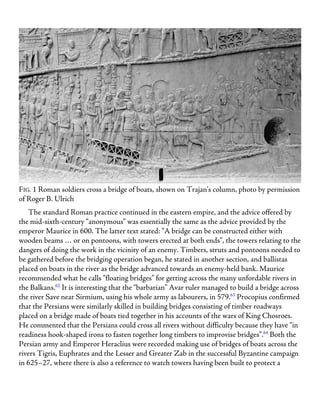
![bridge, and to a bridge being disconnected from the opposite bank and brought back to the
near side.65
There is, in contrast, an absence of reference to bridge-building of any kind in western
Europe over several centuries. There is no reference in Bede’s writings to bridges. It remains a
matter of dispute whether the issue of maintaining bridges was dealt with by it being made a
communal responsibility in the mid eighth century, as elsewhere. Certainly, fords appear to
have been a routine way to cross rivers. In such conditions, there would be no call for people
with bridge-building skills. An eighth-century manuscript of the technical treatise known as
the Mappae Clavicula contains instructions about building bridge foundations in water (based
on the Roman method) but there is no evidence that it reflected contemporary practice.66
Did
Merovingian kings continue to maintain Roman bridges as a communal responsibility? Did
they get their armies across rivers where bridges did not exist by following traditional Roman
practice, in which case there must have been some engineers familiar with how to do it? The
evidence is mixed and there is only one unequivocal statement from events reported by Bishop
Gregory. In 580, his enemies began to cross the Loire upstream from the bridge that “used to
be supported on two pontoon boats” using a ferry. King Chilperic posted guards on a bridge
across the Orge near Paris, and King Gundobald managed to cross the Garonne on the way to
Comminges but his men had to swim. In 591, King Guntram’s army sent against the Bretons
managed to cross both the Vilaine and the Oust, where they “constructed bridges”, but on
their return some of their troops waded across the Vilaine.67
When across western Europe
there was renewed bridge work from the eighth century the evidence does not confirm or deny
continuity with traditional Roman methods [Fig. 2].](https://image.slidesharecdn.com/5312381-250627015059-5895792a/85/The-Medieval-Military-Engineer-Peter-Purton-52-320.jpg)