CAVITYPREPARATION
OF CAST METAL
RESTORATIONS
DR.BASAVAN GOWDA
READER
DEPT.CONSERVATIVE
&ENDODONTICS
NAVODAYA DENTAL; COLLEGE
RAICHUR
Introduction
• The cast metal restorations are versatile and procedure requires
meticulous care in preparation and laboratory procedures.
• Dr. Phil Brook in 1897, was the first to introduce Inlay in
dentistry who gave the concept of forming an investment
around a wax pattern, eliminating the wax and filling the
created mold with a gold alloy.
• In 1907 Taggart changed the practice of restorative dentistryby
introducing his technique of cast gold dental restorations.
• It was most certainly Taggart who recognised the significance of
cast gold restorations.
Definitions
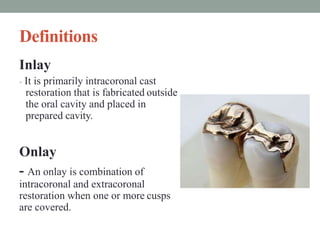
Inlay
- It is primarily intracoronal cast
restoration that is fabricated outside
the oral cavity and placed in
prepared cavity.
Onlay
- An onlay is combination of
intracoronal and extracoronal
restoration when one or more cusps
are covered.
Materials For CastRestoration
• Until recently gold based alloys were the only choice for cast
dental restorations. The ADA specification #25 still requires
75% of gold – plus – platinum group metals to be present in the
alloys for cast restoration.
• According to sturdevant,
Traditional high gold alloys Low
gold alloys
Platinum-silver alloys
Base metal alloys
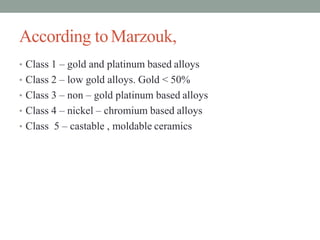
According toMarzouk,
• Class 1 – gold and platinum based alloys
• Class 2 – low gold alloys. Gold < 50%
• Class 3 – non – gold platinum based alloys
• Class 4 – nickel – chromium based alloys
• Class 5 – castable , moldable ceramics
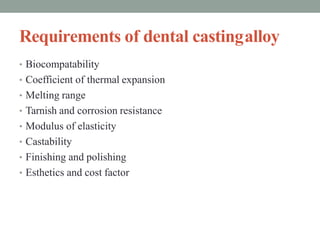
Requirements of dental castingalloy
• Biocompatability
• Coefficient of thermal expansion
• Melting range
• Tarnish and corrosion resistance
• Modulus of elasticity
• Castability
• Finishing and polishing
• Esthetics and cost factor
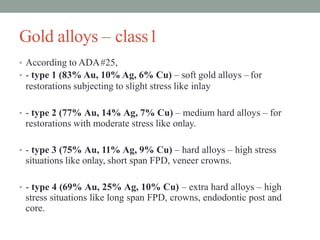
Gold alloys – class1
• According to ADA#25,
• - type 1 (83% Au, 10% Ag, 6% Cu) – soft gold alloys – for
restorations subjecting to slight stress like inlay
• - type 2 (77% Au, 14% Ag, 7% Cu) – medium hard alloys – for
restorations with moderate stress like onlay.
• - type 3 (75% Au, 11% Ag, 9% Cu) – hard alloys – high stress
situations like onlay, short span FPD, veneer crowns.
• - type 4 (69% Au, 25% Ag, 10% Cu) – extra hard alloys – high
stress situations like long span FPD, crowns, endodontic post and
core.
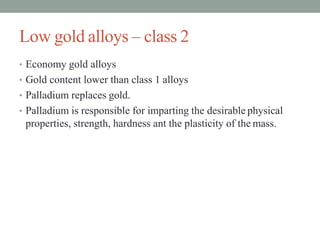
Low gold alloys – class 2
• Economy gold alloys
• Gold content lower than class 1 alloys
• Palladium replaces gold.
• Palladium is responsible for imparting the desirable physical
properties, strength, hardness ant the plasticity of the mass.
Non – gold platinum based alloys – class 3
• Composed mainly of palladium and silver.
• They are either palladium – silver alloys or silver – palladium
alloys.
• Palladium is most influential in dictating the properties.
• Also has indium, copper, tin, zinc constituting not more than
10%.
• Indium acts as a scavenger while melting, and increases
resistance to tarnish and corrosion.
Nickel – chromium based alloys – class 4
• These metals are referred to as non-noble or non-precious alloys
because of their low cost.
• The chromium content in these alloys should not exceed 30%.
• The chromium imparts the passivating effect on base metals
making them corrosion resistant.
• Beryllium and molybdenum have been added to improve upon
properties of the base metals.
• Beryllium – control castability and oxidation
• Molybdenum – decreases co-efficient of thermal expansion.
Castable moldable ceramics –class 5
• Composed of aluminium tri oxide( at least 50%) and
magnesium oxide ( at least 15%)
• Ratio of Al2O3 : MgO is 7:1
• To this 0.5% of stearate or wax is added to improve the
moldability.
• When heated above the glass transition temperature ( 30-150°)
the mass becomes moldable and deformable.
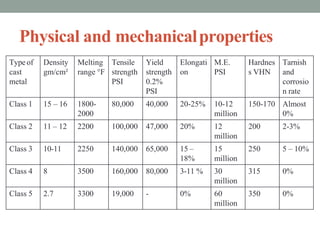
Physical and mechanicalproperties
Typeof
cast
metal
Density
gm/cm²
Melting
range °F
Tensile
strength
PSI
Yield
strength
0.2%
PSI
Elongati
on
M.E.
PSI
Hardnes
s VHN
Tarnish
and
corrosio
n rate
Class 1 15 – 16 1800-
2000
80,000 40,000 20-25% 10-12
million
150-170 Almost
0%
Class 2 11 – 12 2200 100,000 47,000 20% 12
million
200 2-3%
Class 3 10-11 2250 140,000 65,000 15 –
18%
15
million
250 5 – 10%
Class 4 8 3500 160,000 80,000 3-11 % 30
million
315 0%
Class 5 2.7 3300 19,000 - 0% 60
million
350 0%
Indications
• Large restorations
• Endodontically treated teeth
• Teeth at risk of fracture
• Dental rehabilitation with cast metal alloy
• Diastema closure and occlusal plane correction.
• Prosthodontic abutment.
• Correction of occlusion.
• Wide open contacts.
• Sub – gingival lesion.
Contraindications
• Physiologically young dentition with large pulp chamber.
• Developing and deciduous tooth.
• High plaque / caries index
• Dissimilar metals.
• Esthetics.
• Small restoration.
Advantage
• Strength
• Biocompatability
• Low wear
• Control of contour and contacts.
Dis-advantage
• Extensive tooth preparation
• Cemented restoration, discrepancy and microleakage
• Abarassive and splitting force on natural tooth
• Galvanic currents.
• Number of appointments and chair side time.
• Cost and temporary restoration requirement.
• Technique sensitive.
Factors affecting the design of the cavity
• Length of clinical crown.
• Anatomic contours of the occlusal, proximal, buccal and lingual
surface.
• The position of tooth in arch.
• The occlusal and proximal relations.
• Unusual esthetic conditions, if any.
• The condition of soft tissues around the tooth.
• The extend and location of carious lesion.
Mouth preparationprior to cast restoration
For a single tooth cast restoration, every precaution should be
taken to ensure that the longevity of the restoration.
• Control of plaque.
• Control of caries.
• Control of periodontal problems.
• Proper foundation.
• Control of pulpal condition of tooth.
• Occlusal equilibrium.
• Diagnostic wax-ups and temporary restoration.
• marzouk
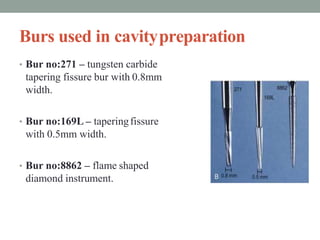
Burs used in cavitypreparation
• Bur no:271 – tungsten carbide
tapering fissure bur with 0.8mm
width.
• Bur no:169L – taperingfissure
with 0.5mm width.
• Bur no:8862 – flame shaped
diamond instrument.
Principles of cavity preparationfor cast
restorations
• Cast alloys can be used to restore intra-coronal or extra-coronal
restorations.
• Most single tooth restorations are a combination of these intra
and extra coronal restorations.
• Intracoronal restorations are mortise shaped, having definite
walls and floors joined by line angles and point angles.
• General principles of tooth preparation can be applied to
intracoronal preparation with slight modifications for the
effectiveness of the preparation.
Outline form
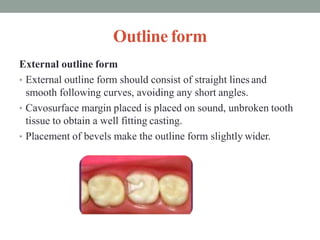
External outline form
• External outline form should consist of straight lines and
smooth following curves, avoiding any short angles.
• Cavosurface margin placed is placed on sound, unbroken tooth
tissue to obtain a well fitting casting.
• Placement of bevels make the outline form slightly wider.
Internal outline form:
• The pulpal floor and the axial wall of the inlay preparation
should be placed in the dentin and care should be taken to
protect the pulp.
• Line angles in both occlusal and proximal portions of the
preparations should be well defined and the axio-pulpal line
angle slightly rounded.
• It is sometimes desirable to incline the cutting instrument so that
it forms either an exaggerated taper from the cavosurface to
pulpal floor or a long bevel on that area.
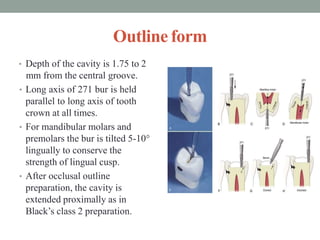
Outline form
• Depth of the cavity is 1.75 to 2
mm from the central groove.
• Long axis of 271 bur is held
parallel to long axis of tooth
crown at all times.
• For mandibular molars and
premolars the bur is tilted 5-10°
lingually to conserve the
strength of lingual cusp.
• After occlusal outline
preparation, the cavity is
extended proximally as in
Black’s class 2 preparation.
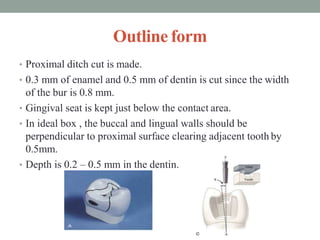
Outline form
• Proximal ditch cut is made.
• 0.3 mm of enamel and 0.5 mm of dentin is cut since the width
of the bur is 0.8 mm.
• Gingival seat is kept just below the contact area.
• In ideal box , the buccal and lingual walls should be
perpendicular to proximal surface clearing adjacent tooth by
0.5mm.
• Depth is 0.2 – 0.5 mm in the dentin.
Outline form
• Ragged enamel edges at the gingival and proximal areas may be
removed using hand instrument such as chisel or flame shame
shaped diamond point.
• However it is better to postpone the finishing till the remaining
caries and/or old restorative material is completely removed and
the base is applied.
• Width of the cavity – 1/3rd of the cuspal inclines is included on
both sides of the central groove.
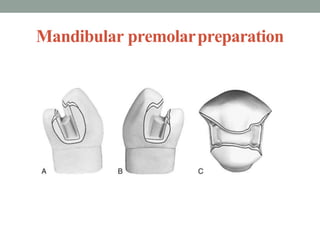
• In madibular premolar, 2/3rd of occlusal width is placed on the
buccal inclined plane and 1/3rd from lingual inclineplane.
Mandibular premolarpreparation
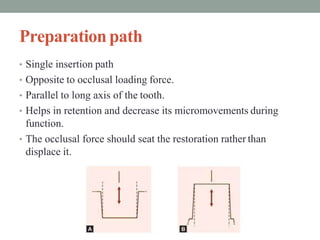
Preparationpath
• Single insertion path
• Opposite to occlusal loading force.
• Parallel to long axis of the tooth.
• Helps in retention and decrease its micromovements during
function.
• The occlusal force should seat the restoration rather than
displace it.
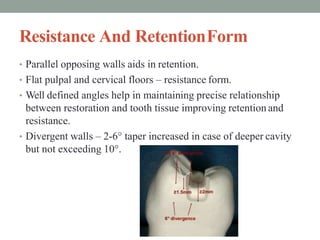
Resistance And RetentionForm
• Parallel opposing walls aids in retention.
• Flat pulpal and cervical floors – resistance form.
• Well defined angles help in maintaining precise relationship
between restoration and tooth tissue improving retention and
resistance.
• Divergent walls – 2-6° taper increased in case of deeper cavity
but not exceeding 10°.
Factors affecting proximalmargins
• The extend of tooth tissue loss
• The location of that loss.
• Configuration of tooth i.e curvatures and embarasures.
• The relationship with adjacent teeth.
• The need for extra retentive devices.
Pulpal floor
• The pulpal floor should be flat.
• It should be 1 – 1.5 mm from DEJ.
• The pulpal floor should meet all the surrounding walls at
definite line angles except for the axiopulpal line angle where it
should be rounded.
Features for resistance andretention
• Axiopulpal line angle rounded to dissipate stress equally.
• Occlusal dovetail or interlock prevents proximal displacement
of restoration.
• If no proper parallelism or no proper depth of cavity is there
then secondary retentive devices like slots and pinholes can be
given.
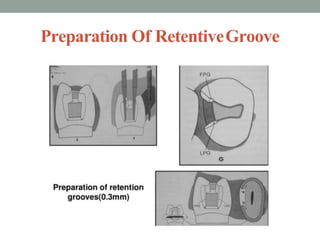
• Shallow retentive grooves , 0.3mm deep, maybe given on
buccoaxial and linguoaxial line angles. – indicated when
preparation is shallow.
Preparation Of RetentiveGroove
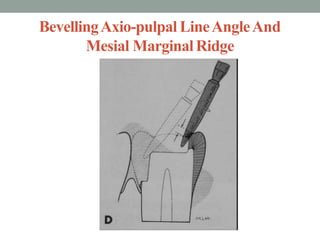
BevellingAxio-pulpal LineAngleAnd
Mesial MarginalRidge
PreparationFeaturesForCircumferentialTie
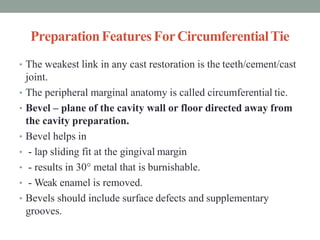
• The weakest link in any cast restoration is the teeth/cement/cast
joint.
• The peripheral marginal anatomy is called circumferential tie.
• Bevel – plane of the cavity wall or floor directed away from
the cavity preparation.
• Bevel helps in
• - lap sliding fit at the gingival margin
• - results in 30° metal that is burnishable.
• - Weak enamel is removed.
• Bevels should include surface defects and supplementary
grooves.
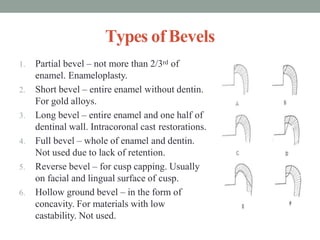
Types of Bevels
1. Partial bevel – not more than 2/3rd of
enamel. Enameloplasty.
2. Short bevel – entire enamel without dentin.
For gold alloys.
3. Long bevel – entire enamel and one half of
dentinal wall. Intracoronal cast restorations.
4. Full bevel – whole of enamel and dentin.
Not used due to lack of retention.
5. Reverse bevel – for cusp capping. Usually
on facial and lingual surface of cusp.
6. Hollow ground bevel – in the form of
concavity. For materials with low
castability. Not used.
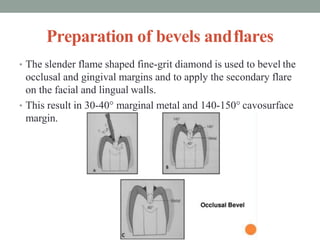
Preparation of bevels andflares
• The slender flame shaped fine-grit diamond is used to bevel the
occlusal and gingival margins and to apply the secondary flare
on the facial and lingual walls.
• This result in 30-40° marginal metal and 140-150° cavosurface
margin.
TypesAnd Features Of FacialAnd Lingual
Flares
• Flares are present on the proximal box of intra-coronal cast
preparations.
Two types of flares:
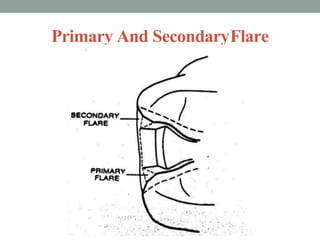
1. Primary flare – similar to long bevel formed on the facial
and lingual wall of proximal box. It has angulation of 45° to
the inner dentinal wall proper.
Funtions : makes the proximal portion of the restoration self
cleansable.
1. Secondary flare – it is a flat plane superimposed peripherally
to a primary flare. Indicated in lesions with wide contact areas
and wide bucco-lingual extensions.
Primary And SecondaryFlare
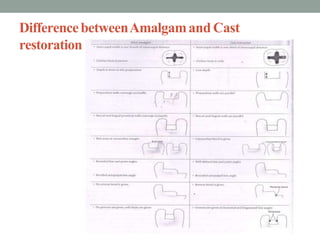
DifferencebetweenAmalgamand Cast
restoration
Modifications of proximal boxpreparation
• Box preparation
• Slice preparation
• Auxiliary slice preparation
• Modified flare
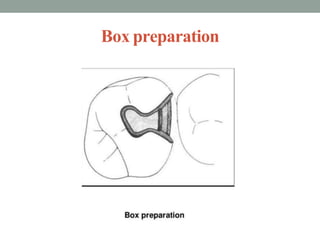
Box preparation
Introduced by Dr.G.V.Black
Proximal cavities are box shaped.
Advantages are
• Resistence and retention form
• The outline form can be made on all types of teeth.
• Minimum display of metal.
Disadvantages are
• Involves removal of lot of tooth structure.
• Time consuming clinically.
• Narrow bevels leave a sharp edge and an undercut gingivally, which cannot
be reproduced satisfactorily.
• While taking impressions, distortions and breaking of wax patternoccurs
Box preparation
Slice preparations
• This form of cavity is modified so that the proximal surface is
flat without definite side walls.
• Retention mainly depends upon occlusal key, locks cut in the
axial wall.
Indications
• As abutment in bridge work.
• Teeth with proximal undercuts can be eliminated which
facilitates taking impression.
• For indirect wax pattern technique.
Slice preparations
Advantages :
• Less tooth structure is sacrificed.
• Quicker and easier.
• Well protected enamel margins.
• Increase resistence and retention by exposing larger amount of
tooth structure.
Disadvantages :
• It displays more amount of gold. (Thoma 1951)
• Direct wax pattern cannot be made as distinguishing between
margins become difficult.
• Metal margins are likely to distort due to less thickness.
Slice preparations
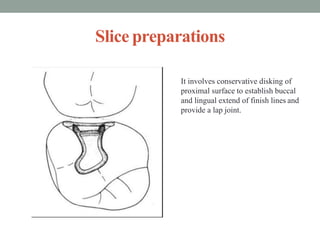
It involves conservative disking of
proximal surface to establish buccal
and lingual extend of finish lines and
provide a lap joint.
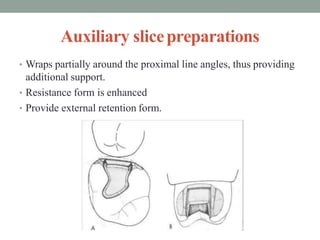
Auxiliary slicepreparations
• Wraps partially around the proximal line angles, thus providing
additional support.
• Resistance form is enhanced
• Provide external retention form.
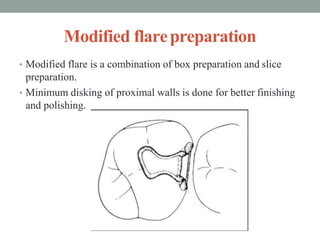
Modified flarepreparation
• Modified flare is a combination of box preparation and slice
preparation.
• Minimum disking of proximal walls is done for better finishing
and polishing.
Secondary modes ofretention
Luting cement
• Fills gaps between the inlay and the tooth giving a physio
chemical bonding.
• Physical – zinc phosphate
• Chemical – glass ionomer cement
• The exposed cement dissolves in oral cavity . So it should not
be considered as a retentive factor
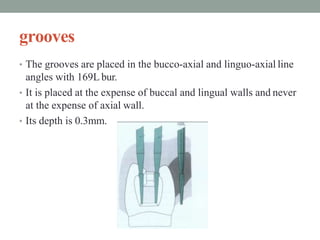
grooves
• The grooves are placed in the bucco-axial and linguo-axial line
angles with 169L bur.
• It is placed at the expense of buccal and lingual walls and never
at the expense of axial wall.
• Its depth is 0.3mm.
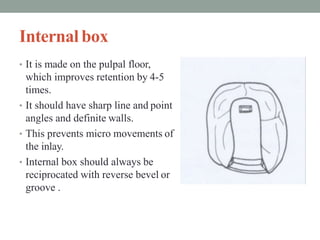
Internalbox
• It is made on the pulpal floor,
which improves retention by 4-5
times.
• It should have sharp line and point
angles and definite walls.
• This prevents micro movements of
the inlay.
• Internal box should always be
reciprocated with reverse bevel or
groove .
Tooth preparations for onlaycast
restorations
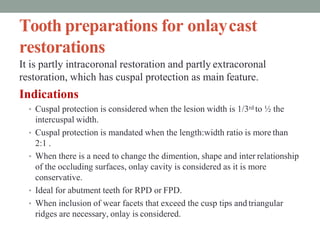
It is partly intracoronal restoration and partly extracoronal
restoration, which has cuspal protection as main feature.
Indications
• Cuspal protection is considered when the lesion width is 1/3rd to ½ the
intercuspal width.
• Cuspal protection is mandated when the length:width ratio is more than
2:1 .
• When there is a need to change the dimention, shape and inter relationship
of the occluding surfaces, onlay cavity is considered as it is more
conservative.
• Ideal for abutment teeth for RPD or FPD.
• When inclusion of wear facets that exceed the cusp tips and triangular
ridges are necessary, onlay is considered.
General shape
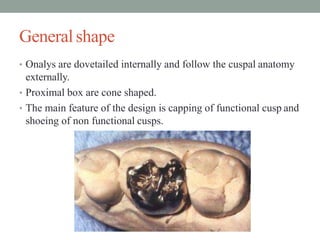
• Onalys are dovetailed internally and follow the cuspal anatomy
externally.
• Proximal box are cone shaped.
• The main feature of the design is capping of functional cusp and
shoeing of non functional cusps.
Tooth preparation foronlay
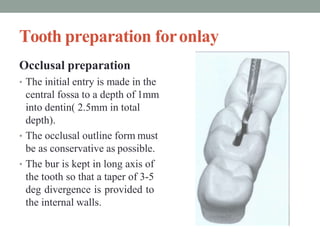
Occlusal preparation
• The initial entry is made in the
central fossa to a depth of 1mm
into dentin( 2.5mm in total
depth).
• The occlusal outline form must
be as conservative as possible.
• The bur is kept in long axis of
the tooth so that a taper of 3-5
deg divergence is provided to
the internal walls.
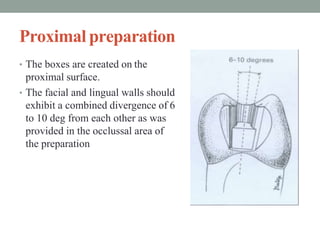
Proximal preparation
• The boxes are created on the
proximal surface.
• The facial and lingual walls should
exhibit a combined divergence of 6
to 10 deg from each other as was
provided in the occlussal area of
the preparation
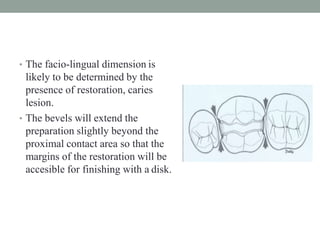
• The facio-lingual dimension is
likely to be determined by the
presence of restoration, caries
lesion.
• The bevels will extend the
preparation slightly beyond the
proximal contact area so that the
margins of the restoration will be
accesible for finishing with a disk.
Cuspal reduction
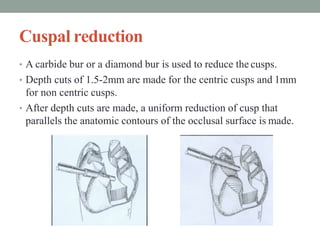
• A carbide bur or a diamond bur is used to reduce the cusps.
• Depth cuts of 1.5-2mm are made for the centric cusps and 1mm
for non centric cusps.
• After depth cuts are made, a uniform reduction of cusp that
parallels the anatomic contours of the occlusal surface is made.
Shoulderpreparation
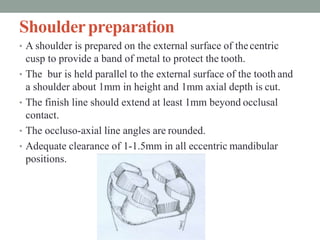
• A shoulder is prepared on the external surface of thecentric
cusp to provide a band of metal to protect the tooth.
• The bur is held parallel to the external surface of the tooth and
a shoulder about 1mm in height and 1mm axial depth is cut.
• The finish line should extend at least 1mm beyond occlusal
contact.
• The occluso-axial line angles are rounded.
• Adequate clearance of 1-1.5mm in all eccentric mandibular
positions.
Non – centriccusp
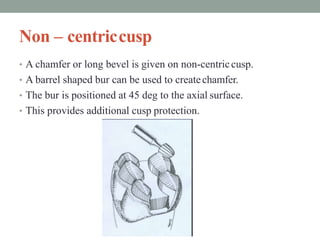
• A chamfer or long bevel is given on non-centriccusp.
• A barrel shaped bur can be used to createchamfer.
• The bur is positioned at 45 deg to the axial surface.
• This provides additional cusp protection.
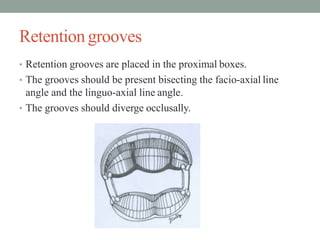
Retentiongrooves
• Retention grooves are placed in the proximal boxes.
• The grooves should be present bisecting the facio-axial line
angle and the linguo-axial line angle.
• The grooves should diverge occlusally.

castrestorations-170210145741-converted.pptx

  • 1.
    CAVITYPREPARATION OF CAST METAL RESTORATIONS DR.BASAVANGOWDA READER DEPT.CONSERVATIVE &ENDODONTICS NAVODAYA DENTAL; COLLEGE RAICHUR
  • 2.
    Introduction • The castmetal restorations are versatile and procedure requires meticulous care in preparation and laboratory procedures. • Dr. Phil Brook in 1897, was the first to introduce Inlay in dentistry who gave the concept of forming an investment around a wax pattern, eliminating the wax and filling the created mold with a gold alloy. • In 1907 Taggart changed the practice of restorative dentistryby introducing his technique of cast gold dental restorations. • It was most certainly Taggart who recognised the significance of cast gold restorations.
  • 3.
    Definitions Inlay - It isprimarily intracoronal cast restoration that is fabricated outside the oral cavity and placed in prepared cavity. Onlay - An onlay is combination of intracoronal and extracoronal restoration when one or more cusps are covered.
  • 4.
    Materials For CastRestoration •Until recently gold based alloys were the only choice for cast dental restorations. The ADA specification #25 still requires 75% of gold – plus – platinum group metals to be present in the alloys for cast restoration. • According to sturdevant, Traditional high gold alloys Low gold alloys Platinum-silver alloys Base metal alloys
  • 5.
    According toMarzouk, • Class1 – gold and platinum based alloys • Class 2 – low gold alloys. Gold < 50% • Class 3 – non – gold platinum based alloys • Class 4 – nickel – chromium based alloys • Class 5 – castable , moldable ceramics
  • 6.
    Requirements of dentalcastingalloy • Biocompatability • Coefficient of thermal expansion • Melting range • Tarnish and corrosion resistance • Modulus of elasticity • Castability • Finishing and polishing • Esthetics and cost factor
  • 7.
    Gold alloys –class1 • According to ADA#25, • - type 1 (83% Au, 10% Ag, 6% Cu) – soft gold alloys – for restorations subjecting to slight stress like inlay • - type 2 (77% Au, 14% Ag, 7% Cu) – medium hard alloys – for restorations with moderate stress like onlay. • - type 3 (75% Au, 11% Ag, 9% Cu) – hard alloys – high stress situations like onlay, short span FPD, veneer crowns. • - type 4 (69% Au, 25% Ag, 10% Cu) – extra hard alloys – high stress situations like long span FPD, crowns, endodontic post and core.
  • 8.
    Low gold alloys– class 2 • Economy gold alloys • Gold content lower than class 1 alloys • Palladium replaces gold. • Palladium is responsible for imparting the desirable physical properties, strength, hardness ant the plasticity of the mass.
  • 9.
    Non – goldplatinum based alloys – class 3 • Composed mainly of palladium and silver. • They are either palladium – silver alloys or silver – palladium alloys. • Palladium is most influential in dictating the properties. • Also has indium, copper, tin, zinc constituting not more than 10%. • Indium acts as a scavenger while melting, and increases resistance to tarnish and corrosion.
  • 10.
    Nickel – chromiumbased alloys – class 4 • These metals are referred to as non-noble or non-precious alloys because of their low cost. • The chromium content in these alloys should not exceed 30%. • The chromium imparts the passivating effect on base metals making them corrosion resistant. • Beryllium and molybdenum have been added to improve upon properties of the base metals. • Beryllium – control castability and oxidation • Molybdenum – decreases co-efficient of thermal expansion.
  • 11.
    Castable moldable ceramics–class 5 • Composed of aluminium tri oxide( at least 50%) and magnesium oxide ( at least 15%) • Ratio of Al2O3 : MgO is 7:1 • To this 0.5% of stearate or wax is added to improve the moldability. • When heated above the glass transition temperature ( 30-150°) the mass becomes moldable and deformable.
  • 12.
    Physical and mechanicalproperties Typeof cast metal Density gm/cm² Melting range°F Tensile strength PSI Yield strength 0.2% PSI Elongati on M.E. PSI Hardnes s VHN Tarnish and corrosio n rate Class 1 15 – 16 1800- 2000 80,000 40,000 20-25% 10-12 million 150-170 Almost 0% Class 2 11 – 12 2200 100,000 47,000 20% 12 million 200 2-3% Class 3 10-11 2250 140,000 65,000 15 – 18% 15 million 250 5 – 10% Class 4 8 3500 160,000 80,000 3-11 % 30 million 315 0% Class 5 2.7 3300 19,000 - 0% 60 million 350 0%
  • 13.
    Indications • Large restorations •Endodontically treated teeth • Teeth at risk of fracture • Dental rehabilitation with cast metal alloy • Diastema closure and occlusal plane correction. • Prosthodontic abutment. • Correction of occlusion. • Wide open contacts. • Sub – gingival lesion.
  • 14.
    Contraindications • Physiologically youngdentition with large pulp chamber. • Developing and deciduous tooth. • High plaque / caries index • Dissimilar metals. • Esthetics. • Small restoration.
  • 15.
    Advantage • Strength • Biocompatability •Low wear • Control of contour and contacts.
  • 16.
    Dis-advantage • Extensive toothpreparation • Cemented restoration, discrepancy and microleakage • Abarassive and splitting force on natural tooth • Galvanic currents. • Number of appointments and chair side time. • Cost and temporary restoration requirement. • Technique sensitive.
  • 17.
    Factors affecting thedesign of the cavity • Length of clinical crown. • Anatomic contours of the occlusal, proximal, buccal and lingual surface. • The position of tooth in arch. • The occlusal and proximal relations. • Unusual esthetic conditions, if any. • The condition of soft tissues around the tooth. • The extend and location of carious lesion.
  • 18.
    Mouth preparationprior tocast restoration For a single tooth cast restoration, every precaution should be taken to ensure that the longevity of the restoration. • Control of plaque. • Control of caries. • Control of periodontal problems. • Proper foundation. • Control of pulpal condition of tooth. • Occlusal equilibrium. • Diagnostic wax-ups and temporary restoration. • marzouk
  • 19.
    Burs used incavitypreparation • Bur no:271 – tungsten carbide tapering fissure bur with 0.8mm width. • Bur no:169L – taperingfissure with 0.5mm width. • Bur no:8862 – flame shaped diamond instrument.
  • 20.
    Principles of cavitypreparationfor cast restorations • Cast alloys can be used to restore intra-coronal or extra-coronal restorations. • Most single tooth restorations are a combination of these intra and extra coronal restorations. • Intracoronal restorations are mortise shaped, having definite walls and floors joined by line angles and point angles. • General principles of tooth preparation can be applied to intracoronal preparation with slight modifications for the effectiveness of the preparation.
  • 21.
    Outline form External outlineform • External outline form should consist of straight lines and smooth following curves, avoiding any short angles. • Cavosurface margin placed is placed on sound, unbroken tooth tissue to obtain a well fitting casting. • Placement of bevels make the outline form slightly wider.
  • 22.
    Internal outline form: •The pulpal floor and the axial wall of the inlay preparation should be placed in the dentin and care should be taken to protect the pulp. • Line angles in both occlusal and proximal portions of the preparations should be well defined and the axio-pulpal line angle slightly rounded. • It is sometimes desirable to incline the cutting instrument so that it forms either an exaggerated taper from the cavosurface to pulpal floor or a long bevel on that area.
  • 23.
    Outline form • Depthof the cavity is 1.75 to 2 mm from the central groove. • Long axis of 271 bur is held parallel to long axis of tooth crown at all times. • For mandibular molars and premolars the bur is tilted 5-10° lingually to conserve the strength of lingual cusp. • After occlusal outline preparation, the cavity is extended proximally as in Black’s class 2 preparation.
  • 24.
    Outline form • Proximalditch cut is made. • 0.3 mm of enamel and 0.5 mm of dentin is cut since the width of the bur is 0.8 mm. • Gingival seat is kept just below the contact area. • In ideal box , the buccal and lingual walls should be perpendicular to proximal surface clearing adjacent tooth by 0.5mm. • Depth is 0.2 – 0.5 mm in the dentin.
  • 25.
    Outline form • Raggedenamel edges at the gingival and proximal areas may be removed using hand instrument such as chisel or flame shame shaped diamond point. • However it is better to postpone the finishing till the remaining caries and/or old restorative material is completely removed and the base is applied. • Width of the cavity – 1/3rd of the cuspal inclines is included on both sides of the central groove. • In madibular premolar, 2/3rd of occlusal width is placed on the buccal inclined plane and 1/3rd from lingual inclineplane.
  • 26.
  • 27.
    Preparationpath • Single insertionpath • Opposite to occlusal loading force. • Parallel to long axis of the tooth. • Helps in retention and decrease its micromovements during function. • The occlusal force should seat the restoration rather than displace it.
  • 28.
    Resistance And RetentionForm •Parallel opposing walls aids in retention. • Flat pulpal and cervical floors – resistance form. • Well defined angles help in maintaining precise relationship between restoration and tooth tissue improving retention and resistance. • Divergent walls – 2-6° taper increased in case of deeper cavity but not exceeding 10°.
  • 29.
    Factors affecting proximalmargins •The extend of tooth tissue loss • The location of that loss. • Configuration of tooth i.e curvatures and embarasures. • The relationship with adjacent teeth. • The need for extra retentive devices.
  • 30.
    Pulpal floor • Thepulpal floor should be flat. • It should be 1 – 1.5 mm from DEJ. • The pulpal floor should meet all the surrounding walls at definite line angles except for the axiopulpal line angle where it should be rounded.
  • 31.
    Features for resistanceandretention • Axiopulpal line angle rounded to dissipate stress equally. • Occlusal dovetail or interlock prevents proximal displacement of restoration. • If no proper parallelism or no proper depth of cavity is there then secondary retentive devices like slots and pinholes can be given. • Shallow retentive grooves , 0.3mm deep, maybe given on buccoaxial and linguoaxial line angles. – indicated when preparation is shallow.
  • 32.
  • 33.
  • 34.
    PreparationFeaturesForCircumferentialTie • The weakestlink in any cast restoration is the teeth/cement/cast joint. • The peripheral marginal anatomy is called circumferential tie. • Bevel – plane of the cavity wall or floor directed away from the cavity preparation. • Bevel helps in • - lap sliding fit at the gingival margin • - results in 30° metal that is burnishable. • - Weak enamel is removed. • Bevels should include surface defects and supplementary grooves.
  • 35.
    Types of Bevels 1.Partial bevel – not more than 2/3rd of enamel. Enameloplasty. 2. Short bevel – entire enamel without dentin. For gold alloys. 3. Long bevel – entire enamel and one half of dentinal wall. Intracoronal cast restorations. 4. Full bevel – whole of enamel and dentin. Not used due to lack of retention. 5. Reverse bevel – for cusp capping. Usually on facial and lingual surface of cusp. 6. Hollow ground bevel – in the form of concavity. For materials with low castability. Not used.
  • 36.
    Preparation of bevelsandflares • The slender flame shaped fine-grit diamond is used to bevel the occlusal and gingival margins and to apply the secondary flare on the facial and lingual walls. • This result in 30-40° marginal metal and 140-150° cavosurface margin.
  • 37.
    TypesAnd Features OfFacialAnd Lingual Flares • Flares are present on the proximal box of intra-coronal cast preparations. Two types of flares: 1. Primary flare – similar to long bevel formed on the facial and lingual wall of proximal box. It has angulation of 45° to the inner dentinal wall proper. Funtions : makes the proximal portion of the restoration self cleansable. 1. Secondary flare – it is a flat plane superimposed peripherally to a primary flare. Indicated in lesions with wide contact areas and wide bucco-lingual extensions.
  • 38.
  • 39.
  • 40.
    Modifications of proximalboxpreparation • Box preparation • Slice preparation • Auxiliary slice preparation • Modified flare
  • 41.
    Box preparation Introduced byDr.G.V.Black Proximal cavities are box shaped. Advantages are • Resistence and retention form • The outline form can be made on all types of teeth. • Minimum display of metal. Disadvantages are • Involves removal of lot of tooth structure. • Time consuming clinically. • Narrow bevels leave a sharp edge and an undercut gingivally, which cannot be reproduced satisfactorily. • While taking impressions, distortions and breaking of wax patternoccurs
  • 42.
  • 43.
    Slice preparations • Thisform of cavity is modified so that the proximal surface is flat without definite side walls. • Retention mainly depends upon occlusal key, locks cut in the axial wall. Indications • As abutment in bridge work. • Teeth with proximal undercuts can be eliminated which facilitates taking impression. • For indirect wax pattern technique.
  • 44.
    Slice preparations Advantages : •Less tooth structure is sacrificed. • Quicker and easier. • Well protected enamel margins. • Increase resistence and retention by exposing larger amount of tooth structure. Disadvantages : • It displays more amount of gold. (Thoma 1951) • Direct wax pattern cannot be made as distinguishing between margins become difficult. • Metal margins are likely to distort due to less thickness.
  • 45.
    Slice preparations It involvesconservative disking of proximal surface to establish buccal and lingual extend of finish lines and provide a lap joint.
  • 46.
    Auxiliary slicepreparations • Wrapspartially around the proximal line angles, thus providing additional support. • Resistance form is enhanced • Provide external retention form.
  • 47.
    Modified flarepreparation • Modifiedflare is a combination of box preparation and slice preparation. • Minimum disking of proximal walls is done for better finishing and polishing.
  • 48.
    Secondary modes ofretention Lutingcement • Fills gaps between the inlay and the tooth giving a physio chemical bonding. • Physical – zinc phosphate • Chemical – glass ionomer cement • The exposed cement dissolves in oral cavity . So it should not be considered as a retentive factor
  • 49.
    grooves • The groovesare placed in the bucco-axial and linguo-axial line angles with 169L bur. • It is placed at the expense of buccal and lingual walls and never at the expense of axial wall. • Its depth is 0.3mm.
  • 50.
    Internalbox • It ismade on the pulpal floor, which improves retention by 4-5 times. • It should have sharp line and point angles and definite walls. • This prevents micro movements of the inlay. • Internal box should always be reciprocated with reverse bevel or groove .
  • 51.
    Tooth preparations foronlaycast restorations It is partly intracoronal restoration and partly extracoronal restoration, which has cuspal protection as main feature. Indications • Cuspal protection is considered when the lesion width is 1/3rd to ½ the intercuspal width. • Cuspal protection is mandated when the length:width ratio is more than 2:1 . • When there is a need to change the dimention, shape and inter relationship of the occluding surfaces, onlay cavity is considered as it is more conservative. • Ideal for abutment teeth for RPD or FPD. • When inclusion of wear facets that exceed the cusp tips and triangular ridges are necessary, onlay is considered.
  • 52.
    General shape • Onalysare dovetailed internally and follow the cuspal anatomy externally. • Proximal box are cone shaped. • The main feature of the design is capping of functional cusp and shoeing of non functional cusps.
  • 53.
    Tooth preparation foronlay Occlusalpreparation • The initial entry is made in the central fossa to a depth of 1mm into dentin( 2.5mm in total depth). • The occlusal outline form must be as conservative as possible. • The bur is kept in long axis of the tooth so that a taper of 3-5 deg divergence is provided to the internal walls.
  • 54.
    Proximal preparation • Theboxes are created on the proximal surface. • The facial and lingual walls should exhibit a combined divergence of 6 to 10 deg from each other as was provided in the occlussal area of the preparation
  • 55.
    • The facio-lingualdimension is likely to be determined by the presence of restoration, caries lesion. • The bevels will extend the preparation slightly beyond the proximal contact area so that the margins of the restoration will be accesible for finishing with a disk.
  • 56.
    Cuspal reduction • Acarbide bur or a diamond bur is used to reduce the cusps. • Depth cuts of 1.5-2mm are made for the centric cusps and 1mm for non centric cusps. • After depth cuts are made, a uniform reduction of cusp that parallels the anatomic contours of the occlusal surface is made.
  • 57.
    Shoulderpreparation • A shoulderis prepared on the external surface of thecentric cusp to provide a band of metal to protect the tooth. • The bur is held parallel to the external surface of the tooth and a shoulder about 1mm in height and 1mm axial depth is cut. • The finish line should extend at least 1mm beyond occlusal contact. • The occluso-axial line angles are rounded. • Adequate clearance of 1-1.5mm in all eccentric mandibular positions.
  • 58.
    Non – centriccusp •A chamfer or long bevel is given on non-centriccusp. • A barrel shaped bur can be used to createchamfer. • The bur is positioned at 45 deg to the axial surface. • This provides additional cusp protection.
  • 59.
    Retentiongrooves • Retention groovesare placed in the proximal boxes. • The grooves should be present bisecting the facio-axial line angle and the linguo-axial line angle. • The grooves should diverge occlusally.