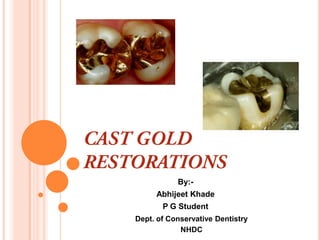


By:-
     Abhijeet Khade
       P G Student
Dept. of Conservative Dentistry
            NHDC
CONTENTS:-
     Introduction.
     Materials for cast restorations
     Indications & Contraindications
     Advantages and disadvantages
     Principles of Cavity design for Cast inlay
      restorations.
     Tooth preparation for Inlay Class II cast
      metal inlays
     Bevels- Various types and significance.
     Variations in proximal margin design.
     Tooth Preparations For Cast Restorations
      With Surface Extension.
     Conclusion
     References
INTRODUCTION

   Dr. Phil brook in 1897,was the first to introduce
    Inlay in dentistry who gave the concept of forming
    an investment around a wax pattern, eliminating the
    wax, and filling the resultant mold with a gold alloy.

   In 1907 Taggart changed the practice of restorative
    dentistry by introducing his technique for cast gold
    dental restorations.

   It was most certainly Taggart who recognized the
    significance of cast gold restorations.
METERIALS FOR CAST RESTORATIONS
   Until recently gold-based alloys have been the only
    ones used for cast dental restorations. The ADA
    sp#5 still requires 75% of gold-plus- platinum group
    metals to be present in alloys for cast restorations

According to Sturdevant there are 4 distinct groups of
  alloys.
 The traditional high gold alloys.
 Low gold alloys.
 Palladium-silver alloys
 Base metal alloys.
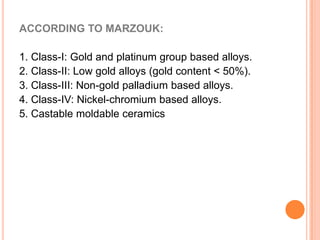
ACCORDING TO MARZOUK:

1. Class-I: Gold and platinum group based alloys.
2. Class-II: Low gold alloys (gold content < 50%).
3. Class-III: Non-gold palladium based alloys.
4. Class-IV: Nickel-chromium based alloys.
5. Castable moldable ceramics
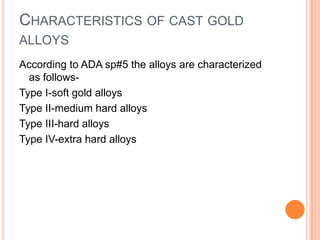
CHARACTERISTICS OF CAST GOLD
ALLOYS
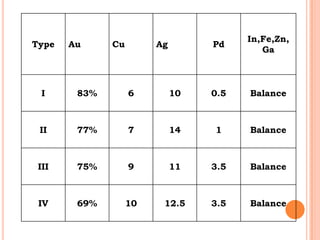
According to ADA sp#5 the alloys are characterized
  as follows-
Type I-soft gold alloys
Type II-medium hard alloys
Type III-hard alloys
Type IV-extra hard alloys
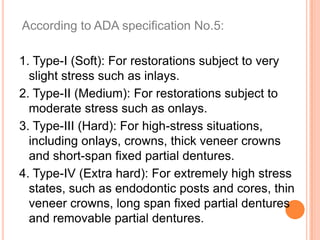
According to ADA specification No.5:

1. Type-I (Soft): For restorations subject to very
  slight stress such as inlays.
2. Type-II (Medium): For restorations subject to
  moderate stress such as onlays.
3. Type-III (Hard): For high-stress situations,
  including onlays, crowns, thick veneer crowns
  and short-span fixed partial dentures.
4. Type-IV (Extra hard): For extremely high stress
  states, such as endodontic posts and cores, thin
  veneer crowns, long span fixed partial dentures
  and removable partial dentures.
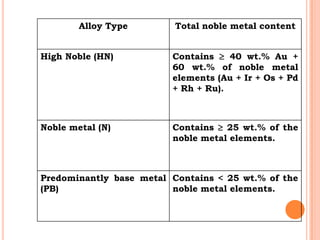
Alloy Type        Total noble metal content


High Noble (HN)          Contains  40 wt.% Au +
                         60 wt.% of noble metal
                         elements (Au + Ir + Os + Pd
                         + Rh + Ru).


Noble metal (N)          Contains  25 wt.% of the
                         noble metal elements.


Predominantly base metal Contains < 25 wt.% of the
(PB)                     noble metal elements.
In,Fe,Zn,
Type   Au     Cu        Ag        Pd
                                           Ga


  I     83%        6         10   0.5   Balance


 II     77%        7         14   1     Balance


 III    75%        9         11   3.5   Balance


 IV     69%        10    12.5     3.5   Balance
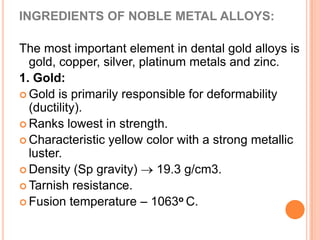
INGREDIENTS OF NOBLE METAL ALLOYS:

The most important element in dental gold alloys is
  gold, copper, silver, platinum metals and zinc.
1. Gold:
 Gold is primarily responsible for deformability
  (ductility).
 Ranks lowest in strength.
 Characteristic yellow color with a strong metallic
  luster.
 Density (Sp gravity)  19.3 g/cm3.
 Tarnish resistance.
 Fusion temperature – 1063o C.
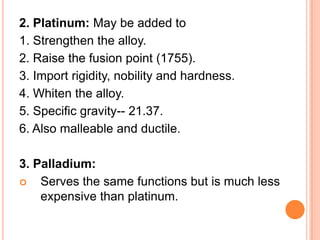
2. Platinum: May be added to
1. Strengthen the alloy.
2. Raise the fusion point (1755).
3. Import rigidity, nobility and hardness.
4. Whiten the alloy.
5. Specific gravity-- 21.37.
6. Also malleable and ductile.

3. Palladium:
   Serves the same functions but is much less
    expensive than platinum.
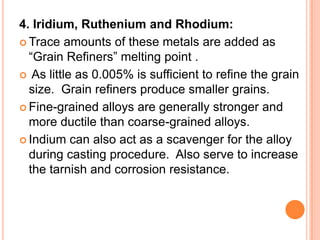
4. Iridium, Ruthenium and Rhodium:
 Trace amounts of these metals are added as
  “Grain Refiners” melting point .
 As little as 0.005% is sufficient to refine the grain
  size. Grain refiners produce smaller grains.
 Fine-grained alloys are generally stronger and
  more ductile than coarse-grained alloys.
 Indium can also act as a scavenger for the alloy
  during casting procedure. Also serve to increase
  the tarnish and corrosion resistance.
5. Silver:
 It contributes to the strength and hardness of the
  alloy. Although it mimics gold in its deformability
  effect, it adversely affects the malleability and it
  lowers tarnish resistance.
 Food containing sulfur compounds, cause severe
  tarnish on silver.
 Silver serves to balance the red color given by
  copper.
 Adding small amounts of palladium to silver
  containing alloys prevents the rapid corrosion of
  such alloys in the oral environment
6. Copper:
 Contributes strength and hardness, but
  decreases the malleability of the alloy, i.e., it
  decreases the tarnish and corrosion resistance .
  The content should not exceed 16%. Gives the
  alloy reddish appearance. Lowers the fusion
  temperature.
7. Zinc: (Present only in low percentages, around
  0.5%)
 Acts as a deoxidizer and reduces the oxygen
  content (because O2 released during
  solidification results in porosity).
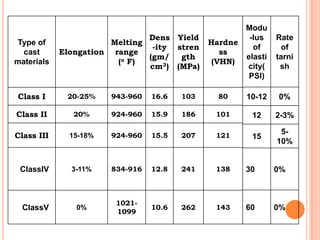
Modu
                               Dens Yield             -lus    Rate
 Type of               Melting                Hardne
                                -ity stren             of       of
  cast      Elongation range                     ss
                               (gm/   gth            elasti   tarni
materials               (o F)                  (VHN)
                               cm3) (MPa)            city(     sh
                                                      PSI)

Class I      20-25%    943-960   16.6   103     80    10-12   0%

Class II       20%     924-960   15.9   186    101     12     2-3%

Class III     15-18%   924-960   15.5   207    121
                                                               5-
                                                       15
                                                              10%


 ClassIV      3-11%    834-916   12.8   241    138    30      0%


                        1021-
  ClassV       0%                10.6   262    143    60      0%
                        1099
INDICATIONS

 Large restorations
 Endodontically treated teeth

 Teeth at risk for fracture

 Dental rehabilitation with cast metal alloys

 Diastema closure and occlusal plane correction

 Prosthodontic abutment

 Correction of occlusion

 Wide open contacts and occlusal plane correction

 Adjunct to periodontal therapy to correct tooth
  anamolies predisposing to plaque accumulation
 Sub gingival lesions
CONTRAINDICATIONS

 Physiologically young dentition with large pulp
  chambers are poor candidates for cast restoration
 Developing and deciduous teeth

 High plaque / caries indices.

 Dissimilar metals.

 Esthetics

 Small restorations
ADVANTAGES

 Strength
 Biocompatibility

 Low wear

 Control of contours & contacts
DISADVANTAGES

 Extensive tooth preparation
 Cemented restoration, discrepancy and micro
  leakage
 Abrasive and splitting force on natural teeth

 Galvanic currents

 Number of appointments and higher chair time

 Cost and Temporary restoration requirement

 Technique sensitive
PRINCIPLES OF CAVITY DESIGN FOR CAST
INLAY RESTORATIONS.

Basic differences between Amalgam and Cast
restoration preparation are
 Intercuspal distance

 Undercuts

 Bevels- occlusal and gingival
APICO-OCCLUSAL TAPER
PREPARATION
 For maximum retention in a cast restoration
  opposing walls and opposing axial surfaces of a
  tooth preparation should be perfectly parallel to
  each other.
 Taper should be an average of 2-5 degree from
  path of preparation. It can be decreased or
  increased according to the length of the preparation
  wall and/or axial surface, surface involvement and
  internal anatomy in the preparations.
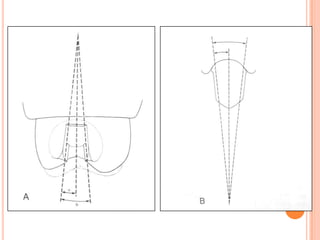
CONVERGENT ANGLE
Extension of opposing walls, which diverge toward
 the occlusal form a convergent angle. A bisection of
 this angle positions the “line of draw” which is
 perpendicular to the pulpal floor.
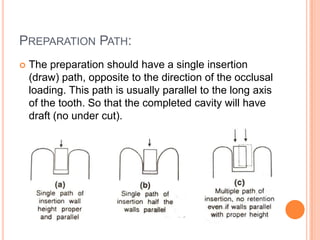
PREPARATION PATH:
   The preparation should have a single insertion
    (draw) path, opposite to the direction of the occlusal
    loading. This path is usually parallel to the long axis
    of the tooth. So that the completed cavity will have
    draft (no under cut).
PREPARATION FEATURES OF THE
CIRCUMFERENTIAL TIE
 The peripheral margin anatomy of the preparation
  is called circumferential tie.
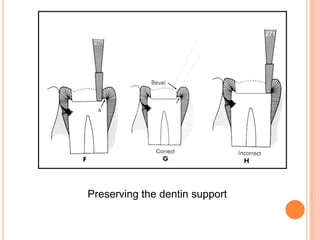
 Enamel must be supported by sound dentin.

 Enamel rods forming the cavosurface margin
  should be continuous with sound dentin.
 Enamel rods forming the cavosurface margin
  should be covered with the restorative material
 Angular cavosurface angles should be trimmed
BEVELS
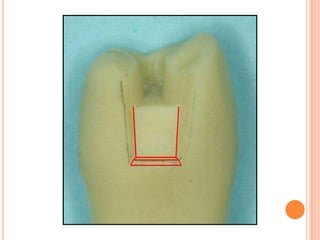
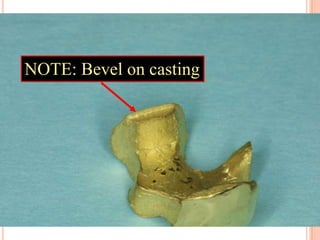
 Bevels are the flexible extensions of a cavity
  preparation, allowing the inclusion of surface
  defects, supplementary grooves, or other areas on
  the tooth surface.
 Require minimum tooth involvement

 Bevels create obtuse-angled tooth structure i.e. the
  strongest configuration and acute-angled marginal
  alloy i.e. burnish able. Thus makes it possible to
  decrease the cement line.
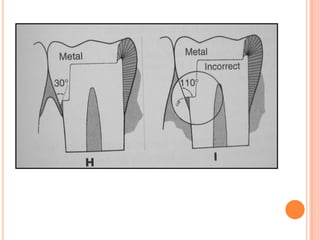
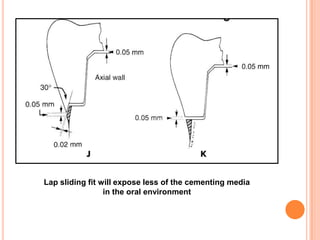
 A lap, sliding fit is produced at gingival margin.

 It results in 30-degree metal that is burnish able.

 Weak enamel is removed.
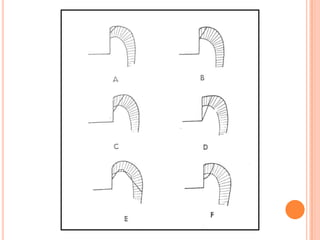
SIX TYPES OF BEVELS

 Partial Bevel: involves part of enamel wall, not
  exceeding 2/3rds its dimension. It is not used in
  cast restorations, except to trim weak enamel rods.
 Short Bevel: includes entire enamel wall, but not
  dentin, it is used with class-I alloys specially for
  type 1 & 2 (Gold platinum based alloys).
 Long Bevel: includes all enamel & up to ½ of the
  dentinal wall, its major advantage is that it
  preserves the internal boxed-up resistance. , most
  frequently used for the 1st 3 classes of cast
  material.
   Full Bevel: Includes all of the dentinal and enamel walls
    of the cavity wall or floor. Its use should be avoided
    except in cases where it is impossible to use any other
    form of bevel

   Counter Bevel: when capping cusps to protect and
    support these, this type of bevel is used, opposite to an
    axial cavity wall, on the facial or lingual surface of the
    tooth.

   Hollow ground bevel (concave)- All the types of bevels
    are in the form of a flat plane, but any of them especially
    that last three can be prepared in a concave form.
PRINCIPLES OF CAVITY DESIGN FOR
CAST INLAY RESTORATIONS
 An Inlay is defined as a restoration which has been
  constructed out of the mouth from gold, porcelain or
  other metal and then cemented into the prepared
  cavity of the tooth.
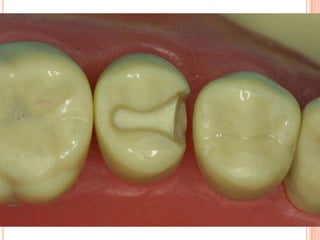
 The class-II inlay involves the occlusal and
  proximal surfaces of a posterior tooth and may cap
  one or more cusps but not all of the cusps.
 The class-II onlay involves the proximal surfaces of
  a posterior tooth and caps all of the cusps.
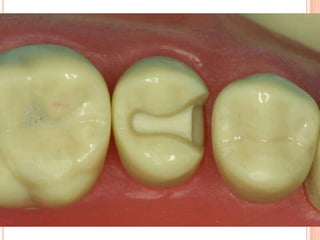
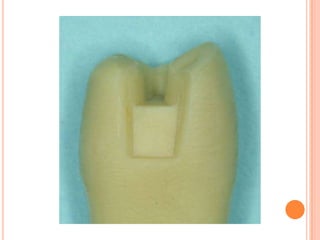
TOOTH PREPARATIONS FOR CLASS II
CAST METAL INLAYS
 Initial preparation
 Occlusal step

 Proximal box

 Resistance and Retention form

 Final preparation

 Removal of infected caries and pulpal protection.

 Preparation of bevels and flares

 Modifications
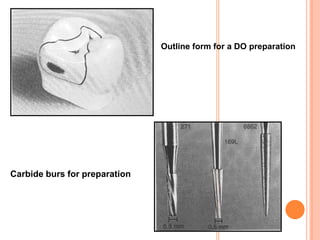
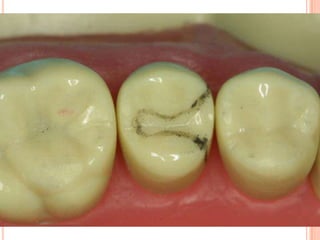
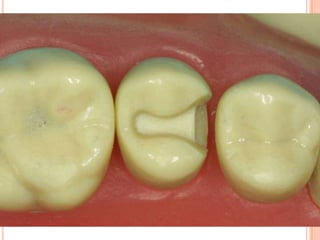
Outline form for a DO preparation


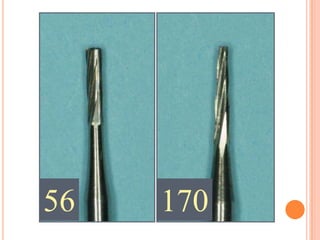
Carbide burs for preparation
OCCLUSAL STEP
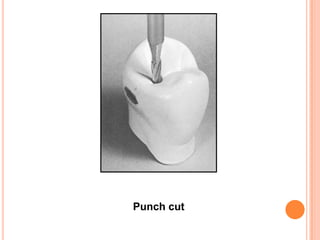
   Initial entry is made in the central fossa/pit with a
    tapered fissure bur no.271 to establish the pulpal
    floor (punch cut) to a depth of 1.5mm.

   The depth is determined by the extent of existing
    carious lesions or restorations or the need for
    additional retention
Punch cut
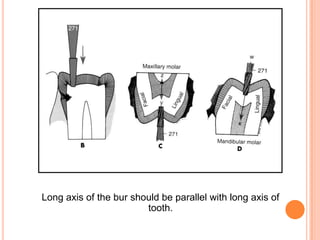
Long axis of the bur should be parallel with long axis of
                        tooth.
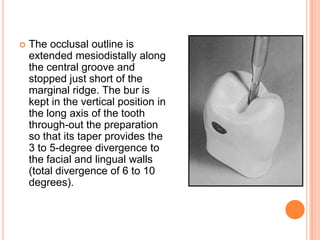
   The occlusal outline is
    extended mesiodistally along
    the central groove and
    stopped just short of the
    marginal ridge. The bur is
    kept in the vertical position in
    the long axis of the tooth
    through-out the preparation
    so that its taper provides the
    3 to 5-degree divergence to
    the facial and lingual walls
    (total divergence of 6 to 10
    degrees).
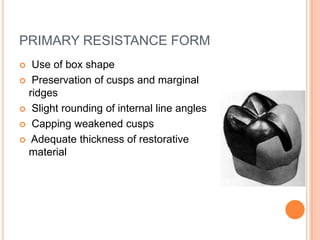
PRIMARY RESISTANCE FORM
  Use of box shape
 Preservation of cusps and marginal
  ridges
 Slight rounding of internal line angles

 Capping weakened cusps

 Adequate thickness of restorative
  material
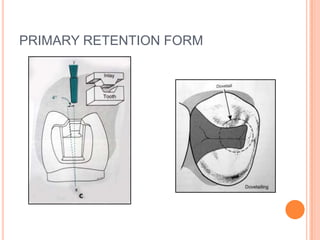
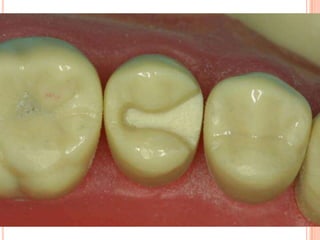
PRIMARY RETENTION FORM
Preserving the dentin support
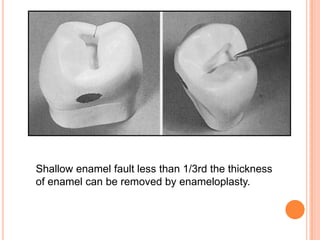
Shallow enamel fault less than 1/3rd the thickness
of enamel can be removed by enameloplasty.
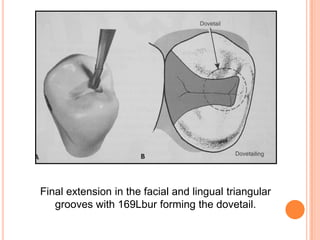
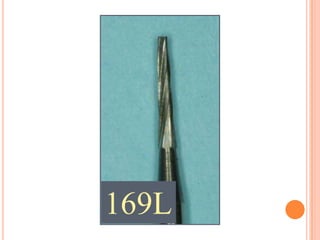
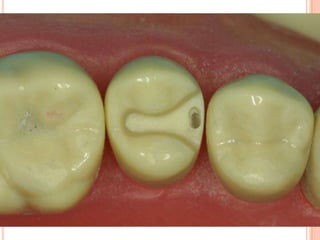
Final extension in the facial and lingual triangular
   grooves with 169Lbur forming the dovetail.
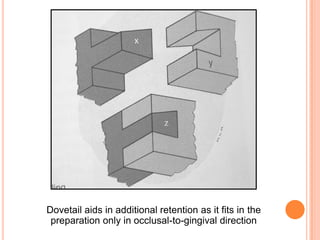
Dovetail aids in additional retention as it fits in the
 preparation only in occlusal-to-gingival direction
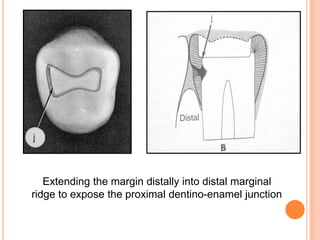
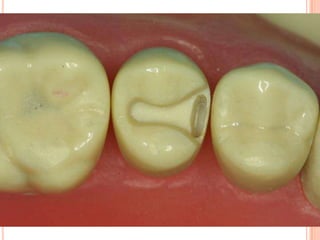
Extending the margin distally into distal marginal
ridge to expose the proximal dentino-enamel junction
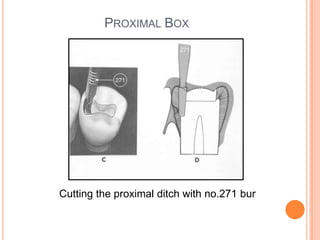
PROXIMAL BOX


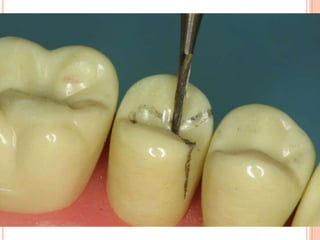
Cutting the proximal ditch with no.271 bur
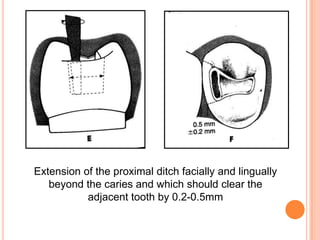
Extension of the proximal ditch facially and lingually
   beyond the caries and which should clear the
           adjacent tooth by 0.2-0.5mm
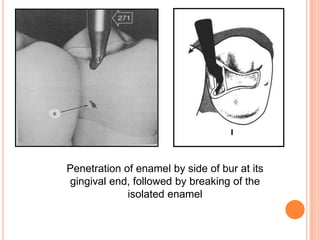
Penetration of enamel by side of bur at its
gingival end, followed by breaking of the
             isolated enamel
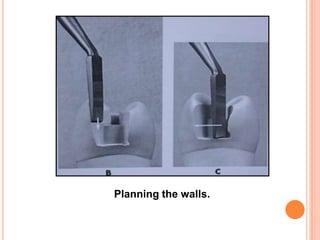
Planning the walls.
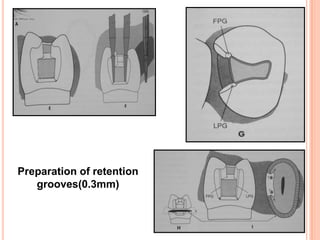
Preparation of retention
   grooves(0.3mm)
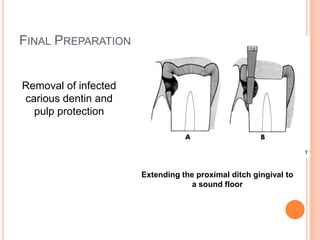
FINAL PREPARATION


Removal of infected
carious dentin and
  pulp protection


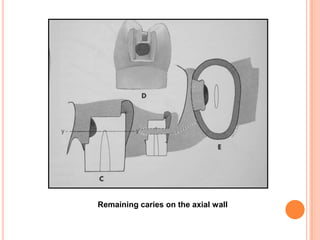
                      Extending the proximal ditch gingival to
                                   a sound floor
Remaining caries on the axial wall
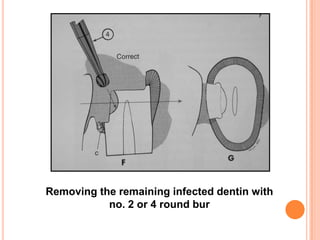
Removing the remaining infected dentin with
           no. 2 or 4 round bur
M


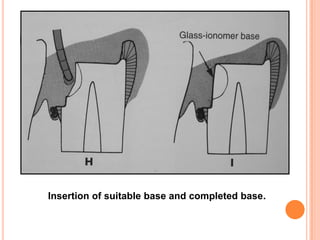
    Insertion of suitable base and completed base.
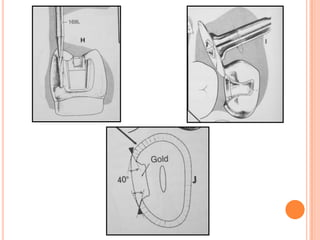
PREPARATION OF BEVELS AND FLARES
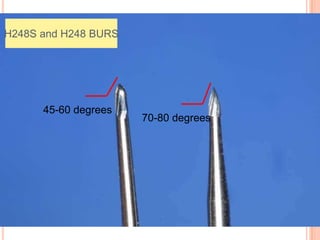
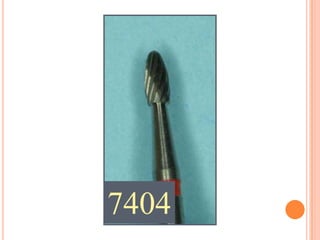
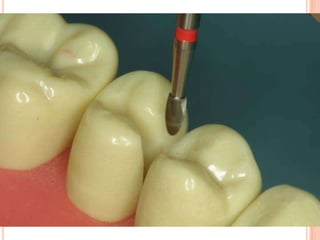
 The slender flame shaped fine-grit diamond is used
  to bevel the occlusal and gingival margins and to
  apply the secondary flare on the proximal-facial and
  lingual walls.
 It will result in 30-400 marginal metal & 140-1500
  cavosurface margin
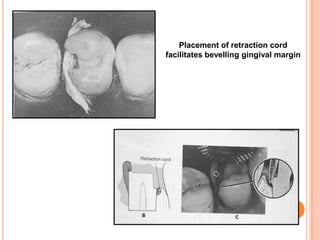
Placement of retraction cord
facilitates bevelling gingival margin
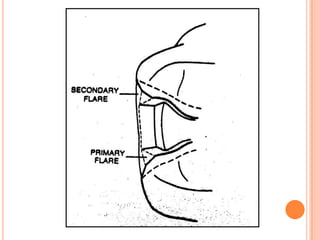
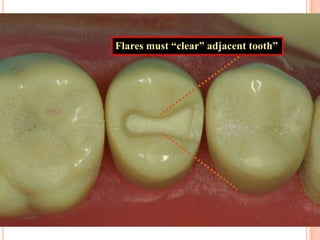
For the facial and lingual proximal walls in an inlay
cavity preparation for castings flares are used, which
are the flat or concave peripheral portions of the facial
and lingual walls
There are 2 types of flares
 The primary flare
 The secondary flare


The primary flare:
 Is the conventional and basic part of the cavity
  facially and lingually for an intra coronal preparation.
 It is very similar to a long bevel formed of enamel and
  part of dentin on the facial or lingual wall. Primary
  flares also have a special angulation i.e., 450 to the
  inner dentinal wall proper.
Functions and indications –
 These design features perform the same function
  as bevels.
 They can bring the facial and lingual margins of the
  cavity preparation to cleansable finishable areas.
 They are indicated for any facial or lingual proximal
  wall of an intracoronal cavity preparation.
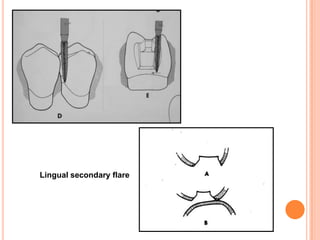
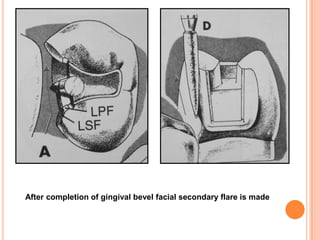
SECONDARY FLARE
 It is almost always a flat plane super imposed
  peripherally to a primary flare. It is usually prepared
  solely in enamel. Unlike primary flares, secondary
  flares may have different angulations, involvement
  and extent depending on their function
Functions and indications of secondary flare-
 Lesions with wide bucco-lingual extensions

 Contact areas too broad
Lingual secondary flare
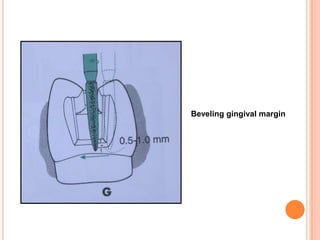
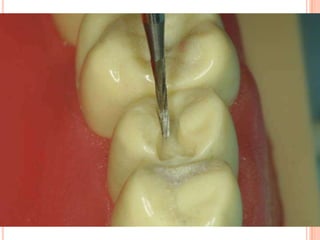
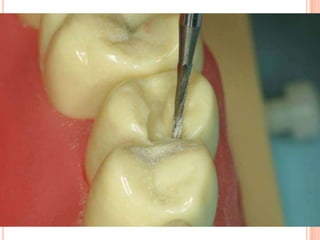
Beveling gingival margin
Lap sliding fit will expose less of the cementing media
                 in the oral environment
After completion of gingival bevel facial secondary flare is made
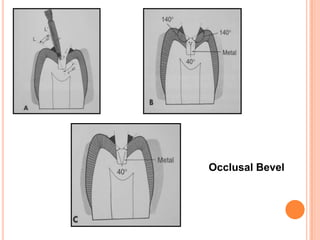
Occlusal Bevel
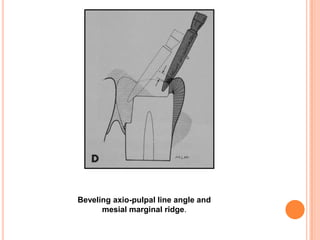
Beveling axio-pulpal line angle and
      mesial marginal ridge.
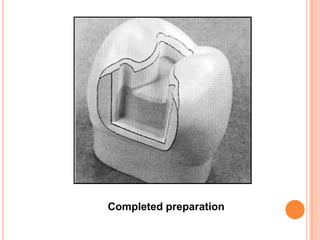
Completed preparation
56   170
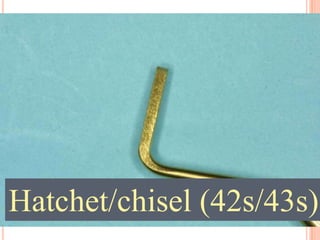
Hatchet/chisel (42s/43s)
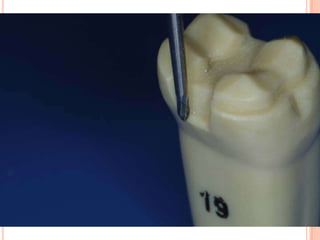
Flares must “clear” adjacent tooth”
169L
H248S and H248 BURS


      45-60 degrees
                      70-80 degrees
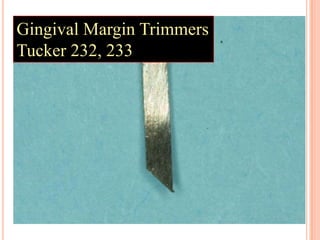
Gingival Margin Trimmers
Tucker 232, 233
NOTE: Bevel on casting
7404
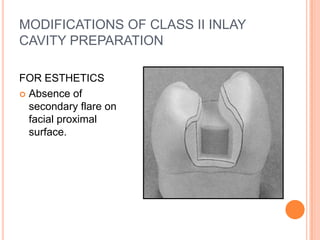
MODIFICATIONS OF CLASS II INLAY
CAVITY PREPARATION

FOR ESTHETICS
 Absence of
  secondary flare on
  facial proximal
  surface.
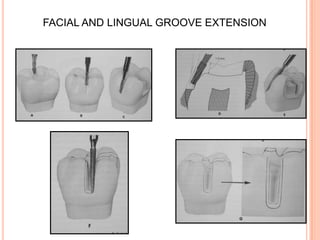
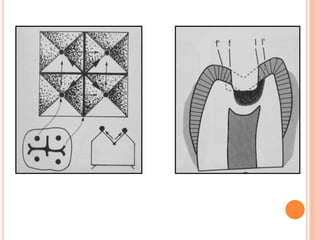
FACIAL AND LINGUAL GROOVE EXTENSION
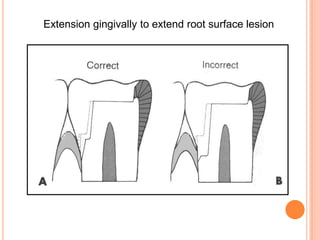
Extension gingivally to extend root surface lesion
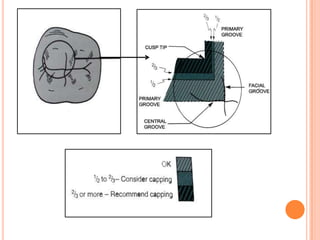
CAPPING CUSPS
 When the occlusal outline is extended up the cusp
  slopes more than half the distance from primary
  groove, capping the cusp should be considered.
 If it is extended two thirds or more, capping is
  necessary.
MODIFICATIONS OF PROXIMAL CAVITY DESIGN
 Box preparation
 Slice preparation

 Auxiliary slice preparation

 Modified Flare
BOX
Introduced by Dr.G.V Black in which the proximal
cavities are prepared box shaped with buccal and
lingual walls and a definite gingival floor.
Advantages-
 It has its own resistance and retention form.

 Direct wax pattern can be made.

 The outline form of the proximal surface can be
   made on all types of teeth.
 Minimum display of metal.
Disadvantages-
 It involves removal of lots of tooth structure.

 Clinically it is time consuming.

 Narrow bevels leave a sharp edge and an undercut
  gingivally , which cannot be satisfactorily
  reproduced.
 While taking impression distortions and breaking of
  wax pattern occurs.
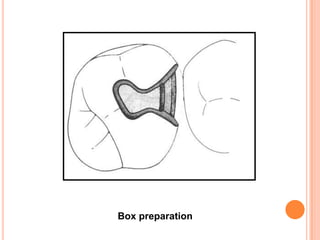
Box preparation
SLICE PREPARATION
 This form of cavity is modified so that the proximal
  surface is flat without definite side walls. This is
  slice preparation which depends for its retention
  mainly on the occlusal key, channels or locks cut in
  the axial wall.
 Historically ,a slice referred to the placement of
  extra coronal taper using a disk of adequate
  diameter to contact nearly the entire proximal
  surface
INDICATIONS
 As abutment in bridge work
 Small carious lesion only on the middle of the
  proximal surface.
 To improve retention form.

 Teeth with proximal undercuts can be eliminated
  which facilitates taking impression.
 Advocated for quadrant work where proximal
  outline form can be rapidly developed.
 For indirect wax pattern technique.
Advantages-
 Less tooth structure is sacrificed.
 Quicker and easier.

 Well protected enamel margins.

 Increases resistance and retention form by
  exposing a larger amount of tissue surface to the
  frictional grasp of the restoration.
Disadvantages-
 Thoma(1951)pointed out that it displays
  unnecessary amount of gold.
 Reduced retention form.

 Direct wax pattern cannot be made as
  distinguishing between the margins is difficult.
 The margins of metal which we’ll get are very thin
  which can get distorted.
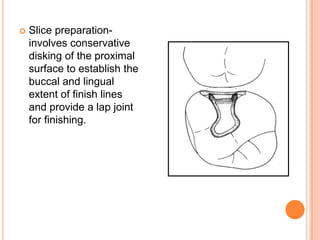
   Slice preparation-
    involves conservative
    disking of the proximal
    surface to establish the
    buccal and lingual
    extent of finish lines
    and provide a lap joint
    for finishing.
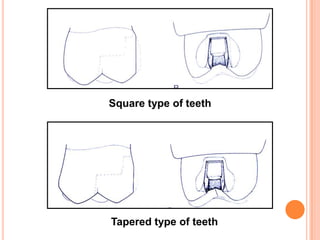
Square type of teeth


Tapered type of teeth
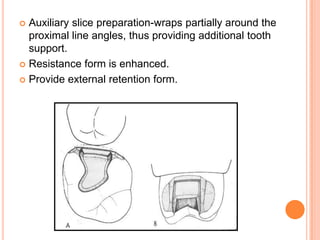
 Auxiliary slice preparation-wraps partially around the
  proximal line angles, thus providing additional tooth
  support.
 Resistance form is enhanced.

 Provide external retention form.
MODIFIED FLARE
 In view of the shortcomings of box type and slice
  type preparations ,Barishman advocates a modified
  preparation which may be called the box cum
  gingival slice.
 Modified flare is nothing but a combination of box
  and slice preparation taking advantage of the box
  preparation and slice preparation.
 Minimum disking of the proximal walls is done for
  better finishing and polishing
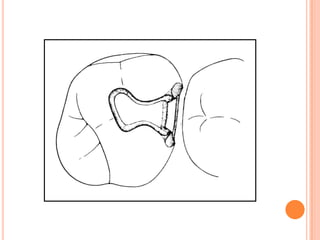
TOOTH PREPARATION WITH SURFACE
EXTENSIONS

INDICATIONS-
 Surface extensions are required to include facial or
  lingual defects beyond the axial angle of the tooth.
 Surface extensions are required to eradicate severe
  peripheral Marginal undercuts, which have not been
  removed by the maximum angulations and extent of
  a secondary flare.
 A surface extension is necessary to encompass an
  axial angle for reinforcing and supporting reasons.
 A surface extensions is needed to add to the
  retentive capability of the restoration proximally
  especially with shortened facial and lingual walls or
  as a reciprocal means of retention
 More surface extension is required to fulfil the
  objectives of secondary flares in extremely wide
  cavities or contact areas
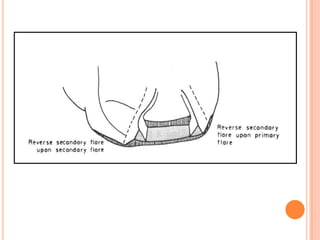
REVERSE SECONDARY FLARES
 Can be added to a cavity (tooth) preparation in lieu
  of a secondary flare
 The reverse secondary flare is in the form a partial
  bevel. It involves only enamel with its maximum
  depth at its junction with the main cavity
  preparation. In ends on the facial or lingual surface
  with a knife edge finishing line, and its extent
  should not exceed the height of contour of the facial
  or lingual surface in the mesio-distal direction nor
  should it include the tip of the cusp.
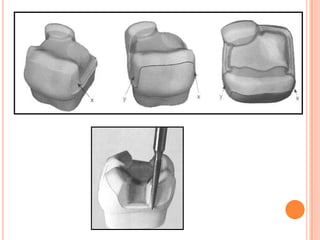
SKIRT
 This is a more extensive surface extension than the
  reverse secondary flare also superimposed on the
  basic intracoronal inlay or onlay cavity preparation
  facially and or lingually
INDICATIONS-
 Skirting is required to involve defects with more
  dimensions (especially depth) than those that can
  be involve in a reverse secondary flare
 A skirt is required to import resistance and retention
  on a cast restoration in lieu of a missing or
  shortened opposing facial or lingual walls.
 Skirting is necessary when the contact areas and
  contour of the proximal surface are to be changed
 Skirts are essential facially and lingually for tilted
  teeth in order to restore the occlusal plane.
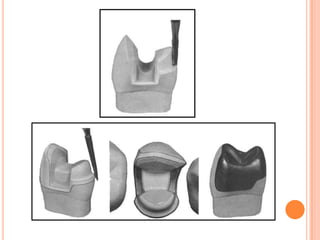
COLLAR
 This type of surface extension is the most involving
  surface wise and depth wise.
 They are two types

a) Cuspal collars
b) Tooth collars

 Cuspal collars which involve the facial or lingual
  surface of one cusp only in a multi-cusped tooth.
 Tooth collars involve the entire facial or lingual
  surfaces of the tooth.
INDICATIONS
 They help in retention and resistance when an
  entire cusp is lost prior to the tooth preparation or
  when it is necessary to remove if due to excessive
  undermining.
 They help retention in shortened teeth.

 They help resistance and to enhance support for
  tooth that is endodontically treated.
CONCLUSION
Cast restorations form an integral link in the dental
restorative chain. They are an excellent choice in
many demanding situations. Understanding the
principles of tooth preparations and the intricacies of
cast restorations will enable the dentist to optimally
utilize this excellent option when the clinical situation
demands.
REFERENCES
 Art and science of operative dentistry-Sturdevant
 Principles and practice Operative Dentistry-
  Charbeneau
 Fundamentals of operative dentistry-Marzouk

 Operative Dentistry-Summit

 Atlas of inlays, onlays, crown and bridges-
  Shillinberg
 Inlays Crowns & Bridges-Cowell and Curson

 Textbook of Operative Dentistry-Vimal Sikri
Cast gold Inlay restorations

Cast gold Inlay restorations

  • 1.
    By:- Abhijeet Khade P G Student Dept. of Conservative Dentistry NHDC
  • 2.
    CONTENTS:-  Introduction.  Materials for cast restorations  Indications & Contraindications  Advantages and disadvantages  Principles of Cavity design for Cast inlay restorations.  Tooth preparation for Inlay Class II cast metal inlays  Bevels- Various types and significance.  Variations in proximal margin design.  Tooth Preparations For Cast Restorations With Surface Extension.  Conclusion  References
  • 3.
    INTRODUCTION  Dr. Phil brook in 1897,was the first to introduce Inlay in dentistry who gave the concept of forming an investment around a wax pattern, eliminating the wax, and filling the resultant mold with a gold alloy.  In 1907 Taggart changed the practice of restorative dentistry by introducing his technique for cast gold dental restorations.  It was most certainly Taggart who recognized the significance of cast gold restorations.
  • 4.
    METERIALS FOR CASTRESTORATIONS  Until recently gold-based alloys have been the only ones used for cast dental restorations. The ADA sp#5 still requires 75% of gold-plus- platinum group metals to be present in alloys for cast restorations According to Sturdevant there are 4 distinct groups of alloys.  The traditional high gold alloys.  Low gold alloys.  Palladium-silver alloys  Base metal alloys.
  • 5.
    ACCORDING TO MARZOUK: 1.Class-I: Gold and platinum group based alloys. 2. Class-II: Low gold alloys (gold content < 50%). 3. Class-III: Non-gold palladium based alloys. 4. Class-IV: Nickel-chromium based alloys. 5. Castable moldable ceramics
  • 6.
    CHARACTERISTICS OF CASTGOLD ALLOYS According to ADA sp#5 the alloys are characterized as follows- Type I-soft gold alloys Type II-medium hard alloys Type III-hard alloys Type IV-extra hard alloys
  • 7.
    According to ADAspecification No.5: 1. Type-I (Soft): For restorations subject to very slight stress such as inlays. 2. Type-II (Medium): For restorations subject to moderate stress such as onlays. 3. Type-III (Hard): For high-stress situations, including onlays, crowns, thick veneer crowns and short-span fixed partial dentures. 4. Type-IV (Extra hard): For extremely high stress states, such as endodontic posts and cores, thin veneer crowns, long span fixed partial dentures and removable partial dentures.
  • 8.
    Alloy Type Total noble metal content High Noble (HN) Contains  40 wt.% Au + 60 wt.% of noble metal elements (Au + Ir + Os + Pd + Rh + Ru). Noble metal (N) Contains  25 wt.% of the noble metal elements. Predominantly base metal Contains < 25 wt.% of the (PB) noble metal elements.
  • 9.
    In,Fe,Zn, Type Au Cu Ag Pd Ga I 83% 6 10 0.5 Balance II 77% 7 14 1 Balance III 75% 9 11 3.5 Balance IV 69% 10 12.5 3.5 Balance
  • 10.
    INGREDIENTS OF NOBLEMETAL ALLOYS: The most important element in dental gold alloys is gold, copper, silver, platinum metals and zinc. 1. Gold:  Gold is primarily responsible for deformability (ductility).  Ranks lowest in strength.  Characteristic yellow color with a strong metallic luster.  Density (Sp gravity)  19.3 g/cm3.  Tarnish resistance.  Fusion temperature – 1063o C.
  • 11.
    2. Platinum: Maybe added to 1. Strengthen the alloy. 2. Raise the fusion point (1755). 3. Import rigidity, nobility and hardness. 4. Whiten the alloy. 5. Specific gravity-- 21.37. 6. Also malleable and ductile. 3. Palladium:  Serves the same functions but is much less expensive than platinum.
  • 12.
    4. Iridium, Rutheniumand Rhodium:  Trace amounts of these metals are added as “Grain Refiners” melting point .  As little as 0.005% is sufficient to refine the grain size. Grain refiners produce smaller grains.  Fine-grained alloys are generally stronger and more ductile than coarse-grained alloys.  Indium can also act as a scavenger for the alloy during casting procedure. Also serve to increase the tarnish and corrosion resistance.
  • 13.
    5. Silver:  Itcontributes to the strength and hardness of the alloy. Although it mimics gold in its deformability effect, it adversely affects the malleability and it lowers tarnish resistance.  Food containing sulfur compounds, cause severe tarnish on silver.  Silver serves to balance the red color given by copper.  Adding small amounts of palladium to silver containing alloys prevents the rapid corrosion of such alloys in the oral environment
  • 14.
    6. Copper:  Contributesstrength and hardness, but decreases the malleability of the alloy, i.e., it decreases the tarnish and corrosion resistance . The content should not exceed 16%. Gives the alloy reddish appearance. Lowers the fusion temperature. 7. Zinc: (Present only in low percentages, around 0.5%)  Acts as a deoxidizer and reduces the oxygen content (because O2 released during solidification results in porosity).
  • 15.
    Modu Dens Yield -lus Rate Type of Melting Hardne -ity stren of of cast Elongation range ss (gm/ gth elasti tarni materials (o F) (VHN) cm3) (MPa) city( sh PSI) Class I 20-25% 943-960 16.6 103 80 10-12 0% Class II 20% 924-960 15.9 186 101 12 2-3% Class III 15-18% 924-960 15.5 207 121 5- 15 10% ClassIV 3-11% 834-916 12.8 241 138 30 0% 1021- ClassV 0% 10.6 262 143 60 0% 1099
  • 16.
    INDICATIONS  Large restorations Endodontically treated teeth  Teeth at risk for fracture  Dental rehabilitation with cast metal alloys  Diastema closure and occlusal plane correction  Prosthodontic abutment  Correction of occlusion  Wide open contacts and occlusal plane correction  Adjunct to periodontal therapy to correct tooth anamolies predisposing to plaque accumulation  Sub gingival lesions
  • 17.
    CONTRAINDICATIONS  Physiologically youngdentition with large pulp chambers are poor candidates for cast restoration  Developing and deciduous teeth  High plaque / caries indices.  Dissimilar metals.  Esthetics  Small restorations
  • 18.
    ADVANTAGES  Strength  Biocompatibility Low wear  Control of contours & contacts
  • 19.
    DISADVANTAGES  Extensive toothpreparation  Cemented restoration, discrepancy and micro leakage  Abrasive and splitting force on natural teeth  Galvanic currents  Number of appointments and higher chair time  Cost and Temporary restoration requirement  Technique sensitive
  • 20.
    PRINCIPLES OF CAVITYDESIGN FOR CAST INLAY RESTORATIONS. Basic differences between Amalgam and Cast restoration preparation are  Intercuspal distance  Undercuts  Bevels- occlusal and gingival
  • 21.
    APICO-OCCLUSAL TAPER PREPARATION  Formaximum retention in a cast restoration opposing walls and opposing axial surfaces of a tooth preparation should be perfectly parallel to each other.  Taper should be an average of 2-5 degree from path of preparation. It can be decreased or increased according to the length of the preparation wall and/or axial surface, surface involvement and internal anatomy in the preparations.
  • 22.
    CONVERGENT ANGLE Extension ofopposing walls, which diverge toward the occlusal form a convergent angle. A bisection of this angle positions the “line of draw” which is perpendicular to the pulpal floor.
  • 24.
    PREPARATION PATH:  The preparation should have a single insertion (draw) path, opposite to the direction of the occlusal loading. This path is usually parallel to the long axis of the tooth. So that the completed cavity will have draft (no under cut).
  • 25.
    PREPARATION FEATURES OFTHE CIRCUMFERENTIAL TIE  The peripheral margin anatomy of the preparation is called circumferential tie.  Enamel must be supported by sound dentin.  Enamel rods forming the cavosurface margin should be continuous with sound dentin.  Enamel rods forming the cavosurface margin should be covered with the restorative material  Angular cavosurface angles should be trimmed
  • 26.
    BEVELS  Bevels arethe flexible extensions of a cavity preparation, allowing the inclusion of surface defects, supplementary grooves, or other areas on the tooth surface.  Require minimum tooth involvement  Bevels create obtuse-angled tooth structure i.e. the strongest configuration and acute-angled marginal alloy i.e. burnish able. Thus makes it possible to decrease the cement line.  A lap, sliding fit is produced at gingival margin.  It results in 30-degree metal that is burnish able.  Weak enamel is removed.
  • 27.
    SIX TYPES OFBEVELS  Partial Bevel: involves part of enamel wall, not exceeding 2/3rds its dimension. It is not used in cast restorations, except to trim weak enamel rods.  Short Bevel: includes entire enamel wall, but not dentin, it is used with class-I alloys specially for type 1 & 2 (Gold platinum based alloys).  Long Bevel: includes all enamel & up to ½ of the dentinal wall, its major advantage is that it preserves the internal boxed-up resistance. , most frequently used for the 1st 3 classes of cast material.
  • 28.
    Full Bevel: Includes all of the dentinal and enamel walls of the cavity wall or floor. Its use should be avoided except in cases where it is impossible to use any other form of bevel  Counter Bevel: when capping cusps to protect and support these, this type of bevel is used, opposite to an axial cavity wall, on the facial or lingual surface of the tooth.  Hollow ground bevel (concave)- All the types of bevels are in the form of a flat plane, but any of them especially that last three can be prepared in a concave form.
  • 30.
    PRINCIPLES OF CAVITYDESIGN FOR CAST INLAY RESTORATIONS  An Inlay is defined as a restoration which has been constructed out of the mouth from gold, porcelain or other metal and then cemented into the prepared cavity of the tooth.  The class-II inlay involves the occlusal and proximal surfaces of a posterior tooth and may cap one or more cusps but not all of the cusps.  The class-II onlay involves the proximal surfaces of a posterior tooth and caps all of the cusps.
  • 31.
    TOOTH PREPARATIONS FORCLASS II CAST METAL INLAYS  Initial preparation  Occlusal step  Proximal box  Resistance and Retention form  Final preparation  Removal of infected caries and pulpal protection.  Preparation of bevels and flares  Modifications
  • 32.
    Outline form fora DO preparation Carbide burs for preparation
  • 33.
    OCCLUSAL STEP  Initial entry is made in the central fossa/pit with a tapered fissure bur no.271 to establish the pulpal floor (punch cut) to a depth of 1.5mm.  The depth is determined by the extent of existing carious lesions or restorations or the need for additional retention
  • 34.
  • 35.
    Long axis ofthe bur should be parallel with long axis of tooth.
  • 36.
    The occlusal outline is extended mesiodistally along the central groove and stopped just short of the marginal ridge. The bur is kept in the vertical position in the long axis of the tooth through-out the preparation so that its taper provides the 3 to 5-degree divergence to the facial and lingual walls (total divergence of 6 to 10 degrees).
  • 37.
    PRIMARY RESISTANCE FORM  Use of box shape  Preservation of cusps and marginal ridges  Slight rounding of internal line angles  Capping weakened cusps  Adequate thickness of restorative material
  • 38.
  • 39.
  • 40.
    Shallow enamel faultless than 1/3rd the thickness of enamel can be removed by enameloplasty.
  • 41.
    Final extension inthe facial and lingual triangular grooves with 169Lbur forming the dovetail.
  • 42.
    Dovetail aids inadditional retention as it fits in the preparation only in occlusal-to-gingival direction
  • 43.
    Extending the margindistally into distal marginal ridge to expose the proximal dentino-enamel junction
  • 44.
    PROXIMAL BOX Cutting theproximal ditch with no.271 bur
  • 45.
    Extension of theproximal ditch facially and lingually beyond the caries and which should clear the adjacent tooth by 0.2-0.5mm
  • 46.
    Penetration of enamelby side of bur at its gingival end, followed by breaking of the isolated enamel
  • 47.
  • 48.
  • 49.
    FINAL PREPARATION Removal ofinfected carious dentin and pulp protection Extending the proximal ditch gingival to a sound floor
  • 50.
    Remaining caries onthe axial wall
  • 51.
    Removing the remaininginfected dentin with no. 2 or 4 round bur
  • 52.
    M Insertion of suitable base and completed base.
  • 53.
    PREPARATION OF BEVELSAND FLARES  The slender flame shaped fine-grit diamond is used to bevel the occlusal and gingival margins and to apply the secondary flare on the proximal-facial and lingual walls.  It will result in 30-400 marginal metal & 140-1500 cavosurface margin
  • 54.
    Placement of retractioncord facilitates bevelling gingival margin
  • 55.
    For the facialand lingual proximal walls in an inlay cavity preparation for castings flares are used, which are the flat or concave peripheral portions of the facial and lingual walls There are 2 types of flares  The primary flare  The secondary flare The primary flare:  Is the conventional and basic part of the cavity facially and lingually for an intra coronal preparation.  It is very similar to a long bevel formed of enamel and part of dentin on the facial or lingual wall. Primary flares also have a special angulation i.e., 450 to the inner dentinal wall proper.
  • 56.
    Functions and indications–  These design features perform the same function as bevels.  They can bring the facial and lingual margins of the cavity preparation to cleansable finishable areas.  They are indicated for any facial or lingual proximal wall of an intracoronal cavity preparation.
  • 57.
    SECONDARY FLARE  Itis almost always a flat plane super imposed peripherally to a primary flare. It is usually prepared solely in enamel. Unlike primary flares, secondary flares may have different angulations, involvement and extent depending on their function Functions and indications of secondary flare-  Lesions with wide bucco-lingual extensions  Contact areas too broad
  • 59.
  • 60.
  • 62.
    Lap sliding fitwill expose less of the cementing media in the oral environment
  • 63.
    After completion ofgingival bevel facial secondary flare is made
  • 65.
  • 66.
    Beveling axio-pulpal lineangle and mesial marginal ridge.
  • 67.
  • 72.
    56 170
  • 76.
  • 77.
    Flares must “clear”adjacent tooth”
  • 79.
  • 87.
    H248S and H248BURS 45-60 degrees 70-80 degrees
  • 89.
  • 91.
  • 92.
  • 96.
    MODIFICATIONS OF CLASSII INLAY CAVITY PREPARATION FOR ESTHETICS  Absence of secondary flare on facial proximal surface.
  • 97.
    FACIAL AND LINGUALGROOVE EXTENSION
  • 98.
    Extension gingivally toextend root surface lesion
  • 99.
    CAPPING CUSPS  Whenthe occlusal outline is extended up the cusp slopes more than half the distance from primary groove, capping the cusp should be considered.  If it is extended two thirds or more, capping is necessary.
  • 102.
    MODIFICATIONS OF PROXIMALCAVITY DESIGN  Box preparation  Slice preparation  Auxiliary slice preparation  Modified Flare
  • 103.
    BOX Introduced by Dr.G.VBlack in which the proximal cavities are prepared box shaped with buccal and lingual walls and a definite gingival floor. Advantages-  It has its own resistance and retention form.  Direct wax pattern can be made.  The outline form of the proximal surface can be made on all types of teeth.  Minimum display of metal.
  • 104.
    Disadvantages-  It involvesremoval of lots of tooth structure.  Clinically it is time consuming.  Narrow bevels leave a sharp edge and an undercut gingivally , which cannot be satisfactorily reproduced.  While taking impression distortions and breaking of wax pattern occurs.
  • 105.
  • 106.
    SLICE PREPARATION  Thisform of cavity is modified so that the proximal surface is flat without definite side walls. This is slice preparation which depends for its retention mainly on the occlusal key, channels or locks cut in the axial wall.  Historically ,a slice referred to the placement of extra coronal taper using a disk of adequate diameter to contact nearly the entire proximal surface
  • 107.
    INDICATIONS  As abutmentin bridge work  Small carious lesion only on the middle of the proximal surface.  To improve retention form.  Teeth with proximal undercuts can be eliminated which facilitates taking impression.  Advocated for quadrant work where proximal outline form can be rapidly developed.  For indirect wax pattern technique.
  • 108.
    Advantages-  Less toothstructure is sacrificed.  Quicker and easier.  Well protected enamel margins.  Increases resistance and retention form by exposing a larger amount of tissue surface to the frictional grasp of the restoration.
  • 109.
    Disadvantages-  Thoma(1951)pointed outthat it displays unnecessary amount of gold.  Reduced retention form.  Direct wax pattern cannot be made as distinguishing between the margins is difficult.  The margins of metal which we’ll get are very thin which can get distorted.
  • 110.
    Slice preparation- involves conservative disking of the proximal surface to establish the buccal and lingual extent of finish lines and provide a lap joint for finishing.
  • 111.
    Square type ofteeth Tapered type of teeth
  • 112.
     Auxiliary slicepreparation-wraps partially around the proximal line angles, thus providing additional tooth support.  Resistance form is enhanced.  Provide external retention form.
  • 113.
    MODIFIED FLARE  Inview of the shortcomings of box type and slice type preparations ,Barishman advocates a modified preparation which may be called the box cum gingival slice.  Modified flare is nothing but a combination of box and slice preparation taking advantage of the box preparation and slice preparation.  Minimum disking of the proximal walls is done for better finishing and polishing
  • 115.
    TOOTH PREPARATION WITHSURFACE EXTENSIONS INDICATIONS-  Surface extensions are required to include facial or lingual defects beyond the axial angle of the tooth.  Surface extensions are required to eradicate severe peripheral Marginal undercuts, which have not been removed by the maximum angulations and extent of a secondary flare.  A surface extension is necessary to encompass an axial angle for reinforcing and supporting reasons.
  • 116.
     A surfaceextensions is needed to add to the retentive capability of the restoration proximally especially with shortened facial and lingual walls or as a reciprocal means of retention  More surface extension is required to fulfil the objectives of secondary flares in extremely wide cavities or contact areas
  • 117.
    REVERSE SECONDARY FLARES Can be added to a cavity (tooth) preparation in lieu of a secondary flare  The reverse secondary flare is in the form a partial bevel. It involves only enamel with its maximum depth at its junction with the main cavity preparation. In ends on the facial or lingual surface with a knife edge finishing line, and its extent should not exceed the height of contour of the facial or lingual surface in the mesio-distal direction nor should it include the tip of the cusp.
  • 119.
    SKIRT  This isa more extensive surface extension than the reverse secondary flare also superimposed on the basic intracoronal inlay or onlay cavity preparation facially and or lingually INDICATIONS-  Skirting is required to involve defects with more dimensions (especially depth) than those that can be involve in a reverse secondary flare  A skirt is required to import resistance and retention on a cast restoration in lieu of a missing or shortened opposing facial or lingual walls.
  • 121.
     Skirting isnecessary when the contact areas and contour of the proximal surface are to be changed  Skirts are essential facially and lingually for tilted teeth in order to restore the occlusal plane.
  • 122.
    COLLAR  This typeof surface extension is the most involving surface wise and depth wise.  They are two types a) Cuspal collars b) Tooth collars  Cuspal collars which involve the facial or lingual surface of one cusp only in a multi-cusped tooth.  Tooth collars involve the entire facial or lingual surfaces of the tooth.
  • 123.
    INDICATIONS  They helpin retention and resistance when an entire cusp is lost prior to the tooth preparation or when it is necessary to remove if due to excessive undermining.  They help retention in shortened teeth.  They help resistance and to enhance support for tooth that is endodontically treated.
  • 125.
    CONCLUSION Cast restorations forman integral link in the dental restorative chain. They are an excellent choice in many demanding situations. Understanding the principles of tooth preparations and the intricacies of cast restorations will enable the dentist to optimally utilize this excellent option when the clinical situation demands.
  • 126.
    REFERENCES  Art andscience of operative dentistry-Sturdevant  Principles and practice Operative Dentistry- Charbeneau  Fundamentals of operative dentistry-Marzouk  Operative Dentistry-Summit  Atlas of inlays, onlays, crown and bridges- Shillinberg  Inlays Crowns & Bridges-Cowell and Curson  Textbook of Operative Dentistry-Vimal Sikri