Mineral Trioxide Aggregate
[MTA]
Dept. of Conservative & Endodontics
Kantipur Dental College
Chetan Basnet
BDS 4th Batch
CONTENTS
• Introduction
• Composition
• Types – Gray & White
• Mixing time
• Setting time
• Solubility
• Biocompatibility
• Radiopacity
• pH
• Physical Properties
• Advantages / Disadvantages
• Indications / Contra-Indication
• Clinical Applications
– Direct pulp capping
– Apical plug
– Root end filling
– Root perforations
– Furcation involvement
– Resorptive defect
• Comparison of Ca(OH)2 & MTA
• Conclusion
• References
INTRODUCTION
Independent analysis suggests that the material of Mineral Trioxide
Aggregate (MTA) is identical to Portland cement. It is a new remarkable biocompatible
material with exciting clinical applications pioneered by Dr. Mahmoud
Torabinejad, Loma Linda University, in 1993. Its first description in the dental
literature in 1993, by Lee & colleagues, that MTA has been used in both surgical
and non – surgical applications, including root end fillings, direct pulp capping,
perforation repairs in roots or furcations and Apexification.
• In 1998, MTA’s approval by U.S Food and Drug Administration led to widespread
use. MTA cement provides a better sealing ability over Amalgam, GIC, IRM, ZOE,
and Super EBA.
• It’s an ideal material for use against bone for the overgrowth of cementum,
formation of bone and facilitates the regeneration of the periodontal ligament fibers.
Composition
Chemical Composition
(Sarkar et al – JOE 2005)
MTA is a mechanical mixture of 3 powder ingredients:
• Portland cement (75%)
• Bismuth oxide (20%)
• Gypsum (5%)
Composition includes :
• Tricalcium silicate
• Dicalcium silicate
• Tricalcium aluminate
• Tetracalcium aluminoferrite
• Calcium sulfate
• Bismuth oxide
MTA powder consists of fine hydrophilic particles. Tricalcium silicate, Tricalcium
aluminate, Silica oxide and Tricalcium oxide are the major components and few other
mineral oxides are responsible for chemical and physical properties of MTA.
Bismuth oxide added for radio opacity.
Types of MTA:
There are two types of MTA
1. Gray
2. White
(Saeed Asgary et al JOE 2005)
Grey MTA White MTA
FeO -present FeO replaced with MgO
FeO- Black MgO-White(Hue matched the color of
teeth)
Mixing MTA
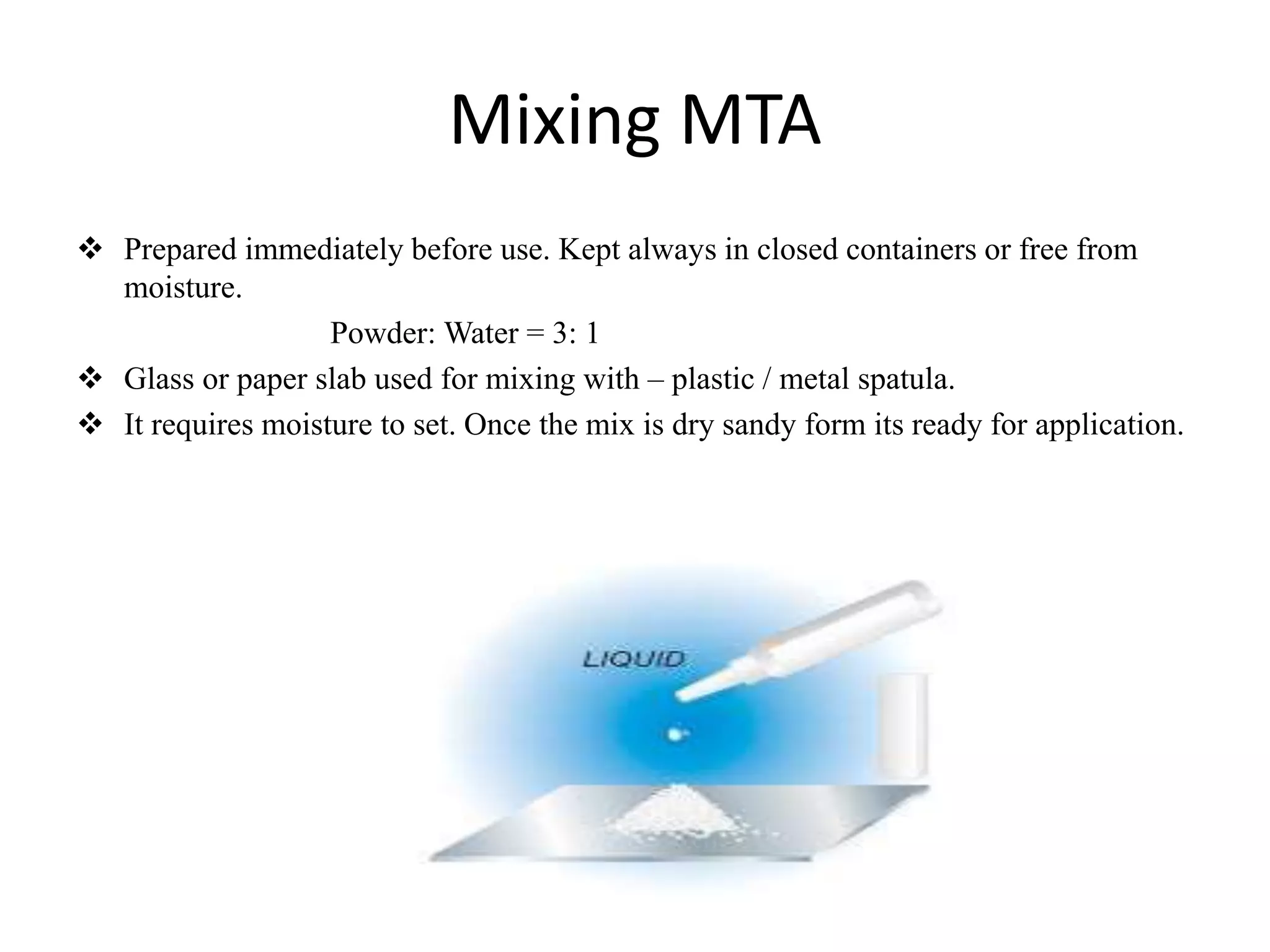
 Prepared immediately before use. Kept always in closed containers or free from
moisture.
Powder: Water = 3: 1
 Glass or paper slab used for mixing with – plastic / metal spatula.
 It requires moisture to set. Once the mix is dry sandy form its ready for application.
Setting Time
MTA powder consists of fine hydrophilic particles. Hydration of MTA
powder results in a colloidal gel that solidifies to a hard structure in ~ 4 hrs which has a
long setting time.
It is generally considered that a potential root end filling material should set as soon
as placed in root end cavity without significant shrinkage.
This condition would allow the dimensional stability of the material after placement
and less time for an unset material to be in contact with vital tissues. In general, quicker
a material sets more it shrinks.
But MTA has long setting time with less shrinkage
Solubility
Lack of solubility is an ideal characteristic of MTA as a root end filling
material.
Despite of some advantages of controlled long term clinical studies, because of its long
setting time, the recommended methods of ISO (6) or ADAS # 30 (7), the test solubility
of MTA had to be modified.
Biocompatibility
Clinically MTA is a biocompatible material with good sealing ability
should generate little or no inflammatory response in periradicular tissues, and
encourage the formation of fibrous connective tissue and / or cementum covering the
entire root end.
• Calcium & Phosphorus are the main ions present in this material, which are the
principle components of dental tissues, hence MTA proved to be biocompatible
when used in contact with cells and tissues.
Radio Opacity
Bismuth oxide added for radio opacity and it is more radio opaque than its
surrounding structures.
Shah et al in 1995 showed that the MTA is less radio opaque than Kalzinol- (7.97) and
more radio opaque than GP (6.14), IRM (5.30), Super EBA (5.16), Dentin- (0.70).
More radio opaque than GP & dentin are very much distinguishable on radiographs
pH
• MTA has a high pH of 12.5 similar to calcium hydroxide cement, which
prevents the bacterial growth and maintains the long lasting bactericidal potential.
• Induction of hard tissue formation / barrier in Apexification procedures and root
end filling would minimize the interaction between material and host tissues
Physical Property
Compressive Strength is an important factor to be considered when a filling material
is placed in a cavity that bears occlusal pressure. As a root end filling material do not
bear direct pressure, the Compressive strength of this material is not as significant as
materials used to repair defects in occlusal surfaces. Compressive strength in 21days
≈70 Mpa.
Mechanical wear, an important factor in coronal restoration, MTA is not used as
coronal restoration or not placed in functional areas.
Advantages
• Antimicrobial Activity
• MicroLeakage
• Cementoconductive
• Non toxic
• Non-mutagenic
• Cell adherence & growth
• Alkaline phosphotase/ osteocalcin
• Interleukin production
• Periodontal ligament attachment to cementum growth
• Dentinal bridge formation
Disadvantages
• More difficult to manipulate
• Longer setting time
Indications
• To preserve pulp vitality
• Prevent pathological changes in the periradicular tissues
• Mechanical pulp exposures
• Carious pulp exposures with immature apices.
Contraindications
• Irreversible pulpitis
Clinical Applications
• Direct Pulp Capping
• Apical plug
• Root End Filling
• Perforation Repair
• Furcation involvment
• Resorptive Defects
• Immature apices
(apexogenesis/ Apexification)
Direct Pulp Capping
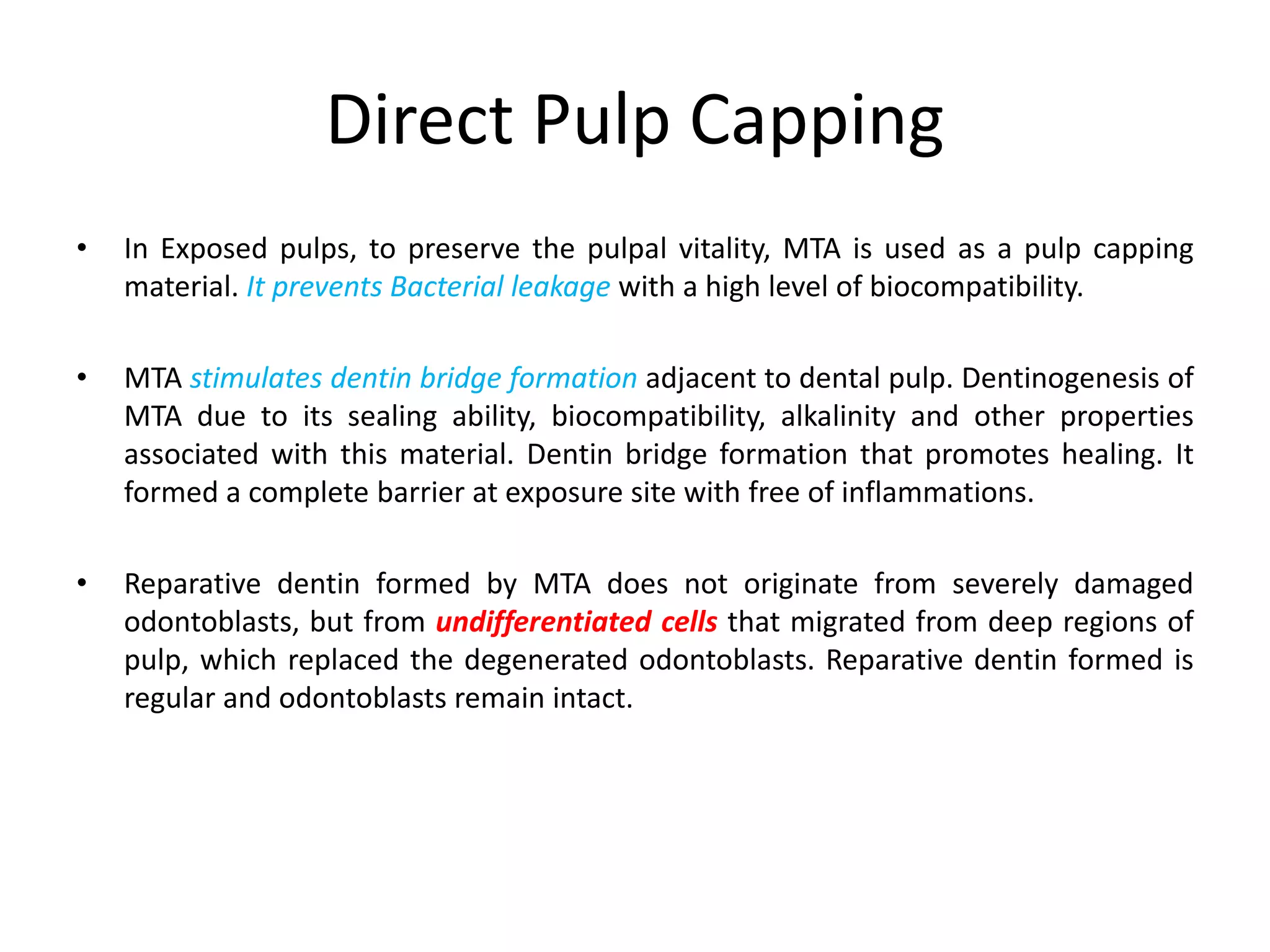
• In Exposed pulps, to preserve the pulpal vitality, MTA is used as a pulp capping
material. It prevents Bacterial leakage with a high level of biocompatibility.
• MTA stimulates dentin bridge formation adjacent to dental pulp. Dentinogenesis of
MTA due to its sealing ability, biocompatibility, alkalinity and other properties
associated with this material. Dentin bridge formation that promotes healing. It
formed a complete barrier at exposure site with free of inflammations.
• Reparative dentin formed by MTA does not originate from severely damaged
odontoblasts, but from undifferentiated cells that migrated from deep regions of
pulp, which replaced the degenerated odontoblasts. Reparative dentin formed is
regular and odontoblasts remain intact.
Root End Filling
(Torabinejad et al - 1995 & 1997)
MTA has the ability to prevent the irritants in the root canal to extrude into
periradicular tissues. There is a less inflammation, with cementum formation
and the regeneration of periradicular tissues.
Apical Plug
MTA indicated for Necrotic pulps and With open apices. MTA can be used as
a material of choice for apical plug and placed 3- 4mm in the apical plug. It creates a
hard tissue formation or as an apical plug to prevent the extrusion of filling material
during obturation of the canal with open apices.
Retrograde Filling
Jordan in 1998 ,MTA was tried as retro grade filling material.
It was found that it Inhibits dye penetration with a Good sealing ability.
-Nicholson et al: BDJ 2000
Root Perforations
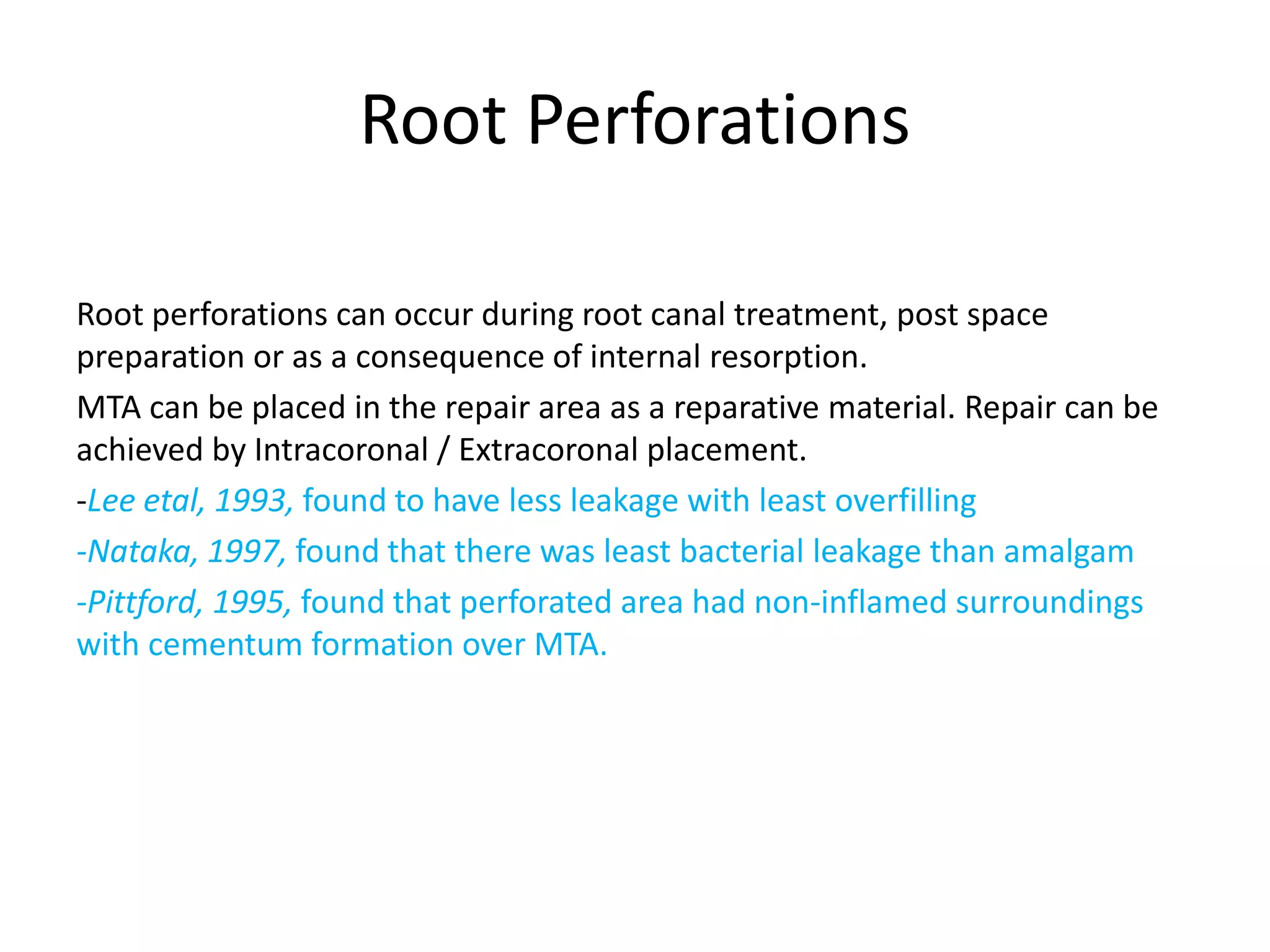
Root perforations can occur during root canal treatment, post space
preparation or as a consequence of internal resorption.
MTA can be placed in the repair area as a reparative material. Repair can be
achieved by Intracoronal / Extracoronal placement.
-Lee etal, 1993, found to have less leakage with least overfilling
-Nataka, 1997, found that there was least bacterial leakage than amalgam
-Pittford, 1995, found that perforated area had non-inflamed surroundings
with cementum formation over MTA.
Furcation Involvement
• No inflammation with no loss of periodontal attachment surrounding
MTA.
• MTA forms cementum and is continuous with cementum and also forms a
hard tissue bridges. MTA extruded into bony defect cementum formed
around excess material and the periodontal ligament has a separated
cementum from bone.
Resorptive Defects
• MTA used for repairing the resorptive defects. There will not be
inflammation surrounding it with continuous cementum formation.
• It forms a hard tissue bridges also with reduced ostoeclastic activity.
Comparision of MTA & Calcium
Hydroxide
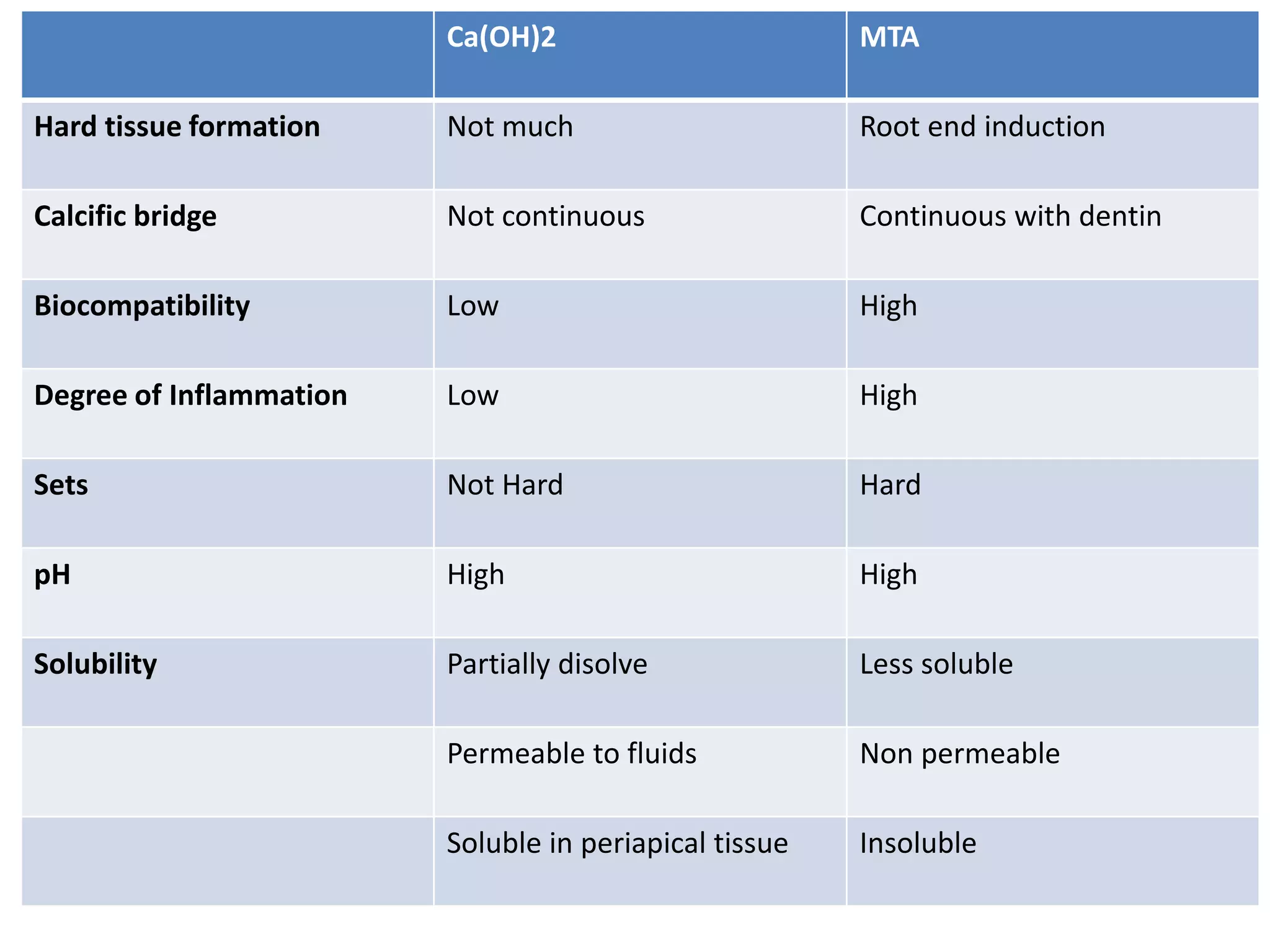
Ca(OH)2 MTA
Hard tissue formation Not much Root end induction
Calcific bridge Not continuous Continuous with dentin
Biocompatibility Low High
Degree of Inflammation Low High
Sets Not Hard Hard
pH High High
Solubility Partially disolve Less soluble
Permeable to fluids Non permeable
Soluble in periapical tissue Insoluble
Viscosity Poor Good
Application Not easy to apply in RC Easy
Resorption Rate vary with density Non-resorbable
Appical barrier formation Change rate/ initial narrow
appical width
Less/wide
Apexification Multiple one
Appical closure Unpredictability Good
Patient follow up More Less
Treatment Delay shortens
MTA is an Insoluble matrix of silica that maintains the integrity even in
contact with water.
MTA is itself apical barrier material with good sealing ability properties and a
high degree of biocompatibility.
MTA has root-end induction capacity by producing an apical hard tissue
formation with significant greater consistency.
MTA is capable of maintaining high pH during a long time and forms an apical
barrier that creates a favorable environment for cell division and matrix
formation.
Its advantages over calcium hydroxide are
 One- visit Apexification.
 Shortens the treatment time.
 Pt’s recall visit is less.
Disadvantages Of Ca(OH)2
• Permeable to fluids
• Soluble in periapical tissues
• Poor viscosity
• Not easy to apply in RC
• Multiple step Apexification with
• Unpredictability of apical closure
• Patients follow up
• Delay in the completion of treatment
Furcation Repair Case Done By
Dr. Sontosh Shrestha
Kantipur Dental College
Dept Of Cons & Endo
Patient Name: Anita Shrestha Regd. No: 44620
Age/Sex: 18yrs/Female Date: 2072/06/10
Ocupation: student
Address: Tokha
Chief Complaint: Patient complaint of dislodged filling on upper right back teeth
region since 4 months.
History Of Present Illness:
Gave H/O RCT on the same teeth 2 yrs back and dislodged since 4 months. No
associated history of pain and sensitivity.
But the associated with BAD SMELL from same region.
Medical History: Nothing Relevant Reported
Dental History: RCT done 2 yrs back
Family History: Nothing Relevant Reported
Personal History:
Brushes 2*daily with fluoridated toothpaste
Extra oral examination:
TMJ :Bilaterally Synchronous movement
Facial Symmetry: bilaterally Symmetrical
Lymph Node: non palpable
Intra oral Examination
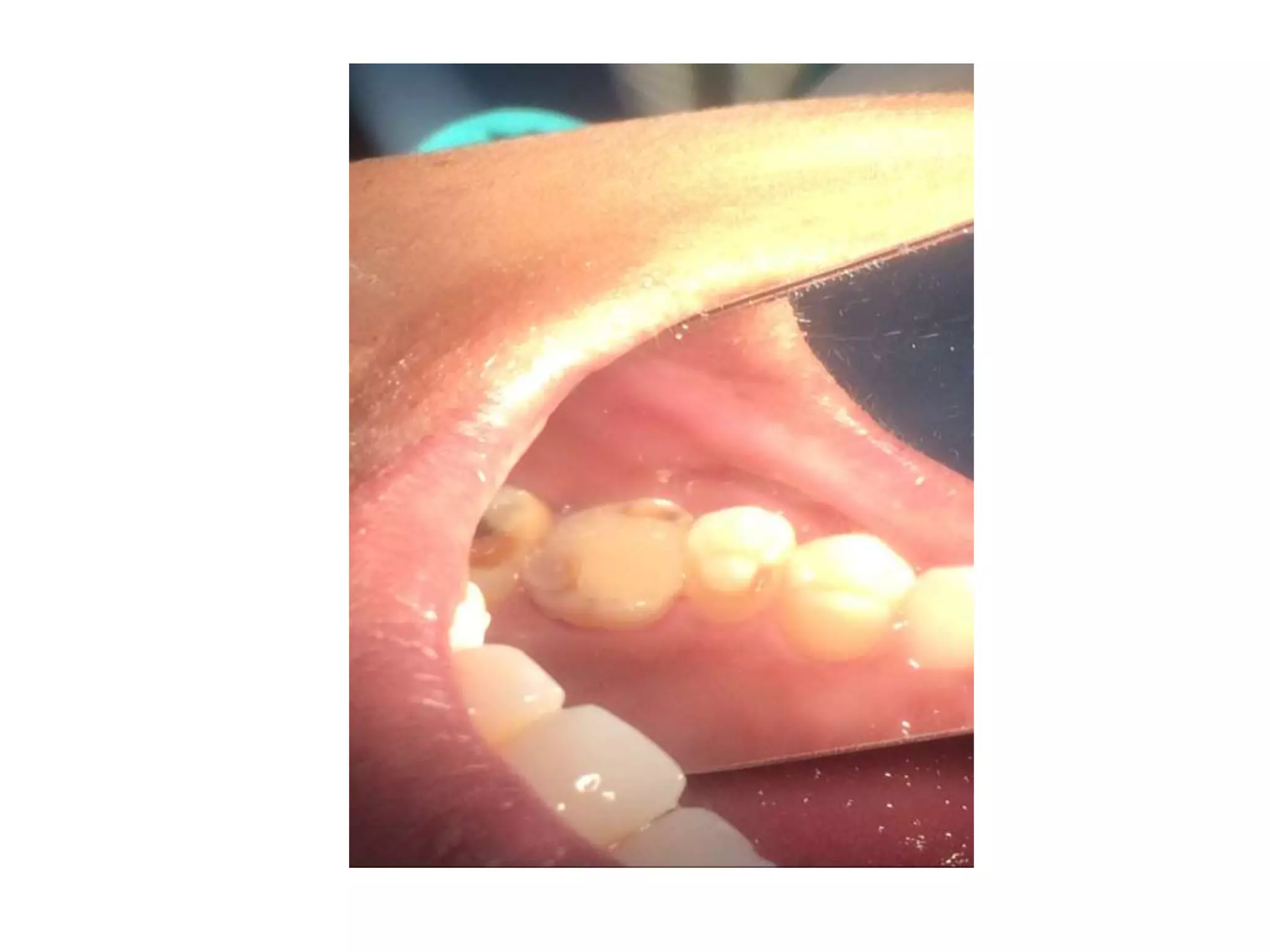
• Decayed wrt: 17, 16, 36, 46
• Grossly Decayed wrt: 26
• Generalised yellowish discoloration wrt upper and lower posterior teeth
Provisional Diagnosis:
• Deep dental caries secondary to dislodged restoration wrt 26
• Dental caries wrt 17, 16, 36, 46
• Chronic generalised gingivitis
• Generalise Enamel Hypoplasia
Investigation:
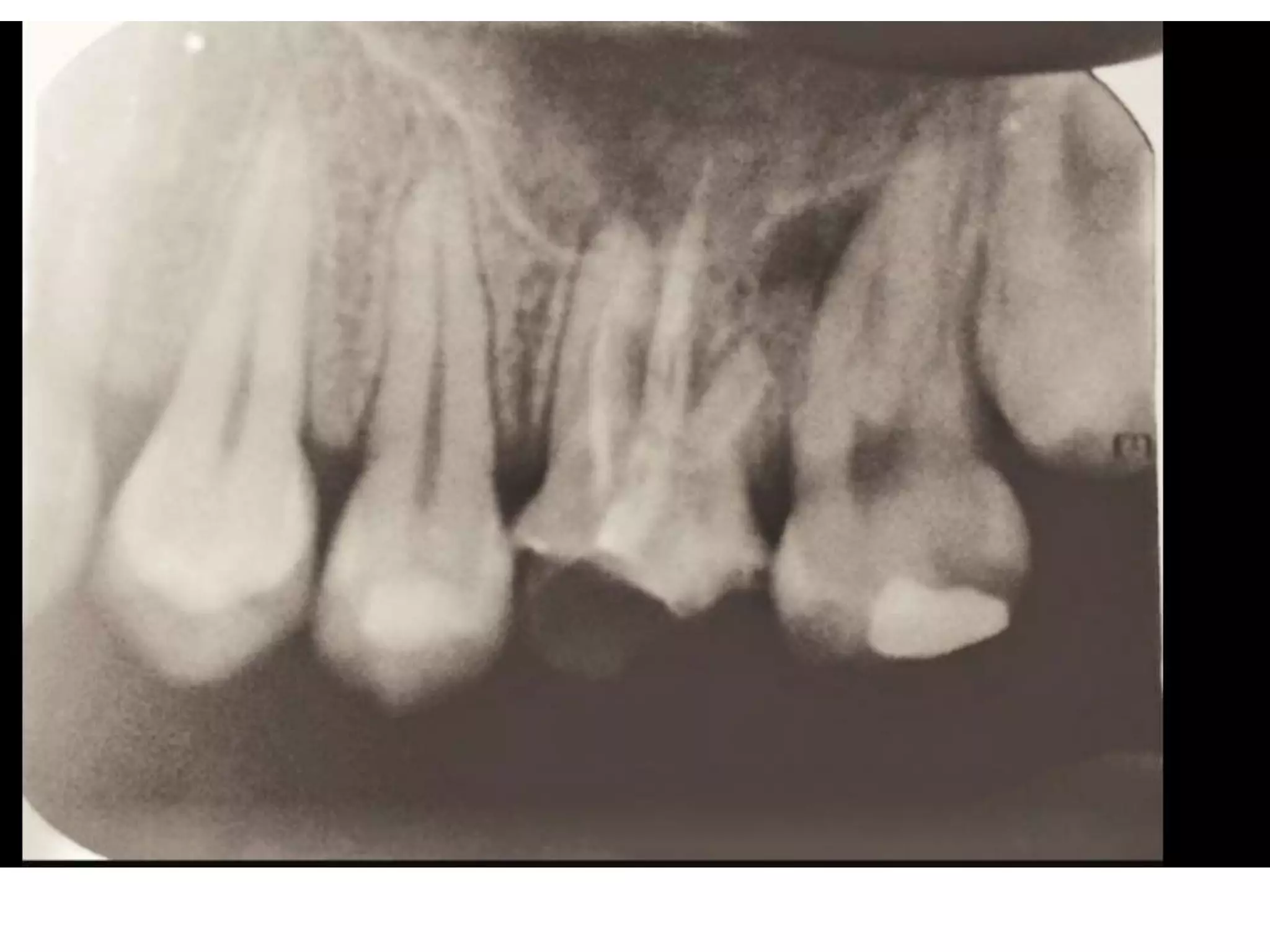
IOPA wrt 26
Reveals loss of coronal portion with coronal and linear radicular radioopacity indicating rootcanal
treated tooth with diffuse periappical radiolucency.
Final Diagnosis:
• Deep dental caries secondary to dislodged restoration wrt 26
Treatment Plan:
• Oral Prophylaxis and oral Hygiene Instructions
• Prefabrication of post on palatal site and composite builup wrt 26
• Restoration wrt :17, 16, 36, 46
BUT
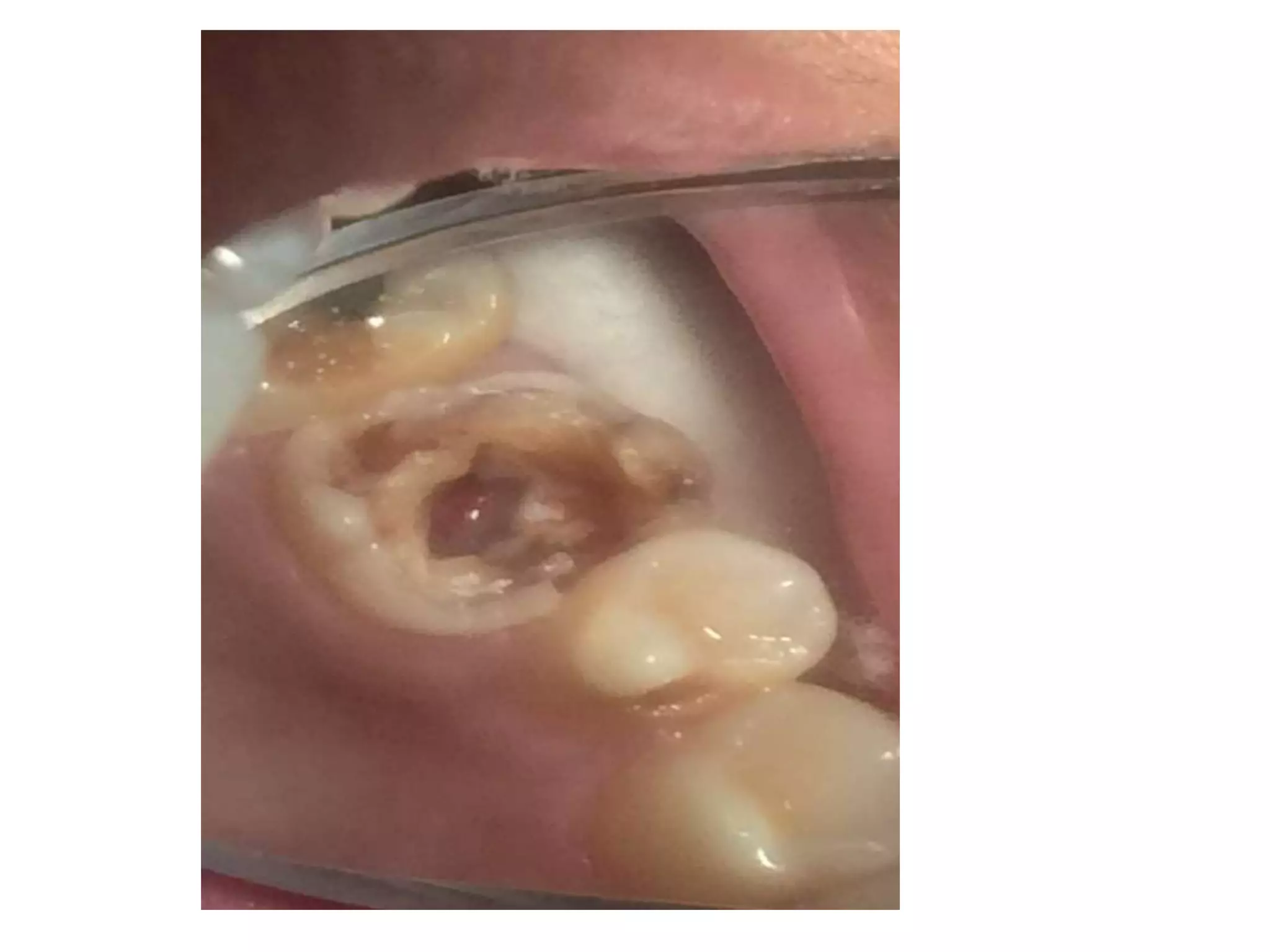
When treatment was started and caries excavation was done PERFORATION
was noted on sub-palatal floor and patient was informed about the
cause of bad smell.
The patient desired extraction of same teeth but was advised to save the teeth
and repair perforation. After getting the CONSENT of patient the furcation
repair was stared by using MINERAL TRIOXIDE AGGREGATE [MTA].
• The pre-operative radiograph was taken and the tooth
was meticulously evaluated.
• The old restoration was removed to rule out secondary
caries.
• Since the tooth was already root canal treated no re-rct
was done.
• The site of perforation was properly irrigated with
normal saline and betadine .
• Once the tooth was prepared the site of perforation
was filled with MTA.
• Then the composite build up was done (light
cure filling)
• The patient was instructed to follow up after 1
month.
Conclusion
• Thanks to Dr Torabinejad for remarkable material for use in endodontics.
• MTA with high biocompatibility, alkalinity, sealing ability provided the best
hermetic seal till DATE.

Mineral trioxide aggregate

  • 1.
    Mineral Trioxide Aggregate [MTA] Dept.of Conservative & Endodontics Kantipur Dental College Chetan Basnet BDS 4th Batch
  • 2.
    CONTENTS • Introduction • Composition •Types – Gray & White • Mixing time • Setting time • Solubility • Biocompatibility • Radiopacity • pH • Physical Properties • Advantages / Disadvantages • Indications / Contra-Indication • Clinical Applications – Direct pulp capping – Apical plug – Root end filling – Root perforations – Furcation involvement – Resorptive defect • Comparison of Ca(OH)2 & MTA • Conclusion • References
  • 3.
    INTRODUCTION Independent analysis suggeststhat the material of Mineral Trioxide Aggregate (MTA) is identical to Portland cement. It is a new remarkable biocompatible material with exciting clinical applications pioneered by Dr. Mahmoud Torabinejad, Loma Linda University, in 1993. Its first description in the dental literature in 1993, by Lee & colleagues, that MTA has been used in both surgical and non – surgical applications, including root end fillings, direct pulp capping, perforation repairs in roots or furcations and Apexification. • In 1998, MTA’s approval by U.S Food and Drug Administration led to widespread use. MTA cement provides a better sealing ability over Amalgam, GIC, IRM, ZOE, and Super EBA. • It’s an ideal material for use against bone for the overgrowth of cementum, formation of bone and facilitates the regeneration of the periodontal ligament fibers.
  • 4.
    Composition Chemical Composition (Sarkar etal – JOE 2005) MTA is a mechanical mixture of 3 powder ingredients: • Portland cement (75%) • Bismuth oxide (20%) • Gypsum (5%) Composition includes : • Tricalcium silicate • Dicalcium silicate • Tricalcium aluminate • Tetracalcium aluminoferrite • Calcium sulfate • Bismuth oxide MTA powder consists of fine hydrophilic particles. Tricalcium silicate, Tricalcium aluminate, Silica oxide and Tricalcium oxide are the major components and few other mineral oxides are responsible for chemical and physical properties of MTA. Bismuth oxide added for radio opacity.
  • 5.
    Types of MTA: Thereare two types of MTA 1. Gray 2. White (Saeed Asgary et al JOE 2005) Grey MTA White MTA FeO -present FeO replaced with MgO FeO- Black MgO-White(Hue matched the color of teeth)
  • 6.
    Mixing MTA  Preparedimmediately before use. Kept always in closed containers or free from moisture. Powder: Water = 3: 1  Glass or paper slab used for mixing with – plastic / metal spatula.  It requires moisture to set. Once the mix is dry sandy form its ready for application.
  • 7.
    Setting Time MTA powderconsists of fine hydrophilic particles. Hydration of MTA powder results in a colloidal gel that solidifies to a hard structure in ~ 4 hrs which has a long setting time. It is generally considered that a potential root end filling material should set as soon as placed in root end cavity without significant shrinkage. This condition would allow the dimensional stability of the material after placement and less time for an unset material to be in contact with vital tissues. In general, quicker a material sets more it shrinks. But MTA has long setting time with less shrinkage
  • 8.
    Solubility Lack of solubilityis an ideal characteristic of MTA as a root end filling material. Despite of some advantages of controlled long term clinical studies, because of its long setting time, the recommended methods of ISO (6) or ADAS # 30 (7), the test solubility of MTA had to be modified.
  • 9.
    Biocompatibility Clinically MTA isa biocompatible material with good sealing ability should generate little or no inflammatory response in periradicular tissues, and encourage the formation of fibrous connective tissue and / or cementum covering the entire root end. • Calcium & Phosphorus are the main ions present in this material, which are the principle components of dental tissues, hence MTA proved to be biocompatible when used in contact with cells and tissues.
  • 10.
    Radio Opacity Bismuth oxideadded for radio opacity and it is more radio opaque than its surrounding structures. Shah et al in 1995 showed that the MTA is less radio opaque than Kalzinol- (7.97) and more radio opaque than GP (6.14), IRM (5.30), Super EBA (5.16), Dentin- (0.70). More radio opaque than GP & dentin are very much distinguishable on radiographs
  • 11.
    pH • MTA hasa high pH of 12.5 similar to calcium hydroxide cement, which prevents the bacterial growth and maintains the long lasting bactericidal potential. • Induction of hard tissue formation / barrier in Apexification procedures and root end filling would minimize the interaction between material and host tissues
  • 12.
    Physical Property Compressive Strengthis an important factor to be considered when a filling material is placed in a cavity that bears occlusal pressure. As a root end filling material do not bear direct pressure, the Compressive strength of this material is not as significant as materials used to repair defects in occlusal surfaces. Compressive strength in 21days ≈70 Mpa. Mechanical wear, an important factor in coronal restoration, MTA is not used as coronal restoration or not placed in functional areas.
  • 13.
    Advantages • Antimicrobial Activity •MicroLeakage • Cementoconductive • Non toxic • Non-mutagenic • Cell adherence & growth • Alkaline phosphotase/ osteocalcin • Interleukin production • Periodontal ligament attachment to cementum growth • Dentinal bridge formation
  • 14.
    Disadvantages • More difficultto manipulate • Longer setting time
  • 15.
    Indications • To preservepulp vitality • Prevent pathological changes in the periradicular tissues • Mechanical pulp exposures • Carious pulp exposures with immature apices.
  • 16.
  • 17.
    Clinical Applications • DirectPulp Capping • Apical plug • Root End Filling • Perforation Repair • Furcation involvment • Resorptive Defects • Immature apices (apexogenesis/ Apexification)
  • 18.
    Direct Pulp Capping •In Exposed pulps, to preserve the pulpal vitality, MTA is used as a pulp capping material. It prevents Bacterial leakage with a high level of biocompatibility. • MTA stimulates dentin bridge formation adjacent to dental pulp. Dentinogenesis of MTA due to its sealing ability, biocompatibility, alkalinity and other properties associated with this material. Dentin bridge formation that promotes healing. It formed a complete barrier at exposure site with free of inflammations. • Reparative dentin formed by MTA does not originate from severely damaged odontoblasts, but from undifferentiated cells that migrated from deep regions of pulp, which replaced the degenerated odontoblasts. Reparative dentin formed is regular and odontoblasts remain intact.
  • 19.
    Root End Filling (Torabinejadet al - 1995 & 1997) MTA has the ability to prevent the irritants in the root canal to extrude into periradicular tissues. There is a less inflammation, with cementum formation and the regeneration of periradicular tissues.
  • 20.
    Apical Plug MTA indicatedfor Necrotic pulps and With open apices. MTA can be used as a material of choice for apical plug and placed 3- 4mm in the apical plug. It creates a hard tissue formation or as an apical plug to prevent the extrusion of filling material during obturation of the canal with open apices.
  • 21.
    Retrograde Filling Jordan in1998 ,MTA was tried as retro grade filling material. It was found that it Inhibits dye penetration with a Good sealing ability. -Nicholson et al: BDJ 2000
  • 22.
    Root Perforations Root perforationscan occur during root canal treatment, post space preparation or as a consequence of internal resorption. MTA can be placed in the repair area as a reparative material. Repair can be achieved by Intracoronal / Extracoronal placement. -Lee etal, 1993, found to have less leakage with least overfilling -Nataka, 1997, found that there was least bacterial leakage than amalgam -Pittford, 1995, found that perforated area had non-inflamed surroundings with cementum formation over MTA.
  • 23.
    Furcation Involvement • Noinflammation with no loss of periodontal attachment surrounding MTA. • MTA forms cementum and is continuous with cementum and also forms a hard tissue bridges. MTA extruded into bony defect cementum formed around excess material and the periodontal ligament has a separated cementum from bone.
  • 24.
    Resorptive Defects • MTAused for repairing the resorptive defects. There will not be inflammation surrounding it with continuous cementum formation. • It forms a hard tissue bridges also with reduced ostoeclastic activity.
  • 25.
    Comparision of MTA& Calcium Hydroxide
  • 26.
    Ca(OH)2 MTA Hard tissueformation Not much Root end induction Calcific bridge Not continuous Continuous with dentin Biocompatibility Low High Degree of Inflammation Low High Sets Not Hard Hard pH High High Solubility Partially disolve Less soluble Permeable to fluids Non permeable Soluble in periapical tissue Insoluble
  • 27.
    Viscosity Poor Good ApplicationNot easy to apply in RC Easy Resorption Rate vary with density Non-resorbable Appical barrier formation Change rate/ initial narrow appical width Less/wide Apexification Multiple one Appical closure Unpredictability Good Patient follow up More Less Treatment Delay shortens
  • 28.
    MTA is anInsoluble matrix of silica that maintains the integrity even in contact with water. MTA is itself apical barrier material with good sealing ability properties and a high degree of biocompatibility. MTA has root-end induction capacity by producing an apical hard tissue formation with significant greater consistency. MTA is capable of maintaining high pH during a long time and forms an apical barrier that creates a favorable environment for cell division and matrix formation. Its advantages over calcium hydroxide are  One- visit Apexification.  Shortens the treatment time.  Pt’s recall visit is less.
  • 29.
    Disadvantages Of Ca(OH)2 •Permeable to fluids • Soluble in periapical tissues • Poor viscosity • Not easy to apply in RC • Multiple step Apexification with • Unpredictability of apical closure • Patients follow up • Delay in the completion of treatment
  • 30.
    Furcation Repair CaseDone By Dr. Sontosh Shrestha Kantipur Dental College Dept Of Cons & Endo
  • 31.
    Patient Name: AnitaShrestha Regd. No: 44620 Age/Sex: 18yrs/Female Date: 2072/06/10 Ocupation: student Address: Tokha Chief Complaint: Patient complaint of dislodged filling on upper right back teeth region since 4 months. History Of Present Illness: Gave H/O RCT on the same teeth 2 yrs back and dislodged since 4 months. No associated history of pain and sensitivity. But the associated with BAD SMELL from same region. Medical History: Nothing Relevant Reported
  • 32.
    Dental History: RCTdone 2 yrs back Family History: Nothing Relevant Reported Personal History: Brushes 2*daily with fluoridated toothpaste Extra oral examination: TMJ :Bilaterally Synchronous movement Facial Symmetry: bilaterally Symmetrical Lymph Node: non palpable
  • 33.
    Intra oral Examination •Decayed wrt: 17, 16, 36, 46 • Grossly Decayed wrt: 26 • Generalised yellowish discoloration wrt upper and lower posterior teeth Provisional Diagnosis: • Deep dental caries secondary to dislodged restoration wrt 26 • Dental caries wrt 17, 16, 36, 46 • Chronic generalised gingivitis • Generalise Enamel Hypoplasia Investigation: IOPA wrt 26 Reveals loss of coronal portion with coronal and linear radicular radioopacity indicating rootcanal treated tooth with diffuse periappical radiolucency. Final Diagnosis: • Deep dental caries secondary to dislodged restoration wrt 26
  • 34.
    Treatment Plan: • OralProphylaxis and oral Hygiene Instructions • Prefabrication of post on palatal site and composite builup wrt 26 • Restoration wrt :17, 16, 36, 46 BUT When treatment was started and caries excavation was done PERFORATION was noted on sub-palatal floor and patient was informed about the cause of bad smell. The patient desired extraction of same teeth but was advised to save the teeth and repair perforation. After getting the CONSENT of patient the furcation repair was stared by using MINERAL TRIOXIDE AGGREGATE [MTA].
  • 36.
    • The pre-operativeradiograph was taken and the tooth was meticulously evaluated. • The old restoration was removed to rule out secondary caries. • Since the tooth was already root canal treated no re-rct was done. • The site of perforation was properly irrigated with normal saline and betadine . • Once the tooth was prepared the site of perforation was filled with MTA.
  • 39.
    • Then thecomposite build up was done (light cure filling) • The patient was instructed to follow up after 1 month.
  • 43.
    Conclusion • Thanks toDr Torabinejad for remarkable material for use in endodontics. • MTA with high biocompatibility, alkalinity, sealing ability provided the best hermetic seal till DATE.