+


Genetic Dilated Cardiomyopathy
                        Melissa Ciampo, Dietetic Intern
                   University of Maryland College Park
        Children’s National Medical Center Case Study
                                          April 5, 2013
+ Outline
  Overview    of Dilated Cardiomyopathy (DCMP)
  Case   Study Background
  Patient Assessment

  PES    Statement
  Plan   and Goals
  Follow-up
+ Dilated Cardiomyopathy
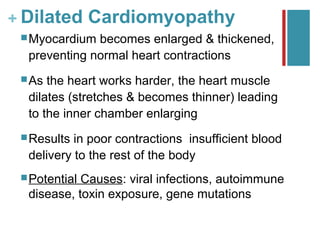
  Myocardium becomes enlarged & thickened,
  preventing normal heart contractions
  As the heart works harder, the heart muscle
  dilates (stretches & becomes thinner) leading
  to the inner chamber enlarging
  Results in poor contractions insufficient blood
  delivery to the rest of the body
  PotentialCauses: viral infections, autoimmune
  disease, toxin exposure, gene mutations
+ Dilated Cardiomyopathy
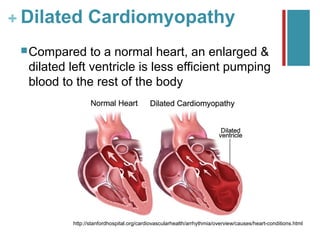
  Compared    to a normal heart, an enlarged &
  dilated left ventricle is less efficient pumping
  blood to the rest of the body


          http://stanfordhospital.org/cardiovascularhealth/arrhythmia/overview/causes/heart-conditions.html
+ Dilated Cardiomyopathy
  Genetically   inherited in ~30 – 48% of cases
  Symptoms: labored breathing, poor appetite,
  slow weight gain, heart failure (severe cases)
  Treatment  Options:
   No single proven surgical technique
   Pacemakers
   Ventricular assist devices: Improved the
    survival rate of adults & children w/end-
    stage DCMP who are awaiting heart
    transplantation
  Prognosis:    9-year survival rate ~69.8%
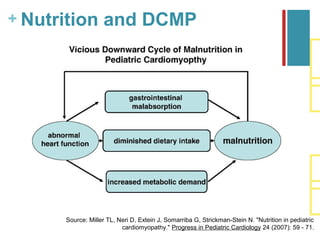
+ Nutrition and DCMP


      Source: Miller TL, Neri D, Extein J, Somarriba G, Strickman-Stein N. "Nutrition in pediatric
                          cardiomyopathy." Progress in Pediatric Cardiology 24 (2007): 59 - 71.
+ Case Study: Background
  Name:    CW; Ex-35 week preemie (twin)
  Gender:   Female
  DOB:    5/4/2012
  Birth
       Weight: 2.06 kg (10th%tile on preemie
  growth chart)
  Twin
      brother with intrauterine growth retardation
  (IUGR), but otherwise healthy
  Diagnosed with Genetic Dilated Cardiomyopathy
  in August 2012
  Genetictesting revealed mutation of TNNI3
  gene (involved in coding for cardiac muscle
  tissue)
+ Case Study: Background
  Hospitalized   at CNMC from July – Sept. 2012
  From  previous admission report patient with
  recurrent food aversions, poor intake, &
  difficulty gaining weight
  On 9/23/12, sent home on Similac Sensitive
  (28 kcal/oz.) 96 ml q 3 hrs
   Notesreport patient consuming ~75% upon
   discharge
+ Case Study: PTA
  Takingsome solid foods, oatmeal and
  pureed baby foods
  CW refusing feeds, in response- parents
  reported decreasing formula concentration
  from 28 kcal/oz to 22 kcal/oz
   Parents   changed formula to Similac Advance
  Eats
      very well for babysitter, but not for
  parents
  Motherfeels that eating has become a very
  negative and stressful event, therefore has
  developed food aversions
+ Case Study: PTA
  Parents   report increased WOB, new post-
  prandial emesis, and continued feeding
  difficulties
  Worried   about poor weight gain
   Twin   sister is ~2-3 pounds heavier
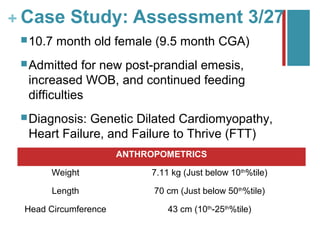
+ Case Study: Assessment 3/27
  10.7   month old female (9.5 month CGA)
  Admitted   for new post-prandial emesis,
  increased WOB, and continued feeding
  difficulties
  Diagnosis:Genetic Dilated Cardiomyopathy,
  Heart Failure, and Failure to Thrive (FTT)
                      ANTHROPOMETRICS

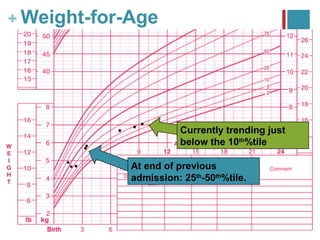
      Weight               7.11 kg (Just below 10th%tile)

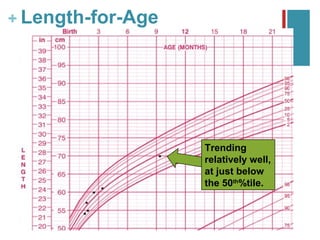
       Length               70 cm (Just below 50th%tile)

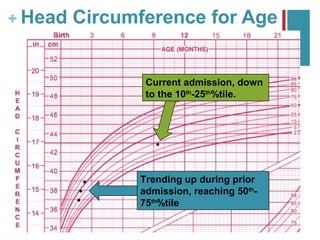
 Head Circumference            43 cm (10th-25th%tile)
+ Case Study: Assessment 3/27
  On3/26, Similac Advance concentrated to
  22 kcal/oz.
  Goal    rate (40ml/hr) reached & tolerating it
  well
 1   emesis- ~60 ml undigested formula
 1   BM
  Weight    is up 10 gm since admission on 3/22
+ Weight-for-Age


                        Currently trending just
                        below the 10th%tile

             At end of previous
             admission: 25th-50th%tile.
+ Length-for-Age


                   Trending
                   relatively well,
                   at just below
                   the 50th%tile.
+ Head Circumference for Age


              Current admission, down
              to the 10th-25th%tile.


             Trending up during prior
             admission, reaching 50th-
             75th%tile
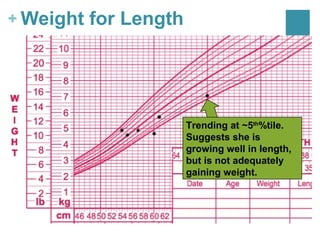
+ Weight for Length


                      Trending at ~5th%tile.
                      Suggests she is
                      growing well in length,
                      but is not adequately
                      gaining weight.
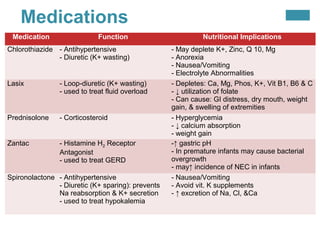
Medications
 Medication                  Function                       Nutritional Implications
Chlorothiazide - Antihypertensive                  - May deplete K+, Zinc, Q 10, Mg
               - Diuretic (K+ wasting)             - Anorexia
                                                   - Nausea/Vomiting
                                                   - Electrolyte Abnormalities
Lasix           - Loop-diuretic (K+ wasting)       - Depletes: Ca, Mg, Phos, K+, Vit B1, B6 & C
                - used to treat fluid overload     - ↓ utilization of folate
                                                   - Can cause: GI distress, dry mouth, weight
                                                   gain, & swelling of extremities
Prednisolone    - Corticosteroid                   - Hyperglycemia
                                                   - ↓ calcium absorption
                                                   - weight gain
Zantac          - Histamine H2 Receptor            -↑ gastric pH
                Antagonist                         - In premature infants may cause bacterial
                - used to treat GERD               overgrowth
                                                   - may↑ incidence of NEC in infants
Spironolactone - Antihypertensive                  - Nausea/Vomiting
               - Diuretic (K+ sparing): prevents   - Avoid vit. K supplements
               Na reabsorption & K+ secretion      - ↑ excretion of Na, Cl, &Ca
               - used to treat hypokalemia
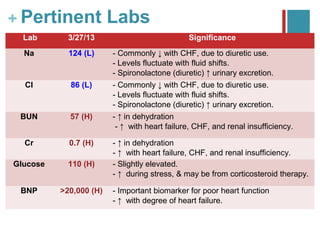
+ Pertinent Labs
  Lab       3/27/13                           Significance
  Na        124 (L)     - Commonly ↓ with CHF, due to diuretic use.
                        - Levels fluctuate with fluid shifts.
                        - Spironolactone (diuretic) ↑ urinary excretion.
  Cl        86 (L)      - Commonly ↓ with CHF, due to diuretic use.
                        - Levels fluctuate with fluid shifts.
                        - Spironolactone (diuretic) ↑ urinary excretion.
 BUN        57 (H)      - ↑ in dehydration
                         - ↑ with heart failure, CHF, and renal insufficiency.

  Cr        0.7 (H)     - ↑ in dehydration
                        - ↑ with heart failure, CHF, and renal insufficiency.
Glucose     110 (H)     - Slightly elevated.
                        - ↑ during stress, & may be from corticosteroid therapy.

 BNP      >20,000 (H)   - Important biomarker for poor heart function
                        - ↑ with degree of heart failure.
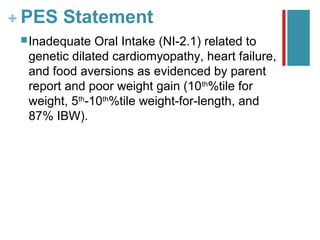
+ PES Statement
  Inadequate  Oral Intake (NI-2.1) related to
  genetic dilated cardiomyopathy, heart failure,
  and food aversions as evidenced by parent
  report and poor weight gain (10th%tile for
  weight, 5th-10th%tile weight-for-length, and
  87% IBW).
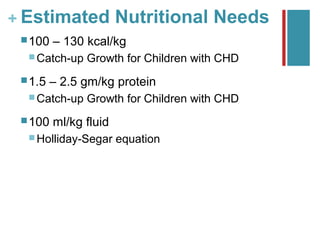
+ Estimated Nutritional Needs
  100   – 130 kcal/kg
   Catch-up   Growth for Children with CHD
  1.5   – 2.5 gm/kg protein
   Catch-up   Growth for Children with CHD
  100   ml/kg fluid
   Holliday-Segar     equation
+ Recommendations
  Increase concentration of   Similac Advance to
     24kcal/oz (goal) & continue @ 40ml/hr. x 24 hrs.
      Will
          provide 135ml/kg fluid, 108kcal/kg, &
      2.16gm/kg protein (meeting 100% estimated
      needs).
    If feeds tolerated x 24 hrs, condense to run over
     20 hrs.
      Similac
             Advance 24kcal/oz @ 48ml/hr x 20 hrs via
      NGT. Can divide 4-hr break into 2 hrs off BID.
+ Recommendations
  Iffeeds are tolerated running over 20 hrs,
   consider condensing to bolus feeds q 3 hrs
    Similac Advance 24kcal/oz, 120 ml q 3 hrs.
    Allow pt to PO trial 20 min before each bolus feed
    NG gavage remaining volume.
    Recommend initially running each bolus feed over
     2 hrs, & condense by 15 min as tolerated to a goal
     of each bolus run over 30 – 60 min.

        By slowly increasing the rate and condensing to
        bolus feeds, it allows enteral nutrition to be more
        physiologic.
+ Recommendations
  Obtain
        weights daily. Goal weight gain is 15 – 25
  gms/day for catch-up growth.
  Measure   HC & length weekly.
  Start
       Poly-vi-sol w/Iron. (Pt is a preemie and
  currently on standard infant formula).
+ Follow-up
  On 3/28 CW was transferred from HKU to CICU for
  Milrinone drip (heart failure medication, she
  responded well to during previous admission).
  Aftertransfer to CICU, pt was visited by sick
  relatives. Pt became ill and TF was stopped for the
  day.
  Until
       she is hemodynamically stable, close
  monitoring of her enteral intake and tolerance will be
  key during assessment at the next follow-up.
+ Follow-up
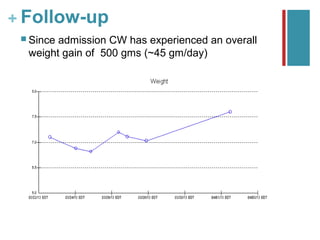
  Sinceadmission CW has experienced an overall
  weight gain of 500 gms (~45 gm/day)
+ References
 Hong, Y. "Cardiomyopathies in Children." The Korean
  Pediatric Society 56.2 (2013): 52 - 59.

 Ku L, Feiger J, Taylor M, Mestroni L. "Familial dilated
  cardiomyopathy. ." Circulation 108 (2003): 118 - 121.

 Miller TL, Neri D, Extein J, Somarriba G, Strickman-Stein
  N. "Nutrition in pediatric cardiomyopathy." Progress in
  Pediatric Cardiology 24 (2007): 59 - 71.

 Pronsky, Zaneta M. and Jeanne P. Crowe. Food
  Medication Interactions. 17th Edition. Birchrunville: Food
  Medication Interactions, 2012.

 Towbin JA, Lowe AM, Colan SD, et al. "Incidence, Causes,
  and Outcomes of Dilated Cardiomyopathy in Children ."
  JAMA 296.15 (2006): 1867 - 1876.
+ Any Questions?

Case Study: Genetic Dilated Cardiomyopathy

  • 1.
    + Genetic Dilated Cardiomyopathy Melissa Ciampo, Dietetic Intern University of Maryland College Park Children’s National Medical Center Case Study April 5, 2013
  • 2.
    + Outline Overview of Dilated Cardiomyopathy (DCMP)  Case Study Background  Patient Assessment  PES Statement  Plan and Goals  Follow-up
  • 3.
    + Dilated Cardiomyopathy  Myocardium becomes enlarged & thickened, preventing normal heart contractions  As the heart works harder, the heart muscle dilates (stretches & becomes thinner) leading to the inner chamber enlarging  Results in poor contractions insufficient blood delivery to the rest of the body  PotentialCauses: viral infections, autoimmune disease, toxin exposure, gene mutations
  • 4.
    + Dilated Cardiomyopathy  Compared to a normal heart, an enlarged & dilated left ventricle is less efficient pumping blood to the rest of the body http://stanfordhospital.org/cardiovascularhealth/arrhythmia/overview/causes/heart-conditions.html
  • 5.
    + Dilated Cardiomyopathy  Genetically inherited in ~30 – 48% of cases  Symptoms: labored breathing, poor appetite, slow weight gain, heart failure (severe cases)  Treatment Options:  No single proven surgical technique  Pacemakers  Ventricular assist devices: Improved the survival rate of adults & children w/end- stage DCMP who are awaiting heart transplantation  Prognosis: 9-year survival rate ~69.8%
  • 6.
    + Nutrition andDCMP Source: Miller TL, Neri D, Extein J, Somarriba G, Strickman-Stein N. "Nutrition in pediatric cardiomyopathy." Progress in Pediatric Cardiology 24 (2007): 59 - 71.
  • 7.
    + Case Study:Background  Name: CW; Ex-35 week preemie (twin)  Gender: Female  DOB: 5/4/2012  Birth Weight: 2.06 kg (10th%tile on preemie growth chart)  Twin brother with intrauterine growth retardation (IUGR), but otherwise healthy  Diagnosed with Genetic Dilated Cardiomyopathy in August 2012  Genetictesting revealed mutation of TNNI3 gene (involved in coding for cardiac muscle tissue)
  • 8.
    + Case Study:Background  Hospitalized at CNMC from July – Sept. 2012  From previous admission report patient with recurrent food aversions, poor intake, & difficulty gaining weight  On 9/23/12, sent home on Similac Sensitive (28 kcal/oz.) 96 ml q 3 hrs  Notesreport patient consuming ~75% upon discharge
  • 9.
    + Case Study:PTA  Takingsome solid foods, oatmeal and pureed baby foods  CW refusing feeds, in response- parents reported decreasing formula concentration from 28 kcal/oz to 22 kcal/oz  Parents changed formula to Similac Advance  Eats very well for babysitter, but not for parents  Motherfeels that eating has become a very negative and stressful event, therefore has developed food aversions
  • 10.
    + Case Study:PTA  Parents report increased WOB, new post- prandial emesis, and continued feeding difficulties  Worried about poor weight gain  Twin sister is ~2-3 pounds heavier
  • 11.
    + Case Study:Assessment 3/27  10.7 month old female (9.5 month CGA)  Admitted for new post-prandial emesis, increased WOB, and continued feeding difficulties  Diagnosis:Genetic Dilated Cardiomyopathy, Heart Failure, and Failure to Thrive (FTT) ANTHROPOMETRICS Weight 7.11 kg (Just below 10th%tile) Length 70 cm (Just below 50th%tile) Head Circumference 43 cm (10th-25th%tile)
  • 12.
    + Case Study:Assessment 3/27  On3/26, Similac Advance concentrated to 22 kcal/oz.  Goal rate (40ml/hr) reached & tolerating it well 1 emesis- ~60 ml undigested formula 1 BM  Weight is up 10 gm since admission on 3/22
  • 13.
    + Weight-for-Age Currently trending just below the 10th%tile At end of previous admission: 25th-50th%tile.
  • 14.
    + Length-for-Age Trending relatively well, at just below the 50th%tile.
  • 15.
    + Head Circumferencefor Age Current admission, down to the 10th-25th%tile. Trending up during prior admission, reaching 50th- 75th%tile
  • 16.
    + Weight forLength Trending at ~5th%tile. Suggests she is growing well in length, but is not adequately gaining weight.
  • 17.
    Medications Medication Function Nutritional Implications Chlorothiazide - Antihypertensive - May deplete K+, Zinc, Q 10, Mg - Diuretic (K+ wasting) - Anorexia - Nausea/Vomiting - Electrolyte Abnormalities Lasix - Loop-diuretic (K+ wasting) - Depletes: Ca, Mg, Phos, K+, Vit B1, B6 & C - used to treat fluid overload - ↓ utilization of folate - Can cause: GI distress, dry mouth, weight gain, & swelling of extremities Prednisolone - Corticosteroid - Hyperglycemia - ↓ calcium absorption - weight gain Zantac - Histamine H2 Receptor -↑ gastric pH Antagonist - In premature infants may cause bacterial - used to treat GERD overgrowth - may↑ incidence of NEC in infants Spironolactone - Antihypertensive - Nausea/Vomiting - Diuretic (K+ sparing): prevents - Avoid vit. K supplements Na reabsorption & K+ secretion - ↑ excretion of Na, Cl, &Ca - used to treat hypokalemia
  • 18.
    + Pertinent Labs Lab 3/27/13 Significance Na 124 (L) - Commonly ↓ with CHF, due to diuretic use. - Levels fluctuate with fluid shifts. - Spironolactone (diuretic) ↑ urinary excretion. Cl 86 (L) - Commonly ↓ with CHF, due to diuretic use. - Levels fluctuate with fluid shifts. - Spironolactone (diuretic) ↑ urinary excretion. BUN 57 (H) - ↑ in dehydration - ↑ with heart failure, CHF, and renal insufficiency. Cr 0.7 (H) - ↑ in dehydration - ↑ with heart failure, CHF, and renal insufficiency. Glucose 110 (H) - Slightly elevated. - ↑ during stress, & may be from corticosteroid therapy. BNP >20,000 (H) - Important biomarker for poor heart function - ↑ with degree of heart failure.
  • 19.
    + PES Statement  Inadequate Oral Intake (NI-2.1) related to genetic dilated cardiomyopathy, heart failure, and food aversions as evidenced by parent report and poor weight gain (10th%tile for weight, 5th-10th%tile weight-for-length, and 87% IBW).
  • 20.
    + Estimated NutritionalNeeds  100 – 130 kcal/kg  Catch-up Growth for Children with CHD  1.5 – 2.5 gm/kg protein  Catch-up Growth for Children with CHD  100 ml/kg fluid  Holliday-Segar equation
  • 21.
    + Recommendations Increase concentration of Similac Advance to 24kcal/oz (goal) & continue @ 40ml/hr. x 24 hrs.  Will provide 135ml/kg fluid, 108kcal/kg, & 2.16gm/kg protein (meeting 100% estimated needs).  If feeds tolerated x 24 hrs, condense to run over 20 hrs.  Similac Advance 24kcal/oz @ 48ml/hr x 20 hrs via NGT. Can divide 4-hr break into 2 hrs off BID.
  • 22.
    + Recommendations Iffeeds are tolerated running over 20 hrs, consider condensing to bolus feeds q 3 hrs  Similac Advance 24kcal/oz, 120 ml q 3 hrs.  Allow pt to PO trial 20 min before each bolus feed  NG gavage remaining volume.  Recommend initially running each bolus feed over 2 hrs, & condense by 15 min as tolerated to a goal of each bolus run over 30 – 60 min. By slowly increasing the rate and condensing to bolus feeds, it allows enteral nutrition to be more physiologic.
  • 23.
    + Recommendations Obtain weights daily. Goal weight gain is 15 – 25 gms/day for catch-up growth.  Measure HC & length weekly.  Start Poly-vi-sol w/Iron. (Pt is a preemie and currently on standard infant formula).
  • 24.
    + Follow-up On 3/28 CW was transferred from HKU to CICU for Milrinone drip (heart failure medication, she responded well to during previous admission).  Aftertransfer to CICU, pt was visited by sick relatives. Pt became ill and TF was stopped for the day.  Until she is hemodynamically stable, close monitoring of her enteral intake and tolerance will be key during assessment at the next follow-up.
  • 25.
    + Follow-up Sinceadmission CW has experienced an overall weight gain of 500 gms (~45 gm/day)
  • 26.
    + References Hong,Y. "Cardiomyopathies in Children." The Korean Pediatric Society 56.2 (2013): 52 - 59. Ku L, Feiger J, Taylor M, Mestroni L. "Familial dilated cardiomyopathy. ." Circulation 108 (2003): 118 - 121. Miller TL, Neri D, Extein J, Somarriba G, Strickman-Stein N. "Nutrition in pediatric cardiomyopathy." Progress in Pediatric Cardiology 24 (2007): 59 - 71. Pronsky, Zaneta M. and Jeanne P. Crowe. Food Medication Interactions. 17th Edition. Birchrunville: Food Medication Interactions, 2012. Towbin JA, Lowe AM, Colan SD, et al. "Incidence, Causes, and Outcomes of Dilated Cardiomyopathy in Children ." JAMA 296.15 (2006): 1867 - 1876.
  • 27.

Editor's Notes

  • #6 According to the Korean Journal of Pediatrics, “use of ventricular assist devices has been shown to significantly improve the survival of adults and children with end-stage DCMP who are awaiting heart transplantation”