          


      Mary Rodavich
WVU Graduate Dietetic Intern
       Sept 2012
   Overview of patient
   What is Cystic Fibrosis (CF)?
   What is CFRD?
   Medical Nutrition Therapy for CF
   Nutrition Assessment of Patient
    o Nutrition Diagnosis
    o Nutrition Prescription
    o Nutrition Intervention
    o Monitoring/Evaluation


                                       2
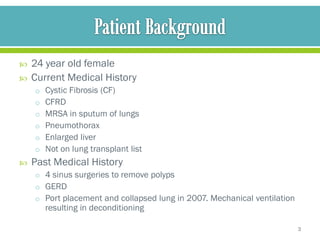
   24 year old female
   Current Medical History
    o Cystic Fibrosis (CF)
    o CFRD
    o MRSA in sputum of lungs
    o Pneumothorax
    o Enlarged liver
    o Not on lung transplant list
   Past Medical History
    o 4 sinus surgeries to remove polyps
    o GERD
    o Port placement and collapsed lung in 2007. Mechanical ventilation
       resulting in deconditioning

                                                                          3
   4   
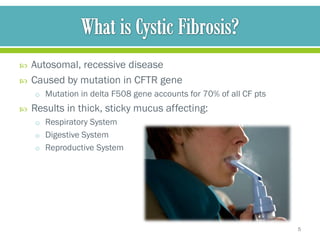
   Autosomal, recessive disease
   Caused by mutation in CFTR gene
    o Mutation in delta F508 gene accounts for 70% of all CF pts
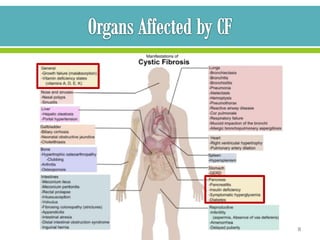
   Results in thick, sticky mucus affecting:
    o Respiratory System
    o Digestive System
    o Reproductive System


                                                                   5
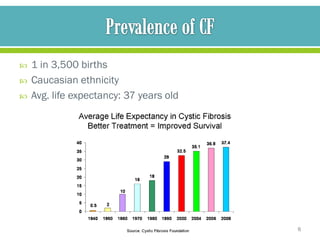
   1 in 3,500 births
   Caucasian ethnicity
   Avg. life expectancy: 37 years old


                                         6
7
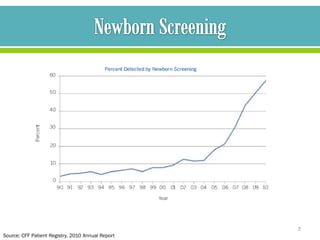
Source: CFF Patient Registry, 2010 Annual Report
8
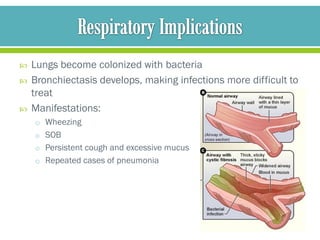
   Lungs become colonized with bacteria
   Bronchiectasis develops, making infections more difficult to
    treat
   Manifestations:
    o Wheezing
    o SOB
    o Persistent cough and excessive mucus
    o Repeated cases of pneumonia


                                                               9
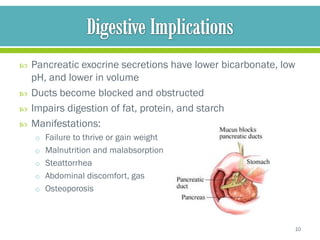
   Pancreatic exocrine secretions have lower bicarbonate, low
    pH, and lower in volume
   Ducts become blocked and obstructed
   Impairs digestion of fat, protein, and starch
   Manifestations:
    o Failure to thrive or gain weight
    o Malnutrition and malabsorption
    o Steattorrhea
    o Abdominal discomfort, gas
    o Osteoporosis


                                                             10
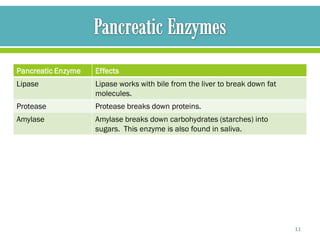
Pancreatic Enzyme   Effects
Lipase              Lipase works with bile from the liver to break down fat
                    molecules.
Protease            Protease breaks down proteins.
Amylase             Amylase breaks down carbohydrates (starches) into
                    sugars. This enzyme is also found in saliva.


                                                                              11
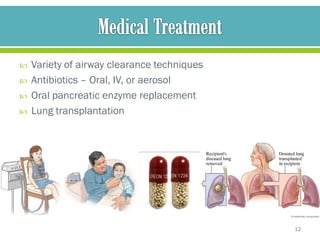
   Variety of airway clearance techniques
   Antibiotics – Oral, IV, or aerosol
   Oral pancreatic enzyme replacement
   Lung transplantation


                                             12
   13   
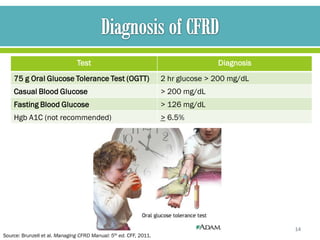
Test                                                   Diagnosis
    75 g Oral Glucose Tolerance Test (OGTT)                            2 hr glucose > 200 mg/dL
    Casual Blood Glucose                                               > 200 mg/dL
    Fasting Blood Glucose                                              > 126 mg/dL
    Hgb A1C (not recommended)                                          > 6.5%


                                                                                                  14
Source: Brunzell et al. Managing CFRD Manual:   5th   ed. CFF, 2011.
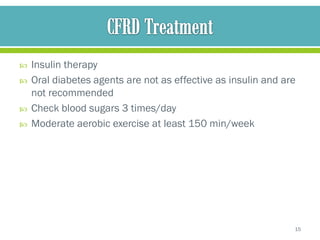
   Insulin therapy
   Oral diabetes agents are not as effective as insulin and are
    not recommended
   Check blood sugars 3 times/day
   Moderate aerobic exercise at least 150 min/week


                                                               15
16
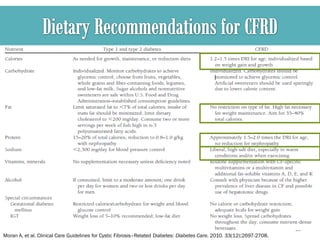
Moran A, et al. Clinical Care Guidelines for Cystic Fibrosis–Related Diabetes: Diabetes Care. 2010. 33(12);2697-2708.
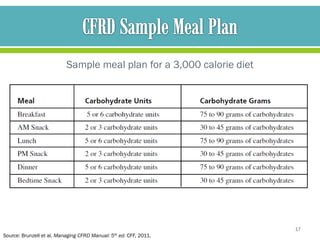
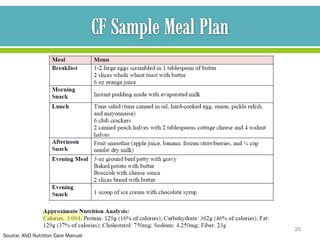
Sample meal plan for a 3,000 calorie diet


                                                                       17
Source: Brunzell et al. Managing CFRD Manual:   5th   ed. CFF, 2011.
   18   
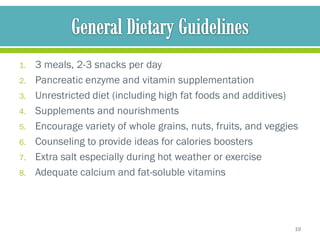
1.   3 meals, 2-3 snacks per day
2.   Pancreatic enzyme and vitamin supplementation
3.   Unrestricted diet (including high fat foods and additives)
4.   Supplements and nourishments
5.   Encourage variety of whole grains, nuts, fruits, and veggies
6.   Counseling to provide ideas for calories boosters
7.   Extra salt especially during hot weather or exercise
8.   Adequate calcium and fat-soluble vitamins


                                                                19
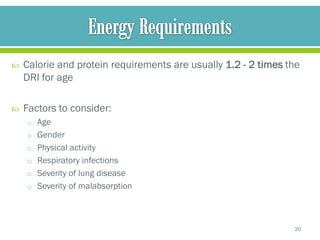
   Calorie and protein requirements are usually 1.2 - 2 times the
    DRI for age

   Factors to consider:
    o Age
    o Gender
    o Physical activity
    o Respiratory infections
    o Severity of lung disease
    o Severity of malabsorption


                                                                20
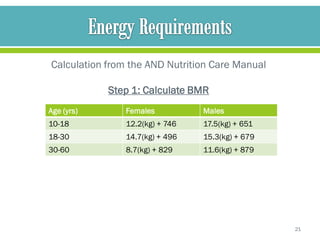
Calculation from the AND Nutrition Care Manual

            Step 1: Calculate BMR
Age (yrs)      Females          Males
10-18          12.2(kg) + 746   17.5(kg) + 651
18-30          14.7(kg) + 496   15.3(kg) + 679
30-60          8.7(kg) + 829    11.6(kg) + 879


                                                 21
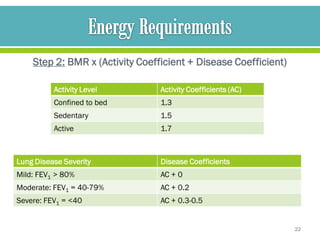
Step 2: BMR x (Activity Coefficient + Disease Coefficient)

          Activity Level         Activity Coefficients (AC)
          Confined to bed        1.3
          Sedentary              1.5
          Active                 1.7


Lung Disease Severity            Disease Coefficients
Mild: FEV1 > 80%                 AC + 0
Moderate: FEV1 = 40-79%          AC + 0.2
Severe: FEV1 = <40               AC + 0.3-0.5


                                                                 22
Step 3: Calculate Daily Energy Expenditure,
              taking into account the degree of steatorrhea

•   For pancreatic sufficient pts (including pts w/ a coefficient of fat
    absorption [CFA] >93%)
     • Daily energy requirement equals the daily energy expenditure
•   For pancreatic insufficient pts
     • Daily energy requirement equals the daily energy expenditure
        time 0.93/CFA


                                                                     23
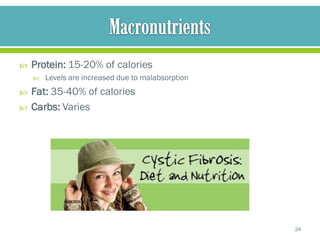
   Protein: 15-20% of calories
       Levels are increased due to malabsorption
   Fat: 35-40% of calories
   Carbs: Varies


                                                    24
25
Source: AND Nutrition Care Manual
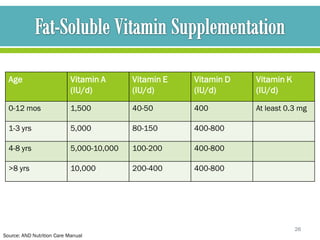
Age                       Vitamin A      Vitamin E   Vitamin D   Vitamin K
                            (IU/d)         (IU/d)      (IU/d)      (IU/d)

  0-12 mos                  1,500          40-50       400         At least 0.3 mg

  1-3 yrs                   5,000          80-150      400-800

  4-8 yrs                   5,000-10,000   100-200     400-800

  >8 yrs                    10,000         200-400     400-800


                                                                               26
Source: AND Nutrition Care Manual
    If initial nutrition interventions are not effective and
           BMI<19, consider enteral feedings
          Can be NG tube, G-tube, or J-tube
             o Usually nocturnal feedings
          Caloric-dense formulas, greater than 1 kcal/mL
          Enzyme replacement:
             o If nocturnal feedings – enzymes taken orally before feeding and
               once or twice during the night
             o Enzyme powder can also be added directly to the formula


                                                                                 27
Sources: AND Nutr. Care Manual, Krause’s Food & Nutr. Therapy
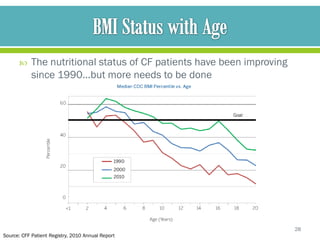
     The nutritional status of CF patients have been improving
            since 1990…but more needs to be done


                                                                        28
Source: CFF Patient Registry, 2010 Annual Report
   29   
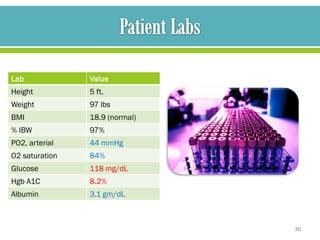
Lab             Value
Height          5 ft.
Weight          97 lbs
BMI             18.9 (normal)
% IBW           97%
PO2, arterial   44 mmHg
O2 saturation   84%
Glucose         118 mg/dL
Hgb A1C         8.2%
Albumin         3.1 gm/dL


                                30
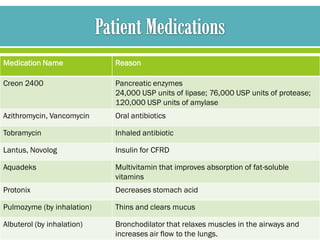
Medication Name             Reason

Creon 2400                  Pancreatic enzymes
                            24,000 USP units of lipase; 76,000 USP units of protease;
                            120,000 USP units of amylase
Azithromycin, Vancomycin    Oral antibiotics

Tobramycin                  Inhaled antibiotic

Lantus, Novolog             Insulin for CFRD

Aquadeks                    Multivitamin that improves absorption of fat-soluble
                            vitamins
Protonix                    Decreases stomach acid

Pulmozyme (by inhalation)   Thins and clears mucus

Albuterol (by inhalation)   Bronchodilator that relaxes muscles in the airways and
                                                                                 31
                            increases air flow to the lungs.
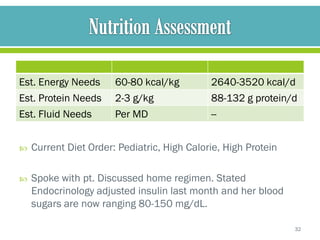
Est. Energy Needs      60-80 kcal/kg         2640-3520 kcal/d
Est. Protein Needs     2-3 g/kg              88-132 g protein/d
Est. Fluid Needs       Per MD                --


   Current Diet Order: Pediatric, High Calorie, High Protein

   Spoke with pt. Discussed home regimen. Stated
    Endocrinology adjusted insulin last month and her blood
    sugars are now ranging 80-150 mg/dL.

                                                                32
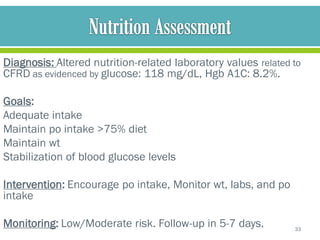
Diagnosis: Altered nutrition-related laboratory values related to
CFRD as evidenced by glucose: 118 mg/dL, Hgb A1C: 8.2%.

Goals:
Adequate intake
Maintain po intake >75% diet
Maintain wt
Stabilization of blood glucose levels

Intervention: Encourage po intake, Monitor wt, labs, and po
intake

Monitoring: Low/Moderate risk. Follow-up in 5-7 days.          33
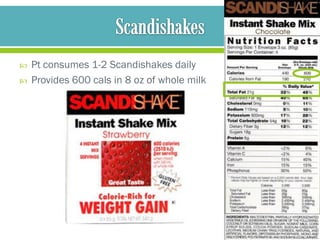
   Pt consumes 1-2 Scandishakes daily
   Provides 600 cals in 8 oz of whole milk


                                              34
35
   AND Nutrition Care Manual
   Cystic Fibrosis Foundation: www.cff.org
   Mahan LK, Escott-Stump S. Krause’s Food and Nutrition Therapy: 12th
    ed. 2008.
   Brunzell C, Hardin DA, Moran A, Schindler T. Managing CFRD Manual,
    An Instruction Guide for Patients and Families: 5th ed. CFF, 2011.
   Moran A, et al. Clinical Care Guidelines for Cystic Fibrosis–Related
    Diabetes: A position statement of the American Diabetes Association
    and a clinical practice guideline of the Cystic Fibrosis Foundation,
    endorsed by the Pediatric Endocrine Society. Diabetes Care. Dec 2010.
    33(12);2697-2708.


                                                                        36

Cystic Fibrosis Nutritional Case Study Presentation

  • 1.
     Mary Rodavich WVU Graduate Dietetic Intern Sept 2012
  • 2.
    Overview of patient  What is Cystic Fibrosis (CF)?  What is CFRD?  Medical Nutrition Therapy for CF  Nutrition Assessment of Patient o Nutrition Diagnosis o Nutrition Prescription o Nutrition Intervention o Monitoring/Evaluation 2
  • 3.
    24 year old female  Current Medical History o Cystic Fibrosis (CF) o CFRD o MRSA in sputum of lungs o Pneumothorax o Enlarged liver o Not on lung transplant list  Past Medical History o 4 sinus surgeries to remove polyps o GERD o Port placement and collapsed lung in 2007. Mechanical ventilation resulting in deconditioning 3
  • 4.
    4 
  • 5.
    Autosomal, recessive disease  Caused by mutation in CFTR gene o Mutation in delta F508 gene accounts for 70% of all CF pts  Results in thick, sticky mucus affecting: o Respiratory System o Digestive System o Reproductive System 5
  • 6.
    1 in 3,500 births  Caucasian ethnicity  Avg. life expectancy: 37 years old 6
  • 7.
    7 Source: CFF PatientRegistry, 2010 Annual Report
  • 8.
  • 9.
    Lungs become colonized with bacteria  Bronchiectasis develops, making infections more difficult to treat  Manifestations: o Wheezing o SOB o Persistent cough and excessive mucus o Repeated cases of pneumonia 9
  • 10.
    Pancreatic exocrine secretions have lower bicarbonate, low pH, and lower in volume  Ducts become blocked and obstructed  Impairs digestion of fat, protein, and starch  Manifestations: o Failure to thrive or gain weight o Malnutrition and malabsorption o Steattorrhea o Abdominal discomfort, gas o Osteoporosis 10
  • 11.
    Pancreatic Enzyme Effects Lipase Lipase works with bile from the liver to break down fat molecules. Protease Protease breaks down proteins. Amylase Amylase breaks down carbohydrates (starches) into sugars. This enzyme is also found in saliva. 11
  • 12.
    Variety of airway clearance techniques  Antibiotics – Oral, IV, or aerosol  Oral pancreatic enzyme replacement  Lung transplantation 12
  • 13.
    13 
  • 14.
    Test Diagnosis 75 g Oral Glucose Tolerance Test (OGTT) 2 hr glucose > 200 mg/dL Casual Blood Glucose > 200 mg/dL Fasting Blood Glucose > 126 mg/dL Hgb A1C (not recommended) > 6.5% 14 Source: Brunzell et al. Managing CFRD Manual: 5th ed. CFF, 2011.
  • 15.
    Insulin therapy  Oral diabetes agents are not as effective as insulin and are not recommended  Check blood sugars 3 times/day  Moderate aerobic exercise at least 150 min/week 15
  • 16.
    16 Moran A, etal. Clinical Care Guidelines for Cystic Fibrosis–Related Diabetes: Diabetes Care. 2010. 33(12);2697-2708.
  • 17.
    Sample meal planfor a 3,000 calorie diet 17 Source: Brunzell et al. Managing CFRD Manual: 5th ed. CFF, 2011.
  • 18.
    18 
  • 19.
    1. 3 meals, 2-3 snacks per day 2. Pancreatic enzyme and vitamin supplementation 3. Unrestricted diet (including high fat foods and additives) 4. Supplements and nourishments 5. Encourage variety of whole grains, nuts, fruits, and veggies 6. Counseling to provide ideas for calories boosters 7. Extra salt especially during hot weather or exercise 8. Adequate calcium and fat-soluble vitamins 19
  • 20.
    Calorie and protein requirements are usually 1.2 - 2 times the DRI for age  Factors to consider: o Age o Gender o Physical activity o Respiratory infections o Severity of lung disease o Severity of malabsorption 20
  • 21.
    Calculation from theAND Nutrition Care Manual Step 1: Calculate BMR Age (yrs) Females Males 10-18 12.2(kg) + 746 17.5(kg) + 651 18-30 14.7(kg) + 496 15.3(kg) + 679 30-60 8.7(kg) + 829 11.6(kg) + 879 21
  • 22.
    Step 2: BMRx (Activity Coefficient + Disease Coefficient) Activity Level Activity Coefficients (AC) Confined to bed 1.3 Sedentary 1.5 Active 1.7 Lung Disease Severity Disease Coefficients Mild: FEV1 > 80% AC + 0 Moderate: FEV1 = 40-79% AC + 0.2 Severe: FEV1 = <40 AC + 0.3-0.5 22
  • 23.
    Step 3: CalculateDaily Energy Expenditure, taking into account the degree of steatorrhea • For pancreatic sufficient pts (including pts w/ a coefficient of fat absorption [CFA] >93%) • Daily energy requirement equals the daily energy expenditure • For pancreatic insufficient pts • Daily energy requirement equals the daily energy expenditure time 0.93/CFA 23
  • 24.
    Protein: 15-20% of calories  Levels are increased due to malabsorption  Fat: 35-40% of calories  Carbs: Varies 24
  • 25.
  • 26.
    Age Vitamin A Vitamin E Vitamin D Vitamin K (IU/d) (IU/d) (IU/d) (IU/d) 0-12 mos 1,500 40-50 400 At least 0.3 mg 1-3 yrs 5,000 80-150 400-800 4-8 yrs 5,000-10,000 100-200 400-800 >8 yrs 10,000 200-400 400-800 26 Source: AND Nutrition Care Manual
  • 27.
    If initial nutrition interventions are not effective and BMI<19, consider enteral feedings  Can be NG tube, G-tube, or J-tube o Usually nocturnal feedings  Caloric-dense formulas, greater than 1 kcal/mL  Enzyme replacement: o If nocturnal feedings – enzymes taken orally before feeding and once or twice during the night o Enzyme powder can also be added directly to the formula 27 Sources: AND Nutr. Care Manual, Krause’s Food & Nutr. Therapy
  • 28.
    The nutritional status of CF patients have been improving since 1990…but more needs to be done 28 Source: CFF Patient Registry, 2010 Annual Report
  • 29.
    29 
  • 30.
    Lab Value Height 5 ft. Weight 97 lbs BMI 18.9 (normal) % IBW 97% PO2, arterial 44 mmHg O2 saturation 84% Glucose 118 mg/dL Hgb A1C 8.2% Albumin 3.1 gm/dL 30
  • 31.
    Medication Name Reason Creon 2400 Pancreatic enzymes 24,000 USP units of lipase; 76,000 USP units of protease; 120,000 USP units of amylase Azithromycin, Vancomycin Oral antibiotics Tobramycin Inhaled antibiotic Lantus, Novolog Insulin for CFRD Aquadeks Multivitamin that improves absorption of fat-soluble vitamins Protonix Decreases stomach acid Pulmozyme (by inhalation) Thins and clears mucus Albuterol (by inhalation) Bronchodilator that relaxes muscles in the airways and 31 increases air flow to the lungs.
  • 32.
    Est. Energy Needs 60-80 kcal/kg 2640-3520 kcal/d Est. Protein Needs 2-3 g/kg 88-132 g protein/d Est. Fluid Needs Per MD --  Current Diet Order: Pediatric, High Calorie, High Protein  Spoke with pt. Discussed home regimen. Stated Endocrinology adjusted insulin last month and her blood sugars are now ranging 80-150 mg/dL. 32
  • 33.
    Diagnosis: Altered nutrition-relatedlaboratory values related to CFRD as evidenced by glucose: 118 mg/dL, Hgb A1C: 8.2%. Goals: Adequate intake Maintain po intake >75% diet Maintain wt Stabilization of blood glucose levels Intervention: Encourage po intake, Monitor wt, labs, and po intake Monitoring: Low/Moderate risk. Follow-up in 5-7 days. 33
  • 34.
    Pt consumes 1-2 Scandishakes daily  Provides 600 cals in 8 oz of whole milk 34
  • 35.
  • 36.
    AND Nutrition Care Manual  Cystic Fibrosis Foundation: www.cff.org  Mahan LK, Escott-Stump S. Krause’s Food and Nutrition Therapy: 12th ed. 2008.  Brunzell C, Hardin DA, Moran A, Schindler T. Managing CFRD Manual, An Instruction Guide for Patients and Families: 5th ed. CFF, 2011.  Moran A, et al. Clinical Care Guidelines for Cystic Fibrosis–Related Diabetes: A position statement of the American Diabetes Association and a clinical practice guideline of the Cystic Fibrosis Foundation, endorsed by the Pediatric Endocrine Society. Diabetes Care. Dec 2010. 33(12);2697-2708. 36