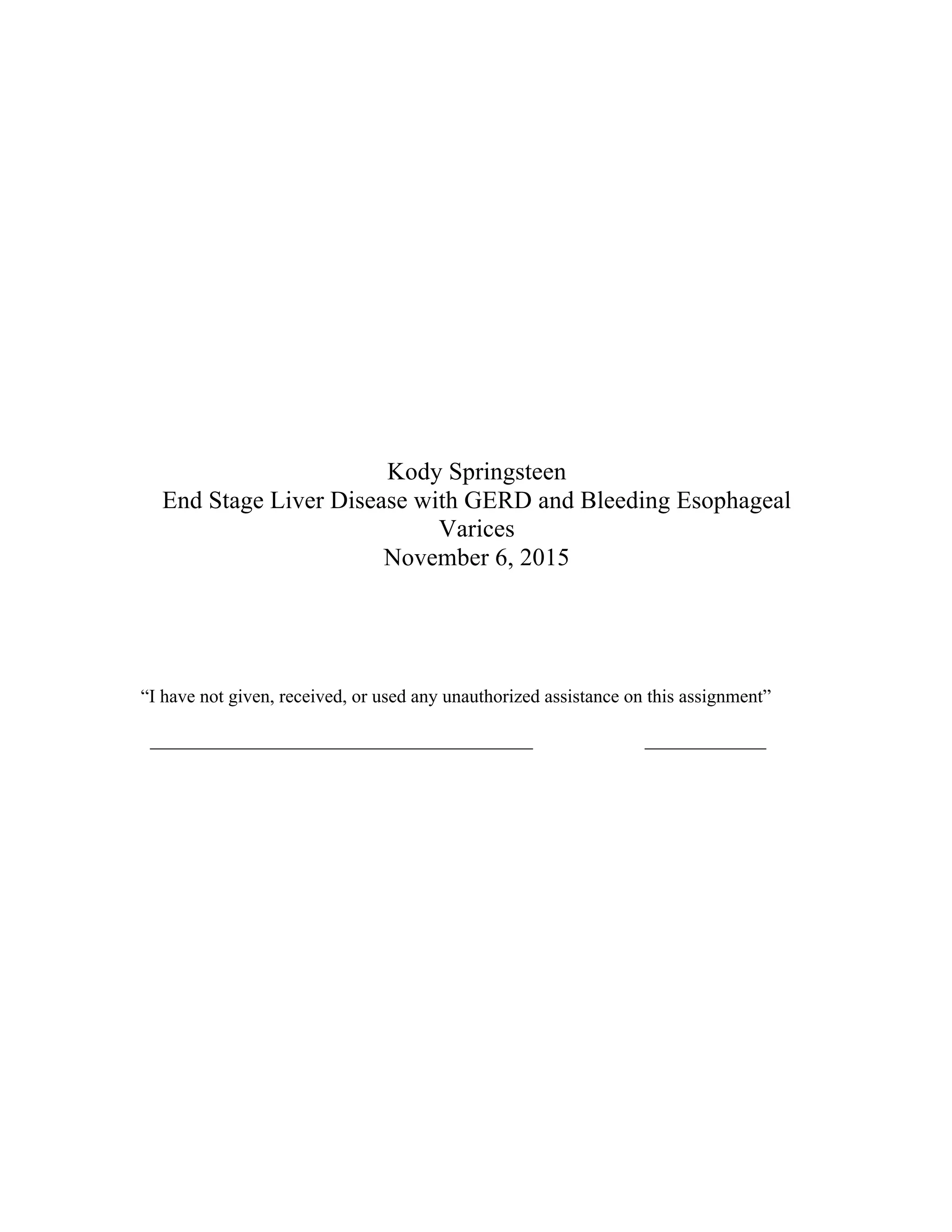
Kody Springsteen
End Stage Liver Disease with GERD and Bleeding Esophageal
Varices
November 6, 2015
“I have not given, received, or used any unauthorized assistance on this assignment”
_________________________________________ _____________
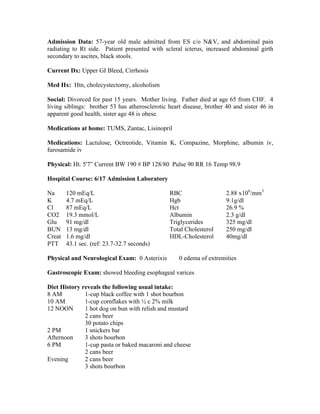
Admission Data: 57-year old male admitted from ES c/o N&V, and abdominal pain
radiating to Rt side. Patient presented with scleral icterus, increased abdominal girth
secondary to ascites, black stools.
Current Dx: Upper GI Bleed, Cirrhosis
Med Hx: Htn, cholecystectomy, alcoholism
Social: Divorced for past 15 years. Mother living. Father died at age 65 from CHF. 4
living siblings: brother 53 has atherosclerotic heart disease, brother 40 and sister 46 in
apparent good health, sister age 48 is obese.
Medications at home: TUMS, Zantac, Lisinopril
Medications: Lactulose, Octreotide, Vitamin K, Compazine, Morphine, albumin iv,
furosamide iv
Physical: Ht. 5'7” Current BW 190 # BP 128/80 Pulse 90 RR 16 Temp 98.9
Hospital Course: 6/17 Admission Laboratory
Na 120 mEq/L
K 4.7 mEq/L
Cl 87 mEq/L
CO2 19.3 mmol/L
Glu 91 mg/dl
BUN 13 mg/dl
Creat 1.6 mg/dl
PTT 43.1 sec. (ref: 23.7-32.7 seconds)
RBC 2.88 x10⁶
/mm3
Hgb 9.1g/dl
Hct 26.9 %
Albumin 2.3 g/dl
Triglycerides 325 mg/dl
Total Cholesterol 250 mg/dl
HDL-Cholesterol 40mg/dl
Physical and Neurological Exam: 0 Asterixis 0 edema of extremities
Gastroscopic Exam: showed bleeding esophageal varices
Diet History reveals the following usual intake:
8 AM 1-cup black coffee with 1 shot bourbon
10 AM 1-cup cornflakes with ½ c 2% milk
12 NOON 1 hot dog on bun with relish and mustard
2 cans beer
30 potato chips
2 PM 1 snickers bar
Afternoon 3 shots bourbon
6 PM 1-cup pasta or baked macaroni and cheese
2 cans beer
Evening 2 cans beer
3 shots bourbon
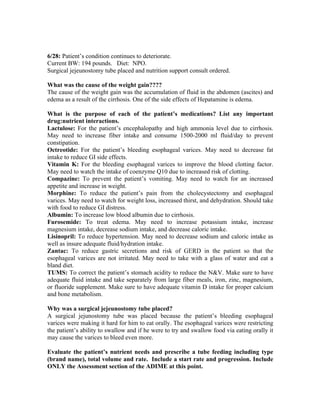
6/28: Patient’s condition continues to deteriorate.
Current BW: 194 pounds. Diet: NPO.
Surgical jejeunostomy tube placed and nutrition support consult ordered.
What was the cause of the weight gain????
The cause of the weight gain was the accumulation of fluid in the abdomen (ascites) and
edema as a result of the cirrhosis. One of the side effects of Hepatamine is edema.
What is the purpose of each of the patient’s medications? List any important
drug:nutrient interactions.
Lactulose: For the patient’s encephalopathy and high ammonia level due to cirrhosis.
May need to increase fiber intake and consume 1500-2000 ml fluid/day to prevent
constipation.
Octreotide: For the patient’s bleeding esophageal varices. May need to decrease fat
intake to reduce GI side effects.
Vitamin K: For the bleeding esophageal varices to improve the blood clotting factor.
May need to watch the intake of coenzyme Q10 due to increased risk of clotting.
Compazine: To prevent the patient’s vomiting. May need to watch for an increased
appetite and increase in weight.
Morphine: To reduce the patient’s pain from the cholecystectomy and esophageal
varices. May need to watch for weight loss, increased thirst, and dehydration. Should take
with food to reduce GI distress.
Albumin: To increase low blood albumin due to cirrhosis.
Furosemide: To treat edema. May need to increase potassium intake, increase
magnesium intake, decrease sodium intake, and decrease caloric intake.
Lisinopril: To reduce hypertension. May need to decrease sodium and caloric intake as
well as insure adequate fluid/hydration intake.
Zantac: To reduce gastric secretions and risk of GERD in the patient so that the
esophageal varices are not irritated. May need to take with a glass of water and eat a
bland diet.
TUMS: To correct the patient’s stomach acidity to reduce the N&V. Make sure to have
adequate fluid intake and take separately from large fiber meals, iron, zinc, magnesium,
or fluoride supplement. Make sure to have adequate vitamin D intake for proper calcium
and bone metabolism.
Why was a surgical jejeunostomy tube placed?
A surgical jejunostomy tube was placed because the patient’s bleeding esophageal
varices were making it hard for him to eat orally. The esophageal varices were restricting
the patient’s ability to swallow and if he were to try and swallow food via eating orally it
may cause the varices to bleed even more.
Evaluate the patient’s nutrient needs and prescribe a tube feeding including type
(brand name), total volume and rate. Include a start rate and progression. Include
ONLY the Assessment section of the ADIME at this point.
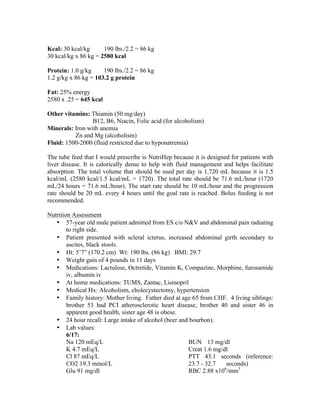
Kcal: 30 kcal/kg 190 lbs./2.2 = 86 kg
30 kcal/kg x 86 kg = 2580 kcal
Protein: 1.0 g/kg 190 lbs./2.2 = 86 kg
1.2 g/kg x 86 kg = 103.2 g protein
Fat: 25% energy
2580 x .25 = 645 kcal
Other vitamins: Thiamin (50 mg/day)
B12, B6, Niacin, Folic acid (for alcoholism)
Minerals: Iron with anemia
Zn and Mg (alcoholism)
Fluid: 1500-2000 (fluid restricted due to hyponatremia)
The tube feed that I would prescribe is NutriHep because it is designed for patients with
liver disease. It is calorically dense to help with fluid management and helps facilitate
absorption. The total volume that should be used per day is 1,720 mL because it is 1.5
kcal/mL (2580 kcal/1.5 kcal/mL = 1720). The total rate should be 71.6 mL/hour (1720
mL/24 hours = 71.6 mL/hour). The start rate should be 10 mL/hour and the progression
rate should be 20 mL every 4 hours until the goal rate is reached. Bolus feeding is not
recommended.
Nutrition Assessment
• 57-year old male patient admitted from ES c/o N&V and abdominal pain radiating
to right side.
• Patient presented with scleral icterus, increased abdominal girth secondary to
ascites, black stools.
• Ht: 5’7” (170.2 cm) Wt: 190 lbs. (86 kg) BMI: 29.7
• Weight gain of 4 pounds in 11 days
• Medications: Lactulose, Octretide, Vitamin K, Compazine, Morphine, furosamide
iv, albumin iv
• At home medications: TUMS, Zantac, Lisinopril
• Medical Hx: Alcoholism, cholecystectomy, hypertension
• Family history: Mother living. Father died at age 65 from CHF. 4 living siblings:
brother 53 had PCI atherosclerotic heart disease, brother 40 and sister 46 in
apparent good health, sister age 48 is obese.
• 24 hour recall: Large intake of alcohol (beer and bourbon).
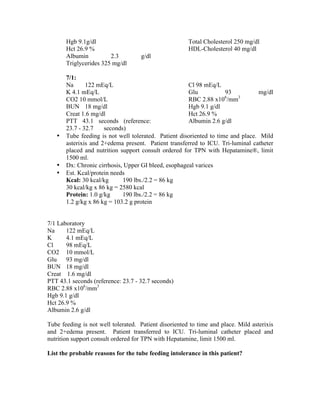
• Lab values:
6/17:
Na 120 mEq/L
K 4.7 mEq/L
Cl 87 mEq/L
CO2 19.3 mmol/L
Glu 91 mg/dl
BUN 13 mg/dl
Creat 1.6 mg/dl
PTT 43.1 seconds (reference:
23.7 - 32.7 seconds)
RBC 2.88 x10⁶
/mm3
Hgb 9.1g/dl
Hct 26.9 %
Albumin 2.3 g/dl
Triglycerides 325 mg/dl
Total Cholesterol 250 mg/dl
HDL-Cholesterol 40 mg/dl
7/1:
Na 122 mEq/L
K 4.1 mEq/L
Cl 98 mEq/L
Glu 93 mg/dl
CO2 10 mmol/L
BUN 18 mg/dl
Creat 1.6 mg/dl
PTT 43.1 seconds (reference:
23.7 - 32.7 seconds)
RBC 2.88 x10⁶
/mm3
Hgb 9.1 g/dl
Hct 26.9 %
Albumin 2.6 g/dl
• Tube feeding is not well tolerated. Patient disoriented to time and place. Mild
asterixis and 2+edema present. Patient transferred to ICU. Tri-luminal catheter
placed and nutrition support consult ordered for TPN with Hepatamine®, limit
1500 ml.
• Dx: Chronic cirrhosis, Upper GI bleed, esophageal varices
• Est. Kcal/protein needs
Kcal: 30 kcal/kg 190 lbs./2.2 = 86 kg
30 kcal/kg x 86 kg = 2580 kcal
Protein: 1.0 g/kg 190 lbs./2.2 = 86 kg
1.2 g/kg x 86 kg = 103.2 g protein
7/1 Laboratory
Na 122 mEq/L
K 4.1 mEq/L
Cl 98 mEq/L
CO2 10 mmol/L
Glu 93 mg/dl
BUN 18 mg/dl
Creat 1.6 mg/dl
PTT 43.1 seconds (reference: 23.7 - 32.7 seconds)
RBC 2.88 x10⁶
/mm3
Hgb 9.1 g/dl
Hct 26.9 %
Albumin 2.6 g/dl
Tube feeding is not well tolerated. Patient disoriented to time and place. Mild asterixis
and 2+edema present. Patient transferred to ICU. Tri-luminal catheter placed and
nutrition support consult ordered for TPN with Hepatamine, limit 1500 ml.
List the probable reasons for the tube feeding intolerance in this patient?
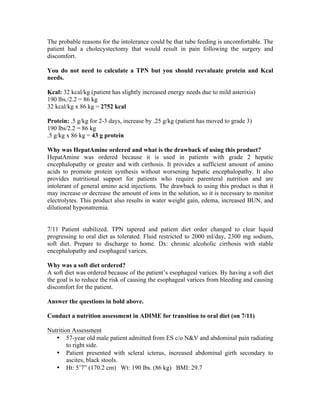
The probable reasons for the intolerance could be that tube feeding is uncomfortable. The
patient had a cholecystectomy that would result in pain following the surgery and
discomfort.
You do not need to calculate a TPN but you should reevaluate protein and Kcal
needs.
Kcal: 32 kcal/kg (patient has slightly increased energy needs due to mild asterixis)
190 lbs./2.2 = 86 kg
32 kcal/kg x 86 kg = 2752 kcal
Protein: .5 g/kg for 2-3 days, increase by .25 g/kg (patient has moved to grade 3)
190 lbs/2.2 = 86 kg
.5 g/kg x 86 kg = 43 g protein
Why was HepatAmine ordered and what is the drawback of using this product?
HepatAmine was ordered because it is used in patients with grade 2 hepatic
encephalopathy or greater and with cirrhosis. It provides a sufficient amount of amino
acids to promote protein synthesis without worsening hepatic encephalopathy. It also
provides nutritional support for patients who require parenteral nutrition and are
intolerant of general amino acid injections. The drawback to using this product is that it
may increase or decrease the amount of ions in the solution, so it is necessary to monitor
electrolytes. This product also results in water weight gain, edema, increased BUN, and
dilutional hyponatremia.
7/11 Patient stabilized. TPN tapered and patient diet order changed to clear liquid
progressing to oral diet as tolerated. Fluid restricted to 2000 ml/day, 2300 mg sodium,
soft diet. Prepare to discharge to home. Dx: chronic alcoholic cirrhosis with stable
encephalopathy and esophageal varices.
Why was a soft diet ordered?
A soft diet was ordered because of the patient’s esophageal varices. By having a soft diet
the goal is to reduce the risk of causing the esophageal varices from bleeding and causing
discomfort for the patient.
Answer the questions in bold above.
Conduct a nutrition assessment in ADIME for transition to oral diet (on 7/11)
Nutrition Assessment
• 57-year old male patient admitted from ES c/o N&V and abdominal pain radiating
to right side.
• Patient presented with scleral icterus, increased abdominal girth secondary to
ascites, black stools.
• Ht: 5’7” (170.2 cm) Wt: 190 lbs. (86 kg) BMI: 29.7
• Weight gain of 4 pounds in 11 days
• Medications: Lactulose, Octretide, Vitamin K, Compazine, Morphine, furosamide
iv, albumin iv
• At home medications: TUMS, Zantac, Lisinopril
• Medical Hx: cholecystectomy, alcoholism, hypertension
• Family history: Mother living. Father died at age 65 from CHF. 4 living siblings:
brother 53 has atherosclerotic heart disease, brother 40 and sister 46 in apparent
good health, sister age 48 is obese.
• 24 hour recall: Large intake of alcohol (beer and bourbon).
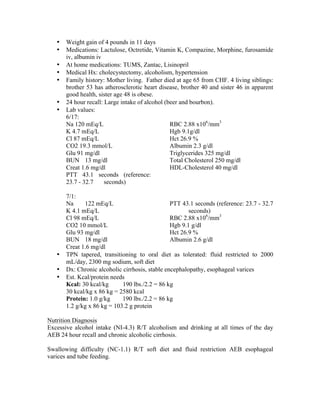
• Lab values:
6/17:
Na 120 mEq/L
K 4.7 mEq/L
Cl 87 mEq/L
CO2 19.3 mmol/L
Glu 91 mg/dl
BUN 13 mg/dl
Creat 1.6 mg/dl
PTT 43.1 seconds (reference:
23.7 - 32.7 seconds)
RBC 2.88 x10⁶
/mm3
Hgb 9.1g/dl
Hct 26.9 %
Albumin 2.3 g/dl
Triglycerides 325 mg/dl
Total Cholesterol 250 mg/dl
HDL-Cholesterol 40 mg/dl
7/1:
Na 122 mEq/L
K 4.1 mEq/L
Cl 98 mEq/L
CO2 10 mmol/L
Glu 93 mg/dl
BUN 18 mg/dl
Creat 1.6 mg/dl
PTT 43.1 seconds (reference: 23.7 - 32.7
seconds)
RBC 2.88 x10⁶
/mm3
Hgb 9.1 g/dl
Hct 26.9 %
Albumin 2.6 g/dl
• TPN tapered, transitioning to oral diet as tolerated: fluid restricted to 2000
mL/day, 2300 mg sodium, soft diet
• Dx: Chronic alcoholic cirrhosis, stable encephalopathy, esophageal varices
• Est. Kcal/protein needs
Kcal: 30 kcal/kg 190 lbs./2.2 = 86 kg
30 kcal/kg x 86 kg = 2580 kcal
Protein: 1.0 g/kg 190 lbs./2.2 = 86 kg
1.2 g/kg x 86 kg = 103.2 g protein
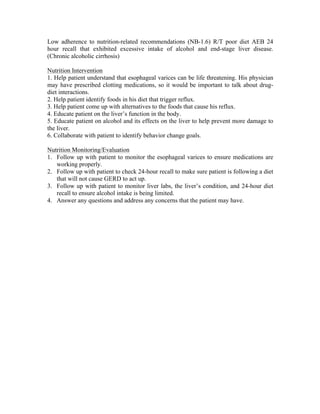
Nutrition Diagnosis
Excessive alcohol intake (NI-4.3) R/T alcoholism and drinking at all times of the day
AEB 24 hour recall and chronic alcoholic cirrhosis.
Swallowing difficulty (NC-1.1) R/T soft diet and fluid restriction AEB esophageal
varices and tube feeding.
Low adherence to nutrition-related recommendations (NB-1.6) R/T poor diet AEB 24
hour recall that exhibited excessive intake of alcohol and end-stage liver disease.
(Chronic alcoholic cirrhosis)
Nutrition Intervention
1. Help patient understand that esophageal varices can be life threatening. His physician
may have prescribed clotting medications, so it would be important to talk about drug-
diet interactions.
2. Help patient identify foods in his diet that trigger reflux.
3. Help patient come up with alternatives to the foods that cause his reflux.
4. Educate patient on the liver’s function in the body.
5. Educate patient on alcohol and its effects on the liver to help prevent more damage to
the liver.
6. Collaborate with patient to identify behavior change goals.
Nutrition Monitoring/Evaluation
1. Follow up with patient to monitor the esophageal varices to ensure medications are
working properly.
2. Follow up with patient to check 24-hour recall to make sure patient is following a diet
that will not cause GERD to act up.
3. Follow up with patient to monitor liver labs, the liver’s condition, and 24-hour diet
recall to ensure alcohol intake is being limited.
4. Answer any questions and address any concerns that the patient may have.

Liver Disease and GERD

  • 1.
    Kody Springsteen End StageLiver Disease with GERD and Bleeding Esophageal Varices November 6, 2015 “I have not given, received, or used any unauthorized assistance on this assignment” _________________________________________ _____________
  • 2.
    Admission Data: 57-yearold male admitted from ES c/o N&V, and abdominal pain radiating to Rt side. Patient presented with scleral icterus, increased abdominal girth secondary to ascites, black stools. Current Dx: Upper GI Bleed, Cirrhosis Med Hx: Htn, cholecystectomy, alcoholism Social: Divorced for past 15 years. Mother living. Father died at age 65 from CHF. 4 living siblings: brother 53 has atherosclerotic heart disease, brother 40 and sister 46 in apparent good health, sister age 48 is obese. Medications at home: TUMS, Zantac, Lisinopril Medications: Lactulose, Octreotide, Vitamin K, Compazine, Morphine, albumin iv, furosamide iv Physical: Ht. 5'7” Current BW 190 # BP 128/80 Pulse 90 RR 16 Temp 98.9 Hospital Course: 6/17 Admission Laboratory Na 120 mEq/L K 4.7 mEq/L Cl 87 mEq/L CO2 19.3 mmol/L Glu 91 mg/dl BUN 13 mg/dl Creat 1.6 mg/dl PTT 43.1 sec. (ref: 23.7-32.7 seconds) RBC 2.88 x10⁶ /mm3 Hgb 9.1g/dl Hct 26.9 % Albumin 2.3 g/dl Triglycerides 325 mg/dl Total Cholesterol 250 mg/dl HDL-Cholesterol 40mg/dl Physical and Neurological Exam: 0 Asterixis 0 edema of extremities Gastroscopic Exam: showed bleeding esophageal varices Diet History reveals the following usual intake: 8 AM 1-cup black coffee with 1 shot bourbon 10 AM 1-cup cornflakes with ½ c 2% milk 12 NOON 1 hot dog on bun with relish and mustard 2 cans beer 30 potato chips 2 PM 1 snickers bar Afternoon 3 shots bourbon 6 PM 1-cup pasta or baked macaroni and cheese 2 cans beer Evening 2 cans beer 3 shots bourbon
  • 3.
    6/28: Patient’s conditioncontinues to deteriorate. Current BW: 194 pounds. Diet: NPO. Surgical jejeunostomy tube placed and nutrition support consult ordered. What was the cause of the weight gain???? The cause of the weight gain was the accumulation of fluid in the abdomen (ascites) and edema as a result of the cirrhosis. One of the side effects of Hepatamine is edema. What is the purpose of each of the patient’s medications? List any important drug:nutrient interactions. Lactulose: For the patient’s encephalopathy and high ammonia level due to cirrhosis. May need to increase fiber intake and consume 1500-2000 ml fluid/day to prevent constipation. Octreotide: For the patient’s bleeding esophageal varices. May need to decrease fat intake to reduce GI side effects. Vitamin K: For the bleeding esophageal varices to improve the blood clotting factor. May need to watch the intake of coenzyme Q10 due to increased risk of clotting. Compazine: To prevent the patient’s vomiting. May need to watch for an increased appetite and increase in weight. Morphine: To reduce the patient’s pain from the cholecystectomy and esophageal varices. May need to watch for weight loss, increased thirst, and dehydration. Should take with food to reduce GI distress. Albumin: To increase low blood albumin due to cirrhosis. Furosemide: To treat edema. May need to increase potassium intake, increase magnesium intake, decrease sodium intake, and decrease caloric intake. Lisinopril: To reduce hypertension. May need to decrease sodium and caloric intake as well as insure adequate fluid/hydration intake. Zantac: To reduce gastric secretions and risk of GERD in the patient so that the esophageal varices are not irritated. May need to take with a glass of water and eat a bland diet. TUMS: To correct the patient’s stomach acidity to reduce the N&V. Make sure to have adequate fluid intake and take separately from large fiber meals, iron, zinc, magnesium, or fluoride supplement. Make sure to have adequate vitamin D intake for proper calcium and bone metabolism. Why was a surgical jejeunostomy tube placed? A surgical jejunostomy tube was placed because the patient’s bleeding esophageal varices were making it hard for him to eat orally. The esophageal varices were restricting the patient’s ability to swallow and if he were to try and swallow food via eating orally it may cause the varices to bleed even more. Evaluate the patient’s nutrient needs and prescribe a tube feeding including type (brand name), total volume and rate. Include a start rate and progression. Include ONLY the Assessment section of the ADIME at this point.
  • 4.
    Kcal: 30 kcal/kg190 lbs./2.2 = 86 kg 30 kcal/kg x 86 kg = 2580 kcal Protein: 1.0 g/kg 190 lbs./2.2 = 86 kg 1.2 g/kg x 86 kg = 103.2 g protein Fat: 25% energy 2580 x .25 = 645 kcal Other vitamins: Thiamin (50 mg/day) B12, B6, Niacin, Folic acid (for alcoholism) Minerals: Iron with anemia Zn and Mg (alcoholism) Fluid: 1500-2000 (fluid restricted due to hyponatremia) The tube feed that I would prescribe is NutriHep because it is designed for patients with liver disease. It is calorically dense to help with fluid management and helps facilitate absorption. The total volume that should be used per day is 1,720 mL because it is 1.5 kcal/mL (2580 kcal/1.5 kcal/mL = 1720). The total rate should be 71.6 mL/hour (1720 mL/24 hours = 71.6 mL/hour). The start rate should be 10 mL/hour and the progression rate should be 20 mL every 4 hours until the goal rate is reached. Bolus feeding is not recommended. Nutrition Assessment • 57-year old male patient admitted from ES c/o N&V and abdominal pain radiating to right side. • Patient presented with scleral icterus, increased abdominal girth secondary to ascites, black stools. • Ht: 5’7” (170.2 cm) Wt: 190 lbs. (86 kg) BMI: 29.7 • Weight gain of 4 pounds in 11 days • Medications: Lactulose, Octretide, Vitamin K, Compazine, Morphine, furosamide iv, albumin iv • At home medications: TUMS, Zantac, Lisinopril • Medical Hx: Alcoholism, cholecystectomy, hypertension • Family history: Mother living. Father died at age 65 from CHF. 4 living siblings: brother 53 had PCI atherosclerotic heart disease, brother 40 and sister 46 in apparent good health, sister age 48 is obese. • 24 hour recall: Large intake of alcohol (beer and bourbon). • Lab values: 6/17: Na 120 mEq/L K 4.7 mEq/L Cl 87 mEq/L CO2 19.3 mmol/L Glu 91 mg/dl BUN 13 mg/dl Creat 1.6 mg/dl PTT 43.1 seconds (reference: 23.7 - 32.7 seconds) RBC 2.88 x10⁶ /mm3
  • 5.
    Hgb 9.1g/dl Hct 26.9% Albumin 2.3 g/dl Triglycerides 325 mg/dl Total Cholesterol 250 mg/dl HDL-Cholesterol 40 mg/dl 7/1: Na 122 mEq/L K 4.1 mEq/L Cl 98 mEq/L Glu 93 mg/dl CO2 10 mmol/L BUN 18 mg/dl Creat 1.6 mg/dl PTT 43.1 seconds (reference: 23.7 - 32.7 seconds) RBC 2.88 x10⁶ /mm3 Hgb 9.1 g/dl Hct 26.9 % Albumin 2.6 g/dl • Tube feeding is not well tolerated. Patient disoriented to time and place. Mild asterixis and 2+edema present. Patient transferred to ICU. Tri-luminal catheter placed and nutrition support consult ordered for TPN with Hepatamine®, limit 1500 ml. • Dx: Chronic cirrhosis, Upper GI bleed, esophageal varices • Est. Kcal/protein needs Kcal: 30 kcal/kg 190 lbs./2.2 = 86 kg 30 kcal/kg x 86 kg = 2580 kcal Protein: 1.0 g/kg 190 lbs./2.2 = 86 kg 1.2 g/kg x 86 kg = 103.2 g protein 7/1 Laboratory Na 122 mEq/L K 4.1 mEq/L Cl 98 mEq/L CO2 10 mmol/L Glu 93 mg/dl BUN 18 mg/dl Creat 1.6 mg/dl PTT 43.1 seconds (reference: 23.7 - 32.7 seconds) RBC 2.88 x10⁶ /mm3 Hgb 9.1 g/dl Hct 26.9 % Albumin 2.6 g/dl Tube feeding is not well tolerated. Patient disoriented to time and place. Mild asterixis and 2+edema present. Patient transferred to ICU. Tri-luminal catheter placed and nutrition support consult ordered for TPN with Hepatamine, limit 1500 ml. List the probable reasons for the tube feeding intolerance in this patient?
  • 6.
    The probable reasonsfor the intolerance could be that tube feeding is uncomfortable. The patient had a cholecystectomy that would result in pain following the surgery and discomfort. You do not need to calculate a TPN but you should reevaluate protein and Kcal needs. Kcal: 32 kcal/kg (patient has slightly increased energy needs due to mild asterixis) 190 lbs./2.2 = 86 kg 32 kcal/kg x 86 kg = 2752 kcal Protein: .5 g/kg for 2-3 days, increase by .25 g/kg (patient has moved to grade 3) 190 lbs/2.2 = 86 kg .5 g/kg x 86 kg = 43 g protein Why was HepatAmine ordered and what is the drawback of using this product? HepatAmine was ordered because it is used in patients with grade 2 hepatic encephalopathy or greater and with cirrhosis. It provides a sufficient amount of amino acids to promote protein synthesis without worsening hepatic encephalopathy. It also provides nutritional support for patients who require parenteral nutrition and are intolerant of general amino acid injections. The drawback to using this product is that it may increase or decrease the amount of ions in the solution, so it is necessary to monitor electrolytes. This product also results in water weight gain, edema, increased BUN, and dilutional hyponatremia. 7/11 Patient stabilized. TPN tapered and patient diet order changed to clear liquid progressing to oral diet as tolerated. Fluid restricted to 2000 ml/day, 2300 mg sodium, soft diet. Prepare to discharge to home. Dx: chronic alcoholic cirrhosis with stable encephalopathy and esophageal varices. Why was a soft diet ordered? A soft diet was ordered because of the patient’s esophageal varices. By having a soft diet the goal is to reduce the risk of causing the esophageal varices from bleeding and causing discomfort for the patient. Answer the questions in bold above. Conduct a nutrition assessment in ADIME for transition to oral diet (on 7/11) Nutrition Assessment • 57-year old male patient admitted from ES c/o N&V and abdominal pain radiating to right side. • Patient presented with scleral icterus, increased abdominal girth secondary to ascites, black stools. • Ht: 5’7” (170.2 cm) Wt: 190 lbs. (86 kg) BMI: 29.7
  • 7.
    • Weight gainof 4 pounds in 11 days • Medications: Lactulose, Octretide, Vitamin K, Compazine, Morphine, furosamide iv, albumin iv • At home medications: TUMS, Zantac, Lisinopril • Medical Hx: cholecystectomy, alcoholism, hypertension • Family history: Mother living. Father died at age 65 from CHF. 4 living siblings: brother 53 has atherosclerotic heart disease, brother 40 and sister 46 in apparent good health, sister age 48 is obese. • 24 hour recall: Large intake of alcohol (beer and bourbon). • Lab values: 6/17: Na 120 mEq/L K 4.7 mEq/L Cl 87 mEq/L CO2 19.3 mmol/L Glu 91 mg/dl BUN 13 mg/dl Creat 1.6 mg/dl PTT 43.1 seconds (reference: 23.7 - 32.7 seconds) RBC 2.88 x10⁶ /mm3 Hgb 9.1g/dl Hct 26.9 % Albumin 2.3 g/dl Triglycerides 325 mg/dl Total Cholesterol 250 mg/dl HDL-Cholesterol 40 mg/dl 7/1: Na 122 mEq/L K 4.1 mEq/L Cl 98 mEq/L CO2 10 mmol/L Glu 93 mg/dl BUN 18 mg/dl Creat 1.6 mg/dl PTT 43.1 seconds (reference: 23.7 - 32.7 seconds) RBC 2.88 x10⁶ /mm3 Hgb 9.1 g/dl Hct 26.9 % Albumin 2.6 g/dl • TPN tapered, transitioning to oral diet as tolerated: fluid restricted to 2000 mL/day, 2300 mg sodium, soft diet • Dx: Chronic alcoholic cirrhosis, stable encephalopathy, esophageal varices • Est. Kcal/protein needs Kcal: 30 kcal/kg 190 lbs./2.2 = 86 kg 30 kcal/kg x 86 kg = 2580 kcal Protein: 1.0 g/kg 190 lbs./2.2 = 86 kg 1.2 g/kg x 86 kg = 103.2 g protein Nutrition Diagnosis Excessive alcohol intake (NI-4.3) R/T alcoholism and drinking at all times of the day AEB 24 hour recall and chronic alcoholic cirrhosis. Swallowing difficulty (NC-1.1) R/T soft diet and fluid restriction AEB esophageal varices and tube feeding.
  • 8.
    Low adherence tonutrition-related recommendations (NB-1.6) R/T poor diet AEB 24 hour recall that exhibited excessive intake of alcohol and end-stage liver disease. (Chronic alcoholic cirrhosis) Nutrition Intervention 1. Help patient understand that esophageal varices can be life threatening. His physician may have prescribed clotting medications, so it would be important to talk about drug- diet interactions. 2. Help patient identify foods in his diet that trigger reflux. 3. Help patient come up with alternatives to the foods that cause his reflux. 4. Educate patient on the liver’s function in the body. 5. Educate patient on alcohol and its effects on the liver to help prevent more damage to the liver. 6. Collaborate with patient to identify behavior change goals. Nutrition Monitoring/Evaluation 1. Follow up with patient to monitor the esophageal varices to ensure medications are working properly. 2. Follow up with patient to check 24-hour recall to make sure patient is following a diet that will not cause GERD to act up. 3. Follow up with patient to monitor liver labs, the liver’s condition, and 24-hour diet recall to ensure alcohol intake is being limited. 4. Answer any questions and address any concerns that the patient may have.