Case Presentation
Diagnostic Hematology
Ahmad Adel A.
• Patient A, a 24-year old female, was admitted to hospital with
complaints of recurrent epistaxis, progressive weakness and
shortness of breath with minimal physical effort. she has experienced
recurrent fever reaching 38.2°C.
• Upon physical examination she showed a pale skin, good nutritional
status and no acute distress.
• There's no lymphadenopathy or hepatosplenomegaly.
• Many petechial hemorrhages cover her chest and legs.
• Several bruises are found on her legs and thighs.
• The patient denies sinus congestion, throat pain, cough, nausea,
emesis, melena, or hematuria.
• For the past 3 months, patient A's family physician has been following
her recovery from viral hepatitis. her recovery was uneventful.
• Her liver enzyme levels returning to normal within two months.
• She has no past medical history, and there's no family history of
hematological disorders.
• Laboratory tests were ordered on admission.
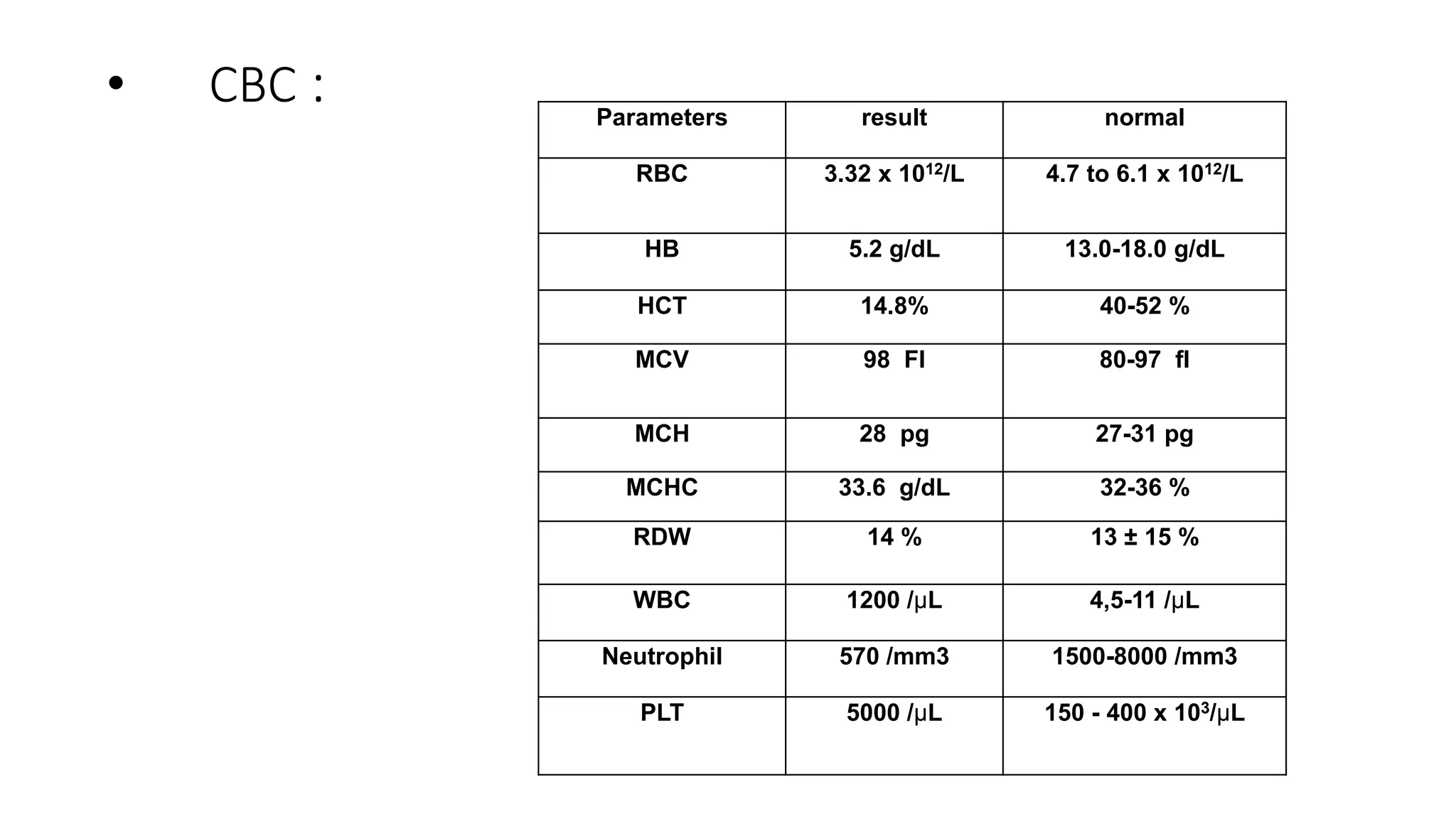
• Blood cells count showed a peripheral pancytopenia:
- Hemoglobin 5.2 g/dl,
- White cell count 1200/mmc (neutrophils 570; lymphocytes 540,
monocytes 80),
- Platelets 5,000/mmc,
- Reticulocytes < 1 %.
• CBC : Parameters result normal
RBC 3.32 x 10¹²/L 4.7 to 6.1 x 10¹²/L
HB 5.2 g/dL 13.0-18.0 g/dL
HCT 14.8% 40-52 %
MCV 98 Fl 80-97 fl
MCH 28 pg 27-31 pg
MCHC 33.6 g/dL 32-36 %
RDW 14 % 13 ± 15 %
WBC 1200 /μL 4,5-11 /μL
Neutrophil 570 /mm3 1500-8000 /mm3
PLT 5000 /μL 150 - 400 x 103/μL
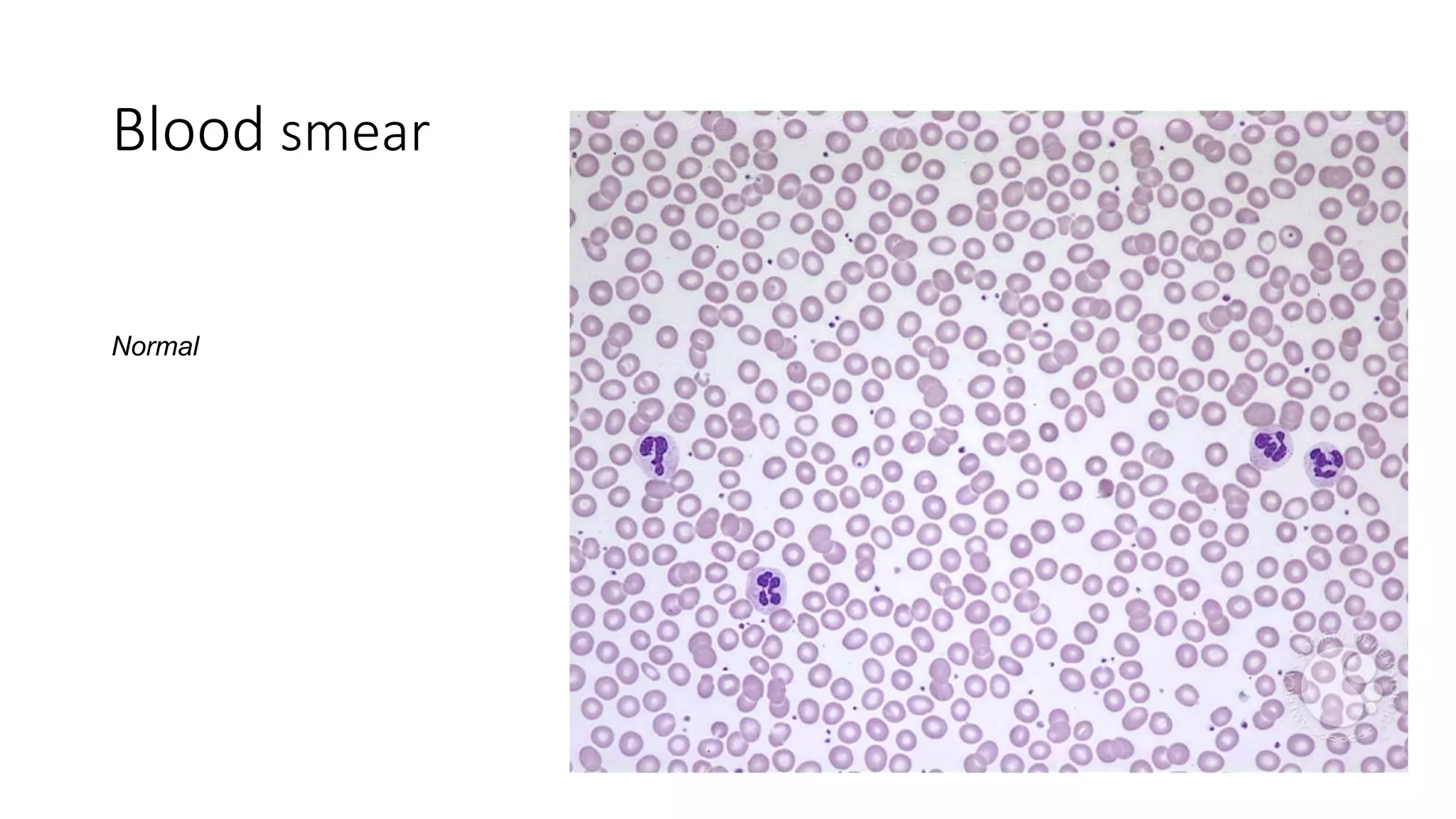
Blood smear
Normal
Blood smear
Pancytopenia and reticulocytopenia
• Patient A was referred to a hematologist who ordered a bone marrow
examination.
• The aspirate obtained was inadequate for evaluation.
• Only a single site could be aspirated.
• Preps made from the aspirate showed a markedly hypo-cellular
marrow with very few hematopoietic cells.
• Cells present consisted of lymphocyte, plasma cells, and stromal cells.
• There's no malignant cells present.
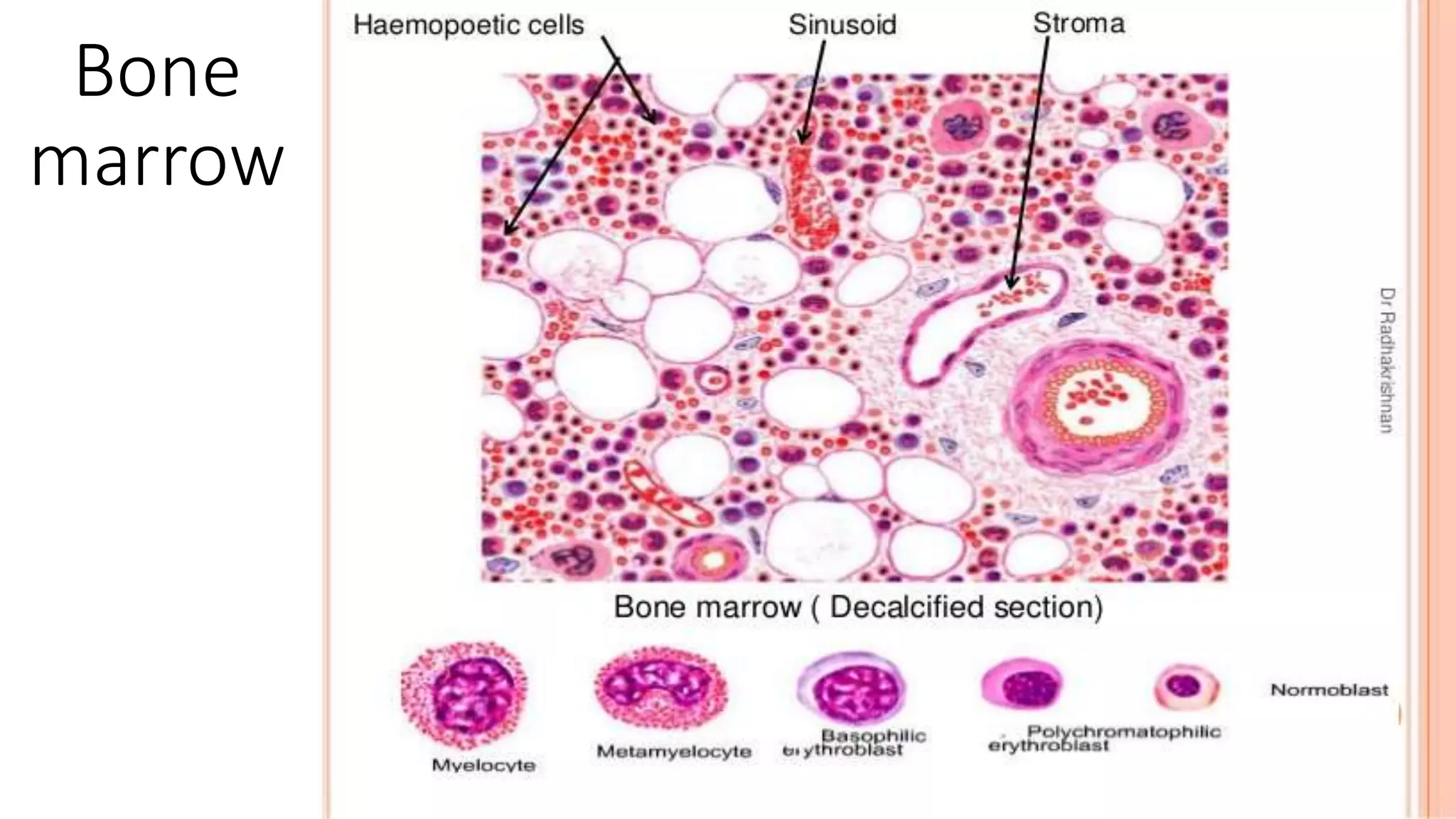
Bone
marrow
Bone marrow
Normal marrow
Bone marrow
Hypocellular with
increased fat spaces
Severely Reduced
Hematopoietic Stem Cell
Precursors In Bone
Marrow
Bone marrow cellularity <
25%.
Diagnosis
Involves low counts in 2 of 3 cell lines:
red blood cells (RBC), white blood cells (WBC), platelets.
• Bone marrow cellularity is too low.
• No evidence of damage or mutation to the stem cell pool
(NORMAL cytogenetic).
• No dysplasia.
** (If dysplasia or abnormal cytogenetic seen, think myelodysplastic
syndrome (MDS)).
Diagnosis
Aplastic Anemia
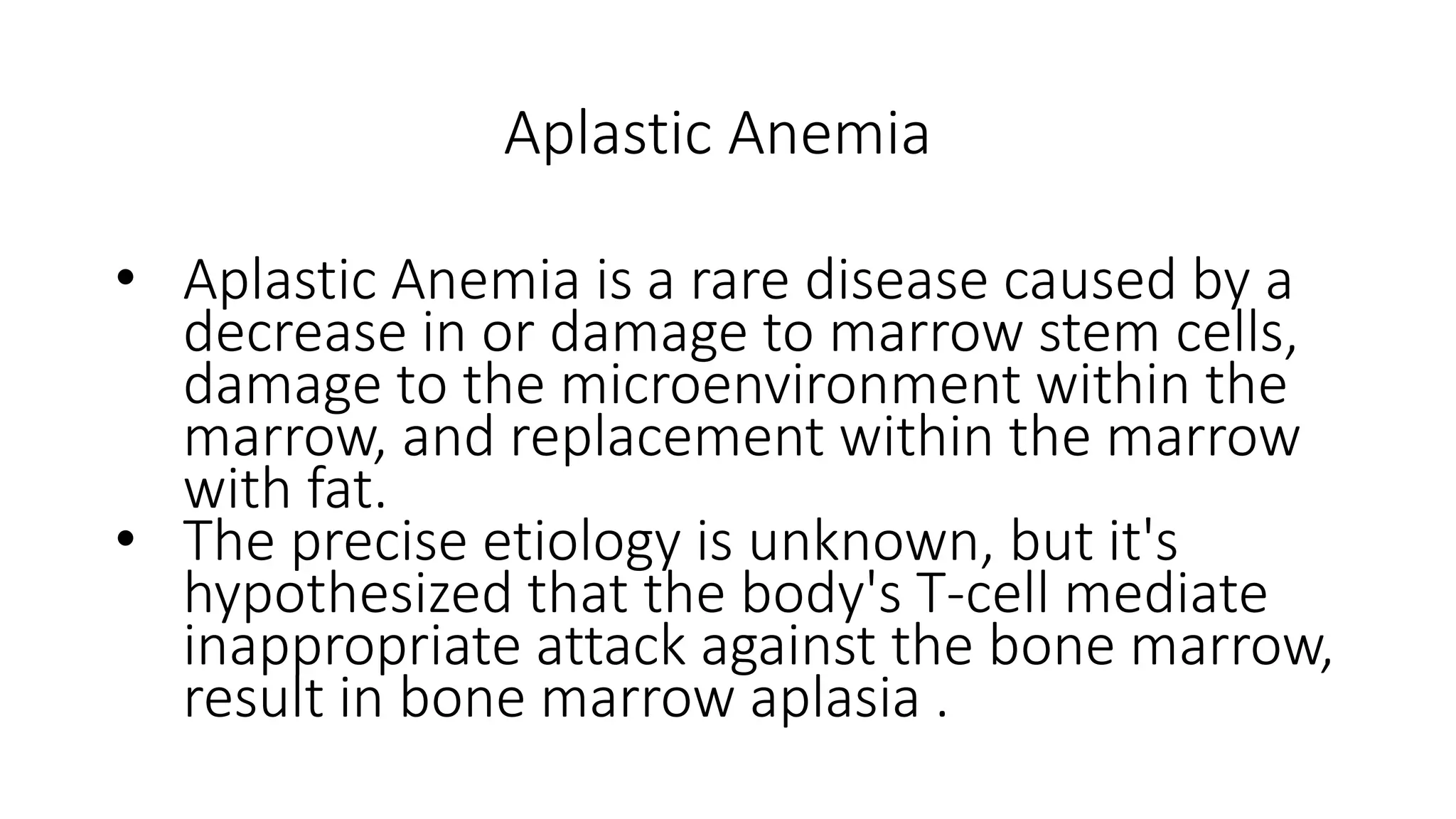
Aplastic Anemia
• Aplastic Anemia is a rare disease caused by a
decrease in or damage to marrow stem cells,
damage to the microenvironment within the
marrow, and replacement within the marrow
with fat.
• The precise etiology is unknown, but it's
hypothesized that the body's T-cell mediate
inappropriate attack against the bone marrow,
result in bone marrow aplasia .
Classification
• Severe Aplastic Anemia
• Patient must meet the following criteria:
(a) Bone marrow cellularity < 25%
Or
30-50% with < 30% residual
hematopoietic cells
(b) Two of three of the following:
(1) Neutrophils < 0.5 x 10⁹/L
(2) Platelets < 20 x 109/L
(3) Reticulocytes < 1%
• Very Severe Aplastic Anemia
• Patient must meet the criteria
for severe aplastic anemia and
have:
Neutrophils < 0.2 x 10⁹/L
Causes
• In about 50% of cases, aplastic anemia is considered to be idiopathic,
meaning that the cause of the disease is unknown.
• Acquired aplastic anemia (environmental factors and physical
conditions):
- radiation or chemotherapy.
- medications: chloramphenicol, sulfonamides.
• Genetic (Inherited) disorders: Fanconi anemia.
• Autoimmune diseases.
• Viruses: EBV, HIV, and Hepatitis virus.
Fanconi anemia
Fanconi anemia (FA) is a rare genetic disease resulting in impaired
response to DNA damage.
FA is the result of a genetic defect in a cluster of proteins responsible
for DNA repair.
Among those affected, the majority develop cancer, most often acute
myelogenous leukemia, and 90% develop bone marrow failure by age
40.
About 60–75% of people have congenital defects, commonly short
stature, abnormalities of the skin, arms, head, eyes, kidneys, and ears,
and developmental disabilities. Around 75% of people have some
form of endocrine problems, with varying degrees of severity.
• FA is primarily an autosomal recessive genetic disorder.
• This means that two mutated alleles (one from each parent) are
required to cause the disease.
• Scientists have identified 17 FA or FA-like genes: FANCA, FANCB,
FANCC, FANCD1 (BRCA2), FANCD2, FANCE, FANCF, FANCG, FANCI,
FANCJ (BRIP1), FANCL, FANCM, FANCN (PALB2), FANCP (SLX4), FANCS
(BRCA1), RAD51C and XPF.
Case Study - Aplastic Anemia

Case Study - Aplastic Anemia

  • 1.
  • 2.
    • Patient A,a 24-year old female, was admitted to hospital with complaints of recurrent epistaxis, progressive weakness and shortness of breath with minimal physical effort. she has experienced recurrent fever reaching 38.2°C. • Upon physical examination she showed a pale skin, good nutritional status and no acute distress. • There's no lymphadenopathy or hepatosplenomegaly. • Many petechial hemorrhages cover her chest and legs. • Several bruises are found on her legs and thighs. • The patient denies sinus congestion, throat pain, cough, nausea, emesis, melena, or hematuria.
  • 3.
    • For thepast 3 months, patient A's family physician has been following her recovery from viral hepatitis. her recovery was uneventful. • Her liver enzyme levels returning to normal within two months. • She has no past medical history, and there's no family history of hematological disorders. • Laboratory tests were ordered on admission.
  • 4.
    • Blood cellscount showed a peripheral pancytopenia: - Hemoglobin 5.2 g/dl, - White cell count 1200/mmc (neutrophils 570; lymphocytes 540, monocytes 80), - Platelets 5,000/mmc, - Reticulocytes < 1 %.
  • 5.
    • CBC :Parameters result normal RBC 3.32 x 10¹²/L 4.7 to 6.1 x 10¹²/L HB 5.2 g/dL 13.0-18.0 g/dL HCT 14.8% 40-52 % MCV 98 Fl 80-97 fl MCH 28 pg 27-31 pg MCHC 33.6 g/dL 32-36 % RDW 14 % 13 ± 15 % WBC 1200 /μL 4,5-11 /μL Neutrophil 570 /mm3 1500-8000 /mm3 PLT 5000 /μL 150 - 400 x 103/μL
  • 6.
  • 7.
  • 8.
    • Patient Awas referred to a hematologist who ordered a bone marrow examination. • The aspirate obtained was inadequate for evaluation. • Only a single site could be aspirated. • Preps made from the aspirate showed a markedly hypo-cellular marrow with very few hematopoietic cells. • Cells present consisted of lymphocyte, plasma cells, and stromal cells. • There's no malignant cells present.
  • 9.
  • 10.
  • 11.
    Bone marrow Hypocellular with increasedfat spaces Severely Reduced Hematopoietic Stem Cell Precursors In Bone Marrow Bone marrow cellularity < 25%.
  • 12.
    Diagnosis Involves low countsin 2 of 3 cell lines: red blood cells (RBC), white blood cells (WBC), platelets. • Bone marrow cellularity is too low. • No evidence of damage or mutation to the stem cell pool (NORMAL cytogenetic). • No dysplasia. ** (If dysplasia or abnormal cytogenetic seen, think myelodysplastic syndrome (MDS)).
  • 13.
  • 14.
    Aplastic Anemia • AplasticAnemia is a rare disease caused by a decrease in or damage to marrow stem cells, damage to the microenvironment within the marrow, and replacement within the marrow with fat. • The precise etiology is unknown, but it's hypothesized that the body's T-cell mediate inappropriate attack against the bone marrow, result in bone marrow aplasia .
  • 15.
    Classification • Severe AplasticAnemia • Patient must meet the following criteria: (a) Bone marrow cellularity < 25% Or 30-50% with < 30% residual hematopoietic cells (b) Two of three of the following: (1) Neutrophils < 0.5 x 10⁹/L (2) Platelets < 20 x 109/L (3) Reticulocytes < 1% • Very Severe Aplastic Anemia • Patient must meet the criteria for severe aplastic anemia and have: Neutrophils < 0.2 x 10⁹/L
  • 16.
    Causes • In about50% of cases, aplastic anemia is considered to be idiopathic, meaning that the cause of the disease is unknown. • Acquired aplastic anemia (environmental factors and physical conditions): - radiation or chemotherapy. - medications: chloramphenicol, sulfonamides. • Genetic (Inherited) disorders: Fanconi anemia. • Autoimmune diseases. • Viruses: EBV, HIV, and Hepatitis virus.
  • 18.
    Fanconi anemia Fanconi anemia(FA) is a rare genetic disease resulting in impaired response to DNA damage. FA is the result of a genetic defect in a cluster of proteins responsible for DNA repair. Among those affected, the majority develop cancer, most often acute myelogenous leukemia, and 90% develop bone marrow failure by age 40. About 60–75% of people have congenital defects, commonly short stature, abnormalities of the skin, arms, head, eyes, kidneys, and ears, and developmental disabilities. Around 75% of people have some form of endocrine problems, with varying degrees of severity.
  • 19.
    • FA isprimarily an autosomal recessive genetic disorder. • This means that two mutated alleles (one from each parent) are required to cause the disease. • Scientists have identified 17 FA or FA-like genes: FANCA, FANCB, FANCC, FANCD1 (BRCA2), FANCD2, FANCE, FANCF, FANCG, FANCI, FANCJ (BRIP1), FANCL, FANCM, FANCN (PALB2), FANCP (SLX4), FANCS (BRCA1), RAD51C and XPF.

Editor's Notes

  • #13 Myelodysplastic syndromes (MDS) are a group of cancers in which immature blood cells in the bone marrow do not mature and therefore do not become healthy blood cells. By “Wright-Giemsa stained smears”. MDS: 15% hypocellular, others is hyper.
  • #19 Tetracycline , and aminoglycoside> induce Fanconi syndrome.
  • #21 #