A Case Study on the Use
of Unstructured Data
in Healthcare Analytics
Analysis of Images for Diabetic Retinopathy
A Case Study on the Use
of Unstructured Data in Healthcare Analytics:
Analysis of Images for Diabetic Retinopathy
Precision medicine is being advanced today
by a combination of advanced analytics and
physician expertise. The new frontier in this field
is the analysis of unstructured data.
We know that most medical information resides
in unstructured form – the most common forms
are clinical notes and images. However, most
of the analytics in healthcare today focuses on
structured data, typically from hospital EMR
and claims/reimbursement related systems.
In this paper, the authors explore the new
frontiers in the analysis of unstructured data by
discussing a specific case where images were
used effectively in vision care, and discuss the
potential uses of images across a wide range of
situations and use cases.
Importantly, the case study is an illustration
of how technology and advanced analytics
complement a skilled physician’s intuition and
expertise, without necessarily supplanting it.
The Project
EyePACS, a provider of picture archive
communication systems offered the original data
set for analysis. WPC Healthcare, a Nashville-
based advanced analytics company enabled
the evaluation of diabetic retinopathy through
an analysis of retinal images that gave early
warning of disease progression. By applying the
industry standard, a five-part scoring system,
each individual patient was evaluated for degree
of risk, and the results were then compared with
the physician’s original diagnosis.
Diabetic retinopathy is a condition suffered by
diabetics that causes progressive damage to
the retina. There is a classification system used
dividing the retina into quadrants and counting
hemorrhages, exudates, neovascularization,
and other defects. Counting hemorrhages is
an objective measurement but classification
by visual analysis is subject to human error.
This gives rise to a lot of variance. The premise
here is that a data science approach, driven by
technology, could reduce/eliminate this variance
by enabling the analysis of a large number of
images to more accurately detect patterns that
can inform a physician’s diagnosis.
Most ophthalmologists see about 5,000 patients
per year (or 10,000 eyes). In this case, the
analysis included a half a million images to train
a computer to recognize the disease stages
by “looking at” a more expansive view of the
image, and discounting errors. So, 50 years of
clinical experience compressed into a single
24-hour period. The resulting benefits from
an enhanced ability to analyze a vast number
of images using software greatly improve the
quality of diagnosis. These benefits can be
extended to other use cases in the field of
radiology in general.
1
The Data Science Principles
and Approach to the Problem
Although human beings learn over time,
gathering knowledge and applying it, a
computer retains everything that is learned and
continues to evolve at a staggering rate.
From a data science perspective, the approach
was to treat this as a multi-class classification
problem. In this case there were 5 classes,
4 disease states and no disease state. The
computer was trained to identify disease states
based on the images. The nature of the problem
required the team to create a neural network
algorithm. There was a small set of images
that came to us originally (35k images). Neural
network algorithms need large datasets to
expand the opportunity to find issues, hence
the data sets were expanded synthetically to
train the computer to see an ``infinite” number
of things. The value of using this approach
was to enable to the physician to benefit from
computerized backup with the ability to see
more based on a better process and greater
history.
All healthcare data is “dirty” from an analytic
standpoint.
When dealing with images, there are often
defects on the images resulting from poor image
quality that may erroneously appear to indicate
disease. The software learns to discriminate
between a defect in the image (poor quality,
incorrect position such as left and right eye),
and actual disease. This provides more context
to the provider to arrive at a final diagnosis.
The volume of the total dataset required an
appropriate computing infrastructure. The
Graphics Processing Unit (GPU) infrastructure
enabled the processing of the images in 24
hours to train the model. On a regular CPU,
it would have taken 2 weeks or more. The
goal was to have enough data to minimize the
outliers and train the computer to read the
image correctly.
Data is everywhere, images are no different than
0s and 1s. But many data scientists don’t touch
imaging because it’s layered and has a spatial
aspect, it’s not flat and not labeled. A computer
reads this kind of data differently and can retain
the memory of what is being viewed.
Data and Computing Challenges
2
How We Executed the Project
and What We Learned from
the Process Conclusions
Several conclusions and business benefits can be
derived from this unique project:
1.	 Software developed from this use case could be
extended and applied to imaging software (along
with pre-authorization software for example). So
in a real-time context, the provider could actually
use this to validate and ensure that their impression
is accurate. It thus creates a real opportunity
to enhance quality so that treatment matches
diagnosis.
2.	 In rural settings, physicians can read images with
software and obtain “second opinions” without
requiring patients to go anywhere else.
3.	 This can be extended to high-volume radiology use
cases such mammography that typically requires
a dedicated radiologic resource. Most radiologists
read everything (broken bones to cancer scans)
with a computer backup providing expertise that a
single radiologist can’t gather in a lifetime, physician
training is enhanced and mistakes minimized. Of
course, a physician review would still be a necessity.
The feedback from, Daxx Dunn, O.D., a provider with
years in the field provides further insight:
The use of unstructured data is a new frontier
in healthcare data analytics. The analysis of
images, in particular, requires specialized skills
and advanced software. Typically, the computing
infrastructure has to be more robust than in
standard environments. Since images form a
significant part of patient medical history, it is
important to explore this frontier and expand it to
other use cases such as radiology departments.
The ability to rely on a computer to process large
volumes of images and approve the results is a
game changer in precision medicine. The resulting
ability to scale would be tremendous and the
accuracy would certainly be improved as well.
Finally, the cost savings could also be significant.
Ultimately, the benefits will be in the form of
early detection and treatment which will result in
improved quality of care and lower costs of care
for patient populations.
“This concept could provide a more
consistent means for doctors to confidently
classify various stages of diabetic
retinopathy. It could also be a valuable
tool for students as well as established
clinicians in giving them an instant,
objective second opinion. Beyond the
benefit to the doctors, there is the potential
added benefit to the patients (time, money,
and peace of mind) and cost saving
benefits to the healthcare system (less
money spent on facilities, tests, multiple
visits for the same diagnoses, etc.)”
3
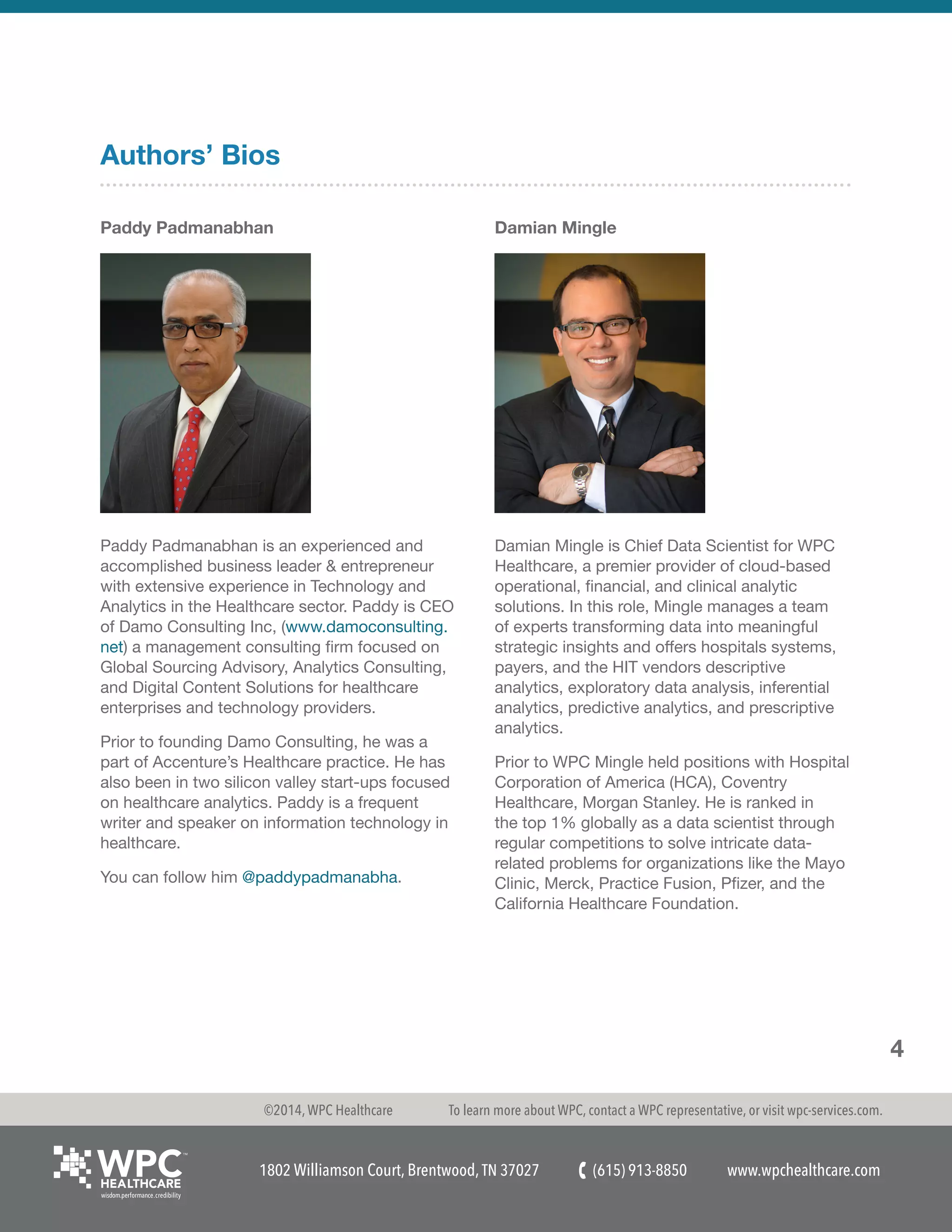
Authors’ Bios
Paddy Padmanabhan Damian Mingle
Paddy Padmanabhan is an experienced and
accomplished business leader & entrepreneur
with extensive experience in Technology and
Analytics in the Healthcare sector. Paddy is CEO
of Damo Consulting Inc, (www.damoconsulting.
net) a management consulting firm focused on
Global Sourcing Advisory, Analytics Consulting,
and Digital Content Solutions for healthcare
enterprises and technology providers.
Prior to founding Damo Consulting, he was a
part of Accenture’s Healthcare practice. He has
also been in two silicon valley start-ups focused
on healthcare analytics. Paddy is a frequent
writer and speaker on information technology in
healthcare.
You can follow him @paddypadmanabha.
©2014,WPC Healthcare To learn more about WPC, contact a WPC representative, or visit wpc-services.com.
Damian Mingle is Chief Data Scientist for WPC
Healthcare, a premier provider of cloud-based
operational, financial, and clinical analytic
solutions. In this role, Mingle manages a team
of experts transforming data into meaningful
strategic insights and offers hospitals systems,
payers, and the HIT vendors descriptive
analytics, exploratory data analysis, inferential
analytics, predictive analytics, and prescriptive
analytics.
Prior to WPC Mingle held positions with Hospital
Corporation of America (HCA), Coventry
Healthcare, Morgan Stanley. He is ranked in
the top 1% globally as a data scientist through
regular competitions to solve intricate data-
related problems for organizations like the Mayo
Clinic, Merck, Practice Fusion, Pfizer, and the
California Healthcare Foundation.
1802 Williamson Court, Brentwood, TN 37027 (615) 913-8850 www.wpchealthcare.com
4

Case Study: Advanced analytics in healthcare using unstructured data

  • 1.
    A Case Studyon the Use of Unstructured Data in Healthcare Analytics Analysis of Images for Diabetic Retinopathy
  • 2.
    A Case Studyon the Use of Unstructured Data in Healthcare Analytics: Analysis of Images for Diabetic Retinopathy Precision medicine is being advanced today by a combination of advanced analytics and physician expertise. The new frontier in this field is the analysis of unstructured data. We know that most medical information resides in unstructured form – the most common forms are clinical notes and images. However, most of the analytics in healthcare today focuses on structured data, typically from hospital EMR and claims/reimbursement related systems. In this paper, the authors explore the new frontiers in the analysis of unstructured data by discussing a specific case where images were used effectively in vision care, and discuss the potential uses of images across a wide range of situations and use cases. Importantly, the case study is an illustration of how technology and advanced analytics complement a skilled physician’s intuition and expertise, without necessarily supplanting it. The Project EyePACS, a provider of picture archive communication systems offered the original data set for analysis. WPC Healthcare, a Nashville- based advanced analytics company enabled the evaluation of diabetic retinopathy through an analysis of retinal images that gave early warning of disease progression. By applying the industry standard, a five-part scoring system, each individual patient was evaluated for degree of risk, and the results were then compared with the physician’s original diagnosis. Diabetic retinopathy is a condition suffered by diabetics that causes progressive damage to the retina. There is a classification system used dividing the retina into quadrants and counting hemorrhages, exudates, neovascularization, and other defects. Counting hemorrhages is an objective measurement but classification by visual analysis is subject to human error. This gives rise to a lot of variance. The premise here is that a data science approach, driven by technology, could reduce/eliminate this variance by enabling the analysis of a large number of images to more accurately detect patterns that can inform a physician’s diagnosis. Most ophthalmologists see about 5,000 patients per year (or 10,000 eyes). In this case, the analysis included a half a million images to train a computer to recognize the disease stages by “looking at” a more expansive view of the image, and discounting errors. So, 50 years of clinical experience compressed into a single 24-hour period. The resulting benefits from an enhanced ability to analyze a vast number of images using software greatly improve the quality of diagnosis. These benefits can be extended to other use cases in the field of radiology in general. 1
  • 3.
    The Data SciencePrinciples and Approach to the Problem Although human beings learn over time, gathering knowledge and applying it, a computer retains everything that is learned and continues to evolve at a staggering rate. From a data science perspective, the approach was to treat this as a multi-class classification problem. In this case there were 5 classes, 4 disease states and no disease state. The computer was trained to identify disease states based on the images. The nature of the problem required the team to create a neural network algorithm. There was a small set of images that came to us originally (35k images). Neural network algorithms need large datasets to expand the opportunity to find issues, hence the data sets were expanded synthetically to train the computer to see an ``infinite” number of things. The value of using this approach was to enable to the physician to benefit from computerized backup with the ability to see more based on a better process and greater history. All healthcare data is “dirty” from an analytic standpoint. When dealing with images, there are often defects on the images resulting from poor image quality that may erroneously appear to indicate disease. The software learns to discriminate between a defect in the image (poor quality, incorrect position such as left and right eye), and actual disease. This provides more context to the provider to arrive at a final diagnosis. The volume of the total dataset required an appropriate computing infrastructure. The Graphics Processing Unit (GPU) infrastructure enabled the processing of the images in 24 hours to train the model. On a regular CPU, it would have taken 2 weeks or more. The goal was to have enough data to minimize the outliers and train the computer to read the image correctly. Data is everywhere, images are no different than 0s and 1s. But many data scientists don’t touch imaging because it’s layered and has a spatial aspect, it’s not flat and not labeled. A computer reads this kind of data differently and can retain the memory of what is being viewed. Data and Computing Challenges 2
  • 4.
    How We Executedthe Project and What We Learned from the Process Conclusions Several conclusions and business benefits can be derived from this unique project: 1. Software developed from this use case could be extended and applied to imaging software (along with pre-authorization software for example). So in a real-time context, the provider could actually use this to validate and ensure that their impression is accurate. It thus creates a real opportunity to enhance quality so that treatment matches diagnosis. 2. In rural settings, physicians can read images with software and obtain “second opinions” without requiring patients to go anywhere else. 3. This can be extended to high-volume radiology use cases such mammography that typically requires a dedicated radiologic resource. Most radiologists read everything (broken bones to cancer scans) with a computer backup providing expertise that a single radiologist can’t gather in a lifetime, physician training is enhanced and mistakes minimized. Of course, a physician review would still be a necessity. The feedback from, Daxx Dunn, O.D., a provider with years in the field provides further insight: The use of unstructured data is a new frontier in healthcare data analytics. The analysis of images, in particular, requires specialized skills and advanced software. Typically, the computing infrastructure has to be more robust than in standard environments. Since images form a significant part of patient medical history, it is important to explore this frontier and expand it to other use cases such as radiology departments. The ability to rely on a computer to process large volumes of images and approve the results is a game changer in precision medicine. The resulting ability to scale would be tremendous and the accuracy would certainly be improved as well. Finally, the cost savings could also be significant. Ultimately, the benefits will be in the form of early detection and treatment which will result in improved quality of care and lower costs of care for patient populations. “This concept could provide a more consistent means for doctors to confidently classify various stages of diabetic retinopathy. It could also be a valuable tool for students as well as established clinicians in giving them an instant, objective second opinion. Beyond the benefit to the doctors, there is the potential added benefit to the patients (time, money, and peace of mind) and cost saving benefits to the healthcare system (less money spent on facilities, tests, multiple visits for the same diagnoses, etc.)” 3
  • 5.
    Authors’ Bios Paddy PadmanabhanDamian Mingle Paddy Padmanabhan is an experienced and accomplished business leader & entrepreneur with extensive experience in Technology and Analytics in the Healthcare sector. Paddy is CEO of Damo Consulting Inc, (www.damoconsulting. net) a management consulting firm focused on Global Sourcing Advisory, Analytics Consulting, and Digital Content Solutions for healthcare enterprises and technology providers. Prior to founding Damo Consulting, he was a part of Accenture’s Healthcare practice. He has also been in two silicon valley start-ups focused on healthcare analytics. Paddy is a frequent writer and speaker on information technology in healthcare. You can follow him @paddypadmanabha. ©2014,WPC Healthcare To learn more about WPC, contact a WPC representative, or visit wpc-services.com. Damian Mingle is Chief Data Scientist for WPC Healthcare, a premier provider of cloud-based operational, financial, and clinical analytic solutions. In this role, Mingle manages a team of experts transforming data into meaningful strategic insights and offers hospitals systems, payers, and the HIT vendors descriptive analytics, exploratory data analysis, inferential analytics, predictive analytics, and prescriptive analytics. Prior to WPC Mingle held positions with Hospital Corporation of America (HCA), Coventry Healthcare, Morgan Stanley. He is ranked in the top 1% globally as a data scientist through regular competitions to solve intricate data- related problems for organizations like the Mayo Clinic, Merck, Practice Fusion, Pfizer, and the California Healthcare Foundation. 1802 Williamson Court, Brentwood, TN 37027 (615) 913-8850 www.wpchealthcare.com 4