Machine Learning and
Prediction in Medicine
Chad You
Agenda
Source: https://www.ncbi.nlm.nih.gov/pmc/articles/PMC5953825/
• Capabilities of ML in Medicine
• Limitations of ML
• Solutions
Capabilities of
ML in Medicine
• Improve prognosis dramatically
• Data could be drawn directly
from EHRs or claims databases,
allowing models to use
thousands of rich predictor
variables.
• Precisely identify metastatic
cancer patients with high
mortality rates.
• Prognostic algorithms will come
into use in recent years.
Capabilities of
ML in Medicine
• Displace much of the work of
radiologists and anatomical
pathologists
• Algorithms can replace a second
radiologist reading
mammograms and will soon
exceed human accuracy.
• Algorithms need no sleep, and
their vigilance is the same at
2am as at 9am.
Capabilities of
ML in Medicine
• Improve diagnostic accuracy
• Algorithms will soon generate
differential diagnoses, suggest
high-value tests, and reduce
overuse of testing.
Limitations of
ML
• Diagnosis
• Gold standard for diagnosis is unclear
in many conditions, which makes it
harder to train algorithms.
• High-value EHR data are often stored
in unstructured formats that are
inaccessible to algorithms without
layers of preprocessing.
• Models need to be built and
validated individually for each
diagnosis.
Limitations of
ML
• Prediction
• No ML can squeeze out information
that is not present.
• Clinical data alone have relatively
limited predictive power for
hospital readmissions.
Limitations of
ML
• Prediction
• Accumulating multiple years of
historical data is worse than simply
using the most recent year of data.
• Half-life of clinical data: 4 months
Limitations of
ML
• Prediction
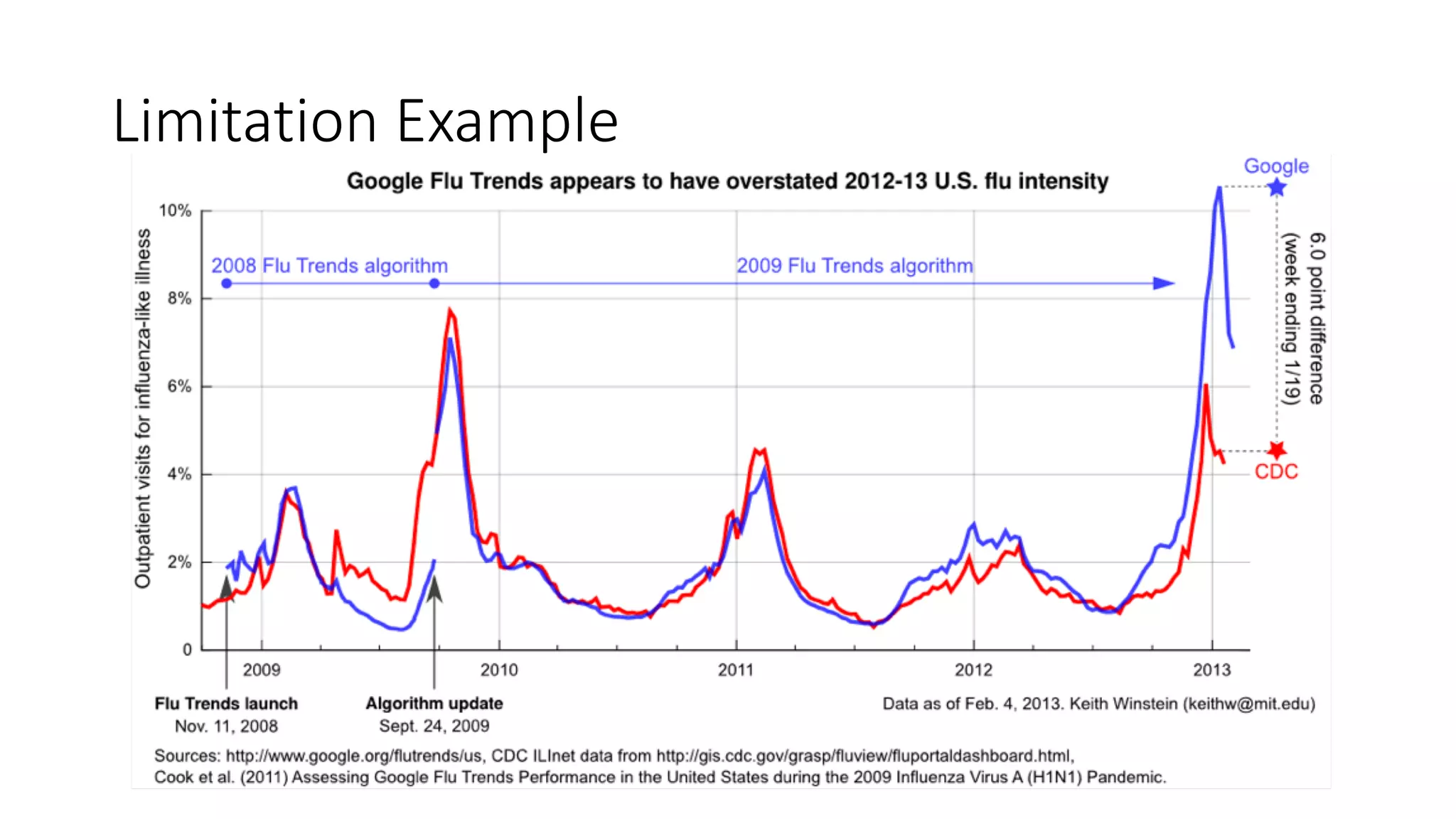
• To assess the usefulness of
prediction models, we must evaluate
the accuracy in predicting future
events, not on their ability to
recapitulate historical trends.
Limitation Example
Solutions
• Get varieties of data
• social-demographics
• personal genomics
• mobile-sensor readouts
• patient’s credit history
• Web-browsing logs
Solutions
• Reframing complex phenomena in
terms of limited multiple-choice
questions
• Will you have a heart attack
within 10 years?
• Are you more or less likely than
average to end up back in the
hospital within 30 days?
Solutions
• Predicting events early enough for a
relevant intervention to influence care
decisions and outcomes.
Machine Learning and Prediction in Medicine

Machine Learning and Prediction in Medicine

  • 1.
    Machine Learning and Predictionin Medicine Chad You
  • 3.
  • 4.
    Capabilities of ML inMedicine • Improve prognosis dramatically • Data could be drawn directly from EHRs or claims databases, allowing models to use thousands of rich predictor variables. • Precisely identify metastatic cancer patients with high mortality rates. • Prognostic algorithms will come into use in recent years.
  • 5.
    Capabilities of ML inMedicine • Displace much of the work of radiologists and anatomical pathologists • Algorithms can replace a second radiologist reading mammograms and will soon exceed human accuracy. • Algorithms need no sleep, and their vigilance is the same at 2am as at 9am.
  • 6.
    Capabilities of ML inMedicine • Improve diagnostic accuracy • Algorithms will soon generate differential diagnoses, suggest high-value tests, and reduce overuse of testing.
  • 8.
    Limitations of ML • Diagnosis •Gold standard for diagnosis is unclear in many conditions, which makes it harder to train algorithms. • High-value EHR data are often stored in unstructured formats that are inaccessible to algorithms without layers of preprocessing. • Models need to be built and validated individually for each diagnosis.
  • 9.
    Limitations of ML • Prediction •No ML can squeeze out information that is not present. • Clinical data alone have relatively limited predictive power for hospital readmissions.
  • 10.
    Limitations of ML • Prediction •Accumulating multiple years of historical data is worse than simply using the most recent year of data. • Half-life of clinical data: 4 months
  • 11.
    Limitations of ML • Prediction •To assess the usefulness of prediction models, we must evaluate the accuracy in predicting future events, not on their ability to recapitulate historical trends.
  • 12.
  • 13.
    Solutions • Get varietiesof data • social-demographics • personal genomics • mobile-sensor readouts • patient’s credit history • Web-browsing logs
  • 14.
    Solutions • Reframing complexphenomena in terms of limited multiple-choice questions • Will you have a heart attack within 10 years? • Are you more or less likely than average to end up back in the hospital within 30 days?
  • 15.
    Solutions • Predicting eventsearly enough for a relevant intervention to influence care decisions and outcomes.