USING DATA MINING TECHNIQUES IN HEART DISEASE DIAGNOSIS
                               AND TREATMENT


OBJECTIVE:


      The main Objective of the project Is by applying the predictive data
miningtechniques (both single and hybrid) to the heart disease patients for
diagnosing and also for the treatment of heart disease.


PROBLEM STATEMENT:


           Clinical decisions are often made based on doctors’ intuition and
             experience rather than on the knowledge rich data hidden in the
             database.
           Medical Misdiagnoses are a serious risk to our healthcare profession.
             If they continue, then people will fear going to the hospital for
             treatment. We can put an end to medical misdiagnosis by informing
             the public and filing claims and suits against the medical practitioners
             at fault.


ABSTRACT:


      Disease diagnosis is one of the applications where data mining tools are
proving successful results. Heart disease is the leading cause of death all over the
world. Using Single Data Mining Technique in the diagnosis of heart disease has
been comprehensively investigated showing acceptable levels of accuracy.
However, using data mining techniques to identify a suitable treatment for heart
disease patients has received less attention. This paper identifies gaps in the
research on heart disease diagnosis and treatment and proposes a model to
systematically close those gaps to discover if applying data mining techniques to
heart disease treatment data can provide as reliable performance as that achieved in
diagnosing heart disease.


EXISTING SYSTEM:


          In Existing system, the single data mining technique is used to
            diagnose the heart disease. There is no previous research that
            identifies which data mining technique can provide more reliable
            accuracy in identifying suitable treatment for heart disease patients.
          Practical use of healthcare database systems and knowledge discovery
            is difficult in heart disease diagnosis.


DISADVANTAGES:


          Hospitals do not provide the same quality of service even though they
            provide the same type of service.
          There is no previous research that identifies which data mining
            technique can provide more reliable accuracy in identifying suitable
            treatment for heart disease patients.
          It takes more time consumption for practical use of healthcare
            database systems.
PROPOSED SYSTEM:


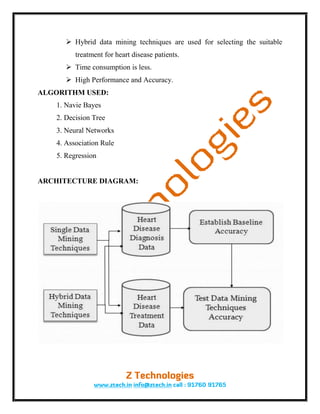
       In Proposed System, we are applying data mining techniques (Hybrid)
         in identifying suitable treatments for heart disease patients.
       Apply single data mining techniques to heart disease diagnosis
         benchmark dataset to establish baseline accuracy for each single data
         mining technique in the diagnosis of heart disease patients.
       Apply the same single data mining techniques used in heart disease
         diagnosis to heart disease treatment dataset to investigate if single data
         mining techniques can achieve equivalent (or better) results in
         identifying suitable treatments as that achieved in the diagnosis.
       Apply hybrid data mining techniques to heart disease diagnosis
         benchmark dataset to establish baseline accuracy for each hybrid data
         mining technique in the diagnosis of heart disease patients.
       Apply the same hybrid data mining techniques used in heart disease
         diagnosis to heart disease treatment dataset to investigate if hybrid
         data mining techniques can achieve equivalent (or better) results in
         identifying suitable treatments as that achieved in the diagnosis.


ADVANTAGES:


       By applying data mining techniques to help health care professionals
         in the diagnosis of heart disease.
 Hybrid data mining techniques are used for selecting the suitable
         treatment for heart disease patients.
       Time consumption is less.
       High Performance and Accuracy.
ALGORITHM USED:
   1. Navie Bayes
   2. Decision Tree
   3. Neural Networks
   4. Association Rule
   5. Regression


ARCHITECTURE DIAGRAM:
SYSTEM REQUIREMENTS:


  Hardware Requirements:
           •     Intel Pentium IV
           •     256/512 MB RAM
           •     1 GB Free disk space or greater
           •     1 GB on Boot Drive
           •     17” XVGA display monitor
           •      1 Network Interface Card (NIC)


  Software Requirements:

           •     MS Windows XP/ Windows 7
           •     MS IE Browser 6.0/later
           •     MS Dot Net Framework 4.0
           •     MS Visual Studio.Net 2010
           •     Internet Information Server (IIS)
           •     MS SQL Server 2005
           •     Windows Installer 3.1


Applications

         Hospitals Management
         Health care Institutions.

Psdot 14 using data mining techniques in heart

  • 1.
    USING DATA MININGTECHNIQUES IN HEART DISEASE DIAGNOSIS AND TREATMENT OBJECTIVE: The main Objective of the project Is by applying the predictive data miningtechniques (both single and hybrid) to the heart disease patients for diagnosing and also for the treatment of heart disease. PROBLEM STATEMENT:  Clinical decisions are often made based on doctors’ intuition and experience rather than on the knowledge rich data hidden in the database.  Medical Misdiagnoses are a serious risk to our healthcare profession. If they continue, then people will fear going to the hospital for treatment. We can put an end to medical misdiagnosis by informing the public and filing claims and suits against the medical practitioners at fault. ABSTRACT: Disease diagnosis is one of the applications where data mining tools are proving successful results. Heart disease is the leading cause of death all over the world. Using Single Data Mining Technique in the diagnosis of heart disease has
  • 2.
    been comprehensively investigatedshowing acceptable levels of accuracy. However, using data mining techniques to identify a suitable treatment for heart disease patients has received less attention. This paper identifies gaps in the research on heart disease diagnosis and treatment and proposes a model to systematically close those gaps to discover if applying data mining techniques to heart disease treatment data can provide as reliable performance as that achieved in diagnosing heart disease. EXISTING SYSTEM:  In Existing system, the single data mining technique is used to diagnose the heart disease. There is no previous research that identifies which data mining technique can provide more reliable accuracy in identifying suitable treatment for heart disease patients.  Practical use of healthcare database systems and knowledge discovery is difficult in heart disease diagnosis. DISADVANTAGES:  Hospitals do not provide the same quality of service even though they provide the same type of service.  There is no previous research that identifies which data mining technique can provide more reliable accuracy in identifying suitable treatment for heart disease patients.  It takes more time consumption for practical use of healthcare database systems.
  • 3.
    PROPOSED SYSTEM:  In Proposed System, we are applying data mining techniques (Hybrid) in identifying suitable treatments for heart disease patients.  Apply single data mining techniques to heart disease diagnosis benchmark dataset to establish baseline accuracy for each single data mining technique in the diagnosis of heart disease patients.  Apply the same single data mining techniques used in heart disease diagnosis to heart disease treatment dataset to investigate if single data mining techniques can achieve equivalent (or better) results in identifying suitable treatments as that achieved in the diagnosis.  Apply hybrid data mining techniques to heart disease diagnosis benchmark dataset to establish baseline accuracy for each hybrid data mining technique in the diagnosis of heart disease patients.  Apply the same hybrid data mining techniques used in heart disease diagnosis to heart disease treatment dataset to investigate if hybrid data mining techniques can achieve equivalent (or better) results in identifying suitable treatments as that achieved in the diagnosis. ADVANTAGES:  By applying data mining techniques to help health care professionals in the diagnosis of heart disease.
  • 4.
     Hybrid datamining techniques are used for selecting the suitable treatment for heart disease patients.  Time consumption is less.  High Performance and Accuracy. ALGORITHM USED: 1. Navie Bayes 2. Decision Tree 3. Neural Networks 4. Association Rule 5. Regression ARCHITECTURE DIAGRAM:
  • 5.
    SYSTEM REQUIREMENTS: Hardware Requirements: • Intel Pentium IV • 256/512 MB RAM • 1 GB Free disk space or greater • 1 GB on Boot Drive • 17” XVGA display monitor • 1 Network Interface Card (NIC) Software Requirements: • MS Windows XP/ Windows 7 • MS IE Browser 6.0/later • MS Dot Net Framework 4.0 • MS Visual Studio.Net 2010 • Internet Information Server (IIS) • MS SQL Server 2005 • Windows Installer 3.1 Applications  Hospitals Management  Health care Institutions.