ASSIGNMENT
ON
Expert System Design
SUBMITTED TO
Dr. Rudra Banerjee
SUBMITTED BY
Shashwat Shankar
IMB2018017
1. (a) Give a definition of “Expert System”.
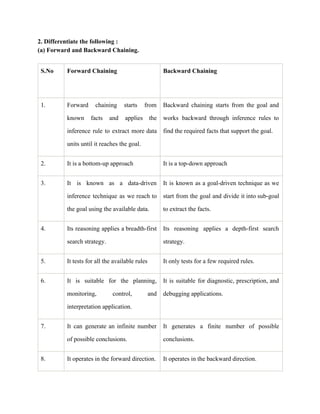
A computer application that performs a task that would otherwise be performed by a human
expert. For example, there are expert systems that can diagnose human illnesses, make financial
forecasts, and schedule routes for delivery vehicles. Some expert systems are designed to take
the place of human experts, while others are designed to aid them.
Expert systems are part of a general category of computer applications known as artificial
intelligence. To design an expert system, one needs a knowledge engineer, an individual who
studies how human experts make decisions and translates the rules into terms that a computer
can understand.
An expert system has been reliably used in the business world to gain tactical advantages and
forecast the market’s condition. In this globalization era where every decision made in the
business world is critical for success; the assistance provided from an expert system is
undoubtedly essential and highly reliable for an organization to succeed.
Advantages of Using Expert System:
● Providing consistent solutions:
● Provides reasonable explanations:
● Overcome human limitations:
● Easy to adapt to new conditions:
Although the expert system does provide many significant advantages, it does have its
drawbacks as well.
Disadvantages of Using Expert System:
● Lacks common sense:
● High implementation and maintenance cost:
● Difficulty in creating inference rules:
● May provide wrong solutions:
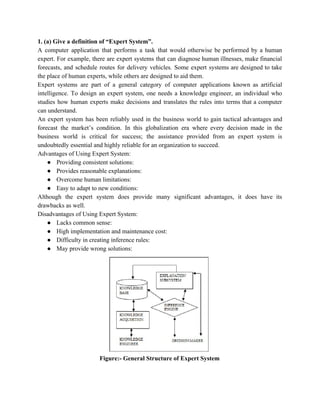
Figure:- General Structure of Expert System
For example, biomedical researchers started creating computer-aided systems for diagnostic
applications in medicine and biology. These early diagnostic systems used patients’ symptoms
and laboratory test results as inputs to generate a diagnostic outcome. These systems were often
described as the early forms of expert systems. However, researchers had realized that there were
significant limitations when using traditional methods such as flow-charts statistical
pattern-matching, or probability theory.
(b) Outline how Expert Systems can be distinguished from more conventional computer
systems.
Expert Systems Conventional computer systems.
1. In the expert system approach all of
the problem-related expertise is
encoded in data structures only, none
is in programs.
2. In expert systems, the use of
knowledge is vital.
3. Expert systems are capable of
explaining how a particular conclusion
is reached and why requested
information is needed during a
process. However, the problems are
solved more efficiently than a
conventional system by an expert
system
4. Generally in an expert system, it uses
the symbolic representations for
knowledge i.e. the rules, different
forms of networks, frames, scripts, etc.
and performs their inference through
symbolic computations.
1. In conventional applications, problem
expertise is encoded in both program
and data structures.
2. Conventional system data is used
more efficiently than knowledge.
3. Conventional systems are not capable
of explaining a particular conclusion
for a problem. These systems try to
solve in a straight forward manner.
4. But conventional systems are unable
to express these terms. They just
simplify the problems in a straight
forward manner and are incapable to
express the “how, why” questions.
Also, the problem-solving tools that
are present in the expert systems are
purely absent in conventional systems.
(c) In the context of Expert Systems, describe what the term “knowledge acquisition”
covers.
Knowledge acquisition is the process to extract structure and organize the knowledge from
various sources of human experts and is also consider as the process of adding new knowledge
and to change which was anonymously acquired to the knowledge base. It is mainly used in
system development. The purpose of knowledge acquisition is to elaborate on the capability of
the system to improve the specific task of the performance consisting of facts, rules, concepts,
procedures, heuristics, formulas, relationships, or other useful information.
The knowledge acquisition process facilitates the assimilation of knowledge and experiences of
different specialties. For example, an agricultural diagnostic expert system requires the
integration of specialists in various fields such as nutrition, plant pathology, entomology,
breading, and production. When the problem occurs, the system can help the user more efficient
in identifying the cause of the problem. It then helps in consulting a document that handles a
specific problem
Expert databases are developed through a formal knowledge acquisition process which includes
identification, conceptualization, formalization, implementation, and testing. To extract
information from a human expert, we are using the common means of extracting methods like
interviews, transactional tracking, observation, case study, and self-reporting choices. Expert
Systems put together the investigation and interpretation of data input with specific rules of
actions and facts to arrive at a recommended outcome using programmatic and physical
representation of logic, data, and choice.
The importance of assuring the quality of expert systems is now widely recognized. Quality
assurance is a major issue in the development of expert systems. A consensus has been reached
in the literature that the evaluation of expert systems to ensure their reliability involves two
principal activities, usually called verification and validation. Studies have shown that
verification, can lead to the early detection of errors that otherwise would have remained even
after extensive validation tests. This verification and validation process is molded in the IS
Expert module of the system prototype.
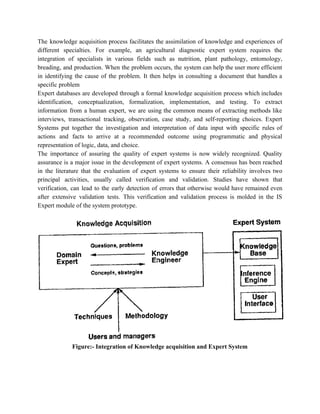
Figure:- Integration of Knowledge acquisition and Expert System
2. Differentiate the following :
(a) Forward and Backward Chaining.
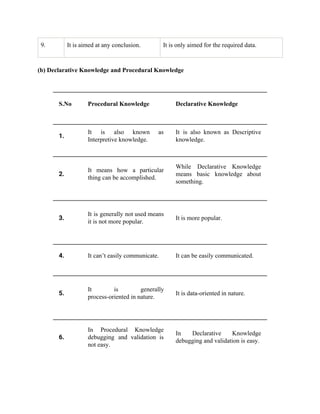
S.No Forward Chaining Backward Chaining
1. Forward chaining starts from
known facts and applies the
inference rule to extract more data
units until it reaches the goal.
Backward chaining starts from the goal and
works backward through inference rules to
find the required facts that support the goal.
2. It is a bottom-up approach It is a top-down approach
3. It is known as a data-driven
inference technique as we reach to
the goal using the available data.
It is known as a goal-driven technique as we
start from the goal and divide it into sub-goal
to extract the facts.
4. Its reasoning applies a breadth-first
search strategy.
Its reasoning applies a depth-first search
strategy.
5. It tests for all the available rules It only tests for a few required rules.
6. It is suitable for the planning,
monitoring, control, and
interpretation application.
It is suitable for diagnostic, prescription, and
debugging applications.
7. It can generate an infinite number
of possible conclusions.
It generates a finite number of possible
conclusions.
8. It operates in the forward direction. It operates in the backward direction.
9. It is aimed at any conclusion. It is only aimed for the required data.
(b) Declarative Knowledge and Procedural Knowledge
S.No Procedural Knowledge Declarative Knowledge
1. 
It is also known as
Interpretive knowledge.
It is also known as Descriptive
knowledge.
2. 
It means how a particular
thing can be accomplished.
While Declarative Knowledge
means basic knowledge about
something.
3. 
It is generally not used means
it is not more popular.
It is more popular.
4.  It can’t easily communicate. It can be easily communicated.
5. 
It is generally
process-oriented in nature.
It is data-oriented in nature.
6. 
In Procedural Knowledge
debugging and validation is
not easy.
In Declarative Knowledge
debugging and validation is easy.
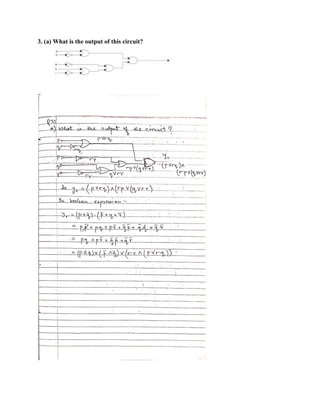
3. (a) What is the output of this circuit?
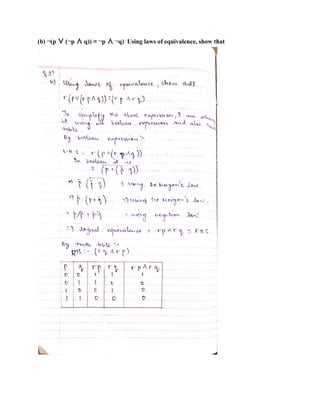
(b) ¬(p ∨ (¬p ∧ q)) ≡ ¬p ∧ ¬q) Using laws of equivalence, show that
4. P be a probability function on a sample space Ω. Let hi ⊆ Ω, i = 1, . . . , n, n > [10]Let 1,
be mutually exclusive hypotheses with P(hi) > 0, such that ∪ n i=1hi = Ω (that is, they are
collectively exhaustive). Furthermore, let e ⊆ Ω such that P (e) > 0.
Then, the following property holds:
P(hi |e) = P(e|hi) · P(hi) Pn j=1 P(e|hj ) · P(hj )
Expert system design

Expert system design

  • 1.
    ASSIGNMENT ON Expert System Design SUBMITTEDTO Dr. Rudra Banerjee SUBMITTED BY Shashwat Shankar IMB2018017
  • 2.
    1. (a) Givea definition of “Expert System”. A computer application that performs a task that would otherwise be performed by a human expert. For example, there are expert systems that can diagnose human illnesses, make financial forecasts, and schedule routes for delivery vehicles. Some expert systems are designed to take the place of human experts, while others are designed to aid them. Expert systems are part of a general category of computer applications known as artificial intelligence. To design an expert system, one needs a knowledge engineer, an individual who studies how human experts make decisions and translates the rules into terms that a computer can understand. An expert system has been reliably used in the business world to gain tactical advantages and forecast the market’s condition. In this globalization era where every decision made in the business world is critical for success; the assistance provided from an expert system is undoubtedly essential and highly reliable for an organization to succeed. Advantages of Using Expert System: ● Providing consistent solutions: ● Provides reasonable explanations: ● Overcome human limitations: ● Easy to adapt to new conditions: Although the expert system does provide many significant advantages, it does have its drawbacks as well. Disadvantages of Using Expert System: ● Lacks common sense: ● High implementation and maintenance cost: ● Difficulty in creating inference rules: ● May provide wrong solutions: Figure:- General Structure of Expert System
  • 3.
    For example, biomedicalresearchers started creating computer-aided systems for diagnostic applications in medicine and biology. These early diagnostic systems used patients’ symptoms and laboratory test results as inputs to generate a diagnostic outcome. These systems were often described as the early forms of expert systems. However, researchers had realized that there were significant limitations when using traditional methods such as flow-charts statistical pattern-matching, or probability theory. (b) Outline how Expert Systems can be distinguished from more conventional computer systems. Expert Systems Conventional computer systems. 1. In the expert system approach all of the problem-related expertise is encoded in data structures only, none is in programs. 2. In expert systems, the use of knowledge is vital. 3. Expert systems are capable of explaining how a particular conclusion is reached and why requested information is needed during a process. However, the problems are solved more efficiently than a conventional system by an expert system 4. Generally in an expert system, it uses the symbolic representations for knowledge i.e. the rules, different forms of networks, frames, scripts, etc. and performs their inference through symbolic computations. 1. In conventional applications, problem expertise is encoded in both program and data structures. 2. Conventional system data is used more efficiently than knowledge. 3. Conventional systems are not capable of explaining a particular conclusion for a problem. These systems try to solve in a straight forward manner. 4. But conventional systems are unable to express these terms. They just simplify the problems in a straight forward manner and are incapable to express the “how, why” questions. Also, the problem-solving tools that are present in the expert systems are purely absent in conventional systems. (c) In the context of Expert Systems, describe what the term “knowledge acquisition” covers. Knowledge acquisition is the process to extract structure and organize the knowledge from various sources of human experts and is also consider as the process of adding new knowledge and to change which was anonymously acquired to the knowledge base. It is mainly used in system development. The purpose of knowledge acquisition is to elaborate on the capability of the system to improve the specific task of the performance consisting of facts, rules, concepts, procedures, heuristics, formulas, relationships, or other useful information.
  • 4.
    The knowledge acquisitionprocess facilitates the assimilation of knowledge and experiences of different specialties. For example, an agricultural diagnostic expert system requires the integration of specialists in various fields such as nutrition, plant pathology, entomology, breading, and production. When the problem occurs, the system can help the user more efficient in identifying the cause of the problem. It then helps in consulting a document that handles a specific problem Expert databases are developed through a formal knowledge acquisition process which includes identification, conceptualization, formalization, implementation, and testing. To extract information from a human expert, we are using the common means of extracting methods like interviews, transactional tracking, observation, case study, and self-reporting choices. Expert Systems put together the investigation and interpretation of data input with specific rules of actions and facts to arrive at a recommended outcome using programmatic and physical representation of logic, data, and choice. The importance of assuring the quality of expert systems is now widely recognized. Quality assurance is a major issue in the development of expert systems. A consensus has been reached in the literature that the evaluation of expert systems to ensure their reliability involves two principal activities, usually called verification and validation. Studies have shown that verification, can lead to the early detection of errors that otherwise would have remained even after extensive validation tests. This verification and validation process is molded in the IS Expert module of the system prototype. Figure:- Integration of Knowledge acquisition and Expert System
  • 5.
    2. Differentiate thefollowing : (a) Forward and Backward Chaining. S.No Forward Chaining Backward Chaining 1. Forward chaining starts from known facts and applies the inference rule to extract more data units until it reaches the goal. Backward chaining starts from the goal and works backward through inference rules to find the required facts that support the goal. 2. It is a bottom-up approach It is a top-down approach 3. It is known as a data-driven inference technique as we reach to the goal using the available data. It is known as a goal-driven technique as we start from the goal and divide it into sub-goal to extract the facts. 4. Its reasoning applies a breadth-first search strategy. Its reasoning applies a depth-first search strategy. 5. It tests for all the available rules It only tests for a few required rules. 6. It is suitable for the planning, monitoring, control, and interpretation application. It is suitable for diagnostic, prescription, and debugging applications. 7. It can generate an infinite number of possible conclusions. It generates a finite number of possible conclusions. 8. It operates in the forward direction. It operates in the backward direction.
  • 6.
    9. It isaimed at any conclusion. It is only aimed for the required data. (b) Declarative Knowledge and Procedural Knowledge S.No Procedural Knowledge Declarative Knowledge 1.  It is also known as Interpretive knowledge. It is also known as Descriptive knowledge. 2.  It means how a particular thing can be accomplished. While Declarative Knowledge means basic knowledge about something. 3.  It is generally not used means it is not more popular. It is more popular. 4.  It can’t easily communicate. It can be easily communicated. 5.  It is generally process-oriented in nature. It is data-oriented in nature. 6.  In Procedural Knowledge debugging and validation is not easy. In Declarative Knowledge debugging and validation is easy.
  • 7.
    3. (a) Whatis the output of this circuit?
  • 8.
    (b) ¬(p ∨(¬p ∧ q)) ≡ ¬p ∧ ¬q) Using laws of equivalence, show that
  • 10.
    4. P bea probability function on a sample space Ω. Let hi ⊆ Ω, i = 1, . . . , n, n > [10]Let 1, be mutually exclusive hypotheses with P(hi) > 0, such that ∪ n i=1hi = Ω (that is, they are collectively exhaustive). Furthermore, let e ⊆ Ω such that P (e) > 0. Then, the following property holds: P(hi |e) = P(e|hi) · P(hi) Pn j=1 P(e|hj ) · P(hj )