Machine Learning for Medical Imaging
Bradley J. Erickson, MD, PhD, Panagiotis Korfiatis, PhD,
Zeynettin Akkus, PhD, Timothy L. Kline, PhD
Machine learning has become one of the most promising tools for automating our
day to day life. If it is provided with a set of data and some knowledge about these
data, then the algorithm system can learn from the training data and apply what it
has learnt to make predictions.
It is now being widely applied in speech recognition, autonomous vehicle
navigation, product recommendation, language translation and medicine. One of
the promising fields in which machine learning algorithms can bring a revolution is
the medical image diagnosis.
Processing and analysing medical images for humans has been quite challenging
and error prone for decades. False positive or false negative can lead to fatal
results. Thus, machine learning algorithms can help to improve on image analysis
and prediction.
However, machine learning algorithms have their own pitfalls which must be taken
into consideration while using those algorithms.
Computer aided detection and diagnosis performed by using machine learning
algorithms can help physicians interpret medical findings and reduce
interpretations times.
Machine learning algorithms are user in several challenging task in radiology such
as pulmonary embolism segmentation with CT angiography, polyp detection with
virtual colonoscopy, CT in the setting of colon-cancer, breast cancer detection and
diagnosis with mammography, Brain tumor segmentation with MRI, Detection of
the cognitive state of brain with functional MRI to diagnose neuro-logic
disease(eg.Alzheimer disease)
In the mentioned article the researchers have taken a specific example of “Benign
or malignant tumors” detection.
There are three basic types of machine learning algorithms on the basis of training
styles. Supervised, unsupervised and reinforced machine learning. In the area of
medical science supervised machine learning is the widely used methodology
today.
In supervised machine learning the algorithm is provided with a set of data with
labels. The algorithm then learns from the training data and applies those training
results on a new data set.
For this article the training data set is the benign or malignant tumors images. And
it tries to predict whether an image of the brain does contain benign or malignant
tumors or not when provided with a new data set.
Most widely used supervised machine learning algorithms are Neural Networks,
k-Nearest Neighbors, Support Vector Machines, Decision Trees, Naive Bayes
Algorithm, Deep Learning.
Neural Networks
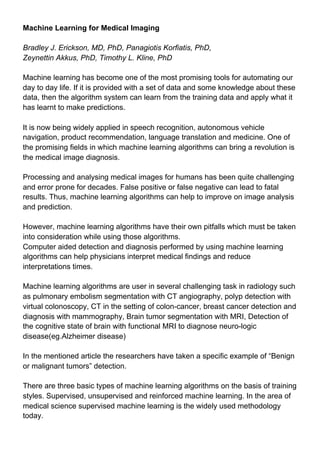
During the training phase, examples are presented to the neural network system,
the error for each example is computed, and the total error is computed.
On the basis of the error, the search
function determines.
This is an iterative process, and one
typically continues to adjust the
weights until there is little
improvement in the error. Real-world
examples typically have one or more
hidden layers and more complex
functions at each node.
k-Nearest Neighbors
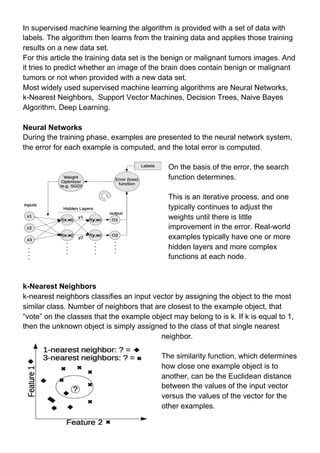
k-nearest neighbors classifies an input vector by assigning the object to the most
similar class. Number of neighbors that are closest to the example object, that
“vote” on the classes that the example object may belong to is k. If k is equal to 1,
then the unknown object is simply assigned to the class of that single nearest
neighbor.
The similarity function, which determines
how close one example object is to
another, can be the Euclidean distance
between the values of the input vector
versus the values of the vector for the
other examples.
Decision Trees
Decision trees uses rapid search for the many possible combinations of decision
points to find the points that will result in the simplest
tree with the most accurate results.
Naive Bayes Algorithm
In machine learning, where there are multiple input features, one must chain the
probabilities of each feature together to compute the final probability of a class,
given the array of input features that is provided. It follows the bayes theorem
formula. ​P(y|x) = [P(y) ×P(x|y)]/P(x)​: the probability (P) of y given x equals the
probability of y times the probability of x given y, divided by the probability of x.
Support Vector Machines
Support vector machines are so
named because they transform input
data in a way that produces the
widest plane, or support vector, of
separation between the two classes.
Deep Learning
Deep learning i.e. deep neural network learning is yielding impressive results and
growing fast. Early neural networks were typically only a few layers deep, largely
because the computing power was not sufficient for more layers and owing to
challenges in updating the weights properly. Deep learning refers to the use of
neural networks with many layers, typically more than 20.
There are several open source tools for developing and implementing machine
learning algorithms are available for the majority of modern programming
languages including Python, C++, MATLAB, R and Lua.
Furthermore, tools such as Apache Storm, Spark and H2O libraries have been
developed for machine learning tasks and large datasets.
Machine learning has been introduced in the field of medicine with tremendous
promise and expectations. However, Understanding the properties of machine
learning tools is critical to ensuring that they are applied in the safest and most
effective manner.

Artificial Intelligence in Medical Imaging

  • 1.
    Machine Learning forMedical Imaging Bradley J. Erickson, MD, PhD, Panagiotis Korfiatis, PhD, Zeynettin Akkus, PhD, Timothy L. Kline, PhD Machine learning has become one of the most promising tools for automating our day to day life. If it is provided with a set of data and some knowledge about these data, then the algorithm system can learn from the training data and apply what it has learnt to make predictions. It is now being widely applied in speech recognition, autonomous vehicle navigation, product recommendation, language translation and medicine. One of the promising fields in which machine learning algorithms can bring a revolution is the medical image diagnosis. Processing and analysing medical images for humans has been quite challenging and error prone for decades. False positive or false negative can lead to fatal results. Thus, machine learning algorithms can help to improve on image analysis and prediction. However, machine learning algorithms have their own pitfalls which must be taken into consideration while using those algorithms. Computer aided detection and diagnosis performed by using machine learning algorithms can help physicians interpret medical findings and reduce interpretations times. Machine learning algorithms are user in several challenging task in radiology such as pulmonary embolism segmentation with CT angiography, polyp detection with virtual colonoscopy, CT in the setting of colon-cancer, breast cancer detection and diagnosis with mammography, Brain tumor segmentation with MRI, Detection of the cognitive state of brain with functional MRI to diagnose neuro-logic disease(eg.Alzheimer disease) In the mentioned article the researchers have taken a specific example of “Benign or malignant tumors” detection. There are three basic types of machine learning algorithms on the basis of training styles. Supervised, unsupervised and reinforced machine learning. In the area of medical science supervised machine learning is the widely used methodology today.
  • 2.
    In supervised machinelearning the algorithm is provided with a set of data with labels. The algorithm then learns from the training data and applies those training results on a new data set. For this article the training data set is the benign or malignant tumors images. And it tries to predict whether an image of the brain does contain benign or malignant tumors or not when provided with a new data set. Most widely used supervised machine learning algorithms are Neural Networks, k-Nearest Neighbors, Support Vector Machines, Decision Trees, Naive Bayes Algorithm, Deep Learning. Neural Networks During the training phase, examples are presented to the neural network system, the error for each example is computed, and the total error is computed. On the basis of the error, the search function determines. This is an iterative process, and one typically continues to adjust the weights until there is little improvement in the error. Real-world examples typically have one or more hidden layers and more complex functions at each node. k-Nearest Neighbors k-nearest neighbors classifies an input vector by assigning the object to the most similar class. Number of neighbors that are closest to the example object, that “vote” on the classes that the example object may belong to is k. If k is equal to 1, then the unknown object is simply assigned to the class of that single nearest neighbor. The similarity function, which determines how close one example object is to another, can be the Euclidean distance between the values of the input vector versus the values of the vector for the other examples.
  • 3.
    Decision Trees Decision treesuses rapid search for the many possible combinations of decision points to find the points that will result in the simplest tree with the most accurate results. Naive Bayes Algorithm In machine learning, where there are multiple input features, one must chain the probabilities of each feature together to compute the final probability of a class, given the array of input features that is provided. It follows the bayes theorem formula. ​P(y|x) = [P(y) ×P(x|y)]/P(x)​: the probability (P) of y given x equals the probability of y times the probability of x given y, divided by the probability of x. Support Vector Machines Support vector machines are so named because they transform input data in a way that produces the widest plane, or support vector, of separation between the two classes. Deep Learning Deep learning i.e. deep neural network learning is yielding impressive results and growing fast. Early neural networks were typically only a few layers deep, largely because the computing power was not sufficient for more layers and owing to challenges in updating the weights properly. Deep learning refers to the use of neural networks with many layers, typically more than 20. There are several open source tools for developing and implementing machine learning algorithms are available for the majority of modern programming languages including Python, C++, MATLAB, R and Lua. Furthermore, tools such as Apache Storm, Spark and H2O libraries have been developed for machine learning tasks and large datasets. Machine learning has been introduced in the field of medicine with tremendous promise and expectations. However, Understanding the properties of machine learning tools is critical to ensuring that they are applied in the safest and most effective manner.