Prepared By:
Devesh Kumar
Manish Kumar
Raghvendra
Narendra
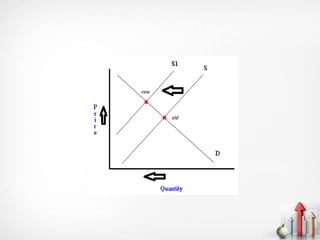
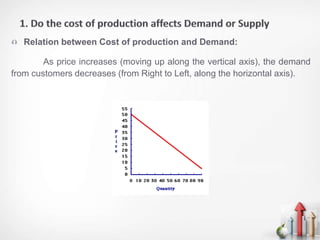
 Relation between Cost of production and Demand:
As price increases (moving up along the vertical axis), the demand
from customers decreases (from Right to Left, along the horizontal axis).
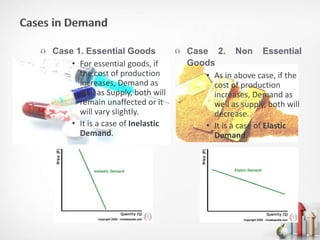
 Case 1. Essential Goods
• For essential goods, if
the cost of production
increases, Demand as
well as Supply, both will
remain unaffected or it
will vary slightly.
• It is a case of Inelastic
Demand.
 Case 2. Non Essential
Goods
• As in above case, if the
cost of production
increases, Demand as
well as supply, both will
decrease.
• It is a case of Elastic
Demand.
 Case 1: Essential Goods
• For essential goods,if
the Cost of Production
increases, the supply
will remain almost
unchanged.
• The more necessary a
good is, the lower the
price elasticity of
supply, as people will
attempt to buy it no
matter the price.
• E.g. Salt, Water etc.
 Case 2. Non essential
Goods
• As in above case, there
is shift in supply curve
i.e. the supply will
decreased with
increase in price.
e.g. Luxury items, Movie
Tickets etc.
 As in above case, there is shift along supply curve after taxation.
 Here two cases arise.
 Case 1.
• Essential goods:
• Demand and Supply curves are unaffected for essential goods with
price change.
• Inelastic supply
• It is a market situation in which any increase or decrease in the price
of a good or service does not result in a corresponding increase or
decrease in its supply.
• No shift along supply curve.
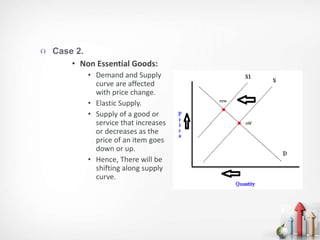
 Case 2.
• Non Essential Goods:
• Demand and Supply
curve are affected
with price change.
• Elastic Supply.
• Supply of a good or
service that increases
or decreases as the
price of an item goes
down or up.
• Hence, There will be
shifting along supply
curve.
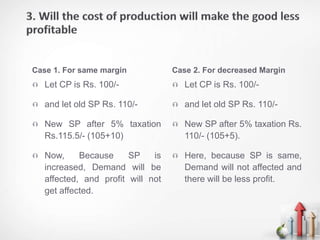
Case 1. For same margin
 Let CP is Rs. 100/-
 and let old SP Rs. 110/-
 New SP after 5% taxation
Rs.115.5/- (105+10)
 Now, Because SP is
increased, Demand will be
affected, and profit will not
get affected.
Case 2. For decreased Margin
 Let CP is Rs. 100/-
 and let old SP Rs. 110/-
 New SP after 5% taxation Rs.
110/- (105+5).
 Here, because SP is same,
Demand will not affected and
there will be less profit.
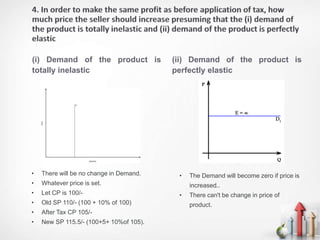
(i) Demand of the product is
totally inelastic
(ii) Demand of the product is
perfectly elastic
• There will be no change in Demand.
• Whatever price is set.
• Let CP is 100/-
• Old SP 110/- (100 + 10% of 100)
• After Tax CP 105/-
• New SP 115.5/- (100+5+ 10%of 105).
• The Demand will become zero if price is
increased..
• There can't be change in price of
product.
 Price
• Usually viewed as the most important factor that affects demand.
• Products have different sensitivity to changes in price.
• For example, demand for necessities such as bread, eggs and butter
does not tend to change significantly when prices move up or down
 Income levels
• When an individual’s income goes up, their ability to purchase
goods and services increases, and this causes demand to increase.
• When incomes fall there will be a decrease in the demand for most
goods.
 Consumer tastes and preferences
• Changing tastes and preferences can have a significant effect on
demand for different products. Persuasive advertising is designed to
cause a change in tastes and preferences and thereby create an
increase in demand. A good example of this is the recent surge in
sales of smoothies!
 Competition
• Competitors are always looking to take a bigger share of the market,
perhaps by cutting their prices or by introducing a new or better
version of a product
 Fashions
• When a product becomes unfashionable, demand can quickly fall
away.
 consumers´ tastes:
• when a consumer likes the good more he or she buys it more and
the demand increases
 consumers´ future expectations:
• When consumers expect higher prices in the future, they buy more
goods in order to avoid higher prices and as a result the demand
increases.

Case studies using Demand and Supply Concept

  • 1.
    Prepared By: Devesh Kumar ManishKumar Raghvendra Narendra
  • 4.
     Relation betweenCost of production and Demand: As price increases (moving up along the vertical axis), the demand from customers decreases (from Right to Left, along the horizontal axis).
  • 5.
     Case 1.Essential Goods • For essential goods, if the cost of production increases, Demand as well as Supply, both will remain unaffected or it will vary slightly. • It is a case of Inelastic Demand.  Case 2. Non Essential Goods • As in above case, if the cost of production increases, Demand as well as supply, both will decrease. • It is a case of Elastic Demand.
  • 6.
     Case 1:Essential Goods • For essential goods,if the Cost of Production increases, the supply will remain almost unchanged. • The more necessary a good is, the lower the price elasticity of supply, as people will attempt to buy it no matter the price. • E.g. Salt, Water etc.  Case 2. Non essential Goods • As in above case, there is shift in supply curve i.e. the supply will decreased with increase in price. e.g. Luxury items, Movie Tickets etc.
  • 7.
     As inabove case, there is shift along supply curve after taxation.  Here two cases arise.  Case 1. • Essential goods: • Demand and Supply curves are unaffected for essential goods with price change. • Inelastic supply • It is a market situation in which any increase or decrease in the price of a good or service does not result in a corresponding increase or decrease in its supply. • No shift along supply curve.
  • 8.
     Case 2. •Non Essential Goods: • Demand and Supply curve are affected with price change. • Elastic Supply. • Supply of a good or service that increases or decreases as the price of an item goes down or up. • Hence, There will be shifting along supply curve.
  • 9.
    Case 1. Forsame margin  Let CP is Rs. 100/-  and let old SP Rs. 110/-  New SP after 5% taxation Rs.115.5/- (105+10)  Now, Because SP is increased, Demand will be affected, and profit will not get affected. Case 2. For decreased Margin  Let CP is Rs. 100/-  and let old SP Rs. 110/-  New SP after 5% taxation Rs. 110/- (105+5).  Here, because SP is same, Demand will not affected and there will be less profit.
  • 10.
    (i) Demand ofthe product is totally inelastic (ii) Demand of the product is perfectly elastic • There will be no change in Demand. • Whatever price is set. • Let CP is 100/- • Old SP 110/- (100 + 10% of 100) • After Tax CP 105/- • New SP 115.5/- (100+5+ 10%of 105). • The Demand will become zero if price is increased.. • There can't be change in price of product.
  • 11.
     Price • Usuallyviewed as the most important factor that affects demand. • Products have different sensitivity to changes in price. • For example, demand for necessities such as bread, eggs and butter does not tend to change significantly when prices move up or down  Income levels • When an individual’s income goes up, their ability to purchase goods and services increases, and this causes demand to increase. • When incomes fall there will be a decrease in the demand for most goods.
  • 12.
     Consumer tastesand preferences • Changing tastes and preferences can have a significant effect on demand for different products. Persuasive advertising is designed to cause a change in tastes and preferences and thereby create an increase in demand. A good example of this is the recent surge in sales of smoothies!  Competition • Competitors are always looking to take a bigger share of the market, perhaps by cutting their prices or by introducing a new or better version of a product
  • 13.
     Fashions • Whena product becomes unfashionable, demand can quickly fall away.  consumers´ tastes: • when a consumer likes the good more he or she buys it more and the demand increases  consumers´ future expectations: • When consumers expect higher prices in the future, they buy more goods in order to avoid higher prices and as a result the demand increases.