TYPES OF ELASTICITY OF
DEMAND
• 1) PRICE ELASTICITY OF DEMAND
• 2) CROSS ELASTICITY OF DEMAND
• 3) INCOME ELASTICITY OF DEMAND
• 4) ADVERTISING OR PROMOTIONAL
ELASTICITY OF DEMAND
CROSS ELASTICITY OF
DEMAND
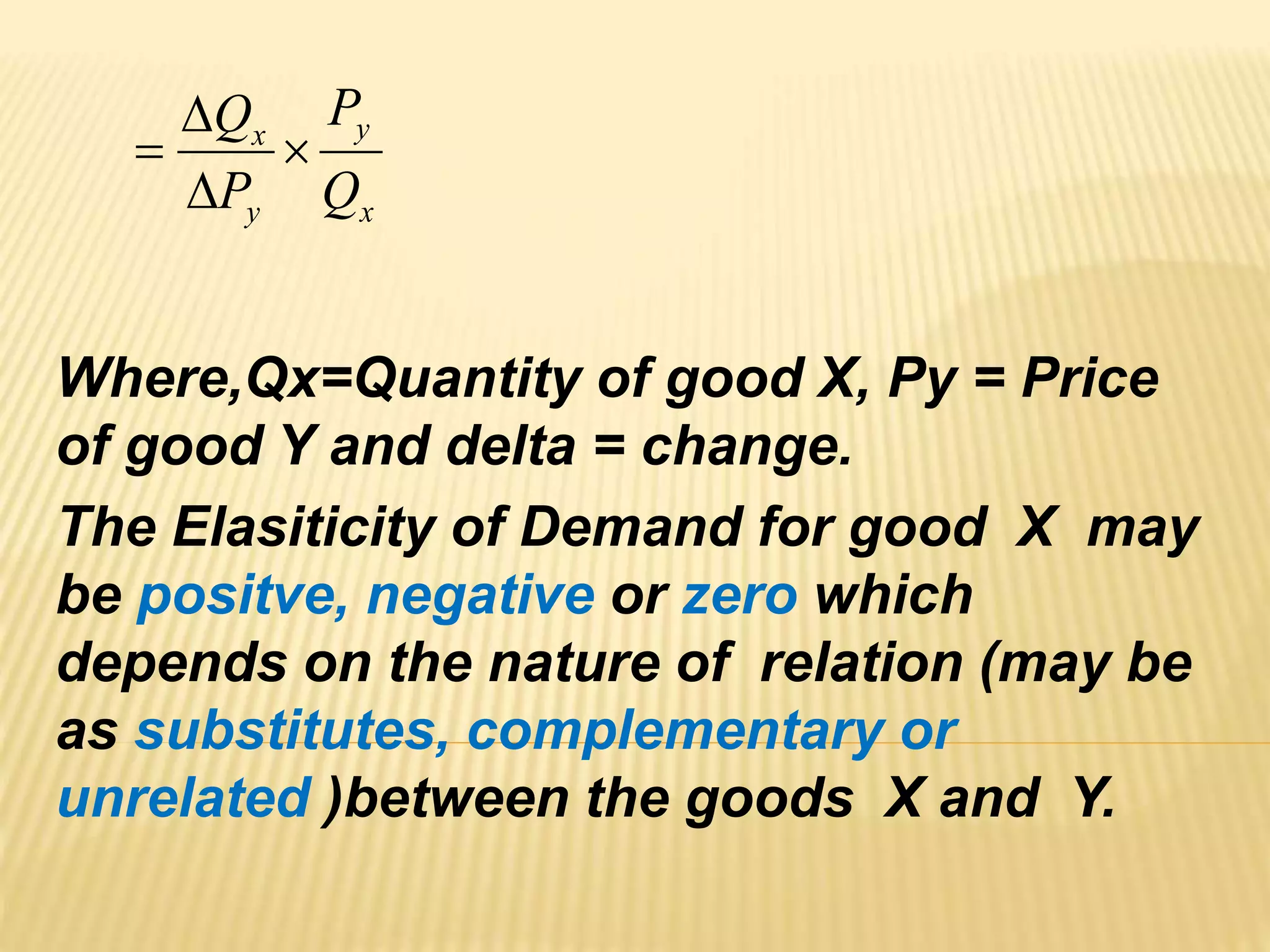
It is the relationship between % change in
the quantity demanded of a good to the %
change in the price of a related good.
Eba= % Change in Quantity of X
% Change in Price of Y
Where,Qx=Quantity of good X, Py = Price
of good Y and delta = change.
The Elasiticity of Demand for good X may
be positve, negative or zero which
depends on the nature of relation (may be
as substitutes, complementary or
unrelated )between the goods X and Y.
x
y
y
x
Q
P
P
Q




1.SUBSTITUTE GOODS
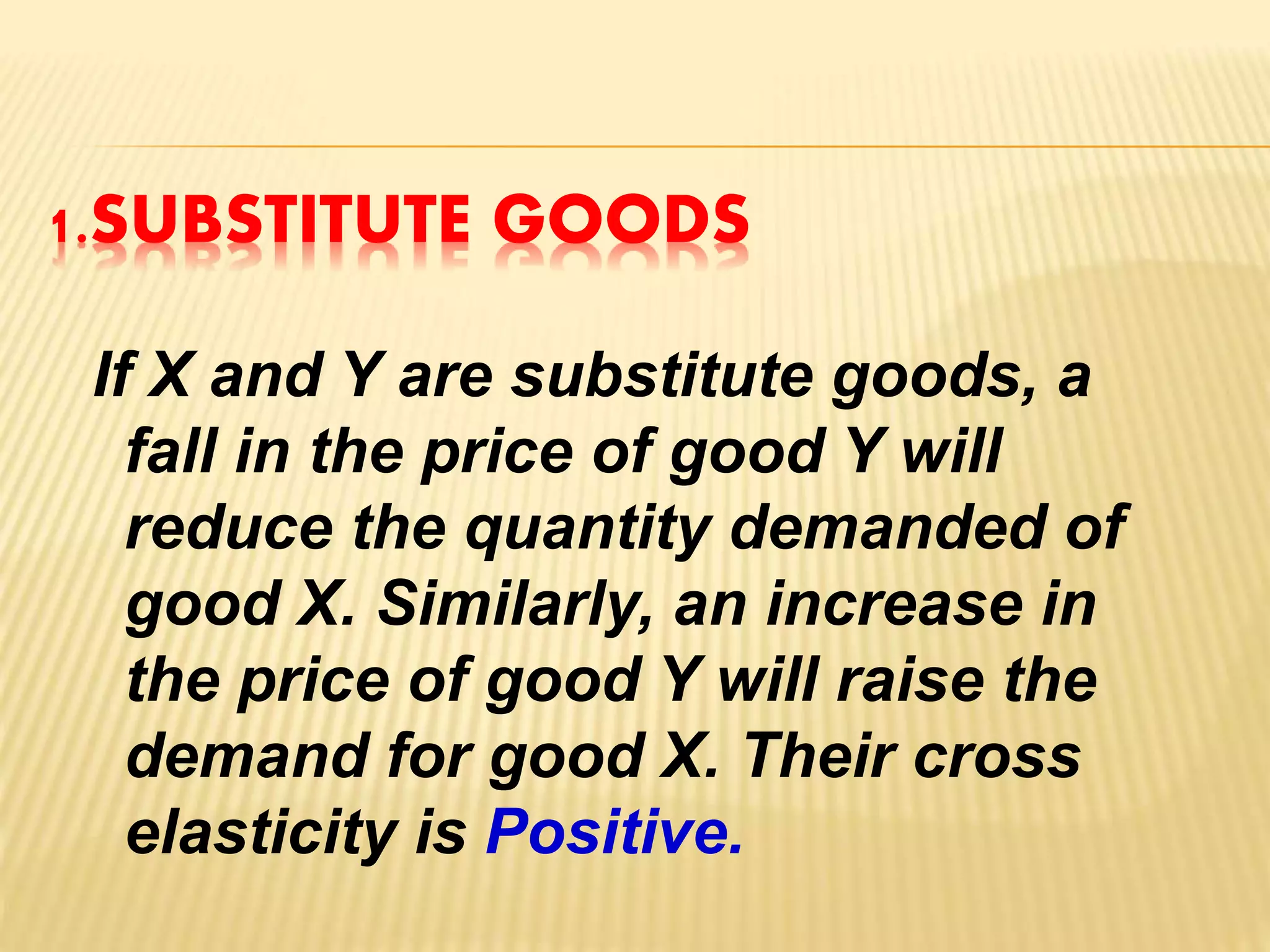
If X and Y are substitute goods, a
fall in the price of good Y will
reduce the quantity demanded of
good X. Similarly, an increase in
the price of good Y will raise the
demand for good X. Their cross
elasticity is Positive.
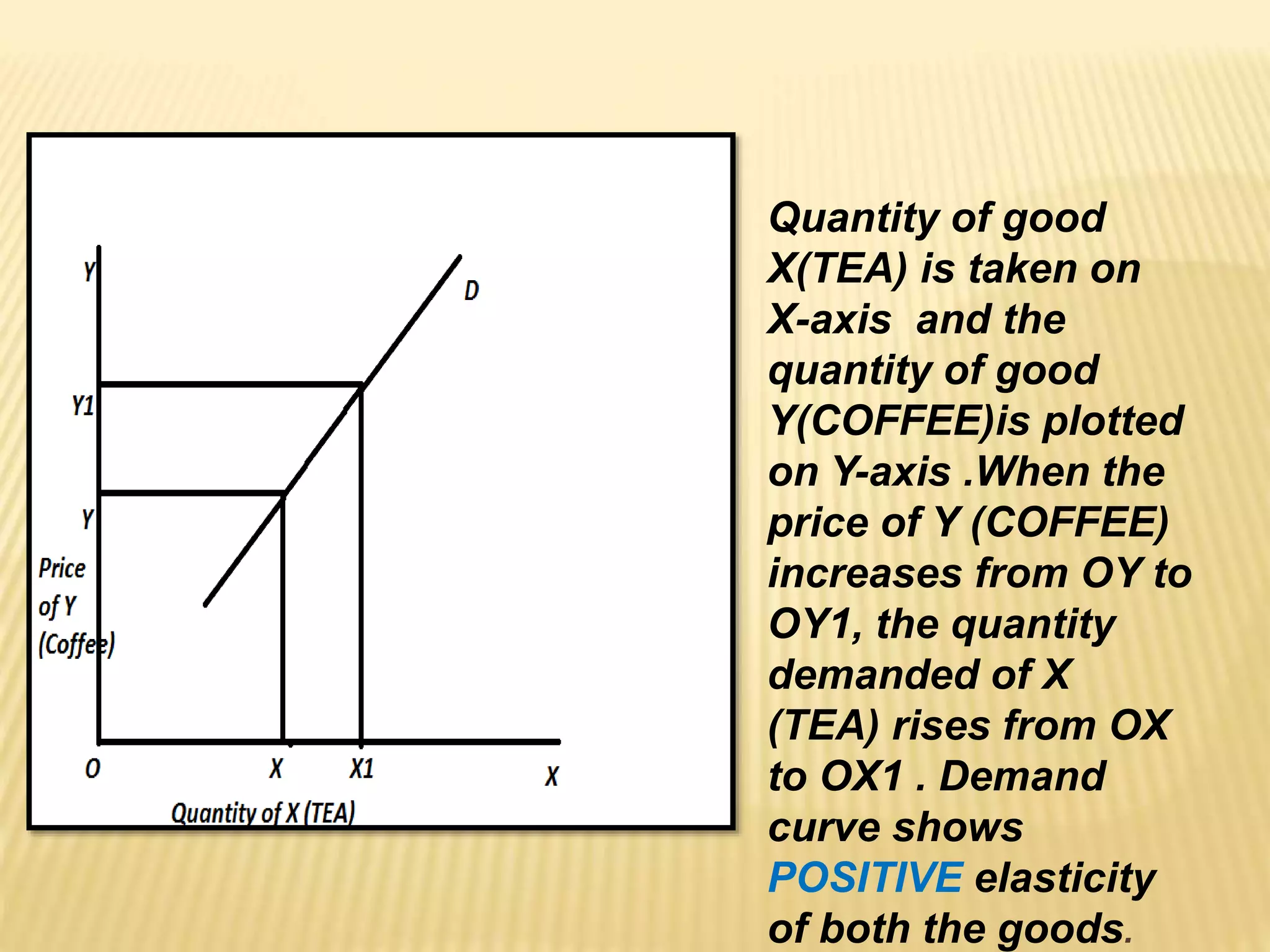
Quantity of good
X(TEA) is taken on
X-axis and the
quantity of good
Y(COFFEE)is plotted
on Y-axis .When the
price of Y (COFFEE)
increases from OY to
OY1, the quantity
demanded of X
(TEA) rises from OX
to OX1 . Demand
curve shows
POSITIVE elasticity
of both the goods.
2.COMPLEMENTARY GOODS
If two goods are jointly demanded, rise in
the price of one leads to a fall in the
demand for the other.
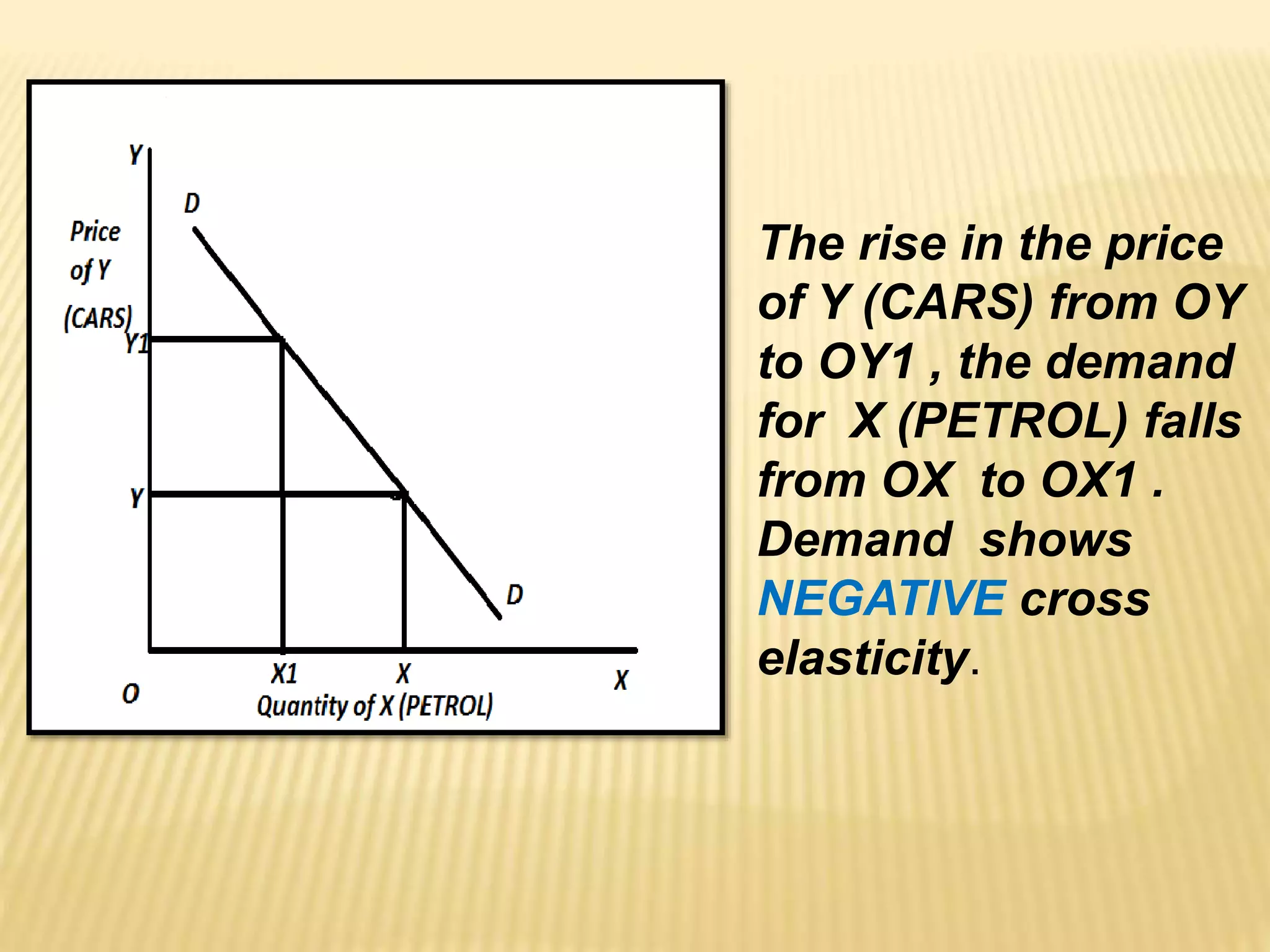
Rise in he prices of cars will bring a fall in their
demand together with the demand for petrol. A
fall in the prices of cars will raise the demand for
petrol . Cross elasticity of demand is NEGATIVE.
The rise in the price
of Y (CARS) from OY
to OY1 , the demand
for X (PETROL) falls
from OX to OX1 .
Demand shows
NEGATIVE cross
elasticity.
3. UNRELATED GOODS
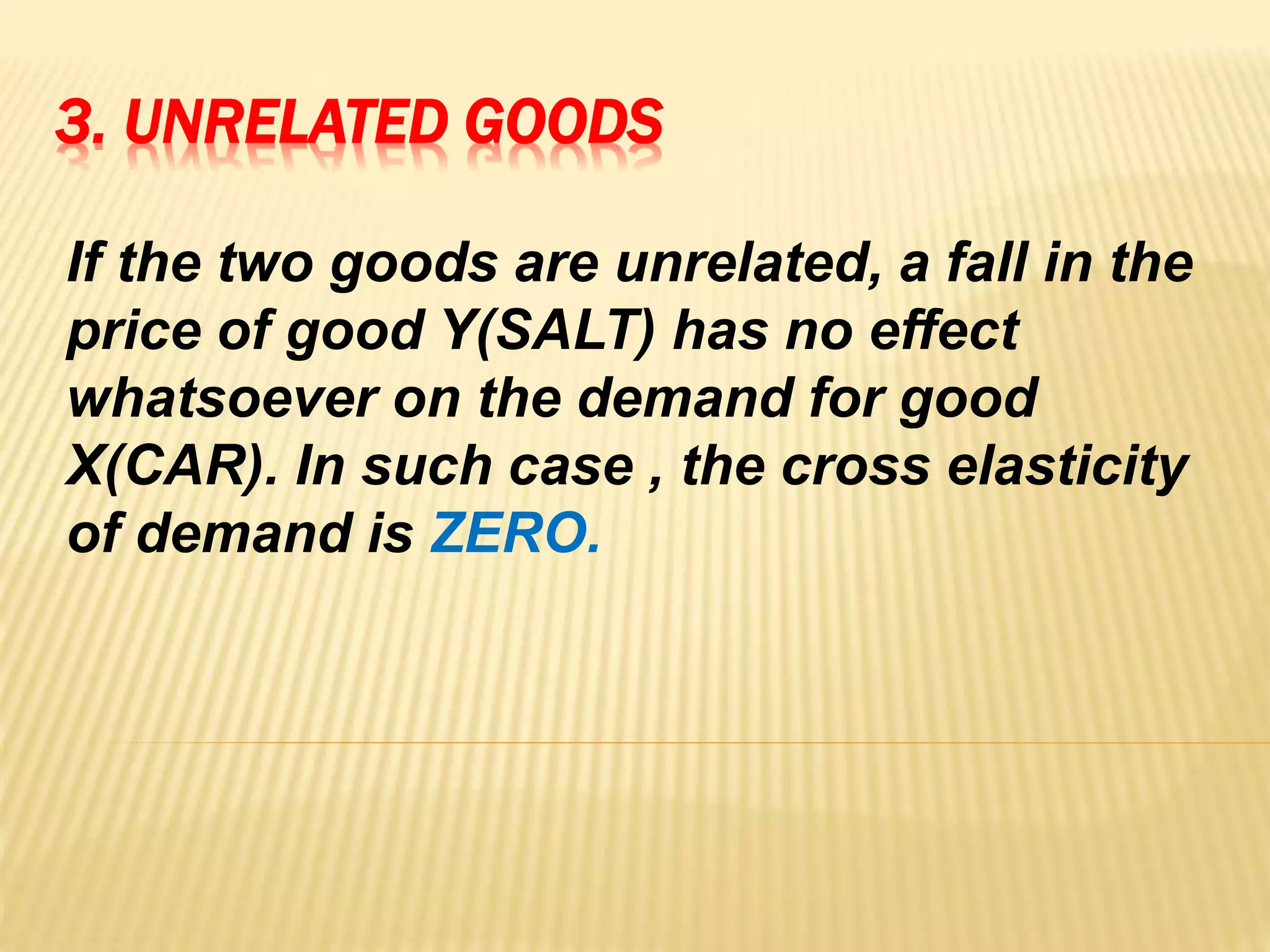
If the two goods are unrelated, a fall in the
price of good Y(SALT) has no effect
whatsoever on the demand for good
X(CAR). In such case , the cross elasticity
of demand is ZERO.
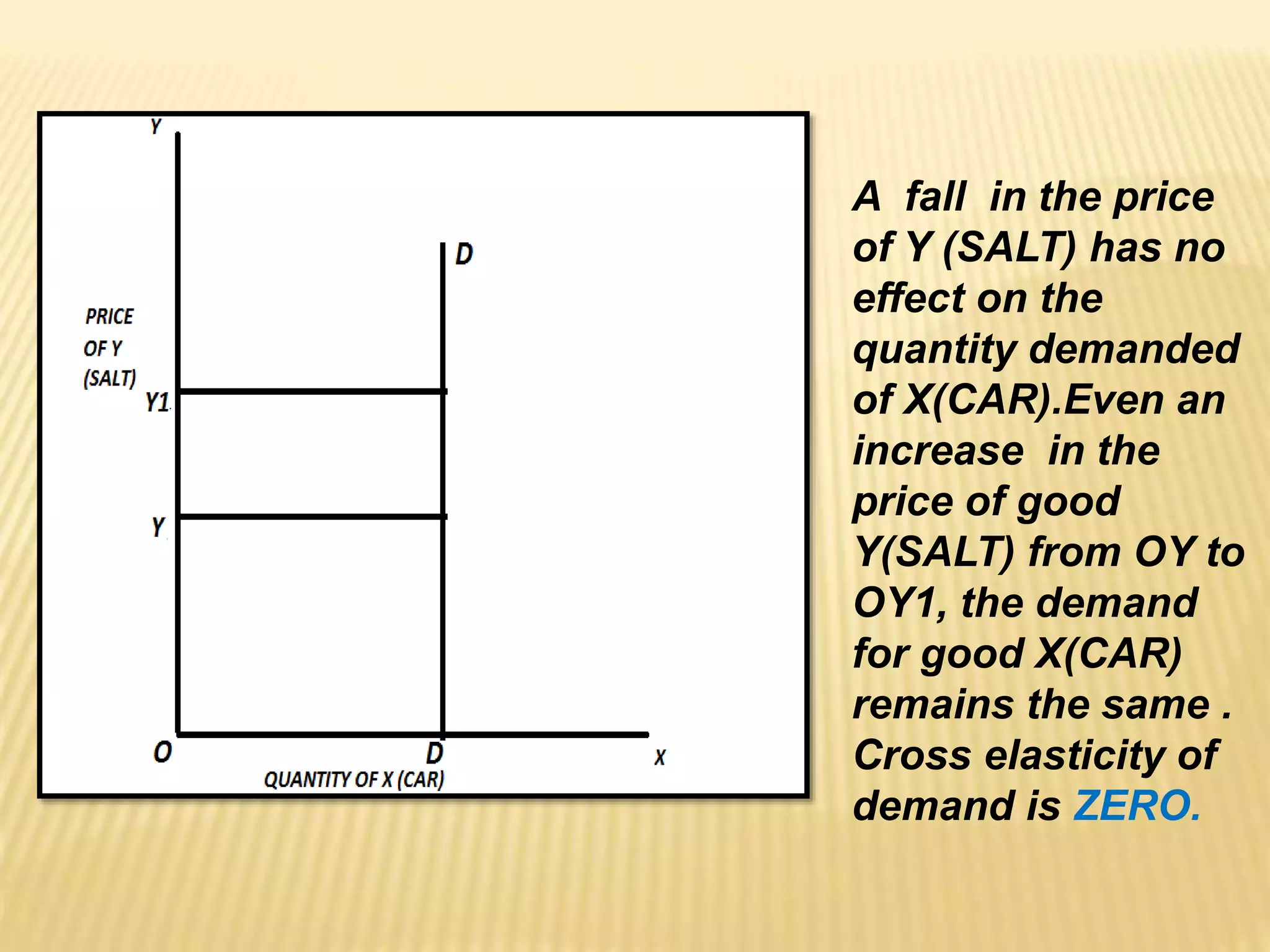
A fall in the price
of Y (SALT) has no
effect on the
quantity demanded
of X(CAR).Even an
increase in the
price of good
Y(SALT) from OY to
OY1, the demand
for good X(CAR)
remains the same .
Cross elasticity of
demand is ZERO.
APPLICATIONS OF CROSS ELASTICITY IN
MANAGEMENT
 1.PRODUCTION
 2.DEMAND FORECASTING AND PRICING
 3.INTERNATIONL TRADE AND BALANCE
OF PAYMENTS
INCOME ELASTICITY OF DEMAND
The concept of income elasticity of demand
expresses the responsiveness of a
consumer’s demand for any good to the
change in his income.
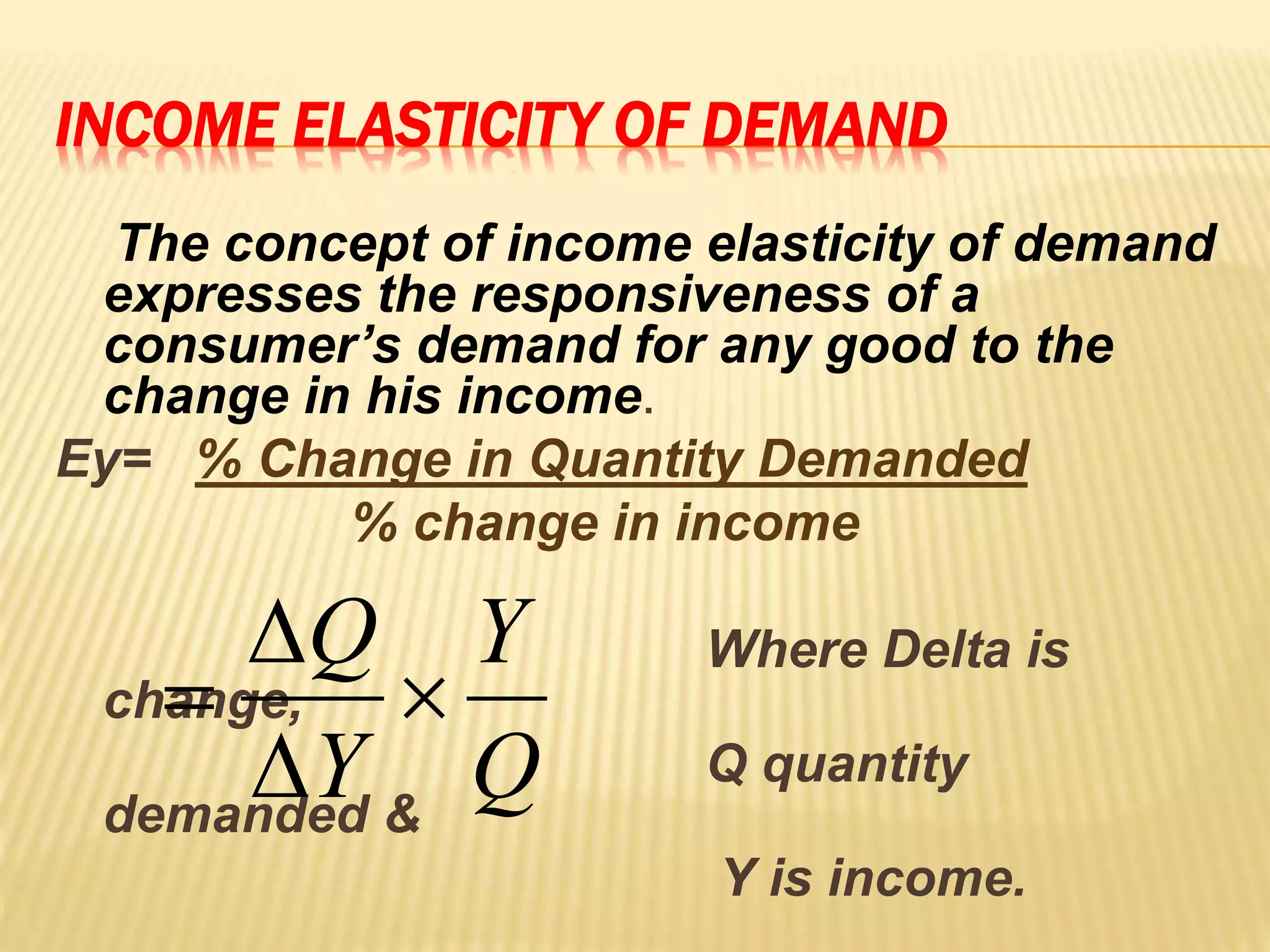
Ey= % Change in Quantity Demanded
% change in income
Where Delta is
change,
Q quantity
demanded &
Y is income.
Q
Y
Y
Q




INCOME ELASTICITY OF DEMAND
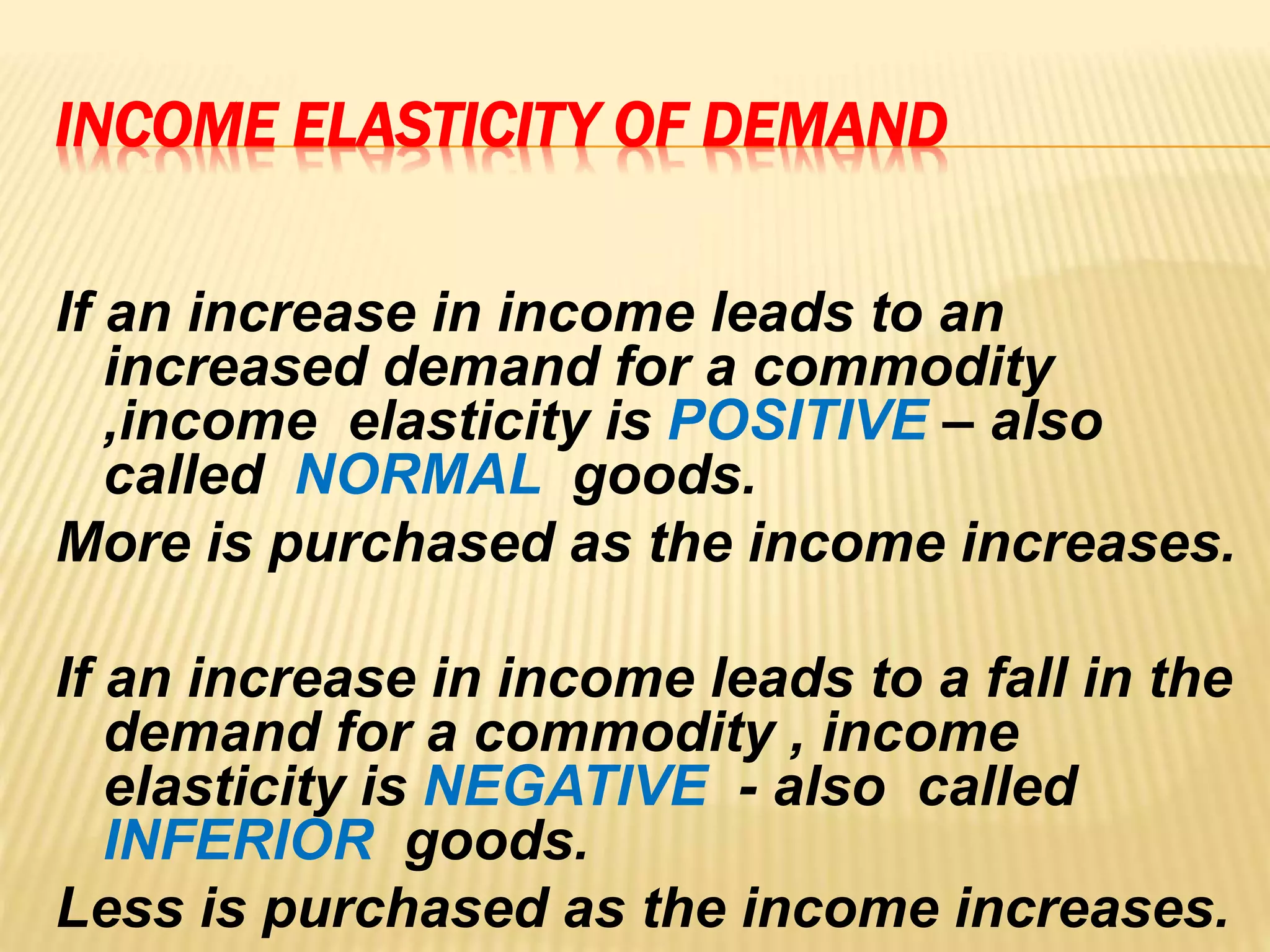
If an increase in income leads to an
increased demand for a commodity
,income elasticity is POSITIVE – also
called NORMAL goods.
More is purchased as the income increases.
If an increase in income leads to a fall in the
demand for a commodity , income
elasticity is NEGATIVE - also called
INFERIOR goods.
Less is purchased as the income increases.
NORMAL GOODS ARE OF 3 TYPES –
NECESSARIES ,LUXURIES & COMFORTS
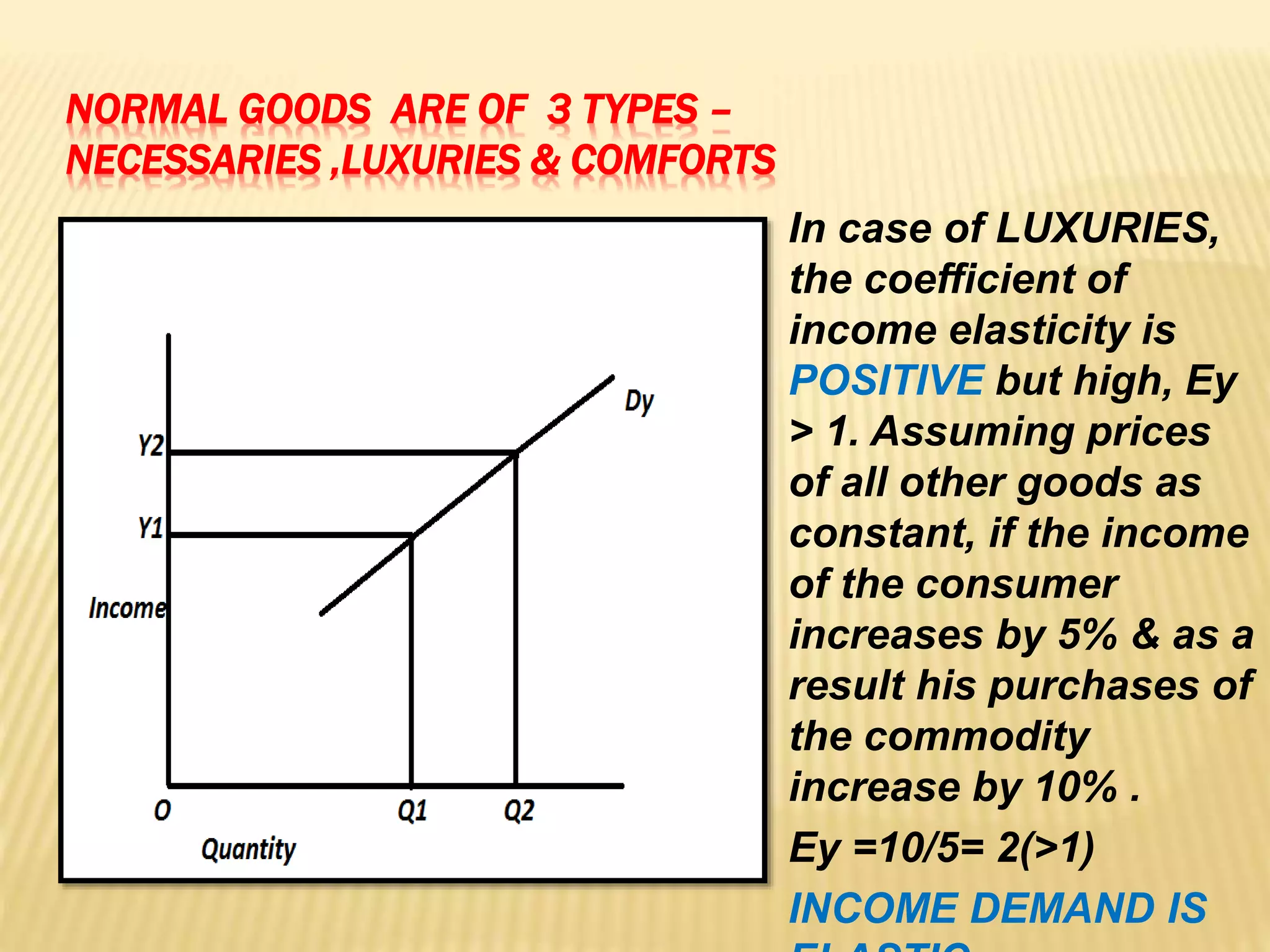
In case of LUXURIES,
the coefficient of
income elasticity is
POSITIVE but high, Ey
> 1. Assuming prices
of all other goods as
constant, if the income
of the consumer
increases by 5% & as a
result his purchases of
the commodity
increase by 10% .
Ey =10/5= 2(>1)
INCOME DEMAND IS
NECESSITIES
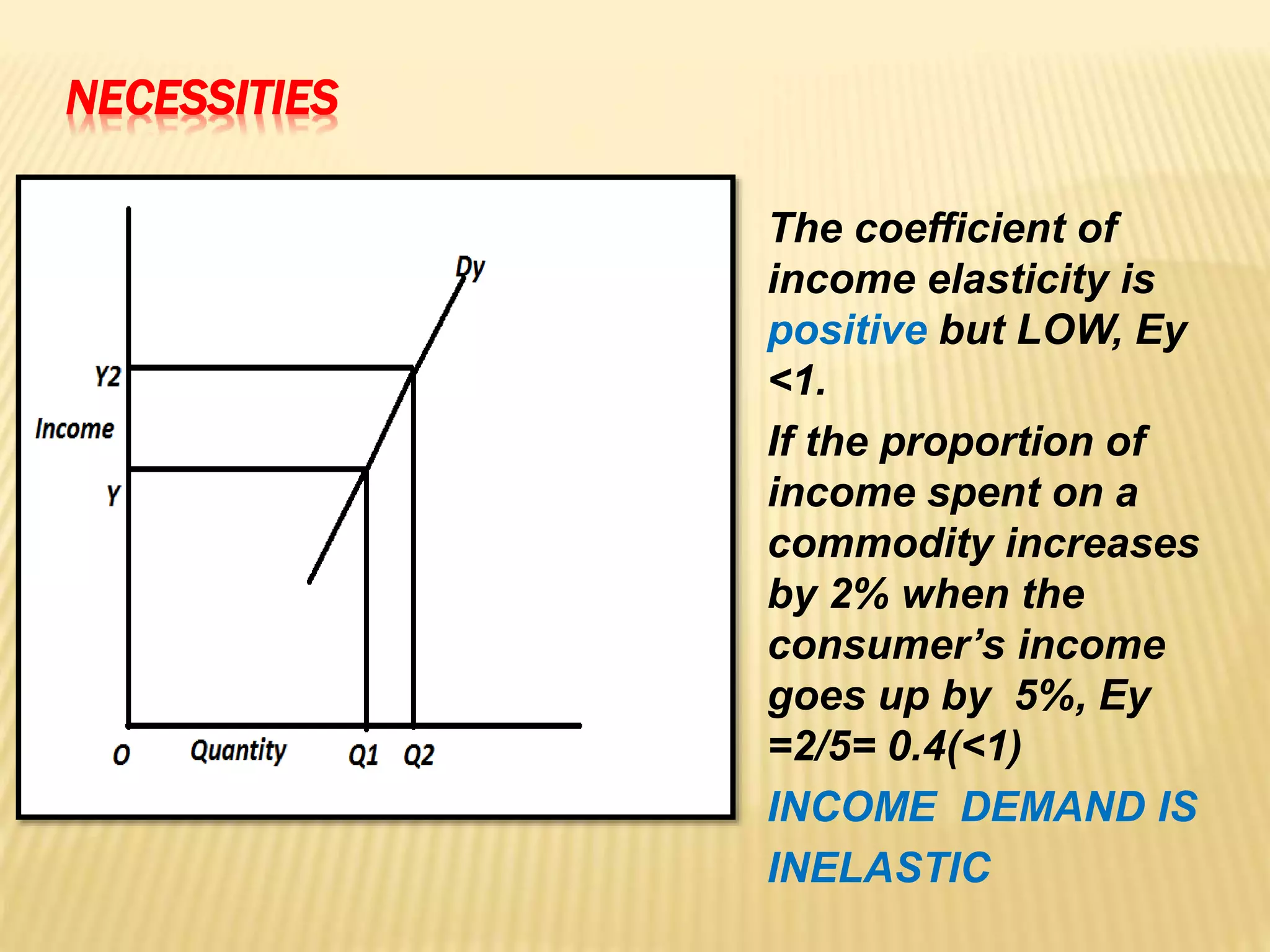
The coefficient of
income elasticity is
positive but LOW, Ey
<1.
If the proportion of
income spent on a
commodity increases
by 2% when the
consumer’s income
goes up by 5%, Ey
=2/5= 0.4(<1)
INCOME DEMAND IS
INELASTIC
COMFORTS
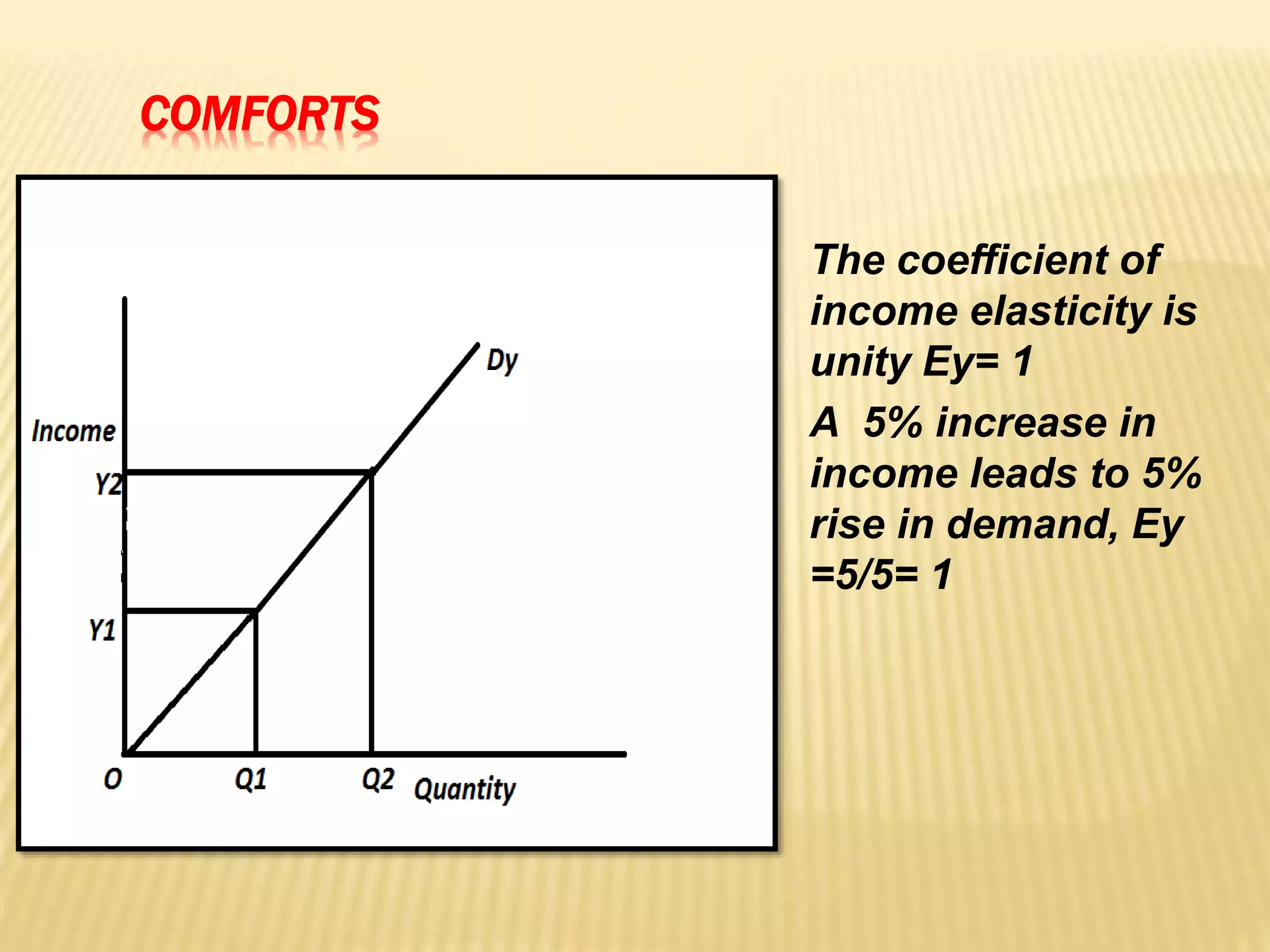
The coefficient of
income elasticity is
unity Ey= 1
A 5% increase in
income leads to 5%
rise in demand, Ey
=5/5= 1
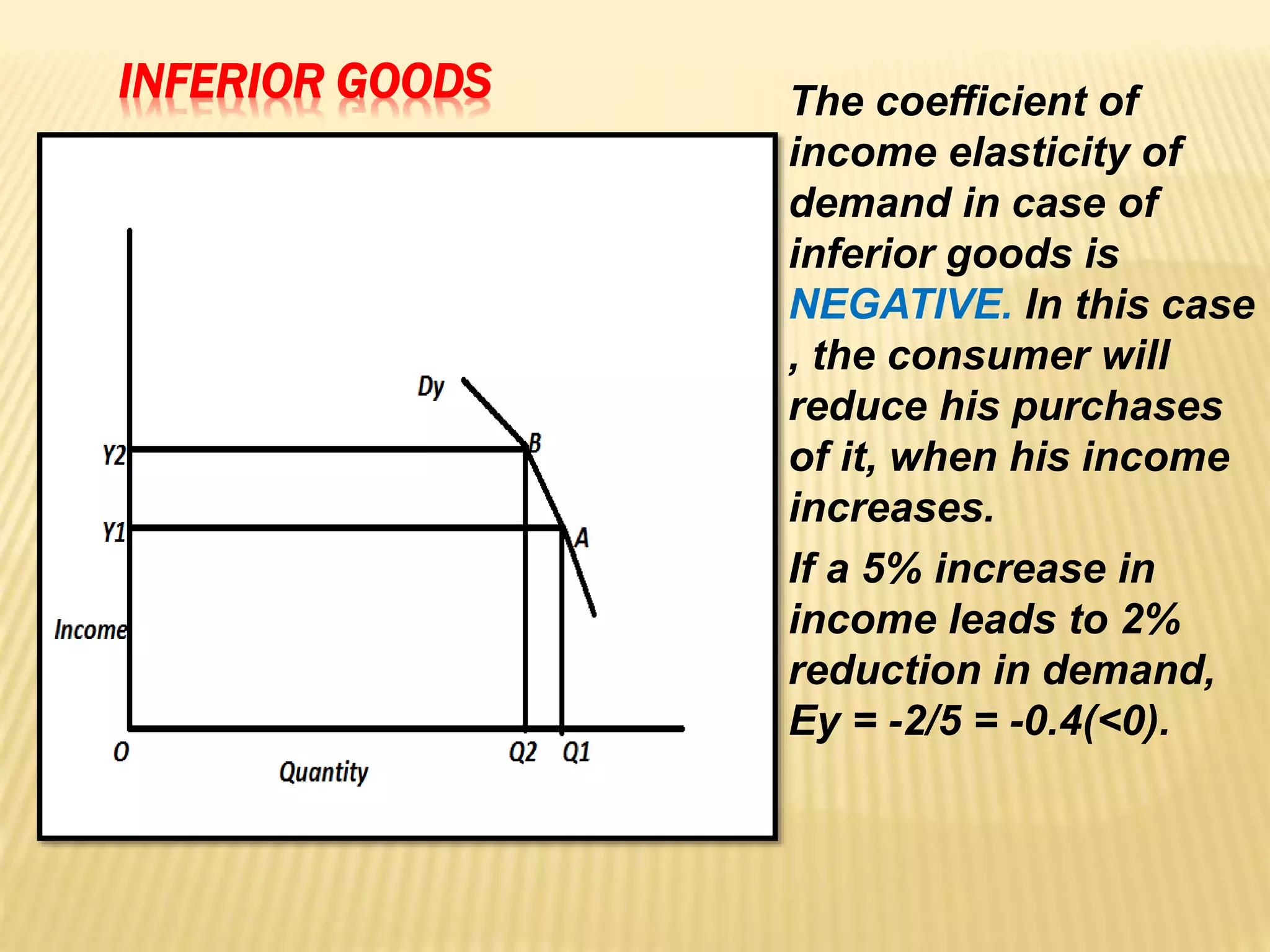
INFERIOR GOODS The coefficient of
income elasticity of
demand in case of
inferior goods is
NEGATIVE. In this case
, the consumer will
reduce his purchases
of it, when his income
increases.
If a 5% increase in
income leads to 2%
reduction in demand,
Ey = -2/5 = -0.4(<0).
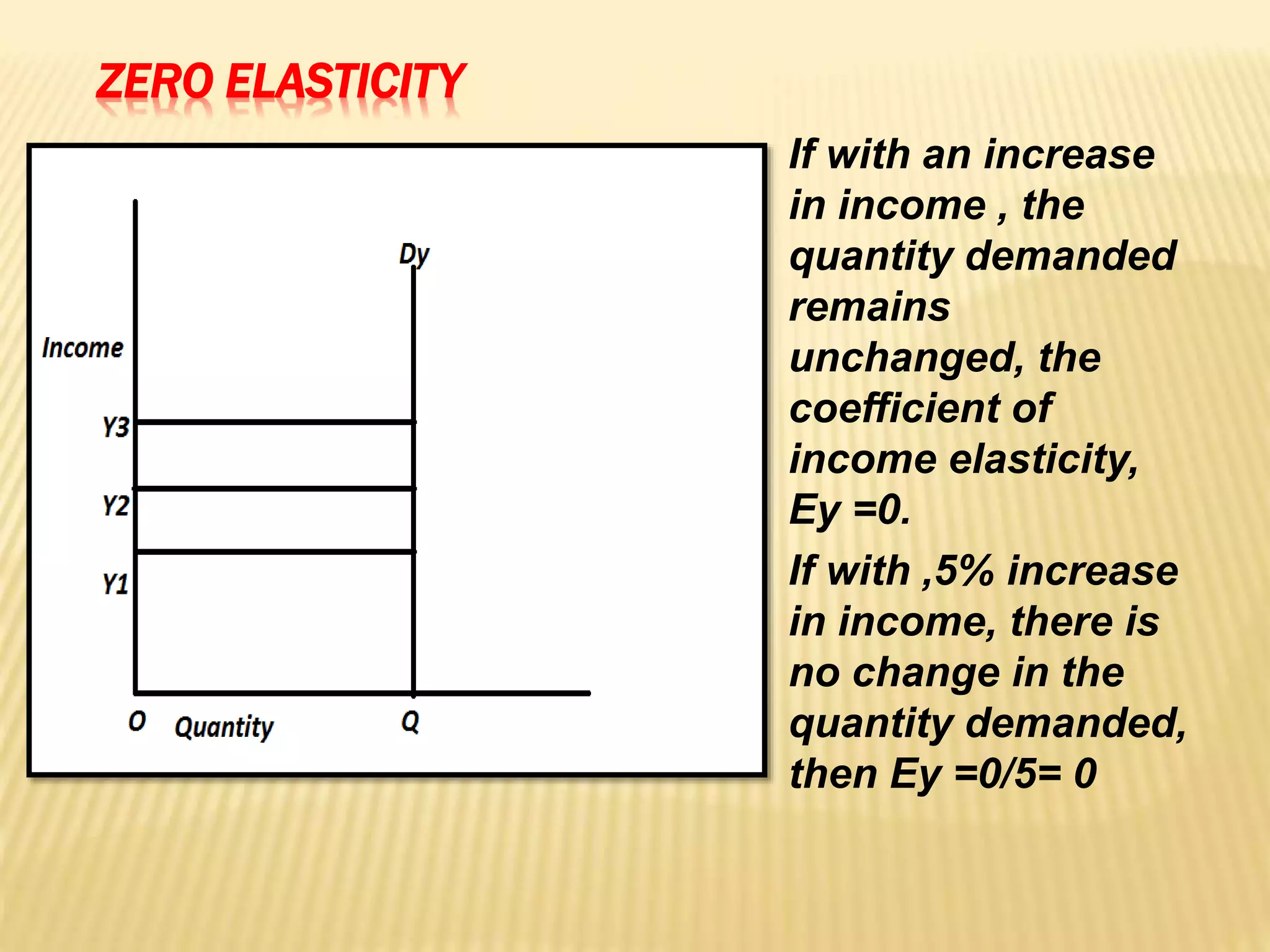
ZERO ELASTICITY
If with an increase
in income , the
quantity demanded
remains
unchanged, the
coefficient of
income elasticity,
Ey =0.
If with ,5% increase
in income, there is
no change in the
quantity demanded,
then Ey =0/5= 0
ENGEL CURVE
Engel curve shows the
quantities of a commodity
which a consumer would
buy at various levels of
income . It expresses the
income- quantity
relationship.
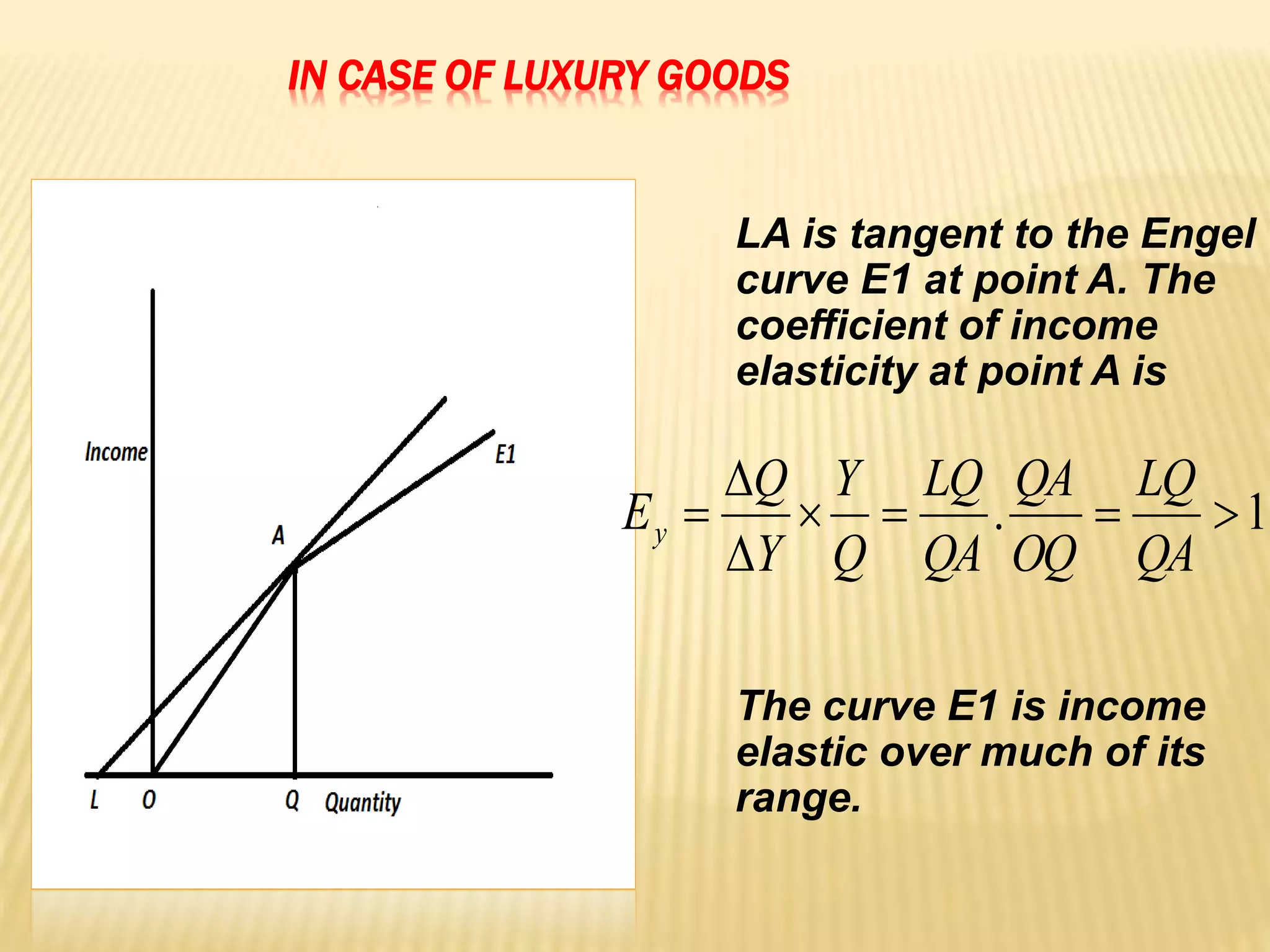
IN CASE OF LUXURY GOODS
LA is tangent to the Engel
curve E1 at point A. The
coefficient of income
elasticity at point A is
The curve E1 is income
elastic over much of its
range.
1. 



QA
LQ
OQ
QA
QA
LQ
Q
Y
Y
Q
Ey
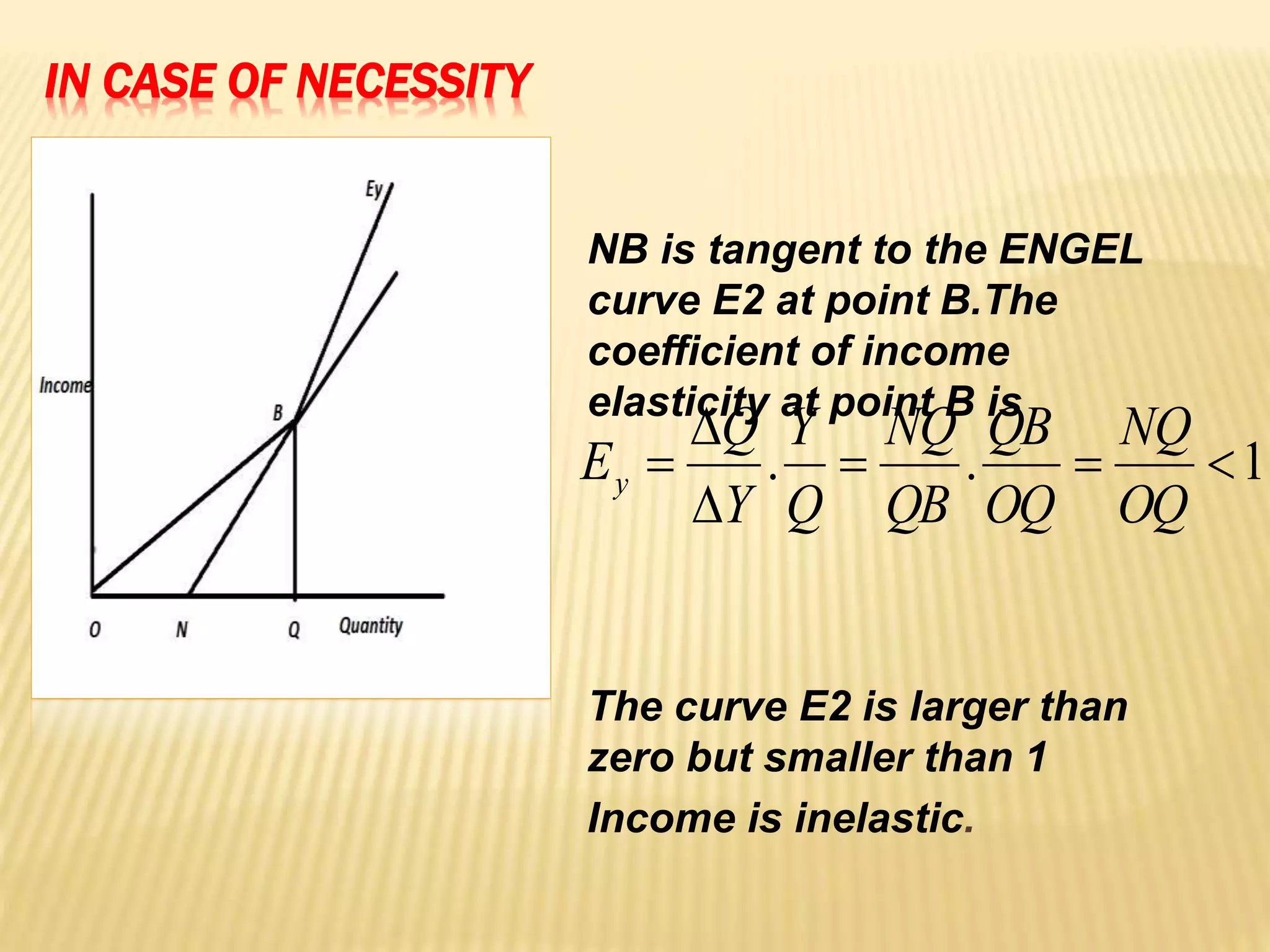
IN CASE OF NECESSITY
NB is tangent to the ENGEL
curve E2 at point B.The
coefficient of income
elasticity at point B is
The curve E2 is larger than
zero but smaller than 1
Income is inelastic.
1.. 



OQ
NQ
OQ
QB
QB
NQ
Q
Y
Y
Q
Ey
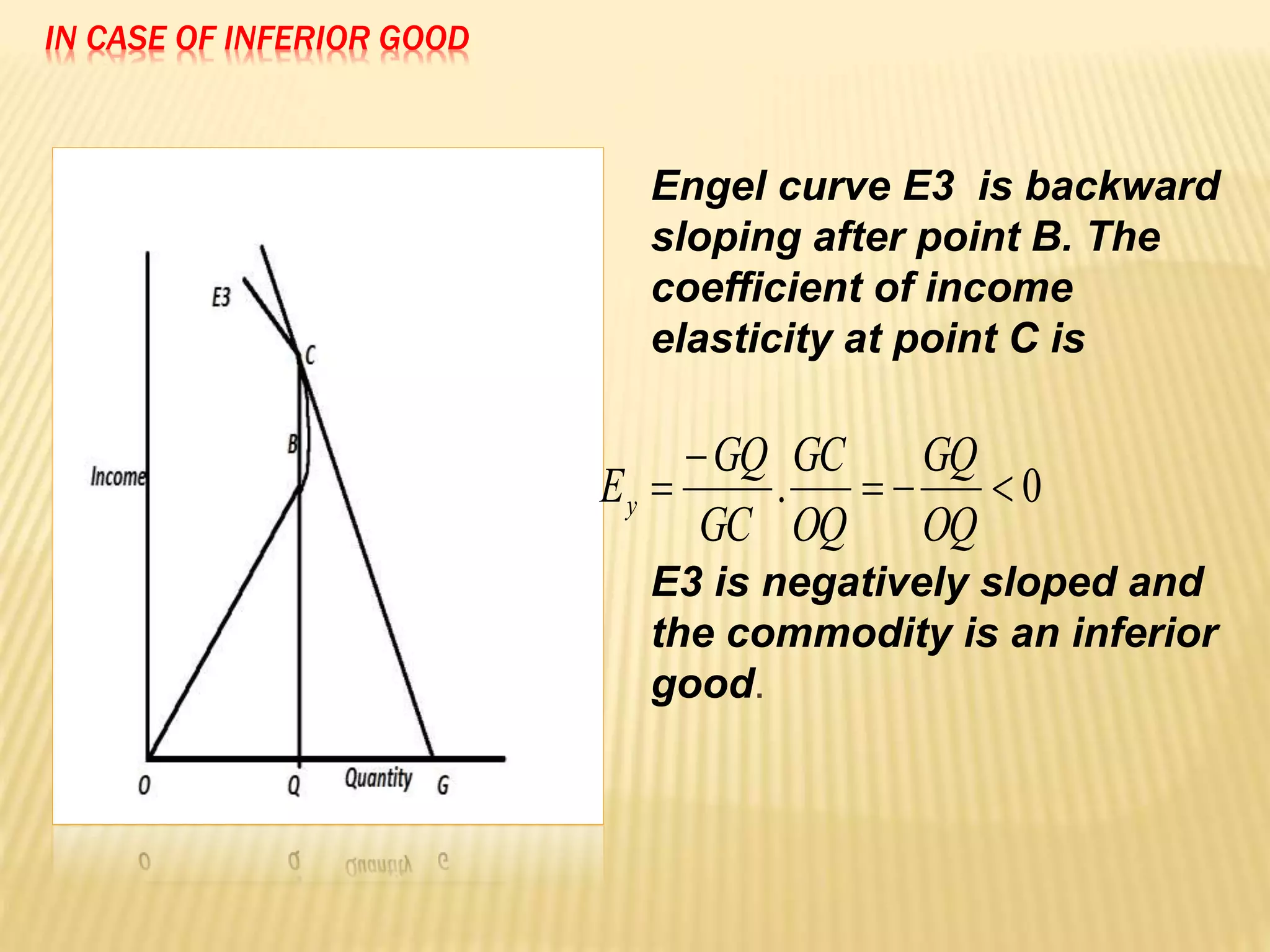
IN CASE OF INFERIOR GOOD
Engel curve E3 is backward
sloping after point B. The
coefficient of income
elasticity at point C is
E3 is negatively sloped and
the commodity is an inferior
good.
0. 


OQ
GQ
OQ
GC
GC
GQ
Ey
DETERMINANTS OF INCOME ELASTICITY OF
DEMAND
1.Nature of commodity:
Commodities are grouped in to necessities, comforts &
luxuries.
2.Income level:
Depends upon the income of the country.
3.Time period:
Over a long run a luxury may become a necessity.
4.Demonstration effect:
Changing tastes, preferences & choices of people.
5.Frequency:
Higher frequency ,income elasticity will be high.
USE OF INCOME ELASTICITY IN BUSINESS
DECISIONS
1.Planning of the firm’s growth:
The knowledge of income elasticity of demand is
important for both the firms & govt.
2.Formulation of farm policy:
The govt. of India has considered it necessary to
continue & increase various agricultural subsidies.
3.Forecasting demands:
Used in forecasting future demand provided the firm
knows the growth rate of income & income elasticity of
demand for the good
4.Formulating marketing strategies:
The income elasticity of demand of potential buyer
class for products affects the no. ,nature & location of
sales centres ,& the policies related to other sales
promotion activities.
ADVERTISING ELASTICITY OF DEMAND
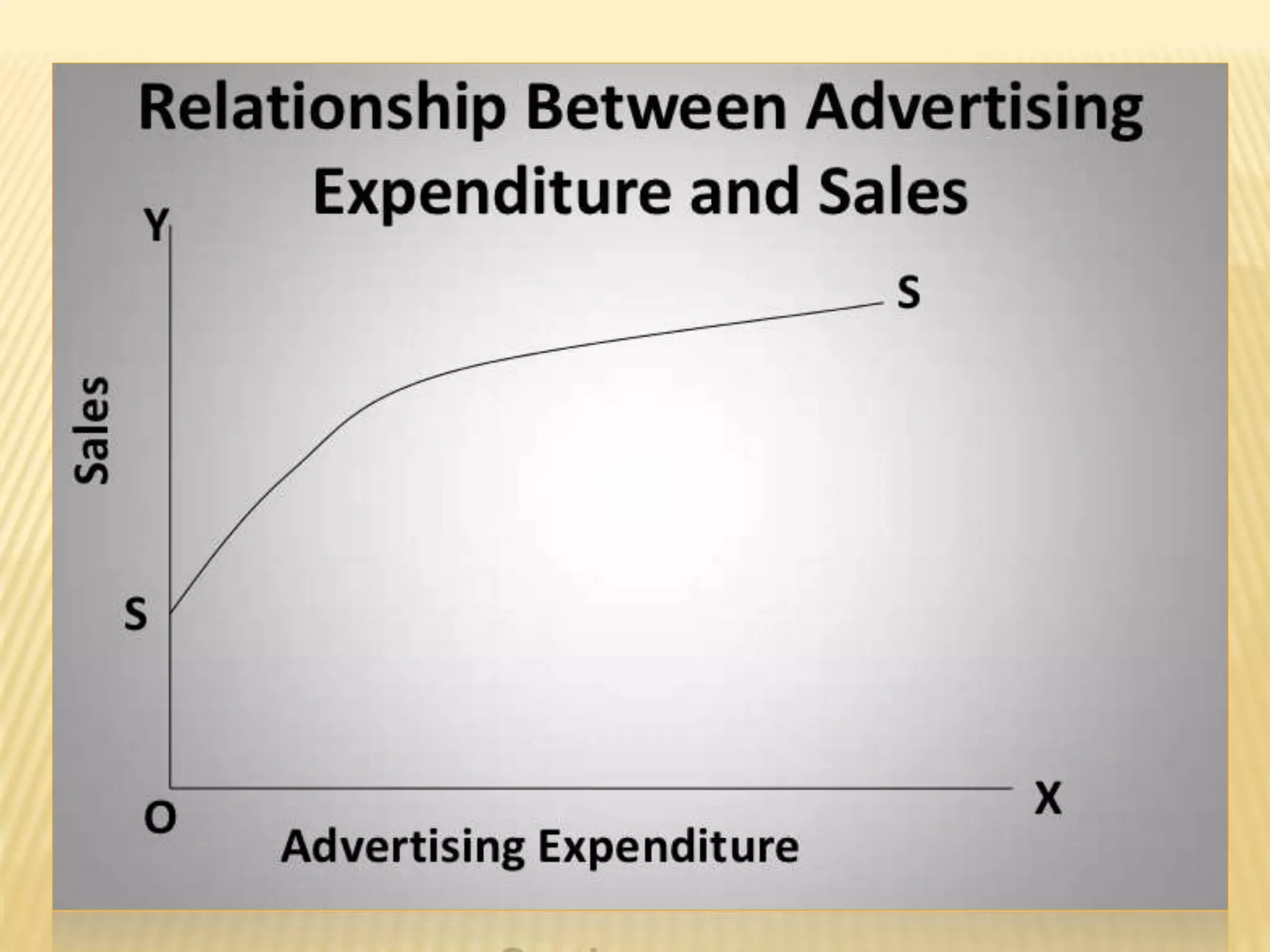
Advertising elasticity of demand is the
measure of the rate of change in demand
due to changes in advertising
expenditure.
The amount of change in demand of goods
due to advertisement is known as
advertising elasticity of demand
ADVERTISING ELASTICITY OF DEMAND
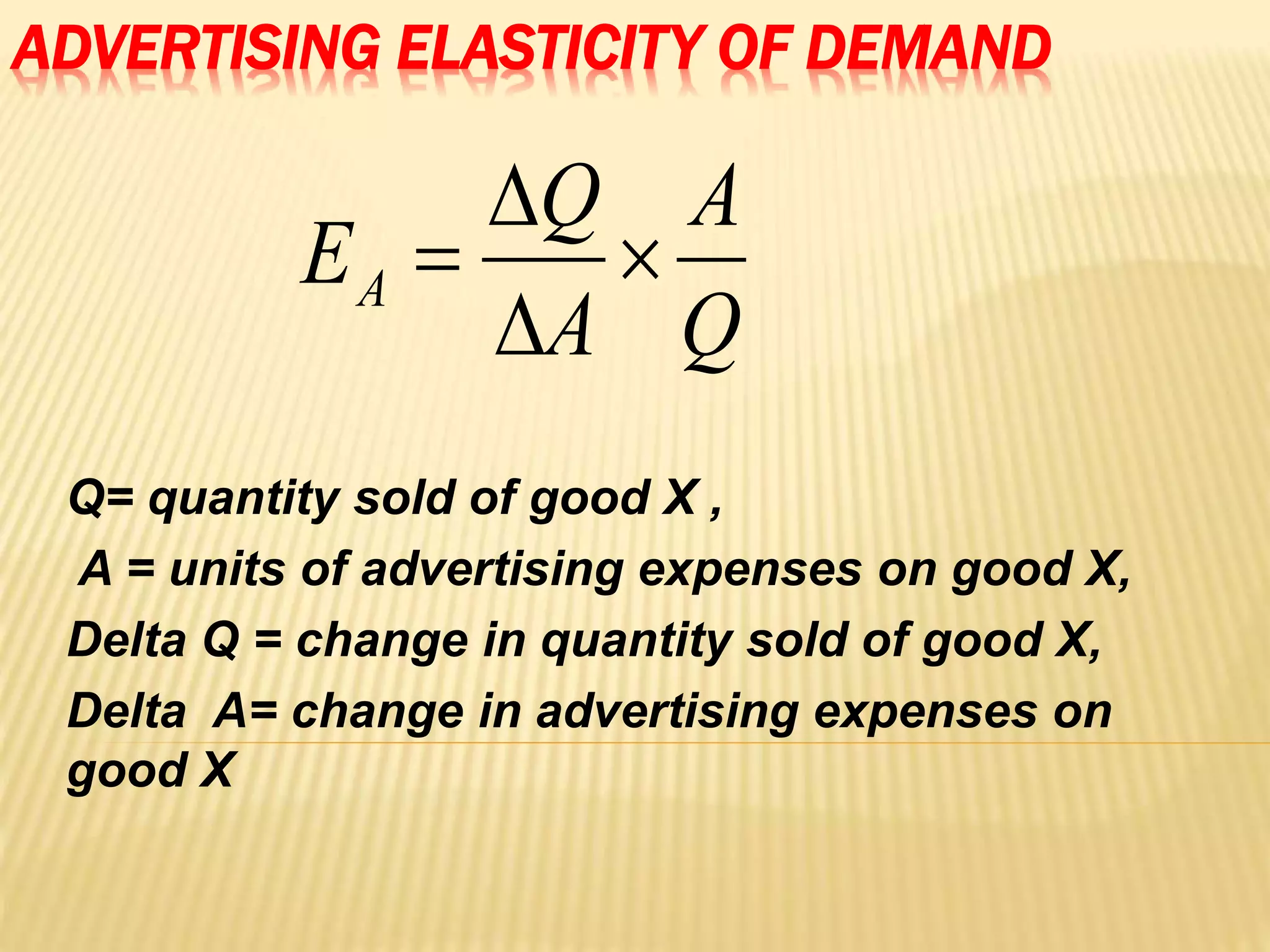
Q= quantity sold of good X ,
A = units of advertising expenses on good X,
Delta Q = change in quantity sold of good X,
Delta A= change in advertising expenses on
good X
Q
A
A
Q
EA 



FACTORS INFLUENCING ADVERTISING
ELASTICITY OF DEMAND
 1.Stage of product’s development
 2.Degree of competition
 3.Effects of advertising in terms of time
 4.Effect of advertising by rival firms
THANK YOU

Types of elasticity of demand

  • 1.
    TYPES OF ELASTICITYOF DEMAND • 1) PRICE ELASTICITY OF DEMAND • 2) CROSS ELASTICITY OF DEMAND • 3) INCOME ELASTICITY OF DEMAND • 4) ADVERTISING OR PROMOTIONAL ELASTICITY OF DEMAND
  • 2.
    CROSS ELASTICITY OF DEMAND Itis the relationship between % change in the quantity demanded of a good to the % change in the price of a related good. Eba= % Change in Quantity of X % Change in Price of Y
  • 3.
    Where,Qx=Quantity of goodX, Py = Price of good Y and delta = change. The Elasiticity of Demand for good X may be positve, negative or zero which depends on the nature of relation (may be as substitutes, complementary or unrelated )between the goods X and Y. x y y x Q P P Q    
  • 4.
    1.SUBSTITUTE GOODS If Xand Y are substitute goods, a fall in the price of good Y will reduce the quantity demanded of good X. Similarly, an increase in the price of good Y will raise the demand for good X. Their cross elasticity is Positive.
  • 5.
    Quantity of good X(TEA)is taken on X-axis and the quantity of good Y(COFFEE)is plotted on Y-axis .When the price of Y (COFFEE) increases from OY to OY1, the quantity demanded of X (TEA) rises from OX to OX1 . Demand curve shows POSITIVE elasticity of both the goods.
  • 6.
    2.COMPLEMENTARY GOODS If twogoods are jointly demanded, rise in the price of one leads to a fall in the demand for the other. Rise in he prices of cars will bring a fall in their demand together with the demand for petrol. A fall in the prices of cars will raise the demand for petrol . Cross elasticity of demand is NEGATIVE.
  • 7.
    The rise inthe price of Y (CARS) from OY to OY1 , the demand for X (PETROL) falls from OX to OX1 . Demand shows NEGATIVE cross elasticity.
  • 8.
    3. UNRELATED GOODS Ifthe two goods are unrelated, a fall in the price of good Y(SALT) has no effect whatsoever on the demand for good X(CAR). In such case , the cross elasticity of demand is ZERO.
  • 9.
    A fall inthe price of Y (SALT) has no effect on the quantity demanded of X(CAR).Even an increase in the price of good Y(SALT) from OY to OY1, the demand for good X(CAR) remains the same . Cross elasticity of demand is ZERO.
  • 10.
    APPLICATIONS OF CROSSELASTICITY IN MANAGEMENT  1.PRODUCTION  2.DEMAND FORECASTING AND PRICING  3.INTERNATIONL TRADE AND BALANCE OF PAYMENTS
  • 11.
    INCOME ELASTICITY OFDEMAND The concept of income elasticity of demand expresses the responsiveness of a consumer’s demand for any good to the change in his income. Ey= % Change in Quantity Demanded % change in income Where Delta is change, Q quantity demanded & Y is income. Q Y Y Q    
  • 12.
    INCOME ELASTICITY OFDEMAND If an increase in income leads to an increased demand for a commodity ,income elasticity is POSITIVE – also called NORMAL goods. More is purchased as the income increases. If an increase in income leads to a fall in the demand for a commodity , income elasticity is NEGATIVE - also called INFERIOR goods. Less is purchased as the income increases.
  • 13.
    NORMAL GOODS AREOF 3 TYPES – NECESSARIES ,LUXURIES & COMFORTS In case of LUXURIES, the coefficient of income elasticity is POSITIVE but high, Ey > 1. Assuming prices of all other goods as constant, if the income of the consumer increases by 5% & as a result his purchases of the commodity increase by 10% . Ey =10/5= 2(>1) INCOME DEMAND IS
  • 14.
    NECESSITIES The coefficient of incomeelasticity is positive but LOW, Ey <1. If the proportion of income spent on a commodity increases by 2% when the consumer’s income goes up by 5%, Ey =2/5= 0.4(<1) INCOME DEMAND IS INELASTIC
  • 15.
    COMFORTS The coefficient of incomeelasticity is unity Ey= 1 A 5% increase in income leads to 5% rise in demand, Ey =5/5= 1
  • 16.
    INFERIOR GOODS Thecoefficient of income elasticity of demand in case of inferior goods is NEGATIVE. In this case , the consumer will reduce his purchases of it, when his income increases. If a 5% increase in income leads to 2% reduction in demand, Ey = -2/5 = -0.4(<0).
  • 17.
    ZERO ELASTICITY If withan increase in income , the quantity demanded remains unchanged, the coefficient of income elasticity, Ey =0. If with ,5% increase in income, there is no change in the quantity demanded, then Ey =0/5= 0
  • 18.
    ENGEL CURVE Engel curveshows the quantities of a commodity which a consumer would buy at various levels of income . It expresses the income- quantity relationship.
  • 19.
    IN CASE OFLUXURY GOODS LA is tangent to the Engel curve E1 at point A. The coefficient of income elasticity at point A is The curve E1 is income elastic over much of its range. 1.     QA LQ OQ QA QA LQ Q Y Y Q Ey
  • 20.
    IN CASE OFNECESSITY NB is tangent to the ENGEL curve E2 at point B.The coefficient of income elasticity at point B is The curve E2 is larger than zero but smaller than 1 Income is inelastic. 1..     OQ NQ OQ QB QB NQ Q Y Y Q Ey
  • 21.
    IN CASE OFINFERIOR GOOD Engel curve E3 is backward sloping after point B. The coefficient of income elasticity at point C is E3 is negatively sloped and the commodity is an inferior good. 0.    OQ GQ OQ GC GC GQ Ey
  • 22.
    DETERMINANTS OF INCOMEELASTICITY OF DEMAND 1.Nature of commodity: Commodities are grouped in to necessities, comforts & luxuries. 2.Income level: Depends upon the income of the country. 3.Time period: Over a long run a luxury may become a necessity. 4.Demonstration effect: Changing tastes, preferences & choices of people. 5.Frequency: Higher frequency ,income elasticity will be high.
  • 23.
    USE OF INCOMEELASTICITY IN BUSINESS DECISIONS 1.Planning of the firm’s growth: The knowledge of income elasticity of demand is important for both the firms & govt. 2.Formulation of farm policy: The govt. of India has considered it necessary to continue & increase various agricultural subsidies. 3.Forecasting demands: Used in forecasting future demand provided the firm knows the growth rate of income & income elasticity of demand for the good 4.Formulating marketing strategies: The income elasticity of demand of potential buyer class for products affects the no. ,nature & location of sales centres ,& the policies related to other sales promotion activities.
  • 24.
    ADVERTISING ELASTICITY OFDEMAND Advertising elasticity of demand is the measure of the rate of change in demand due to changes in advertising expenditure. The amount of change in demand of goods due to advertisement is known as advertising elasticity of demand
  • 25.
    ADVERTISING ELASTICITY OFDEMAND Q= quantity sold of good X , A = units of advertising expenses on good X, Delta Q = change in quantity sold of good X, Delta A= change in advertising expenses on good X Q A A Q EA    
  • 27.
    FACTORS INFLUENCING ADVERTISING ELASTICITYOF DEMAND  1.Stage of product’s development  2.Degree of competition  3.Effects of advertising in terms of time  4.Effect of advertising by rival firms
  • 28.