Welcome
Welcome
Welcome
Welcome
PRICE AND
CONSUMPTION
RATE
- A Short PowerPoint Presentation Assigned
To:
Nishant Baduwal (Roll 11)
And Mahesh Majhi (Roll 10)
ASSIGNED BY: MISS. KUSUM DEO (ENG.
ECONOMICS)
Welcome
Definition of Correlation
• Statistical Measure that expresses the
extent to which two variables are linearly
related
Importance of Studying Price and
Consumption Rate
• Essential for understanding consumer
behavior.
• Helps in Economic Forecasting and
policy making.
• Importance for businesses for pricing
strategies.
Factors Influencing Correlation
Elasticity of Demand:
• Price Elasticity: Measure of how much the quantity
demanded of a good responds to a change in the
price.
• Inelastic Goods: Necessities with fewer substitutes
(e.g., Petroleum, medications).
• Elastic Goods: Luxuries or goods with many
substitutes (e.g., electronics, clothing).
Consumer Income
• Changes in income levels can shift the demand
curve, affecting consumption rates.
Definition of Correlation
• Statistical Measure that expresses the
extent to which two variables are linearly
related
Importance of Studying Price and
Consumption Rate
• Essential for understanding consumer
behavior.
• Helps in Economic Forecasting and
policy making.
• Importance for businesses for pricing
strategies.
Factors Influencing Correlation
Elasticity of Demand:
• Price Elasticity: Measure of how much the quantity
demanded of a good responds to a change in the
price.
• Inelastic Goods: Necessities with fewer substitutes
(e.g., Petroleum, medications).
• Elastic Goods: Luxuries or goods with many
substitutes (e.g., electronics, clothing).
Consumer Income
• Changes in income levels can shift the demand
curve, affecting consumption rates.
Price and Consumption Rate
• Basic Economic Theory: As the price of a
good increases, the quantity demanded
generally decreases, and vice versa.
Factors Influencing the Correlation
Elasticity of Price Elasticity: Measure of how
much the quantity demanded of a good
responds to a change in the price.
Inelastic Goods: Necessities with fewer
substitutes (e.g., gasoline, medications).
Elastic Goods: Luxuries or goods with many
substitutes (e.g., electronics, clothing).
• Consumption Rate: Refers to the quantity of
a product that consumers are willing and
able to purchase at a given price over a
specific period.
Consumer Income: Changes in income levels
can shift the demand curve, affecting
consumption rates.
Necessities, Luxuries, And Price-Demand
Goods and Services
Consumer Goods & Services: Products or
Services that are directly used by people to
satisfy their wants.
Example: Food, Clothing, T.V. , Haircut,
Medical Service.
Producer Goods & Services: Products or
Services that are used to produce Consumer
Goods & Services or other Producer goods.
Example: Machine Tools, Factory Buildings,
Goods and services are categorized into
necessities and luxuries, though these terms are
relative and influenced by individual perceptions
and economic status
The distinction between luxuries and necessities
is more straightforward for consumer goods than
for producer goods. Nonetheless, a fundamental
economic principle applies to all goods and
services: the relationship between price and
demand.
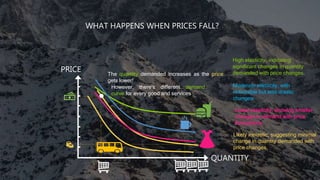
WHAT HAPPENS WHEN PRICES FALL?
PRICE
QUANTITY
The quantity demanded increases as the price
gets lower!
However, there's different demand
curve for every good and services
Likely inelastic, suggesting minimal
change in quantity demanded with
price changes.
High elasticity, indicating
significant changes in quantity
demanded with price changes.
Moderate elasticity, with
noticeable but less drastic
changes.
Lower elasticity, showing smaller
changes in demand with price
fluctuations.
Necessities, Luxuries, And Price-Demand
Goods and Services
Consumer Goods & Services: Products or
Services that are directly used by people to
satisfy their wants.
Example: Food, Clothing, T.V. , Haircut,
Medical Service.
Producer Goods & Services: Products or
Services that are used to produce Consumer
Goods & Services or other Producer goods.
Example: Machine Tools, Factory Buildings,
Goods and services are categorized into
necessities and luxuries, though these terms are
relative and influenced by individual perceptions
and economic status
The distinction between luxuries and necessities
is more straightforward for consumer goods than
for producer goods. Nonetheless, a fundamental
economic principle applies to all goods and
services: the relationship between price and
demand.
Necessities, Luxuries, And Price-Demand
Goods and Services
Consumer Goods & Services: Products or
Services that are directly used by people to
satisfy their wants.
Example: Food, Clothing, T.V. , Haircut,
Medical Service.
Producer Goods & Services: Products or
Services that are used to produce Consumer
Goods & Services or other Producer goods.
Example: Machine Tools, Factory Buildings,
Goods and services are categorized into
necessities and luxuries, though these terms are
relative and influenced by individual perceptions
and economic status
The distinction between luxuries and necessities
is more straightforward for consumer goods than
for producer goods. Nonetheless, a fundamental
economic principle applies to all goods and
services: the relationship between price and
demand.
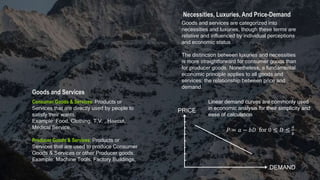
DEMAND
PRICE
Linear demand curves are commonly used
in economic analysis for their simplicity and
ease of calculation
𝑃 = 𝑎 − 𝑏𝐷 for 0 ≤ 𝐷 ≤
𝑎
𝑏
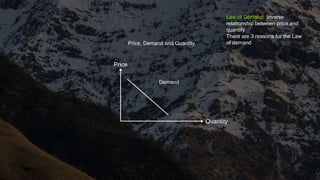
Quantity
Price
Price, Demand and Quantity
Demand
Law of Demand: Inverse
relationship between price and
quantity
There are 3 reasons for the Law
of demand
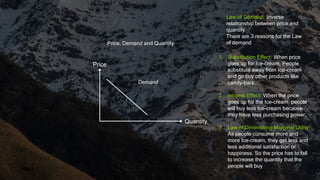
Quantity
Price
Price, Demand and Quantity
Demand
1. Substitution Effect: When price
goes up for Ice-cream, People
substitute away from Ice-cream
and go buy other products like
candy-bars.
2. Income Effect: When the price
goes up for the Ice-cream, people
will buy less Ice-cream because
they have less purchasing power.
3. Law of Diminishing Marginal Utility:
As people consume more and
more Ice-cream, they get less and
less additional satisfaction or
happiness. So the price has to fall
to increase the quantity that the
people will buy
Law of Demand: Inverse
relationship between price and
quantity
There are 3 reasons for the Law
of demand
Quantity
Price
Price, Demand and Quantity
Demand
A change in price causes a move
along the curve
Quantity
Price
Price, Demand and Quantity
Demand
A change in price causes a move
along the curve
But what if something else
changes that causes the demand
curve to shift ?
Quantity
Price
Price, Demand and Quantity
Demand
There are 5 shifters or
determinants of demand that
causes the demand curve to
increase and shift to the right or
decrease and shift to the left:
1. Preferences
2. Number of buyers
3. Price of related goods
4. Income
5. Expectations
Quantity
Price
Price, Demand and Quantity
Demand
1. Preferences: It’s 100 degrees outside
and the demand for Ice-cream shifts
to the right
There is no change in the price of Ice-
cream, it’s the other factor that is causing
the demand to go up. (i.e. People are
buying more because it’s a hot day
outside)
Quantity
Price
Price, Demand and Quantity
Demand
And it could shift to the left if it was a cold
day in the winter, meaning there’s less
demand for Ice-cream.
Quantity
Price
Price, Demand and Quantity
Demand
2. Number of buyers: More consumers
will increase the demand while less
consumers would decrease the demand
3. Price of related goods: This is not the
price of Ice-cream but some other goods
like candy-bar. Candy-bar and Ice-Cream
are substitutes so if the price goes up for
candy-bar people are going to buy more
Ice-cream and the demand curve is going
to shift right.
But if the price of ice-cream cone goes up
the demand curve is going to shift left
since its not substitute for ice-cream.
Quantity
Price
Price, Demand and Quantity
Demand
4. Income: It depends on the type of the
product:
Normal goods: when income goes up
people buy more of it and when income
goes down people buy less of it.
Example: Pizza
Inferior goods: When income goes up
people buy less of it and when income
goes down people buy more of it.
Example: Wai Wai
5. Expectations: This is when people
expect the prices to go up in near future
and end up increasing the demand
THANK YOU
REFERENCES:
Book: Engineering Economy Degarmo, E. Paul 7th
edition(page no. 23)
Youtube: Supply and demand in 8 minutes by Jacob
Clifford" https://www.youtube.com/watch?v=kIFBaaPJUO0
The Demand Curve by Marginal Revolution University
https://www.youtube.com/watch?v=kIFBaaPJUO0&t=69s

price and consumption presentation by KCC

  • 1.
  • 2.
  • 3.
  • 4.
    Welcome PRICE AND CONSUMPTION RATE - AShort PowerPoint Presentation Assigned To: Nishant Baduwal (Roll 11) And Mahesh Majhi (Roll 10) ASSIGNED BY: MISS. KUSUM DEO (ENG. ECONOMICS)
  • 5.
    Welcome Definition of Correlation •Statistical Measure that expresses the extent to which two variables are linearly related Importance of Studying Price and Consumption Rate • Essential for understanding consumer behavior. • Helps in Economic Forecasting and policy making. • Importance for businesses for pricing strategies. Factors Influencing Correlation Elasticity of Demand: • Price Elasticity: Measure of how much the quantity demanded of a good responds to a change in the price. • Inelastic Goods: Necessities with fewer substitutes (e.g., Petroleum, medications). • Elastic Goods: Luxuries or goods with many substitutes (e.g., electronics, clothing). Consumer Income • Changes in income levels can shift the demand curve, affecting consumption rates.
  • 6.
    Definition of Correlation •Statistical Measure that expresses the extent to which two variables are linearly related Importance of Studying Price and Consumption Rate • Essential for understanding consumer behavior. • Helps in Economic Forecasting and policy making. • Importance for businesses for pricing strategies. Factors Influencing Correlation Elasticity of Demand: • Price Elasticity: Measure of how much the quantity demanded of a good responds to a change in the price. • Inelastic Goods: Necessities with fewer substitutes (e.g., Petroleum, medications). • Elastic Goods: Luxuries or goods with many substitutes (e.g., electronics, clothing). Consumer Income • Changes in income levels can shift the demand curve, affecting consumption rates.
  • 7.
    Price and ConsumptionRate • Basic Economic Theory: As the price of a good increases, the quantity demanded generally decreases, and vice versa. Factors Influencing the Correlation Elasticity of Price Elasticity: Measure of how much the quantity demanded of a good responds to a change in the price. Inelastic Goods: Necessities with fewer substitutes (e.g., gasoline, medications). Elastic Goods: Luxuries or goods with many substitutes (e.g., electronics, clothing). • Consumption Rate: Refers to the quantity of a product that consumers are willing and able to purchase at a given price over a specific period. Consumer Income: Changes in income levels can shift the demand curve, affecting consumption rates.
  • 8.
    Necessities, Luxuries, AndPrice-Demand Goods and Services Consumer Goods & Services: Products or Services that are directly used by people to satisfy their wants. Example: Food, Clothing, T.V. , Haircut, Medical Service. Producer Goods & Services: Products or Services that are used to produce Consumer Goods & Services or other Producer goods. Example: Machine Tools, Factory Buildings, Goods and services are categorized into necessities and luxuries, though these terms are relative and influenced by individual perceptions and economic status The distinction between luxuries and necessities is more straightforward for consumer goods than for producer goods. Nonetheless, a fundamental economic principle applies to all goods and services: the relationship between price and demand.
  • 9.
    WHAT HAPPENS WHENPRICES FALL? PRICE QUANTITY The quantity demanded increases as the price gets lower! However, there's different demand curve for every good and services Likely inelastic, suggesting minimal change in quantity demanded with price changes. High elasticity, indicating significant changes in quantity demanded with price changes. Moderate elasticity, with noticeable but less drastic changes. Lower elasticity, showing smaller changes in demand with price fluctuations.
  • 10.
    Necessities, Luxuries, AndPrice-Demand Goods and Services Consumer Goods & Services: Products or Services that are directly used by people to satisfy their wants. Example: Food, Clothing, T.V. , Haircut, Medical Service. Producer Goods & Services: Products or Services that are used to produce Consumer Goods & Services or other Producer goods. Example: Machine Tools, Factory Buildings, Goods and services are categorized into necessities and luxuries, though these terms are relative and influenced by individual perceptions and economic status The distinction between luxuries and necessities is more straightforward for consumer goods than for producer goods. Nonetheless, a fundamental economic principle applies to all goods and services: the relationship between price and demand.
  • 11.
    Necessities, Luxuries, AndPrice-Demand Goods and Services Consumer Goods & Services: Products or Services that are directly used by people to satisfy their wants. Example: Food, Clothing, T.V. , Haircut, Medical Service. Producer Goods & Services: Products or Services that are used to produce Consumer Goods & Services or other Producer goods. Example: Machine Tools, Factory Buildings, Goods and services are categorized into necessities and luxuries, though these terms are relative and influenced by individual perceptions and economic status The distinction between luxuries and necessities is more straightforward for consumer goods than for producer goods. Nonetheless, a fundamental economic principle applies to all goods and services: the relationship between price and demand. DEMAND PRICE Linear demand curves are commonly used in economic analysis for their simplicity and ease of calculation 𝑃 = 𝑎 − 𝑏𝐷 for 0 ≤ 𝐷 ≤ 𝑎 𝑏
  • 12.
    Quantity Price Price, Demand andQuantity Demand Law of Demand: Inverse relationship between price and quantity There are 3 reasons for the Law of demand
  • 13.
    Quantity Price Price, Demand andQuantity Demand 1. Substitution Effect: When price goes up for Ice-cream, People substitute away from Ice-cream and go buy other products like candy-bars. 2. Income Effect: When the price goes up for the Ice-cream, people will buy less Ice-cream because they have less purchasing power. 3. Law of Diminishing Marginal Utility: As people consume more and more Ice-cream, they get less and less additional satisfaction or happiness. So the price has to fall to increase the quantity that the people will buy Law of Demand: Inverse relationship between price and quantity There are 3 reasons for the Law of demand
  • 14.
    Quantity Price Price, Demand andQuantity Demand A change in price causes a move along the curve
  • 15.
    Quantity Price Price, Demand andQuantity Demand A change in price causes a move along the curve But what if something else changes that causes the demand curve to shift ?
  • 16.
    Quantity Price Price, Demand andQuantity Demand There are 5 shifters or determinants of demand that causes the demand curve to increase and shift to the right or decrease and shift to the left: 1. Preferences 2. Number of buyers 3. Price of related goods 4. Income 5. Expectations
  • 17.
    Quantity Price Price, Demand andQuantity Demand 1. Preferences: It’s 100 degrees outside and the demand for Ice-cream shifts to the right There is no change in the price of Ice- cream, it’s the other factor that is causing the demand to go up. (i.e. People are buying more because it’s a hot day outside)
  • 18.
    Quantity Price Price, Demand andQuantity Demand And it could shift to the left if it was a cold day in the winter, meaning there’s less demand for Ice-cream.
  • 19.
    Quantity Price Price, Demand andQuantity Demand 2. Number of buyers: More consumers will increase the demand while less consumers would decrease the demand 3. Price of related goods: This is not the price of Ice-cream but some other goods like candy-bar. Candy-bar and Ice-Cream are substitutes so if the price goes up for candy-bar people are going to buy more Ice-cream and the demand curve is going to shift right. But if the price of ice-cream cone goes up the demand curve is going to shift left since its not substitute for ice-cream.
  • 20.
    Quantity Price Price, Demand andQuantity Demand 4. Income: It depends on the type of the product: Normal goods: when income goes up people buy more of it and when income goes down people buy less of it. Example: Pizza Inferior goods: When income goes up people buy less of it and when income goes down people buy more of it. Example: Wai Wai 5. Expectations: This is when people expect the prices to go up in near future and end up increasing the demand
  • 21.
  • 22.
    REFERENCES: Book: Engineering EconomyDegarmo, E. Paul 7th edition(page no. 23) Youtube: Supply and demand in 8 minutes by Jacob Clifford" https://www.youtube.com/watch?v=kIFBaaPJUO0 The Demand Curve by Marginal Revolution University https://www.youtube.com/watch?v=kIFBaaPJUO0&t=69s