CASE PRESENTATION
On Previous two cesarean section
Presenter : Dr Vaibhav Sharma & Dr Priyanka Gaur
S.P MEDICAL COLLEGE ,BIKANER,RAJASTHAN,INDIA
 A booked case of a 32 year old patient,
Mrs.Rajshree,resident of W.N.-49,PURANI
GINNANI,BIKANER.admitted on 14th September on
2:30pm at janana hospital , BIKANER
She is a housewife ,G3P2L2 with chief complain of
9 months amenorrhoea pain abdomen since 2
hours
LMP-07-12-2018
EDD-14-09-2019
HISTORY OF PRESENTING ILLNESS
 Patient presented with complaints of 9
months amenorrhoea with pain abdomen
since 2 hours
 No H/O decreased perception of fetal movements
No H/O leaking P/V
 No H/O bleeding P/V
No H/O burning micturition
No H/O swelling of legs
No H/O headache
No H/O blurring of vision
 No H/O of epigastric pain
 No H/O frequency of micturition
No H/O of fever and vomiting
No H/O of trauma
OBSTETRIC
HISTORY
G3P2L2
Marital life-6years
No h/o usage of OCP’S or ovulation induction drugs
1st Pregnancy:
Conceived spontaneously 1 year after marriage
Antenatal period was uneventful
 Full term, LSCS (indication-MSL with FD), female baby,
4years
 Birth weight was 2.9kg,at PVT. Hospital, BIKANER.
 Postpartum period was uneventful (no h/o puerperal
fever, wound discharge)
 Exclusive breast feeding for 6 months
 Developmental milestones were normal and baby
immunized till date
2nd Pregnancy:
conceived spontaneously 1 year after 1st Delivery
Full term, LSCS (indication-PREVIOUS LSCS WITH Scar
Tenderness), female baby,2years
 Birth weight was 2.5kg,at PBM Hospital,BIKANER.
Postpartum period was uneventful (no h/o puerperal
fever, wound discharge)
Present pregnancy:
Conceived spontaneously 1year after 2nd Delivery.
Regular antenatal check ups at PBM Hospital,BIKANER.
1stTrimester
spontaneous conception confirmed by urine pregnancy test
done after 10 days of missed period.
1st ANC visit has at 3month.
 No H/O excessive nausea and vomiting
No H/O of pain abdomen and bleeding
P/V
 Folic acid prophylaxis taken
No H/O radiation
exposure
No H/O drug intake
2nd Trimester:
Continue ANC visit taken every month
 Quickening felt in 5th month
 Iron and calcium supplementation
taken
Two doses tetanus toxoid taken
3rd Trimester:
Perceived adequate fetal movement
No H/O bleeding or leaking
P/V
No H/O pedal edema
MENSTRUAL HISTORY
 Attained menarche at 13years of age
 4-5 days/30days, regular, normal flow, no
clots, no dysmenorrhoea
PAST HISTORY
 No H/O Hypertension, Diabetes mellitus, Epilepsy,
Tuberculosis, Asthma or Heart disease and
 No H/O Blood transfusions.
SURGICAL HISTORY
 No significant surgical history except for previous two
caesarean.
FAMILY HISTORY:
 No h/o multiple pregnancy,congenital anomalies
PERSONAL HISTORY
 Diet-mixed, Appetite-good
Sleep-adequate
 Bowel & Bladder- Regular
No addictions
GENERAL EXAMINATION
 Patient is conscious and coherent, moderately built
and nourished.
 Ht-152cm
Wt-64kgs
BMI- 28
 No pallor, icterus, cyanosis, clubbing,
lymphadenopathy and pedal edema
Spine, Breast and Thyroid - NAD
Vitals-
Temperature-Afebrile
PR-82/min,normal volume
BP-110/70mmof Hg in right arm supine position
CVS Examination: S1 and S2 heard, No murmurs
RESPIRATORY SYSTEM: Bilateral air entry-present, clear and
equal on both sides, No adventitious sounds
PER ABDOMEN:
. On Inspection - Uterus uniformly enlarged to size
corresponding to term size, umbilicus is central and
everted, linea nigra and stria graviderum seen. A
transverse suprapubic healthy scar of previous
caesarean section seen.
 On palpation fundal height was corresponding to
32 Week.
 Fundal grip: broad, soft and irregular mass suggestive
of buttocks
Lateral grip: back felt on left side, limb buds felt on
right side
 Pawlik’s grip: A hard round, smooth mass s/o
cephalic and head was engaged.
 Pelvic grip :Finger are divergent, head was
engaged
Uterus was irritable and scar tenderness was present
Symphysio fundal height was 34cms
Abdominal girth-94cms
Clinically liquor was adequate
AUSCULTATION
FHS heard,at left spino
umbilical line, regular,164/min
 On local examination : pubic hair is normal in texture and
distribution, external genitalia healthy. No LPV / BPV.
 P/S-cervix and vagina healthy
 P/V-cervix was 20-30%
effaced, os admitting 2 finger
membranes+
presenting part vertex at -2
station
pelvis adequate
Single live intrauterine fetus with longitudinal lie and
cephalic presentation, head engaged and fetal heart
sound heard on left spino-umbilical line and was
164/min.
SUMMARY
 A 32year old booked case,G3P2L2 with 9months
amenorrhoea with prev two LSCS with complaints of
pain abdomen since 2hrs
On examination uterus was corresponding to 32wk
with single live fetus with cephalic presentation with
scar tenderness
DIAGNOSIS:
G3P2L2 with 40wk GA with previous two LSCS
with scar tenderness in labour
INVESTIGATION
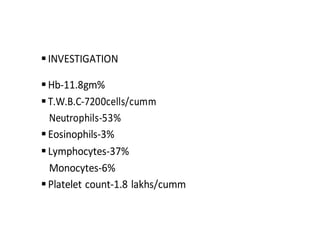
Hb-11.8gm%
T.W.B.C-7200cells/cumm
Neutrophils-53%
Eosinophils-3%
Lymphocytes-37%
Monocytes-6%
Platelet count-1.8 lakhs/cumm
RBS-70mg/dl
HIV-NR
 HBsAg-NR
VDRL-NR
B/G/T-B+ve
 BT-1min 20 seconds
CT-3min 30 seconds
Patient was admitted
 High risk consent was taken
Emergency LSCS was planned
Operation perfomed: Emergency LSCS with bilateral
tubectomy under spinal anaesthesia
Operative Procedure
Under complete aseptic conditions abdomen cleaned
and draped. Pfannensteil-Kerr incision was given over
abdomen
Abdomen opened In layers
Lower uterine segment identified and incised
LUS was thinned out
Lower transverse uterine incision given over lower
segment of uterus
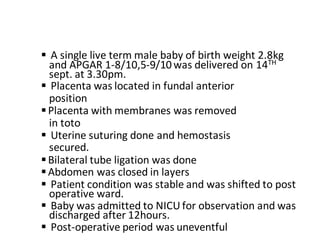
 A single live term male baby of birth weight 2.8kg
and APGAR 1-8/10,5-9/10was delivered on 14TH
sept. at 3.30pm.
 Placenta was located in fundal anterior
position
Placenta with membranes was removed
in toto
 Uterine suturing done and hemostasis
secured.
Bilateral tube ligation was done
Abdomen was closed in layers
 Patient condition was stable and was shifted to post
operative ward.
 Baby was admitted to NICU for observation and was
discharged after 12hours.
 Post-operative period was uneventful
 Suture removal done on 8th post operative day and
wound was healthy.
 Patient was discharged on 9th postoperative day and
was reviewed in OPD after 1 week.
SOME IMPORTANT POINTS
TOLAC-Trial of labour after Cesarean section
ERCD- Elective repeat cesarian delivery
If Cesarean delivery become necessary during trying of labour
termed at “failed trial of labour”
Some factor that influence a successfull trial of labour in
women with prior Cesarean delivery.
Delivery route risk:
o1.Maternal Risks: Uterine rupture increase with TOLAC.
oUterine rupture classified as:
Complete-all layers of uterine wall are seprate
Incomplete / uterine dehiscence- uterine muscle seprate but visceral
peritonium intact.
Uterine rupture risk- 0.47% is absolute risk and 20.7% is relative risk
as compare to ECRD(elective repeat caesarean delivery)-as per review ofGUISE 2010
Maternal death rate is more in ERCD(5.6/1LAC)then compared
to TOLAC (1.6/1LAC)as per retrospective CONDIN study2005
Infection and blood transfusion: TOLAC>ERCDas per LODANE study2004
2. Fetal and Neonatal risk:
a.Perinatal mortality rate : TOLAC(0.13%) > ERCD(0.05%)
b.Neonatal mortality rate :TOLAC(.11%) > ERCD(0.06%)
c.Hypoxic Ischemic Encephalopathy :TOLAC(46/1lac) >ERCD (0)
d.Transient tacypnea of newborn : ERCD (4.2%) > TOLAC(3.6%)
e.Birth trauma(lacerations) : ERCD > TOLAC
Type of incision:
Prior T-shaped or classical uterine incision contraindicated to TOLAC.
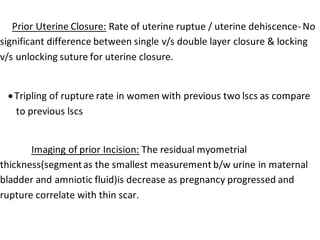
Prior Uterine Closure: Rate of uterine ruptue / uterine dehiscence- No
significant difference between single v/s double layer closure & locking
v/s unlocking suture for uterine closure.
Tripling of rupture rate in women with previous two lscs as compare
to previous lscs
Imaging of prior Incision: The residual myometrial
thickness(segmentas the smallest measurement b/w urine in maternal
bladder and amniotic fluid)is decrease as pregnancy progressed and
rupture correlate with thin scar.
High risk | intermediate risk | low risk
Risk of U.rupture according to : <2mm|2mm-2.4mm|>2.5mm
Myometrial thickness during TOLAC
TOLAC rates : 9% | 42% | 61%
Prior uterine rupture risk for recurrence
Previous lower uterine rupture(6%) > previous upper segment
rupture
Interdelivery interval: Uterine rupture is threefold increase in
interdelivery interval <18months as compare to >18 months.
Previous vaginal delivery after caesarean birth improve the prognosis for subsequent vaginal delivery with spontaneous or induced labour.
fetal size : fetal size inversely proportional to VBAC rates
uterine rupture during TOLAC : < 4kg | >4kg | >4.2kg
1% | 1.6% | 2.4 %
Multifetal gestation :Twin delivery does not increase the
risk of uterine rupture. U.rupture rate is 0.7% and VBAC
rate is 85%
 Maternal obesity: BMI inversely proportional to VBAC.
 BMI : 19.9-24.9 |25-30 |30-40 | >40
VBAC rates: 85% | 78% |70% | 61%
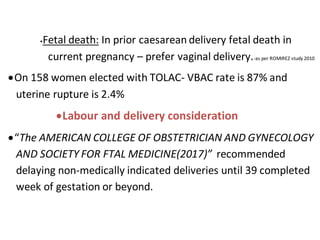
Fetal death: In prior caesarean delivery fetal death in
current pregnancy – prefer vaginal delivery.-as per ROMIREZ study 2010
On 158 women elected with TOLAC- VBAC rate is 87% and
uterine rupture is 2.4%
Labour and delivery consideration
“The AMERICAN COLLEGE OF OBSTETRICIAN AND GYNECOLOGY
AND SOCIETY FOR FTAL MEDICINE(2017)” recommended
delaying non-medically indicated deliveries until 39 completed
week of gestation or beyond.
Establish the guideline for timing of electiveCesarean section:
1.Sonographic measurement taken before 20th week gestation
supports a gestational age >39weeks.
2.Fetal heart sound has been documented for 30 weeks by
Doppler ultrasound.
3.A positive serum/urine B-hcg test result has been documented
for > 36 week.
 Intrapartum care: as per obstetric anaesthesia workforcesurvey
TOLAC allowed in- 88%, where >1500 annual delivery
59%, 500 to 1499 annual delivery
43%, < 500 annual delivery-as per TRAYNOR study 2016
Cervical ripening and labour stimulation:
Prostagldlandin E1- Misoprostol- is contraindicated-as per AMERICAN COLLEGE
OBSTETRICIAN & GYNECOLOGISTS 2017a
1.Oxytocin-Induction and augmentation of labour with oxytocin-
increase rate of uterine rupture.
Uterine rupture- induced with oxytocin(1.1%) > spontaneous
labour(0.4%)
2.Uterine rupture - misoprostol > oxytocin
3.uterine rupture – PGE2gel(2.9%) > spontaneous labour(0.9%)
As per LOYDEN- RAHELLE and ASSOCIATION 2001
Prostaglandin follow by oxytocin was associated with a three
fold greater risk of uterine rupture to spontaneous labour.
Mechanical methods: on Retrospectivedelivery in2479 women with prior c.section
Uterine rupture: transcervical folly catheter for labour
induction(1.6%) > spontaneous labour (1.1%)
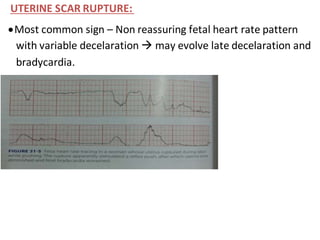
UTERINE SCAR RUPTURE:
Most common sign – Non reassuring fetal heart rate pattern
with variable decelaration  may evolve late decelaration and
bradycardia.
Uterine rupture diagnosis: symptoms of Hypovolumic shock
occour due to Hemoperitonium due to rupture uterus  causes
Diaphragmetic irritation & pain reffered to chest. may direct to
other diagnosis- pulmonary/Amniotic fluid embolism instead of
uterine rupture.
In some women clinical appearance uterine rupture mirrors that
placenta previa.
Decisionto delivery time :With uterine rupture and expulsion of
fetus into the peritoneal cavity chance of intact fetus is less and
mortality ranges from 50-70 %.
“Fetal condition, depends on the degree to which placental
implantation remains intact” this can change with in minute.
On uterine rupture only chance to fetal survive is by immediate
delivery or laprotomy otherwise hypoxia occur which is
inevitable.
If uterine rupture occur f/b total placental sepration  very few
Neurogically intact fetus will be salvaged.
As per “HOLMEGREN study 2012 “on 35 labour patient with
uterine rupture :
Decision to delivery time was-
a)<18 minutes in 17 patients- no neurogical outcome in infants.
b)>18 minutes in 3 infants which was deliver at 31,40,42min –
long term neurological impairment occur.
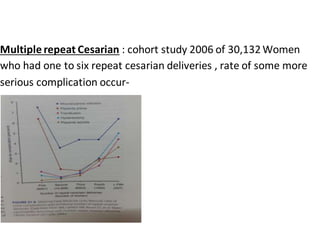
Multiple repeat Cesarian : cohort study 2006 of 30,132Women
who had one to six repeat cesarian deliveries , rate of some more
serious complication occur-
Case presentation of previous two cesarean section

Case presentation of previous two cesarean section

  • 1.
    CASE PRESENTATION On Previoustwo cesarean section Presenter : Dr Vaibhav Sharma & Dr Priyanka Gaur S.P MEDICAL COLLEGE ,BIKANER,RAJASTHAN,INDIA
  • 3.
     A bookedcase of a 32 year old patient, Mrs.Rajshree,resident of W.N.-49,PURANI GINNANI,BIKANER.admitted on 14th September on 2:30pm at janana hospital , BIKANER She is a housewife ,G3P2L2 with chief complain of 9 months amenorrhoea pain abdomen since 2 hours LMP-07-12-2018 EDD-14-09-2019
  • 4.
    HISTORY OF PRESENTINGILLNESS  Patient presented with complaints of 9 months amenorrhoea with pain abdomen since 2 hours  No H/O decreased perception of fetal movements No H/O leaking P/V  No H/O bleeding P/V
  • 5.
    No H/O burningmicturition No H/O swelling of legs No H/O headache No H/O blurring of vision  No H/O of epigastric pain  No H/O frequency of micturition No H/O of fever and vomiting No H/O of trauma
  • 6.
    OBSTETRIC HISTORY G3P2L2 Marital life-6years No h/ousage of OCP’S or ovulation induction drugs
  • 7.
    1st Pregnancy: Conceived spontaneously1 year after marriage Antenatal period was uneventful  Full term, LSCS (indication-MSL with FD), female baby, 4years  Birth weight was 2.9kg,at PVT. Hospital, BIKANER.  Postpartum period was uneventful (no h/o puerperal fever, wound discharge)  Exclusive breast feeding for 6 months  Developmental milestones were normal and baby immunized till date
  • 8.
    2nd Pregnancy: conceived spontaneously1 year after 1st Delivery Full term, LSCS (indication-PREVIOUS LSCS WITH Scar Tenderness), female baby,2years  Birth weight was 2.5kg,at PBM Hospital,BIKANER. Postpartum period was uneventful (no h/o puerperal fever, wound discharge) Present pregnancy: Conceived spontaneously 1year after 2nd Delivery. Regular antenatal check ups at PBM Hospital,BIKANER.
  • 9.
    1stTrimester spontaneous conception confirmedby urine pregnancy test done after 10 days of missed period. 1st ANC visit has at 3month.  No H/O excessive nausea and vomiting No H/O of pain abdomen and bleeding P/V  Folic acid prophylaxis taken No H/O radiation exposure No H/O drug intake
  • 10.
    2nd Trimester: Continue ANCvisit taken every month  Quickening felt in 5th month  Iron and calcium supplementation taken Two doses tetanus toxoid taken 3rd Trimester: Perceived adequate fetal movement No H/O bleeding or leaking P/V No H/O pedal edema
  • 11.
    MENSTRUAL HISTORY  Attainedmenarche at 13years of age  4-5 days/30days, regular, normal flow, no clots, no dysmenorrhoea
  • 12.
    PAST HISTORY  NoH/O Hypertension, Diabetes mellitus, Epilepsy, Tuberculosis, Asthma or Heart disease and  No H/O Blood transfusions. SURGICAL HISTORY  No significant surgical history except for previous two caesarean.
  • 13.
    FAMILY HISTORY:  Noh/o multiple pregnancy,congenital anomalies PERSONAL HISTORY  Diet-mixed, Appetite-good Sleep-adequate  Bowel & Bladder- Regular No addictions
  • 14.
    GENERAL EXAMINATION  Patientis conscious and coherent, moderately built and nourished.  Ht-152cm Wt-64kgs BMI- 28  No pallor, icterus, cyanosis, clubbing, lymphadenopathy and pedal edema Spine, Breast and Thyroid - NAD
  • 15.
    Vitals- Temperature-Afebrile PR-82/min,normal volume BP-110/70mmof Hgin right arm supine position CVS Examination: S1 and S2 heard, No murmurs RESPIRATORY SYSTEM: Bilateral air entry-present, clear and equal on both sides, No adventitious sounds
  • 16.
    PER ABDOMEN: . OnInspection - Uterus uniformly enlarged to size corresponding to term size, umbilicus is central and everted, linea nigra and stria graviderum seen. A transverse suprapubic healthy scar of previous caesarean section seen.  On palpation fundal height was corresponding to 32 Week.  Fundal grip: broad, soft and irregular mass suggestive of buttocks Lateral grip: back felt on left side, limb buds felt on right side  Pawlik’s grip: A hard round, smooth mass s/o cephalic and head was engaged.
  • 17.
     Pelvic grip:Finger are divergent, head was engaged
  • 18.
    Uterus was irritableand scar tenderness was present Symphysio fundal height was 34cms Abdominal girth-94cms Clinically liquor was adequate AUSCULTATION FHS heard,at left spino umbilical line, regular,164/min
  • 19.
     On localexamination : pubic hair is normal in texture and distribution, external genitalia healthy. No LPV / BPV.  P/S-cervix and vagina healthy  P/V-cervix was 20-30% effaced, os admitting 2 finger membranes+ presenting part vertex at -2 station pelvis adequate Single live intrauterine fetus with longitudinal lie and cephalic presentation, head engaged and fetal heart
  • 20.
    sound heard onleft spino-umbilical line and was 164/min.
  • 21.
    SUMMARY  A 32yearold booked case,G3P2L2 with 9months amenorrhoea with prev two LSCS with complaints of pain abdomen since 2hrs On examination uterus was corresponding to 32wk with single live fetus with cephalic presentation with scar tenderness
  • 22.
    DIAGNOSIS: G3P2L2 with 40wkGA with previous two LSCS with scar tenderness in labour
  • 23.
  • 24.
  • 25.
    Patient was admitted High risk consent was taken Emergency LSCS was planned
  • 26.
    Operation perfomed: EmergencyLSCS with bilateral tubectomy under spinal anaesthesia Operative Procedure Under complete aseptic conditions abdomen cleaned and draped. Pfannensteil-Kerr incision was given over abdomen Abdomen opened In layers Lower uterine segment identified and incised LUS was thinned out Lower transverse uterine incision given over lower segment of uterus
  • 27.
     A singlelive term male baby of birth weight 2.8kg and APGAR 1-8/10,5-9/10was delivered on 14TH sept. at 3.30pm.  Placenta was located in fundal anterior position Placenta with membranes was removed in toto  Uterine suturing done and hemostasis secured. Bilateral tube ligation was done Abdomen was closed in layers  Patient condition was stable and was shifted to post operative ward.  Baby was admitted to NICU for observation and was discharged after 12hours.  Post-operative period was uneventful
  • 28.
     Suture removaldone on 8th post operative day and wound was healthy.  Patient was discharged on 9th postoperative day and was reviewed in OPD after 1 week.
  • 29.
    SOME IMPORTANT POINTS TOLAC-Trialof labour after Cesarean section ERCD- Elective repeat cesarian delivery If Cesarean delivery become necessary during trying of labour termed at “failed trial of labour” Some factor that influence a successfull trial of labour in women with prior Cesarean delivery. Delivery route risk: o1.Maternal Risks: Uterine rupture increase with TOLAC.
  • 30.
    oUterine rupture classifiedas: Complete-all layers of uterine wall are seprate Incomplete / uterine dehiscence- uterine muscle seprate but visceral peritonium intact. Uterine rupture risk- 0.47% is absolute risk and 20.7% is relative risk as compare to ECRD(elective repeat caesarean delivery)-as per review ofGUISE 2010 Maternal death rate is more in ERCD(5.6/1LAC)then compared to TOLAC (1.6/1LAC)as per retrospective CONDIN study2005 Infection and blood transfusion: TOLAC>ERCDas per LODANE study2004
  • 31.
    2. Fetal andNeonatal risk: a.Perinatal mortality rate : TOLAC(0.13%) > ERCD(0.05%) b.Neonatal mortality rate :TOLAC(.11%) > ERCD(0.06%) c.Hypoxic Ischemic Encephalopathy :TOLAC(46/1lac) >ERCD (0) d.Transient tacypnea of newborn : ERCD (4.2%) > TOLAC(3.6%) e.Birth trauma(lacerations) : ERCD > TOLAC
  • 32.
    Type of incision: PriorT-shaped or classical uterine incision contraindicated to TOLAC.
  • 33.
    Prior Uterine Closure:Rate of uterine ruptue / uterine dehiscence- No significant difference between single v/s double layer closure & locking v/s unlocking suture for uterine closure. Tripling of rupture rate in women with previous two lscs as compare to previous lscs Imaging of prior Incision: The residual myometrial thickness(segmentas the smallest measurement b/w urine in maternal bladder and amniotic fluid)is decrease as pregnancy progressed and rupture correlate with thin scar.
  • 34.
    High risk |intermediate risk | low risk Risk of U.rupture according to : <2mm|2mm-2.4mm|>2.5mm Myometrial thickness during TOLAC TOLAC rates : 9% | 42% | 61% Prior uterine rupture risk for recurrence Previous lower uterine rupture(6%) > previous upper segment rupture Interdelivery interval: Uterine rupture is threefold increase in interdelivery interval <18months as compare to >18 months. Previous vaginal delivery after caesarean birth improve the prognosis for subsequent vaginal delivery with spontaneous or induced labour.
  • 35.
    fetal size :fetal size inversely proportional to VBAC rates uterine rupture during TOLAC : < 4kg | >4kg | >4.2kg 1% | 1.6% | 2.4 % Multifetal gestation :Twin delivery does not increase the risk of uterine rupture. U.rupture rate is 0.7% and VBAC rate is 85%  Maternal obesity: BMI inversely proportional to VBAC.  BMI : 19.9-24.9 |25-30 |30-40 | >40 VBAC rates: 85% | 78% |70% | 61%
  • 36.
    Fetal death: Inprior caesarean delivery fetal death in current pregnancy – prefer vaginal delivery.-as per ROMIREZ study 2010 On 158 women elected with TOLAC- VBAC rate is 87% and uterine rupture is 2.4% Labour and delivery consideration “The AMERICAN COLLEGE OF OBSTETRICIAN AND GYNECOLOGY AND SOCIETY FOR FTAL MEDICINE(2017)” recommended delaying non-medically indicated deliveries until 39 completed week of gestation or beyond.
  • 38.
    Establish the guidelinefor timing of electiveCesarean section: 1.Sonographic measurement taken before 20th week gestation supports a gestational age >39weeks. 2.Fetal heart sound has been documented for 30 weeks by Doppler ultrasound. 3.A positive serum/urine B-hcg test result has been documented for > 36 week.
  • 39.
     Intrapartum care:as per obstetric anaesthesia workforcesurvey TOLAC allowed in- 88%, where >1500 annual delivery 59%, 500 to 1499 annual delivery 43%, < 500 annual delivery-as per TRAYNOR study 2016 Cervical ripening and labour stimulation: Prostagldlandin E1- Misoprostol- is contraindicated-as per AMERICAN COLLEGE OBSTETRICIAN & GYNECOLOGISTS 2017a 1.Oxytocin-Induction and augmentation of labour with oxytocin- increase rate of uterine rupture.
  • 40.
    Uterine rupture- inducedwith oxytocin(1.1%) > spontaneous labour(0.4%) 2.Uterine rupture - misoprostol > oxytocin 3.uterine rupture – PGE2gel(2.9%) > spontaneous labour(0.9%) As per LOYDEN- RAHELLE and ASSOCIATION 2001 Prostaglandin follow by oxytocin was associated with a three fold greater risk of uterine rupture to spontaneous labour. Mechanical methods: on Retrospectivedelivery in2479 women with prior c.section Uterine rupture: transcervical folly catheter for labour induction(1.6%) > spontaneous labour (1.1%)
  • 41.
    UTERINE SCAR RUPTURE: Mostcommon sign – Non reassuring fetal heart rate pattern with variable decelaration  may evolve late decelaration and bradycardia.
  • 42.
    Uterine rupture diagnosis:symptoms of Hypovolumic shock occour due to Hemoperitonium due to rupture uterus  causes Diaphragmetic irritation & pain reffered to chest. may direct to other diagnosis- pulmonary/Amniotic fluid embolism instead of uterine rupture. In some women clinical appearance uterine rupture mirrors that placenta previa. Decisionto delivery time :With uterine rupture and expulsion of fetus into the peritoneal cavity chance of intact fetus is less and mortality ranges from 50-70 %.
  • 43.
    “Fetal condition, dependson the degree to which placental implantation remains intact” this can change with in minute. On uterine rupture only chance to fetal survive is by immediate delivery or laprotomy otherwise hypoxia occur which is inevitable. If uterine rupture occur f/b total placental sepration  very few Neurogically intact fetus will be salvaged. As per “HOLMEGREN study 2012 “on 35 labour patient with uterine rupture : Decision to delivery time was- a)<18 minutes in 17 patients- no neurogical outcome in infants. b)>18 minutes in 3 infants which was deliver at 31,40,42min – long term neurological impairment occur.
  • 44.
    Multiple repeat Cesarian: cohort study 2006 of 30,132Women who had one to six repeat cesarian deliveries , rate of some more serious complication occur-