Abnormal Uterine Bleeding
Muhammad Redzwan
081303583
MMMC
today
CASE
Patient’s Profile
Name: Puan ZA
Age: 42
Parity Index: Para 4
Occupation: Teacher
Address: Malim Jaya, Melaka
Education: Degree
LMP: 30th March 2014
Date of Admission: 7th April 2014
Date of Examination: 8th April 2014
Chief Complaint
Heavy menstruation for 6 months
History of Presenting Illness
Patient went to KK Cheng due to heavy menstruation for 6 months. She is
apparently well and asymptomatic until 6 months ago when there is increase
in flow and quantity of menstruation. Before that her flow was 4-5 days with
2 pads daily, but now it is 7-9 days with 3-4 pads daily. There is minimal blood
clot. For current cycle, bleeding already stopped 2 days ago. She also
experienced dysmenorrhea, but it started since menarche. Her cycle is regular
of 28 days. No inter-menstrual or post-coital bleed.
No similar history before.
Systemic review reveals that she is lethargic and has palpitations. Other
systems are unremarkable.
After admission, blood was taken for investigations. She undergo abdominal
and transvaginal ultrasound. IV saline has been infused, and tablet iron has
been prescribed.
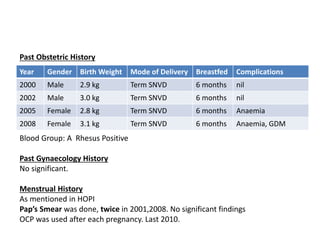
Past Obstetric History
Blood Group: A Rhesus Positive
Past Gynaecology History
No significant.
Menstrual History
As mentioned in HOPI
Pap’s Smear was done, twice in 2001,2008. No significant findings
OCP was used after each pregnancy. Last 2010.
Year Gender Birth Weight Mode of Delivery Breastfed Complications
2000 Male 2.9 kg Term SNVD 6 months nil
2002 Male 3.0 kg Term SNVD 6 months nil
2005 Female 2.8 kg Term SNVD 6 months Anaemia
2008 Female 3.1 kg Term SNVD 6 months Anaemia, GDM
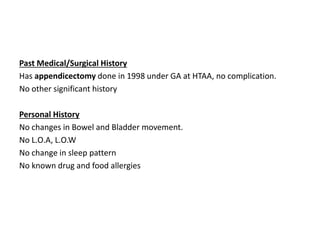
Past Medical/Surgical History
Has appendicectomy done in 1998 under GA at HTAA, no complication.
No other significant history
Personal History
No changes in Bowel and Bladder movement.
No L.O.A, L.O.W
No change in sleep pattern
No known drug and food allergies
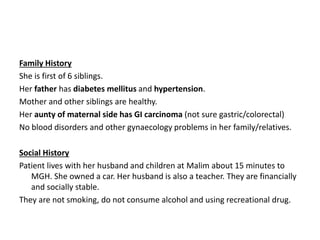
Family History
She is first of 6 siblings.
Her father has diabetes mellitus and hypertension.
Mother and other siblings are healthy.
Her aunty of maternal side has GI carcinoma (not sure gastric/colorectal)
No blood disorders and other gynaecology problems in her family/relatives.
Social History
Patient lives with her husband and children at Malim about 15 minutes to
MGH. She owned a car. Her husband is also a teacher. They are financially
and socially stable.
They are not smoking, do not consume alcohol and using recreational drug.
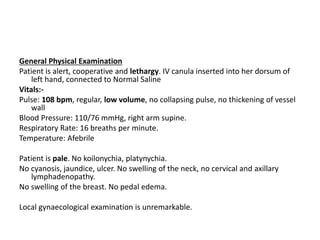
General Physical Examination
Patient is alert, cooperative and lethargy. IV canula inserted into her dorsum of
left hand, connected to Normal Saline
Vitals:-
Pulse: 108 bpm, regular, low volume, no collapsing pulse, no thickening of vessel
wall
Blood Pressure: 110/76 mmHg, right arm supine.
Respiratory Rate: 16 breaths per minute.
Temperature: Afebrile
Patient is pale. No koilonychia, platynychia.
No cyanosis, jaundice, ulcer. No swelling of the neck, no cervical and axillary
lymphadenopathy.
No swelling of the breast. No pedal edema.
Local gynaecological examination is unremarkable.
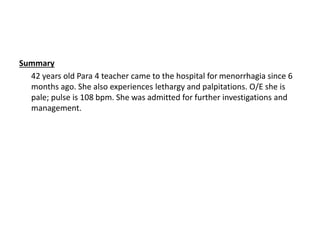
Summary
42 years old Para 4 teacher came to the hospital for menorrhagia since 6
months ago. She also experiences lethargy and palpitations. O/E she is
pale; pulse is 108 bpm. She was admitted for further investigations and
management.
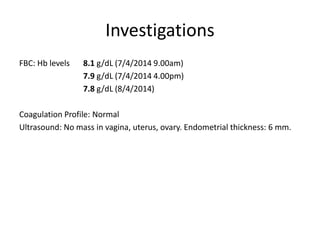
Investigations
FBC: Hb levels 8.1 g/dL (7/4/2014 9.00am)
7.9 g/dL (7/4/2014 4.00pm)
7.8 g/dL (8/4/2014)
Coagulation Profile: Normal
Ultrasound: No mass in vagina, uterus, ovary. Endometrial thickness: 6 mm.
Discussion
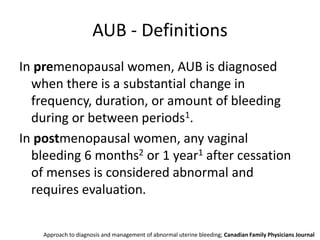
AUB - Definitions
In premenopausal women, AUB is diagnosed
when there is a substantial change in
frequency, duration, or amount of bleeding
during or between periods1.
In postmenopausal women, any vaginal
bleeding 6 months2 or 1 year1 after cessation
of menses is considered abnormal and
requires evaluation.
Approach to diagnosis and management of abnormal uterine bleeding; Canadian Family Physicians Journal
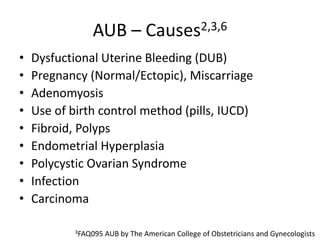
AUB – Causes2,3,6
• Dysfuctional Uterine Bleeding (DUB)
• Pregnancy (Normal/Ectopic), Miscarriage
• Adenomyosis
• Use of birth control method (pills, IUCD)
• Fibroid, Polyps
• Endometrial Hyperplasia
• Polycystic Ovarian Syndrome
• Infection
• Carcinoma
3FAQ095 AUB by The American College of Obstetricians and Gynecologists
How to Proceed?
1. Primary Survey and Resuscitation1
2. History taking1,2,4,5
To identify the type of AUB [ovulatory (cyclical), anovulatory (irregular,
heavy), anatomical (e.g fibroids/polyps)]
Past obstetric/gynaecology history – fibroids, h/o myomectomy
Family history of cervical/endometrial ca.
Medications: ASA, Antidepressants, Anticoagulants, HRT, etc
3. Physical Examination1,2,4,5
To detect systemic involvements, mass per abdomen; pelvic and
bimanual examination must be done. Vaginal swabs TRO infections,
cervical cytology.
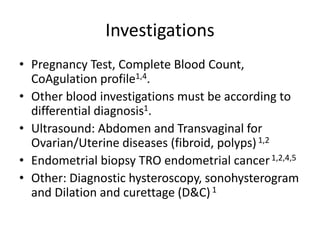
Investigations
• Pregnancy Test, Complete Blood Count,
CoAgulation profile1,4.
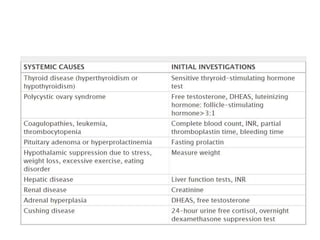
• Other blood investigations must be according to
differential diagnosis1.
• Ultrasound: Abdomen and Transvaginal for
Ovarian/Uterine diseases (fibroid, polyps)1,2
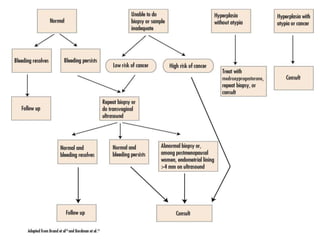
• Endometrial biopsy TRO endometrial cancer1,2,4,5
• Other: Diagnostic hysteroscopy, sonohysterogram
and Dilation and curettage (D&C)1
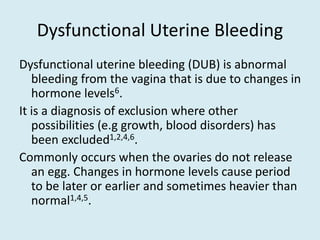
Dysfunctional Uterine Bleeding
Dysfunctional uterine bleeding (DUB) is abnormal
bleeding from the vagina that is due to changes in
hormone levels6.
It is a diagnosis of exclusion where other
possibilities (e.g growth, blood disorders) has
been excluded1,2,4,6.
Commonly occurs when the ovaries do not release
an egg. Changes in hormone levels cause period
to be later or earlier and sometimes heavier than
normal1,4,5.
DUB – Symptoms and Signs2,6
• Bleeding or spotting from the vagina between
periods
• Cycle <28 days or >35 days
• Cycle changes each month (irregular)
• Heavier bleeding (such as passing large clots,
needing to change protection during the night,
soaking through a sanitary pad or tampon every
hour for 2 - 3 hours in a row)
• Bleeding lasts for more days than normal or for
more than 7 days
DUB – Other Symptoms6
Due to hormonal imbalance:
• Excessive growth of body hair in a male
pattern
• Hot flashes
• Mood swings
• Tenderness and dryness of the vagina
Symptoms of Anaemia
DUB - Prognosis
Hormone therapy alone usually alleviates the
symptoms4,6.
Other complications include:
a. infertility6
b. anemia (due to blood loss)
c. endometrial cancer6
Management
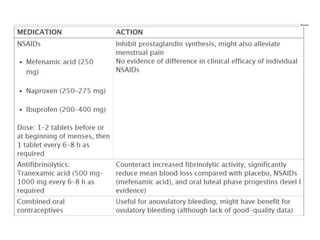
In Premenopausal and Perimenopausal Women1,4
• Menorrhagia assc. with ovulatory cycles can be
treated with/without hormones. NSAIDs and
Antifybrinolytics.
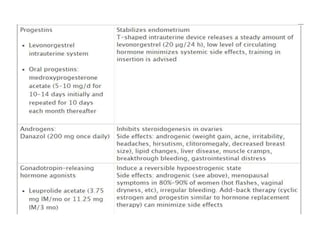
• Menorrhagia assc. with anovulatory cycles need
to be treated by COCP, levonorgestrel intra-
uterine system (LNG-IUS) or Cyclic Oral Progestin
• Menorrhagia assc. with fibroids can be treated
by tranexamic acid, low-dose COCPs, androgens,
or GnRH agonists.
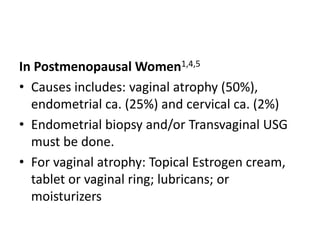
In Postmenopausal Women1,4,5
• Causes includes: vaginal atrophy (50%),
endometrial ca. (25%) and cervical ca. (2%)
• Endometrial biopsy and/or Transvaginal USG
must be done.
• For vaginal atrophy: Topical Estrogen cream,
tablet or vaginal ring; lubricans; or
moisturizers
Surgical Options1,4,5,6,7
• Endometrial ablation (laser, electrical, thermal or
radiofrequency energy) can be suggested [85% have
fewer symptoms].1,4,7
• Hysterectomy (permanent cure)1,5,7
• Uterine artery embolization and myomectomy can be
used for fibroids.1
• Dilation and Curettage (D&C) is no longer considered
as treatment.1
References
1. D. E. Telner, D. Jakubovicz (2007), ‘Approach to diagnosis and management of
abnormal uterine bleeding’, Canadian Family Physicians Journal, Vol. 53 No. 1, pp
58-64.
2. ‘Disorders of Menstruation’ (2012), Gynaecology Today, 1st Ed., pp.197-240.
3. The American College of Obstetricians and Gynecologists (2012), ‘Abnormal
Uterine Bleeding’, FAQ No.095
4. G. A. Vilos et. al. (2001), ’Guidelines for the management of Abnormal Uterine
Bleeding’, J. Obstet. Gynaecol. Can., Vol. 23, No. 8, pp 704-709
5. The American College of Obstetricians and Gynecologists (2013), ‘Management
of Acute Abnormal Uterine Bleeding in Nonpregnant Reproductive-Aged
Women’, Committee Opinion No.557, Obstet Gynecol 2013;121:891–6.
6. MedlinePlus (2011) ‘Dysfunctional uterine bleeding (DUB)’, National Library of
Medicine National Institute of Health
7. P. Bourdrez (2004), ‘Treatment of dysfunctional uterine bleeding: patient
preferences for endometrial ablation, a levonorgestrel-releasing intrauterine
device, or hysterectomy’, Fertility and Sterility, Vol. 82 Issue 1, pp 160-166
8. MedlinePlus (2011) ‘Endometrial Carcinoma’, National Library of Medicine
National Institute of Health
Q & A
THANK YOU
P/s: Further reading: Gynaecology Today Chapter Disorders of Menstruation Page 197-240
Slides can be retrieved in Slideshare

Abnormal Uterine Bleeding (AUB)

  • 1.
    Abnormal Uterine Bleeding MuhammadRedzwan 081303583 MMMC today
  • 2.
    CASE Patient’s Profile Name: PuanZA Age: 42 Parity Index: Para 4 Occupation: Teacher Address: Malim Jaya, Melaka Education: Degree LMP: 30th March 2014 Date of Admission: 7th April 2014 Date of Examination: 8th April 2014
  • 3.
    Chief Complaint Heavy menstruationfor 6 months History of Presenting Illness Patient went to KK Cheng due to heavy menstruation for 6 months. She is apparently well and asymptomatic until 6 months ago when there is increase in flow and quantity of menstruation. Before that her flow was 4-5 days with 2 pads daily, but now it is 7-9 days with 3-4 pads daily. There is minimal blood clot. For current cycle, bleeding already stopped 2 days ago. She also experienced dysmenorrhea, but it started since menarche. Her cycle is regular of 28 days. No inter-menstrual or post-coital bleed. No similar history before. Systemic review reveals that she is lethargic and has palpitations. Other systems are unremarkable. After admission, blood was taken for investigations. She undergo abdominal and transvaginal ultrasound. IV saline has been infused, and tablet iron has been prescribed.
  • 4.
    Past Obstetric History BloodGroup: A Rhesus Positive Past Gynaecology History No significant. Menstrual History As mentioned in HOPI Pap’s Smear was done, twice in 2001,2008. No significant findings OCP was used after each pregnancy. Last 2010. Year Gender Birth Weight Mode of Delivery Breastfed Complications 2000 Male 2.9 kg Term SNVD 6 months nil 2002 Male 3.0 kg Term SNVD 6 months nil 2005 Female 2.8 kg Term SNVD 6 months Anaemia 2008 Female 3.1 kg Term SNVD 6 months Anaemia, GDM
  • 5.
    Past Medical/Surgical History Hasappendicectomy done in 1998 under GA at HTAA, no complication. No other significant history Personal History No changes in Bowel and Bladder movement. No L.O.A, L.O.W No change in sleep pattern No known drug and food allergies
  • 6.
    Family History She isfirst of 6 siblings. Her father has diabetes mellitus and hypertension. Mother and other siblings are healthy. Her aunty of maternal side has GI carcinoma (not sure gastric/colorectal) No blood disorders and other gynaecology problems in her family/relatives. Social History Patient lives with her husband and children at Malim about 15 minutes to MGH. She owned a car. Her husband is also a teacher. They are financially and socially stable. They are not smoking, do not consume alcohol and using recreational drug.
  • 7.
    General Physical Examination Patientis alert, cooperative and lethargy. IV canula inserted into her dorsum of left hand, connected to Normal Saline Vitals:- Pulse: 108 bpm, regular, low volume, no collapsing pulse, no thickening of vessel wall Blood Pressure: 110/76 mmHg, right arm supine. Respiratory Rate: 16 breaths per minute. Temperature: Afebrile Patient is pale. No koilonychia, platynychia. No cyanosis, jaundice, ulcer. No swelling of the neck, no cervical and axillary lymphadenopathy. No swelling of the breast. No pedal edema. Local gynaecological examination is unremarkable.
  • 8.
    Summary 42 years oldPara 4 teacher came to the hospital for menorrhagia since 6 months ago. She also experiences lethargy and palpitations. O/E she is pale; pulse is 108 bpm. She was admitted for further investigations and management.
  • 9.
    Investigations FBC: Hb levels8.1 g/dL (7/4/2014 9.00am) 7.9 g/dL (7/4/2014 4.00pm) 7.8 g/dL (8/4/2014) Coagulation Profile: Normal Ultrasound: No mass in vagina, uterus, ovary. Endometrial thickness: 6 mm.
  • 10.
  • 11.
    AUB - Definitions Inpremenopausal women, AUB is diagnosed when there is a substantial change in frequency, duration, or amount of bleeding during or between periods1. In postmenopausal women, any vaginal bleeding 6 months2 or 1 year1 after cessation of menses is considered abnormal and requires evaluation. Approach to diagnosis and management of abnormal uterine bleeding; Canadian Family Physicians Journal
  • 12.
    AUB – Causes2,3,6 •Dysfuctional Uterine Bleeding (DUB) • Pregnancy (Normal/Ectopic), Miscarriage • Adenomyosis • Use of birth control method (pills, IUCD) • Fibroid, Polyps • Endometrial Hyperplasia • Polycystic Ovarian Syndrome • Infection • Carcinoma 3FAQ095 AUB by The American College of Obstetricians and Gynecologists
  • 13.
    How to Proceed? 1.Primary Survey and Resuscitation1 2. History taking1,2,4,5 To identify the type of AUB [ovulatory (cyclical), anovulatory (irregular, heavy), anatomical (e.g fibroids/polyps)] Past obstetric/gynaecology history – fibroids, h/o myomectomy Family history of cervical/endometrial ca. Medications: ASA, Antidepressants, Anticoagulants, HRT, etc 3. Physical Examination1,2,4,5 To detect systemic involvements, mass per abdomen; pelvic and bimanual examination must be done. Vaginal swabs TRO infections, cervical cytology.
  • 14.
    Investigations • Pregnancy Test,Complete Blood Count, CoAgulation profile1,4. • Other blood investigations must be according to differential diagnosis1. • Ultrasound: Abdomen and Transvaginal for Ovarian/Uterine diseases (fibroid, polyps)1,2 • Endometrial biopsy TRO endometrial cancer1,2,4,5 • Other: Diagnostic hysteroscopy, sonohysterogram and Dilation and curettage (D&C)1
  • 16.
    Dysfunctional Uterine Bleeding Dysfunctionaluterine bleeding (DUB) is abnormal bleeding from the vagina that is due to changes in hormone levels6. It is a diagnosis of exclusion where other possibilities (e.g growth, blood disorders) has been excluded1,2,4,6. Commonly occurs when the ovaries do not release an egg. Changes in hormone levels cause period to be later or earlier and sometimes heavier than normal1,4,5.
  • 17.
    DUB – Symptomsand Signs2,6 • Bleeding or spotting from the vagina between periods • Cycle <28 days or >35 days • Cycle changes each month (irregular) • Heavier bleeding (such as passing large clots, needing to change protection during the night, soaking through a sanitary pad or tampon every hour for 2 - 3 hours in a row) • Bleeding lasts for more days than normal or for more than 7 days
  • 18.
    DUB – OtherSymptoms6 Due to hormonal imbalance: • Excessive growth of body hair in a male pattern • Hot flashes • Mood swings • Tenderness and dryness of the vagina Symptoms of Anaemia
  • 19.
    DUB - Prognosis Hormonetherapy alone usually alleviates the symptoms4,6. Other complications include: a. infertility6 b. anemia (due to blood loss) c. endometrial cancer6
  • 20.
    Management In Premenopausal andPerimenopausal Women1,4 • Menorrhagia assc. with ovulatory cycles can be treated with/without hormones. NSAIDs and Antifybrinolytics. • Menorrhagia assc. with anovulatory cycles need to be treated by COCP, levonorgestrel intra- uterine system (LNG-IUS) or Cyclic Oral Progestin • Menorrhagia assc. with fibroids can be treated by tranexamic acid, low-dose COCPs, androgens, or GnRH agonists.
  • 23.
    In Postmenopausal Women1,4,5 •Causes includes: vaginal atrophy (50%), endometrial ca. (25%) and cervical ca. (2%) • Endometrial biopsy and/or Transvaginal USG must be done. • For vaginal atrophy: Topical Estrogen cream, tablet or vaginal ring; lubricans; or moisturizers
  • 25.
    Surgical Options1,4,5,6,7 • Endometrialablation (laser, electrical, thermal or radiofrequency energy) can be suggested [85% have fewer symptoms].1,4,7 • Hysterectomy (permanent cure)1,5,7 • Uterine artery embolization and myomectomy can be used for fibroids.1 • Dilation and Curettage (D&C) is no longer considered as treatment.1
  • 26.
    References 1. D. E.Telner, D. Jakubovicz (2007), ‘Approach to diagnosis and management of abnormal uterine bleeding’, Canadian Family Physicians Journal, Vol. 53 No. 1, pp 58-64. 2. ‘Disorders of Menstruation’ (2012), Gynaecology Today, 1st Ed., pp.197-240. 3. The American College of Obstetricians and Gynecologists (2012), ‘Abnormal Uterine Bleeding’, FAQ No.095 4. G. A. Vilos et. al. (2001), ’Guidelines for the management of Abnormal Uterine Bleeding’, J. Obstet. Gynaecol. Can., Vol. 23, No. 8, pp 704-709 5. The American College of Obstetricians and Gynecologists (2013), ‘Management of Acute Abnormal Uterine Bleeding in Nonpregnant Reproductive-Aged Women’, Committee Opinion No.557, Obstet Gynecol 2013;121:891–6. 6. MedlinePlus (2011) ‘Dysfunctional uterine bleeding (DUB)’, National Library of Medicine National Institute of Health 7. P. Bourdrez (2004), ‘Treatment of dysfunctional uterine bleeding: patient preferences for endometrial ablation, a levonorgestrel-releasing intrauterine device, or hysterectomy’, Fertility and Sterility, Vol. 82 Issue 1, pp 160-166 8. MedlinePlus (2011) ‘Endometrial Carcinoma’, National Library of Medicine National Institute of Health
  • 27.
  • 28.
    THANK YOU P/s: Furtherreading: Gynaecology Today Chapter Disorders of Menstruation Page 197-240 Slides can be retrieved in Slideshare