Carwhisperer
Bluetooth Attack
What is Bluetooth??
• Bluetooth is “A specification for short-range radio
  links between mobile phones, mobile computers,
  digital cameras, and other portable devices.”
• Enables users to establish ad hoc networks
  supporting voice and data communications
History


• It has been called after Harald Blatand (Harald
  bluetooth), the king of Denmark.
• The Bluetooth wireless technology was invented in
  1994 by Ericsson
• In September 1998, the Bluetooth Special Interest
  Group (SIG) was founded with the objective of
  developing the Bluetooth wireless technology
Bluetooth Basics

• Bluetooth operates in the licensed-free ISM band
  between 2.4 and 2.48 GHz.
• For Prevention of interference with other devices working
  within ISM, Bluetooth make use of a technique called
  frequency hopping.
• It takes 1600 hops/sec
• It has 79 base band frequencies
• Bluetooth is a connection oriented service.
Bluetooth Basics(Continued)

• In order to connect two Bluetooth devices, one of them,
  normally the device initiating the connection, elevates to
  the master, leaving the second device as a slave.
• Piconet
• Scatternet
• ACL (Asynchronous connection-oriented) and SCO
  (Synchronous connection-less)
• Data rates up to 3 Mb/s
• Typical communication range is 10 to100 meters
Bluetooth Topology (ACL link)
Bluetooth Topology (SCO/eSCO link)
Master-Slave Architecture


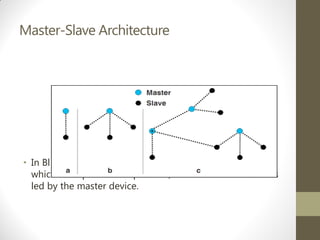
• In Bluetooth, connections with up to seven devices,
  which form piconet are possible, where communication is
  led by the master device.
Bluetooth Services

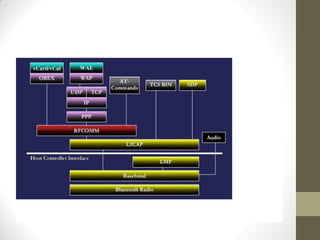
• Bluetooth makes use of a protocol stack, which makes it
  simple to separate application logic from physical data
  connections.

• The protocol architecture of Bluetooth allows for straight
  forward implementation of existing network protocols
  like HTTP, FTP, etc.
Bluetooth Radio & Baseband
• Bluetooth Radio work as a digital signal processing
  component of the system
• Bluetooth device transmit data, which is made up of bits
  (ones and zeros), over a radio frequency
• Baseband processes the signal received and transmitted
  by Radio
• Controls links, packets, error and flow
LMP & HCI
• LMP manages link setup, authentication, link
  configuration and other low level protocols
• Connection establishment
• HCI provides command interface to the baseband
  controller and link manager
• Exists across three sections, the host, transport layer and
  the host controller
L2CAP & RFCOMM
• L2CAP provides connection-oriented and connection-
  less data services to upper layer protocols
• Permits protocols and applications to transmit and
  receive data packets up to 64 kilobytes in length
• RFCOMM protocol supports 60 simultaneous connection
  between two Bluetooth devices
• The number of connections that can be used
  simultaneously in a bluetooth device is implementation
  specific, meaning what profile is being used
SDP-Service Discovery Protocol

• Bluetooth is a technology, which is deployed in a
  dynamical environment. Devices may get out of range or
  even switched on, while new devices might become
  activated.

• In order to detect services, provided by other devices, a
  protocol, which detects services makes sense. In
  Bluetooth, the Service Discovery Protocol is responsible
  for keeping track of services, provided within a device’s
  operating range
TCS - Telephony Control Protocol

• The Telephony Control Protocol provides functionality to
  control telephony applications and makes use of L2CAP
  connections.
OBEX - Object Exchange Protocol

• The Object Exchange Protocol (OBEX) provides services
  for the exchange of binary data objects. To initiate an
  OBEX session, an optional OBEX authentication is
  possible.


• Therefore, a limited set of commands like PUT, GET or
  ABORT exist for easy file transfers, comparable to HTTP.
Bluetooth Profiles

• In Bluetooth, provided services are composed to a
  Bluetooth Profile. Bluetooth devices communicate via the
  profiles, that act as ”interfaces”.

• For further consideration, two Bluetooth profiles are
  especially interesting, concerning BlueSnarfing and
  BlueBugging attacks:
   1. OBEX Object Push Profile (OPP).
   2. Synchronisation Profile (SYNCH).
OBEX Object Push Profile (OPP)

• The Object Push Profile (OPP) provides basic functions
  for exchange of binary objects, mainly used for vCards in
  Bluetooth.

• vCard is a file format standard for electronic business
  cards.

• Since vCards are not worth being especially protected, no
  authorization procedure is performed before OPP
  transactions. Supported OBEX commands are connect,
  disconnect, put , get and abort.
Synchronization Profile (SYNCH)

• The Synchronization Profile (SYNCH) provides functions
  for exchange of Personal Information Manager (PIM)
  data and was adopted from the IrDA infrared
  specification.


• In Bluetooth, especially private data, like the address
  book, calendar, etc. is sent using the SYNCH profile.
Overview On Bluetooth Security

• Security within Bluetooth itself covers three major
  areas:
      – Authentication
      – Authorization
      – Encryption

• Security levels:
      – Silent
      – Private
      – Public
Thank You !!

Carwhisperer Bluetooth Attack

  • 1.
  • 2.
    What is Bluetooth?? •Bluetooth is “A specification for short-range radio links between mobile phones, mobile computers, digital cameras, and other portable devices.” • Enables users to establish ad hoc networks supporting voice and data communications
  • 3.
    History • It hasbeen called after Harald Blatand (Harald bluetooth), the king of Denmark. • The Bluetooth wireless technology was invented in 1994 by Ericsson • In September 1998, the Bluetooth Special Interest Group (SIG) was founded with the objective of developing the Bluetooth wireless technology
  • 4.
    Bluetooth Basics • Bluetoothoperates in the licensed-free ISM band between 2.4 and 2.48 GHz. • For Prevention of interference with other devices working within ISM, Bluetooth make use of a technique called frequency hopping. • It takes 1600 hops/sec • It has 79 base band frequencies • Bluetooth is a connection oriented service.
  • 5.
    Bluetooth Basics(Continued) • Inorder to connect two Bluetooth devices, one of them, normally the device initiating the connection, elevates to the master, leaving the second device as a slave. • Piconet • Scatternet • ACL (Asynchronous connection-oriented) and SCO (Synchronous connection-less) • Data rates up to 3 Mb/s • Typical communication range is 10 to100 meters
  • 6.
  • 7.
  • 8.
    Master-Slave Architecture • InBluetooth, connections with up to seven devices, which form piconet are possible, where communication is led by the master device.
  • 9.
    Bluetooth Services • Bluetoothmakes use of a protocol stack, which makes it simple to separate application logic from physical data connections. • The protocol architecture of Bluetooth allows for straight forward implementation of existing network protocols like HTTP, FTP, etc.
  • 11.
    Bluetooth Radio &Baseband • Bluetooth Radio work as a digital signal processing component of the system • Bluetooth device transmit data, which is made up of bits (ones and zeros), over a radio frequency • Baseband processes the signal received and transmitted by Radio • Controls links, packets, error and flow
  • 12.
    LMP & HCI •LMP manages link setup, authentication, link configuration and other low level protocols • Connection establishment • HCI provides command interface to the baseband controller and link manager • Exists across three sections, the host, transport layer and the host controller
  • 13.
    L2CAP & RFCOMM •L2CAP provides connection-oriented and connection- less data services to upper layer protocols • Permits protocols and applications to transmit and receive data packets up to 64 kilobytes in length • RFCOMM protocol supports 60 simultaneous connection between two Bluetooth devices • The number of connections that can be used simultaneously in a bluetooth device is implementation specific, meaning what profile is being used
  • 14.
    SDP-Service Discovery Protocol •Bluetooth is a technology, which is deployed in a dynamical environment. Devices may get out of range or even switched on, while new devices might become activated. • In order to detect services, provided by other devices, a protocol, which detects services makes sense. In Bluetooth, the Service Discovery Protocol is responsible for keeping track of services, provided within a device’s operating range
  • 15.
    TCS - TelephonyControl Protocol • The Telephony Control Protocol provides functionality to control telephony applications and makes use of L2CAP connections.
  • 16.
    OBEX - ObjectExchange Protocol • The Object Exchange Protocol (OBEX) provides services for the exchange of binary data objects. To initiate an OBEX session, an optional OBEX authentication is possible. • Therefore, a limited set of commands like PUT, GET or ABORT exist for easy file transfers, comparable to HTTP.
  • 17.
    Bluetooth Profiles • InBluetooth, provided services are composed to a Bluetooth Profile. Bluetooth devices communicate via the profiles, that act as ”interfaces”. • For further consideration, two Bluetooth profiles are especially interesting, concerning BlueSnarfing and BlueBugging attacks: 1. OBEX Object Push Profile (OPP). 2. Synchronisation Profile (SYNCH).
  • 18.
    OBEX Object PushProfile (OPP) • The Object Push Profile (OPP) provides basic functions for exchange of binary objects, mainly used for vCards in Bluetooth. • vCard is a file format standard for electronic business cards. • Since vCards are not worth being especially protected, no authorization procedure is performed before OPP transactions. Supported OBEX commands are connect, disconnect, put , get and abort.
  • 19.
    Synchronization Profile (SYNCH) •The Synchronization Profile (SYNCH) provides functions for exchange of Personal Information Manager (PIM) data and was adopted from the IrDA infrared specification. • In Bluetooth, especially private data, like the address book, calendar, etc. is sent using the SYNCH profile.
  • 20.
    Overview On BluetoothSecurity • Security within Bluetooth itself covers three major areas: – Authentication – Authorization – Encryption • Security levels: – Silent – Private – Public
  • 25.