
















































Dan Steinberg
                      Salford Systems
Ph: 619-543-8880 Fax: 619-543-8888
           info@salford-systems.com
   Provide Overview of                Explain Key Concepts
    Methodology                         ◦ Tree growing & splitting –
                                          Testing & pruning
    ◦ Historical background
                                        ◦ Selection of “optimal” tree
    ◦ Motivation for research             – Refinement of analysis

   Introduce Software                 Guide to Reading the
    ◦ New look and feel of              Output
      CART – hints, tricks, traps       ◦ How to interpret statistics
                                          and reports
    ◦ Troubleshooting
                                        ◦ What to ask for in way of
                                          diagnostic reports
   A computer intensive technique that could
    automatically analyze data

   Method could sift through any number of variables
    ◦ Could separate relevant from irrelevant predictors

    ◦ Did not require any kind of variable transforms (logs, square
      roots) – impervious to outliers and missing values

    ◦ Could yield relatively simple and easy to comprehend models –
      required little to no supervision by the analyst

    ◦ Was frequently more accurate than traditional logistic
      regression or discriminant analysis, and other parametric tools
   CART was slow to gain widespread recognition
    for several reasons
    ◦ Monograph introducing CART is challenging to read
       Brilliant book overflowing with insights into tree growing methodology but
        fairly technical and brief

    ◦ Method was not expounded in any textbooks

    ◦ Originally taught only in advanced graduate statistics
      classes at a handful of leading universities

    ◦ Original standalone software came with slender
      documentations, and output was not self-explanatory

    ◦ Method was such a radical departure from conventional
      statistics
   Rising interest in data mining- Availability of huge data sets
    requiring analysis
    ◦ Need to automate or accelerate and improve analysis
      process comparative performance studies

   Advantages of CART over other tree methods
    ◦ Handling of missing values
    ◦ Assistance in interpretation of results (surrogates)
    ◦ Performance advantages: speed, accuracy

   New software and documentation make techniques accessible
    to end users
    ◦ Word of mouth generated by early adopters
   Best illustrated with a famous example- the UCSD Heart
    Disease study

   Given the diagnosis of a heart attack based on
    ◦ Chest pain, Indicative EKGs, Elevation of enzymes typically
      released by damaged heart muscle

   Predict who is at risk of a 2nd heart attack and early death
    within 30 days
    ◦ Prediction will determine treatment program (intensive care
      or not)

   For each patient about 100 variables were
    available, including: demographics, medical history, lab
    results
    ◦ 19 noninvasive variables were used in the analysis
   Example of a CLASSIFICATION tree

   Dependent variable is categorical (SURVIVE, DIE)

   Want to predict class membership

   (insert graph)
   Entire tree represents a complete analysis or

   Has the form of a decision tree

   Root of inverted tree contains all data

   Root gives rise to child nodes

   At some point a given path ends in a terminal node

   Terminal node classifies object

   Path through the tree governed by the answers to QUESTIONS or
    RULES
   Is continuous variable X C?

   Does categorical variable D take on levels i, j, or k?
    ◦ e.g. Is geographical region 1, 2, 4, or 7?

   Standard split:
    ◦ If answer to question is YES a case goes left; otherwise it
      goes right- This is the form of all primary splits

   Question is formulated so that only two answers are
    possible- Called binary partitioning
    ◦ In CART the YES answer always goes left
   Terminal nodes are associated with a single class
    ◦ Any case arriving at a terminal nose is assigned to that
      class

   In standard classification, tree assignment is not probabilistic
    ◦ Another type of CART tree, the class probability tree does
      not report distributions of class membership in nodes
      (discussed later)

   With large data sets we can take the empirical distribution in
    a terminal node to represent the distribution of classes
   For classification trees

    ◦ All objects reaching a terminal node are classified in the same way
       e.g. All heart attack victims with BP>91 and AGE less than 62.5
        are classified as SURVIVORS
    ◦    Classification is same regardless of other medical history and
      lab results

   Some cases may be misclassified:

    ◦ Simplest measure:
       R(T)= percent of learning sample misclassified in tree T
         R(t)=percent of learning sample in node t
        Misclassified – T identifies a TREE
        - T identifies a NODE
   (Insert table)

   In CART terminology the performance is
    described by the error rate R(T), where T
    indexes a specific tree- in the example
    R(T)=1-.8651=.1349
   Practical decision tool
    ◦ Trees like this are used for real world decision making
       Rules for physicians
         Decision tool for a nationwide team of salesmen needing to
          classify potential customers


   Selection of the most important prognostic variables –
    variable screen for parametric model building
    ◦ Example data set had 100 variables
    ◦ Use results to find variables to include in a logistic regression


   Insight- in our example AGE is not relevant if BP is not high-
    suggests which interactions will be important
   Data is split into two partitions
    ◦ Thus “binary” partition

   Partitions can also be split into sub-partitions
    ◦ Hence procedure is recursive

   CART tree is generated by repeated
    partitioning of data set
   Approximates the data pattern via local summaries
   BUT
    ◦ Determines which variables to use dynamically

    ◦ Determines which regions to focus on dynamically

    ◦ Focuses on only a moderate and possibly very small number of
      variables

    ◦ All automatically determined by the data

   We saw in the CHD study CART focused on just 3 of 19
    variables
   Iris Setosa

   Iris Versicolor

   Iris Virginica
   IRIS data set
   3 classes of species
   We can use the PETALLEN & PETALWID
    variables to produce a tree
   Key
    = species 1
    = species 2
    = species 3
    (insert graph)
   Partitioning line parallel to an axis

 Root node split
First- 2.450
   ◦ Isolates all the type 1 species from rest of the sample

   This gives us two child nodes
    ◦ One is a terminal node with only type 1 species
    ◦ The other contains only type 2 and 3

   Note: entire data set divided into two separate parts
   (insert graph)
   Again, partition with line parallel to one of the two axes

   CART selects PETALWID to split this NODE
    ◦ Split it at 1.75
    ◦ Gives a tree with a misclassification rate of 4%

   Split applies only to a single partition of the data

   Each partition is analyzed separately
   (insert graph)
   Tree growing

    ◦ Consider all possible splits of a node

    ◦ Find the best split according to the given splitting rule (best
      improvement)

   Tree Pruning- creating a sequence of nested trees (pruning
    sequence) by systematic removal of the weakest branches

   Optimal Tree Selection- using test sample or cross-validation
    to find the best tree in the pruning sequence
   For any node CART will examine ALL possible splits
    ◦ Computationally intensive but there are only a finite number of splits


   Consider first the variable AGE- in our data set has minimum
    value 40
    ◦ The rule
       Is AGE 40? Will separate out these cases to the left- the youngest
        persons


   Next increase the AGE threshold to the next youngest person
    ◦ Is AGE 43
    ◦ This will direct six cases to the left


   Continue increasing the splitting threshold value by value
   Sorted by Age Sorted by Blood Pressure
   (insert graphs)
   Cart considers all possible splits based on a categorical
    predictor unless the number of categories exceeds 15

   Example: four regions- A,B,C,D
   (insert graph)

   Each decision is a possible split of the node and each is
    evaluated for improvement of impurity
   Here special algorithms reduce compute time to linear in
    number of levels

   30 levels take twice as long as 15 not 10,000+ times as long

   When you have high-level categorical variables in a multi-
    class problem
    ◦ Create a binary classification problem

    ◦ Try different definitions of DPV (which groups to combine)-
      Explore predictor groupings produced by CART

    ◦ From a study of all results decide which are most informative-
      Create new grouped predicted variable for multi-class problem
   Problem: needed to understand a market research clustering
    scheme

   Clusters were created using 18 variables and conventional
    clustering software

   Wanted simple rules to describe cluster membership

   Experimented with CART tree to see if there was an intuitive
    story
   (Insert graph)
   (Insert graph)
   (Insert Graph)
   (Insert graph)
   (Insert graph)
   (Insert graph)
   (Insert graph)
   (Insert graph)
   (Insert graph)
   (Insert graph)
   (Insert graph)
   (Insert graph)
   (Insert graph)
   This latter split seems to be a little better

   Relatively less class DEAD in the left node

   More of class SURVIVE in the right node
   A node which contains members of only one class is perfectly
    pure
    ◦ A node which contains an equal proportion of every class is least
      pure
    ◦ CART evaluates the goodness of any candidate split using an
      impurity funtion:
       Must be 0 for perfectly pure node

       Must attain maximum for least pure node

       Must be convex (need to accelerate towards 0 as node becomes pure)


   I(t) – impurity measure of the node t
   You can experiment with several in CART
   GINI impurity
    ◦ i(t) = 4p (1-p)

   Entropy impurity
    ◦ i(t) = -p log(p)

   (Insert graph)
   (1) Can almost always improve purity- Often unable to improve
    accuracy for a specific node

    ◦ We will see later: if parent and both children are all assigned to same
      class then split does nothing for accuracy

   (2) Predictive accuracy is the long run objective of the tree- This
    goal is not served well by maximizing it at every node!

   Instead we need splitting rules that encourage good tree
    evolution

    ◦ Since splitting is myopic (looks only at current node- the next step)
    ◦ Need rules that are in some sense geared towards the long run
      outcome
   Both splits below result to the same accuracy- 200 cases
    remain misclassified

   However, split #2 is unambiguously better- the right node is
    pure, no more work is needed on this side

   A convex impurity function will favor the 2nd split
   (Insert graph)
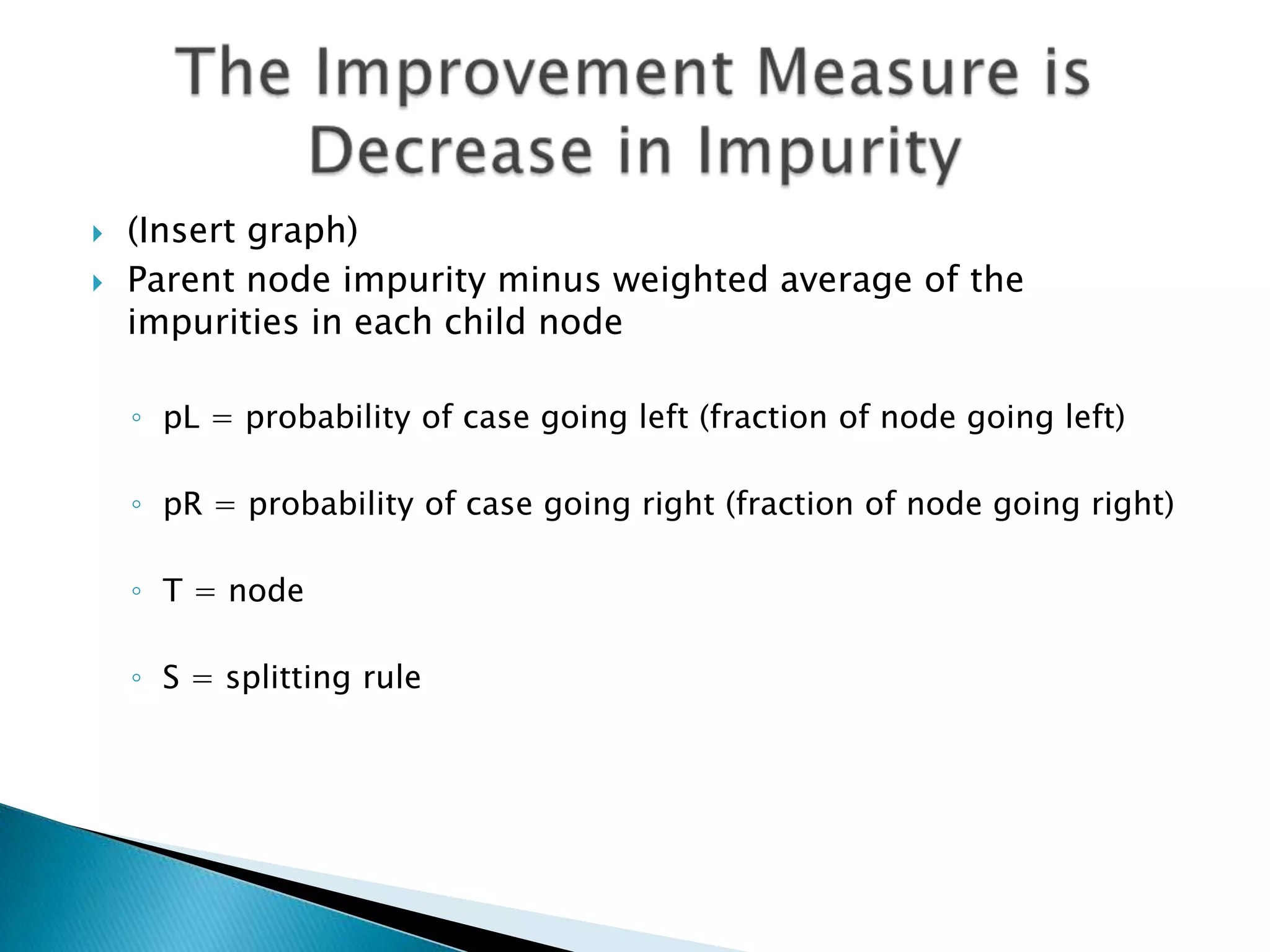
   (Insert graph)
   Parent node impurity minus weighted average of the
    impurities in each child node

    ◦ pL = probability of case going left (fraction of node going left)

    ◦ pR = probability of case going right (fraction of node going right)

    ◦ T = node

    ◦ S = splitting rule
   Primary splitting rules for classification: Gini,
    Twoing, Power Modified Twoing

   Other rules available: Ordered Twoing, Symmetric
    Gini
   (Insert graph)
   Here we have a very satisfactory split

   3 segments go left in their entirety

   Remainder go right

   What has happened to impurity?

   (Insert graph)
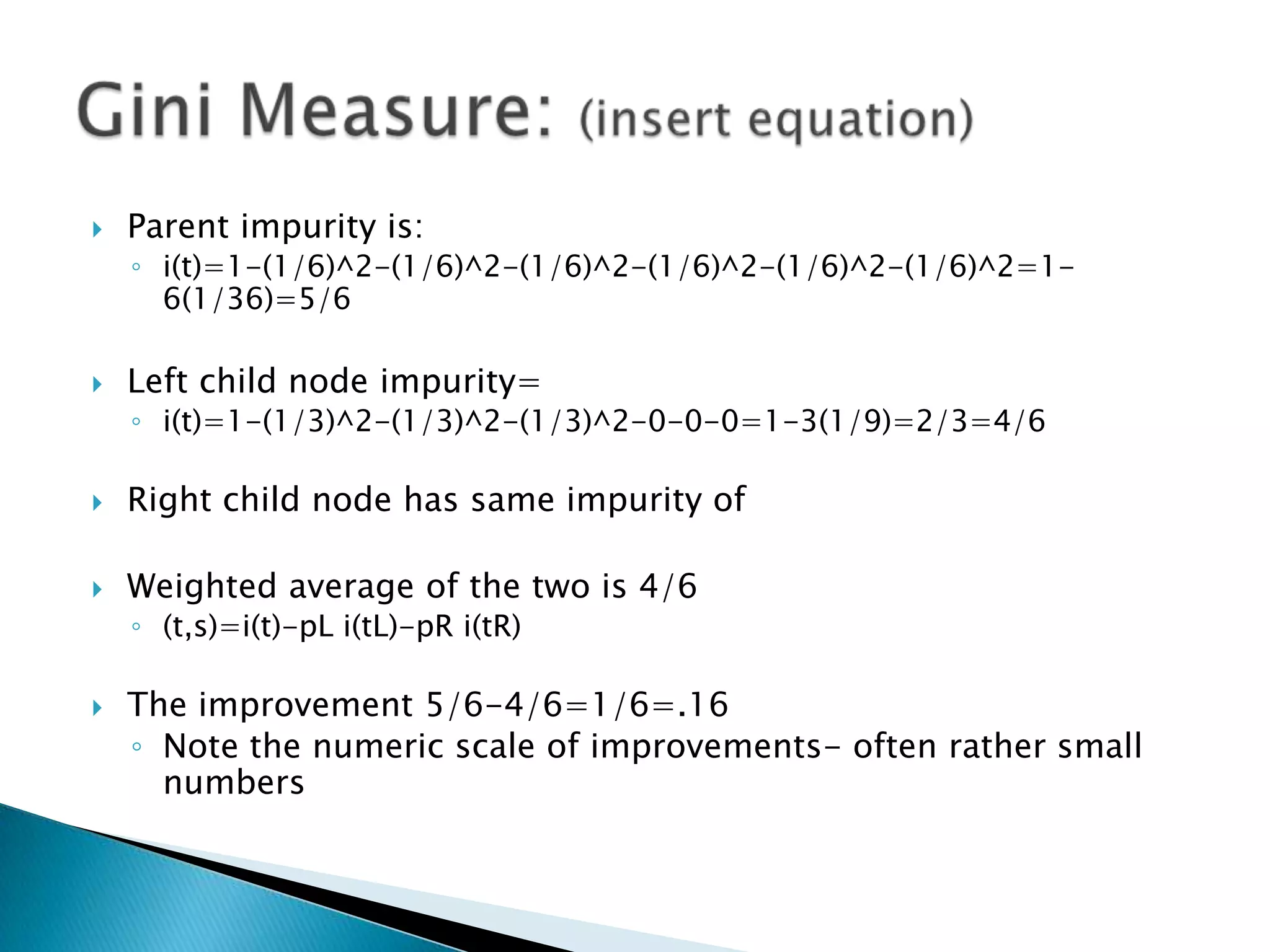
   Parent impurity is:
    ◦ i(t)=1-(1/6)^2-(1/6)^2-(1/6)^2-(1/6)^2-(1/6)^2-(1/6)^2=1-
      6(1/36)=5/6

   Left child node impurity=
    ◦ i(t)=1-(1/3)^2-(1/3)^2-(1/3)^2-0-0-0=1-3(1/9)=2/3=4/6

   Right child node has same impurity of

   Weighted average of the two is 4/6
    ◦ (t,s)=i(t)-pL i(tL)-pR i(tR)

   The improvement 5/6-4/6=1/6=.16
    ◦ Note the numeric scale of improvements- often rather small
      numbers
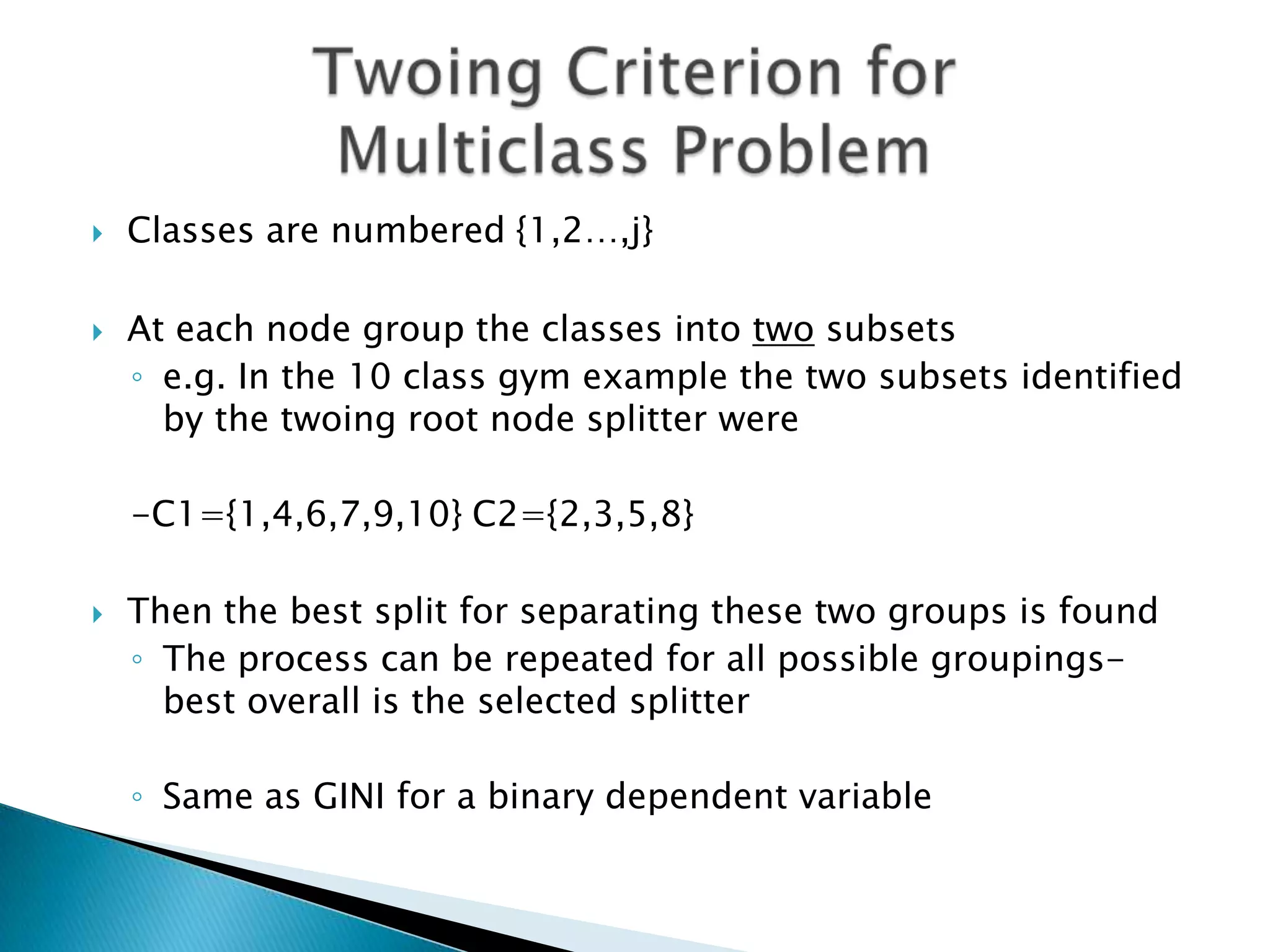
   Classes are numbered {1,2…,j}

   At each node group the classes into two subsets
    ◦ e.g. In the 10 class gym example the two subsets identified
      by the twoing root node splitter were

    -C1={1,4,6,7,9,10} C2={2,3,5,8}

   Then the best split for separating these two groups is found
    ◦ The process can be repeated for all possible groupings-
      best overall is the selected splitter

    ◦ Same as GINI for a binary dependent variable
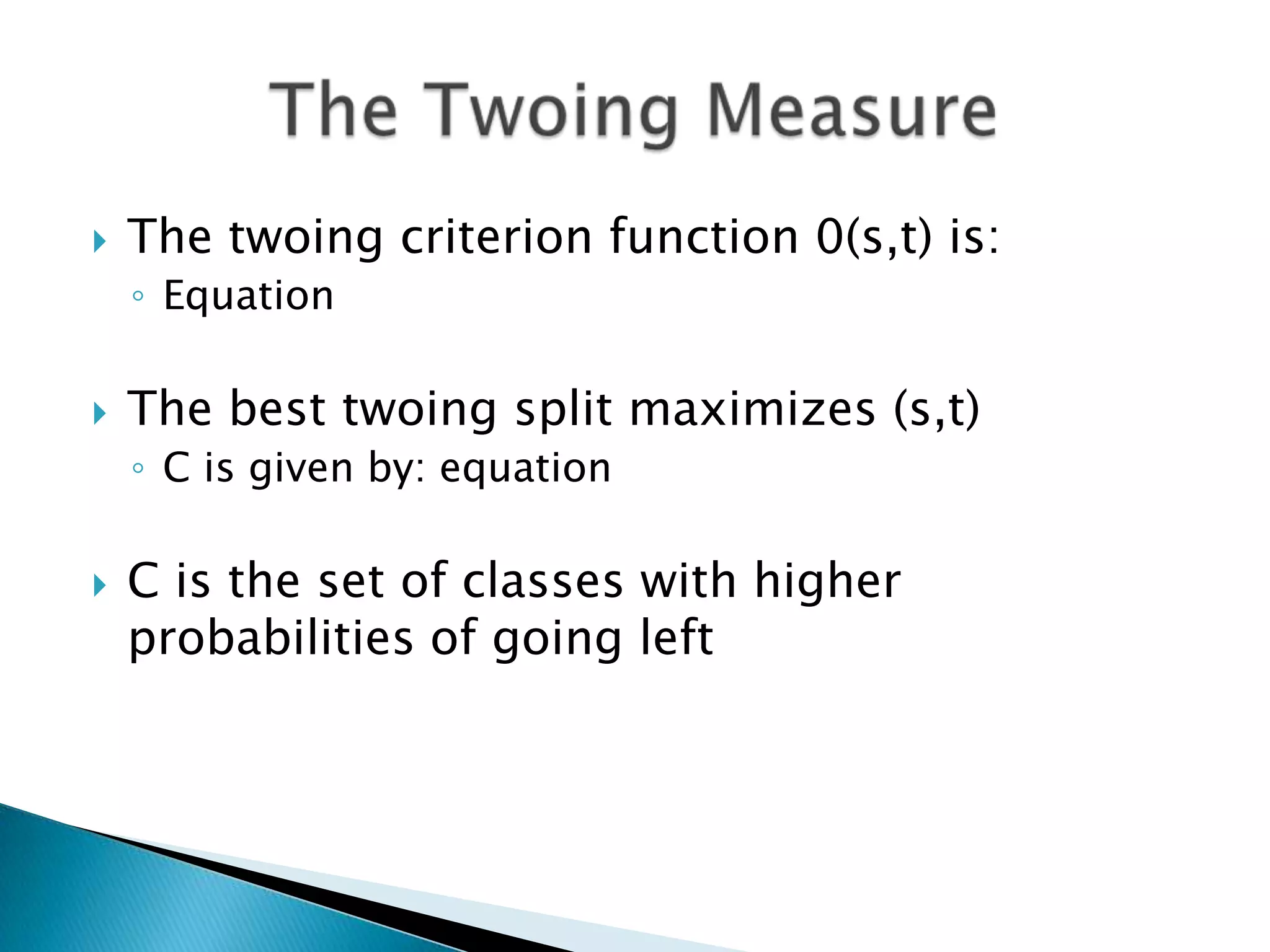
   The twoing criterion function 0(s,t) is:
    ◦ Equation

   The best twoing split maximizes (s,t)
    ◦ C is given by: equation

   C is the set of classes with higher
    probabilities of going left
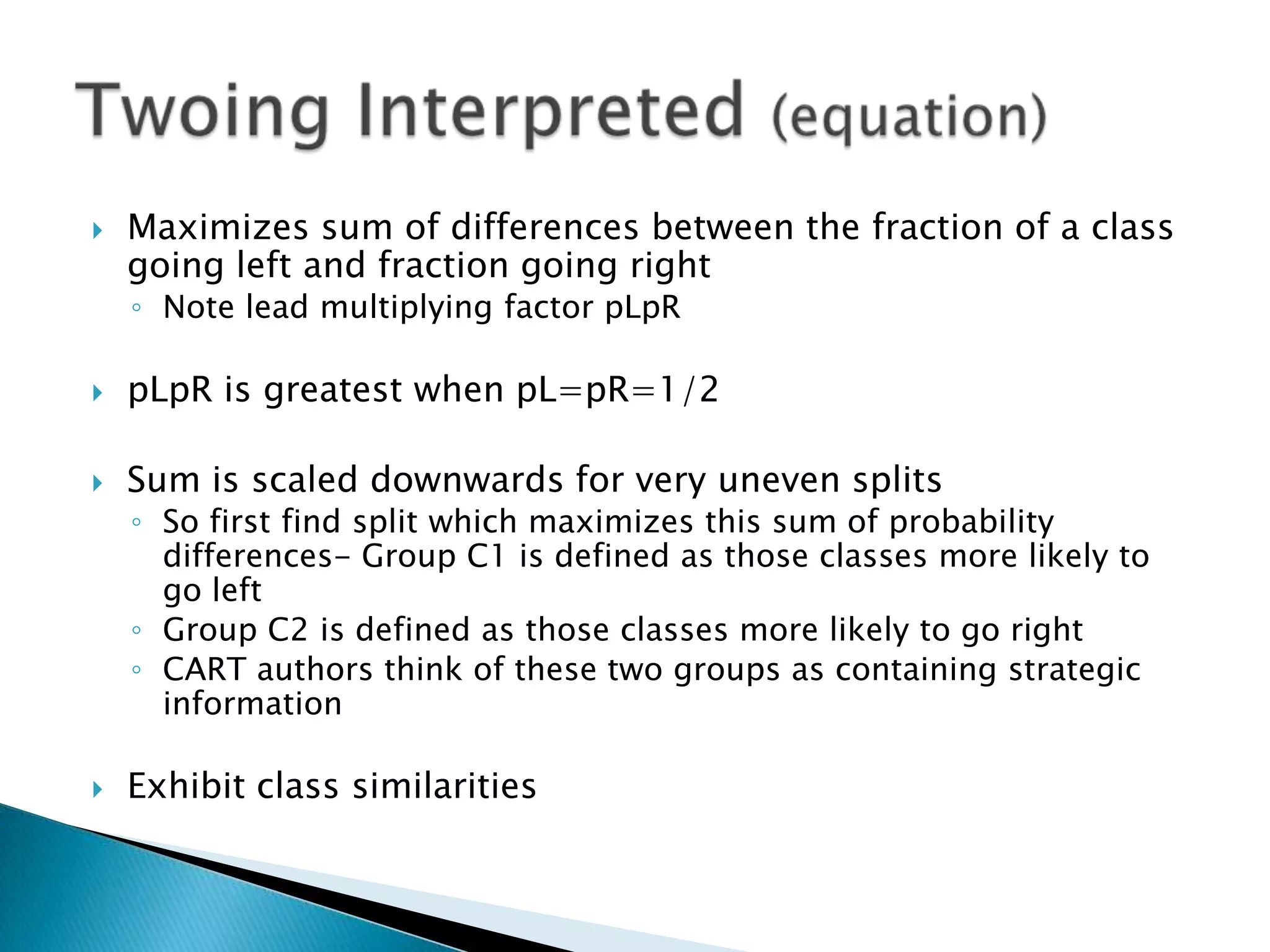
   Maximizes sum of differences between the fraction of a class
    going left and fraction going right
    ◦ Note lead multiplying factor pLpR

   pLpR is greatest when pL=pR=1/2

   Sum is scaled downwards for very uneven splits
    ◦ So first find split which maximizes this sum of probability
      differences- Group C1 is defined as those classes more likely to
      go left
    ◦ Group C2 is defined as those classes more likely to go right
    ◦ CART authors think of these two groups as containing strategic
      information

   Exhibit class similarities
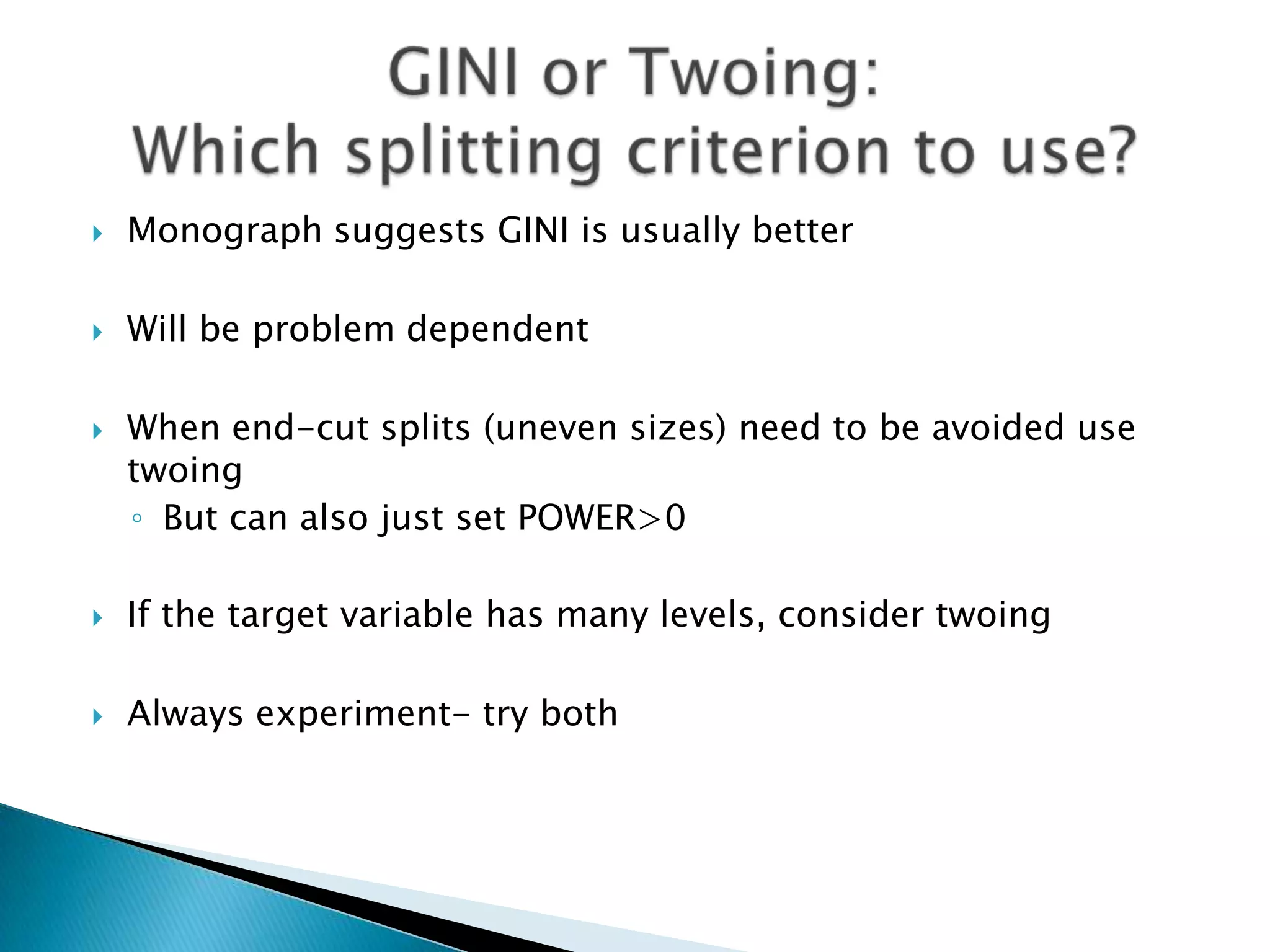
   Monograph suggests GINI is usually better

   Will be problem dependent

   When end-cut splits (uneven sizes) need to be avoided use
    twoing
    ◦ But can also just set POWER>0

   If the target variable has many levels, consider twoing

   Always experiment- try both
   (Insert graph)
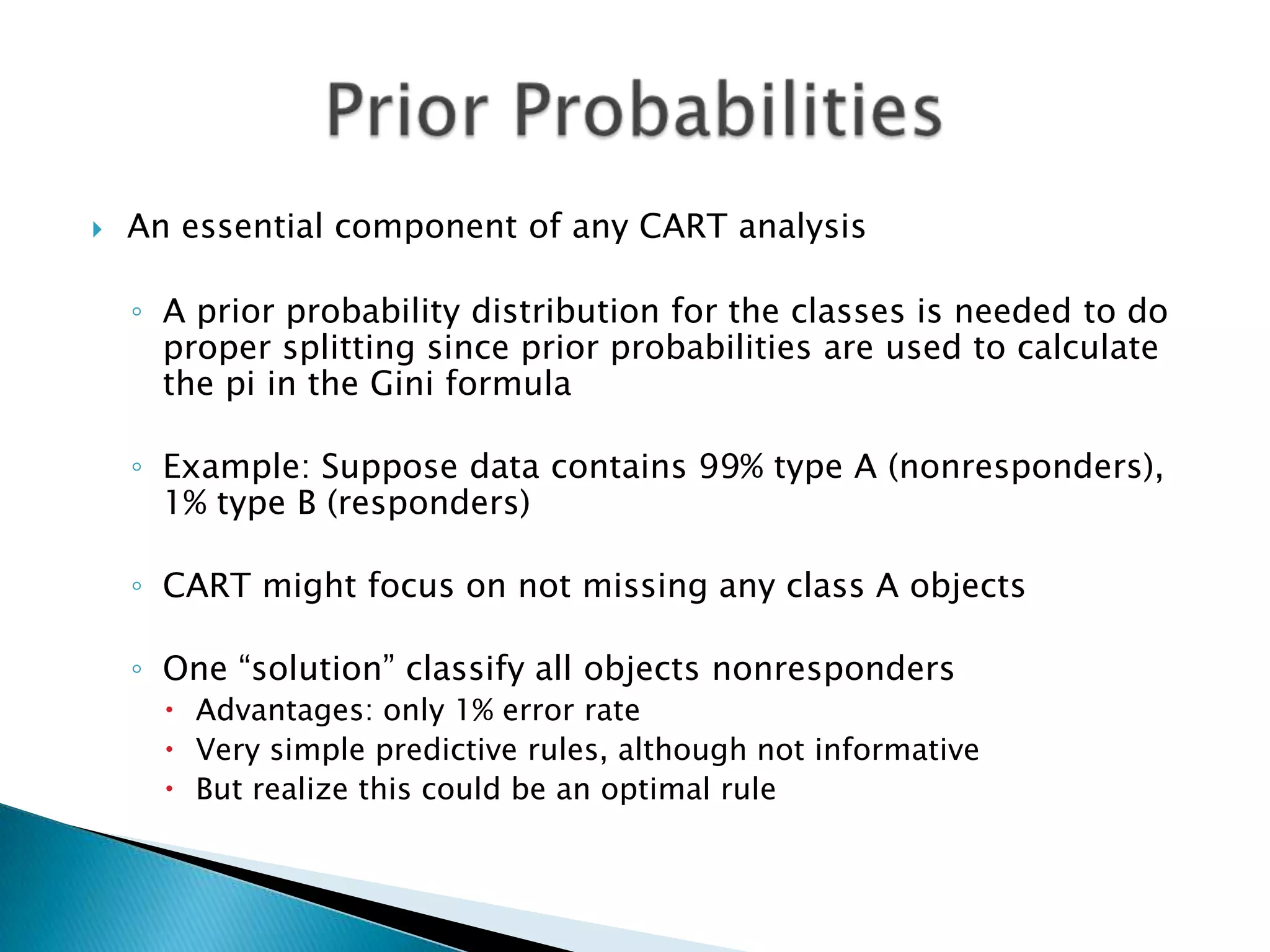
   An essential component of any CART analysis

    ◦ A prior probability distribution for the classes is needed to do
      proper splitting since prior probabilities are used to calculate
      the pi in the Gini formula

    ◦ Example: Suppose data contains 99% type A (nonresponders),
      1% type B (responders)

    ◦ CART might focus on not missing any class A objects

    ◦ One “solution” classify all objects nonresponders
       Advantages: only 1% error rate
       Very simple predictive rules, although not informative
       But realize this could be an optimal rule
   Most common priors: PRIORS EQUAL

   This gives each class equal weight regardless of its frequency in the data

   Prevents CART from favoring more prevalent classes

   If we have 900 classes A and 100 classes B and equal priors
   (Insert graph)

   With equal priors prevalence measured as percent of OWN class size

   Measurements relative to own class not entire learning set

   If PRIORS DATA both child nodes would be class A

   Equal priors puts both classes on an equal footing
   Priors settings:
    equal, learn, test, data, mix, user-specified
   (Insert graph)
   For equal priors class node is class 1 if
    ◦ (equation)

   Classify any node by “count ratio in node” relative to “count
    ratio in root”

   Classify by which level has greatest relative richness
   When priors are not equal: equation
    ◦ Where is the prior for that class

    ◦ Since (1)/(j) always appears as ratio just think in terms of boosting
      amount Ni(t) by a factor, e.g. 9:1, 100:1, 2:1

    ◦ If priors are EQUAL, terms cancel out

If priors are DATA, then
which simplifies forumla to Pl (equation) (simple counting)
 classify as class1 if

   If priors are neither EQUAL nor DATA then formula will
    provide boost to up-weighted classes
   (Insert equations)
   EQUAL PRIORS is the default setting for all CART analyses
   Gives each class an equal chance at being correctly classified
   Example of PRIORS
    ◦ PRIORS EQUAL Default- should use this to start with

    ◦ PRIORS DATA Empirical frequency, whatever is found in data

    ◦ PRIORS MIX Average of EQUAL and DATA- shades toward empirical

    ◦ PRIORS=n1,n2 Explicit priors

    ◦ PRIORS=2,1 Makes class 1 prior twice class 2 prior

    ◦ PRIORS=.67, .33 Same as PRIORS 2,1
   Pi(t)= within- node probability of class i in node t

   If priors DATA then (insert equation)

   Proportions of class i in node t with data priors

   Otherwise proportions are always calculated as weighted
    shares using priors adjusted pi
   Putting a larger prior on a class will tend to decrease its
    misclassification rate
   Hence can use priors to shape and analysis
   Example:

MISCLASSIFICATION RATES BY CLASS FOR ALTERNATIVE PRIORS:
  Number Misclassified (N) and probability of Misclassification
                               (%)
                        (Insert graph)
   For most classification schemes…
    ◦ “AN ERROR IS AN ERROR IS AN ERROR”

    ◦ No distinction made between different types of error- All count
      equally- are equally bad

    ◦ In practical applications different errors are quite different in
      importance

    ◦ In medical application: classifying a breast tumor as malignant or
      benign

       Misclassify malignant as benign- possible death of patient
       Misclassify benign as malignant- unnecessary open breast biopsy

   Want both classes classified correctly- either mistake is serious
   May want to up-weight the misclassification of malignant tumors
    error
   Martin & Wright (1974): Segmenting population into buyers
    vs. non-buyers
    ◦ Purpose: allocate marketing effort to buyers- marketing to a non-
      buyer loses the company $1- Not marketing to a buyer forgoes $3
      of profit

    ◦ Want to include this in the analysis

    ◦ Consider group of customers to be classified on demographics
       Actually contain 40% buyers 60% non-buyers

       Would want to classify this group as ALL buyers!

       Even though we would be misclassifying MOST people in the group-
        .40X$3+.60(-$1)=$1.20-$0.60=$0.60 per person profit
   (Insert graph)
   Explicit cost commands
    ◦ Misclass Cost= 3 class 2 as 1
   Specifying in GUI: (Insert graph)
   Can increase the “importance” of a class by increasing
    prior

   Prior weights equivalent to raising all costs for a
    given class

   Misclassification costs can vary by specific error
    ◦ Misclassify a class B as a class C high cost
    ◦ Misclassify a class B as a class A low cost

   This level of control not available by manipulating
    priors

   (insert graph)
   C(2/1)= cost of classifying as 2 when it is really a
    class 1

   Classify a node as class 1 rather than class 2 if:
    ◦ Insert equation

    ◦ Note the adjustments are (a) reweight by priors and (b)
      reweight by costs

    ◦ Generalize by comparing any two classes i,j with: insert
      equation

   Node classified as class i if the inequality held for
    all j (ji)
   (Insert graph)

   Formula simplifies only when UNIT costs are
    used

   This is an entirely new splitting rule
   Allow cases with missing split variable to follow majority

   Assign cases with missing split variable to go left or right
    probabilistically, using PL and PR as probabilities

   Allow missing to be a value of variable
   One option: send all cases with missings with the majority of that node

   Some machine learning programs use this procedure

   CHAID treats missing as a categorical value; all missings go the same
    way

   CART uses a more refined method- a surrogate is used as a stand in for
    a missing primary field

   Consider variable like INCOME- could often be missing

   Other variables like Father’s or Mother’s Education or Mean Income of
    Occup. might work as good surrogates

   Using surrogate means that missing on primary not all treated the same
    way

   Whether go left or right depends on surrogate value
   A primary splitter is the best splitter of a node

    ◦ A surrogate is a splitter that splits in a fashion similar to the
      primary

    ◦ Surrogate- A Variable with possibly equivalent information

    ◦ Why useful
       Reveals structure of the information in the variables

       If the primary is expensive or difficult to gather and the surrogate is not

          Then consider using the surrogate instead

          Loss in predictive accuracy might be slight

       If primary splitter is MISSING then CART will use a surrogate
   How well can another variable mimic the primary splitter?

   Predictive association between primary and surrogate splitter

   Consider another variable and allow reverse splits
    ◦ A reverse split sends cases to the RIGHT if the condition is met- Standard split
      (primary) always sends cases to the left

   Consider a default splitter to mimic primary
    ◦ Send ALL cases to the node that the primary splitter favors- Default mismatch rate is
      min (pls pR)
         e.g. if primary sends 400 cases left and 100 cases right with PRIORS DATA

         pL=.8 pR=.2

         If default sends all cases left then 400 cases are matched and 100 mismatched

         Default mismatch rate is .2

         A credible surrogate must yield a mismatch rate LESS THAN the default
   Matches are evaluated on a case by case basis
   If surrogate matches on 85% of cases then error rate is 15%
                            Association=
                default mismatch-surrogate mismatch
                                Default mismatch
    In this example: Association= (.2-.15)/.2=.05/.2=.25

    ◦ Note that surrogate is quite good by a priori standards yet
      measure seems low

    ◦ Also note that association could be negative and will be for most
      variables

    ◦ If match is perfect then surrogate mismatch=0 and association=1
   (Insert graph)
   (Insert graph)
   Even is a case goes wrong way on a node (say surrogate is
    imperfect) it is not necessarily a problem

   Case may get correctly classified on next node or further
    down tree

   CART trees will frequently contain self-correcting information
   Depends on the data- you might not get any!

    ◦ Often will see fewer than the top 5 that would be printed by
      default

    ◦ A splitter qualifies as a surrogate ONLY if association
      value>0

    ◦ Note surrogates are ranked in order of association

    ◦ A relatively weak surrogate might have better
      IMPROVEMENT than best surrogate

    ◦ A variable can be both a good competitor and a good
      surrogate- competitor split values might be different than
      surrogate split value
   (Insert graph)
   (Insert graph)
   How can we asses the relative importance of the variables in our data

   Issue is a measure of the splitting potential of all variables

    ◦ CART includes a general measure with very interesting characteristics- The
      most important variables might not ever be used to split a node!-
      Importance is related to both potential and actual splitting behavior- If
      one variable say EDUCATION is masked by another say INCOME then…

       Both variables have SIMILAR splitting information
       In any one node only one variable will be best but the other may be a
        close second best

    ◦ If INCOME appears just once as a primary splitter and EDUCATION is never
      a primary splitter

       But EDUCATION appears as a strong surrogate in several different nodes
       Then EDUCATION may have more potential splitting power

    ◦ Means that if you had to live with just one of the variables

       EDUCATION would most likely be the better performer
   Only look at primary splitters and SURROGATES not
    COMPETITORS

    ◦ Reason: Competitors are trying to make a particular split

       If prevented from making split at one node will try again at next node
       Next node attempt could be SAME split conceptually leading to double
        count

   Focus is on improvement among surrogates: non-
    surrogates not counted

    ◦ Hence IMPROVEMENT is a measure relative to a given tree
      structure

    ◦ Changing the tree structure could yield different importance
      measures
   Importance is a function of the OVERALL tree including deepest
    nodes

   Suppose you grow a large exploratory tree- review importance's

   Then find an optimal tree via test set or CV yielding smaller tree

   Optimal tree SAME as exploratory tree in the top nodes

   YET importance's might be quite different

   WHY? Because larger tree uses more nodes to compute the
    importance

   When comparing results be sure to compare similar or same
    sized trees
   Importance determined by number of surrogates tracked

   Tables below are derived from SAME tree

   WAVE data set example

   (insert graph)
   Each surrogate gets full credit for any improvement it might yield
    on a split

   Credit accrues in proportion to improvement irrespective of
    degree of association

   May want to down weight surrogates

   BOPTIONS IMPROVEMENT=q where q<1down weights best
    surrogate
    ◦ Credits surrogate with proportion q of the improvement

    ◦ Credits second surrogate with proportion q^2 of the improvement-
      Credits third surrogate with proportion q^3 of the improvement

   CART also allows weight to be proportional to association
   CART searches for the BEST splitter at every node

    ◦ To accomplish this it first finds the best split for a specific
      variable

    ◦ Then it repeats this search over all other variables

    ◦ Results in a split quality measure of EVERY variable

    ◦ The variable with the highest score is the PRIMARY SPLITTER

    ◦ The other variables are the COMPETITORS

    ◦ Can see as many COMPETITORS as you want- they have all been
      computed

    ◦ BOPTIONS COMPETITORS=5 is the default for number to PRINT

    ◦ To see scores for every variable try BOPTIONS COMPETITORS=250
   (Insert graph)
   Decision tree methods are notoriously awkward in tracking linear structure
    ◦ If functional relationship is y=X+error, CART will generate a sequence of
      splits of the form
       Is X<c1
       Is X<c2
       Is X<c3 etc.

    ◦ Awkward, crude, and not always easy to recognize when multiple variables
      are involved

    ◦ Can instead allow CART to search for linear combinations of predictors-
      so decision rule could be: If .85*X1/ .52*X2<-5 then go left

    ◦ If the best linear combination found beats all standard splits it becomes
      the primary splitter

    ◦ The linear combination will be reported as a splitter only, never as a
      surrogate or a competitor
   Linear combination involves only numeric not categorical variables

   Scale not unique; coefficients normalized to sum of squared coefficients=1

    ◦ Linear combinations searched using a stepwise algorithm- global best
      may not be found

    ◦ Backward deletion used; start with all numeric's and back down

    ◦ May want to limit search to larger nodes

    ◦ LINEAR N=500 prevents search when number of cases in node<500

    ◦ Benefit to favoring small number of variables in combinations- Easier to
      interpret and assess
       Does combination make any empirical sense
   LINEAR N=500 DELETE=.40 permits deletion if variable
    value<.4
    ◦ Would generate linear combinations with few variables

   Linear combinations not invariant to variable
    transformations- Quality of result influenced by log or square
    root transforms

   Default DELETE=.20

    ◦ Linear combination- get best improvement- Drop one
      variable and re-optimize coefficients- repeat for each
      variable
    ◦ Rank loss in
   Standard CART invariant to monotone transforms of variables

    ◦ Linear combination splits and quality of splits not invariant
      to transforms

    ◦ Might want to create log transforms of selected predictor
      variables and search linear combinations

    ◦ Allows CART to split on 1lnx1-2lnx2

    ◦ Would suggest using the x1/x2 ratio
 LINEAR N= sample size,
e.g. LINEAR N- 12347
When the learn sample is 12347 will prevent linear
  combination splits below the root

   Linear N= 12347/EXHAUSTIVE

    ◦ Lengthy search for global maximum

    ◦ Not efficient but can find superior to default method-
      could take 100 times longer to compute; use judiciously
   CART differs from earlier methods such as AID or CHAID on
    stopping
    ◦ STOPPING not an essential component of CART

    ◦ IF time and data were available CART would NOT stop!

    ◦ Grow tree until further growth is not possible
       Terminal nodes only have one case

       Terminal nodes with more than one case are identical on predictor variables

   Result is called the MAXIMAL tree

   In practice certain limits can be imposed
    ◦ Do not attempt to split smaller nodes

    ◦ 100 cases in binary dependent variables market research problems
   Take some large tree such as the maximal tree
   Tree may be radically overfit
    ◦ Tracks all the idiosyncrasies of THIS data set
    ◦ Tracks patterns that may not be found in other data sets
    ◦ Analogous to a regression with very large number of variables


   PRUNE branches from the large tree

   CHALLENGE is HOW TO PRUNE
    ◦ Which branch to cut first?
    ◦ What sequence- There are hundreds, if not thousands of pruning
      sequences


   If you have 200 terminal nodes, then…
    ◦ 200 ways to prune away 1st deleted node
    ◦ 199 ways to prune away 2nd deleted node, etc.
   Begin with a large enough tree- one that is larger than the
    truth

    ◦ With no processing constraints grow until 1 case in each terminal
      node

    ◦ PRUNING AT A NODE means making that node terminal by
      deleting its descendants

    ◦ Idea

       Suppose we have a 100 node tree and we want to prune to a 90 node
        tree
       should prune to 90 node sub-tree that has the smallest error- similarly
        for all other sub-trees with 89,88,…5,4,3,2 nodes
       Prune to sub-tree with smallest misclassification cost for that tree size
   Prune away “weakest link”- the nodes that add least to overall
    accuracy

   If several nodes add the same overall accuracy they all prune
    away simultaneously

   Hence more than two terminal nodes could be cut off in one
    pruning

   Often happens in the larger trees; less likely as tree gets
    smaller
   (insert table)
   Compare error rates measured by
    ◦ Learn data
    ◦ Large test data

   Learn R(T) always decreases as tree grows

   Test R(T) first declines then increases

   Much previous disenchantment with tree
    methods due to reliance on learn R(T)

   Can lead to disasters when applied to new data
   (insert table)
   First, provides a rough guide of how you are doing- Truth
    will typically be WORSE than resubstitution measure

    ◦ If tree performing poorly on resubstitution error may not want to
      pursue further

    ◦ Resubstitution error more accurate for smaller trees
       So better guide for small nodes
       Should be poor guide for many nodes

    ◦ Resubstitution rate useful for comparing SIMILAR SIZED trees

    ◦ Even though true error rate is not measured correctly relative
      ranking of different trees probably is correct
       Different trees because of different splitting rules
       Different trees because of different variables allowed in search
   Within a single CART run which tree is best?
    ◦ The process of pruning the maximal tree can yield many sub-
      trees

    ◦ The test data or cross-validation measures the error rate of each
      tree

    ◦ Current wisdom- select the tree with smallest error rate

    ◦ Only drawback- minimum may not be precisely estimated

    ◦ Running CV with a new random seed could yield a different sized
      tree

    ◦ Typical error rate as a function of tree size has flat region

    ◦ Minimum could be anywhere in this region
   Original CART monograph recommends NOT choosing minimum error
    tree because of possible instability of results from run to run

   Instead suggest SMALLEST TREE within 1 SE of the minimum error tree

   1 SE tree is smaller than minimum error tree

   Lies one standard error away from minimum error tree

   Tends to provide very stable results from run to run

   Is possibly as accurate as minimum cost tree yet simpler
    ◦   BOPTIONS SERULE=0
    ◦   BOPTIONS SERULE=1
    ◦   These are all options for the analyst
    ◦   BOPTIONS SERULE=.5

   Current learning- one SERULE is generally too conservative, will prune up
    to too small a tree
   Tree has lowest or near lowest cost as determined by a test
    procedure

   Tree should exhibit very similar accuracy when applied to new
    data
    ◦ This is key to the CART selection procedure- applicability to external data
    ◦ BUT tree is NOT necessarily unique- other tree structures may be as good
    ◦ Other tree structures might be found by

       Using other learning data
       Using other growing rules

   Running CV with a different random number seed

   Some variability of results needs to be expected

   Overall story should be similar for good size data sets
   Cross-validation is a recent computer intensive
    development in statistics

    ◦ Purpose is to protect oneself from over fitting errors

       Don’t want to capitalize on chance- track idiosyncrasies of this data
       Idiosyncrasies which will NOT be observed on fresh data

   Ideally would like to use large test data sets to evaluate
    trees, N>5000

   Practically, some studies don’t have sufficient data to
    spare for testing

   Cross-validation will use SAME data for learning and for
    testing
   Begin by growing maximal tree on ALL data; put results aside

   Divide data into 10 portions stratified on dependent variable levels

   Reverse first portion for test

   Grow new trees on remaining 9 portions
    ◦ Use the 1/10 test set to measure error rate for this 9/10 data tree- Error rate is
      measured for the maximal tree and for all sub-trees- Error rate available for
      2,3,4,5…etc. nodes of 9/10 data sub-trees

    ◦ Now rotate out new 1/10 test data set

    ◦ Grow new tree on remaining 9 portions

    ◦ Compute error rates as before

   Repeat until all 10 portions of the data have been used as test sets
   (Insert table)
   Every observation is used as test case exactly once

   In 10 fold CV each observation is used as a learning case 9 times

   In 10 fold CV auxiliary CART trees are grown in addition to initial tree

   When all 10 CV trees are done the error rates are cumulated (summed)

   Summing of error rates is done by tree complexity

   Summed Error (cost) rates are then attributed to INITIAL tree

   Observe that no two of these trees need to be the same
    ◦ Even the primary splitter of the root node may be different across CV trees
    ◦ Results are subject to random fluctuations- sometimes severe
   Look at the separate CV tree results of a single CV analysis
    ◦ CART produces a summary of the results for each tree at
      end of output

    ◦ Table titled “CV TREE COMPETITOR LISTINGS” reports
      results for each CV tree Root (TOP), Left Child or Root
      (LEFT), and right child of root (RIGHT)

    ◦ Want to know how stable results are- do different variables
      split root node in different trees?

    ◦ Only different between different CV trees is random
      elimination of 1/10 data
   Cross-Validation Tree Number
   (Insert table)

   Note: Initial tree might be huge and variable importance
    measures based on it are not useful

   V05 is important in many CV trees

   V01 is never important
 CV-TREE Competitor Listings
(Split type, Variable, Split Value, Improvement)
 Note V15 strong in all trees
 (insert table)
   Although pruning is done node by node, CART trees are
    evaluated as trees

   Error rates reported based on the test set or CV refer to the tree
    overall

   Why? Tree is a statistical object and error rate is expected for the
    structure

   In practice you WILL want to look at the node error rates AND
    sample size

   May want to reduce confidence in nodes that look inaccurate or
    small size

   Is there any help here?
   Breiman introduced an adjustment scheme incorporated into
    CART

   Printed on terminal NODE INFORMATION report

   Here is a fragment of one such report

   Breiman estimates printed in brackets and can be far higher
    than raw reports

   Terminal nodes 1 and 2 have adjusted node errors 2 to 3
    times raw rate
   (insert graph)
   Remember that missing values are not a problem- CART will use
    surrogates (if available)

   Core results go to SAVE file
    ◦ Classification for each case

    ◦ Specific terminal node this case reached

    ◦ Complete path down tree

    ◦ Whether class was corrected or not

   Can also save other variables
    ◦ Up to 50 user specified variables such as ID

    ◦ Will want ID variables for tracking and merging

    ◦ Optionally, all variables used in original model

    ◦ Splitters, surrogates
   One record saved for each case

   RESPONSE: classification assigned by CART

   NODE: terminal node number

   DEPTH: depth level of the terminal node

   PATH(n): non-terminal node number at each depth
   (insert table)

   Case 2: drops down into node=7, predicted response=0, final
    depth=3

   Case 3: from Root node 1, splits to node 2. Splits again to
    node 5, splits again reaching terminal node 7
   Start with ERROR EXPLORE

   Set FORMAT=9 to get more decimal places printed in output

   Fast runs since only one tree grown
    ◦ If you have a trivial model (perfect classifiers) you’ll learn
    ◦ quickly and won’t waste time testing

    ◦ If your resubstitution error rate is very high, test based
      results will only be worse

    ◦ Look for some good predictor variables while still exploring
   Review your TREE SEQUENCE

   How large a tree is likely to be needed to give accurate results?

   Gives you an idea of where to set complexity to limit tree growth

    ◦ Consider sample output- maximal tree grown had 354 nodes many more
      than credibly needed

    ◦ So choose a complexity that will limit maximal tree to say 100 nodes- may
      have to guess at a complexity value
       Just use something other than 0 for large problems

   Each cross-validation tree will grow a tree until target complexity
    reached

    ◦ Limiting trees to 100 instead of 300 nodes could substantially reduce your
      run times without risking error
   Default of SERULE=1 could trim trees back too far
    ◦ New wisdom SERULE=0 could give you trees that are
      too large to absorb

    ◦ Could try something in between (SERULE=.5 or
      SERULE=.25)

    ◦ Once you have settled on a model and test results don’t
      need SE rule at all
       Go back to ERROR EXPLORE and use complexity to select
        tree

      Within an interactive analysis choose another tree from
       the TREE SEQUENCE with the PICK command

      PICK NODES=10
   Prepare batches of CART runs with varying control parameters

    ◦ Experienced CART users realize many runs may be
      necessary to really understand data

    ◦ Experiment with splitting rules
       GINI is default and should always be used

       TWOING will differ for multi-class problems

       TWOING power=1 will develop different trees


    ◦ POWER option can break an impasse; sometimes allows very
      difficult problems to make headway
   PRIORS EQUAL is default- best chance of good results

   Olshen favors PRIORS MIX- bow in direction of data

   PRIORS DATA least likely to give satisfactory results

    ◦ Try a grid search. For a binary classification tree… -march their
      priors from (.3,.7) to (.7,.3) –see if a shift in priors grows a more
      interesting tree

    ◦ Remember, priors shift CART’s emphasis from one class to
      another

    ◦ A small shift in priors can make an unbalanced tree more
      balanced and cause CART to prune a tree a little differently

    ◦ The testing and pruning process will keep trees honest
   CV=10 should be used for small data sets

   Rerun CV with new random number seed
    ◦ e.g. SEED 100,200,500

   Check for general agreement of estimated error rate

   Splits and initial tree will not change
    ◦ ONLY ERROR RATE estimate and possibly optimal size tree will
      change

   Try ERROR P=p
    ◦ Where p=.1 or .25 or .5 etc.
    ◦ Very fast compared to CV
    ◦ Problematic when sample is very small
   Print out just the TREE SEQUENCES

   In a separate report print out just the primary split variables

    ◦ In a separate report print out the top of the VARIABLE
      IMPORTANCE list
   In theory CART can find the important variables for you

    ◦ Theory holds when you have massive data sets (say 50,000 per level)

    ◦ In practice you need to be judicious and help

    ◦ Eliminate nonsense variables such as ID, Account, numbers- They
      probably track other information

    ◦ Eliminate variations of the dependent variable

       You might have Y and LOGY in the data set

       You might have a close but important variant of DPV

   Can control these nuisance variables with EXCLUDE command
   Worthwhile to think about variables that should matter

   Begin with excluding those that should not- TO GET STARTED

    ◦ CART’s performance on model with few variables could be much better
      than with a larger search set

    ◦ Reason is potential for mistracking in INITIAL tree

       Say a chance variation makes X50 a primary splitter- Testing finds that this
        does not hold up
       Error rate on tree is high and results disappointing

    ◦ If fluke variable not even in search set then bad split doesn’t happen

       Instead of fluky X50 a less improving but solid variable is used- Testing
        supports it and final tree performs better
   CART Run with 168 Independent Variables- Dependent
    Variable: MALIGN

   (insert table)

   Initial misclassification cost=0.500

   Initial class assignment= 0
   CART run with subset of 20 Independent Variables (Same
    Dataset, Same Dependent Variable all variables from orginal
    set of 168)

   Dependent variable: MALIGN

   (insert table)

   Initial misclassification cost=0.500

   Initial class assignment=0
   CART run with 168 Independent Variables

   (insert table)

   CART run with subset of 20 Independent Variables (Same
    Dataset, Same Dependent Variable)

   (insert table)
   CART requires at least one case in each level of DPV

    ◦ If only a few cases for a given level in data set, random test
      set during cross-validation might get no observations in
      that level

    ◦ May need to aggregate levels OR

    ◦ Delete levels with very low representation from problem
   CART will produce a TREE SEQUENCE and nothing else when test error rate for tree
    of any size is higher than for root node

   In this case CART prunes ALL branches away leaving no tree

   Could also be caused by SERULE=1 and large SE

   Trees actually generated- including initial and all CV trees

   CART maintains nothing worthwhile to print

   Need some output to diagnose

   Try an exploratory tree with ERROR EXPLORE

   Grows maximal tree but does not test

   Maximum size of any initial tree or CV tree controlled by COMPLEXITY parameter
   CART is a highly memory intensive program

    ◦ Stores all data in RAM

    ◦ All tree information maintained in RAM

   Not a problem for modest data sets or Unix workstations

   Can be a problem for PCs

    ◦ Windows versions available for 16,32,64 and 128 mb. RAM-
      custom versions are available

    ◦ If your problem appears to be too big for your current CART, there
      are things you can do
   Issuing the MEMORY command after problem set up & before
    BUILD

   Example comes from a small PC version

   Windows and minicomputer versions will have much larger
    workspaces- from 100,000 to 32,000 workspace elements

   But any CART analysis can run out of memory if the data set
    is large enough
   Current Memory Requirements
    ◦ TOTAL: 90969 DATA: 37464 ANALYSIS: 53505

    ◦ AVAILABLE: 55502

    ◦ DEFICIT: 35467
    (insert table)
   Report displays current demanders of memory

   Also displays possible ways to free up memory

   Could reduce learning sample size to just 700 cases

   Alternatively, could reduce variables searched to 12

   There are the only definite solutions displayed
    ◦ However, a combination of other parameter values might help- by playing with
      DEPTH and NODES together

    ◦ MAXIMAL TREE probably does not need to get to 257 terminal nodes

    ◦ DEPTH of maximal tree does not need to reach 32

    ◦ Can learn more by reducing learn set size a little and reissuing MEMORY command
   Set some LIMITS to let tree get started

   After results obtained refine with BOPTIONS COMPLEXITY, etc.

    ◦ Try LIMIT LEARN=1000, SUBSAMPLE=500 in above situation
      and get some further feedback from the memory analyzer
   CART methods are continuing to be developed and advanced by
    Breiman, Friedman, Olshen and Stone

   Also, an active R&D program at Salford Systems

   Methods designed to improve accuracy of classifiers

   Introduce fuzzy logic like concepts for split points

   Extend methods to time series data (financial market
    applications)

   Adaptation to censored data (survival analysis)

   Enhancements will be incorporated into new versions of CART
    software

CART Training 1999

  • 1.
    Dan Steinberg Salford Systems Ph: 619-543-8880 Fax: 619-543-8888 info@salford-systems.com
  • 2.
    Provide Overview of  Explain Key Concepts Methodology ◦ Tree growing & splitting – Testing & pruning ◦ Historical background ◦ Selection of “optimal” tree ◦ Motivation for research – Refinement of analysis  Introduce Software  Guide to Reading the ◦ New look and feel of Output CART – hints, tricks, traps ◦ How to interpret statistics and reports ◦ Troubleshooting ◦ What to ask for in way of diagnostic reports
  • 3.
    A computer intensive technique that could automatically analyze data  Method could sift through any number of variables ◦ Could separate relevant from irrelevant predictors ◦ Did not require any kind of variable transforms (logs, square roots) – impervious to outliers and missing values ◦ Could yield relatively simple and easy to comprehend models – required little to no supervision by the analyst ◦ Was frequently more accurate than traditional logistic regression or discriminant analysis, and other parametric tools
  • 4.
    CART was slow to gain widespread recognition for several reasons ◦ Monograph introducing CART is challenging to read  Brilliant book overflowing with insights into tree growing methodology but fairly technical and brief ◦ Method was not expounded in any textbooks ◦ Originally taught only in advanced graduate statistics classes at a handful of leading universities ◦ Original standalone software came with slender documentations, and output was not self-explanatory ◦ Method was such a radical departure from conventional statistics
  • 5.
    Rising interest in data mining- Availability of huge data sets requiring analysis ◦ Need to automate or accelerate and improve analysis process comparative performance studies  Advantages of CART over other tree methods ◦ Handling of missing values ◦ Assistance in interpretation of results (surrogates) ◦ Performance advantages: speed, accuracy  New software and documentation make techniques accessible to end users ◦ Word of mouth generated by early adopters
  • 6.
    Best illustrated with a famous example- the UCSD Heart Disease study  Given the diagnosis of a heart attack based on ◦ Chest pain, Indicative EKGs, Elevation of enzymes typically released by damaged heart muscle  Predict who is at risk of a 2nd heart attack and early death within 30 days ◦ Prediction will determine treatment program (intensive care or not)  For each patient about 100 variables were available, including: demographics, medical history, lab results ◦ 19 noninvasive variables were used in the analysis
  • 7.
    Example of a CLASSIFICATION tree  Dependent variable is categorical (SURVIVE, DIE)  Want to predict class membership  (insert graph)
  • 8.
    Entire tree represents a complete analysis or  Has the form of a decision tree  Root of inverted tree contains all data  Root gives rise to child nodes  At some point a given path ends in a terminal node  Terminal node classifies object  Path through the tree governed by the answers to QUESTIONS or RULES
  • 9.
    Is continuous variable X C?  Does categorical variable D take on levels i, j, or k? ◦ e.g. Is geographical region 1, 2, 4, or 7?  Standard split: ◦ If answer to question is YES a case goes left; otherwise it goes right- This is the form of all primary splits  Question is formulated so that only two answers are possible- Called binary partitioning ◦ In CART the YES answer always goes left
  • 10.
    Terminal nodes are associated with a single class ◦ Any case arriving at a terminal nose is assigned to that class  In standard classification, tree assignment is not probabilistic ◦ Another type of CART tree, the class probability tree does not report distributions of class membership in nodes (discussed later)  With large data sets we can take the empirical distribution in a terminal node to represent the distribution of classes
  • 11.
    For classification trees ◦ All objects reaching a terminal node are classified in the same way  e.g. All heart attack victims with BP>91 and AGE less than 62.5 are classified as SURVIVORS ◦ Classification is same regardless of other medical history and lab results  Some cases may be misclassified: ◦ Simplest measure:  R(T)= percent of learning sample misclassified in tree T  R(t)=percent of learning sample in node t Misclassified – T identifies a TREE - T identifies a NODE
  • 12.
    (Insert table)  In CART terminology the performance is described by the error rate R(T), where T indexes a specific tree- in the example R(T)=1-.8651=.1349
  • 13.
    Practical decision tool ◦ Trees like this are used for real world decision making  Rules for physicians  Decision tool for a nationwide team of salesmen needing to classify potential customers  Selection of the most important prognostic variables – variable screen for parametric model building ◦ Example data set had 100 variables ◦ Use results to find variables to include in a logistic regression  Insight- in our example AGE is not relevant if BP is not high- suggests which interactions will be important
  • 14.
    Data is split into two partitions ◦ Thus “binary” partition  Partitions can also be split into sub-partitions ◦ Hence procedure is recursive  CART tree is generated by repeated partitioning of data set
  • 15.
    Approximates the data pattern via local summaries  BUT ◦ Determines which variables to use dynamically ◦ Determines which regions to focus on dynamically ◦ Focuses on only a moderate and possibly very small number of variables ◦ All automatically determined by the data  We saw in the CHD study CART focused on just 3 of 19 variables
  • 16.
    Iris Setosa  Iris Versicolor  Iris Virginica
  • 17.
    IRIS data set  3 classes of species  We can use the PETALLEN & PETALWID variables to produce a tree  Key = species 1 = species 2 = species 3 (insert graph)
  • 18.
    Partitioning line parallel to an axis  Root node split First- 2.450 ◦ Isolates all the type 1 species from rest of the sample  This gives us two child nodes ◦ One is a terminal node with only type 1 species ◦ The other contains only type 2 and 3  Note: entire data set divided into two separate parts  (insert graph)
  • 19.
    Again, partition with line parallel to one of the two axes  CART selects PETALWID to split this NODE ◦ Split it at 1.75 ◦ Gives a tree with a misclassification rate of 4%  Split applies only to a single partition of the data  Each partition is analyzed separately  (insert graph)
  • 20.
    Tree growing ◦ Consider all possible splits of a node ◦ Find the best split according to the given splitting rule (best improvement)  Tree Pruning- creating a sequence of nested trees (pruning sequence) by systematic removal of the weakest branches  Optimal Tree Selection- using test sample or cross-validation to find the best tree in the pruning sequence
  • 21.
    For any node CART will examine ALL possible splits ◦ Computationally intensive but there are only a finite number of splits  Consider first the variable AGE- in our data set has minimum value 40 ◦ The rule  Is AGE 40? Will separate out these cases to the left- the youngest persons  Next increase the AGE threshold to the next youngest person ◦ Is AGE 43 ◦ This will direct six cases to the left  Continue increasing the splitting threshold value by value
  • 22.
    Sorted by Age Sorted by Blood Pressure  (insert graphs)
  • 23.
    Cart considers all possible splits based on a categorical predictor unless the number of categories exceeds 15  Example: four regions- A,B,C,D  (insert graph)  Each decision is a possible split of the node and each is evaluated for improvement of impurity
  • 24.
    Here special algorithms reduce compute time to linear in number of levels  30 levels take twice as long as 15 not 10,000+ times as long  When you have high-level categorical variables in a multi- class problem ◦ Create a binary classification problem ◦ Try different definitions of DPV (which groups to combine)- Explore predictor groupings produced by CART ◦ From a study of all results decide which are most informative- Create new grouped predicted variable for multi-class problem
  • 25.
    Problem: needed to understand a market research clustering scheme  Clusters were created using 18 variables and conventional clustering software  Wanted simple rules to describe cluster membership  Experimented with CART tree to see if there was an intuitive story
  • 26.
    (Insert graph)
  • 27.
    (Insert graph)
  • 28.
    (Insert Graph)
  • 29.
    (Insert graph)
  • 30.
    (Insert graph)
  • 31.
    (Insert graph)
  • 32.
    (Insert graph)
  • 33.
    (Insert graph)
  • 34.
    (Insert graph)
  • 35.
    (Insert graph)
  • 36.
    (Insert graph)
  • 37.
    (Insert graph)
  • 38.
    (Insert graph)  This latter split seems to be a little better  Relatively less class DEAD in the left node  More of class SURVIVE in the right node
  • 39.
    A node which contains members of only one class is perfectly pure ◦ A node which contains an equal proportion of every class is least pure ◦ CART evaluates the goodness of any candidate split using an impurity funtion:  Must be 0 for perfectly pure node  Must attain maximum for least pure node  Must be convex (need to accelerate towards 0 as node becomes pure)  I(t) – impurity measure of the node t
  • 40.
    You can experiment with several in CART  GINI impurity ◦ i(t) = 4p (1-p)  Entropy impurity ◦ i(t) = -p log(p)  (Insert graph)
  • 41.
    (1) Can almost always improve purity- Often unable to improve accuracy for a specific node ◦ We will see later: if parent and both children are all assigned to same class then split does nothing for accuracy  (2) Predictive accuracy is the long run objective of the tree- This goal is not served well by maximizing it at every node!  Instead we need splitting rules that encourage good tree evolution ◦ Since splitting is myopic (looks only at current node- the next step) ◦ Need rules that are in some sense geared towards the long run outcome
  • 42.
    Both splits below result to the same accuracy- 200 cases remain misclassified  However, split #2 is unambiguously better- the right node is pure, no more work is needed on this side  A convex impurity function will favor the 2nd split  (Insert graph)
  • 43.
    (Insert graph)  Parent node impurity minus weighted average of the impurities in each child node ◦ pL = probability of case going left (fraction of node going left) ◦ pR = probability of case going right (fraction of node going right) ◦ T = node ◦ S = splitting rule
  • 44.
    Primary splitting rules for classification: Gini, Twoing, Power Modified Twoing  Other rules available: Ordered Twoing, Symmetric Gini  (Insert graph)
  • 45.
    Here we have a very satisfactory split  3 segments go left in their entirety  Remainder go right  What has happened to impurity?  (Insert graph)
  • 46.
    Parent impurity is: ◦ i(t)=1-(1/6)^2-(1/6)^2-(1/6)^2-(1/6)^2-(1/6)^2-(1/6)^2=1- 6(1/36)=5/6  Left child node impurity= ◦ i(t)=1-(1/3)^2-(1/3)^2-(1/3)^2-0-0-0=1-3(1/9)=2/3=4/6  Right child node has same impurity of  Weighted average of the two is 4/6 ◦ (t,s)=i(t)-pL i(tL)-pR i(tR)  The improvement 5/6-4/6=1/6=.16 ◦ Note the numeric scale of improvements- often rather small numbers
  • 47.
    Classes are numbered {1,2…,j}  At each node group the classes into two subsets ◦ e.g. In the 10 class gym example the two subsets identified by the twoing root node splitter were -C1={1,4,6,7,9,10} C2={2,3,5,8}  Then the best split for separating these two groups is found ◦ The process can be repeated for all possible groupings- best overall is the selected splitter ◦ Same as GINI for a binary dependent variable
  • 48.
    The twoing criterion function 0(s,t) is: ◦ Equation  The best twoing split maximizes (s,t) ◦ C is given by: equation  C is the set of classes with higher probabilities of going left
  • 49.
    Maximizes sum of differences between the fraction of a class going left and fraction going right ◦ Note lead multiplying factor pLpR  pLpR is greatest when pL=pR=1/2  Sum is scaled downwards for very uneven splits ◦ So first find split which maximizes this sum of probability differences- Group C1 is defined as those classes more likely to go left ◦ Group C2 is defined as those classes more likely to go right ◦ CART authors think of these two groups as containing strategic information  Exhibit class similarities
  • 50.
    Monograph suggests GINI is usually better  Will be problem dependent  When end-cut splits (uneven sizes) need to be avoided use twoing ◦ But can also just set POWER>0  If the target variable has many levels, consider twoing  Always experiment- try both
  • 51.
    (Insert graph)
  • 52.
    An essential component of any CART analysis ◦ A prior probability distribution for the classes is needed to do proper splitting since prior probabilities are used to calculate the pi in the Gini formula ◦ Example: Suppose data contains 99% type A (nonresponders), 1% type B (responders) ◦ CART might focus on not missing any class A objects ◦ One “solution” classify all objects nonresponders  Advantages: only 1% error rate  Very simple predictive rules, although not informative  But realize this could be an optimal rule
  • 53.
    Most common priors: PRIORS EQUAL  This gives each class equal weight regardless of its frequency in the data  Prevents CART from favoring more prevalent classes  If we have 900 classes A and 100 classes B and equal priors  (Insert graph)  With equal priors prevalence measured as percent of OWN class size  Measurements relative to own class not entire learning set  If PRIORS DATA both child nodes would be class A  Equal priors puts both classes on an equal footing
  • 54.
    Priors settings: equal, learn, test, data, mix, user-specified  (Insert graph)
  • 55.
    For equal priors class node is class 1 if ◦ (equation)  Classify any node by “count ratio in node” relative to “count ratio in root”  Classify by which level has greatest relative richness
  • 56.
    When priors are not equal: equation ◦ Where is the prior for that class ◦ Since (1)/(j) always appears as ratio just think in terms of boosting amount Ni(t) by a factor, e.g. 9:1, 100:1, 2:1 ◦ If priors are EQUAL, terms cancel out If priors are DATA, then which simplifies forumla to Pl (equation) (simple counting) classify as class1 if  If priors are neither EQUAL nor DATA then formula will provide boost to up-weighted classes
  • 57.
    (Insert equations)
  • 58.
    EQUAL PRIORS is the default setting for all CART analyses  Gives each class an equal chance at being correctly classified  Example of PRIORS ◦ PRIORS EQUAL Default- should use this to start with ◦ PRIORS DATA Empirical frequency, whatever is found in data ◦ PRIORS MIX Average of EQUAL and DATA- shades toward empirical ◦ PRIORS=n1,n2 Explicit priors ◦ PRIORS=2,1 Makes class 1 prior twice class 2 prior ◦ PRIORS=.67, .33 Same as PRIORS 2,1
  • 59.
    Pi(t)= within- node probability of class i in node t  If priors DATA then (insert equation)  Proportions of class i in node t with data priors  Otherwise proportions are always calculated as weighted shares using priors adjusted pi
  • 60.
    Putting a larger prior on a class will tend to decrease its misclassification rate  Hence can use priors to shape and analysis  Example: MISCLASSIFICATION RATES BY CLASS FOR ALTERNATIVE PRIORS: Number Misclassified (N) and probability of Misclassification (%) (Insert graph)
  • 61.
    For most classification schemes… ◦ “AN ERROR IS AN ERROR IS AN ERROR” ◦ No distinction made between different types of error- All count equally- are equally bad ◦ In practical applications different errors are quite different in importance ◦ In medical application: classifying a breast tumor as malignant or benign  Misclassify malignant as benign- possible death of patient  Misclassify benign as malignant- unnecessary open breast biopsy  Want both classes classified correctly- either mistake is serious  May want to up-weight the misclassification of malignant tumors error
  • 62.
    Martin & Wright (1974): Segmenting population into buyers vs. non-buyers ◦ Purpose: allocate marketing effort to buyers- marketing to a non- buyer loses the company $1- Not marketing to a buyer forgoes $3 of profit ◦ Want to include this in the analysis ◦ Consider group of customers to be classified on demographics  Actually contain 40% buyers 60% non-buyers  Would want to classify this group as ALL buyers!  Even though we would be misclassifying MOST people in the group- .40X$3+.60(-$1)=$1.20-$0.60=$0.60 per person profit
  • 63.
    (Insert graph)
  • 64.
    Explicit cost commands ◦ Misclass Cost= 3 class 2 as 1  Specifying in GUI: (Insert graph)
  • 65.
    Can increase the “importance” of a class by increasing prior  Prior weights equivalent to raising all costs for a given class  Misclassification costs can vary by specific error ◦ Misclassify a class B as a class C high cost ◦ Misclassify a class B as a class A low cost  This level of control not available by manipulating priors  (insert graph)
  • 66.
    C(2/1)= cost of classifying as 2 when it is really a class 1  Classify a node as class 1 rather than class 2 if: ◦ Insert equation ◦ Note the adjustments are (a) reweight by priors and (b) reweight by costs ◦ Generalize by comparing any two classes i,j with: insert equation  Node classified as class i if the inequality held for all j (ji)
  • 67.
    (Insert graph)  Formula simplifies only when UNIT costs are used  This is an entirely new splitting rule
  • 68.
    Allow cases with missing split variable to follow majority  Assign cases with missing split variable to go left or right probabilistically, using PL and PR as probabilities  Allow missing to be a value of variable
  • 69.
    One option: send all cases with missings with the majority of that node  Some machine learning programs use this procedure  CHAID treats missing as a categorical value; all missings go the same way  CART uses a more refined method- a surrogate is used as a stand in for a missing primary field  Consider variable like INCOME- could often be missing  Other variables like Father’s or Mother’s Education or Mean Income of Occup. might work as good surrogates  Using surrogate means that missing on primary not all treated the same way  Whether go left or right depends on surrogate value
  • 70.
    A primary splitter is the best splitter of a node ◦ A surrogate is a splitter that splits in a fashion similar to the primary ◦ Surrogate- A Variable with possibly equivalent information ◦ Why useful  Reveals structure of the information in the variables  If the primary is expensive or difficult to gather and the surrogate is not  Then consider using the surrogate instead  Loss in predictive accuracy might be slight  If primary splitter is MISSING then CART will use a surrogate
  • 71.
    How well can another variable mimic the primary splitter?  Predictive association between primary and surrogate splitter  Consider another variable and allow reverse splits ◦ A reverse split sends cases to the RIGHT if the condition is met- Standard split (primary) always sends cases to the left  Consider a default splitter to mimic primary ◦ Send ALL cases to the node that the primary splitter favors- Default mismatch rate is min (pls pR)  e.g. if primary sends 400 cases left and 100 cases right with PRIORS DATA  pL=.8 pR=.2  If default sends all cases left then 400 cases are matched and 100 mismatched  Default mismatch rate is .2  A credible surrogate must yield a mismatch rate LESS THAN the default
  • 72.
    Matches are evaluated on a case by case basis  If surrogate matches on 85% of cases then error rate is 15%  Association= default mismatch-surrogate mismatch Default mismatch  In this example: Association= (.2-.15)/.2=.05/.2=.25 ◦ Note that surrogate is quite good by a priori standards yet measure seems low ◦ Also note that association could be negative and will be for most variables ◦ If match is perfect then surrogate mismatch=0 and association=1
  • 73.
    (Insert graph)
  • 74.
    (Insert graph)
  • 75.
    Even is a case goes wrong way on a node (say surrogate is imperfect) it is not necessarily a problem  Case may get correctly classified on next node or further down tree  CART trees will frequently contain self-correcting information
  • 76.
    Depends on the data- you might not get any! ◦ Often will see fewer than the top 5 that would be printed by default ◦ A splitter qualifies as a surrogate ONLY if association value>0 ◦ Note surrogates are ranked in order of association ◦ A relatively weak surrogate might have better IMPROVEMENT than best surrogate ◦ A variable can be both a good competitor and a good surrogate- competitor split values might be different than surrogate split value
  • 77.
    (Insert graph)
  • 78.
    (Insert graph)
  • 79.
    How can we asses the relative importance of the variables in our data  Issue is a measure of the splitting potential of all variables ◦ CART includes a general measure with very interesting characteristics- The most important variables might not ever be used to split a node!- Importance is related to both potential and actual splitting behavior- If one variable say EDUCATION is masked by another say INCOME then…  Both variables have SIMILAR splitting information  In any one node only one variable will be best but the other may be a close second best ◦ If INCOME appears just once as a primary splitter and EDUCATION is never a primary splitter  But EDUCATION appears as a strong surrogate in several different nodes  Then EDUCATION may have more potential splitting power ◦ Means that if you had to live with just one of the variables  EDUCATION would most likely be the better performer
  • 80.
    Only look at primary splitters and SURROGATES not COMPETITORS ◦ Reason: Competitors are trying to make a particular split  If prevented from making split at one node will try again at next node  Next node attempt could be SAME split conceptually leading to double count  Focus is on improvement among surrogates: non- surrogates not counted ◦ Hence IMPROVEMENT is a measure relative to a given tree structure ◦ Changing the tree structure could yield different importance measures
  • 81.
    Importance is a function of the OVERALL tree including deepest nodes  Suppose you grow a large exploratory tree- review importance's  Then find an optimal tree via test set or CV yielding smaller tree  Optimal tree SAME as exploratory tree in the top nodes  YET importance's might be quite different  WHY? Because larger tree uses more nodes to compute the importance  When comparing results be sure to compare similar or same sized trees
  • 82.
    Importance determined by number of surrogates tracked  Tables below are derived from SAME tree  WAVE data set example  (insert graph)
  • 83.
    Each surrogate gets full credit for any improvement it might yield on a split  Credit accrues in proportion to improvement irrespective of degree of association  May want to down weight surrogates  BOPTIONS IMPROVEMENT=q where q<1down weights best surrogate ◦ Credits surrogate with proportion q of the improvement ◦ Credits second surrogate with proportion q^2 of the improvement- Credits third surrogate with proportion q^3 of the improvement  CART also allows weight to be proportional to association
  • 84.
    CART searches for the BEST splitter at every node ◦ To accomplish this it first finds the best split for a specific variable ◦ Then it repeats this search over all other variables ◦ Results in a split quality measure of EVERY variable ◦ The variable with the highest score is the PRIMARY SPLITTER ◦ The other variables are the COMPETITORS ◦ Can see as many COMPETITORS as you want- they have all been computed ◦ BOPTIONS COMPETITORS=5 is the default for number to PRINT ◦ To see scores for every variable try BOPTIONS COMPETITORS=250
  • 85.
    (Insert graph)
  • 86.
    Decision tree methods are notoriously awkward in tracking linear structure ◦ If functional relationship is y=X+error, CART will generate a sequence of splits of the form  Is X<c1  Is X<c2  Is X<c3 etc. ◦ Awkward, crude, and not always easy to recognize when multiple variables are involved ◦ Can instead allow CART to search for linear combinations of predictors- so decision rule could be: If .85*X1/ .52*X2<-5 then go left ◦ If the best linear combination found beats all standard splits it becomes the primary splitter ◦ The linear combination will be reported as a splitter only, never as a surrogate or a competitor
  • 87.
    Linear combination involves only numeric not categorical variables  Scale not unique; coefficients normalized to sum of squared coefficients=1 ◦ Linear combinations searched using a stepwise algorithm- global best may not be found ◦ Backward deletion used; start with all numeric's and back down ◦ May want to limit search to larger nodes ◦ LINEAR N=500 prevents search when number of cases in node<500 ◦ Benefit to favoring small number of variables in combinations- Easier to interpret and assess  Does combination make any empirical sense
  • 88.
    LINEAR N=500 DELETE=.40 permits deletion if variable value<.4 ◦ Would generate linear combinations with few variables  Linear combinations not invariant to variable transformations- Quality of result influenced by log or square root transforms  Default DELETE=.20 ◦ Linear combination- get best improvement- Drop one variable and re-optimize coefficients- repeat for each variable ◦ Rank loss in
  • 89.
    Standard CART invariant to monotone transforms of variables ◦ Linear combination splits and quality of splits not invariant to transforms ◦ Might want to create log transforms of selected predictor variables and search linear combinations ◦ Allows CART to split on 1lnx1-2lnx2 ◦ Would suggest using the x1/x2 ratio
  • 90.
     LINEAR N=sample size, e.g. LINEAR N- 12347 When the learn sample is 12347 will prevent linear combination splits below the root  Linear N= 12347/EXHAUSTIVE ◦ Lengthy search for global maximum ◦ Not efficient but can find superior to default method- could take 100 times longer to compute; use judiciously
  • 91.
    CART differs from earlier methods such as AID or CHAID on stopping ◦ STOPPING not an essential component of CART ◦ IF time and data were available CART would NOT stop! ◦ Grow tree until further growth is not possible  Terminal nodes only have one case  Terminal nodes with more than one case are identical on predictor variables  Result is called the MAXIMAL tree  In practice certain limits can be imposed ◦ Do not attempt to split smaller nodes ◦ 100 cases in binary dependent variables market research problems
  • 92.
    Take some large tree such as the maximal tree  Tree may be radically overfit ◦ Tracks all the idiosyncrasies of THIS data set ◦ Tracks patterns that may not be found in other data sets ◦ Analogous to a regression with very large number of variables  PRUNE branches from the large tree  CHALLENGE is HOW TO PRUNE ◦ Which branch to cut first? ◦ What sequence- There are hundreds, if not thousands of pruning sequences  If you have 200 terminal nodes, then… ◦ 200 ways to prune away 1st deleted node ◦ 199 ways to prune away 2nd deleted node, etc.
  • 93.
    Begin with a large enough tree- one that is larger than the truth ◦ With no processing constraints grow until 1 case in each terminal node ◦ PRUNING AT A NODE means making that node terminal by deleting its descendants ◦ Idea  Suppose we have a 100 node tree and we want to prune to a 90 node tree  should prune to 90 node sub-tree that has the smallest error- similarly for all other sub-trees with 89,88,…5,4,3,2 nodes  Prune to sub-tree with smallest misclassification cost for that tree size
  • 94.
    Prune away “weakest link”- the nodes that add least to overall accuracy  If several nodes add the same overall accuracy they all prune away simultaneously  Hence more than two terminal nodes could be cut off in one pruning  Often happens in the larger trees; less likely as tree gets smaller
  • 95.
    (insert table)
  • 96.
    Compare error rates measured by ◦ Learn data ◦ Large test data  Learn R(T) always decreases as tree grows  Test R(T) first declines then increases  Much previous disenchantment with tree methods due to reliance on learn R(T)  Can lead to disasters when applied to new data  (insert table)
  • 97.
    First, provides a rough guide of how you are doing- Truth will typically be WORSE than resubstitution measure ◦ If tree performing poorly on resubstitution error may not want to pursue further ◦ Resubstitution error more accurate for smaller trees  So better guide for small nodes  Should be poor guide for many nodes ◦ Resubstitution rate useful for comparing SIMILAR SIZED trees ◦ Even though true error rate is not measured correctly relative ranking of different trees probably is correct  Different trees because of different splitting rules  Different trees because of different variables allowed in search
  • 98.
    Within a single CART run which tree is best? ◦ The process of pruning the maximal tree can yield many sub- trees ◦ The test data or cross-validation measures the error rate of each tree ◦ Current wisdom- select the tree with smallest error rate ◦ Only drawback- minimum may not be precisely estimated ◦ Running CV with a new random seed could yield a different sized tree ◦ Typical error rate as a function of tree size has flat region ◦ Minimum could be anywhere in this region
  • 99.
    Original CART monograph recommends NOT choosing minimum error tree because of possible instability of results from run to run  Instead suggest SMALLEST TREE within 1 SE of the minimum error tree  1 SE tree is smaller than minimum error tree  Lies one standard error away from minimum error tree  Tends to provide very stable results from run to run  Is possibly as accurate as minimum cost tree yet simpler ◦ BOPTIONS SERULE=0 ◦ BOPTIONS SERULE=1 ◦ These are all options for the analyst ◦ BOPTIONS SERULE=.5  Current learning- one SERULE is generally too conservative, will prune up to too small a tree
  • 100.
    Tree has lowest or near lowest cost as determined by a test procedure  Tree should exhibit very similar accuracy when applied to new data ◦ This is key to the CART selection procedure- applicability to external data ◦ BUT tree is NOT necessarily unique- other tree structures may be as good ◦ Other tree structures might be found by  Using other learning data  Using other growing rules  Running CV with a different random number seed  Some variability of results needs to be expected  Overall story should be similar for good size data sets
  • 101.
    Cross-validation is a recent computer intensive development in statistics ◦ Purpose is to protect oneself from over fitting errors  Don’t want to capitalize on chance- track idiosyncrasies of this data  Idiosyncrasies which will NOT be observed on fresh data  Ideally would like to use large test data sets to evaluate trees, N>5000  Practically, some studies don’t have sufficient data to spare for testing  Cross-validation will use SAME data for learning and for testing
  • 102.
    Begin by growing maximal tree on ALL data; put results aside  Divide data into 10 portions stratified on dependent variable levels  Reverse first portion for test  Grow new trees on remaining 9 portions ◦ Use the 1/10 test set to measure error rate for this 9/10 data tree- Error rate is measured for the maximal tree and for all sub-trees- Error rate available for 2,3,4,5…etc. nodes of 9/10 data sub-trees ◦ Now rotate out new 1/10 test data set ◦ Grow new tree on remaining 9 portions ◦ Compute error rates as before  Repeat until all 10 portions of the data have been used as test sets
  • 103.
    (Insert table)
  • 104.
    Every observation is used as test case exactly once  In 10 fold CV each observation is used as a learning case 9 times  In 10 fold CV auxiliary CART trees are grown in addition to initial tree  When all 10 CV trees are done the error rates are cumulated (summed)  Summing of error rates is done by tree complexity  Summed Error (cost) rates are then attributed to INITIAL tree  Observe that no two of these trees need to be the same ◦ Even the primary splitter of the root node may be different across CV trees ◦ Results are subject to random fluctuations- sometimes severe
  • 105.
    Look at the separate CV tree results of a single CV analysis ◦ CART produces a summary of the results for each tree at end of output ◦ Table titled “CV TREE COMPETITOR LISTINGS” reports results for each CV tree Root (TOP), Left Child or Root (LEFT), and right child of root (RIGHT) ◦ Want to know how stable results are- do different variables split root node in different trees? ◦ Only different between different CV trees is random elimination of 1/10 data
  • 106.
    Cross-Validation Tree Number  (Insert table)  Note: Initial tree might be huge and variable importance measures based on it are not useful  V05 is important in many CV trees  V01 is never important
  • 107.
     CV-TREE CompetitorListings (Split type, Variable, Split Value, Improvement)  Note V15 strong in all trees  (insert table)
  • 108.
    Although pruning is done node by node, CART trees are evaluated as trees  Error rates reported based on the test set or CV refer to the tree overall  Why? Tree is a statistical object and error rate is expected for the structure  In practice you WILL want to look at the node error rates AND sample size  May want to reduce confidence in nodes that look inaccurate or small size  Is there any help here?
  • 109.
    Breiman introduced an adjustment scheme incorporated into CART  Printed on terminal NODE INFORMATION report  Here is a fragment of one such report  Breiman estimates printed in brackets and can be far higher than raw reports  Terminal nodes 1 and 2 have adjusted node errors 2 to 3 times raw rate
  • 110.
    (insert graph)
  • 111.
    Remember that missing values are not a problem- CART will use surrogates (if available)  Core results go to SAVE file ◦ Classification for each case ◦ Specific terminal node this case reached ◦ Complete path down tree ◦ Whether class was corrected or not  Can also save other variables ◦ Up to 50 user specified variables such as ID ◦ Will want ID variables for tracking and merging ◦ Optionally, all variables used in original model ◦ Splitters, surrogates
  • 112.
    One record saved for each case  RESPONSE: classification assigned by CART  NODE: terminal node number  DEPTH: depth level of the terminal node  PATH(n): non-terminal node number at each depth
  • 113.
    (insert table)  Case 2: drops down into node=7, predicted response=0, final depth=3  Case 3: from Root node 1, splits to node 2. Splits again to node 5, splits again reaching terminal node 7
  • 114.
    Start with ERROR EXPLORE  Set FORMAT=9 to get more decimal places printed in output  Fast runs since only one tree grown ◦ If you have a trivial model (perfect classifiers) you’ll learn ◦ quickly and won’t waste time testing ◦ If your resubstitution error rate is very high, test based results will only be worse ◦ Look for some good predictor variables while still exploring
  • 115.
    Review your TREE SEQUENCE  How large a tree is likely to be needed to give accurate results?  Gives you an idea of where to set complexity to limit tree growth ◦ Consider sample output- maximal tree grown had 354 nodes many more than credibly needed ◦ So choose a complexity that will limit maximal tree to say 100 nodes- may have to guess at a complexity value  Just use something other than 0 for large problems  Each cross-validation tree will grow a tree until target complexity reached ◦ Limiting trees to 100 instead of 300 nodes could substantially reduce your run times without risking error
  • 116.
    Default of SERULE=1 could trim trees back too far ◦ New wisdom SERULE=0 could give you trees that are too large to absorb ◦ Could try something in between (SERULE=.5 or SERULE=.25) ◦ Once you have settled on a model and test results don’t need SE rule at all  Go back to ERROR EXPLORE and use complexity to select tree  Within an interactive analysis choose another tree from the TREE SEQUENCE with the PICK command  PICK NODES=10
  • 117.
    Prepare batches of CART runs with varying control parameters ◦ Experienced CART users realize many runs may be necessary to really understand data ◦ Experiment with splitting rules  GINI is default and should always be used  TWOING will differ for multi-class problems  TWOING power=1 will develop different trees ◦ POWER option can break an impasse; sometimes allows very difficult problems to make headway
  • 118.
    PRIORS EQUAL is default- best chance of good results  Olshen favors PRIORS MIX- bow in direction of data  PRIORS DATA least likely to give satisfactory results ◦ Try a grid search. For a binary classification tree… -march their priors from (.3,.7) to (.7,.3) –see if a shift in priors grows a more interesting tree ◦ Remember, priors shift CART’s emphasis from one class to another ◦ A small shift in priors can make an unbalanced tree more balanced and cause CART to prune a tree a little differently ◦ The testing and pruning process will keep trees honest
  • 119.
    CV=10 should be used for small data sets  Rerun CV with new random number seed ◦ e.g. SEED 100,200,500  Check for general agreement of estimated error rate  Splits and initial tree will not change ◦ ONLY ERROR RATE estimate and possibly optimal size tree will change  Try ERROR P=p ◦ Where p=.1 or .25 or .5 etc. ◦ Very fast compared to CV ◦ Problematic when sample is very small
  • 120.
    Print out just the TREE SEQUENCES  In a separate report print out just the primary split variables ◦ In a separate report print out the top of the VARIABLE IMPORTANCE list
  • 121.
    In theory CART can find the important variables for you ◦ Theory holds when you have massive data sets (say 50,000 per level) ◦ In practice you need to be judicious and help ◦ Eliminate nonsense variables such as ID, Account, numbers- They probably track other information ◦ Eliminate variations of the dependent variable  You might have Y and LOGY in the data set  You might have a close but important variant of DPV  Can control these nuisance variables with EXCLUDE command
  • 122.
    Worthwhile to think about variables that should matter  Begin with excluding those that should not- TO GET STARTED ◦ CART’s performance on model with few variables could be much better than with a larger search set ◦ Reason is potential for mistracking in INITIAL tree  Say a chance variation makes X50 a primary splitter- Testing finds that this does not hold up  Error rate on tree is high and results disappointing ◦ If fluke variable not even in search set then bad split doesn’t happen  Instead of fluky X50 a less improving but solid variable is used- Testing supports it and final tree performs better
  • 123.
    CART Run with 168 Independent Variables- Dependent Variable: MALIGN  (insert table)  Initial misclassification cost=0.500  Initial class assignment= 0
  • 124.
    CART run with subset of 20 Independent Variables (Same Dataset, Same Dependent Variable all variables from orginal set of 168)  Dependent variable: MALIGN  (insert table)  Initial misclassification cost=0.500  Initial class assignment=0
  • 125.
    CART run with 168 Independent Variables  (insert table)  CART run with subset of 20 Independent Variables (Same Dataset, Same Dependent Variable)  (insert table)
  • 126.
    CART requires at least one case in each level of DPV ◦ If only a few cases for a given level in data set, random test set during cross-validation might get no observations in that level ◦ May need to aggregate levels OR ◦ Delete levels with very low representation from problem
  • 127.
    CART will produce a TREE SEQUENCE and nothing else when test error rate for tree of any size is higher than for root node  In this case CART prunes ALL branches away leaving no tree  Could also be caused by SERULE=1 and large SE  Trees actually generated- including initial and all CV trees  CART maintains nothing worthwhile to print  Need some output to diagnose  Try an exploratory tree with ERROR EXPLORE  Grows maximal tree but does not test  Maximum size of any initial tree or CV tree controlled by COMPLEXITY parameter
  • 128.
    CART is a highly memory intensive program ◦ Stores all data in RAM ◦ All tree information maintained in RAM  Not a problem for modest data sets or Unix workstations  Can be a problem for PCs ◦ Windows versions available for 16,32,64 and 128 mb. RAM- custom versions are available ◦ If your problem appears to be too big for your current CART, there are things you can do
  • 129.
    Issuing the MEMORY command after problem set up & before BUILD  Example comes from a small PC version  Windows and minicomputer versions will have much larger workspaces- from 100,000 to 32,000 workspace elements  But any CART analysis can run out of memory if the data set is large enough
  • 130.
    Current Memory Requirements ◦ TOTAL: 90969 DATA: 37464 ANALYSIS: 53505 ◦ AVAILABLE: 55502 ◦ DEFICIT: 35467 (insert table)
  • 131.
    Report displays current demanders of memory  Also displays possible ways to free up memory  Could reduce learning sample size to just 700 cases  Alternatively, could reduce variables searched to 12  There are the only definite solutions displayed ◦ However, a combination of other parameter values might help- by playing with DEPTH and NODES together ◦ MAXIMAL TREE probably does not need to get to 257 terminal nodes ◦ DEPTH of maximal tree does not need to reach 32 ◦ Can learn more by reducing learn set size a little and reissuing MEMORY command
  • 132.
    Set some LIMITS to let tree get started  After results obtained refine with BOPTIONS COMPLEXITY, etc. ◦ Try LIMIT LEARN=1000, SUBSAMPLE=500 in above situation and get some further feedback from the memory analyzer
  • 133.
    CART methods are continuing to be developed and advanced by Breiman, Friedman, Olshen and Stone  Also, an active R&D program at Salford Systems  Methods designed to improve accuracy of classifiers  Introduce fuzzy logic like concepts for split points  Extend methods to time series data (financial market applications)  Adaptation to censored data (survival analysis)  Enhancements will be incorporated into new versions of CART software