LTE-Advance Carrier aggregation
Benefits:
- Increase bandwidth
- Increase bitrate
- can be used for both TDD/FDD
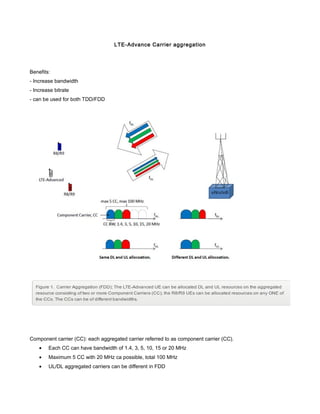
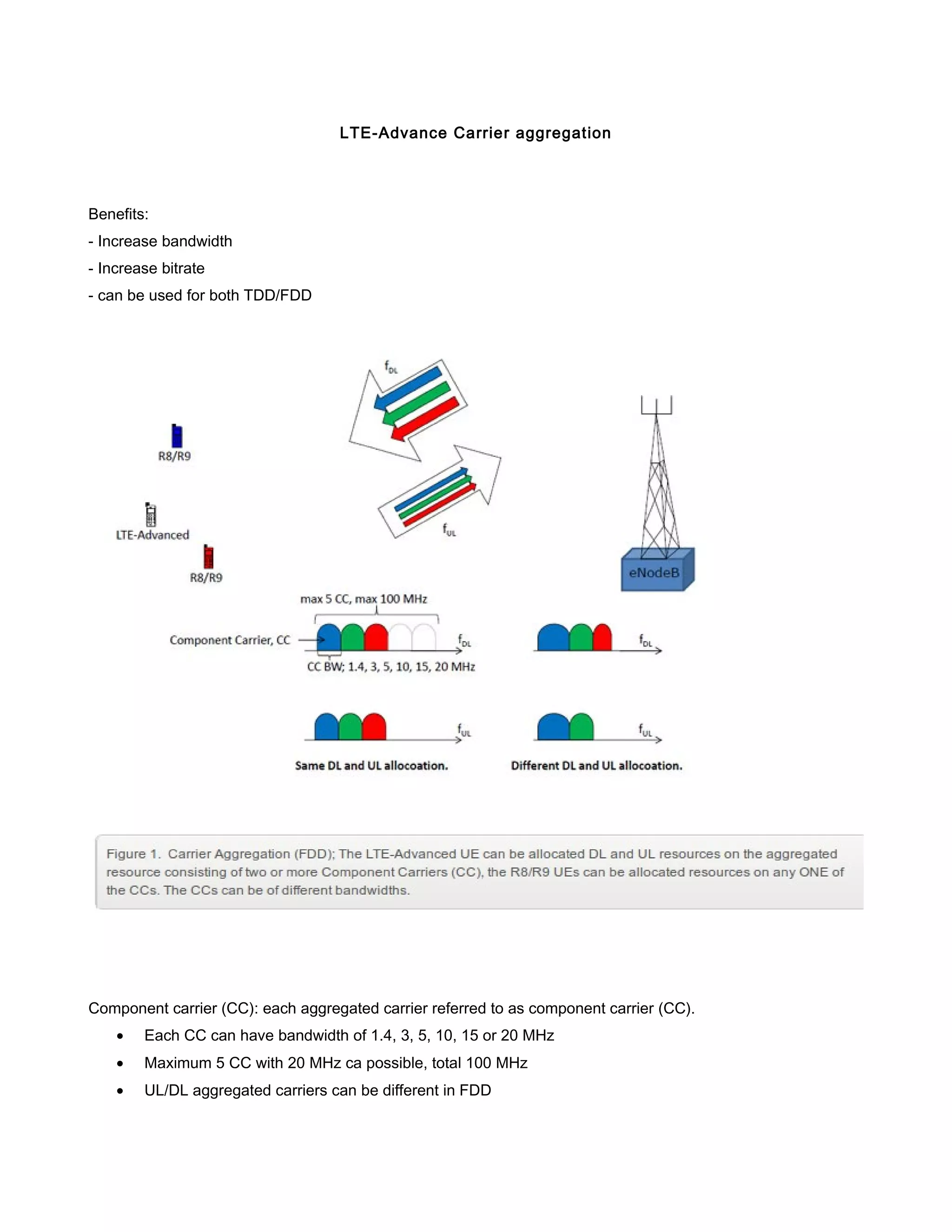
Component carrier (CC): each aggregated carrier referred to as component carrier (CC).
• Each CC can have bandwidth of 1.4, 3, 5, 10, 15 or 20 MHz
• Maximum 5 CC with 20 MHz ca possible, total 100 MHz
• UL/DL aggregated carriers can be different in FDD
Frequency Band Allocation:
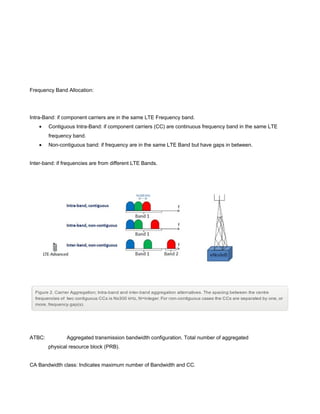
Intra-Band: if component carriers are in the same LTE Frequency band.
• Contiguous Intra-Band: if component carriers (CC) are continuous frequency band in the same LTE
frequency band.
• Non-contiguous band: if frequency are in the same LTE Band but have gaps in between.
Inter-band: if frequencies are from different LTE Bands.
ATBC: Aggregated transmission bandwidth configuration. Total number of aggregated
physical resource block (PRB).
CA Bandwidth class: Indicates maximum number of Bandwidth and CC.
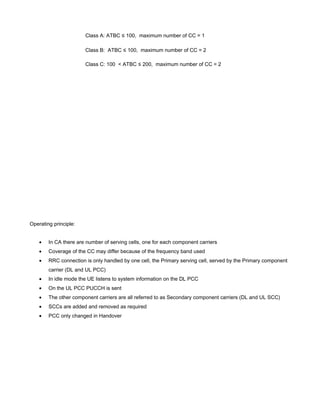
Class A: ATBC ≤ 100, maximum number of CC = 1
Class B: ATBC ≤ 100, maximum number of CC = 2
Class C: 100 < ATBC ≤ 200, maximum number of CC = 2
Operating principle:
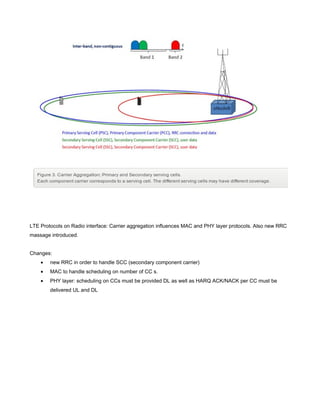
• In CA there are number of serving cells, one for each component carriers
• Coverage of the CC may differ because of the frequency band used
• RRC connection is only handled by one cell, the Primary serving cell, served by the Primary component
carrier (DL and UL PCC)
• In idle mode the UE listens to system information on the DL PCC
• On the UL PCC PUCCH is sent
• The other component carriers are all referred to as Secondary component carriers (DL and UL SCC)
• SCCs are added and removed as required
• PCC only changed in Handover
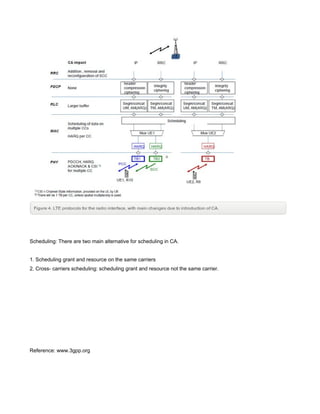
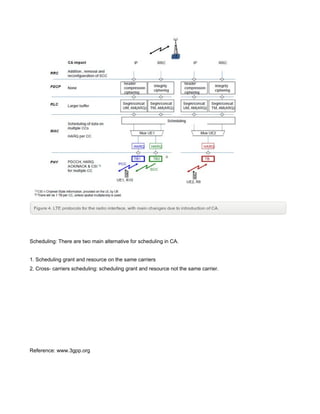
LTE Protocols on Radio interface: Carrier aggregation influences MAC and PHY layer protocols. Also new RRC
massage introduced.
Changes:
• new RRC in order to handle SCC (secondary component carrier)
• MAC to handle scheduling on number of CC s.
• PHY layer: scheduling on CCs must be provided DL as well as HARQ ACK/NACK per CC must be
delivered UL and DL
Scheduling: There are two main alternative for scheduling in CA.
1. Scheduling grant and resource on the same carriers
2. Cross- carriers scheduling: scheduling grant and resource not the same carrier.
Reference: www.3gpp.org
Scheduling: There are two main alternative for scheduling in CA.
1. Scheduling grant and resource on the same carriers
2. Cross- carriers scheduling: scheduling grant and resource not the same carrier.
Reference: www.3gpp.org

Carrier aggregation LTE

  • 1.
    LTE-Advance Carrier aggregation Benefits: -Increase bandwidth - Increase bitrate - can be used for both TDD/FDD Component carrier (CC): each aggregated carrier referred to as component carrier (CC). • Each CC can have bandwidth of 1.4, 3, 5, 10, 15 or 20 MHz • Maximum 5 CC with 20 MHz ca possible, total 100 MHz • UL/DL aggregated carriers can be different in FDD
  • 2.
    Frequency Band Allocation: Intra-Band:if component carriers are in the same LTE Frequency band. • Contiguous Intra-Band: if component carriers (CC) are continuous frequency band in the same LTE frequency band. • Non-contiguous band: if frequency are in the same LTE Band but have gaps in between. Inter-band: if frequencies are from different LTE Bands. ATBC: Aggregated transmission bandwidth configuration. Total number of aggregated physical resource block (PRB). CA Bandwidth class: Indicates maximum number of Bandwidth and CC.
  • 3.
    Class A: ATBC≤ 100, maximum number of CC = 1 Class B: ATBC ≤ 100, maximum number of CC = 2 Class C: 100 < ATBC ≤ 200, maximum number of CC = 2 Operating principle: • In CA there are number of serving cells, one for each component carriers • Coverage of the CC may differ because of the frequency band used • RRC connection is only handled by one cell, the Primary serving cell, served by the Primary component carrier (DL and UL PCC) • In idle mode the UE listens to system information on the DL PCC • On the UL PCC PUCCH is sent • The other component carriers are all referred to as Secondary component carriers (DL and UL SCC) • SCCs are added and removed as required • PCC only changed in Handover
  • 4.
    LTE Protocols onRadio interface: Carrier aggregation influences MAC and PHY layer protocols. Also new RRC massage introduced. Changes: • new RRC in order to handle SCC (secondary component carrier) • MAC to handle scheduling on number of CC s. • PHY layer: scheduling on CCs must be provided DL as well as HARQ ACK/NACK per CC must be delivered UL and DL
  • 5.
    Scheduling: There aretwo main alternative for scheduling in CA. 1. Scheduling grant and resource on the same carriers 2. Cross- carriers scheduling: scheduling grant and resource not the same carrier. Reference: www.3gpp.org
  • 6.
    Scheduling: There aretwo main alternative for scheduling in CA. 1. Scheduling grant and resource on the same carriers 2. Cross- carriers scheduling: scheduling grant and resource not the same carrier. Reference: www.3gpp.org