Question of Interview
Mobile package
“LTE”
1- What is OFDMA?
Send data over orthogonal subcarriers.
2- Why we use OFDMA in DL and SC-FDMA UL?
OFDMA has higher data rate but to overcome high PAPR need well
designed power amplifier, this solution is acceptable only for DL
because this solution is too expensive. We use SC-FDM in UL; this
solution is cheap to overcome high PAPR, SC-FDM is lower data rate
3- What is CDS?
To achieve the maximum possible utilization; cautiously we change
transmission resources.
CDS is channel dependence schedule, we need to schedule radio
resources (Sub carriers), modulation scheme (based on quality), channel
coding scheme (No.of redundancy bits based on quality) and power
control. We need to schedule to High utilization for B.W and
uninterrupted service. Schedule according to Traffic load (No.of user
and service type), channel quality indicators CQI and Quality of service
(Throughput and priority). Base station done for all users every 1
Msec.
4- What is MIMO and propose of MIMO?
MIMO: - is multi input multi output it is antenna technique. It is used to
increase data rate.
5- What is MIMO index “order”?
MIMO order 1*1=100Mbps, 2*2=184Mpbs, 4*4=326Mbps and 8*8=
500Mbps.
6- IF No.of antennas in mobile are not equal No.of base station, how we
work?
We work on lowest order.
7- What is Maximum MIMO order and why?
8*8 MIMO, because when MIMO order increase performance of MIMO
decrease.
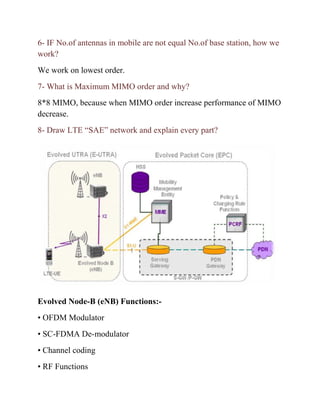
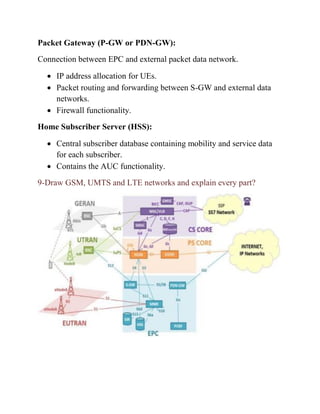
8- Draw LTE “SAE” network and explain every part?
Evolved Node-B (eNB) Functions:-
• OFDM Modulator
• SC-FDMA De-modulator
• Channel coding
• RF Functions
• PA (Power amplifier)
• LNA (Low noise amplifier)
• UP conversion
• DOWN Conversion
• Segmentation, Assembly
• Framing
• Handover decision
• Admission Control
• Scheduler
• Measurement collection and evaluation
• Ciphering
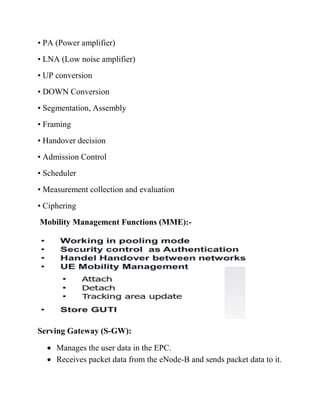
Mobility Management Functions (MME):-
Serving Gateway (S-GW):
• Manages the user data in the EPC.
• Receives packet data from the eNode-B and sends packet data to it.
Packet Gateway (P-GW or PDN-GW):
Connection between EPC and external packet data network.
• IP address allocation for UEs.
• Packet routing and forwarding between S-GW and external data
networks.
• Firewall functionality.
Home Subscriber Server (HSS):
• Central subscriber database containing mobility and service data
for each subscriber.
• Contains the AUC functionality.
9-Draw GSM, UMTS and LTE networks and explain every part?
10- What are X2 interface and S1 interface?
X2 interface: It is used during inter eNodeB handover and exchange of
load information between neighboring eNodeBs to facilitate the
interference management.
S1 interface: Divided into two interfaces
S1_U interface: User plane interface between the eNodeB and S-GW
(Carry traffic).
S1-MME interface: Control plane interface between eNodeB and the
MME for exchange of Non Access Stratum messages between MME
and UE (e.g. paging, tracking area updates and authentication). (Carry
signaling).
11- What is Modulation types are used in LTE?
BPSK (in UL only), QPSK, 16 QAM and 64 QAM (optional in UL).
12- What is carrier B.W are used in LTE?
1.4 M, 3M, 5M, 10M, 15Mand 20M.
13- What is Duplex technique are used in LTE?
FDD and TDD.
14- What is Frequency bands are used in LTE?
700M, 1800M,2100M and 2600M (not used in Egypt).
15- What is ICIC?
Inter cell interference coordination (ICIC), method is used to coordinate
interference between cells to increase reuse to reach reuse factor=1,
There are two methods of ICIC, First is fractional frequency reuse (But
it not used) and second is resource blocks management (used).
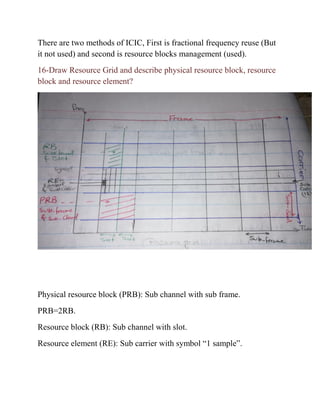
16-Draw Resource Grid and describe physical resource block, resource
block and resource element?
Physical resource block (PRB): Sub channel with sub frame.
PRB=2RB.
Resource block (RB): Sub channel with slot.
Resource element (RE): Sub carrier with symbol “1 sample”.
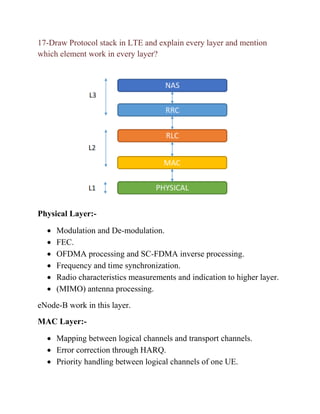
17-Draw Protocol stack in LTE and explain every layer and mention
which element work in every layer?
Physical Layer:-
• Modulation and De-modulation.
• FEC.
• OFDMA processing and SC-FDMA inverse processing.
• Frequency and time synchronization.
• Radio characteristics measurements and indication to higher layer.
• (MIMO) antenna processing.
eNode-B work in this layer.
MAC Layer:-
• Mapping between logical channels and transport channels.
• Error correction through HARQ.
• Priority handling between logical channels of one UE.
• Priority handling between UEs.
• Transport format selection.
• Padding.
eNode-B work in this layer.
RLC Layer:-
• Reliable connection UE and eNB.
• Segmentation.
• Assembly.
• Rate matching.
eNode-B work in this layer.
RRC Layer:-
• Broadcast of system information related to (AS).
• Paging.
• Establishment, maintenance and release of link.
• Handover.
• QoS management functions.
eNode-B work in this layer.
NAS Layer:-
• Mobility management.
o Area update
o Registration
o Detach
• Security management
o Authentication
MME work in this layer.
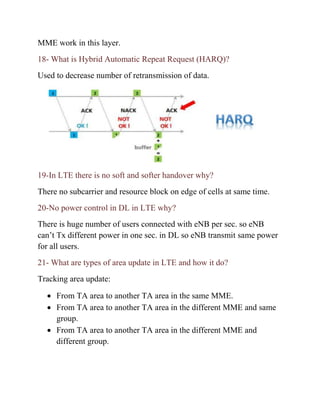
18- What is Hybrid Automatic Repeat Request (HARQ)?
Used to decrease number of retransmission of data.
19-In LTE there is no soft and softer handover why?
There no subcarrier and resource block on edge of cells at same time.
20-No power control in DL in LTE why?
There is huge number of users connected with eNB per sec. so eNB
can’t Tx different power in one sec. in DL so eNB transmit same power
for all users.
21- What are types of area update in LTE and how it do?
Tracking area update:
• From TA area to another TA area in the same MME.
• From TA area to another TA area in the different MME and same
group.
• From TA area to another TA area in the different MME and
different group.
22- What is VOLTE and what is element require in network?
To make voice calls, LTE networks need to have an IMS IP Multimedia
Services), IMS offers several multimedia IP services, including VoIP
(Voice over IP).
23- What is CS full back?
when UE wants to make voice call, MME tells MCS to accept the call
over 2G/3G, SGs is new interface between MSC/VLR and MME.
24- What is SRVCC and what is element require in network?
It is a call transfer method (handover), in a simplified and reliably way,
when an LTE user has an active voice session in IMS and is moving to
areas without LTE coverage, but with legacy 2G/3G coverage, LTE
networks need to have CSFS (Call session control function).
Question 1. What Is Lte?
Answer :
LTEi (Long Term Evolution) is initiated by 3GPPi to improve the mobile phone
standard to cope with future technology evolutions and needs.
Question 2. What Is Goal Of Lte?
Answer :
The goals for LTE include improving spectral efficiency, lowering costs, improving
services, making use of new spectrum and reformed spectrum opportunities, and
better integration with other open standards.
Question 3. What Speed Lte Offers?
Answer :
LTE provides downlink peak rates of at least 100Mbit/s, 50 Mbit/s in the uplink and
RAN (Radio Access Network) round-trip times of less than 10 ms.
Question 4. What Is Lte Advanced?
Answer :
LTE standards are in matured state now with release 8 frozen. While LTE
Advanced is still under works. Often the LTE standard is seen as 4G standard
which is not true. 3.9G is more acceptable for LTE. So why it is not 4G? Answer is
quite simple - LTE does not fulfill all requirements of ITU 4G definition.
Brief History of LTE Advanced: The ITU has introduced the term IMT Advanced to
identify mobile systems whose capabilities go beyond those of IMT 2000. The IMT
Advanced systems shall provide best-in-class performance attributes such as peak
and sustained data rates and corresponding spectral efficiencies, capacity, latency,
overall network complexity and quality-of-service management. The new
capabilities of these IMT-Advanced systems are envisaged to handle a wide range
of supported data rates with target peak data rates of up to approximately 100
Mbit/s for high mobility and up to approximately 1 Gbit/s for low mobility.
Question 5. What Is Lte Architecture?
Answer :
The evolved architecture comprises E-UTRAN (Evolved UTRAN) on the access
side and EPC (Evolved Packet Core) on the core side.
Question 6. What Is Eutran?
Answer :
The E-UTRAN (Evolved UTRAN) consists of eNBs, providing the E-UTRA user
plane (PDCP/RLC/MAC/PHY) and control plane (RRC) protocol terminations
towards the UE. The eNBs are interconnected with each other by means of the X2
interface. The eNBs are also connected by means of the S1 interface to the EPC
(Evolved Packet Core), more specifically to the MME (Mobility Management Entity)
by means of the S1-MME and to the Serving Gateway (S-GW) by means of the S1-
U.
Question 7. What Are Lte Interfaces?
Answer :
The following are LTE Interfaces : (Ref: TS 23.401 v 841)
S1-MME :- Reference point for the control plane protocol between E-UTRAN
and MME.
S1-U:- Reference point between E-UTRAN and Serving GW for the per
bearer user plane tunnelling and inter eNodeB path switching during
handover.
S3:- It enables user and bearer information exchange for inter 3GPP access
network mobility in idle and/or active state.
S4:- It provides related control and mobility support between GPRS Core
and the 3GPP Anchor function of Serving GW. In addition, if Direct Tunnel is
not established, it provides the user plane tunnelling.
S5:- It provides user plane tunnelling and tunnel management between
Serving GW and PDN GW. It is used for Serving GW relocation due to UE
mobility and if the Serving GW needs to connect to a non-collocated PDN
GW for the required PDN connectivity.
S6a:- It enables transfer of subscription and authentication data for
authenticating/authorizing user access to the evolved system (AAA
interface) between MME and HSS.
Gx:- It provides transfer of (QoS) policy and charging rules from PCRF to
Policy and Charging Enforcement Function (PCEF) in the PDN GW.
S8:- Inter-PLMN reference point providing user and control plane between
the Serving GW in the VPLMN and the PDN GW in the HPLMN. S8 is the
inter PLMN variant of S5.
S9:- It provides transfer of (QoS) policy and charging control information
between the Home PCRF and the Visited PCRF in order to support local
breakout function.
S10:- Reference point between MMEs for MME relocation and MME to MME
information transfer.
S11:- Reference point between MME and Serving GW.
S12:- Reference point between UTRAN and Serving GW for user plane
tunnelling when Direct Tunnel is established. It is based on the Iu-u/Gn-u
reference point using the GTP-U protocol as defined between SGSN and
UTRAN or respectively between SGSN and GGSN. Usage of S12 is an
operator configuration option.
S13:- It enables UE identity check procedure between MME and EIR.
SGi:- It is the reference point between the PDN GW and the packet data
network. Packet data network may be an operator external public or private
packet data network or an intra operator packet data network, e.g. for
provision of IMS services. This reference point corresponds to Gi for 3GPP
accesses.
Rx:- The Rx reference point resides between the AF and the PCRF in the
TS 23.203.
SBc:- Reference point between CBC and MME for warning message
delivery and control functions.
Question 8. What Are Lte Network Elements?
Answer :
eNB : eNB interfaces with the UE and hosts the PHYsical (PHY), Medium Access
Control (MAC), Radio Link Control (RLC), and Packet Data Control Protocol
(PDCP) layers. It also hosts Radio Resource Control (RRC) functionality
corresponding to the control plane. It performs many functions including radio
resource management, admission control, scheduling, enforcement of negotiated
UL QoS, cell information broadcast, ciphering/deciphering of user and control plane
data, and compression/decompression of DL/UL user plane packet headers.
Mobility Management Entity : manages and stores UE context (for idle state:
UE/user identities, UE mobility state, user security parameters). It generates
temporary identities and allocates them to UEs. It checks the authorization whether
the UE may camp on the TA or on the PLMN. It also authenticates the user.
Serving Gateway : The SGW routes and forwards user data packets, while also
acting as the mobility anchor for the user plane during inter-eNB handovers and as
the anchor for mobility between LTE and other 3GPP technologies (terminating S4
interface and relaying the traffic between 2G/3G systems and PDN GW).
Packet Data Network Gateway: The PDN GW provides connectivity to the UE to
external packet data networks by being the point of exit and entry of traffic for the
UE. A UE may have simultaneous connectivity with more than one PDN GW for
accessing multiple PDNs. The PDN GW performs policy enforcement, packet
filtering for each user, charging support, lawful Interception and packet screening.
Question 9. What Are Lte Protocols & Specifications?
Answer :
In LTE architecture, core network includes Mobility Management Entity (MME),
Serving Gateway (SGW), Packet Data Network Gateway (PDN GW) where as E-
UTRAN has E-UTRAN NodeB (eNB).
Protocol links are as below
Air Interface Physical Layer
GPRS Tunnelling Protocol User Plane (GTP-U)
GTP-U Transport
Medium Access Control (MAC)
Non-Access-Stratum (NAS) Protocol
Packet Data Convergence Protocol (PDCP)
Radio Link Control (RLC)
Radio Resource Control (RRC)
S1 Application Protocol (S1AP)
S1 layer 1
S1 Signalling Transport
X2 Application Protocol (X2AP)
X2 layer 1
X2 Signalling Transport
Question 10. What Is Volga?
Answer :
VoLGA stands for "Voice over LTE via Generic Access". The VoLGA service
resembles the 3GPP Generic Access Network (GAN). GAN provides a controller
node - the GAN controller (GANC) - inserted between the IP access network (i.e.,
the EPS) and the 3GPP core network.
The GAN provides an overlay access between the terminal and the CS core
without requiring specific enhancements or support in the network it traverses. This
provides a terminal with a 'virtual' connection to the core network already deployed
by an operator. The terminal and network thus reuse most of the existing
mechanisms, deployment and operational aspects.
Question 11. What Is Cs Fallback In Lte?
Answer :
LTE technology supports packet based services only, however 3GPP does
specifies fallback for circuit switched services as well. To achieve this LTE
architecture and network nodes require additional functionality, this blog is an
attempt to provide overview for same.
In LTE architecture, the circuit switched (CS) fallback in EPS enables the
provisioning of voice and traditional CS-domain services (e.g. CS UDI video/ SMS/
LCS/ USSD). To provide these services LTE reuses CS infrastructure when the UE
is served by E UTRAN.
Question 12. How Does Lte Security Works?
Answer :
The following are some of the principles of 3GPP E-UTRAN security based on
3GPP Release 8 specifications:
The keys used for NAS and AS protection shall be dependent on the
algorithm with which they are used.
The eNB keys are cryptographically separated from the EPC keys used for
NAS protection (making it impossible to use the eNB key to figure out an
EPC key).
The AS (RRC and UP) and NAS keys are derived in the EPC/UE from key
material that was generated by a NAS (EPC/UE) level AKA procedure
(KASME) and identified with a key identifier (KSIASME).
The eNB key (KeNB) is sent from the EPC to the eNB when the UE is
entering ECM-CONNECTED state (i.e. during RRC connection or S1
context setup).
Question 13. What Is Ip Multimedia Subsystem (ims)?
Answer :
The 3GPP IP Multimedia Subsystem (IMS) technology provides an architectural
framework for delivering IP based multimedia services. IMS enables telecom
service providers to offer a new generation of rich multimedia services across both
circuit switched and packet switched networks. IMS offers access to IP based
services independent of the access network e.g. wireless access (GPRS, 3GPP’s
UMTS, LTE, 3GPP2’s CDMA2000) and fixed networks (TISPAN’s NGN)
IMS defines a architecture of logical elements using SIP for call signaling between
network elements and Provides a layered approach with defined service, control,
and transport planes. Some of IMS high level requirements are noted below:
The application plane provides an infrastructure for the provision and management
of services, subscriber configuration and identity management and defines
standard interfaces to common functionality.
The IMS control plane handles the call related signaling and controls transport
plane. Major element of control plane is the Call Session Control Function (CSCF) ,
which comprises Proxy-CSCF (P-CSCF), Interrogating-CSCF (I-CSCF) and
Serving-CSCF (S-CSCF). The CSCF (Call/Session Control Function) is essentially
a SIP server.
The IMS transport plane provides a core IP network with access from subscriber
device over wireless or wireline networks.
Question 14. How Does Measurements Work In Lte?
Answer :
In LTE E-UTRAN measurements to be performed by a UE for mobility are
classified as below
Intra-frequency E-UTRAN measurements
Inter-frequency E-UTRAN measurements
Inter-RAT measurements for UTRAN and GERAN
Inter-RAT measurements of CDMA2000 HRPD or 1xRTT frequencies
Question 15. What Is Automatic Neighbour Relation?
Answer :
According to 3GPP specifications, the purpose of the Automatic Neighbour
Relation (ANR) functionality is to relieve the operator from the burden of manually
managing Neighbor Relations (NRs). This feature would operators effort to
provision.
Question 16. How Does Intra E-utran Handover Is Performed?
Answer :
Intra E-UTRAN Handover is used to hand over a UE from a source eNodeB to a
target eNodeB using X2 when the MME is unchanged. In the scenario described
here Serving GW is also unchanged. The presence of IP connectivity between the
Serving GW and the source eNodeB, as well as between the Serving GW and the
target eNodeB is assumed.
The intra E-UTRAN HO in RRC_CONNECTED state is UE assisted NW controlled
HO, with HO preparation signalling in E-UTRAN.
Question 17. How Does Policy Control And Charging Works In Lte?
Answer :
A important component in LTE network is the policy and charging control (PCC)
function that brings together and enhances capabilities from earlier 3GPP releases
to deliver dynamic control of policy and charging on a per subscriber and per IP
flow basis.
LTE Evolved Packet Core (EPC) EPC includes a PCC architecture that provides
support for fine-grained QoS and enables application servers to dynamically control
the QoS and charging requirements of the services they deliver. It also provides
improved support for roaming. Dynamic control over QoS and
charging will help operators monetize their LTE investment by providing customers
with a variety of QoS and charging options when choosing a service.
The LTE PCC functions include:
PCRF (policy and charging rules function) provides policy control and flow
based charging control decisions.
PCEF (policy and charging enforcement function) implemented in the
serving gateway, this enforces gating and QoS for individual IP flows on the
behalf of
the PCRF. It also provides usage measurement to support charging
OCS (online charging system) provides credit management and grants
credit to the PCEF based on time, traffic volume or chargeable events.
OFCS (off-line charging system) receives events from the PCEF and
generates charging data records (CDRs) for the billing system.
Question 18. What Is Son & How Does It Work In Lte?
Answer :
Self-configuring, self-optimizing wireless networks is not a new concept but as the
mobile networks are evolving towards 4G LTE networks, introduction of self
configuring and self optimizing mechanisms is needed to minimize operational
efforts. A self optimizing function would increase network performance and quality
reacting to dynamic processes in the network.
This would minimize the life cycle cost of running a network by eliminating manual
configuration of equipment at the time of deployment, right through to dynamically
optimizing radio network performance during operation. Ultimately it will reduce the
unit cost and retail price of wireless data services.
Question 19. How Does Network Sharing Works In Lte?
Answer :
3GPP network sharing architecture allows different core network operators to
connect to a shared radio access network. The operators do not only share the
radio network elements, but may also share the radio resources themselves.
Question 20. How Does Timing Advance (ta) Works In Lte?
Answer :
In LTE, when UE wish to establish RRC connection with eNB, it transmits a
Random Access Preamble, eNB estimates the transmission timing of the terminal
based on this. Now eNB transmits a Random Access Response which consists of
timing advance command, based on that UE adjusts the terminal transmit timing.
The timing advance is initiated from E-UTRAN with MAC message that implies and
adjustment of the timing advance.
Question 21. How Does Lte Ue Positioning Works In E-utran?
Answer :
UE Positioning function is required to provide the mechanisms to support or assist
the calculation of the geographical position of a UE. UE position knowledge can be
used, for example, in support of Radio Resource Management functions, as well as
location-based services for operators, subscribers, and third-party service
providers.
Question 22. How Many Operators Have Committed For Lte?
Answer :
List of operators committed for LTE has been compiled by 3GAmericas from
Informa Telecoms & Media and public announcements. It includes a variety of
commitment levels including intentions to trial, deploy, migrate, etc.
Question 23. What Is Single Radio Voice Call Continuity (srvcc)?
Answer :
Along with LTE introduction, 3GPP also standardized Single Radio Voice Call
Continuity (SRVCC) in Release 8 specifications to provide seamless continuity
when an UE handovers from LTE coverage (E-UTRAN) to UMTS/GSM coverage
(UTRAN/GERAN). With SRVCC, calls are anchored in IMS network while UE is
capable of transmitting/receiving on only one of those access networks at a given
time.
Question 24. How Does Location Service (lcs) Work In Lte Network?
Answer :
In the LCS architecture, an Evolved SMLC is directly attached to the MME. The
objectives of this evolution is to support location of an IMS emergency call, avoid
impacts to a location session due to an inter-eNodeB handover, make use of an
Evolved and support Mobile originated location request (MO-LR) and mobile
terminated location request MT-LR services.
Release 9 LCS solution introduces new interfaces in the EPC:
SLg between the GMLC and the MME
SLs between the E-SMLC and the MME
Diameter-based SLh between the HSS and the HGMLC
Question 25. How Does Lawful Interception Works In Lte Evolved Packet
System?
Answer :
3GPP Evolved Packet System (EPS) provides IP based services. Hence, EPS is
responsible only for IP layer interception of Content of Communication (CC) data.
In addition to CC data, the Lawful Interception (LI) solution for EPS offers
generation of Intercept Related Information (IRI) records from respective control
plane (signalling) messages as well.
Question 26. What Is Carrier Aggregation In Lte-advanced?
Answer :
To meet LTE-Advanced requirements, support of wider transmission bandwidths is
required than the 20 MHz bandwidth specified in 3GPP Release 8/9. The preferred
solution to this is carrier aggregation.
It is of the most distinct features of 4G LTE-Advanced. Carrier aggregation allows
expansion of effective bandwidth delivered to a user terminal through concurrent
utilization of radio resources across multiple carriers. Multiple component carriers
are aggregated to form a larger overall transmission bandwidth.
Question 27. What Is Relay Node And How Does Relaying Works In Lte-
advanced?
Answer :
For efficient heterogeneous network planning, 3GPP LTE-Advanced has
introduced concept of Relay Nodes (RNs). The Relay Nodes are low power
eNodeBs that provide enhanced coverage and capacity at cell edges. One of the
main benefits of relaying is to provide extended LTE coverage in targeted areas at
low cost.
The Relay Node is connected to the Donor eNB (DeNB) via radio interface, Un, a
modified version of E-UTRAN air interface Uu. Donor eNB also srves its own UE as
usual, in addition to sharing its radio resources for Relay Nodes.
Question 28. What Are The Measurement Events In Lte?
Answer :
Intra/Inter Frequency Events:
Event A1 (Serving becomes better than threshold)
Event A2 (Serving becomes worse than threshold)
Event A3 (Neighbour becomes offset better than PCell)
Event A4 (Neighbour becomes better than threshold)
Event A5 (PCell becomes worse than threshold1 and neighbour becomes
better than threshold2)
Event A6 (Neighbour becomes offset better than SCell)
Inter RAT Events:
Event B1 (Inter RAT neighbour becomes better than threshold)
Event B2 (PCell becomes worse than threshold1 and inter RAT neighbour
becomes better than threshold2)
Question 29. When Radio Link Failure Is Detected?
Answer :
Radio link failure to be detected:
upon T310 expiry
upon random access problem indication from MAC while neither T300,
T301, T304 nor T311 is running
upon indication from RLC that the maximum number of re-transmissions has
been reached
Question 30. What Is Srs Used For?
Answer :
UL reference signal used to measure the channel quality over a section of the
bandwidth.
Node B use this information for frequency selective scheduling and link adaptation
decisions.
Question 31. What Is Dmrs/drs?
Answer :
DMRS/DRS is uplink reference signal.
Used for :
Channel Estimation and synchronization in UL
EnodeB can use DMRS for calculating TA command for each UE.
Two Types: 1) PUSCH DMRS.
2) PUCCH DMRS.
PUSCH DMRS:
Included in every resource block allocated to UE for PUSCH transmission.
Distributed only in Frequency domain to preserve the PAPR characteristic of
SC-FDMA.
12 Resource element per resource block allocated to PUSCH DMRS.
PUCCH DMRS:
Included in every resource block allocated to UE for PUCCH transmission(if
transmitted).PUCCH occupies 2 resource block per 1 ms subframe when
transmitted.
No of REs used for PUCCH DMRS depends on
a) PUCCH format to be transmitted and whether
b) normal or extended cyclic prefix used.
PUCCH DRMS used more no of bits in case of format 1,1a,1b and less no
of bits in caseof format 2, 2a, 2b.
Question 32. What Is Timing Advance? What Happens If Timing Advance
Timer Expires?
Answer :
The timing of UL radio frame is relative to DL radio frame. EnB provides timing
advance command to each UE such that all UL transmissions arrive at the eNodeB
in synchronous manner.
If TA timer expires UE goes of reestablishment procedure or move to idle.
Question 33. What Is Backoff Indicator? What Is The Use Of Backoff
Indicator?
Answer :
Backoff Indicator is a special MAC subheader that carries the parameter indicating
the time delay between a PRACH and the next PRACH.
if the Random Access Response contains a Backoff Indicator subheader:
set the backoff parameter value in the UE as indicated by the BI field of the Backoff
Indicator subheader
else,
set the backoff parameter value in the UE to 0 ms.
Question 34. What Is Bsr?
Answer :
The Buffer Status reporting procedure is used to provide the serving eNB with
information about the amount of data available for transmission in the UL buffers of
the UE.
Question 35. At What Scenario Ue Triggers Bsr?
Answer :
UL data, for a logical channel which belongs to a LCG, becomes available
for transmission in the RLC entity or in the PDCP entity and either the data
belongs to a logical channel with higher priority than the priorities of the
logical channels which belong to any LCG and for which data is already
available for transmission, or there is no data available for transmission for
any of the logical channels which belong to a LCG, in which case the BSR is
referred below to as "Regular BSR";
UL resources are allocated and number of padding bits is equal to or larger
than the size of the Buffer Status Report MAC control element plus its
subheader, in which case the BSR is referred below to as "Padding BSR"
retxBSR-Timer expires and the UE has data available for transmission for
any of the logical channels which belong to a LCG, in which case the BSR is
referred below to as "Regular BSR"
periodicBSR-Timer expires, in which case the BSR is referred below to as
"Periodic BSR".
Question 36. When Different Types Of Bsr Are Triggered?
Answer :
For Regular and Periodic BSR:
if more than one LCG has data available for transmission in the TTI where the BSR
is transmitted
report Long BSR
else,
report Short BSR.
For Padding BSR: if the number of padding bits is equal to or larger than the size of
the Short BSR plus its subheader but smaller than the size of the Long BSR plus
its subheader:
if more than one LCG has data available for transmission in the TTI where the BSR
is transmitted: report Truncated BSR of the LCG with the highest priority logical
channel with data available for transmission;
else
report Short BSR.
else if the number of padding bits is equal to or larger than the size of the Long
BSR plus its subheader, report Long BSR.
Question 37. What Is The Content Of Rar?
Answer :
A MAC RAR consists of the four fields
R
Timing Advance Command
UL Grant
Temporary C-RNTI
Question 38. In What Are The Scenario Ue Triggers Rrc Connection
Reestablishment?
Answer :
UE Triggers RRC Connection Reestablishment procedure on following condition:
Upon detecting Radio Link Failure
Handover Failure
Mobility From E-UTRA Failure
Integrity Failure Indication Received From Lower Layers
RRC Connection Reconfiguration Failure
Question 39. When Ue Activates Integrity And Ciphering?
Answer :
The SECURITY MODE COMMAND message is used to command the UE
for the activation of AS security. E-UTRAN always initiates this procedure
prior to the establishment of Signalling Radio Bearer2 (SRB2) and Data
Radio Bearers (DRBs).
AS security comprises of the integrity protection of RRC signalling (SRBs)
as well as the ciphering of RRC signalling (SRBs) and user plane data
(DRBs). The integrity protection algorithm is common for signalling radio
bearers SRB1 and SRB2. The ciphering algorithm is common for all radio
bearers (i.e. SRB1, SRB2 andDRBs). Neither integrity protection nor
ciphering applies for SRB0.
The eNodeB sends integrity protected SECURITY MODE COMMAND
message to the UE. The UE shall derive KeNB and KRRCint which is
associated with integrity protection algorithm indicated in the SECURITY
MODE COMMAND. Then, UE verifies the Integrity of the received
SECURITY MODE COMMAND by checking the Message Authentication
Code (MAC) in the SECURITY MODE COMMAND message. If the
SECURITY MODE COMMANDmessage fails the integrity protection check,
then the UE sends SECURITY MODE FAILURE to the eNodeB.
If the SECURITY MODE COMMAND passes the integrity protection check,
then the UE shall derive the encryption keys KRRCenc key and the KUPenc
keys associated with the ciphering algorithm indicated in theSECURITY
MODE COMMAND.
The UE shall apply integrity protection using the indicated algorithm (EIA)
and the integrity key, KRRCintimmediately, i.e. integrity protection shall be
applied to all subsequent messages received and sent by the UE, including
the SECURITY MODE COMPLETE message.
The UE shall apply ciphering using the indicated algorithm (EEA),
KRRCenc key and the KUPenc key after completing the procedure, i.e.
ciphering shall be applied to all subsequent messages received and sent by
the UE, except for the SECURITY MODE COMPLETE message which is
sent un-ciphered.
Question 40. What Is The Difference Between Lte Fdd And Lte Tdd?
Answer :
The difference lies in the LTE frame structure in both the FDD and TDD versions of
the LTE. In FDD there will be pair of frequencies assigned in the downlink and
uplink directions and hence transmissions from multiple subscribes can happen at
the same time but on different frequencies as mentioned. In TDD, one single
frequency will be used at different time instants by multiple subscriber terminals
(UEs). Both frame versions of LTE will have 1 ms sub-frame duration and 0.5 ms
slot duration.
Question 41. What Is Resource Block In Lte?
Answer :
LTE frame is divided based on time slots on time axis and frequency subcarrier on
frequency axis. Resource block is the smallest unit of resource allocation in LTE
system. It is of about 0.5ms duration and composed of 12 subcarriers in 1 OFDM
symbol. One time slot is equal to 7 OFDM symbols in normal cyclic prefix and 6
OFDM symbols in extended cyclic prefix. One full resource block is equal to 12
subcarriers by 7 symbols in normal CP. Hence it consists of total 84 time/frequency
elements referred as resource elements in LTE network.
Question 42. What Are The Lte Logical, Transport And Physical Channels?
Answer :
All these channels help LTE UE establish the connection with the eNodeB,
maintain the connection and terminate the same. Logical channels are
characterized by the information that is transferred. Transport channels are
characterized by how the data are transferred over the radio interface. Physical
channel corresponds to a set of resource elements used by the physical layer.
Channels are further divided into control channel and traffic channel at logical
channel stage.
Question 43. Explain The Difference Between Reference Signal (rs) And
Synchronization Signal (ss) In The Lte? Also Mention Types Of Rs And Ss?
Answer :
Reference signal (RS) is used as pilot subcarrier in LTE similar to other broadband
wireless technologies such as WLAN, WIMAX etc. Synchronization signal is used
as preamble sequence in LTE for synchronization purpose. RS is used for channel
estimation and tracking. SS are of two types viz. P-SS and S-SS. P-SS is used for
initial synchronization. S-SS is used for frame boundary determination.
RS are of two types viz.
Demodulation RS (DRS)
Sounding RS (SRS).
DRS is used for sync and channel estimation purpose. SRS is used for channel
quality estimation purpose. DRS is used in both the uplink and downlink, while SRS
is used only in the uplink.
Question 44. What Is The Function Of Lte Physical Broadcast Channel I.e.
Pbch?
Answer :
After initial cell synchronization is completed, UE reads MIB (Master information
block) on PBCH (Physical channel). Broadcast channel is referred as BCH at
transport level and BCCH at logical level. MIB composed of downlink channel
bandwidth in units of RBs, PHICH duration, PHICH resource and system frame
number.
Question 45. What Is The Advantage Of Using Sc-fdma In The Lte Uplink?
Answer :
The main advantage of SC-FDMA is low PAPR compare to OFDMA used in LTE
downlink. This increases the efficiency of power amplifier and hence increases the
battery life.
Question 46. What Is Rssi?
Answer :
RSSI stands for Received Signal Strength Indication. It is used almost in all the
RATs to identify power received from the cell in idle as well as
connected/dedicated modes. This helps UE always camped on to the best cell all
the time. In case of drop in power measured using RSSI, either UE or network
initiates the handover or cell re-selection is carried out.
Question 47. Explain Circuit Switch Fall Back I.e. Csfb With Respect To Lte
And Gsm?
Answer :
Framework allowing the provisioning of voice services by reuse of legacy GSM
served CS infrastructure when the UE is served by E-UTRAN (LTE).To provide
voice call support, Circuit Switch Fall Back is carried out to GSM RAT from LTE
RAT to facilitate the voice over LTE (VoLTE) feature.
Question 48. Explain Lte Network Architecture And Various Interfaces?
Answer :
There are various entities forming the LTE network architecture, the main
interfaces are Uubetween UE and eNB, X2 interface between eNBs and S1
interface between eNB and EPC(Evolved Packet Core).
Question 49. Is Lte A 4g Protocol?
Answer :
The networking industry recognizes LTE a 4G technology along with WiMax and
HSPA+. None of these qualified as 4G based on the original definition of the
International Telecommunications Union (ITU) standards group, but in December
2010 the ITU redefined 4G to include them.
While some marketing professionals and press have labeled LTE-Advanced as 5G,
no widely-approved definition of 5G exists to justify the claim.
Question 50. What Is The Difference Between Lte And Lte Advanced?
Answer :
LTE is specified in 3GPP release 8 and release 9. LTE advanced is specified in
3GPP release 10. The main difference between them is carrier aggregation is
introduced in LTE advanced. Number of antennas supported by MIMO has been
increased to 8 in LTE advanced.
4G-Questions interview.pdf

4G-Questions interview.pdf

  • 1.
  • 2.
    1- What isOFDMA? Send data over orthogonal subcarriers. 2- Why we use OFDMA in DL and SC-FDMA UL? OFDMA has higher data rate but to overcome high PAPR need well designed power amplifier, this solution is acceptable only for DL because this solution is too expensive. We use SC-FDM in UL; this solution is cheap to overcome high PAPR, SC-FDM is lower data rate 3- What is CDS? To achieve the maximum possible utilization; cautiously we change transmission resources. CDS is channel dependence schedule, we need to schedule radio resources (Sub carriers), modulation scheme (based on quality), channel coding scheme (No.of redundancy bits based on quality) and power control. We need to schedule to High utilization for B.W and uninterrupted service. Schedule according to Traffic load (No.of user and service type), channel quality indicators CQI and Quality of service (Throughput and priority). Base station done for all users every 1 Msec. 4- What is MIMO and propose of MIMO? MIMO: - is multi input multi output it is antenna technique. It is used to increase data rate. 5- What is MIMO index “order”? MIMO order 1*1=100Mbps, 2*2=184Mpbs, 4*4=326Mbps and 8*8= 500Mbps.
  • 3.
    6- IF No.ofantennas in mobile are not equal No.of base station, how we work? We work on lowest order. 7- What is Maximum MIMO order and why? 8*8 MIMO, because when MIMO order increase performance of MIMO decrease. 8- Draw LTE “SAE” network and explain every part? Evolved Node-B (eNB) Functions:- • OFDM Modulator • SC-FDMA De-modulator • Channel coding • RF Functions
  • 4.
    • PA (Poweramplifier) • LNA (Low noise amplifier) • UP conversion • DOWN Conversion • Segmentation, Assembly • Framing • Handover decision • Admission Control • Scheduler • Measurement collection and evaluation • Ciphering Mobility Management Functions (MME):- Serving Gateway (S-GW): • Manages the user data in the EPC. • Receives packet data from the eNode-B and sends packet data to it.
  • 5.
    Packet Gateway (P-GWor PDN-GW): Connection between EPC and external packet data network. • IP address allocation for UEs. • Packet routing and forwarding between S-GW and external data networks. • Firewall functionality. Home Subscriber Server (HSS): • Central subscriber database containing mobility and service data for each subscriber. • Contains the AUC functionality. 9-Draw GSM, UMTS and LTE networks and explain every part?
  • 6.
    10- What areX2 interface and S1 interface? X2 interface: It is used during inter eNodeB handover and exchange of load information between neighboring eNodeBs to facilitate the interference management. S1 interface: Divided into two interfaces S1_U interface: User plane interface between the eNodeB and S-GW (Carry traffic). S1-MME interface: Control plane interface between eNodeB and the MME for exchange of Non Access Stratum messages between MME and UE (e.g. paging, tracking area updates and authentication). (Carry signaling). 11- What is Modulation types are used in LTE? BPSK (in UL only), QPSK, 16 QAM and 64 QAM (optional in UL). 12- What is carrier B.W are used in LTE? 1.4 M, 3M, 5M, 10M, 15Mand 20M. 13- What is Duplex technique are used in LTE? FDD and TDD. 14- What is Frequency bands are used in LTE? 700M, 1800M,2100M and 2600M (not used in Egypt). 15- What is ICIC? Inter cell interference coordination (ICIC), method is used to coordinate interference between cells to increase reuse to reach reuse factor=1,
  • 7.
    There are twomethods of ICIC, First is fractional frequency reuse (But it not used) and second is resource blocks management (used). 16-Draw Resource Grid and describe physical resource block, resource block and resource element? Physical resource block (PRB): Sub channel with sub frame. PRB=2RB. Resource block (RB): Sub channel with slot. Resource element (RE): Sub carrier with symbol “1 sample”.
  • 8.
    17-Draw Protocol stackin LTE and explain every layer and mention which element work in every layer? Physical Layer:- • Modulation and De-modulation. • FEC. • OFDMA processing and SC-FDMA inverse processing. • Frequency and time synchronization. • Radio characteristics measurements and indication to higher layer. • (MIMO) antenna processing. eNode-B work in this layer. MAC Layer:- • Mapping between logical channels and transport channels. • Error correction through HARQ. • Priority handling between logical channels of one UE.
  • 9.
    • Priority handlingbetween UEs. • Transport format selection. • Padding. eNode-B work in this layer. RLC Layer:- • Reliable connection UE and eNB. • Segmentation. • Assembly. • Rate matching. eNode-B work in this layer. RRC Layer:- • Broadcast of system information related to (AS). • Paging. • Establishment, maintenance and release of link. • Handover. • QoS management functions. eNode-B work in this layer. NAS Layer:- • Mobility management. o Area update o Registration o Detach • Security management o Authentication
  • 10.
    MME work inthis layer. 18- What is Hybrid Automatic Repeat Request (HARQ)? Used to decrease number of retransmission of data. 19-In LTE there is no soft and softer handover why? There no subcarrier and resource block on edge of cells at same time. 20-No power control in DL in LTE why? There is huge number of users connected with eNB per sec. so eNB can’t Tx different power in one sec. in DL so eNB transmit same power for all users. 21- What are types of area update in LTE and how it do? Tracking area update: • From TA area to another TA area in the same MME. • From TA area to another TA area in the different MME and same group. • From TA area to another TA area in the different MME and different group.
  • 11.
    22- What isVOLTE and what is element require in network? To make voice calls, LTE networks need to have an IMS IP Multimedia Services), IMS offers several multimedia IP services, including VoIP (Voice over IP). 23- What is CS full back? when UE wants to make voice call, MME tells MCS to accept the call over 2G/3G, SGs is new interface between MSC/VLR and MME. 24- What is SRVCC and what is element require in network? It is a call transfer method (handover), in a simplified and reliably way, when an LTE user has an active voice session in IMS and is moving to areas without LTE coverage, but with legacy 2G/3G coverage, LTE networks need to have CSFS (Call session control function).
  • 12.
    Question 1. WhatIs Lte? Answer : LTEi (Long Term Evolution) is initiated by 3GPPi to improve the mobile phone standard to cope with future technology evolutions and needs. Question 2. What Is Goal Of Lte? Answer : The goals for LTE include improving spectral efficiency, lowering costs, improving services, making use of new spectrum and reformed spectrum opportunities, and better integration with other open standards. Question 3. What Speed Lte Offers? Answer : LTE provides downlink peak rates of at least 100Mbit/s, 50 Mbit/s in the uplink and RAN (Radio Access Network) round-trip times of less than 10 ms. Question 4. What Is Lte Advanced? Answer : LTE standards are in matured state now with release 8 frozen. While LTE Advanced is still under works. Often the LTE standard is seen as 4G standard which is not true. 3.9G is more acceptable for LTE. So why it is not 4G? Answer is quite simple - LTE does not fulfill all requirements of ITU 4G definition. Brief History of LTE Advanced: The ITU has introduced the term IMT Advanced to identify mobile systems whose capabilities go beyond those of IMT 2000. The IMT Advanced systems shall provide best-in-class performance attributes such as peak and sustained data rates and corresponding spectral efficiencies, capacity, latency, overall network complexity and quality-of-service management. The new capabilities of these IMT-Advanced systems are envisaged to handle a wide range of supported data rates with target peak data rates of up to approximately 100 Mbit/s for high mobility and up to approximately 1 Gbit/s for low mobility. Question 5. What Is Lte Architecture? Answer : The evolved architecture comprises E-UTRAN (Evolved UTRAN) on the access side and EPC (Evolved Packet Core) on the core side. Question 6. What Is Eutran? Answer : The E-UTRAN (Evolved UTRAN) consists of eNBs, providing the E-UTRA user plane (PDCP/RLC/MAC/PHY) and control plane (RRC) protocol terminations towards the UE. The eNBs are interconnected with each other by means of the X2 interface. The eNBs are also connected by means of the S1 interface to the EPC (Evolved Packet Core), more specifically to the MME (Mobility Management Entity) by means of the S1-MME and to the Serving Gateway (S-GW) by means of the S1- U. Question 7. What Are Lte Interfaces? Answer : The following are LTE Interfaces : (Ref: TS 23.401 v 841)
  • 13.
    S1-MME :- Referencepoint for the control plane protocol between E-UTRAN and MME. S1-U:- Reference point between E-UTRAN and Serving GW for the per bearer user plane tunnelling and inter eNodeB path switching during handover. S3:- It enables user and bearer information exchange for inter 3GPP access network mobility in idle and/or active state. S4:- It provides related control and mobility support between GPRS Core and the 3GPP Anchor function of Serving GW. In addition, if Direct Tunnel is not established, it provides the user plane tunnelling. S5:- It provides user plane tunnelling and tunnel management between Serving GW and PDN GW. It is used for Serving GW relocation due to UE mobility and if the Serving GW needs to connect to a non-collocated PDN GW for the required PDN connectivity. S6a:- It enables transfer of subscription and authentication data for authenticating/authorizing user access to the evolved system (AAA interface) between MME and HSS. Gx:- It provides transfer of (QoS) policy and charging rules from PCRF to Policy and Charging Enforcement Function (PCEF) in the PDN GW. S8:- Inter-PLMN reference point providing user and control plane between the Serving GW in the VPLMN and the PDN GW in the HPLMN. S8 is the inter PLMN variant of S5. S9:- It provides transfer of (QoS) policy and charging control information between the Home PCRF and the Visited PCRF in order to support local breakout function. S10:- Reference point between MMEs for MME relocation and MME to MME information transfer. S11:- Reference point between MME and Serving GW. S12:- Reference point between UTRAN and Serving GW for user plane tunnelling when Direct Tunnel is established. It is based on the Iu-u/Gn-u reference point using the GTP-U protocol as defined between SGSN and UTRAN or respectively between SGSN and GGSN. Usage of S12 is an operator configuration option. S13:- It enables UE identity check procedure between MME and EIR. SGi:- It is the reference point between the PDN GW and the packet data network. Packet data network may be an operator external public or private packet data network or an intra operator packet data network, e.g. for provision of IMS services. This reference point corresponds to Gi for 3GPP accesses. Rx:- The Rx reference point resides between the AF and the PCRF in the TS 23.203. SBc:- Reference point between CBC and MME for warning message delivery and control functions. Question 8. What Are Lte Network Elements? Answer :
  • 14.
    eNB : eNBinterfaces with the UE and hosts the PHYsical (PHY), Medium Access Control (MAC), Radio Link Control (RLC), and Packet Data Control Protocol (PDCP) layers. It also hosts Radio Resource Control (RRC) functionality corresponding to the control plane. It performs many functions including radio resource management, admission control, scheduling, enforcement of negotiated UL QoS, cell information broadcast, ciphering/deciphering of user and control plane data, and compression/decompression of DL/UL user plane packet headers. Mobility Management Entity : manages and stores UE context (for idle state: UE/user identities, UE mobility state, user security parameters). It generates temporary identities and allocates them to UEs. It checks the authorization whether the UE may camp on the TA or on the PLMN. It also authenticates the user. Serving Gateway : The SGW routes and forwards user data packets, while also acting as the mobility anchor for the user plane during inter-eNB handovers and as the anchor for mobility between LTE and other 3GPP technologies (terminating S4 interface and relaying the traffic between 2G/3G systems and PDN GW). Packet Data Network Gateway: The PDN GW provides connectivity to the UE to external packet data networks by being the point of exit and entry of traffic for the UE. A UE may have simultaneous connectivity with more than one PDN GW for accessing multiple PDNs. The PDN GW performs policy enforcement, packet filtering for each user, charging support, lawful Interception and packet screening. Question 9. What Are Lte Protocols & Specifications? Answer : In LTE architecture, core network includes Mobility Management Entity (MME), Serving Gateway (SGW), Packet Data Network Gateway (PDN GW) where as E- UTRAN has E-UTRAN NodeB (eNB). Protocol links are as below Air Interface Physical Layer GPRS Tunnelling Protocol User Plane (GTP-U) GTP-U Transport Medium Access Control (MAC) Non-Access-Stratum (NAS) Protocol Packet Data Convergence Protocol (PDCP) Radio Link Control (RLC) Radio Resource Control (RRC) S1 Application Protocol (S1AP) S1 layer 1 S1 Signalling Transport X2 Application Protocol (X2AP) X2 layer 1 X2 Signalling Transport Question 10. What Is Volga? Answer : VoLGA stands for "Voice over LTE via Generic Access". The VoLGA service resembles the 3GPP Generic Access Network (GAN). GAN provides a controller node - the GAN controller (GANC) - inserted between the IP access network (i.e., the EPS) and the 3GPP core network.
  • 15.
    The GAN providesan overlay access between the terminal and the CS core without requiring specific enhancements or support in the network it traverses. This provides a terminal with a 'virtual' connection to the core network already deployed by an operator. The terminal and network thus reuse most of the existing mechanisms, deployment and operational aspects. Question 11. What Is Cs Fallback In Lte? Answer : LTE technology supports packet based services only, however 3GPP does specifies fallback for circuit switched services as well. To achieve this LTE architecture and network nodes require additional functionality, this blog is an attempt to provide overview for same. In LTE architecture, the circuit switched (CS) fallback in EPS enables the provisioning of voice and traditional CS-domain services (e.g. CS UDI video/ SMS/ LCS/ USSD). To provide these services LTE reuses CS infrastructure when the UE is served by E UTRAN. Question 12. How Does Lte Security Works? Answer : The following are some of the principles of 3GPP E-UTRAN security based on 3GPP Release 8 specifications: The keys used for NAS and AS protection shall be dependent on the algorithm with which they are used. The eNB keys are cryptographically separated from the EPC keys used for NAS protection (making it impossible to use the eNB key to figure out an EPC key). The AS (RRC and UP) and NAS keys are derived in the EPC/UE from key material that was generated by a NAS (EPC/UE) level AKA procedure (KASME) and identified with a key identifier (KSIASME). The eNB key (KeNB) is sent from the EPC to the eNB when the UE is entering ECM-CONNECTED state (i.e. during RRC connection or S1 context setup). Question 13. What Is Ip Multimedia Subsystem (ims)? Answer : The 3GPP IP Multimedia Subsystem (IMS) technology provides an architectural framework for delivering IP based multimedia services. IMS enables telecom service providers to offer a new generation of rich multimedia services across both circuit switched and packet switched networks. IMS offers access to IP based services independent of the access network e.g. wireless access (GPRS, 3GPP’s UMTS, LTE, 3GPP2’s CDMA2000) and fixed networks (TISPAN’s NGN) IMS defines a architecture of logical elements using SIP for call signaling between network elements and Provides a layered approach with defined service, control, and transport planes. Some of IMS high level requirements are noted below: The application plane provides an infrastructure for the provision and management of services, subscriber configuration and identity management and defines standard interfaces to common functionality.
  • 16.
    The IMS controlplane handles the call related signaling and controls transport plane. Major element of control plane is the Call Session Control Function (CSCF) , which comprises Proxy-CSCF (P-CSCF), Interrogating-CSCF (I-CSCF) and Serving-CSCF (S-CSCF). The CSCF (Call/Session Control Function) is essentially a SIP server. The IMS transport plane provides a core IP network with access from subscriber device over wireless or wireline networks. Question 14. How Does Measurements Work In Lte? Answer : In LTE E-UTRAN measurements to be performed by a UE for mobility are classified as below Intra-frequency E-UTRAN measurements Inter-frequency E-UTRAN measurements Inter-RAT measurements for UTRAN and GERAN Inter-RAT measurements of CDMA2000 HRPD or 1xRTT frequencies Question 15. What Is Automatic Neighbour Relation? Answer : According to 3GPP specifications, the purpose of the Automatic Neighbour Relation (ANR) functionality is to relieve the operator from the burden of manually managing Neighbor Relations (NRs). This feature would operators effort to provision. Question 16. How Does Intra E-utran Handover Is Performed? Answer : Intra E-UTRAN Handover is used to hand over a UE from a source eNodeB to a target eNodeB using X2 when the MME is unchanged. In the scenario described here Serving GW is also unchanged. The presence of IP connectivity between the Serving GW and the source eNodeB, as well as between the Serving GW and the target eNodeB is assumed. The intra E-UTRAN HO in RRC_CONNECTED state is UE assisted NW controlled HO, with HO preparation signalling in E-UTRAN. Question 17. How Does Policy Control And Charging Works In Lte? Answer : A important component in LTE network is the policy and charging control (PCC) function that brings together and enhances capabilities from earlier 3GPP releases to deliver dynamic control of policy and charging on a per subscriber and per IP flow basis. LTE Evolved Packet Core (EPC) EPC includes a PCC architecture that provides support for fine-grained QoS and enables application servers to dynamically control the QoS and charging requirements of the services they deliver. It also provides improved support for roaming. Dynamic control over QoS and charging will help operators monetize their LTE investment by providing customers with a variety of QoS and charging options when choosing a service. The LTE PCC functions include:
  • 17.
    PCRF (policy andcharging rules function) provides policy control and flow based charging control decisions. PCEF (policy and charging enforcement function) implemented in the serving gateway, this enforces gating and QoS for individual IP flows on the behalf of the PCRF. It also provides usage measurement to support charging OCS (online charging system) provides credit management and grants credit to the PCEF based on time, traffic volume or chargeable events. OFCS (off-line charging system) receives events from the PCEF and generates charging data records (CDRs) for the billing system. Question 18. What Is Son & How Does It Work In Lte? Answer : Self-configuring, self-optimizing wireless networks is not a new concept but as the mobile networks are evolving towards 4G LTE networks, introduction of self configuring and self optimizing mechanisms is needed to minimize operational efforts. A self optimizing function would increase network performance and quality reacting to dynamic processes in the network. This would minimize the life cycle cost of running a network by eliminating manual configuration of equipment at the time of deployment, right through to dynamically optimizing radio network performance during operation. Ultimately it will reduce the unit cost and retail price of wireless data services. Question 19. How Does Network Sharing Works In Lte? Answer : 3GPP network sharing architecture allows different core network operators to connect to a shared radio access network. The operators do not only share the radio network elements, but may also share the radio resources themselves. Question 20. How Does Timing Advance (ta) Works In Lte? Answer : In LTE, when UE wish to establish RRC connection with eNB, it transmits a Random Access Preamble, eNB estimates the transmission timing of the terminal based on this. Now eNB transmits a Random Access Response which consists of timing advance command, based on that UE adjusts the terminal transmit timing. The timing advance is initiated from E-UTRAN with MAC message that implies and adjustment of the timing advance. Question 21. How Does Lte Ue Positioning Works In E-utran? Answer : UE Positioning function is required to provide the mechanisms to support or assist the calculation of the geographical position of a UE. UE position knowledge can be used, for example, in support of Radio Resource Management functions, as well as location-based services for operators, subscribers, and third-party service providers. Question 22. How Many Operators Have Committed For Lte? Answer :
  • 18.
    List of operatorscommitted for LTE has been compiled by 3GAmericas from Informa Telecoms & Media and public announcements. It includes a variety of commitment levels including intentions to trial, deploy, migrate, etc. Question 23. What Is Single Radio Voice Call Continuity (srvcc)? Answer : Along with LTE introduction, 3GPP also standardized Single Radio Voice Call Continuity (SRVCC) in Release 8 specifications to provide seamless continuity when an UE handovers from LTE coverage (E-UTRAN) to UMTS/GSM coverage (UTRAN/GERAN). With SRVCC, calls are anchored in IMS network while UE is capable of transmitting/receiving on only one of those access networks at a given time. Question 24. How Does Location Service (lcs) Work In Lte Network? Answer : In the LCS architecture, an Evolved SMLC is directly attached to the MME. The objectives of this evolution is to support location of an IMS emergency call, avoid impacts to a location session due to an inter-eNodeB handover, make use of an Evolved and support Mobile originated location request (MO-LR) and mobile terminated location request MT-LR services. Release 9 LCS solution introduces new interfaces in the EPC: SLg between the GMLC and the MME SLs between the E-SMLC and the MME Diameter-based SLh between the HSS and the HGMLC Question 25. How Does Lawful Interception Works In Lte Evolved Packet System? Answer : 3GPP Evolved Packet System (EPS) provides IP based services. Hence, EPS is responsible only for IP layer interception of Content of Communication (CC) data. In addition to CC data, the Lawful Interception (LI) solution for EPS offers generation of Intercept Related Information (IRI) records from respective control plane (signalling) messages as well. Question 26. What Is Carrier Aggregation In Lte-advanced? Answer : To meet LTE-Advanced requirements, support of wider transmission bandwidths is required than the 20 MHz bandwidth specified in 3GPP Release 8/9. The preferred solution to this is carrier aggregation. It is of the most distinct features of 4G LTE-Advanced. Carrier aggregation allows expansion of effective bandwidth delivered to a user terminal through concurrent utilization of radio resources across multiple carriers. Multiple component carriers are aggregated to form a larger overall transmission bandwidth. Question 27. What Is Relay Node And How Does Relaying Works In Lte- advanced? Answer : For efficient heterogeneous network planning, 3GPP LTE-Advanced has introduced concept of Relay Nodes (RNs). The Relay Nodes are low power eNodeBs that provide enhanced coverage and capacity at cell edges. One of the
  • 19.
    main benefits ofrelaying is to provide extended LTE coverage in targeted areas at low cost. The Relay Node is connected to the Donor eNB (DeNB) via radio interface, Un, a modified version of E-UTRAN air interface Uu. Donor eNB also srves its own UE as usual, in addition to sharing its radio resources for Relay Nodes. Question 28. What Are The Measurement Events In Lte? Answer : Intra/Inter Frequency Events: Event A1 (Serving becomes better than threshold) Event A2 (Serving becomes worse than threshold) Event A3 (Neighbour becomes offset better than PCell) Event A4 (Neighbour becomes better than threshold) Event A5 (PCell becomes worse than threshold1 and neighbour becomes better than threshold2) Event A6 (Neighbour becomes offset better than SCell) Inter RAT Events: Event B1 (Inter RAT neighbour becomes better than threshold) Event B2 (PCell becomes worse than threshold1 and inter RAT neighbour becomes better than threshold2) Question 29. When Radio Link Failure Is Detected? Answer : Radio link failure to be detected: upon T310 expiry upon random access problem indication from MAC while neither T300, T301, T304 nor T311 is running upon indication from RLC that the maximum number of re-transmissions has been reached Question 30. What Is Srs Used For? Answer : UL reference signal used to measure the channel quality over a section of the bandwidth. Node B use this information for frequency selective scheduling and link adaptation decisions. Question 31. What Is Dmrs/drs? Answer : DMRS/DRS is uplink reference signal. Used for : Channel Estimation and synchronization in UL EnodeB can use DMRS for calculating TA command for each UE. Two Types: 1) PUSCH DMRS. 2) PUCCH DMRS. PUSCH DMRS: Included in every resource block allocated to UE for PUSCH transmission. Distributed only in Frequency domain to preserve the PAPR characteristic of SC-FDMA.
  • 20.
    12 Resource elementper resource block allocated to PUSCH DMRS. PUCCH DMRS: Included in every resource block allocated to UE for PUCCH transmission(if transmitted).PUCCH occupies 2 resource block per 1 ms subframe when transmitted. No of REs used for PUCCH DMRS depends on a) PUCCH format to be transmitted and whether b) normal or extended cyclic prefix used. PUCCH DRMS used more no of bits in case of format 1,1a,1b and less no of bits in caseof format 2, 2a, 2b. Question 32. What Is Timing Advance? What Happens If Timing Advance Timer Expires? Answer : The timing of UL radio frame is relative to DL radio frame. EnB provides timing advance command to each UE such that all UL transmissions arrive at the eNodeB in synchronous manner. If TA timer expires UE goes of reestablishment procedure or move to idle. Question 33. What Is Backoff Indicator? What Is The Use Of Backoff Indicator? Answer : Backoff Indicator is a special MAC subheader that carries the parameter indicating the time delay between a PRACH and the next PRACH. if the Random Access Response contains a Backoff Indicator subheader: set the backoff parameter value in the UE as indicated by the BI field of the Backoff Indicator subheader else, set the backoff parameter value in the UE to 0 ms. Question 34. What Is Bsr? Answer : The Buffer Status reporting procedure is used to provide the serving eNB with information about the amount of data available for transmission in the UL buffers of the UE. Question 35. At What Scenario Ue Triggers Bsr? Answer : UL data, for a logical channel which belongs to a LCG, becomes available for transmission in the RLC entity or in the PDCP entity and either the data belongs to a logical channel with higher priority than the priorities of the logical channels which belong to any LCG and for which data is already available for transmission, or there is no data available for transmission for any of the logical channels which belong to a LCG, in which case the BSR is referred below to as "Regular BSR"; UL resources are allocated and number of padding bits is equal to or larger than the size of the Buffer Status Report MAC control element plus its subheader, in which case the BSR is referred below to as "Padding BSR"
  • 21.
    retxBSR-Timer expires andthe UE has data available for transmission for any of the logical channels which belong to a LCG, in which case the BSR is referred below to as "Regular BSR" periodicBSR-Timer expires, in which case the BSR is referred below to as "Periodic BSR". Question 36. When Different Types Of Bsr Are Triggered? Answer : For Regular and Periodic BSR: if more than one LCG has data available for transmission in the TTI where the BSR is transmitted report Long BSR else, report Short BSR. For Padding BSR: if the number of padding bits is equal to or larger than the size of the Short BSR plus its subheader but smaller than the size of the Long BSR plus its subheader: if more than one LCG has data available for transmission in the TTI where the BSR is transmitted: report Truncated BSR of the LCG with the highest priority logical channel with data available for transmission; else report Short BSR. else if the number of padding bits is equal to or larger than the size of the Long BSR plus its subheader, report Long BSR. Question 37. What Is The Content Of Rar? Answer : A MAC RAR consists of the four fields R Timing Advance Command UL Grant Temporary C-RNTI Question 38. In What Are The Scenario Ue Triggers Rrc Connection Reestablishment? Answer : UE Triggers RRC Connection Reestablishment procedure on following condition: Upon detecting Radio Link Failure Handover Failure Mobility From E-UTRA Failure Integrity Failure Indication Received From Lower Layers RRC Connection Reconfiguration Failure Question 39. When Ue Activates Integrity And Ciphering? Answer : The SECURITY MODE COMMAND message is used to command the UE for the activation of AS security. E-UTRAN always initiates this procedure prior to the establishment of Signalling Radio Bearer2 (SRB2) and Data Radio Bearers (DRBs).
  • 22.
    AS security comprisesof the integrity protection of RRC signalling (SRBs) as well as the ciphering of RRC signalling (SRBs) and user plane data (DRBs). The integrity protection algorithm is common for signalling radio bearers SRB1 and SRB2. The ciphering algorithm is common for all radio bearers (i.e. SRB1, SRB2 andDRBs). Neither integrity protection nor ciphering applies for SRB0. The eNodeB sends integrity protected SECURITY MODE COMMAND message to the UE. The UE shall derive KeNB and KRRCint which is associated with integrity protection algorithm indicated in the SECURITY MODE COMMAND. Then, UE verifies the Integrity of the received SECURITY MODE COMMAND by checking the Message Authentication Code (MAC) in the SECURITY MODE COMMAND message. If the SECURITY MODE COMMANDmessage fails the integrity protection check, then the UE sends SECURITY MODE FAILURE to the eNodeB. If the SECURITY MODE COMMAND passes the integrity protection check, then the UE shall derive the encryption keys KRRCenc key and the KUPenc keys associated with the ciphering algorithm indicated in theSECURITY MODE COMMAND. The UE shall apply integrity protection using the indicated algorithm (EIA) and the integrity key, KRRCintimmediately, i.e. integrity protection shall be applied to all subsequent messages received and sent by the UE, including the SECURITY MODE COMPLETE message. The UE shall apply ciphering using the indicated algorithm (EEA), KRRCenc key and the KUPenc key after completing the procedure, i.e. ciphering shall be applied to all subsequent messages received and sent by the UE, except for the SECURITY MODE COMPLETE message which is sent un-ciphered. Question 40. What Is The Difference Between Lte Fdd And Lte Tdd? Answer : The difference lies in the LTE frame structure in both the FDD and TDD versions of the LTE. In FDD there will be pair of frequencies assigned in the downlink and uplink directions and hence transmissions from multiple subscribes can happen at the same time but on different frequencies as mentioned. In TDD, one single frequency will be used at different time instants by multiple subscriber terminals (UEs). Both frame versions of LTE will have 1 ms sub-frame duration and 0.5 ms slot duration. Question 41. What Is Resource Block In Lte? Answer : LTE frame is divided based on time slots on time axis and frequency subcarrier on frequency axis. Resource block is the smallest unit of resource allocation in LTE system. It is of about 0.5ms duration and composed of 12 subcarriers in 1 OFDM symbol. One time slot is equal to 7 OFDM symbols in normal cyclic prefix and 6 OFDM symbols in extended cyclic prefix. One full resource block is equal to 12 subcarriers by 7 symbols in normal CP. Hence it consists of total 84 time/frequency elements referred as resource elements in LTE network. Question 42. What Are The Lte Logical, Transport And Physical Channels?
  • 23.
    Answer : All thesechannels help LTE UE establish the connection with the eNodeB, maintain the connection and terminate the same. Logical channels are characterized by the information that is transferred. Transport channels are characterized by how the data are transferred over the radio interface. Physical channel corresponds to a set of resource elements used by the physical layer. Channels are further divided into control channel and traffic channel at logical channel stage. Question 43. Explain The Difference Between Reference Signal (rs) And Synchronization Signal (ss) In The Lte? Also Mention Types Of Rs And Ss? Answer : Reference signal (RS) is used as pilot subcarrier in LTE similar to other broadband wireless technologies such as WLAN, WIMAX etc. Synchronization signal is used as preamble sequence in LTE for synchronization purpose. RS is used for channel estimation and tracking. SS are of two types viz. P-SS and S-SS. P-SS is used for initial synchronization. S-SS is used for frame boundary determination. RS are of two types viz. Demodulation RS (DRS) Sounding RS (SRS). DRS is used for sync and channel estimation purpose. SRS is used for channel quality estimation purpose. DRS is used in both the uplink and downlink, while SRS is used only in the uplink. Question 44. What Is The Function Of Lte Physical Broadcast Channel I.e. Pbch? Answer : After initial cell synchronization is completed, UE reads MIB (Master information block) on PBCH (Physical channel). Broadcast channel is referred as BCH at transport level and BCCH at logical level. MIB composed of downlink channel bandwidth in units of RBs, PHICH duration, PHICH resource and system frame number. Question 45. What Is The Advantage Of Using Sc-fdma In The Lte Uplink? Answer : The main advantage of SC-FDMA is low PAPR compare to OFDMA used in LTE downlink. This increases the efficiency of power amplifier and hence increases the battery life. Question 46. What Is Rssi? Answer : RSSI stands for Received Signal Strength Indication. It is used almost in all the RATs to identify power received from the cell in idle as well as connected/dedicated modes. This helps UE always camped on to the best cell all the time. In case of drop in power measured using RSSI, either UE or network initiates the handover or cell re-selection is carried out. Question 47. Explain Circuit Switch Fall Back I.e. Csfb With Respect To Lte And Gsm? Answer :
  • 24.
    Framework allowing theprovisioning of voice services by reuse of legacy GSM served CS infrastructure when the UE is served by E-UTRAN (LTE).To provide voice call support, Circuit Switch Fall Back is carried out to GSM RAT from LTE RAT to facilitate the voice over LTE (VoLTE) feature. Question 48. Explain Lte Network Architecture And Various Interfaces? Answer : There are various entities forming the LTE network architecture, the main interfaces are Uubetween UE and eNB, X2 interface between eNBs and S1 interface between eNB and EPC(Evolved Packet Core). Question 49. Is Lte A 4g Protocol? Answer : The networking industry recognizes LTE a 4G technology along with WiMax and HSPA+. None of these qualified as 4G based on the original definition of the International Telecommunications Union (ITU) standards group, but in December 2010 the ITU redefined 4G to include them. While some marketing professionals and press have labeled LTE-Advanced as 5G, no widely-approved definition of 5G exists to justify the claim. Question 50. What Is The Difference Between Lte And Lte Advanced? Answer : LTE is specified in 3GPP release 8 and release 9. LTE advanced is specified in 3GPP release 10. The main difference between them is carrier aggregation is introduced in LTE advanced. Number of antennas supported by MIMO has been increased to 8 in LTE advanced.