1
HSPA+ Evolution: Building
upon the solid foundation
May 2014
2
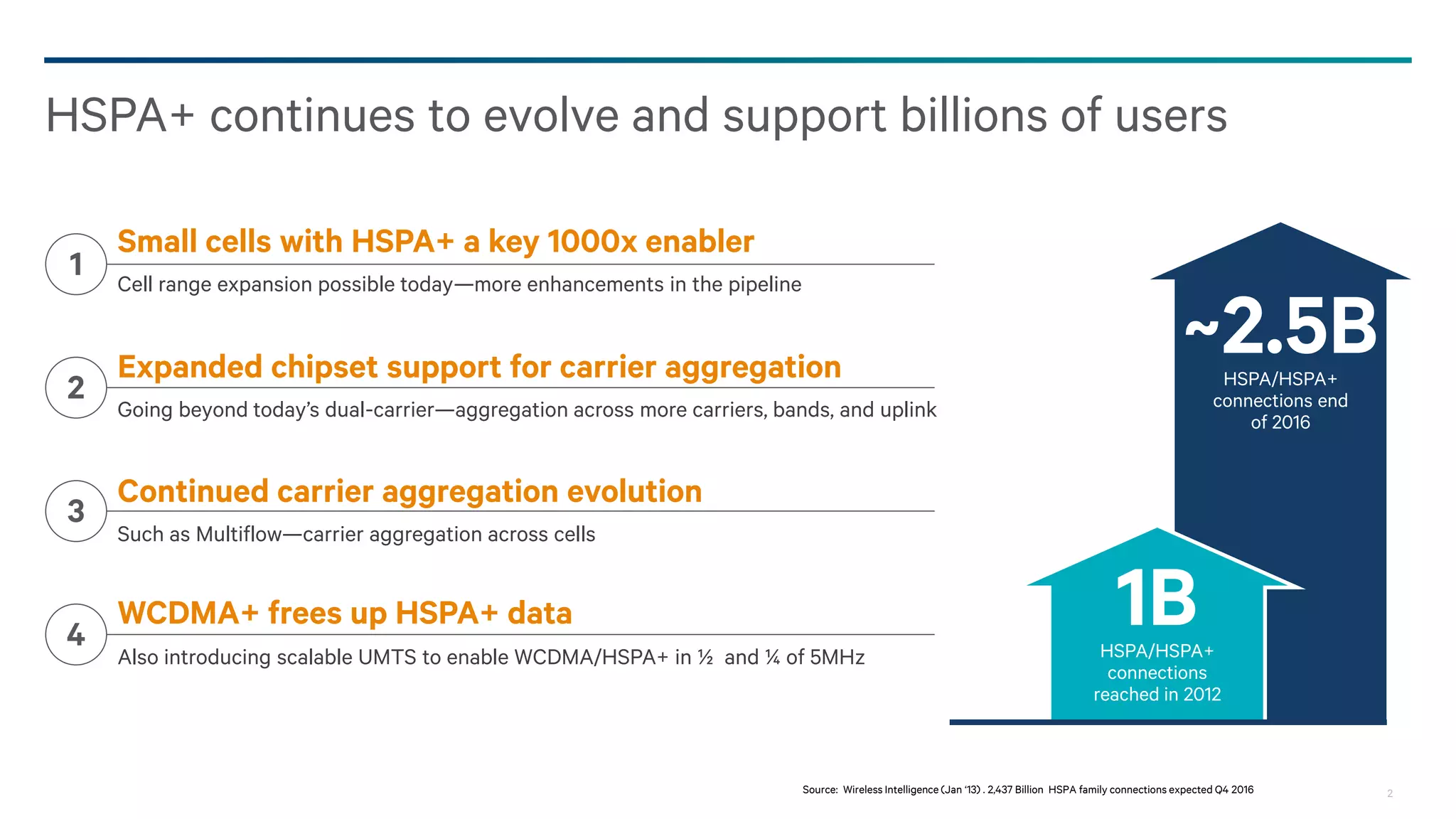
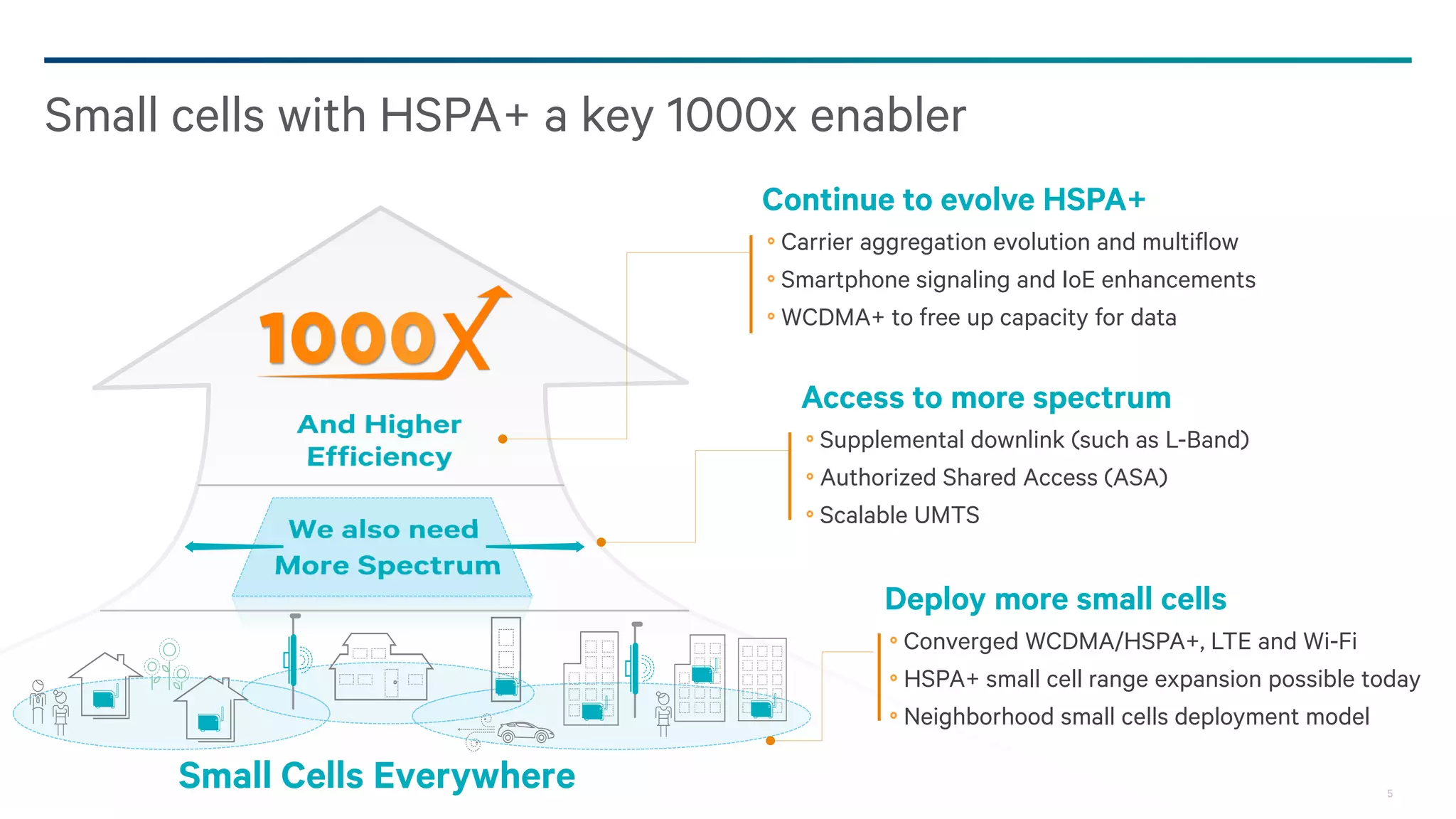
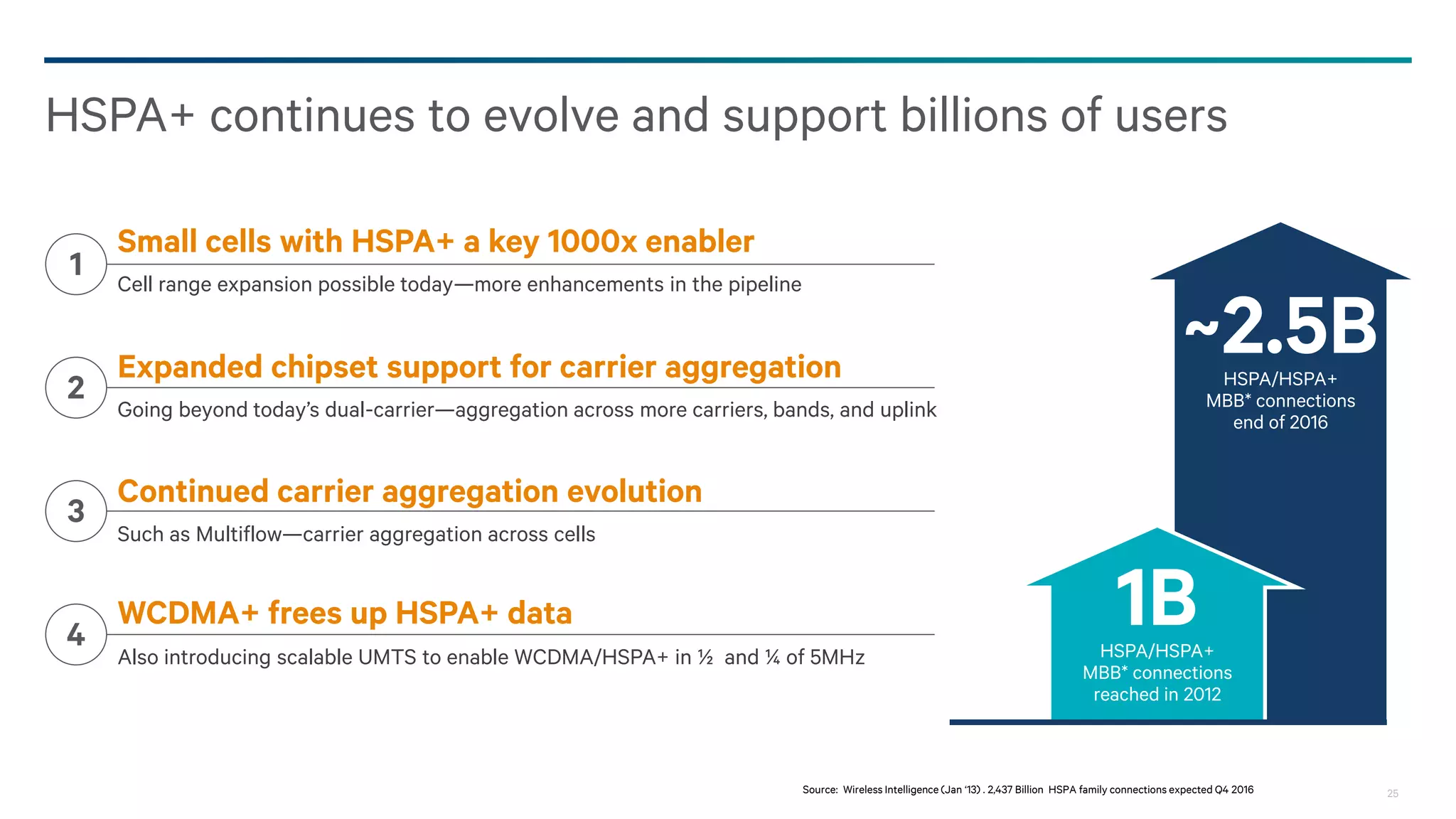
Small cells with HSPA+ a key 1000x enabler
Cell range expansion possible today—more enhancements in the pipeline
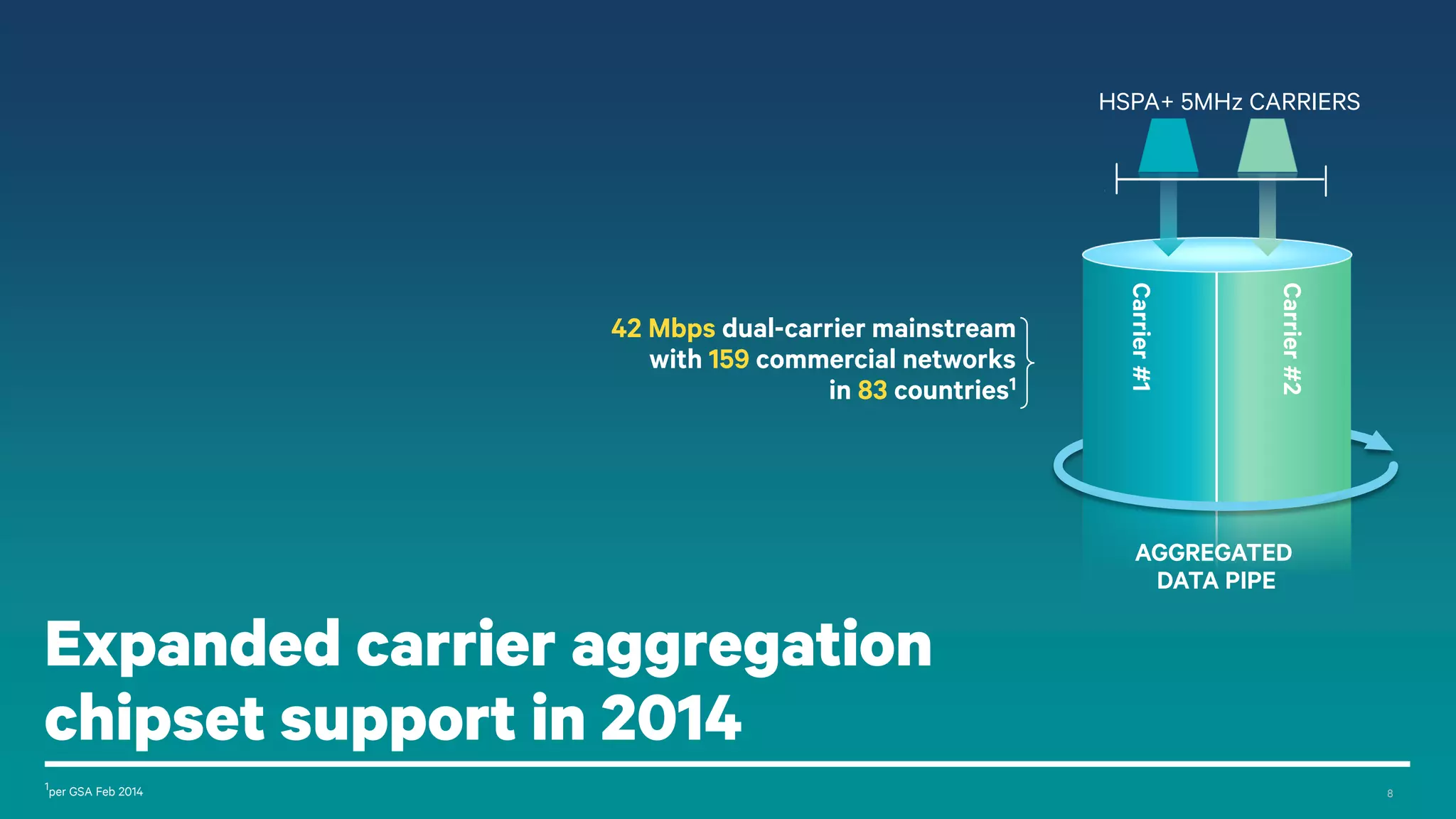
Expanded chipset support for carrier aggregation
Going beyond today’s dual-carrier—aggregation across more carriers, bands, and uplink
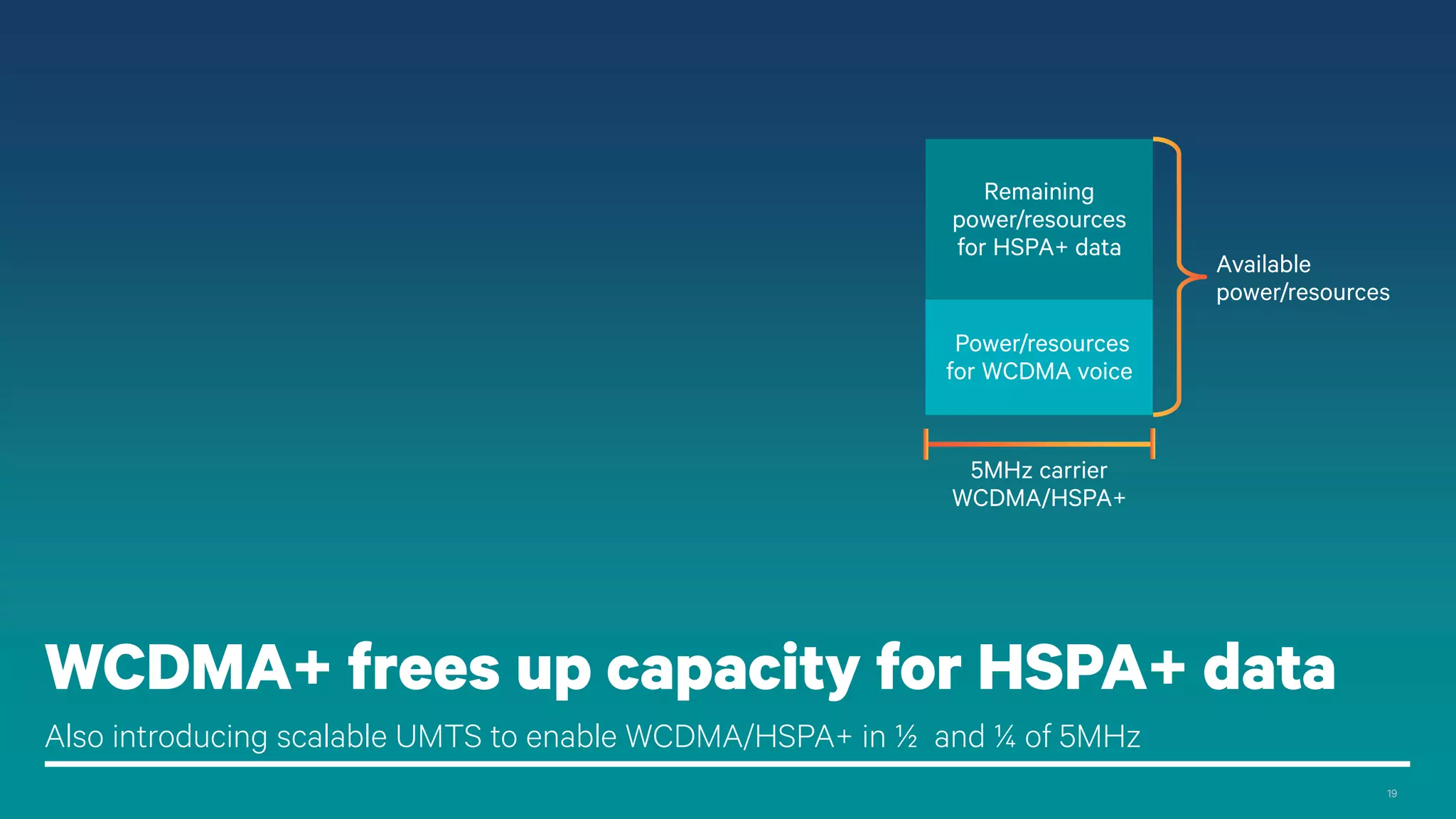
WCDMA+ frees up capacity for HSPA+ data
More efficient voice frees-up resources for data
HSPA+ continues to evolve and support billions of users
Continued carrier aggregation evolution
Such as Multiflow—carrier aggregation across cells
1B
~2.5B
HSPA/HSPA+
MBB* connections
reached in 2012
HSPA/HSPA+
MBB* connections
end of 2016
1
2
3
4
Source: Wireless Intelligence (Jan ‘13) . 2,437 Billion HSPA family connections expected Q4 2016
3Source: www.gsacom.com , Feb 2014
547HSPA NETWORKS IN 205COUNTRIES
363HSPA+ NETWORKS IN 157COUNTRIES
160DUAL-CARRIER NETWORKS IN 83COUNTRIES
HSPA+: Building upon the solid global foundation
4
2013 2014 2015 2016+2014 2015 2016 2017+
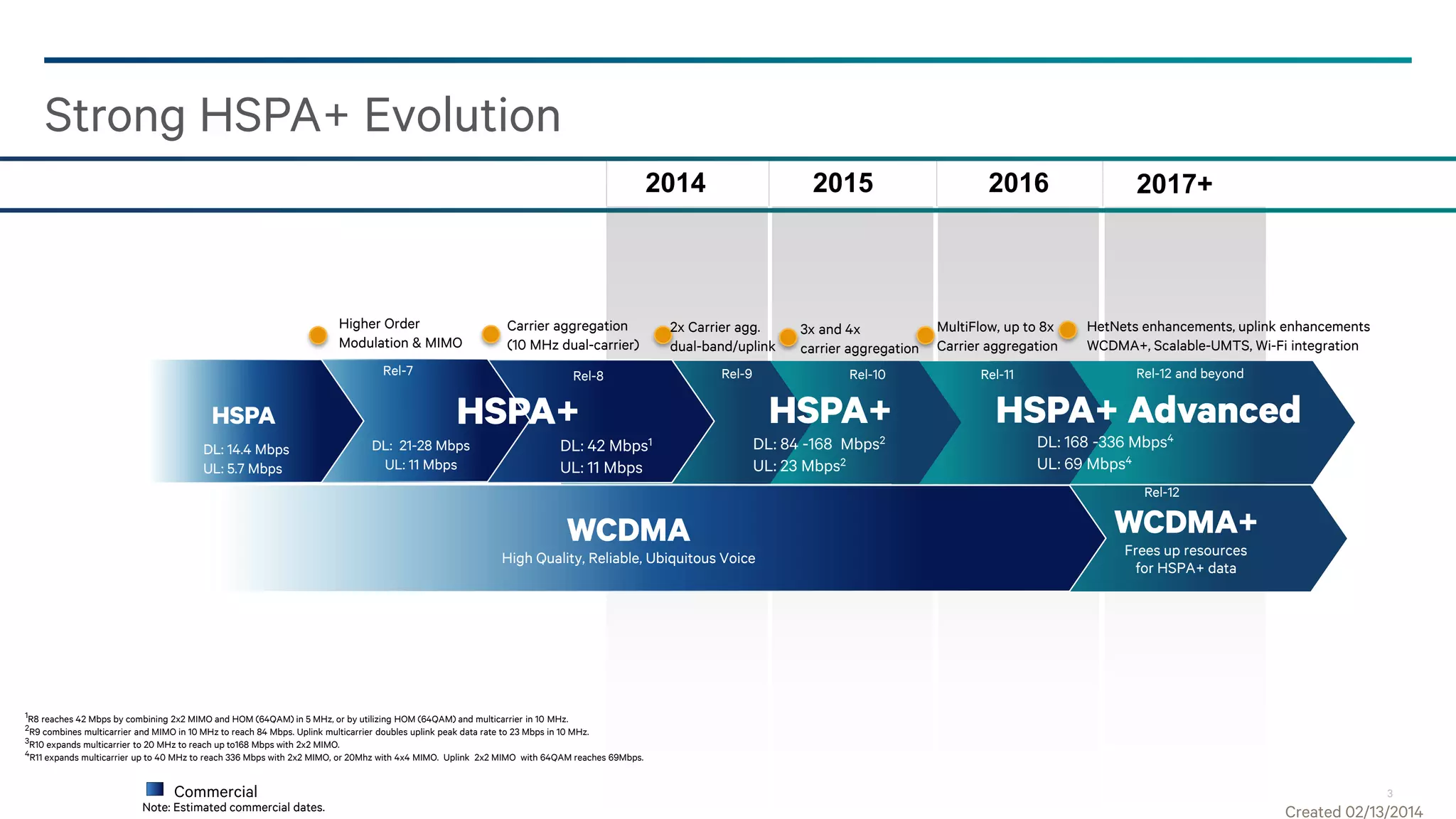
Strong HSPA+ Evolution
Note: Estimated commercial dates.
Rel-11Rel-10Rel-9Rel-8Rel-7
DL: 84 -168 Mbps2
UL: 23 Mbps2
DL: 21-28 Mbps
UL: 11 Mbps
DL: 42 Mbps1
UL: 11 Mbps
DL: 14.4 Mbps
UL: 5.7 Mbps
DL: 168 -336 Mbps4
UL: 69 Mbps4
1R8 reaches 42 Mbps by combining 2x2 MIMO and HOM (64QAM) in 5 MHz, or by utilizing HOM (64QAM) and multicarrier in 10 MHz.
2R9 combines multicarrier and MIMO in 10 MHz to reach 84 Mbps. Uplink multicarrier doubles uplink peak data rate to 23 Mbps in 10 MHz.
3R10 expands multicarrier to 20 MHz to reach up to168 Mbps with 2x2 MIMO.
4R11 expands multicarrier up to 40 MHz to reach 336 Mbps with 2x2 MIMO, or 20Mhz with 4x4 MIMO. Uplink 2x2 MIMO with 64QAM reaches 69Mbps.
Rel-12 and beyond
Rel-12
Created 02/13/2014
Carrier aggregation
(10 MHz dual-carrier)
MultiFlow, 8x CA
Smartphone enhancements
Higher Order
Modulation & MIMO
HetNets enhancements, uplink enhancements
WCDMA+, Wi-Fi integration
HSPA+ AdvancedHSPA+HSPA
WCDMA
High Quality, Reliable, Ubiquitous Voice
HSPA+
WCDMA+
Frees up resources
for HSPA+ data
Commercial
3x and 4x carrier
Aggregation (CA)
2x Carrier agg.
dual-band/uplink
5
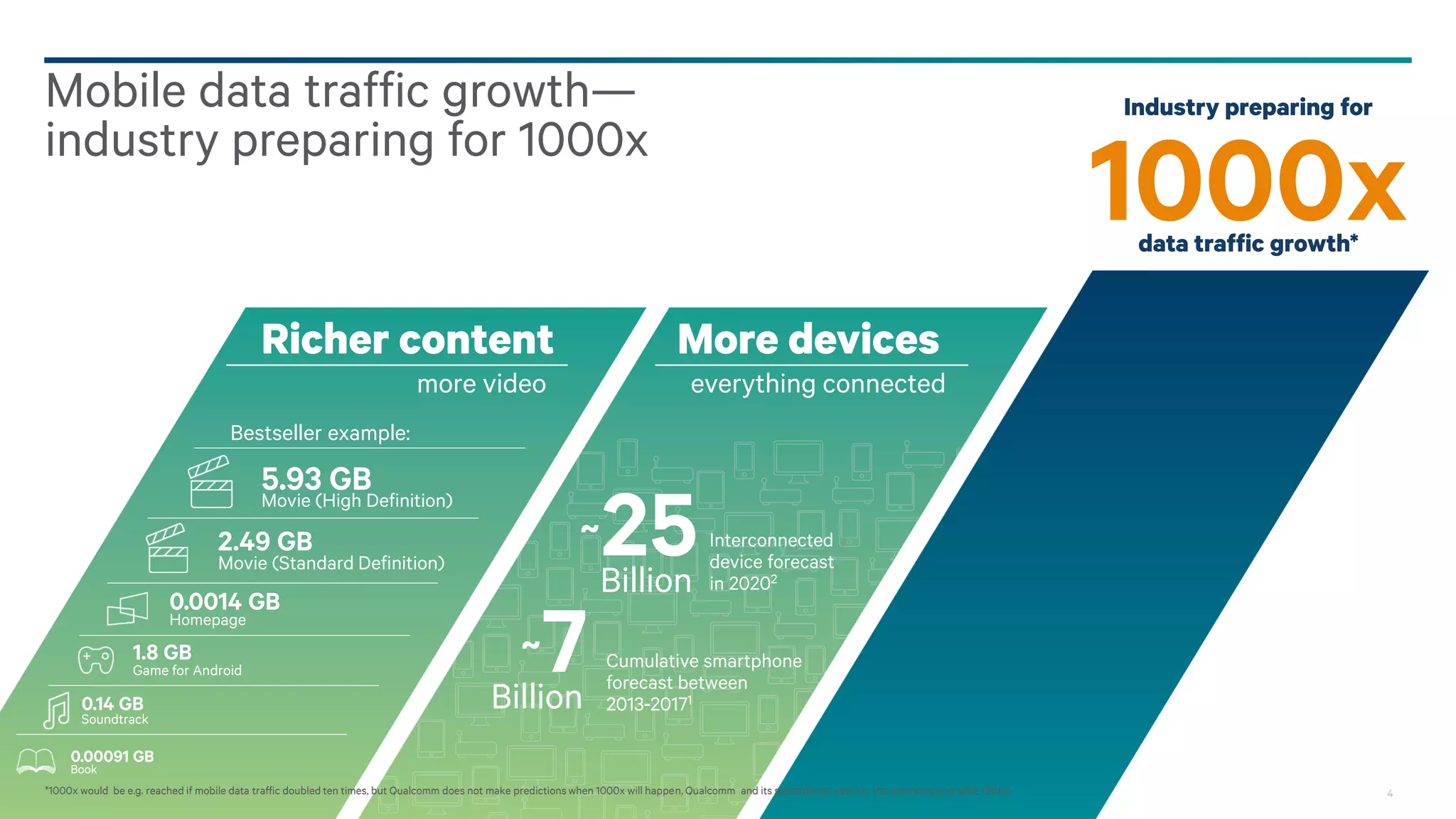
Mobile data traffic growth—
industry preparing for 1000x
1000xdata traffic growth*
Industry preparing for
More devices
everything connected
Richer content
more video
Bestseller example:
Cumulative smartphone
forecast between
2013-20171
7~
Billion
Movie (High Definition)
5.93 GB
Movie (Standard Definition)
2.49 GB
Homepage
0.0014 GB
Game for Android
1.8 GB
Soundtrack
0.14 GB
Book
0.00091 GB
Interconnected
device forecast
in 20202
25~
Billion
1Gartner, Mar’13 ; 2Machina Research/GSMA, Dec. ‘12
*1000x would be e.g. reached if mobile data traffic
doubled ten times, but Qualcomm does not make
predictions when 1000x will happen, Qualcomm and
its subsidiaries work on the solutions to enable 1000x
6
Small Cells Everywhere
Access to more spectrum
Supplemental downlink (such as L-Band)
Authorized Shared Access (ASA)
Continue to evolve HSPA+
Carrier aggregation evolution and multiflow
Smartphone signaling and IoE enhancements
WCDMA+ to free up data
Deploy more small cells
Converged WCDMA/HSPA+, LTE and Wi-Fi
HSPA+ small cell range expansion today
Neighborhood small cells deployment model
Small cells with HSPA+ a key 1000x enabler
7
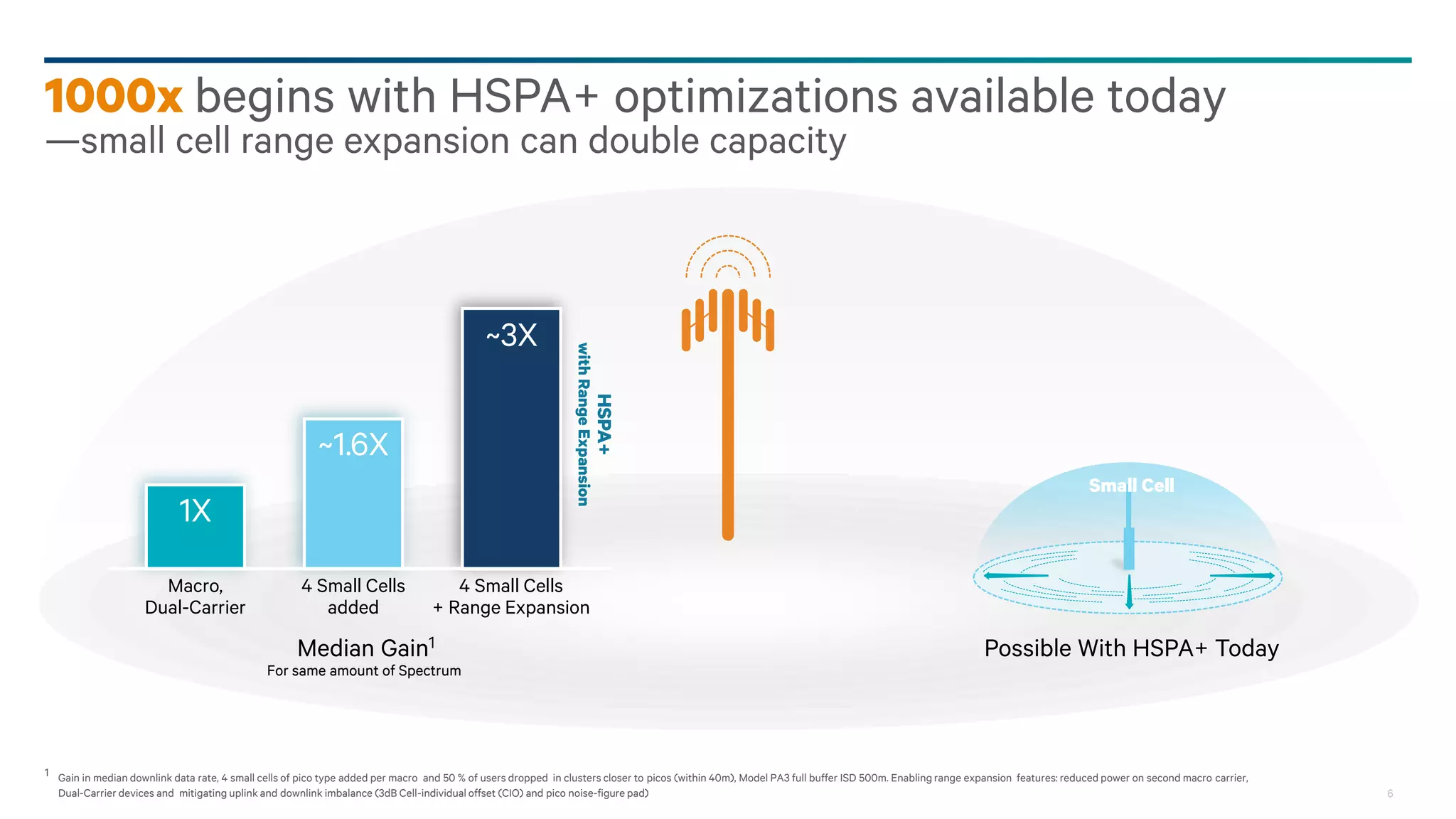
HSPA+
withRangeExpansion
Possible With HSPA+ Today
~3X
4 Small Cells
+ Range Expansion
~1.6X
4 Small Cells
added
1X
Macro,
Dual-Carrier
Median Gain1
For same amount of Spectrum
1 Gain in median downlink data rate, 4 small cells of pico type added per macro and 50 % of users dropped in clusters closer to picos (within 40m), Model PA3 full buffer ISD 500m. Enabling range expansion features: reduced power on second macro carrier,
Dual-Carrier devices and mitigating uplink and downlink imbalance (3dB Cell-individual offset (CIO) and pico noise-figure pad)
1000x begins with HSPA+ optimizations available today
—small cell range expansion can double capacity
Small Cell
8
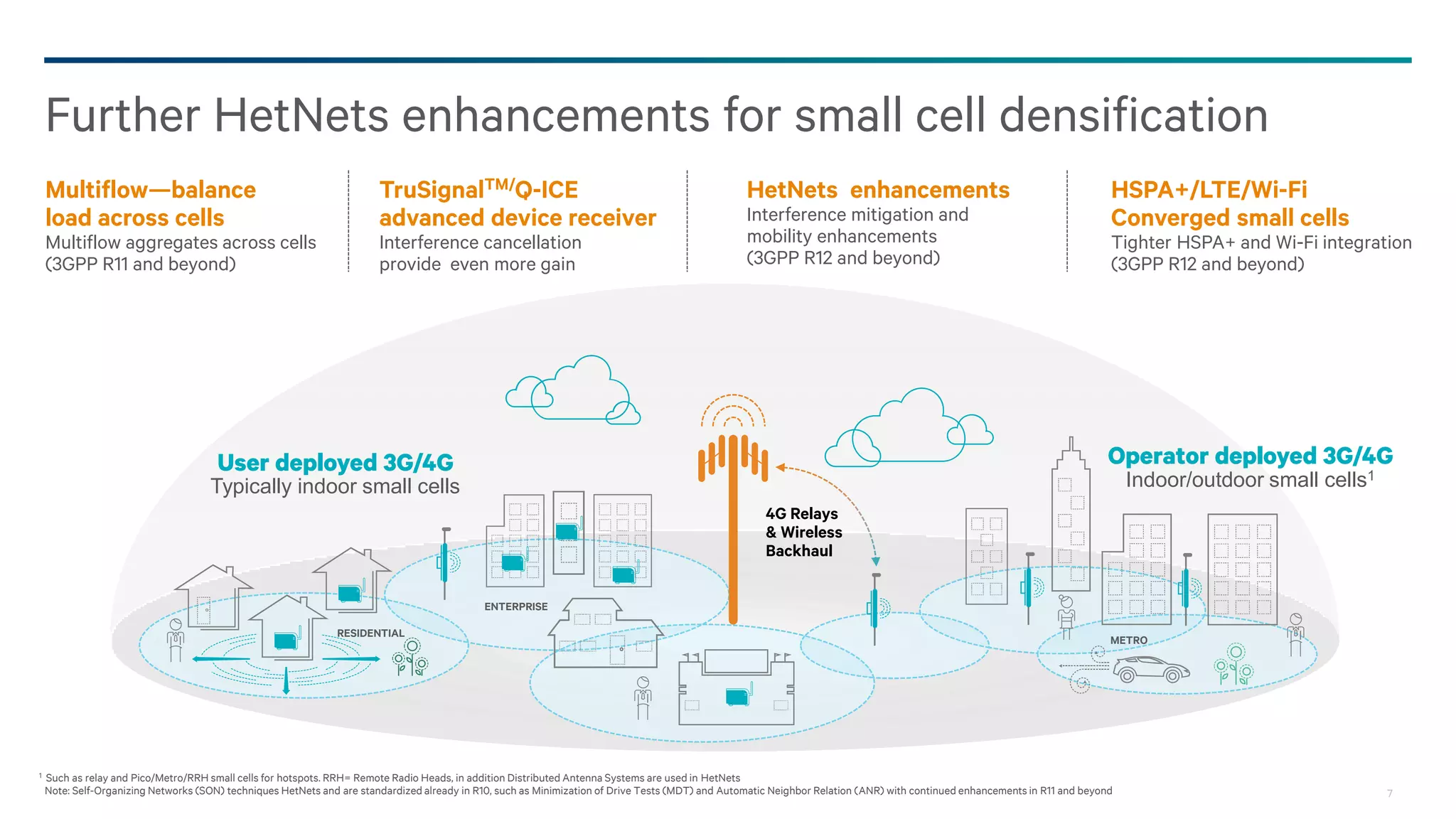
Further HetNets enhancements for small cell densification
1 Such as relay and Pico/Metro/RRH small cells for hotspots. RRH= Remote Radio Heads, in addition Distributed Antenna Systems are used in HetNets
TruSignalTM/Q-ICE
advanced device receiver
Interference cancellation
provide even more gain
Multiflow—balance
load across cells
Multiflow aggregates across cells
(3GPP R11 and beyond)
HetNets enhancements
Interference mitigation and
mobility enhancements
(3GPP R12 and beyond)
Note: Self-Organizing Networks (SON) techniques HetNets and are standardized already in R10, such as Minimization of Drive Tests (MDT) and Automatic Neighbor Relation (ANR) with continued enhancements in R11 and beyond
HSPA+/LTE/Wi-Fi
Converged small cells
Tighter HSPA+ and Wi-Fi integration
(3GPP R12 and beyond)
User deployed 3G/4G
Typically indoor small cells
Operator deployed 3G/4G
Indoor/outdoor small cells1
RESIDENTIAL
ENTERPRISE
METRO
4G Relays
& Wireless
Backhaul
9
HSPA+ Dual-carrier is main-stream
Supporting 42 Mbps downlink peak data rate
Deployment of 42 Mbps
DC-HSPA+ technology
continues as the major
trend in 2014
– GSA, Mar 2014
160NETWORKS
83COUNTRIES
Countries launched/committed to Dual-carrier
Source: www.gsacom.com , Feb 2014
10
Dual-carrier – Delivering high data rates in real networks
>5Mbps >50%
Source: Signals Research Group
Signals Ahead, September 2011, “The Mother of all Network Benchmark Tests”
0 – 0.25Mbps
8.6%
0.25 – 0.5Mbps
4.8%
0.5 – 1Mbps
8.1%
1 – 1.5Mbps
6.5%
1.5 – 2Mbps
4.6%
2 – 2.5Mbps
3.8%
2.5 – 5Mbps
11.4%5 – 7.5Mbps
9.9%
7.5 – 10Mbps
8.8%
10 – 12.5Mbps
8.7%
12.5 – 15Mbps
10.6%
15 – 20Mbps
14.1%
>1Mbps ~80%
USER DATA RATE OF THE TIME
Based on comprehensive benchmarking tests conducted across two
operators in greater Dallas area (Texas), covering more than 23 miles of
driving, downloading nearly 7GB of data
USER DATA RATE OF THE TIME
11
63 Mbps
in 2015
42 Mbps
Commercial
84 Mbps
Future
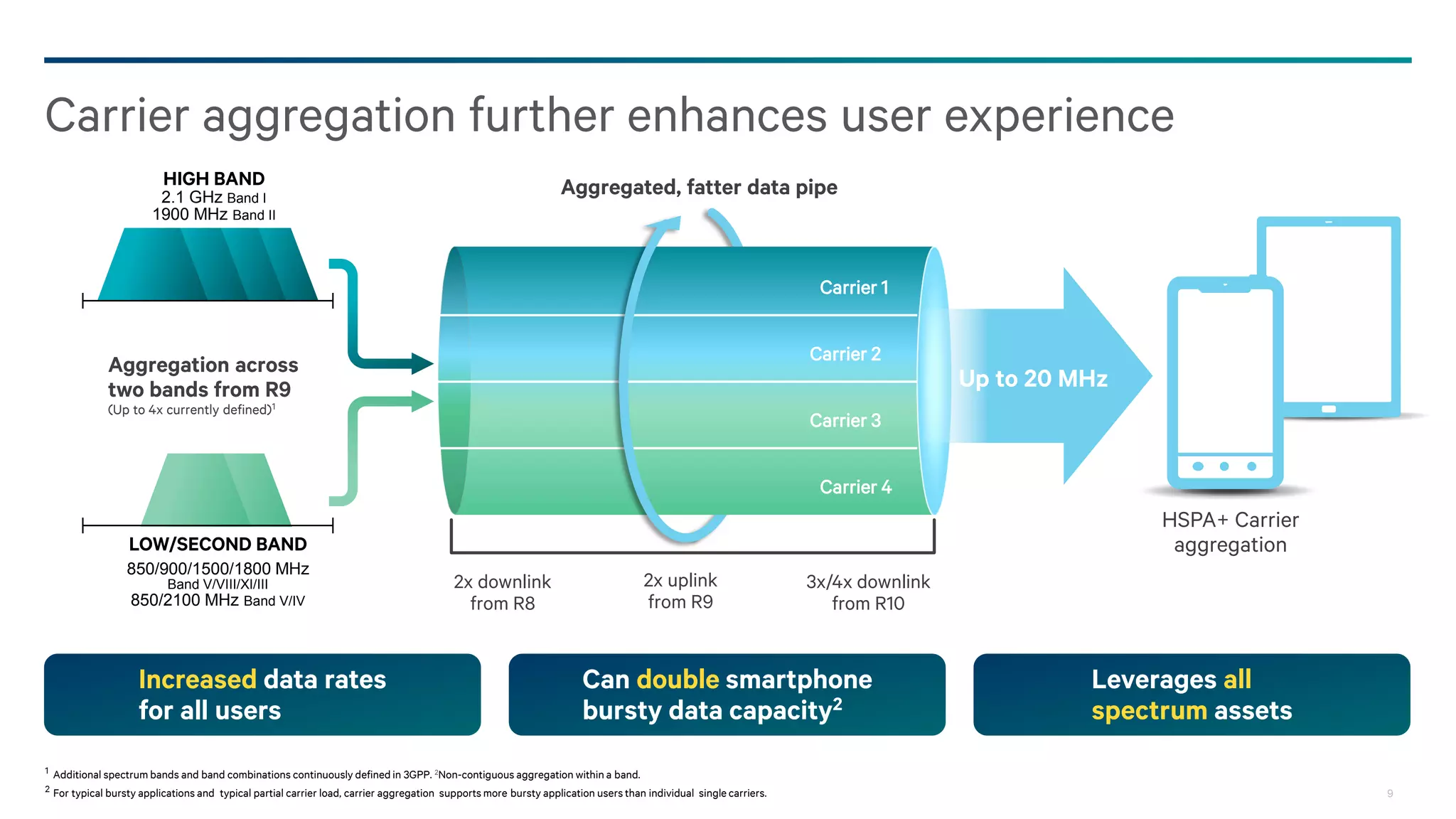
Carrier aggregation enhances user experience
2x CA
Carrier 3
Carrier 2
Carrier 1
3x CA
Carrier 4
4x CA
Increased data rates for all users Leverages all spectrum assets
Can double smartphone
bursty data capacity2
Up to
20 MHz
2 For typical bursty applications and typical partial carrier load, carrier aggregation supports more bursty application users than individual single carriers.
12
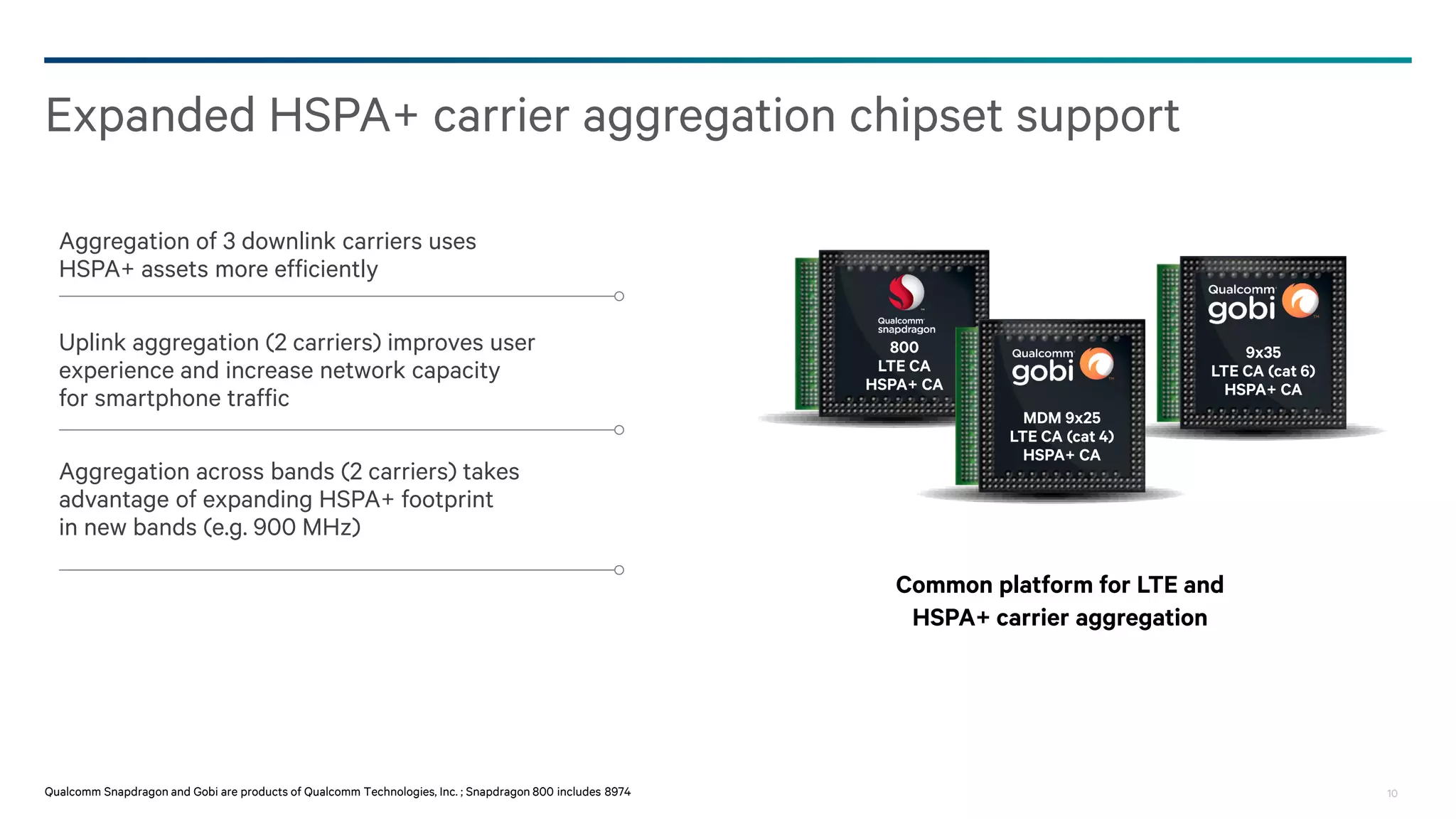
Expanded HSPA+ carrier aggregation support
Aggregation of 3 downlink carriers uses
HSPA+ assets more efficiently
Uplink aggregation (2 carriers) improves user
experience and increase network capacity
for smartphone traffic
Aggregation across bands (2 carriers) takes
advantage of expanding HSPA+ footprint
in new bands (e.g. 900 MHz)
800
LTE CA
HSPA+ CA
MDM 9x25
LTE CA (cat 4)
HSPA+ CA
Common platform for LTE and
HSPA+ carrier aggregation
9x35
LTE CA (cat 6)
HSPA+ CA
Qualcomm Snapdragon and Gobi are products of Qualcomm Technologies, Inc. ; Snapdragon 800 includes 8974
Increased data rates for all users Leverages all spectrum assets
Can double smartphone
bursty data capacity2
2 For typical bursty applications and typical partial carrier load, carrier aggregation supports more bursty application users than individual single carriers.
13
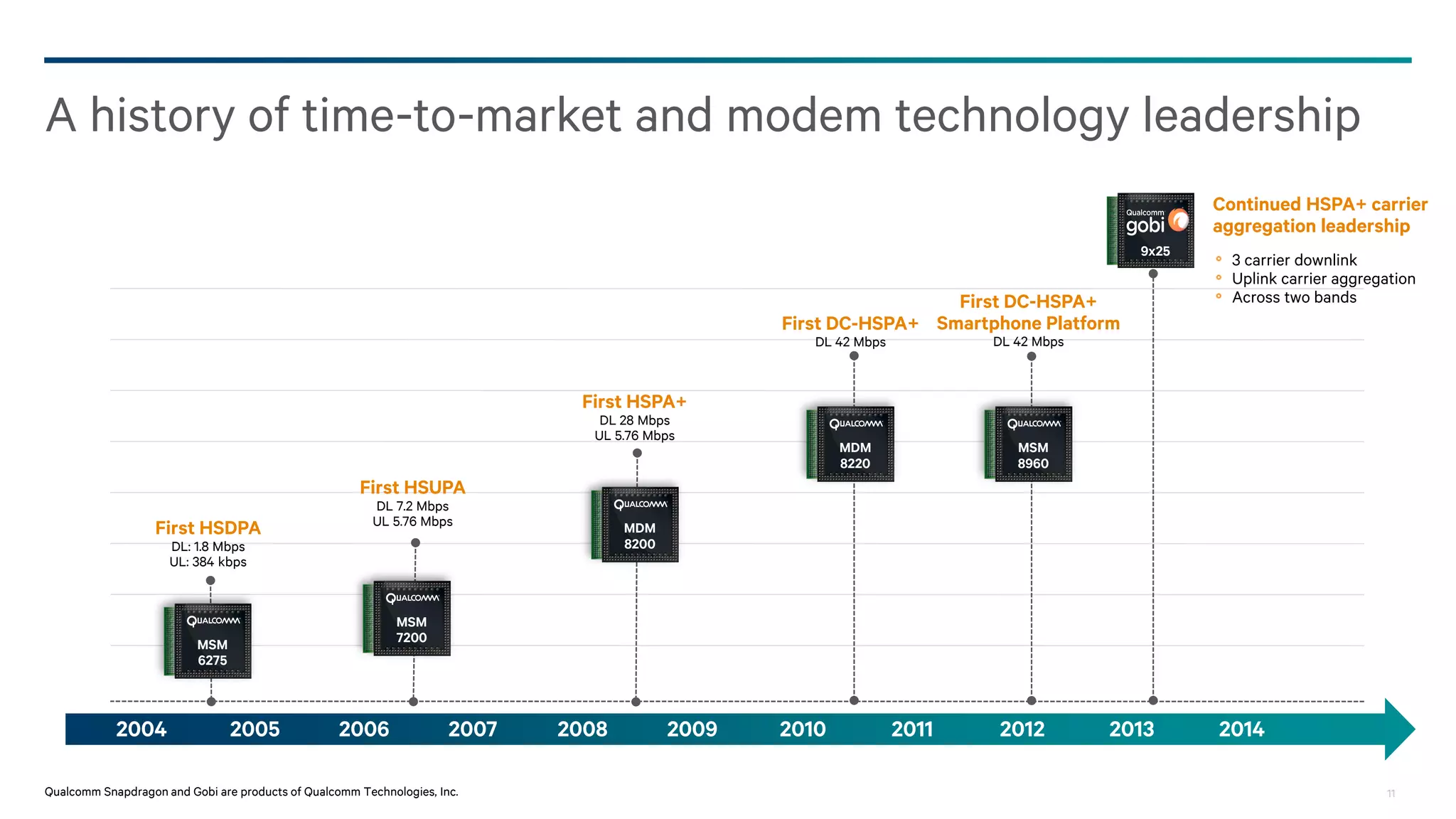
A history of time-to-market and modem technology leadership
2008 2010 20122009 20112007200620052004 20142013
3 carrier downlink
Uplink carrier aggregation
Across two bands
First HSDPA
DL: 1.8 Mbps
UL: 384 kbps
MSM
6275
First HSUPA
DL 7.2 Mbps
UL 5.76 Mbps
First HSPA+
DL 28 Mbps
UL 5.76 Mbps
MDM
8200
MDM
8220
First DC-HSPA+
DL 42 Mbps
First DC-HSPA+
Smartphone Platform
DL 42 Mbps
MSM
8960
Continued HSPA+ carrier
aggregation leadership*
MSM
7200
9x25
* 9x25 - LTE-A CA was launched in 2013, HSPA+ UL-CA expected to launch in 2014; HSPA+ DL 3-carrier CA supported but not yet launched
Qualcomm Snapdragon and Gobi are products of Qualcomm Technologies, Inc.
14
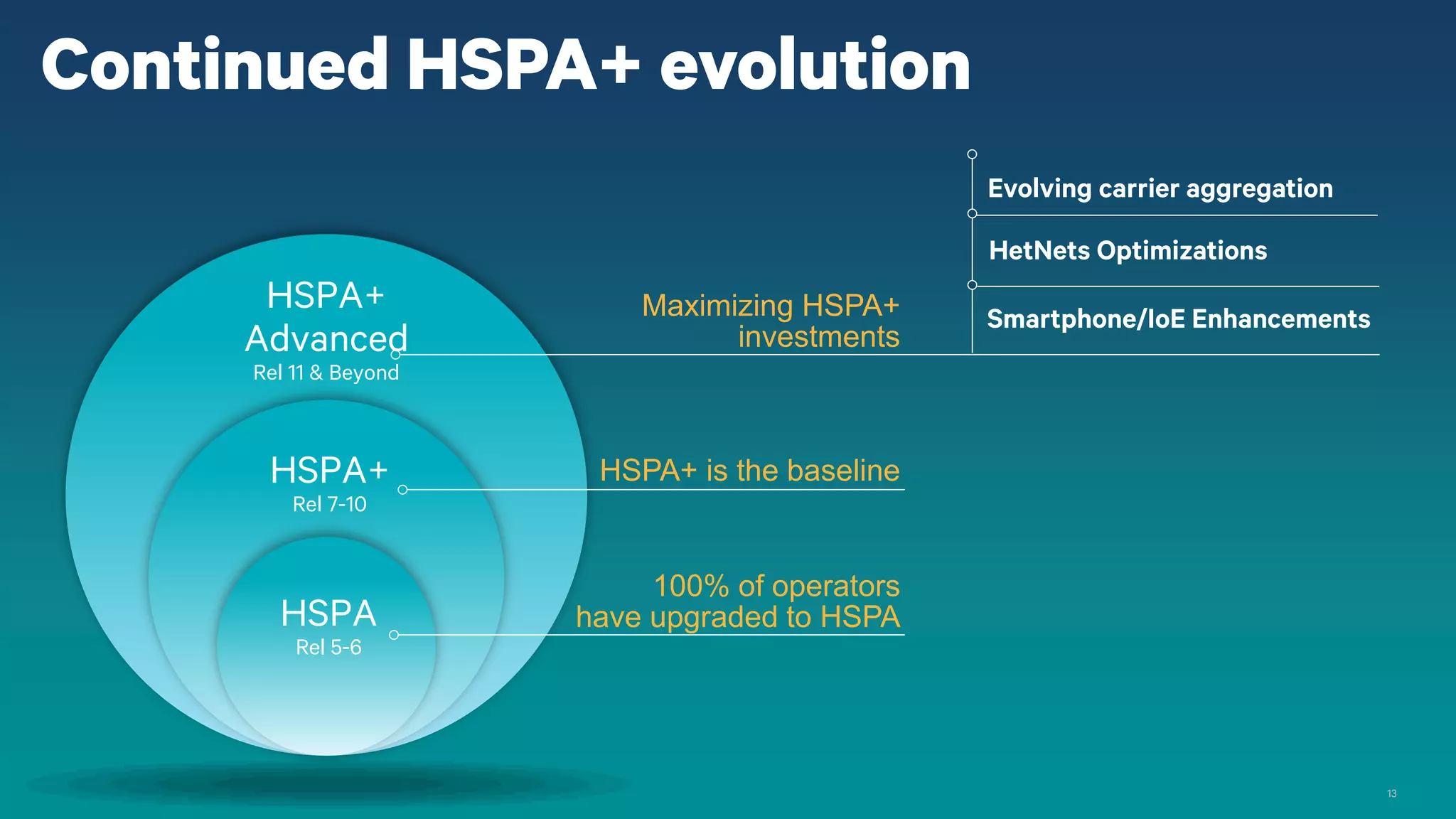
HSPA+
Rel 7-10
HSPA+
Advanced
Rel 11 & Beyond
HSPA
Rel 5-6
Maximizing HSPA+
performance*
HSPA+ is the baseline
100% of operators
have upgraded to HSPA
Multiflow and further carrier
aggregation evolution
HetNets Optimizations
Smartphone/IoE Enhancements
Continued HSPA+ evolution
* Rel. 12 also includes features such as F-EUL that further increases the capacity, coverage and user experience, eBCH to make overhead channels more efficient, and IncMon that increases the number of carriers devices monitors for even better handoffs and cell
reselection between HSPA+ carriers as well as with LTE
15
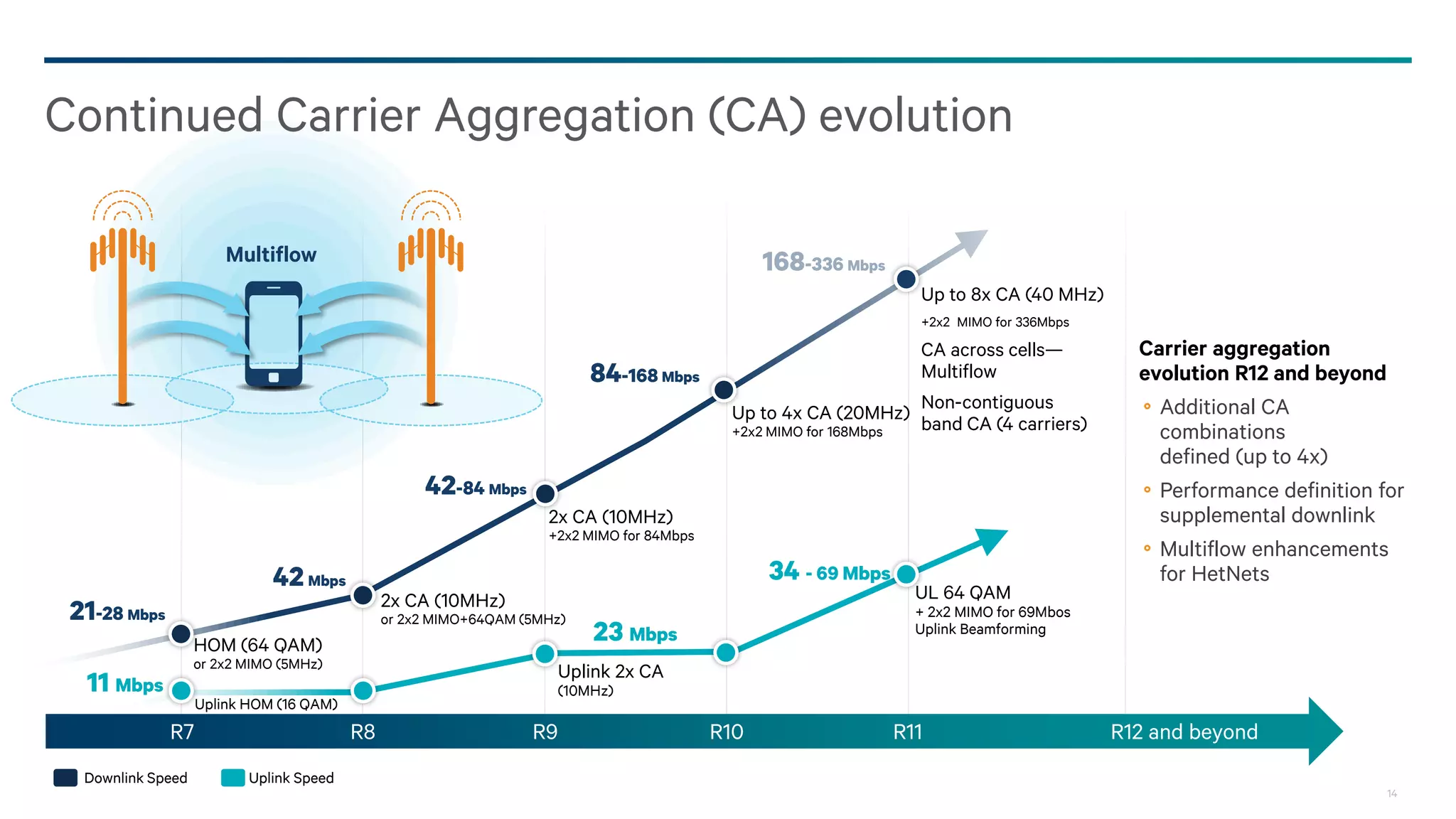
11 Mbps
Continued Carrier Aggregation (CA) evolution
21-28 Mbps
42Mbps
42-84 Mbps
2x CA (10MHz)
or 2x2 MIMO+64QAM (5MHz)
HOM (64 QAM)
or 2x2 MIMO (5MHz)
Up to 4x CA (20MHz)
+2x2 MIMO for 168Mbps
2x CA (10MHz)
+2x2 MIMO for 84Mbps
34 - 69 Mbps
UL 64 QAM
+ 2x2 MIMO for 69Mbos
Uplink Beamforming
Uplink 2x CA
(10MHz)
23 Mbps
84-168 Mbps
Downlink Speed Uplink Speed
Up to 8x CA (40 MHz)
+2x2 MIMO for 336Mbps
Multiflow - CA across
cells
Non-contiguous
band CA (4 carriers)
Uplink HOM (16 QAM)
Carrier aggregation
evolution R12 and beyond
Additional CA
combinations
defined (up to 4x)
Performance definition for
supplemental downlink
R7 R8 R9 R10 R11 R12 and beyond
Multiflow
16
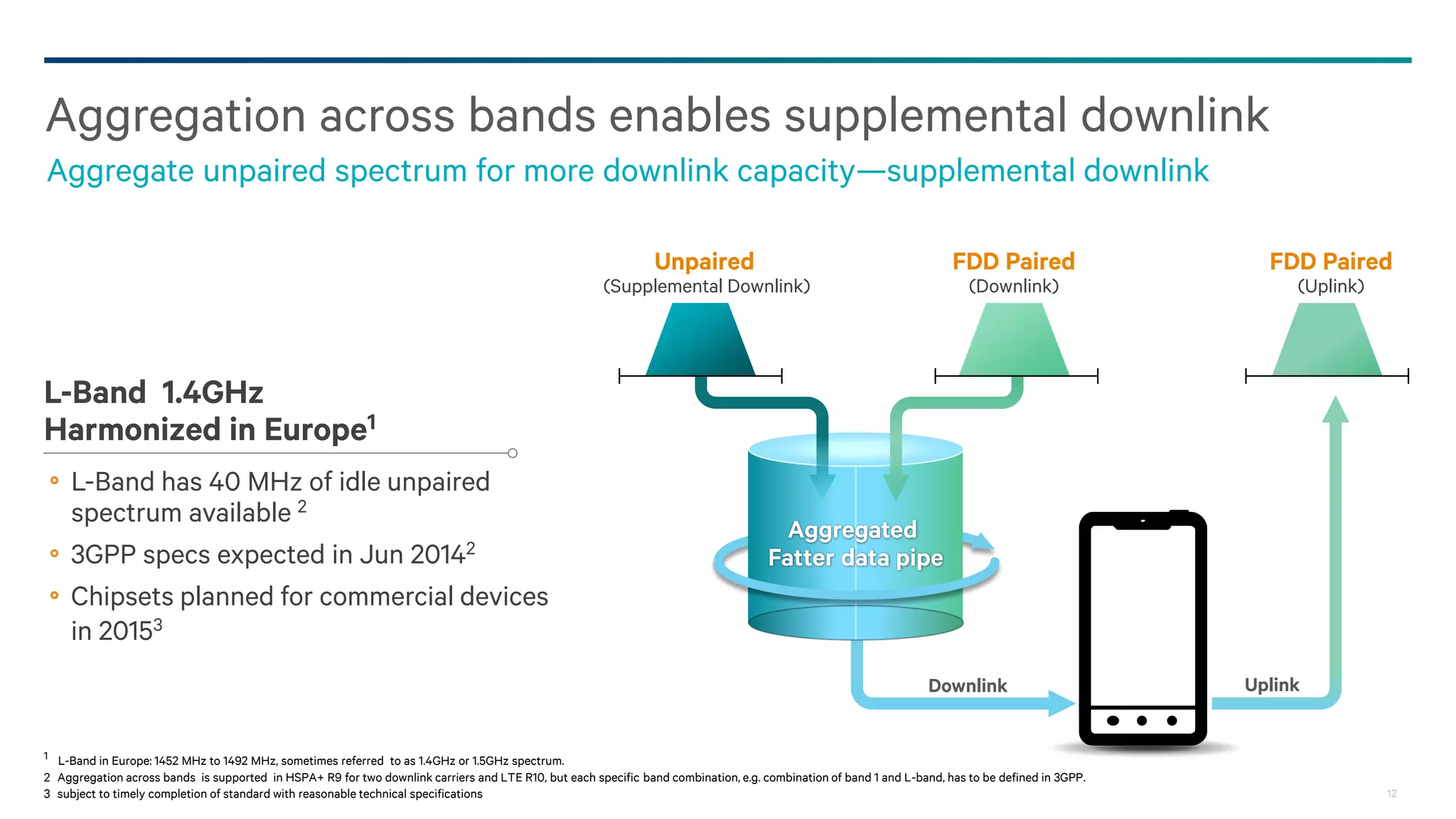
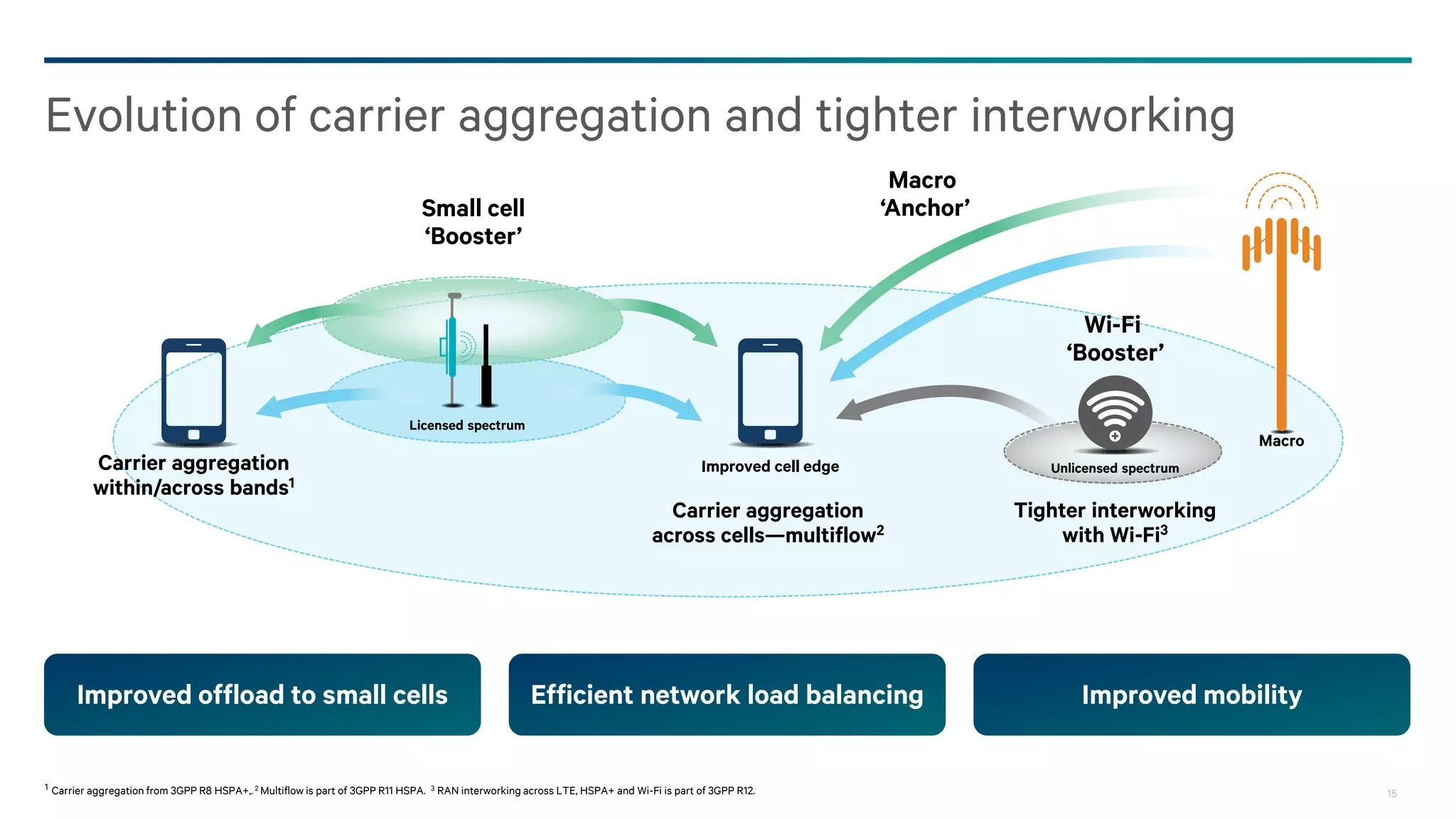
HSPA+ Carrier aggregation expanding reach
Leveraging all spectrum assets
Across Bands
HIGH
BAND
(e.g Band I & II)
LOW
BAND
(e.g Band V, VII & VIII)
PAIRED
SPECTRUM
UNPAIRED
SPECTRUMUplink
More Carriers
DUAL-CARRIER NOW
& COUNTING4
Aggregated
Data Pipe
AGGREGATION ACROSS
CELLS5
Multiflow
Supplemental
Downlink
ULDL DL


3GPP continually defines new band combinations
1-3 carriers in the high band, and
1-2 in the low band2
1Defined in Rel 9; 2 Defined in Rel 9, more carriers and combinations added in Rel 11; 3Defined in Rel 9, band combinations being defined by 3GPP; 4Dual-carrier in Rel 8, 4-carriers in Rel 10, and 8-carriers in Rel11; 5Defined in Rel 11
Combining unpaired spectrum
with the downlink 3
DUAL-CARRIER IN THE
UPLINK1
17
Multiflow - carrier aggregation across cells
Enabling carrier aggregation in all deployments
Bringing benefits of dual-carrier to
single–frequency deployments
Higher cell-edge data rates Higher network capacityBetter network load balancing
Bringing benefits of carrier aggregation
to multi-frequency deployments1
1With the evolution to supporting 4 carrier aggregation, multiflow can aggregate up to 3 carriers from one site/cell and one carrier from the other cells in the future
18
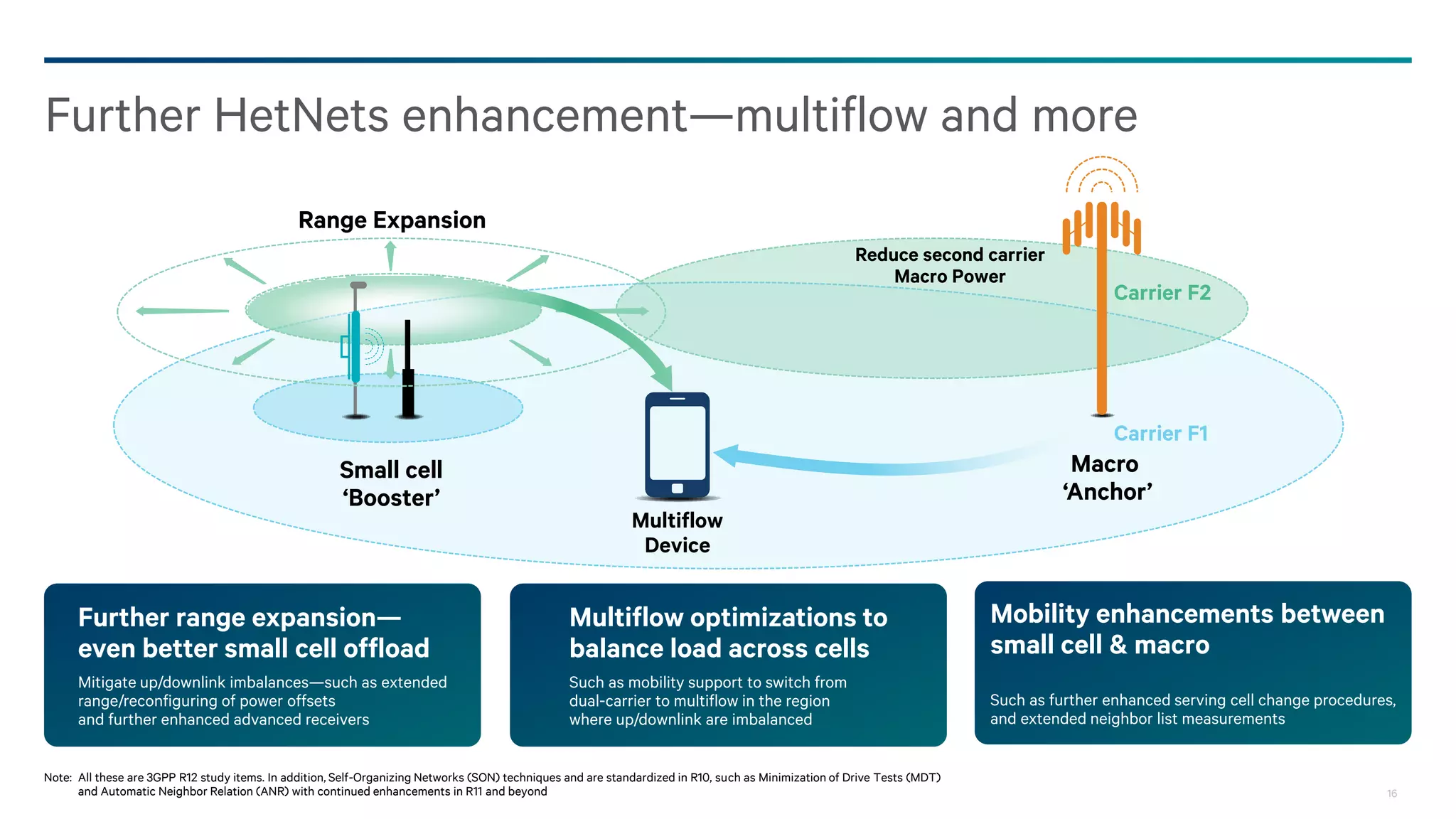
Further HetNets enhancement—multiflow and more
Further range expansion—
even better small cell offload
Mitigate up/downlink imbalances—such as extended
range/reconfiguring of power offsets and further
enhanced advanced receivers
Note: All these are 3GPP R12 study items. In addition, Self-Organizing Networks (SON) techniques and are standardized in R10, such as Minimization of Drive Tests (MDT)
and Automatic Neighbor Relation (ANR) with continued enhancements in R11 and beyond
Further range expansion—
even better small cell offload
Mitigate up/downlink imbalances—such as extended
range/reconfiguring of power offsets
and further enhanced advanced receivers
Multiflow optimizations to
balance load across cells
Such as mobility support to switch from
dual-carrier to multiflow in the region
where up/downlink are imbalanced
Mobility enhancements between
small cell & macro
Such as further enhanced serving cell change procedures,
and extended neighbor list measurements
Dual-carrier
Devices
Range Expansion
Carrier 2
Carrier 1 Macro
Small cell
Reduce second carrier
Macro Power (F2)
19
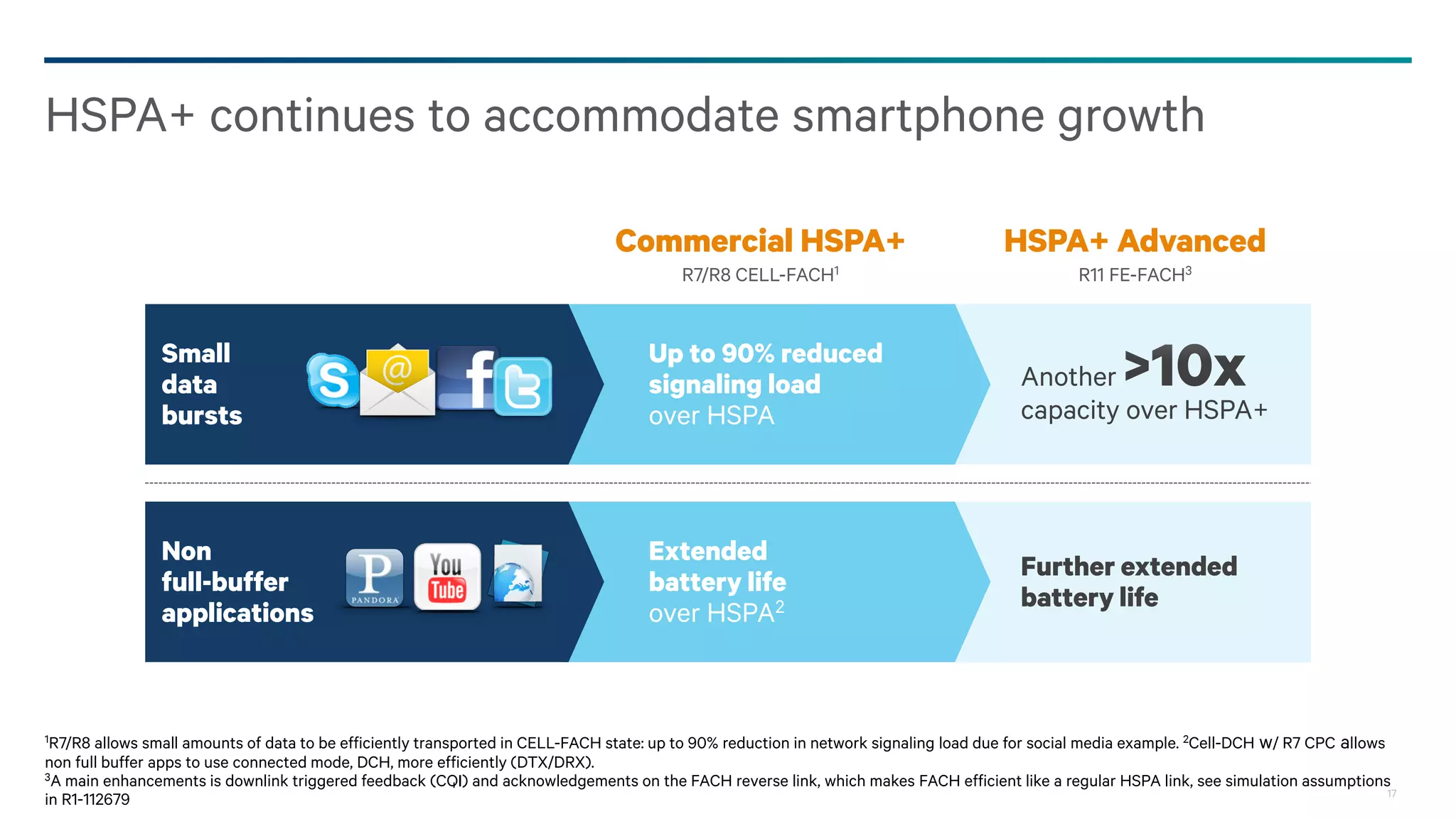
HSPA+ continues to accommodate smartphone growth
1R7/R8 allows small amounts of data to be efficiently transported in CELL-FACH state: up to 90% reduction in network signaling load due for social media example. 2Cell-DCH w/ R7 CPC allows non full buffer apps to use connected mode, DCH, more efficiently (DTX/DRX).
3A main enhancements is downlink triggered feedback (CQI) and acknowledgements on the FACH reverse link, which makes FACH efficient like a regular HSPA link, see simulation assumptions in R1-112679
Another
capacity over HSPA+
Up to 90% reduced
signaling load
over HSPA
HSPA+ Advanced
R11 FE-FACH3
Commercial HSPA+
R7/R8 CELL-FACH1
Small
data
bursts
Further extended
battery life
Extended
battery life
over HSPA2
Non
full-buffer
applications
Skype
Pandora
20
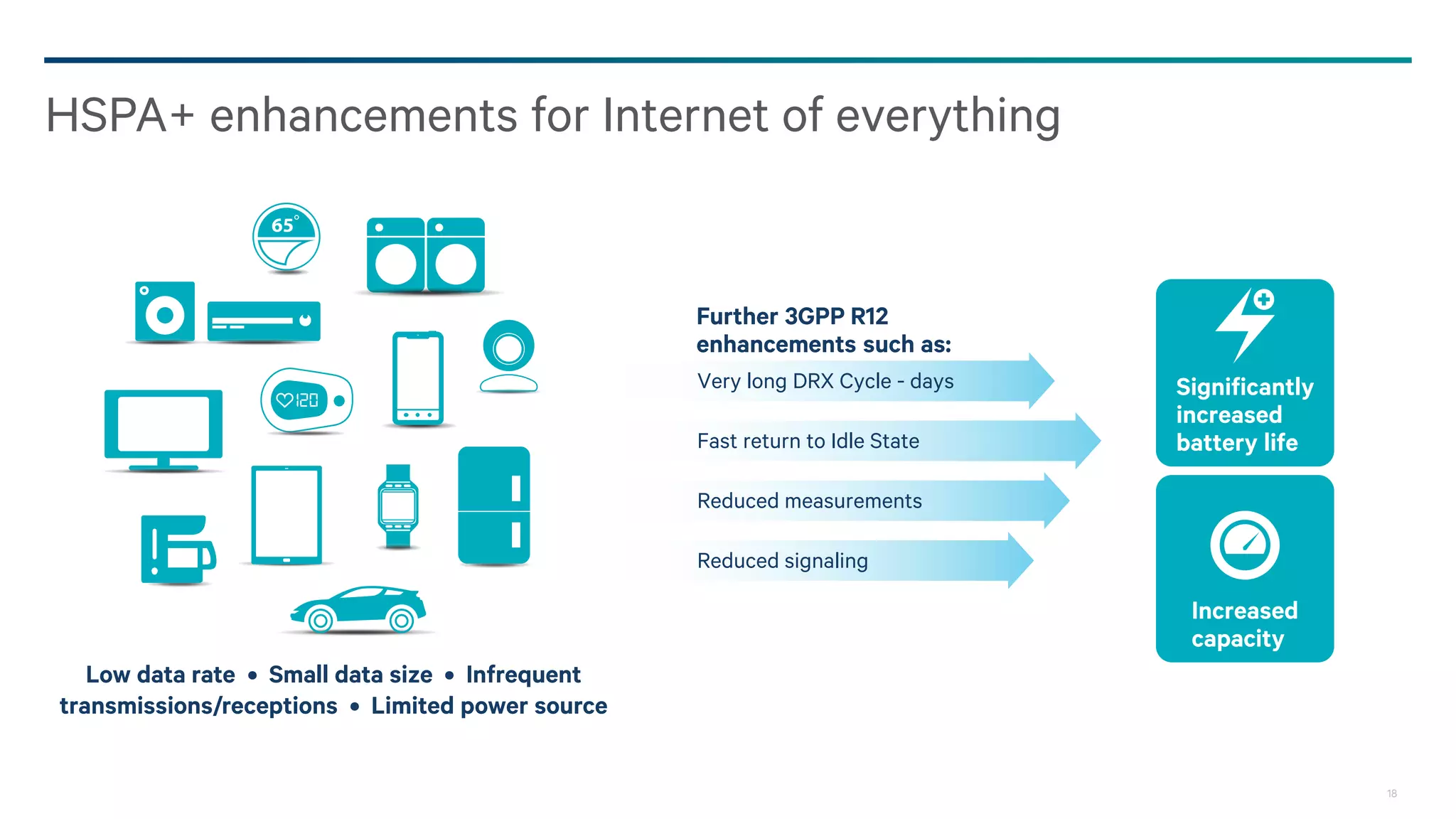
HSPA+ enhancements for Internet of everything
Further 3GPP R12/R13*
enhancements such as:
Very long DRX Cycle - days
Fast return to Idle State
Reduced measurements
Reduced signaling
Low data rate • Small data size • Infrequent
transmissions/receptions • Limited power source
Significantly
increased
battery life
Increased
capacity
*Extended sleep period (aka Power Saving mode (PSM) is part of R12, all others are potential candidates for Rel 13
Extended sleep period
21
WCDMA+ frees up capacity for
HSPA+ data
More efficient voice frees-up resources for data
22
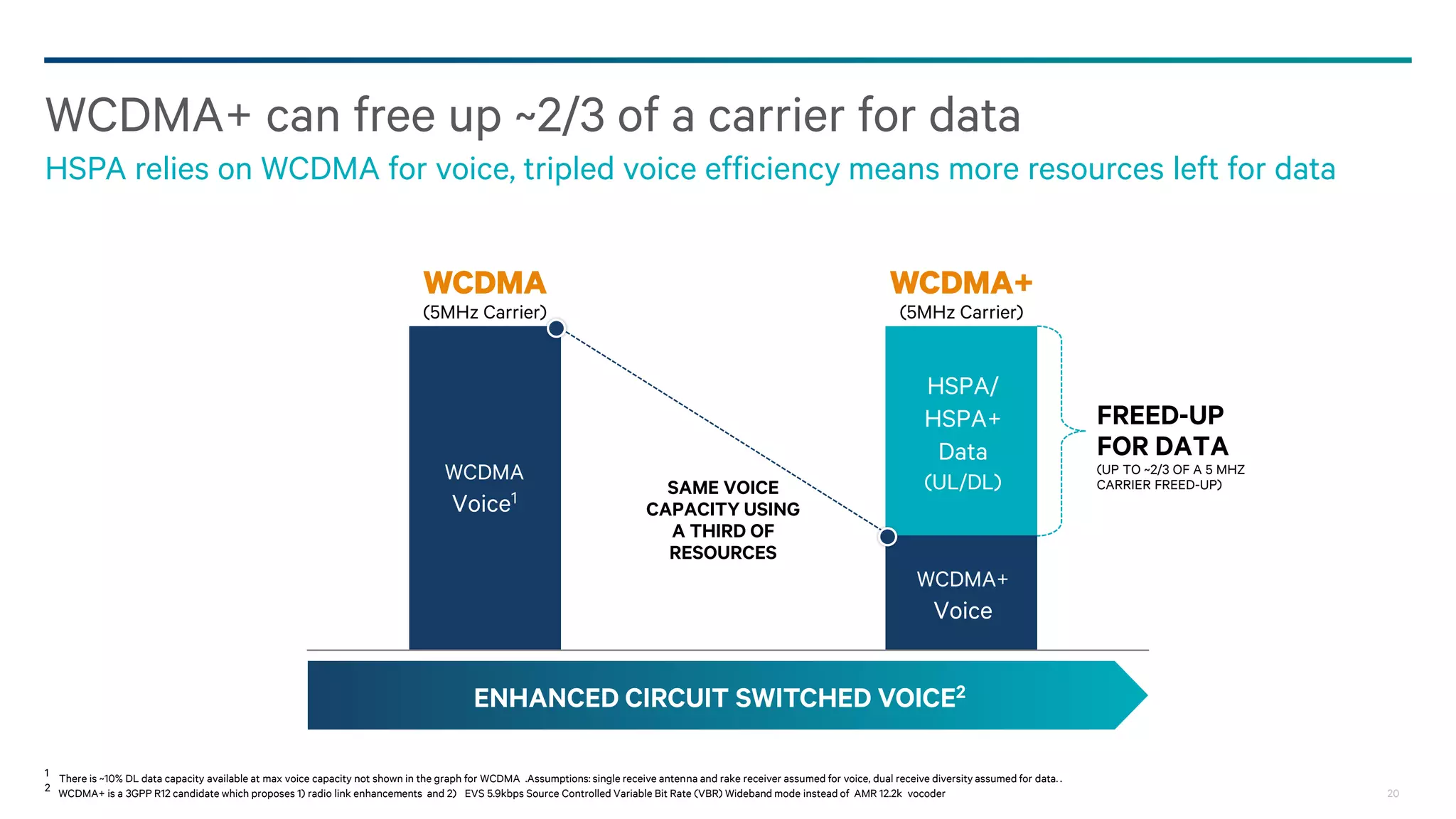
WCDMA+ can free up ~2/3 of a carrier for data
HSPA relies on WCDMA for voice, tripled voice efficiency means more resources left for data
WCDMA
(5MHz Carrier)
WCDMA+
(5MHz Carrier)
ENHANCED CIRCUIT SWITCHED VOICE2
WCDMA+
Voice
FREED-UP
FOR DATA
(UP TO ~2/3 OF A 5 MHZ
CARRIER FREED-UP)SAME VOICE
CAPACITY USING
A THIRD OF
RESOURCES
WCDMA
Voice1
HSPA/
HSPA+
Data
(UL/DL)
1 There is ~10% DL data capacity available at max voice capacity not shown in the graph for WCDMA .Assumptions: single receive antenna and rake receiver assumed for voice, dual receive diversity assumed for data. .
2 WCDMA+ is a 3GPP R12 feature
23
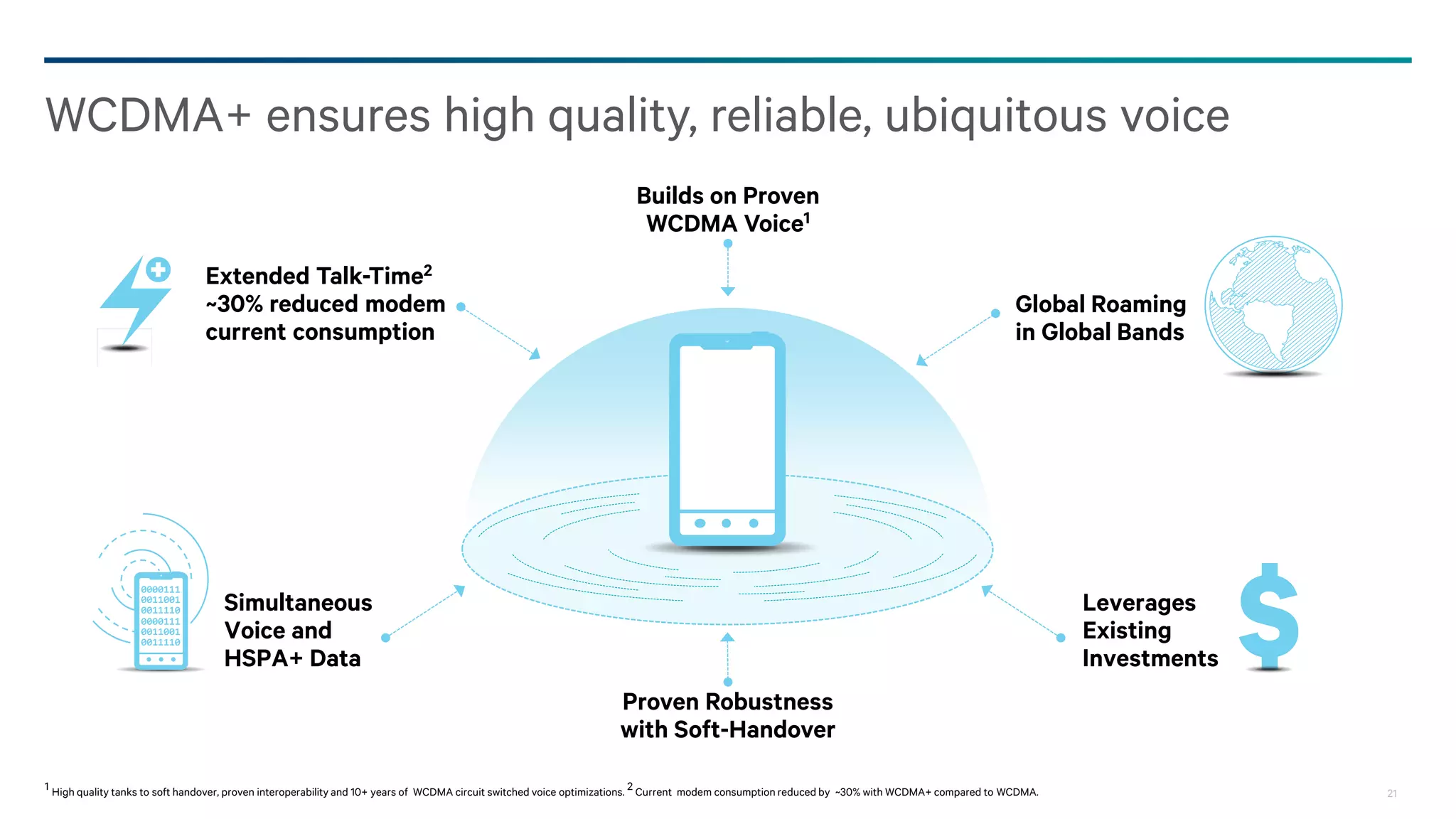
WCDMA+ ensures high quality, reliable, ubiquitous voice
Extended Talk-Time2
~30% reduced modem
current consumption
Simultaneous
Voice and
HSPA+ Data
Global Roaming
in Global Bands
Leverages
Existing
Investments
Builds on Proven
WCDMA Voice1
Proven Robustness
with Soft-Handover
1 High quality, thanks to soft handover, proven interoperability and 10+ years of WCDMA circuit switched voice optimizations. 2 Modem current consumption reduced by ~30% with WCDMA+ compared to WCDMA.
24
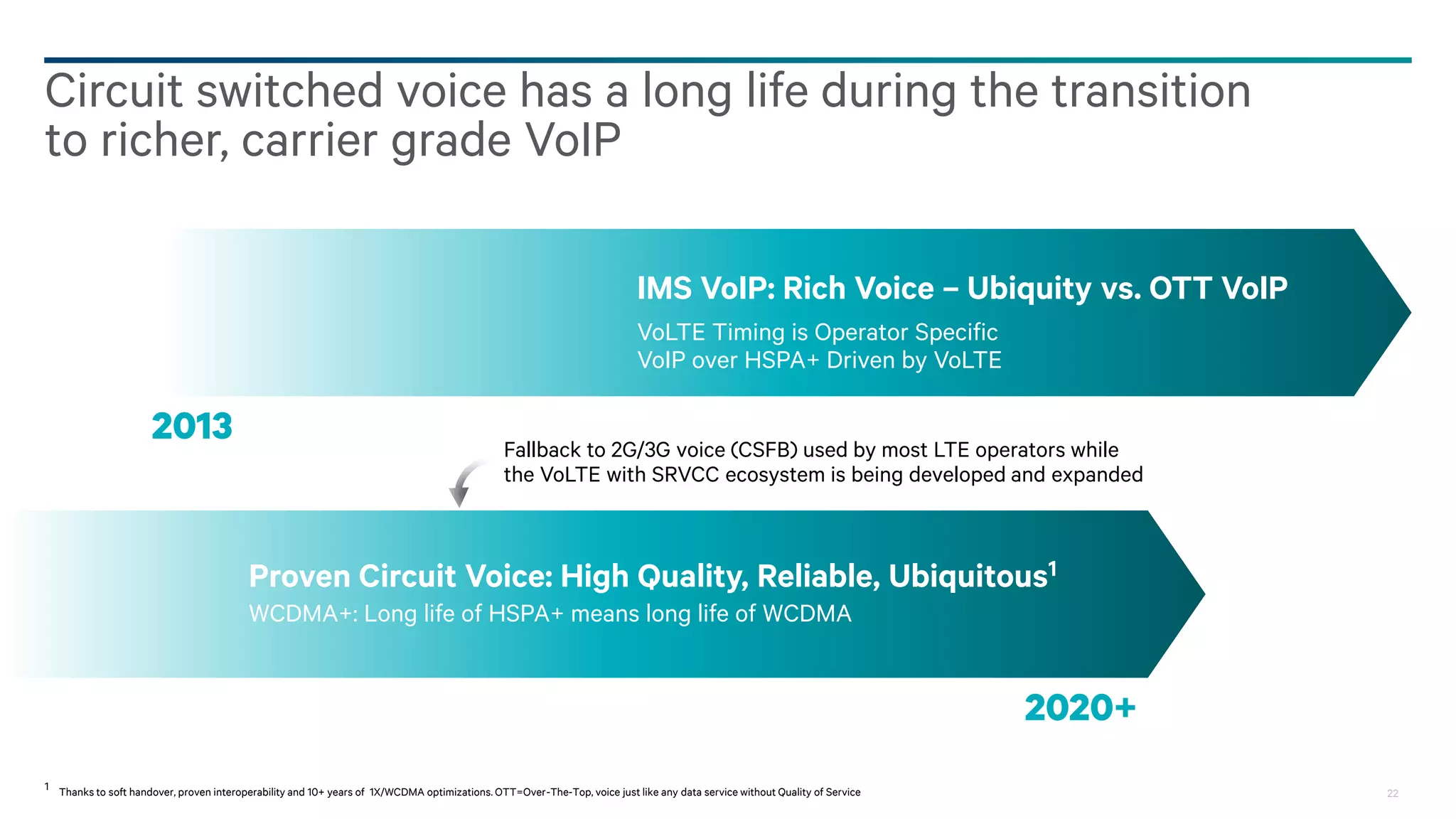
Circuit switched voice has a long life during the transition
to richer, carrier grade VoIP
WCDMA+: Long life of HSPA+ means long life of WCDMA
VoLTE Timing is Operator Specific
VoIP over HSPA+ Driven by VoLTE
Proven Circuit Voice: High Quality, Reliable, Ubiquitous1
IMS VoIP: Rich Voice – Ubiquity vs. OTT VoIP
Fallback to 2G/3G voice (CSFB) used by most LTE operators while
the VoLTE with SRVCC ecosystem is being developed and expanded
1 Thanks to soft handover, proven interoperability and 10+ years of 1X/WCDMA optimizations. OTT=Over-The-Top, voice just like any data service without Quality of Service
2014
2020+
25
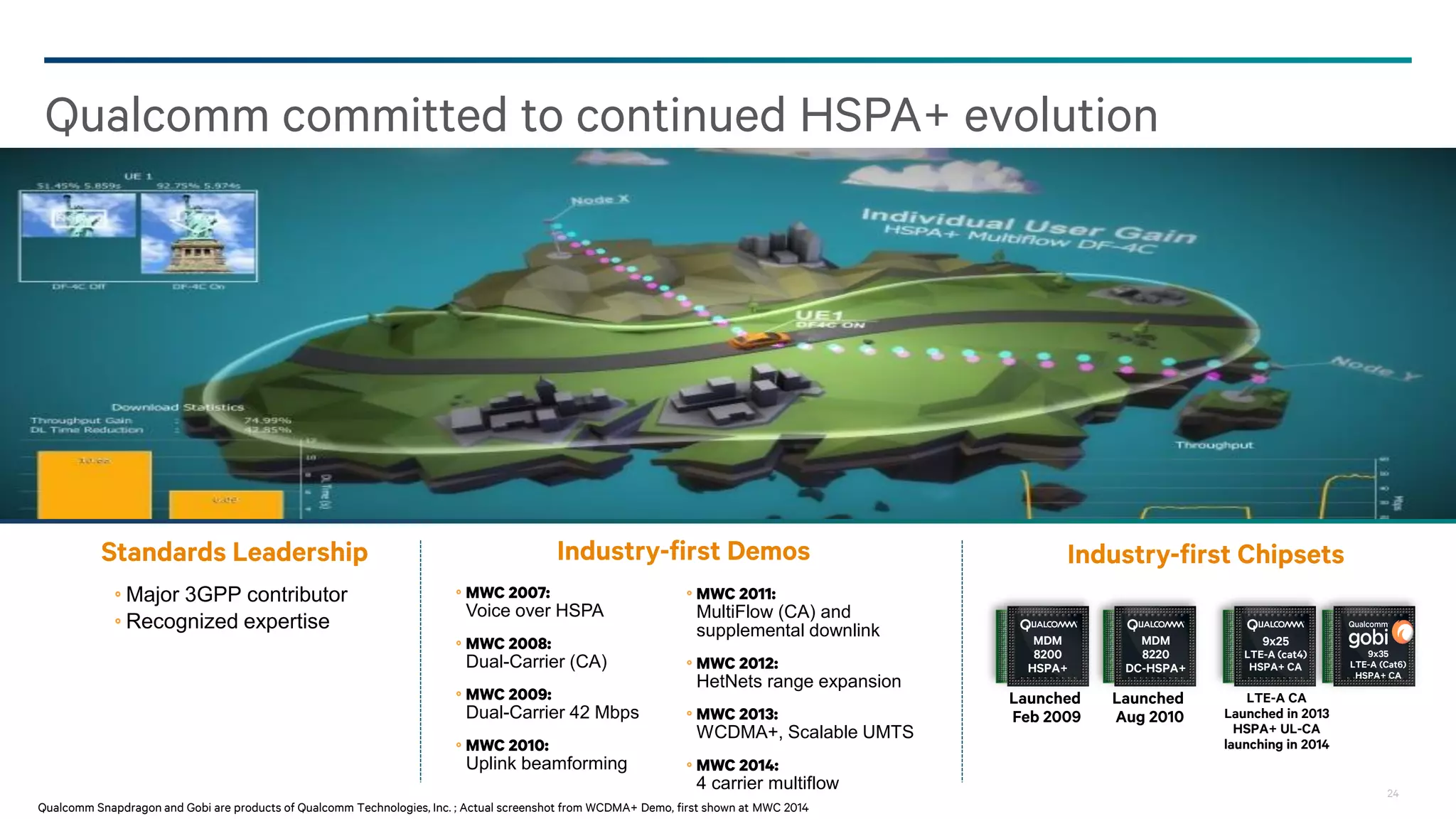
Qualcomm committed to continued HSPA+ evolution
Qualcomm Snapdragon and Gobi are products of Qualcomm Technologies, Inc. ; Actual screenshot from WCDMA+ Demo, first shown at MWC 2014
MWC 2008:
Dual-Carrier (CA)
MWC 2014:
4 carrier multiflow
MWC 2010:
Uplink beamforming
MWC 2012:
HetNets range
expansion
MWC 2007:
Voice over HSPA
MWC 2009:
Dual-Carrier 42 Mbps
MWC 2011:
MultiFlow (CA) and
supplemental downlink
MWC 2013:
WCDMA+
Industry-first Demos
Launched
Feb 2009
Launched
Aug 2010
LTE-A CA
Launched in 2013
HSPA+ UL-CA
launching in 2014
MDM
8200
HSPA+
MDM
8220
DC-HSPA+
9x25
LTE-A (cat4)
HSPA+ CA
9x35
LTE-A (Cat6)
HSPA+ CA
Industry-first Chipsets
Major 3GPP
contributor
Standards
Leadership
Recognized
expertise
26
Small cells with HSPA+ a key 1000x enabler
Cell range expansion possible today—more enhancements in the pipeline
Expanded chipset support for carrier aggregation
Going beyond today’s dual-carrier—aggregation across more carriers, bands, and uplink
WCDMA+ frees up capacity for HSPA+ data
More efficient voice frees-up resources for data
HSPA+ continues to evolve and support billions of users
Continued carrier aggregation evolution
Such as Multiflow—carrier aggregation across cells
1B
~2.5B
HSPA/HSPA+
MBB* connections
reached in 2012
HSPA/HSPA+
MBB* connections
end of 2016
1
2
3
4
Source: Wireless Intelligence (Jan ‘13) . 2,437 Billion HSPA family connections expected Q4 2016
27
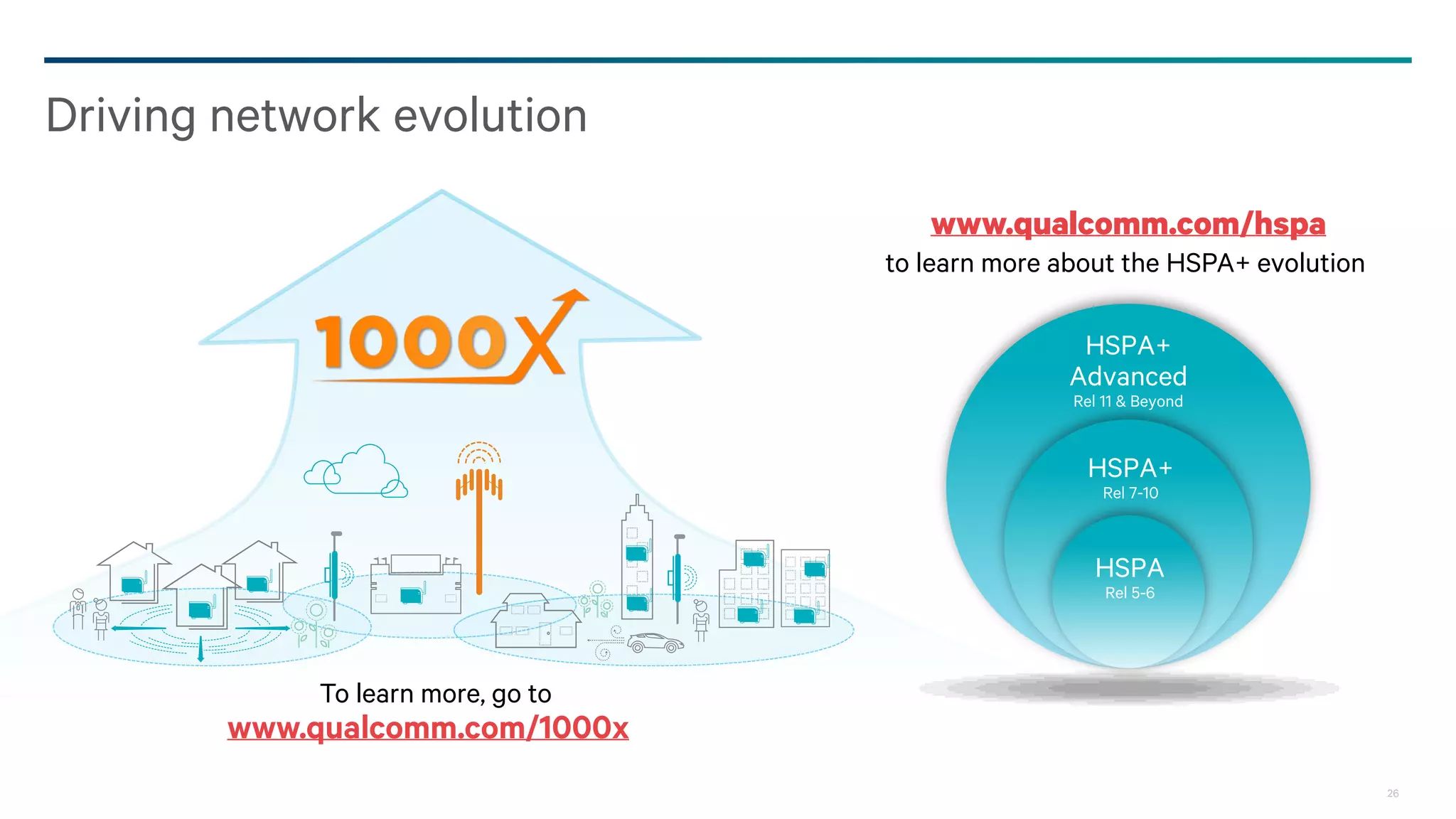
Pushing wireless boundaries
www.qualcomm.com/hspa
to learn more about the HSPA+ evolution
To learn more, go to
www.qualcomm.com/1000x
HSPA+
Rel 7-10
HSPA+
Advanced
Rel 11 & Beyond
HSPA
Rel 5-6
28
@Qualcomm_tech
http://www.qualcomm.com/blog/contributors/prakash-sangam
http://www.slideshare.net/qualcommwirelessevolution
http://storify.com/qualcomm_tech
http://www.youtube.com/playlist?list=PL8AD95E4F585237C1&feature=plcp
www.qualcomm.com/technology
Questions? - Connect with Us
BLOG
29
For more information on Qualcomm, visit us at:
www.qualcomm.com & www.qualcomm.com/blog
© 2013 QUALCOMM Incorporated and/or its subsidiaries. All Rights Reserved.
Qualcomm is a trademark of Qualcomm Incorporated, registered in the United States and other countries.
Other products and brand names may be trademarks or registered trademarks of their respective owners.
References in this presentation to “Qualcomm” may mean Qualcomm Incorporated, Qualcomm Technologies, Inc., and/or other subsidiaries or business
units within the Qualcomm corporate structure, as applicable.
Qualcomm Incorporated includes Qualcomm’s licensing business, QTL, and the vast majority of its patent portfolio. Qualcomm Technologies, Inc., a
wholly-owned subsidiary of Qualcomm Incorporated, operates, along with its subsidiaries, substantially all of Qualcomm’s engineering, research and
development functions, and substantially all of its product and services businesses, including its semiconductor business, QCT.
Thank you
Follow us on:

HSPA+: Building upon solid foundation

  • 1.
    1 HSPA+ Evolution: Building uponthe solid foundation May 2014
  • 2.
    2 Small cells withHSPA+ a key 1000x enabler Cell range expansion possible today—more enhancements in the pipeline Expanded chipset support for carrier aggregation Going beyond today’s dual-carrier—aggregation across more carriers, bands, and uplink WCDMA+ frees up capacity for HSPA+ data More efficient voice frees-up resources for data HSPA+ continues to evolve and support billions of users Continued carrier aggregation evolution Such as Multiflow—carrier aggregation across cells 1B ~2.5B HSPA/HSPA+ MBB* connections reached in 2012 HSPA/HSPA+ MBB* connections end of 2016 1 2 3 4 Source: Wireless Intelligence (Jan ‘13) . 2,437 Billion HSPA family connections expected Q4 2016
  • 3.
    3Source: www.gsacom.com ,Feb 2014 547HSPA NETWORKS IN 205COUNTRIES 363HSPA+ NETWORKS IN 157COUNTRIES 160DUAL-CARRIER NETWORKS IN 83COUNTRIES HSPA+: Building upon the solid global foundation
  • 4.
    4 2013 2014 20152016+2014 2015 2016 2017+ Strong HSPA+ Evolution Note: Estimated commercial dates. Rel-11Rel-10Rel-9Rel-8Rel-7 DL: 84 -168 Mbps2 UL: 23 Mbps2 DL: 21-28 Mbps UL: 11 Mbps DL: 42 Mbps1 UL: 11 Mbps DL: 14.4 Mbps UL: 5.7 Mbps DL: 168 -336 Mbps4 UL: 69 Mbps4 1R8 reaches 42 Mbps by combining 2x2 MIMO and HOM (64QAM) in 5 MHz, or by utilizing HOM (64QAM) and multicarrier in 10 MHz. 2R9 combines multicarrier and MIMO in 10 MHz to reach 84 Mbps. Uplink multicarrier doubles uplink peak data rate to 23 Mbps in 10 MHz. 3R10 expands multicarrier to 20 MHz to reach up to168 Mbps with 2x2 MIMO. 4R11 expands multicarrier up to 40 MHz to reach 336 Mbps with 2x2 MIMO, or 20Mhz with 4x4 MIMO. Uplink 2x2 MIMO with 64QAM reaches 69Mbps. Rel-12 and beyond Rel-12 Created 02/13/2014 Carrier aggregation (10 MHz dual-carrier) MultiFlow, 8x CA Smartphone enhancements Higher Order Modulation & MIMO HetNets enhancements, uplink enhancements WCDMA+, Wi-Fi integration HSPA+ AdvancedHSPA+HSPA WCDMA High Quality, Reliable, Ubiquitous Voice HSPA+ WCDMA+ Frees up resources for HSPA+ data Commercial 3x and 4x carrier Aggregation (CA) 2x Carrier agg. dual-band/uplink
  • 5.
    5 Mobile data trafficgrowth— industry preparing for 1000x 1000xdata traffic growth* Industry preparing for More devices everything connected Richer content more video Bestseller example: Cumulative smartphone forecast between 2013-20171 7~ Billion Movie (High Definition) 5.93 GB Movie (Standard Definition) 2.49 GB Homepage 0.0014 GB Game for Android 1.8 GB Soundtrack 0.14 GB Book 0.00091 GB Interconnected device forecast in 20202 25~ Billion 1Gartner, Mar’13 ; 2Machina Research/GSMA, Dec. ‘12 *1000x would be e.g. reached if mobile data traffic doubled ten times, but Qualcomm does not make predictions when 1000x will happen, Qualcomm and its subsidiaries work on the solutions to enable 1000x
  • 6.
    6 Small Cells Everywhere Accessto more spectrum Supplemental downlink (such as L-Band) Authorized Shared Access (ASA) Continue to evolve HSPA+ Carrier aggregation evolution and multiflow Smartphone signaling and IoE enhancements WCDMA+ to free up data Deploy more small cells Converged WCDMA/HSPA+, LTE and Wi-Fi HSPA+ small cell range expansion today Neighborhood small cells deployment model Small cells with HSPA+ a key 1000x enabler
  • 7.
    7 HSPA+ withRangeExpansion Possible With HSPA+Today ~3X 4 Small Cells + Range Expansion ~1.6X 4 Small Cells added 1X Macro, Dual-Carrier Median Gain1 For same amount of Spectrum 1 Gain in median downlink data rate, 4 small cells of pico type added per macro and 50 % of users dropped in clusters closer to picos (within 40m), Model PA3 full buffer ISD 500m. Enabling range expansion features: reduced power on second macro carrier, Dual-Carrier devices and mitigating uplink and downlink imbalance (3dB Cell-individual offset (CIO) and pico noise-figure pad) 1000x begins with HSPA+ optimizations available today —small cell range expansion can double capacity Small Cell
  • 8.
    8 Further HetNets enhancementsfor small cell densification 1 Such as relay and Pico/Metro/RRH small cells for hotspots. RRH= Remote Radio Heads, in addition Distributed Antenna Systems are used in HetNets TruSignalTM/Q-ICE advanced device receiver Interference cancellation provide even more gain Multiflow—balance load across cells Multiflow aggregates across cells (3GPP R11 and beyond) HetNets enhancements Interference mitigation and mobility enhancements (3GPP R12 and beyond) Note: Self-Organizing Networks (SON) techniques HetNets and are standardized already in R10, such as Minimization of Drive Tests (MDT) and Automatic Neighbor Relation (ANR) with continued enhancements in R11 and beyond HSPA+/LTE/Wi-Fi Converged small cells Tighter HSPA+ and Wi-Fi integration (3GPP R12 and beyond) User deployed 3G/4G Typically indoor small cells Operator deployed 3G/4G Indoor/outdoor small cells1 RESIDENTIAL ENTERPRISE METRO 4G Relays & Wireless Backhaul
  • 9.
    9 HSPA+ Dual-carrier ismain-stream Supporting 42 Mbps downlink peak data rate Deployment of 42 Mbps DC-HSPA+ technology continues as the major trend in 2014 – GSA, Mar 2014 160NETWORKS 83COUNTRIES Countries launched/committed to Dual-carrier Source: www.gsacom.com , Feb 2014
  • 10.
    10 Dual-carrier – Deliveringhigh data rates in real networks >5Mbps >50% Source: Signals Research Group Signals Ahead, September 2011, “The Mother of all Network Benchmark Tests” 0 – 0.25Mbps 8.6% 0.25 – 0.5Mbps 4.8% 0.5 – 1Mbps 8.1% 1 – 1.5Mbps 6.5% 1.5 – 2Mbps 4.6% 2 – 2.5Mbps 3.8% 2.5 – 5Mbps 11.4%5 – 7.5Mbps 9.9% 7.5 – 10Mbps 8.8% 10 – 12.5Mbps 8.7% 12.5 – 15Mbps 10.6% 15 – 20Mbps 14.1% >1Mbps ~80% USER DATA RATE OF THE TIME Based on comprehensive benchmarking tests conducted across two operators in greater Dallas area (Texas), covering more than 23 miles of driving, downloading nearly 7GB of data USER DATA RATE OF THE TIME
  • 11.
    11 63 Mbps in 2015 42Mbps Commercial 84 Mbps Future Carrier aggregation enhances user experience 2x CA Carrier 3 Carrier 2 Carrier 1 3x CA Carrier 4 4x CA Increased data rates for all users Leverages all spectrum assets Can double smartphone bursty data capacity2 Up to 20 MHz 2 For typical bursty applications and typical partial carrier load, carrier aggregation supports more bursty application users than individual single carriers.
  • 12.
    12 Expanded HSPA+ carrieraggregation support Aggregation of 3 downlink carriers uses HSPA+ assets more efficiently Uplink aggregation (2 carriers) improves user experience and increase network capacity for smartphone traffic Aggregation across bands (2 carriers) takes advantage of expanding HSPA+ footprint in new bands (e.g. 900 MHz) 800 LTE CA HSPA+ CA MDM 9x25 LTE CA (cat 4) HSPA+ CA Common platform for LTE and HSPA+ carrier aggregation 9x35 LTE CA (cat 6) HSPA+ CA Qualcomm Snapdragon and Gobi are products of Qualcomm Technologies, Inc. ; Snapdragon 800 includes 8974 Increased data rates for all users Leverages all spectrum assets Can double smartphone bursty data capacity2 2 For typical bursty applications and typical partial carrier load, carrier aggregation supports more bursty application users than individual single carriers.
  • 13.
    13 A history oftime-to-market and modem technology leadership 2008 2010 20122009 20112007200620052004 20142013 3 carrier downlink Uplink carrier aggregation Across two bands First HSDPA DL: 1.8 Mbps UL: 384 kbps MSM 6275 First HSUPA DL 7.2 Mbps UL 5.76 Mbps First HSPA+ DL 28 Mbps UL 5.76 Mbps MDM 8200 MDM 8220 First DC-HSPA+ DL 42 Mbps First DC-HSPA+ Smartphone Platform DL 42 Mbps MSM 8960 Continued HSPA+ carrier aggregation leadership* MSM 7200 9x25 * 9x25 - LTE-A CA was launched in 2013, HSPA+ UL-CA expected to launch in 2014; HSPA+ DL 3-carrier CA supported but not yet launched Qualcomm Snapdragon and Gobi are products of Qualcomm Technologies, Inc.
  • 14.
    14 HSPA+ Rel 7-10 HSPA+ Advanced Rel 11& Beyond HSPA Rel 5-6 Maximizing HSPA+ performance* HSPA+ is the baseline 100% of operators have upgraded to HSPA Multiflow and further carrier aggregation evolution HetNets Optimizations Smartphone/IoE Enhancements Continued HSPA+ evolution * Rel. 12 also includes features such as F-EUL that further increases the capacity, coverage and user experience, eBCH to make overhead channels more efficient, and IncMon that increases the number of carriers devices monitors for even better handoffs and cell reselection between HSPA+ carriers as well as with LTE
  • 15.
    15 11 Mbps Continued CarrierAggregation (CA) evolution 21-28 Mbps 42Mbps 42-84 Mbps 2x CA (10MHz) or 2x2 MIMO+64QAM (5MHz) HOM (64 QAM) or 2x2 MIMO (5MHz) Up to 4x CA (20MHz) +2x2 MIMO for 168Mbps 2x CA (10MHz) +2x2 MIMO for 84Mbps 34 - 69 Mbps UL 64 QAM + 2x2 MIMO for 69Mbos Uplink Beamforming Uplink 2x CA (10MHz) 23 Mbps 84-168 Mbps Downlink Speed Uplink Speed Up to 8x CA (40 MHz) +2x2 MIMO for 336Mbps Multiflow - CA across cells Non-contiguous band CA (4 carriers) Uplink HOM (16 QAM) Carrier aggregation evolution R12 and beyond Additional CA combinations defined (up to 4x) Performance definition for supplemental downlink R7 R8 R9 R10 R11 R12 and beyond Multiflow
  • 16.
    16 HSPA+ Carrier aggregationexpanding reach Leveraging all spectrum assets Across Bands HIGH BAND (e.g Band I & II) LOW BAND (e.g Band V, VII & VIII) PAIRED SPECTRUM UNPAIRED SPECTRUMUplink More Carriers DUAL-CARRIER NOW & COUNTING4 Aggregated Data Pipe AGGREGATION ACROSS CELLS5 Multiflow Supplemental Downlink ULDL DL   3GPP continually defines new band combinations 1-3 carriers in the high band, and 1-2 in the low band2 1Defined in Rel 9; 2 Defined in Rel 9, more carriers and combinations added in Rel 11; 3Defined in Rel 9, band combinations being defined by 3GPP; 4Dual-carrier in Rel 8, 4-carriers in Rel 10, and 8-carriers in Rel11; 5Defined in Rel 11 Combining unpaired spectrum with the downlink 3 DUAL-CARRIER IN THE UPLINK1
  • 17.
    17 Multiflow - carrieraggregation across cells Enabling carrier aggregation in all deployments Bringing benefits of dual-carrier to single–frequency deployments Higher cell-edge data rates Higher network capacityBetter network load balancing Bringing benefits of carrier aggregation to multi-frequency deployments1 1With the evolution to supporting 4 carrier aggregation, multiflow can aggregate up to 3 carriers from one site/cell and one carrier from the other cells in the future
  • 18.
    18 Further HetNets enhancement—multiflowand more Further range expansion— even better small cell offload Mitigate up/downlink imbalances—such as extended range/reconfiguring of power offsets and further enhanced advanced receivers Note: All these are 3GPP R12 study items. In addition, Self-Organizing Networks (SON) techniques and are standardized in R10, such as Minimization of Drive Tests (MDT) and Automatic Neighbor Relation (ANR) with continued enhancements in R11 and beyond Further range expansion— even better small cell offload Mitigate up/downlink imbalances—such as extended range/reconfiguring of power offsets and further enhanced advanced receivers Multiflow optimizations to balance load across cells Such as mobility support to switch from dual-carrier to multiflow in the region where up/downlink are imbalanced Mobility enhancements between small cell & macro Such as further enhanced serving cell change procedures, and extended neighbor list measurements Dual-carrier Devices Range Expansion Carrier 2 Carrier 1 Macro Small cell Reduce second carrier Macro Power (F2)
  • 19.
    19 HSPA+ continues toaccommodate smartphone growth 1R7/R8 allows small amounts of data to be efficiently transported in CELL-FACH state: up to 90% reduction in network signaling load due for social media example. 2Cell-DCH w/ R7 CPC allows non full buffer apps to use connected mode, DCH, more efficiently (DTX/DRX). 3A main enhancements is downlink triggered feedback (CQI) and acknowledgements on the FACH reverse link, which makes FACH efficient like a regular HSPA link, see simulation assumptions in R1-112679 Another capacity over HSPA+ Up to 90% reduced signaling load over HSPA HSPA+ Advanced R11 FE-FACH3 Commercial HSPA+ R7/R8 CELL-FACH1 Small data bursts Further extended battery life Extended battery life over HSPA2 Non full-buffer applications Skype Pandora
  • 20.
    20 HSPA+ enhancements forInternet of everything Further 3GPP R12/R13* enhancements such as: Very long DRX Cycle - days Fast return to Idle State Reduced measurements Reduced signaling Low data rate • Small data size • Infrequent transmissions/receptions • Limited power source Significantly increased battery life Increased capacity *Extended sleep period (aka Power Saving mode (PSM) is part of R12, all others are potential candidates for Rel 13 Extended sleep period
  • 21.
    21 WCDMA+ frees upcapacity for HSPA+ data More efficient voice frees-up resources for data
  • 22.
    22 WCDMA+ can freeup ~2/3 of a carrier for data HSPA relies on WCDMA for voice, tripled voice efficiency means more resources left for data WCDMA (5MHz Carrier) WCDMA+ (5MHz Carrier) ENHANCED CIRCUIT SWITCHED VOICE2 WCDMA+ Voice FREED-UP FOR DATA (UP TO ~2/3 OF A 5 MHZ CARRIER FREED-UP)SAME VOICE CAPACITY USING A THIRD OF RESOURCES WCDMA Voice1 HSPA/ HSPA+ Data (UL/DL) 1 There is ~10% DL data capacity available at max voice capacity not shown in the graph for WCDMA .Assumptions: single receive antenna and rake receiver assumed for voice, dual receive diversity assumed for data. . 2 WCDMA+ is a 3GPP R12 feature
  • 23.
    23 WCDMA+ ensures highquality, reliable, ubiquitous voice Extended Talk-Time2 ~30% reduced modem current consumption Simultaneous Voice and HSPA+ Data Global Roaming in Global Bands Leverages Existing Investments Builds on Proven WCDMA Voice1 Proven Robustness with Soft-Handover 1 High quality, thanks to soft handover, proven interoperability and 10+ years of WCDMA circuit switched voice optimizations. 2 Modem current consumption reduced by ~30% with WCDMA+ compared to WCDMA.
  • 24.
    24 Circuit switched voicehas a long life during the transition to richer, carrier grade VoIP WCDMA+: Long life of HSPA+ means long life of WCDMA VoLTE Timing is Operator Specific VoIP over HSPA+ Driven by VoLTE Proven Circuit Voice: High Quality, Reliable, Ubiquitous1 IMS VoIP: Rich Voice – Ubiquity vs. OTT VoIP Fallback to 2G/3G voice (CSFB) used by most LTE operators while the VoLTE with SRVCC ecosystem is being developed and expanded 1 Thanks to soft handover, proven interoperability and 10+ years of 1X/WCDMA optimizations. OTT=Over-The-Top, voice just like any data service without Quality of Service 2014 2020+
  • 25.
    25 Qualcomm committed tocontinued HSPA+ evolution Qualcomm Snapdragon and Gobi are products of Qualcomm Technologies, Inc. ; Actual screenshot from WCDMA+ Demo, first shown at MWC 2014 MWC 2008: Dual-Carrier (CA) MWC 2014: 4 carrier multiflow MWC 2010: Uplink beamforming MWC 2012: HetNets range expansion MWC 2007: Voice over HSPA MWC 2009: Dual-Carrier 42 Mbps MWC 2011: MultiFlow (CA) and supplemental downlink MWC 2013: WCDMA+ Industry-first Demos Launched Feb 2009 Launched Aug 2010 LTE-A CA Launched in 2013 HSPA+ UL-CA launching in 2014 MDM 8200 HSPA+ MDM 8220 DC-HSPA+ 9x25 LTE-A (cat4) HSPA+ CA 9x35 LTE-A (Cat6) HSPA+ CA Industry-first Chipsets Major 3GPP contributor Standards Leadership Recognized expertise
  • 26.
    26 Small cells withHSPA+ a key 1000x enabler Cell range expansion possible today—more enhancements in the pipeline Expanded chipset support for carrier aggregation Going beyond today’s dual-carrier—aggregation across more carriers, bands, and uplink WCDMA+ frees up capacity for HSPA+ data More efficient voice frees-up resources for data HSPA+ continues to evolve and support billions of users Continued carrier aggregation evolution Such as Multiflow—carrier aggregation across cells 1B ~2.5B HSPA/HSPA+ MBB* connections reached in 2012 HSPA/HSPA+ MBB* connections end of 2016 1 2 3 4 Source: Wireless Intelligence (Jan ‘13) . 2,437 Billion HSPA family connections expected Q4 2016
  • 27.
    27 Pushing wireless boundaries www.qualcomm.com/hspa tolearn more about the HSPA+ evolution To learn more, go to www.qualcomm.com/1000x HSPA+ Rel 7-10 HSPA+ Advanced Rel 11 & Beyond HSPA Rel 5-6
  • 28.
  • 29.
    29 For more informationon Qualcomm, visit us at: www.qualcomm.com & www.qualcomm.com/blog © 2013 QUALCOMM Incorporated and/or its subsidiaries. All Rights Reserved. Qualcomm is a trademark of Qualcomm Incorporated, registered in the United States and other countries. Other products and brand names may be trademarks or registered trademarks of their respective owners. References in this presentation to “Qualcomm” may mean Qualcomm Incorporated, Qualcomm Technologies, Inc., and/or other subsidiaries or business units within the Qualcomm corporate structure, as applicable. Qualcomm Incorporated includes Qualcomm’s licensing business, QTL, and the vast majority of its patent portfolio. Qualcomm Technologies, Inc., a wholly-owned subsidiary of Qualcomm Incorporated, operates, along with its subsidiaries, substantially all of Qualcomm’s engineering, research and development functions, and substantially all of its product and services businesses, including its semiconductor business, QCT. Thank you Follow us on: