Creating a Sustainable Economic Engine
WASTE-TO-ENERGY
THE PROBLEM
Large and growing volumes of municipal solid waste (MSW), sewage, and wastewater
are produced in communities every day, filling landfills and wastewater treatment plants
(WWTPs). As time passes and populations increase, these large, traditional, chemically toxic
landfills and WWTPs, whose design and construction has not changed significantly over the
past 80 years, are exceeding capacity and significantly polluting our environment. A paradigm
shift in the process for the next 100 years has emerged through utilization of new and existing
technologies.
THE RECOMMENDATION
A better way to treat solid waste and wastewater is via robust technologies such as the Clark-
CWTI-Evergreen Integrated Waste-to-Energy Conversion System (IWECS). IWECS provides an
efficient means of reducing the volume of municipal solid wastes (MSW) and sewage. The
wastes are converted into valuable products and by-products such as biogas or green electric
power, organic fertilizer, and clean water.
By following IWECS process conversion, waste storage issues and associated air and water
pollution are significantly reduced. In addition, the significant capital and operating costs
associated with the construction and operation of traditional landfills and wastewater
treatment plants are significantly reduced.
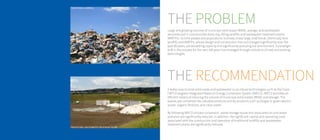
TRADITIONAL WASTEWATER TREATMENT PLANT
TRADITIONAL LANDFILL
THE SOLUTION
The Integrated Waste-to-Energy Conversion System is the gift that keeps on giving,
thanks to the valuable by-products it produces:
Biogas and electricity. Converting most of an organic waste stream into
methane-rich biogas is completed through a patented and robust process, which
happens to be the most efficient biocatalytic process available in the world today.
Fertilizer. The NPK-specific organic fertilizer by-product of IWECS is of a higher
quality than any of today’s fertilizers; it is renewable and highly bioavailable,
unlike commercial fertilizers, yet is almost odorless and high in nutrient content,
unlike most organic fertilizer products.
Diesel Fuel. Many of the plastics and tires that are sorted from the MSW can be
converted back into a valuable No. 2 diesel fuel. This fuel, which is not biodiesel,
can be used to run most diesel engines.
Clean Water. In addition to converting food and agricultural wastes, MSW, and
sewage into valuable “green” energy products, organic fertilizer, and recovering
clean water, the IWECS also mitigates pollution caused by the gaseous emissions
and liquid leakage from landfills and other MSW containment sites. Each plant’s
streamlined design mimics the efficient and patented anaerobic biocatalytic
digestion process that makes IWECS work.
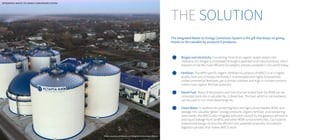
INTEGRATED WASTE-TO-ENERGY CONVERSION SYSTEM
Photo Courtesy of Adverio, an Evergreen Consortium Partner
PAPER
WOOD
FOOD WASTE
OTHER
OTHER GLASS
END USER
COLORED GLASS
END USER
CLEAR GLASS
END USER
FERROUS
END USER
ALUMINUM
END USER
TO LANDFILL
HAZARDOUS WASTE
LANDFILL
END USER
PYROLYSIS Green-DIESEL
OR
MSW
MUNICIPAL
SOLID
WASTE
RECYCLING/SORTING
HAZARDOUS
WASTE
PLASTIC
CLEAR GLASS
END USER
FERROUS
END USER
ALUMINUM
END USER
HAZARDOUS WASTE
LANDFILL
END USER
PYROLYSIS Green-DIESEL
OR
HAZARDOUS
WASTE
PLASTIC METAL GLASS
NON-RECYCLABLE
MATERIAL
SOLID ORGANIC
WASTE
CWTI-
EVERGREEN
SYSTEM
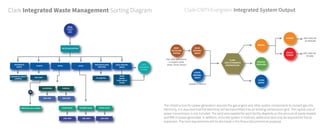
Clark Integrated Waste Management Sorting Diagram
The infrastructure for power generation requires the gas engine and other system components to convert gas into
electricity. It is assumed that the electricity will be transmitted into an existing transmission grid. The capital cost of
power transmission is not included. The land area needed for each facility depends on the amount of waste treated
and MW of power generated. In addition, since the system is modular, additional land may be acquired for future
expansion. The land requirements will be disclosed in the financial/commercial proposal.
MSW
RECYCLING
SYSTEM
SOLID
ORGANIC
WASTE
LIQUID
ORGANIC
WASTE
CLARK
CWTI-EVERGREEN
SYSTEM/PLANT
BIOGAS
ORGANIC
FERTILIZER
CLEAN
WATER
GREEN
POWER
Any other agricultural
or organic waste
(trees, brush, leaves)
Sewage or manure
END USER OR
TO PIPELINE
END USER OR
TO GRID
BIOGAS
Clark-CWTI-Evergreen Integrated System Output
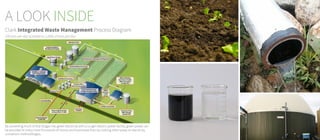
By converting much of that biogas into green electricity with a co-gen electric power facility, green power can
be provided to many more thousands of homes and businesses than by utilizing other waste-to-electricity
conversion methodologies.
Liquid Waste Storage
Underground or Aboveground Digester
Control Building
Solid Waste Collection
and Sorting Facility
Hydrolysis Tanks
Power Generation and
Fertilizer Storage Facility
Biogas
Recovery
15 MW
of Heat
Effluent Building
Industrial or Potable
Water Processing
310,000 GPD
Power to Electrical Grid
or Power Plant (17 MW)
Temporary Clean
Water Storage
250,000 GPD
Fertilizer Concentrate
Solid/Liquid Waste
Blending and Staging
Combined Waste Processing
8 - 12%
Solid
792,000 GPD
Sample Input and
Output: 554 Tons MSW
36-45 Tons
Fertilizer
Diesel Production
14,000 GPD
Pyrolysis Plant -
Diesel Fuel Generation
Solid Waste Processing
Plastics & Tires
A LOOK INSIDE
Clark Integrated Waste Management Process Diagram
100 tons per day scalable to 1,000s of tons per day
TRADITIONAL WASTEWATER TREATMENT PLANT
Expand Environmental Stewardship
Stop the “Use and Dump” Doctrine
Build a Value Engine
Transform Waste from Liability to Asset
Become a Net Energy Producer
Add Value and Improve Efficiencies
Optimize Processes
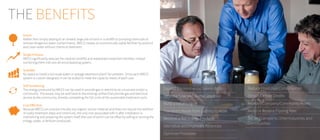
THE BENEFITS
Green.
Rather than simply adding to an already large pile of trash in a landfill or pumping chemicals to
remove dangerous water contaminants, IWECS creates an economically viable fertilizer by-product
and clean water without chemical treatment.
Single Process.
IWECS significantly reduces the need for landfills and wastewater treatment facilities, instead
combining them into one all-encompassing system.
Scalable.
No space to install a full-scale water or sewage treatment plant? No problem. Since each IWECS
system is custom designed, it can be scaled to meet the capacity needs of each user.
Self-Sustaining.
The energy produced by IWECS can be used to provide gas or electricity to a business and/or a
community. The excess may be sold back to the existing utilities that provide gas and electrical
service to the community, thereby completing the full circle of the sustainable treatment cycle.
Cost Effective.
Because IWECS can process virtually any organic source material and does not require the addition
of costly treatment steps and chemicals, the only cost associated with it after installation is
maintaining and powering the system itself (the cost of which can be offset by selling or reusing the
energy, water, or fertilizer produced).
Reduce Fossil Fuel Consumption
Obtain Carbon Credits
Improve Company/Community Assets
Avoid or Reduce Tipping Fees
Set an Example to Other Industries and
Communities
clark-technology.com | 763.545.9196
©2016 Clark Engineering + CWTI Evergreen | Proprietary and Confidential

Integrated Waste-to-Energy Conversion System

  • 1.
    Creating a SustainableEconomic Engine WASTE-TO-ENERGY
  • 2.
    THE PROBLEM Large andgrowing volumes of municipal solid waste (MSW), sewage, and wastewater are produced in communities every day, filling landfills and wastewater treatment plants (WWTPs). As time passes and populations increase, these large, traditional, chemically toxic landfills and WWTPs, whose design and construction has not changed significantly over the past 80 years, are exceeding capacity and significantly polluting our environment. A paradigm shift in the process for the next 100 years has emerged through utilization of new and existing technologies. THE RECOMMENDATION A better way to treat solid waste and wastewater is via robust technologies such as the Clark- CWTI-Evergreen Integrated Waste-to-Energy Conversion System (IWECS). IWECS provides an efficient means of reducing the volume of municipal solid wastes (MSW) and sewage. The wastes are converted into valuable products and by-products such as biogas or green electric power, organic fertilizer, and clean water. By following IWECS process conversion, waste storage issues and associated air and water pollution are significantly reduced. In addition, the significant capital and operating costs associated with the construction and operation of traditional landfills and wastewater treatment plants are significantly reduced. TRADITIONAL WASTEWATER TREATMENT PLANT TRADITIONAL LANDFILL
  • 3.
    THE SOLUTION The IntegratedWaste-to-Energy Conversion System is the gift that keeps on giving, thanks to the valuable by-products it produces: Biogas and electricity. Converting most of an organic waste stream into methane-rich biogas is completed through a patented and robust process, which happens to be the most efficient biocatalytic process available in the world today. Fertilizer. The NPK-specific organic fertilizer by-product of IWECS is of a higher quality than any of today’s fertilizers; it is renewable and highly bioavailable, unlike commercial fertilizers, yet is almost odorless and high in nutrient content, unlike most organic fertilizer products. Diesel Fuel. Many of the plastics and tires that are sorted from the MSW can be converted back into a valuable No. 2 diesel fuel. This fuel, which is not biodiesel, can be used to run most diesel engines. Clean Water. In addition to converting food and agricultural wastes, MSW, and sewage into valuable “green” energy products, organic fertilizer, and recovering clean water, the IWECS also mitigates pollution caused by the gaseous emissions and liquid leakage from landfills and other MSW containment sites. Each plant’s streamlined design mimics the efficient and patented anaerobic biocatalytic digestion process that makes IWECS work. INTEGRATED WASTE-TO-ENERGY CONVERSION SYSTEM Photo Courtesy of Adverio, an Evergreen Consortium Partner
  • 4.
    PAPER WOOD FOOD WASTE OTHER OTHER GLASS ENDUSER COLORED GLASS END USER CLEAR GLASS END USER FERROUS END USER ALUMINUM END USER TO LANDFILL HAZARDOUS WASTE LANDFILL END USER PYROLYSIS Green-DIESEL OR MSW MUNICIPAL SOLID WASTE RECYCLING/SORTING HAZARDOUS WASTE PLASTIC CLEAR GLASS END USER FERROUS END USER ALUMINUM END USER HAZARDOUS WASTE LANDFILL END USER PYROLYSIS Green-DIESEL OR HAZARDOUS WASTE PLASTIC METAL GLASS NON-RECYCLABLE MATERIAL SOLID ORGANIC WASTE CWTI- EVERGREEN SYSTEM Clark Integrated Waste Management Sorting Diagram The infrastructure for power generation requires the gas engine and other system components to convert gas into electricity. It is assumed that the electricity will be transmitted into an existing transmission grid. The capital cost of power transmission is not included. The land area needed for each facility depends on the amount of waste treated and MW of power generated. In addition, since the system is modular, additional land may be acquired for future expansion. The land requirements will be disclosed in the financial/commercial proposal. MSW RECYCLING SYSTEM SOLID ORGANIC WASTE LIQUID ORGANIC WASTE CLARK CWTI-EVERGREEN SYSTEM/PLANT BIOGAS ORGANIC FERTILIZER CLEAN WATER GREEN POWER Any other agricultural or organic waste (trees, brush, leaves) Sewage or manure END USER OR TO PIPELINE END USER OR TO GRID BIOGAS Clark-CWTI-Evergreen Integrated System Output
  • 5.
    By converting muchof that biogas into green electricity with a co-gen electric power facility, green power can be provided to many more thousands of homes and businesses than by utilizing other waste-to-electricity conversion methodologies. Liquid Waste Storage Underground or Aboveground Digester Control Building Solid Waste Collection and Sorting Facility Hydrolysis Tanks Power Generation and Fertilizer Storage Facility Biogas Recovery 15 MW of Heat Effluent Building Industrial or Potable Water Processing 310,000 GPD Power to Electrical Grid or Power Plant (17 MW) Temporary Clean Water Storage 250,000 GPD Fertilizer Concentrate Solid/Liquid Waste Blending and Staging Combined Waste Processing 8 - 12% Solid 792,000 GPD Sample Input and Output: 554 Tons MSW 36-45 Tons Fertilizer Diesel Production 14,000 GPD Pyrolysis Plant - Diesel Fuel Generation Solid Waste Processing Plastics & Tires A LOOK INSIDE Clark Integrated Waste Management Process Diagram 100 tons per day scalable to 1,000s of tons per day TRADITIONAL WASTEWATER TREATMENT PLANT
  • 6.
    Expand Environmental Stewardship Stopthe “Use and Dump” Doctrine Build a Value Engine Transform Waste from Liability to Asset Become a Net Energy Producer Add Value and Improve Efficiencies Optimize Processes THE BENEFITS Green. Rather than simply adding to an already large pile of trash in a landfill or pumping chemicals to remove dangerous water contaminants, IWECS creates an economically viable fertilizer by-product and clean water without chemical treatment. Single Process. IWECS significantly reduces the need for landfills and wastewater treatment facilities, instead combining them into one all-encompassing system. Scalable. No space to install a full-scale water or sewage treatment plant? No problem. Since each IWECS system is custom designed, it can be scaled to meet the capacity needs of each user. Self-Sustaining. The energy produced by IWECS can be used to provide gas or electricity to a business and/or a community. The excess may be sold back to the existing utilities that provide gas and electrical service to the community, thereby completing the full circle of the sustainable treatment cycle. Cost Effective. Because IWECS can process virtually any organic source material and does not require the addition of costly treatment steps and chemicals, the only cost associated with it after installation is maintaining and powering the system itself (the cost of which can be offset by selling or reusing the energy, water, or fertilizer produced). Reduce Fossil Fuel Consumption Obtain Carbon Credits Improve Company/Community Assets Avoid or Reduce Tipping Fees Set an Example to Other Industries and Communities
  • 7.
    clark-technology.com | 763.545.9196 ©2016Clark Engineering + CWTI Evergreen | Proprietary and Confidential