Cardiovascular System
Presented by:
Prof. Mukul Sharma
Medi-Caps University, Indore (M.P.)
Introduction of Heart
The cardiovascular system can be thought of as the transport
system of the body. The heart is the system’s pump and the
blood vessels are like the delivery routes. Blood can be
thought of as a fluid which contains the oxygen and nutrients
the body needs and carries the wastes which need to be
removed.
Three main components:
1. Heart
2. Blood vessel
3. Blood
Prof. Mukul Sharma Medi-Caps University, Indore
2
Prof. Mukul Sharma Medi-Caps University, Indore
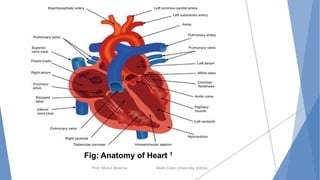
Fig: Anatomy of Heart 1
3
Anatomy of Heart
1. Chambers (4) : 2 small chambers located superiorly, called the left and right
atrium and 2 larger chambers located inferiorly called the left and right
ventricle.
 The left ventricle is larger than the right as it has to pump blood to the majority
of the body, whereas the right ventricle pumps blood into the lungs. The atria
and ventricles are separated from one another by the interatrial septum and the
interventricular septum respectively.
2. Valves : The heart also has four valves. The tricuspid and mitral valves, known as
the atrioventricular valves as they sit between the atria and ventricles allowing
access for blood to pass from the atria to the ventricles.
 The other two valves are the aortic and pulmonary valves, and are referred to as
the semilunar valves which lead to the aorta and the pulmonary artery.
Prof. Mukul Sharma Medi-Caps University, Indore 4
 The principle purpose of the valves is to prevent regurgitation of
blood from the ventricles back into the atria. The valves open when
the pressure in the chamber filled with blood exceeds the pressure
in the area past the valve.
 The valves have flaps that are sometimes referred to as leaflets or
cusps. The tricuspid valve has three such flaps or cusps. The mitral
valve is also referred to as the bicuspid valve and has two cusps.
3. Chordae Tendineae: The chordae tendineae are fibrous tendon
like cords that connect to the tricuspid valve in the right ventricle
and the mitral valve in the left ventricle.
 When the valves close the chordae tendineae prevent the cusps
from swinging upwards into the atrial cavity.
Prof. Mukul Sharma Medi-Caps
University, Indore
5
Anatomy of Heart
4. Fossa Ovalis: It is the remains of what was once a hole (foramen) that
existed between the left atrium and the right atrium, located in the atrial
septum. This hole allows blood to bypass the lungs in a developing fetus
when fetal oxygen supply is provided via the placenta, as the fetal lungs are
undeveloped.
5. Trabeculae Carneae
These are muscular columns of irregular shape that exist in both ventricles.
In the left ventricle they are smooth and fine when compared to those in
the right ventricle. It is believed that the function of the trabeculae
carneae is to prevent suction that could impair the pumping action of the
ventricles that could otherwise occur if the ventricles were smooth. When
the trabeculae carneae contract they inturn pull on the chordae tendineae.
Prof. Mukul Sharma Medi-Caps
University, Indore
6
Anatomy of Heart
6. Papillary Muscle: A type of trabeculae carneae that are connected to ventricular
surface at one end and at the other to the chordae tendineae.
7. Coronary Sinus:The coronary sinus allows the cardiac veins carrying
deoxygenated blood to drain into the right atrium.
8. The Great Vessels: Incorporate the vena cava, pulmonary artery/veins and the
aorta. In the rest of the body oxygenated blood is found in arteries and
deoxygenated blood in the veins.
This general rule does not apply to the heart, which sometimes causes
confusion. The pulmonary artery carries deoxygenated blood into the lungs and
the pulmonary veins carry the resulting oxygenated blood into the left atrium.
The aorta trifurcates into three other branches; brachiocephalic, left common
carotid and left subclavian arteries which supply the upper portion of the body
with blood.
Prof. Mukul Sharma Medi-Caps University, Indore
7
Anatomy of Heart
• The descending aorta bifurcates into the common iliac arteries supplying
the legs with blood.
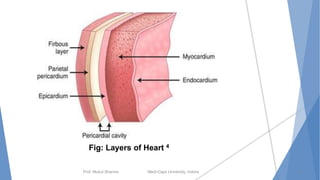
9. Heart Wall: It is made up of several layers. The innermost layer is the
endocardium, followed by the thicker myocardium that makes up the
cardiac muscle and consists of cardiomyocytes, which are cardiac muscle
cells. The outer layer of the heart wall is known as the epicardium. Directly
following the epicardium is a gap called the pericardial cavity that
separates the heart from the pericardium. The pericardial cavity contains
pericardial (serous) fluid. The pericardium is a protective membrane that
covers the heart and also envelops the roots of the great cardiac vessels.
The principle functions of the pericardium are to anchor the heart in place
preventing excess movement, act as a barrier to protect the heart from
internal infection from other organs and to lubricate the heart.
Prof. Mukul Sharma Medi-Caps University, Indore 8
Prof. Mukul Sharma Medi-Caps University, Indore
Fig: Layers of Heart 4
9
Anatomy of Heart
10. Coronary Arteries: In addition to the heart pumping blood to
the rest of the body, the heart itself requires its own blood supply
in order to function as an organ. As blood is pumped via the aorta
to the rest of the body, it also passes into the coronary arteries that
are located at the aortic root.
There are two main coronary arteries, called the left and right
coronary arteries respectively. The left coronary artery bifurcates
into the circumflex and left anterior descending arteries.
Deoxygenated blood is returned to the right ventricle by coronary
veins via the coronary sinus.
Prof. Mukul Sharma Medi-Caps University, Indore 10
Blood circulation
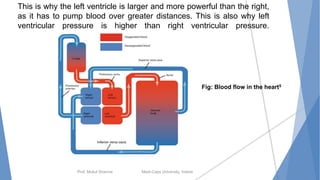
• Deoxygenated blood is emptied into the right atrium via the vena cava. The
inferior vena cava returns blood from the lower portion of the body as the
superior vena cava returns blood from the higher portion.
• Blood is then pumped through the tricuspid valve into the right ventricle and
into the lungs via the pulmonary artery where it is oxygenated. Oxygenated
blood then returns from the lungs into the left atrium where it can be pumped to
the rest of the body by the left ventricle, via the aorta.
• The circulatory system has two divisions; the systemic and pulmonary circulatory
system.
• The pulmonary system is responsible for circulating blood from the right
ventricle to the lungs and back into the left atrium.
• The systemic system as the name implies pumps blood via the aorta to every
other part of the body.
Prof. Mukul Sharma Medi-Caps University, Indore 11
Prof. Mukul Sharma Medi-Caps University, Indore
This is why the left ventricle is larger and more powerful than the right,
as it has to pump blood over greater distances. This is also why left
ventricular pressure is higher than right ventricular pressure.
12
Fig: Blood flow in the heart5
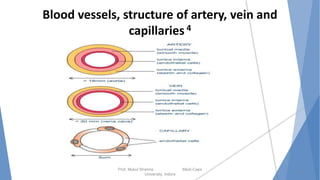
Blood vessels, structure of artery, vein and
capillaries 4
Prof. Mukul Sharma Medi-Caps
University, Indore
13
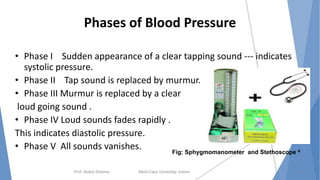
Phases of Blood Pressure
• Phase I Sudden appearance of a clear tapping sound --- indicates
systolic pressure.
• Phase II Tap sound is replaced by murmur.
• Phase III Murmur is replaced by a clear
loud going sound .
• Phase IV Loud sounds fades rapidly .
This indicates diastolic pressure.
• Phase V All sounds vanishes.
Prof. Mukul Sharma Medi-Caps University, Indore 14
Fig: Sphygmomanometer and Stethoscope 4
Pulse
• Pulse: Expansion and elongation of the arterial walls passively produced by
the pressure changes during systole (Contraction) and diastole (Relaxation)
of Ventricles.
• Significance:
1. Finding of condition of heart and Condition of arteries.
2. Extent of Blood pressure.
New born babies: 140 beats/ min
Five Year children: 100 beats/ min
Adult: 60-80 beats/min
Increased pulse rate above the normal values is called Tachycardia while
decreased pulse rate is called bradycardia.
Prof. Mukul Sharma Medi-Caps University, Indore 15
Cardiac output, cardiac cycle.
• Cardiac output (CO) is the volume of blood pumped by the left
ventricle (or right ventricle) per minute. CO pumped by the RV is
also called the pulmonary blood flow. The volume of blood
pumped per beat is called the stroke volume (SV).
CO=Stroke Volume×Heart Rate
CO=SV×HR
where HR = heart rate.
• The output of the two ventricles is essentially equal over a period
of time (minutes), whereas the SV for any one beat can be
Prof. Mukul Sharma Medi-Caps University, Indore 16
Cardiac Cycle
• The cardiac cycle is the performance of the human heart from
the ending of one heartbeat to the beginning of the next. It
consists of two periods: one during which the heart muscle
relaxes and refills with blood, called diastole, following a
period of robust contraction and pumping of blood, dubbed
systole.
Prof. Mukul Sharma Medi-Caps University, Indore 17
Regulation by Autonomic Nervous System,
• The cardiac cycle is the performance of the human heart from
the ending of one heartbeat to the beginning of the next. It
consists of two periods: one during which the heart muscle
relaxes and refills with blood, called diastole, following a
period of robust contraction and pumping of blood, dubbed
systole.
Prof. Mukul Sharma Medi-Caps
University, Indore
18
Elements of conduction system of heart and
heartbeat
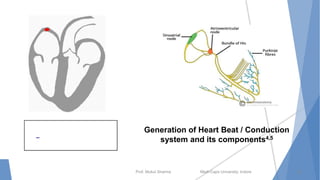
This group of muscle cells is called the cardiac conduction system.
The main parts of the system are
1. SA node,
2. AV node,
3. Bundle of HIS,
4. Bundle branches
5. Purkinje fibers.
Let's follow a signal through the contraction process. The SA node
starts the sequence by causing the atrial muscles to contract.
Prof. Mukul Sharma Medi-Caps
University, Indore
19
Prof. Mukul Sharma Medi-Caps University, Indore
Generation of Heart Beat / Conduction
system and its components4,5
20
S.A. Node
• These pacemaker cells can spontaneously generate electrical impulses.
The wave of excitation created by the SA node spreads via gap
junctions across both atria, resulting in atrial contraction (atrial systole) –
with blood moving from the atria into the ventricles.
• The rate at which the SA node generates impulses is influenced by the
autonomic nervous system:
• Sympathetic nervous system – increases firing rate of the SA node, and
thus increases heart rate.
• Parasympathetic nervous system – decreases firing rate of the SA node,
and thus decreases heart rate.
Prof. Mukul Sharma Medi-Caps University, Indore 21
A.V. Node
• After the electrical impulses spread across the atria, they
converge at the atrioventricular node – located within the
atrioventricular septum, near the opening of the coronary
sinus.
• The AV node acts to delay the impulses by
approximately 120ms, to ensure the atria have enough time to
fully eject blood into the ventricles before ventricular systole.
• The wave of excitation then passes from the atrioventricular
node into the atrioventricular bundle.
Prof. Mukul Sharma Medi-Caps University, Indore 22
Bundle of His
• The atrioventricular bundle (bundle of His) is a continuation of the
specialised tissue of the AV node, and serves to transmit the
electrical impulse from the AV node to the Purkinje fibres of the
ventricles.
• It descends down the membranous part of the interventricular
septum, before dividing into two main bundles:
• Right bundle branch – conducts the impulse to the Purkinje fibres
of the right ventricle
• Left bundle branch – conducts the impulse to the Purkinje fibres of
the left ventricle.
Prof. Mukul Sharma Medi-Caps
University, Indore
23
Purkinje Fibres
• The Purkinje fibres (sub-endocardial plexus of conduction cells)
are a network of specialised cells. They are abundant with
glycogen and have extensive gap junctions.
• These cells are located in the subendocardial surface of the
ventricular walls, and are able to rapidly transmit cardiac action
potentials from the atrioventricular bundle to the myocardium of
the ventricles.
• This rapid conduction allows coordinated ventricular
contraction (ventricular systole) and blood is moved from the right
and left ventricles to the pulmonary artery and aorta respectively.
Prof. Mukul Sharma Medi-Caps University, Indore 24
Sequence of Events
• The sequence of electrical events during one full contraction of the heart
muscle:
• An excitation signal (an action potential) is created by the sinoatrial (SA)
node.
• The wave of excitation spreads across the atria, causing them to contract.
• Upon reaching the atrioventricular (AV) node, the signal is delayed.
• It is then conducted into the bundle of His, down the interventricular
septum.
• The bundle of HIS and the Purkinje fibres spread the wave impulses along
the ventricles, causing them to contract.
Prof. Mukul Sharma Medi-Caps University, Indore 25
References
1. Waugh Anne, Grant Allison, Ross & Wilson: Anatomy and
physiology in health & illness 2006, edition 10th, Elsevier
publication.
2. Tortora GJ, Derrickson B, Principles of anatomy & physiology
2007, edition 11th, John wiley & sons. Inc.
3. Ingawale K D., Mandlik K. S., Human Anatomy and Physiology,
Fourth edition, 2018, Nirali pakashan.
4. www.google.com/teachmeanatomy.com
5. https://images.app.goo.gl/HRJk1BfuueRnSV5u9
Prof. Mukul Sharma Medi-Caps University, Indore 26

Cardiovascular System

  • 1.
    Cardiovascular System Presented by: Prof.Mukul Sharma Medi-Caps University, Indore (M.P.)
  • 2.
    Introduction of Heart Thecardiovascular system can be thought of as the transport system of the body. The heart is the system’s pump and the blood vessels are like the delivery routes. Blood can be thought of as a fluid which contains the oxygen and nutrients the body needs and carries the wastes which need to be removed. Three main components: 1. Heart 2. Blood vessel 3. Blood Prof. Mukul Sharma Medi-Caps University, Indore 2
  • 3.
    Prof. Mukul SharmaMedi-Caps University, Indore Fig: Anatomy of Heart 1 3
  • 4.
    Anatomy of Heart 1.Chambers (4) : 2 small chambers located superiorly, called the left and right atrium and 2 larger chambers located inferiorly called the left and right ventricle.  The left ventricle is larger than the right as it has to pump blood to the majority of the body, whereas the right ventricle pumps blood into the lungs. The atria and ventricles are separated from one another by the interatrial septum and the interventricular septum respectively. 2. Valves : The heart also has four valves. The tricuspid and mitral valves, known as the atrioventricular valves as they sit between the atria and ventricles allowing access for blood to pass from the atria to the ventricles.  The other two valves are the aortic and pulmonary valves, and are referred to as the semilunar valves which lead to the aorta and the pulmonary artery. Prof. Mukul Sharma Medi-Caps University, Indore 4
  • 5.
     The principlepurpose of the valves is to prevent regurgitation of blood from the ventricles back into the atria. The valves open when the pressure in the chamber filled with blood exceeds the pressure in the area past the valve.  The valves have flaps that are sometimes referred to as leaflets or cusps. The tricuspid valve has three such flaps or cusps. The mitral valve is also referred to as the bicuspid valve and has two cusps. 3. Chordae Tendineae: The chordae tendineae are fibrous tendon like cords that connect to the tricuspid valve in the right ventricle and the mitral valve in the left ventricle.  When the valves close the chordae tendineae prevent the cusps from swinging upwards into the atrial cavity. Prof. Mukul Sharma Medi-Caps University, Indore 5
  • 6.
    Anatomy of Heart 4.Fossa Ovalis: It is the remains of what was once a hole (foramen) that existed between the left atrium and the right atrium, located in the atrial septum. This hole allows blood to bypass the lungs in a developing fetus when fetal oxygen supply is provided via the placenta, as the fetal lungs are undeveloped. 5. Trabeculae Carneae These are muscular columns of irregular shape that exist in both ventricles. In the left ventricle they are smooth and fine when compared to those in the right ventricle. It is believed that the function of the trabeculae carneae is to prevent suction that could impair the pumping action of the ventricles that could otherwise occur if the ventricles were smooth. When the trabeculae carneae contract they inturn pull on the chordae tendineae. Prof. Mukul Sharma Medi-Caps University, Indore 6
  • 7.
    Anatomy of Heart 6.Papillary Muscle: A type of trabeculae carneae that are connected to ventricular surface at one end and at the other to the chordae tendineae. 7. Coronary Sinus:The coronary sinus allows the cardiac veins carrying deoxygenated blood to drain into the right atrium. 8. The Great Vessels: Incorporate the vena cava, pulmonary artery/veins and the aorta. In the rest of the body oxygenated blood is found in arteries and deoxygenated blood in the veins. This general rule does not apply to the heart, which sometimes causes confusion. The pulmonary artery carries deoxygenated blood into the lungs and the pulmonary veins carry the resulting oxygenated blood into the left atrium. The aorta trifurcates into three other branches; brachiocephalic, left common carotid and left subclavian arteries which supply the upper portion of the body with blood. Prof. Mukul Sharma Medi-Caps University, Indore 7
  • 8.
    Anatomy of Heart •The descending aorta bifurcates into the common iliac arteries supplying the legs with blood. 9. Heart Wall: It is made up of several layers. The innermost layer is the endocardium, followed by the thicker myocardium that makes up the cardiac muscle and consists of cardiomyocytes, which are cardiac muscle cells. The outer layer of the heart wall is known as the epicardium. Directly following the epicardium is a gap called the pericardial cavity that separates the heart from the pericardium. The pericardial cavity contains pericardial (serous) fluid. The pericardium is a protective membrane that covers the heart and also envelops the roots of the great cardiac vessels. The principle functions of the pericardium are to anchor the heart in place preventing excess movement, act as a barrier to protect the heart from internal infection from other organs and to lubricate the heart. Prof. Mukul Sharma Medi-Caps University, Indore 8
  • 9.
    Prof. Mukul SharmaMedi-Caps University, Indore Fig: Layers of Heart 4 9
  • 10.
    Anatomy of Heart 10.Coronary Arteries: In addition to the heart pumping blood to the rest of the body, the heart itself requires its own blood supply in order to function as an organ. As blood is pumped via the aorta to the rest of the body, it also passes into the coronary arteries that are located at the aortic root. There are two main coronary arteries, called the left and right coronary arteries respectively. The left coronary artery bifurcates into the circumflex and left anterior descending arteries. Deoxygenated blood is returned to the right ventricle by coronary veins via the coronary sinus. Prof. Mukul Sharma Medi-Caps University, Indore 10
  • 11.
    Blood circulation • Deoxygenatedblood is emptied into the right atrium via the vena cava. The inferior vena cava returns blood from the lower portion of the body as the superior vena cava returns blood from the higher portion. • Blood is then pumped through the tricuspid valve into the right ventricle and into the lungs via the pulmonary artery where it is oxygenated. Oxygenated blood then returns from the lungs into the left atrium where it can be pumped to the rest of the body by the left ventricle, via the aorta. • The circulatory system has two divisions; the systemic and pulmonary circulatory system. • The pulmonary system is responsible for circulating blood from the right ventricle to the lungs and back into the left atrium. • The systemic system as the name implies pumps blood via the aorta to every other part of the body. Prof. Mukul Sharma Medi-Caps University, Indore 11
  • 12.
    Prof. Mukul SharmaMedi-Caps University, Indore This is why the left ventricle is larger and more powerful than the right, as it has to pump blood over greater distances. This is also why left ventricular pressure is higher than right ventricular pressure. 12 Fig: Blood flow in the heart5
  • 13.
    Blood vessels, structureof artery, vein and capillaries 4 Prof. Mukul Sharma Medi-Caps University, Indore 13
  • 14.
    Phases of BloodPressure • Phase I Sudden appearance of a clear tapping sound --- indicates systolic pressure. • Phase II Tap sound is replaced by murmur. • Phase III Murmur is replaced by a clear loud going sound . • Phase IV Loud sounds fades rapidly . This indicates diastolic pressure. • Phase V All sounds vanishes. Prof. Mukul Sharma Medi-Caps University, Indore 14 Fig: Sphygmomanometer and Stethoscope 4
  • 15.
    Pulse • Pulse: Expansionand elongation of the arterial walls passively produced by the pressure changes during systole (Contraction) and diastole (Relaxation) of Ventricles. • Significance: 1. Finding of condition of heart and Condition of arteries. 2. Extent of Blood pressure. New born babies: 140 beats/ min Five Year children: 100 beats/ min Adult: 60-80 beats/min Increased pulse rate above the normal values is called Tachycardia while decreased pulse rate is called bradycardia. Prof. Mukul Sharma Medi-Caps University, Indore 15
  • 16.
    Cardiac output, cardiaccycle. • Cardiac output (CO) is the volume of blood pumped by the left ventricle (or right ventricle) per minute. CO pumped by the RV is also called the pulmonary blood flow. The volume of blood pumped per beat is called the stroke volume (SV). CO=Stroke Volume×Heart Rate CO=SV×HR where HR = heart rate. • The output of the two ventricles is essentially equal over a period of time (minutes), whereas the SV for any one beat can be Prof. Mukul Sharma Medi-Caps University, Indore 16
  • 17.
    Cardiac Cycle • Thecardiac cycle is the performance of the human heart from the ending of one heartbeat to the beginning of the next. It consists of two periods: one during which the heart muscle relaxes and refills with blood, called diastole, following a period of robust contraction and pumping of blood, dubbed systole. Prof. Mukul Sharma Medi-Caps University, Indore 17
  • 18.
    Regulation by AutonomicNervous System, • The cardiac cycle is the performance of the human heart from the ending of one heartbeat to the beginning of the next. It consists of two periods: one during which the heart muscle relaxes and refills with blood, called diastole, following a period of robust contraction and pumping of blood, dubbed systole. Prof. Mukul Sharma Medi-Caps University, Indore 18
  • 19.
    Elements of conductionsystem of heart and heartbeat This group of muscle cells is called the cardiac conduction system. The main parts of the system are 1. SA node, 2. AV node, 3. Bundle of HIS, 4. Bundle branches 5. Purkinje fibers. Let's follow a signal through the contraction process. The SA node starts the sequence by causing the atrial muscles to contract. Prof. Mukul Sharma Medi-Caps University, Indore 19
  • 20.
    Prof. Mukul SharmaMedi-Caps University, Indore Generation of Heart Beat / Conduction system and its components4,5 20
  • 21.
    S.A. Node • Thesepacemaker cells can spontaneously generate electrical impulses. The wave of excitation created by the SA node spreads via gap junctions across both atria, resulting in atrial contraction (atrial systole) – with blood moving from the atria into the ventricles. • The rate at which the SA node generates impulses is influenced by the autonomic nervous system: • Sympathetic nervous system – increases firing rate of the SA node, and thus increases heart rate. • Parasympathetic nervous system – decreases firing rate of the SA node, and thus decreases heart rate. Prof. Mukul Sharma Medi-Caps University, Indore 21
  • 22.
    A.V. Node • Afterthe electrical impulses spread across the atria, they converge at the atrioventricular node – located within the atrioventricular septum, near the opening of the coronary sinus. • The AV node acts to delay the impulses by approximately 120ms, to ensure the atria have enough time to fully eject blood into the ventricles before ventricular systole. • The wave of excitation then passes from the atrioventricular node into the atrioventricular bundle. Prof. Mukul Sharma Medi-Caps University, Indore 22
  • 23.
    Bundle of His •The atrioventricular bundle (bundle of His) is a continuation of the specialised tissue of the AV node, and serves to transmit the electrical impulse from the AV node to the Purkinje fibres of the ventricles. • It descends down the membranous part of the interventricular septum, before dividing into two main bundles: • Right bundle branch – conducts the impulse to the Purkinje fibres of the right ventricle • Left bundle branch – conducts the impulse to the Purkinje fibres of the left ventricle. Prof. Mukul Sharma Medi-Caps University, Indore 23
  • 24.
    Purkinje Fibres • ThePurkinje fibres (sub-endocardial plexus of conduction cells) are a network of specialised cells. They are abundant with glycogen and have extensive gap junctions. • These cells are located in the subendocardial surface of the ventricular walls, and are able to rapidly transmit cardiac action potentials from the atrioventricular bundle to the myocardium of the ventricles. • This rapid conduction allows coordinated ventricular contraction (ventricular systole) and blood is moved from the right and left ventricles to the pulmonary artery and aorta respectively. Prof. Mukul Sharma Medi-Caps University, Indore 24
  • 25.
    Sequence of Events •The sequence of electrical events during one full contraction of the heart muscle: • An excitation signal (an action potential) is created by the sinoatrial (SA) node. • The wave of excitation spreads across the atria, causing them to contract. • Upon reaching the atrioventricular (AV) node, the signal is delayed. • It is then conducted into the bundle of His, down the interventricular septum. • The bundle of HIS and the Purkinje fibres spread the wave impulses along the ventricles, causing them to contract. Prof. Mukul Sharma Medi-Caps University, Indore 25
  • 26.
    References 1. Waugh Anne,Grant Allison, Ross & Wilson: Anatomy and physiology in health & illness 2006, edition 10th, Elsevier publication. 2. Tortora GJ, Derrickson B, Principles of anatomy & physiology 2007, edition 11th, John wiley & sons. Inc. 3. Ingawale K D., Mandlik K. S., Human Anatomy and Physiology, Fourth edition, 2018, Nirali pakashan. 4. www.google.com/teachmeanatomy.com 5. https://images.app.goo.gl/HRJk1BfuueRnSV5u9 Prof. Mukul Sharma Medi-Caps University, Indore 26