7.
Cardiovascular system
● Anatomy and Physiology of heart
● Blood vessels and circulation
(Pulmonary, coronary and systemic
circulation)
● Cardiac cycle and Heart sounds,
Basics of ECG
● Blood pressure and its regulation
Anatomy and Physiology of heart
• The heart is a muscular organ about the size of a closed fist
that functions as the body’s circulatory pump. It takes in
deoxygenated blood through the veins and delivers it to the
lungs for oxygenation before pumping it into the various
arteries (which provide oxygen and nutrients to body tissues
by transporting the blood throughout the body). The heart is
located in the thoracic cavity medial to the lungs and
posterior to the sternum.
• On its superior end, the base of the heart is attached to the
aorta, pulmonary arteries and veins, and the vena cava. The
inferior tip of the heart, known as the apex, rests just superior
to the diaphragm. The base of the heart is located along the
body’s midline with the apex pointing toward the left side.
Because the heart points to the left, about 2/3 of the heart’s
mass is found on the left side of the body and the other 1/3 is
on the right.
• Weight. Approximately the size of a person’s fist, the hollow, cone-
shaped heart weighs less than a pound.
• Media stinum. Snugly enclosed within the inferior media stinum, the
medial cavity of the thorax, the heart is flanked on each side by the
lungs.
• Apex. It’s more pointed apex is directed toward the left hip and rests
on the diaphragm, approximately at the level of the fifth intercostal
space.
• Base. Its broad posterosuperior aspect, or base, from which the great
vessels of the body emerge, points toward the right shoulder and lies
beneath the second rib.
• Pericardium. The heart is enclosed in a double-walled sac called the
pericardium and is the outermost layer of the heart.
• Fibrous pericardium. The loosely fitting superficial part of this sac is
referred to as the fibrous pericardium, which helps protect the heart
and anchors it to surrounding structures such as the diaphragm
and sternum.
• Serous pericardium. Deep to the fibrous pericardium is the slippery,
two-layer serous pericardium, where its parietal layer lines the interior
of the fibrous pericardium.
Layers of the Heart
The heart muscle has three layers and they are as follows:
• Epicardium. The epicardium or the visceral and outermost
layer is actually a part of the heart wall.
• Myocardium. The myocardium consists of thick bundles of
cardiac muscle twisted and whirled into ringlike arrangements and
it is the layer that actually contracts.
• Endocardium. The endocardium is the innermost layer of the
heart and is a thin, glistening sheet of endothelium hat lines the
heart chambers.
Chambers of the Heart
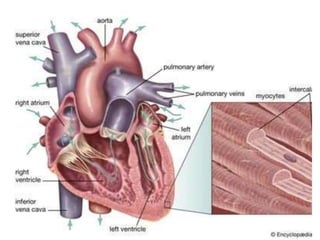
The heart has four hollow chambers, or cavities: two atria and
two ventricles.
• Receiving chambers. The two superior atria are primarily the
receiving chambers, they play a lighter role in the pumping
activity of the heart.
• Discharging chambers. The two inferior, thick-
walled ventricles are the discharging chambers, or actual pumps
of the heart wherein when they contract, blood is propelled out
of the heart and into the circulation.
• Septum. The septum that divides the heart longitudinally is
referred to as either the interventricular septum or
the interatrial septum, depending on which chamber it separates.
Associated Great Vessels
The great blood vessels provide a pathway for the entire cardiac
circulation to proceed.
• Superior and inferior vena cava. The heart receives
relatively oxygen-poor blood from the veins of the body
through the large superior and inferior vena cava and pumps it
through the pulmonary trunk.
• Pulmonary arteries. The pulmonary trunk splits into the right
and left pulmonary arteries, which carry blood to the lungs,
where oxygen is picked up and carbon dioxide is unloaded.
• Pulmonary veins. Oxygen-rich blood drains from the lungs and
is returned to the left side of the heart through the four
pulmonary veins.
• Aorta. Blood returned to the left side of the heart is pumped out
of the heart into the aorta from which the systemic arteries
branch to supply essentially all body tissues.
Heart Valves
The heart is equipped with four valves, which allow blood
to flow in only one direction through the heart chambers.
• Atrioventricular valves. Atrioventricular or AV valves are
located between the atrial and ventricular chambers on
each side, and they prevent backflow into the atria when
the ventricles contract.
• Bicuspid valves. The left AV valve- the bicuspid or mitral
valve, consists of two flaps, or cusps, of endocardium.
• Tricuspid valve. The right AV valve, the tricuspid valve,
has three flaps.
• Semilunar valve. The second set of valves, the semilunar
valves, guards the bases of the two large arteries leaving
the ventricular chambers, thus they are known as the
pulmonary and aortic semilunar valves.
Cardiac Circulation Vessels
Although the heart chambers are bathed with blood
almost continuously, the blood contained in the heart does
not nourish the myocardium.
• Coronary arteries. The coronary arteries branch from the
base of the aorta and encircle the heart in the coronary
sulcus (atrioventricular groove) at the junction of the
atria and ventricles, and these arteries are compressed
when the ventricles are contracting and fill when the heart
is relaxed.
• Cardiac veins. The myocardium is drained by several
cardiac veins, which empty into an enlarged vessel on the
posterior of the heart called the coronary sinus.
Physiology the Heart
The functions of the heart are as follows:
• Managing blood supply. Variations in the rate and force
of heart contraction match blood flow to the changing
metabolic needs of the tissues during rest, exercise, and
changes in body position.
• Producing blood pressure. Contractions of the heart
produce blood pressure, which is needed for blood flow
through the blood vessels.
• Securing one-way blood flow. The valves of the heart
secure a one-way blood flow through the heart and blood
vessels.
• Transmitting blood. The heart separates the pulmonary
and systemic circulations, which ensures the flow of
oxygenated blood to tissues.
Blood vessels and circulation (Pulmonary,
coronary and systemic circulation)
Blood circulates inside the blood vessels, which form a
closed transport system, the so-called vascular system.
• Arteries. As the heart beats, blood is propelled into large
arteries leaving the heart.
• Arterioles. It then moves into successively smaller and
smaller arteries and then into arterioles, which feed
the capillary beds in the tissues.
• Veins. Capillary beds are drained by venules, which in turn
empty into veins that finally empty into the great veins
entering the heart.
Tunics
Except for the microscopic capillaries, the walls of the
blood vessels have three coats or tunics.
• Tunica intima. The tunica intima, which lines the lumen,
or interior, of the vessels, is a thin layer of endothelium
resting on a basement membrane and decreases friction as
blood flows through the vessel lumen.
• Tunica media. The tunica media is the bulky middle coat
which mostly consists of smooth muscle and elastic fibers
that constrict or dilate, making the blood pressure
increase or decrease.
• Tunica externa. The tunica externa is the outermost tunic
composed largely of fibrous connective tissue, and its
function is basically to support and protect the vessels.
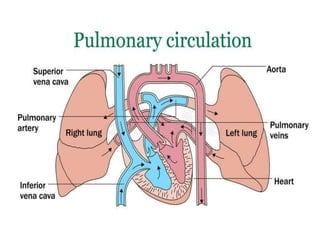
Pulmonary circulation
Pulmonary circulation includes a vast network of arteries, veins,
and lymphatics that function to exchange blood and other tissue
fluids between the heart, the lungs, and back. They are designed to
perform certain specific functions that are unique to the pulmonary
circulation, such as ventilation and gas exchange. The pulmonary
circulation receives the entirety of the cardiac output from the right
heart and is a low pressure, low resistance system due to its parallel
capillary circulation. The system can be divided into the following
components:
• The arterial circuit arises from the main pulmonary artery arising
from the right ventricle and runs a course of only 5 cm before
dividing into right and left main branches and many subsequent
branches to form an extensive network of small arteries, arterioles,
and capillaries. The pulmonary arteries are thinner (one-third the
thickness of their counterpart systemic vessels) and have a larger
diameter. The combined effect makes them much more distensible
and compliant (approximately 7mL/mmHg).
• The venous circuit begins with the venules that drain the
capillaries. They join to form smaller veins and
eventually merge to form the main pulmonary veins
draining into the left atrium. Like the arteries, the
pulmonary veins are thinner and more distensible than the
counterpart systemic veins and accommodate more blood
because of their larger compliance.
• Lymphatics play a crucial role in maintaining a dry
alveolar membrane and preventing accumulation of tissue
fluid around the pulmonary circulation. They can be
found close to the terminal bronchioles and drain the
mediastinal lymphatics before emptying into the right
lymphatic duct.
Function
The pulmonary circulation has many essential functions.
Its primary function involves the exchange of gases across
the alveolar membrane which ultimately supplies
oxygenated blood to the rest of the body and eliminates
carbon dioxide from the circulation. The bronchial
circulation provides oxygenated blood to the lung
parenchyma. There is an overlap between the bronchial and
pulmonary circulations in terms of oxygenating the lungs,
especially near central regions.
The peripheral aspects of the lungs becoming increasingly
dependent on the pulmonary circulation and is more prone
to infarction as a result. The low-pressure venous system
and an intricate system of lymphatics ensure that there is no
build-up of edema fluid in healthy lungs.
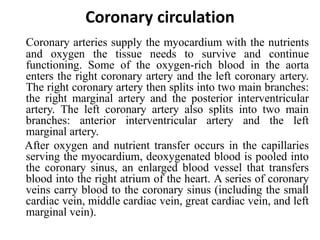
Coronary circulation
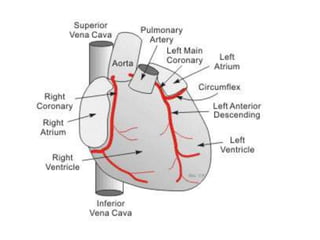
Coronary arteries supply the myocardium with the nutrients
and oxygen the tissue needs to survive and continue
functioning. Some of the oxygen-rich blood in the aorta
enters the right coronary artery and the left coronary artery.
The right coronary artery then splits into two main branches:
the right marginal artery and the posterior interventricular
artery. The left coronary artery also splits into two main
branches: anterior interventricular artery and the left
marginal artery.
After oxygen and nutrient transfer occurs in the capillaries
serving the myocardium, deoxygenated blood is pooled into
the coronary sinus, an enlarged blood vessel that transfers
blood into the right atrium of the heart. A series of coronary
veins carry blood to the coronary sinus (including the small
cardiac vein, middle cardiac vein, great cardiac vein, and left
marginal vein).
Cardiac cycle
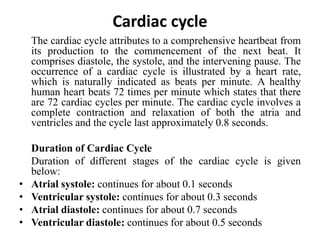
The cardiac cycle attributes to a comprehensive heartbeat from
its production to the commencement of the next beat. It
comprises diastole, the systole, and the intervening pause. The
occurrence of a cardiac cycle is illustrated by a heart rate,
which is naturally indicated as beats per minute. A healthy
human heart beats 72 times per minute which states that there
are 72 cardiac cycles per minute. The cardiac cycle involves a
complete contraction and relaxation of both the atria and
ventricles and the cycle last approximately 0.8 seconds.
Duration of Cardiac Cycle
Duration of different stages of the cardiac cycle is given
below:
• Atrial systole: continues for about 0.1 seconds
• Ventricular systole: continues for about 0.3 seconds
• Atrial diastole: continues for about 0.7 seconds
• Ventricular diastole: continues for about 0.5 seconds
Cardiac Cycle Phases
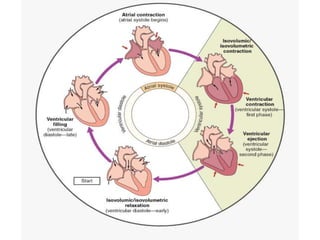
Following are the different phases that occur in a cardiac cycle:
• Atrial Diastole: In this stage, chambers of the heart are calmed. That is
when the aortic valve and pulmonary artery closes and atrioventricular
valves open, thus causing chambers of the heart to relax.
• Atrial Systole: At this phase, blood cells flow from atrium to ventricle
and at this period, atrium contracts.
• Isovolumic Contraction: At this stage, ventricles begin to contract.
The atrioventricular valves, valve, and pulmonary artery valves close,
but there won’t be any transformation in volume.
• Ventricular Ejection: Here ventricles contract and emptying.
Pulmonary artery and aortic valve close.
• Isovolumic Relaxation: In this phase, no blood enters the ventricles
and consequently, pressure decreases, ventricles stop contracting and
begin to relax. Now due to the pressure in the aorta – pulmonary artery
and aortic valve close.
• Ventricular Filling Stage: In this stage, blood flows from atria into the
ventricles. It is altogether known as one stage (first and second stage).
After that, they are three phases that involve the flow of blood to the
pulmonary artery from ventricles.
Heart sounds
Heart sounds are the noises generated by the beating heart
and the resultant flow of blood through it. Specifically, the
sounds reflect the turbulence created when the heart
valves snap shut. In cardiac auscultation, an examiner may
use a stethoscope to listen for these unique and distinct
sounds that provide important auditory data regarding the
condition of the heart.
In healthy adults, there are two normal heart sounds, often
described as a lub and a dub that occur in sequence with
each heartbeat. These are the first heart sound (S1)
and second heart sound (S2), produced by the closing of
the atrioventricular valves and semilunar valves,
respectively. In addition to these normal sounds, a variety of
other sounds may be present including heart
murmurs, adventitious sounds, and gallop rhythms S3 and S4.
Basics of ECG
An electrocardiogram is a tracing of the electrical activity
that is taking place within the heart. Under normal
circumstances, an electrical impulse will travel from the
sinoatrial node, spread across the atrium, to the
atrioventricular node and through the ventricular septum of
the heart. This electrical impulse causes the four chambers
of the heart to contract and relax in a coordinated fashion.
Studying these electrical impulses allows us to understand
how the heart is functioning.
P Wave
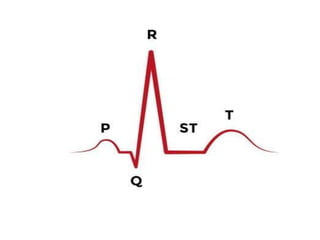
The P wave represents the depolarization of the left and
right atrium and also corresponds to atrial contraction.
Strictly speaking, the atria contract a split second after the P
wave begins. Because it is so small, atrial repolarization is
usually not visible on ECG.
QRS Complex
As the name suggests, the QRS complex includes the Q
wave, R wave, and S wave. These three waves occur in rapid
succession. The QRS complex represents the electrical
impulse as it spreads through the ventricles and indicates
ventricular depolarization. As with the P wave, the QRS
complex starts just before ventricular contraction.
It is important to recognize that not every QRS complex will
contain Q, R, and S waves. The convention is that the Q
wave is always negative and that the R wave is the first
positive wave of the complex.
T Wave
T wave follows the QRS complex and indicates ventricular
repolarization. Unlike a P wave, a normal T wave is slightly
asymmetric; the peak of the wave is a little closer to its end
than to its beginning.
Heart Rate
There are many ways to determine a patient’s heart rate using
ECG. One of the quickest ways is called the sequence method.
To use the sequence method, find an R wave that lines up with
one of the dark vertical lines on the ECG paper.
If the next R wave appears on the next dark vertical line, it
corresponds to heart rate of 300 beats a minute. The dark
vertical lines correspond to 300, 150, 100, 75, 60, and 50 bpm.
THANK YOU

Cardiovascular system by Yogesh patel

  • 1.
    7. Cardiovascular system ● Anatomyand Physiology of heart ● Blood vessels and circulation (Pulmonary, coronary and systemic circulation) ● Cardiac cycle and Heart sounds, Basics of ECG ● Blood pressure and its regulation
  • 2.
    Anatomy and Physiologyof heart • The heart is a muscular organ about the size of a closed fist that functions as the body’s circulatory pump. It takes in deoxygenated blood through the veins and delivers it to the lungs for oxygenation before pumping it into the various arteries (which provide oxygen and nutrients to body tissues by transporting the blood throughout the body). The heart is located in the thoracic cavity medial to the lungs and posterior to the sternum. • On its superior end, the base of the heart is attached to the aorta, pulmonary arteries and veins, and the vena cava. The inferior tip of the heart, known as the apex, rests just superior to the diaphragm. The base of the heart is located along the body’s midline with the apex pointing toward the left side. Because the heart points to the left, about 2/3 of the heart’s mass is found on the left side of the body and the other 1/3 is on the right.
  • 4.
    • Weight. Approximatelythe size of a person’s fist, the hollow, cone- shaped heart weighs less than a pound. • Media stinum. Snugly enclosed within the inferior media stinum, the medial cavity of the thorax, the heart is flanked on each side by the lungs. • Apex. It’s more pointed apex is directed toward the left hip and rests on the diaphragm, approximately at the level of the fifth intercostal space. • Base. Its broad posterosuperior aspect, or base, from which the great vessels of the body emerge, points toward the right shoulder and lies beneath the second rib. • Pericardium. The heart is enclosed in a double-walled sac called the pericardium and is the outermost layer of the heart. • Fibrous pericardium. The loosely fitting superficial part of this sac is referred to as the fibrous pericardium, which helps protect the heart and anchors it to surrounding structures such as the diaphragm and sternum. • Serous pericardium. Deep to the fibrous pericardium is the slippery, two-layer serous pericardium, where its parietal layer lines the interior of the fibrous pericardium.
  • 5.
    Layers of theHeart The heart muscle has three layers and they are as follows: • Epicardium. The epicardium or the visceral and outermost layer is actually a part of the heart wall. • Myocardium. The myocardium consists of thick bundles of cardiac muscle twisted and whirled into ringlike arrangements and it is the layer that actually contracts. • Endocardium. The endocardium is the innermost layer of the heart and is a thin, glistening sheet of endothelium hat lines the heart chambers.
  • 6.
    Chambers of theHeart The heart has four hollow chambers, or cavities: two atria and two ventricles. • Receiving chambers. The two superior atria are primarily the receiving chambers, they play a lighter role in the pumping activity of the heart. • Discharging chambers. The two inferior, thick- walled ventricles are the discharging chambers, or actual pumps of the heart wherein when they contract, blood is propelled out of the heart and into the circulation. • Septum. The septum that divides the heart longitudinally is referred to as either the interventricular septum or the interatrial septum, depending on which chamber it separates.
  • 7.
    Associated Great Vessels Thegreat blood vessels provide a pathway for the entire cardiac circulation to proceed. • Superior and inferior vena cava. The heart receives relatively oxygen-poor blood from the veins of the body through the large superior and inferior vena cava and pumps it through the pulmonary trunk. • Pulmonary arteries. The pulmonary trunk splits into the right and left pulmonary arteries, which carry blood to the lungs, where oxygen is picked up and carbon dioxide is unloaded. • Pulmonary veins. Oxygen-rich blood drains from the lungs and is returned to the left side of the heart through the four pulmonary veins. • Aorta. Blood returned to the left side of the heart is pumped out of the heart into the aorta from which the systemic arteries branch to supply essentially all body tissues.
  • 8.
    Heart Valves The heartis equipped with four valves, which allow blood to flow in only one direction through the heart chambers. • Atrioventricular valves. Atrioventricular or AV valves are located between the atrial and ventricular chambers on each side, and they prevent backflow into the atria when the ventricles contract. • Bicuspid valves. The left AV valve- the bicuspid or mitral valve, consists of two flaps, or cusps, of endocardium. • Tricuspid valve. The right AV valve, the tricuspid valve, has three flaps. • Semilunar valve. The second set of valves, the semilunar valves, guards the bases of the two large arteries leaving the ventricular chambers, thus they are known as the pulmonary and aortic semilunar valves.
  • 9.
    Cardiac Circulation Vessels Althoughthe heart chambers are bathed with blood almost continuously, the blood contained in the heart does not nourish the myocardium. • Coronary arteries. The coronary arteries branch from the base of the aorta and encircle the heart in the coronary sulcus (atrioventricular groove) at the junction of the atria and ventricles, and these arteries are compressed when the ventricles are contracting and fill when the heart is relaxed. • Cardiac veins. The myocardium is drained by several cardiac veins, which empty into an enlarged vessel on the posterior of the heart called the coronary sinus.
  • 10.
    Physiology the Heart Thefunctions of the heart are as follows: • Managing blood supply. Variations in the rate and force of heart contraction match blood flow to the changing metabolic needs of the tissues during rest, exercise, and changes in body position. • Producing blood pressure. Contractions of the heart produce blood pressure, which is needed for blood flow through the blood vessels. • Securing one-way blood flow. The valves of the heart secure a one-way blood flow through the heart and blood vessels. • Transmitting blood. The heart separates the pulmonary and systemic circulations, which ensures the flow of oxygenated blood to tissues.
  • 11.
    Blood vessels andcirculation (Pulmonary, coronary and systemic circulation) Blood circulates inside the blood vessels, which form a closed transport system, the so-called vascular system. • Arteries. As the heart beats, blood is propelled into large arteries leaving the heart. • Arterioles. It then moves into successively smaller and smaller arteries and then into arterioles, which feed the capillary beds in the tissues. • Veins. Capillary beds are drained by venules, which in turn empty into veins that finally empty into the great veins entering the heart.
  • 12.
    Tunics Except for themicroscopic capillaries, the walls of the blood vessels have three coats or tunics. • Tunica intima. The tunica intima, which lines the lumen, or interior, of the vessels, is a thin layer of endothelium resting on a basement membrane and decreases friction as blood flows through the vessel lumen. • Tunica media. The tunica media is the bulky middle coat which mostly consists of smooth muscle and elastic fibers that constrict or dilate, making the blood pressure increase or decrease. • Tunica externa. The tunica externa is the outermost tunic composed largely of fibrous connective tissue, and its function is basically to support and protect the vessels.
  • 13.
    Pulmonary circulation Pulmonary circulationincludes a vast network of arteries, veins, and lymphatics that function to exchange blood and other tissue fluids between the heart, the lungs, and back. They are designed to perform certain specific functions that are unique to the pulmonary circulation, such as ventilation and gas exchange. The pulmonary circulation receives the entirety of the cardiac output from the right heart and is a low pressure, low resistance system due to its parallel capillary circulation. The system can be divided into the following components: • The arterial circuit arises from the main pulmonary artery arising from the right ventricle and runs a course of only 5 cm before dividing into right and left main branches and many subsequent branches to form an extensive network of small arteries, arterioles, and capillaries. The pulmonary arteries are thinner (one-third the thickness of their counterpart systemic vessels) and have a larger diameter. The combined effect makes them much more distensible and compliant (approximately 7mL/mmHg).
  • 14.
    • The venouscircuit begins with the venules that drain the capillaries. They join to form smaller veins and eventually merge to form the main pulmonary veins draining into the left atrium. Like the arteries, the pulmonary veins are thinner and more distensible than the counterpart systemic veins and accommodate more blood because of their larger compliance. • Lymphatics play a crucial role in maintaining a dry alveolar membrane and preventing accumulation of tissue fluid around the pulmonary circulation. They can be found close to the terminal bronchioles and drain the mediastinal lymphatics before emptying into the right lymphatic duct.
  • 16.
    Function The pulmonary circulationhas many essential functions. Its primary function involves the exchange of gases across the alveolar membrane which ultimately supplies oxygenated blood to the rest of the body and eliminates carbon dioxide from the circulation. The bronchial circulation provides oxygenated blood to the lung parenchyma. There is an overlap between the bronchial and pulmonary circulations in terms of oxygenating the lungs, especially near central regions. The peripheral aspects of the lungs becoming increasingly dependent on the pulmonary circulation and is more prone to infarction as a result. The low-pressure venous system and an intricate system of lymphatics ensure that there is no build-up of edema fluid in healthy lungs.
  • 17.
    Coronary circulation Coronary arteriessupply the myocardium with the nutrients and oxygen the tissue needs to survive and continue functioning. Some of the oxygen-rich blood in the aorta enters the right coronary artery and the left coronary artery. The right coronary artery then splits into two main branches: the right marginal artery and the posterior interventricular artery. The left coronary artery also splits into two main branches: anterior interventricular artery and the left marginal artery. After oxygen and nutrient transfer occurs in the capillaries serving the myocardium, deoxygenated blood is pooled into the coronary sinus, an enlarged blood vessel that transfers blood into the right atrium of the heart. A series of coronary veins carry blood to the coronary sinus (including the small cardiac vein, middle cardiac vein, great cardiac vein, and left marginal vein).
  • 19.
    Cardiac cycle The cardiaccycle attributes to a comprehensive heartbeat from its production to the commencement of the next beat. It comprises diastole, the systole, and the intervening pause. The occurrence of a cardiac cycle is illustrated by a heart rate, which is naturally indicated as beats per minute. A healthy human heart beats 72 times per minute which states that there are 72 cardiac cycles per minute. The cardiac cycle involves a complete contraction and relaxation of both the atria and ventricles and the cycle last approximately 0.8 seconds. Duration of Cardiac Cycle Duration of different stages of the cardiac cycle is given below: • Atrial systole: continues for about 0.1 seconds • Ventricular systole: continues for about 0.3 seconds • Atrial diastole: continues for about 0.7 seconds • Ventricular diastole: continues for about 0.5 seconds
  • 21.
    Cardiac Cycle Phases Followingare the different phases that occur in a cardiac cycle: • Atrial Diastole: In this stage, chambers of the heart are calmed. That is when the aortic valve and pulmonary artery closes and atrioventricular valves open, thus causing chambers of the heart to relax. • Atrial Systole: At this phase, blood cells flow from atrium to ventricle and at this period, atrium contracts. • Isovolumic Contraction: At this stage, ventricles begin to contract. The atrioventricular valves, valve, and pulmonary artery valves close, but there won’t be any transformation in volume. • Ventricular Ejection: Here ventricles contract and emptying. Pulmonary artery and aortic valve close. • Isovolumic Relaxation: In this phase, no blood enters the ventricles and consequently, pressure decreases, ventricles stop contracting and begin to relax. Now due to the pressure in the aorta – pulmonary artery and aortic valve close. • Ventricular Filling Stage: In this stage, blood flows from atria into the ventricles. It is altogether known as one stage (first and second stage). After that, they are three phases that involve the flow of blood to the pulmonary artery from ventricles.
  • 22.
    Heart sounds Heart soundsare the noises generated by the beating heart and the resultant flow of blood through it. Specifically, the sounds reflect the turbulence created when the heart valves snap shut. In cardiac auscultation, an examiner may use a stethoscope to listen for these unique and distinct sounds that provide important auditory data regarding the condition of the heart. In healthy adults, there are two normal heart sounds, often described as a lub and a dub that occur in sequence with each heartbeat. These are the first heart sound (S1) and second heart sound (S2), produced by the closing of the atrioventricular valves and semilunar valves, respectively. In addition to these normal sounds, a variety of other sounds may be present including heart murmurs, adventitious sounds, and gallop rhythms S3 and S4.
  • 23.
    Basics of ECG Anelectrocardiogram is a tracing of the electrical activity that is taking place within the heart. Under normal circumstances, an electrical impulse will travel from the sinoatrial node, spread across the atrium, to the atrioventricular node and through the ventricular septum of the heart. This electrical impulse causes the four chambers of the heart to contract and relax in a coordinated fashion. Studying these electrical impulses allows us to understand how the heart is functioning. P Wave The P wave represents the depolarization of the left and right atrium and also corresponds to atrial contraction. Strictly speaking, the atria contract a split second after the P wave begins. Because it is so small, atrial repolarization is usually not visible on ECG.
  • 25.
    QRS Complex As thename suggests, the QRS complex includes the Q wave, R wave, and S wave. These three waves occur in rapid succession. The QRS complex represents the electrical impulse as it spreads through the ventricles and indicates ventricular depolarization. As with the P wave, the QRS complex starts just before ventricular contraction. It is important to recognize that not every QRS complex will contain Q, R, and S waves. The convention is that the Q wave is always negative and that the R wave is the first positive wave of the complex. T Wave T wave follows the QRS complex and indicates ventricular repolarization. Unlike a P wave, a normal T wave is slightly asymmetric; the peak of the wave is a little closer to its end than to its beginning.
  • 26.
    Heart Rate There aremany ways to determine a patient’s heart rate using ECG. One of the quickest ways is called the sequence method. To use the sequence method, find an R wave that lines up with one of the dark vertical lines on the ECG paper. If the next R wave appears on the next dark vertical line, it corresponds to heart rate of 300 beats a minute. The dark vertical lines correspond to 300, 150, 100, 75, 60, and 50 bpm.
  • 27.