Cardiac Cycle
Harshit Jadav
Harshit Jadav 1
Cardiac Cycle
• succession of (sequence of) coordinated events taking place in the
heart during each beat.
• Each heartbeat consists of two major periods called systole and
diastole.
• During systole, heart contracts and pumps the blood through
arteries.
• During diastole, heart relaxes and blood is filled in the heart.
Harshit Jadav 2
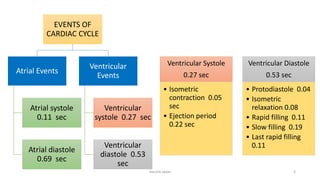
EVENTS OF
CARDIAC CYCLE
Atrial Events
Atrial systole
0.11 sec
Atrial diastole
0.69 sec
Ventricular
Events
Ventricular
systole 0.27 sec
Ventricular
diastole 0.53
sec
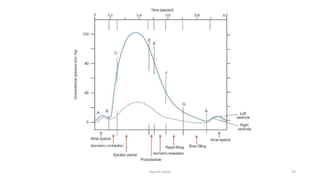
Ventricular Systole
0.27 sec
• Isometric
contraction 0.05
sec
• Ejection period
0.22 sec
Ventricular Diastole
0.53 sec
• Protodiastole 0.04
• Isometric
relaxation 0.08
• Rapid filling 0.11
• Slow filling 0.19
• Last rapid filling
0.11
Harshit Jadav 3
Atrial Systole
• also known as last rapid filling phase or presystole.
• considered as the last phase of ventricular diastole.
• a small amount, i.e. 10% of blood is forced from atria into
ventricles
• not essential for the maintenance of circulation
• During atrial systole, the intra-atrial pressure increases, Intra-
ventricular pressure and ventricular volume also slightly increase
• Contraction of atrial musculature causes the production of fourth heart
sound
Harshit Jadav 4
Atrial Diastole
• After atrial systole, the atrial diastole starts. Simultaneously,
ventricular systole also starts
• This long atrial (0.69 sec) diastole is necessary because, this is the
period during which atrial filling takes place
• Right atrium receives deoxygenated blood from all over the body via
…
• Left atrium receives oxygenated blood from lungs via…
Harshit Jadav 5
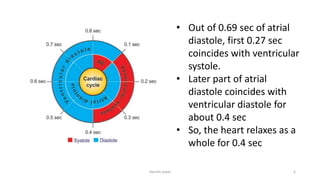
• Out of 0.69 sec of atrial
diastole, first 0.27 sec
coincides with ventricular
systole.
• Later part of atrial
diastole coincides with
ventricular diastole for
about 0.4 sec
• So, the heart relaxes as a
whole for 0.4 sec
Harshit Jadav 6
Isometric Contraction Period
• the first phase of ventricular systole. It lasts for 0.05
• Isometric contraction is the type of muscular contraction
characterized by increase in tension, without any change in the
length of muscle fibers
• also called isovolumetric contraction.
Harshit Jadav 7
• after atrial systole, the atrioventricular valves are closed due
to increase in ventricular pressure.
• Semilunar valves are already closed.
• ventricles contract as closed cavities in such a way that there
is no change in the volume of ventricular chambers or in
the length of muscle fibers
• Only the tension increases in ventricular musculature
• Closure of atrioventricular valves at the beginning of this
phase produces first heart sound
Harshit Jadav 8
Significance of Isometric Contraction
• during this phase, the pressure increases sharply inside the ventricles
• When the pressure increases above the pressure in the aorta and
pulmonary artery, the semilunar valves open
• This phase is responsible for the opening of semilunar valves, leading
to ejection of blood from the ventricles into aorta and pulmonary
artery
Harshit Jadav 9
Ejection Period 0.22 sec
• Due to the opening of semilunar valves and isotonic contraction of
ventricles, blood is ejected out of both the ventricles.
• Ejection period is of two stages:
1. First Stage or Rapid Ejection Period 0.13 sec
• starts immediately after the opening of semilunar valves
• a large amount of blood is rapidly ejected from both the ventricles.
2. Second Stage or Slow Ejection Period 0.09 sec
• the blood is ejected slowly with much less force.
Harshit Jadav 10
End-systolic Volume
• Ventricles are not emptied at the end of ejection period
• some amount of blood remains in each ventricle
• Amount of blood remaining in ventricles at the end of ejection
period is called end systolic volume.
• 60 to 80 mL per ventricle
Harshit Jadav 11
Protodiastole 0.04 second
• first stage of ventricular diastole
• Due to the ejection of blood, the pressure in aorta and pulmonary
artery increases and pressure in ventricles drops
• intraventricular pressure becomes less than the pressure in aorta and
pulmonary artery, the semilunar valves close.
• Second Heart Sound
• Closure of semilunar valves during this phase produces second heart
sound
Harshit Jadav 12
Isometric Relaxation Period 0.08 sec
• Isometric relaxation is the type of muscular relaxation, characterized
by decrease in tension without any change in the length of muscle
fibers
• also called isovolumetric relaxation.
• all the valves of the heart are closed
• both the ventricles relax as closed cavities without any change in
volume or length of the muscle fiber
Harshit Jadav 13
Significance of Isometric Relaxation
• the ventricular pressure decreases
• When the ventricular pressure becomes less than the pressure in the
atria, the atrioventricular valves open
• opening of atrioventricular valves, resulting in filling of ventricles
Harshit Jadav 14
Rapid Filling Phase 0.11 sec
• Atrioventricular valves are opened, there is a sudden rush of blood
from atria into ventricles
• which is accumulated in atria during atrial diastole
• About 70% of filling takes place during this phase
• Rushing of blood into ventricles during this phase causes production
of third heart sound
Harshit Jadav 15
Slow Filling Phase 0.19 sec
• It is also called diastasis.
• about 20% of filling occurs in this phase
Harshit Jadav 16
Last Rapid Filling Phase 0.11 sec
• Last rapid filling phase occurs because of atrial systole.
• After slow filling period the atria contract and push a small amount of
blood into ventricles
• About 10% of ventricular filling takes place during this period
• Flow of additional amount of blood into ventricle due to atrial systole
is called atrial kick.
Harshit Jadav 17
End-diastolic Volume
• the amount of blood remaining in each ventricle at the end of
diastole
• It is about 130 to 150 mL per ventricle.
Harshit Jadav 18
Harshit Jadav 19
• End-systolic Volume: 60 to 80 mL per ventricle
• End-diastolic Volume: 130 to150 mL per ventricle.
• From 130 to 150 mL of end-diastolic volume, 70 mL is ejected out by
each ventricle. Stroke Volume
Harshit Jadav 20
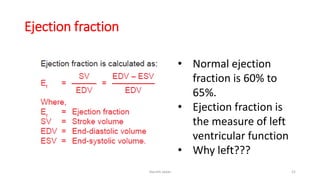
Ejection fraction
• Normal ejection
fraction is 60% to
65%.
• Ejection fraction is
the measure of left
ventricular function
• Why left???
Harshit Jadav 21
Stroke Volume
• Stroke volume is the amount of blood pumped out by each ventricle
during each beat
• Normal value: 70 mL (60 to 80 mL) when the heart rate is normal
(72/minute
Harshit Jadav 22
Cardiac Output / Minute Volume
• Minute volume is the amount of blood pumped out by each ventricle
in one minute
• Minute volume = Stroke volume × Heart rate
• Normal value: 5 L/ventricle/minute.
Harshit Jadav 23