
Carc 04.02
alessandro.bogliolo@uniurb.it
04. Computer systems
04.02. Instruction-set architecture
• Classification criteria
• Instruction set
• Execution model
• Addressing
Computer Architecture
alessandro.bogliolo@uniurb.it
Carc 04.02
alessandro.bogliolo@uniurb.it
Classification criteria
• Instruction set
• Size
• Instruction format
• Execution model
• Stack, Mem-Mem, Mem-Reg, Reg-Reg
• Addressing mode
• Ordering
• Alignment
• Address computation
Carc 04.02
alessandro.bogliolo@uniurb.it
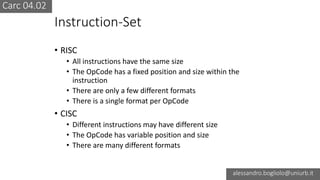
Instruction-Set
• RISC
• All instructions have the same size
• The OpCode has a fixed position and size within the
instruction
• There are only a few different formats
• There is a single format per OpCode
• CISC
• Different instructions may have different size
• The OpCode has variable position and size
• There are many different formats
Carc 04.02
alessandro.bogliolo@uniurb.it
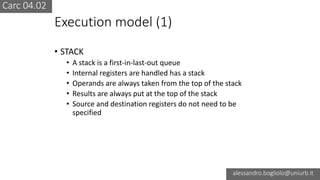
Execution model (1)
• STACK
• A stack is a first-in-last-out queue
• Internal registers are handled has a stack
• Operands are always taken from the top of the stack
• Results are always put at the top of the stack
• Source and destination registers do not need to be
specified
Carc 04.02
alessandro.bogliolo@uniurb.it
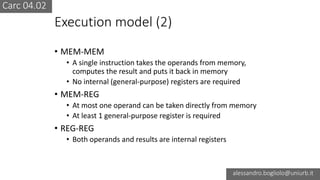
Execution model (2)
• MEM-MEM
• A single instruction takes the operands from memory,
computes the result and puts it back in memory
• No internal (general-purpose) registers are required
• MEM-REG
• At most one operand can be taken directly from memory
• At least 1 general-purpose register is required
• REG-REG
• Both operands and results are internal registers
Carc 04.02
alessandro.bogliolo@uniurb.it
Execution models comparison
Example
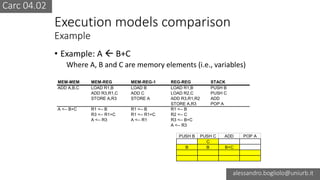
• Example: A  B+C
Where A, B and C are memory elements (i.e., variables)
MEM-MEM MEM-REG MEM-REG-1 REG-REG STACK
ADD A,B,C LOAD R1,B LOAD B LOAD R1,B PUSH B
ADD R3,R1,C ADD C LOAD R2,C PUSH C
STORE A,R3 STORE A ADD R3,R1,R2 ADD
STORE A,R3 POP A
A <-- B+C R1 <-- B R1 <-- B R1 <-- B
R3 <-- R1+C R1 <-- R1+C R2 <-- C
A <-- R3 A <-- R1 R3 <-- B+C
A <-- R3
PUSH B PUSH C ADD POP A
C
B B B+C
Carc 04.02
alessandro.bogliolo@uniurb.it
Addressing
Byte ordering
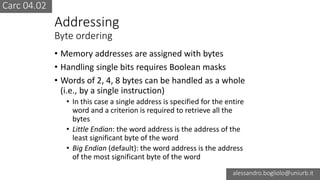
• Memory addresses are assigned with bytes
• Handling single bits requires Boolean masks
• Words of 2, 4, 8 bytes can be handled as a whole
(i.e., by a single instruction)
• In this case a single address is specified for the entire
word and a criterion is required to retrieve all the
bytes
• Little Endian: the word address is the address of the
least significant byte of the word
• Big Endian (default): the word address is the address
of the most significant byte of the word
Carc 04.02
alessandro.bogliolo@uniurb.it
Addressing
Alignment
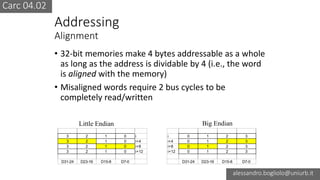
• 32-bit memories make 4 bytes addressable as a whole
as long as the address is dividable by 4 (i.e., the word
is aligned with the memory)
• Misaligned words require 2 bus cycles to be
completely read/written
3 2 1 0 i
3 2 1 0 i+4
3 2 1 0 i+8
3 2 1 0 i+12
D31-24 D23-16 D15-8 D7-0
i 0 1 2 3
i+4 0 1 2 3
i+8 0 1 2 3
i+12 0 1 2 3
D31-24 D23-16 D15-8 D7-0
Little Endian Big Endian
Carc 04.02
alessandro.bogliolo@uniurb.it
Addressing
Address computation
Direct
LD R1,var R1  M[var]
Relative to registers
LD R1,var(R2) R1  M[R2+var]
Indirect
LD R1,(R2) R1  M[R2]
Relative to registers, indexed and scaled
LD R1,var(R2)(RX)
R1  M[R2+var+RX*d]
var
(R2)
(R2)
var
var(R2)
(RX)*d
d

CArcMOOC 04.02 - Instruction Set Architecture

  • 1.
    Carc 04.02 alessandro.bogliolo@uniurb.it 04. Computersystems 04.02. Instruction-set architecture • Classification criteria • Instruction set • Execution model • Addressing Computer Architecture alessandro.bogliolo@uniurb.it
  • 2.
    Carc 04.02 alessandro.bogliolo@uniurb.it Classification criteria •Instruction set • Size • Instruction format • Execution model • Stack, Mem-Mem, Mem-Reg, Reg-Reg • Addressing mode • Ordering • Alignment • Address computation
  • 3.
    Carc 04.02 alessandro.bogliolo@uniurb.it Instruction-Set • RISC •All instructions have the same size • The OpCode has a fixed position and size within the instruction • There are only a few different formats • There is a single format per OpCode • CISC • Different instructions may have different size • The OpCode has variable position and size • There are many different formats
  • 4.
    Carc 04.02 alessandro.bogliolo@uniurb.it Execution model(1) • STACK • A stack is a first-in-last-out queue • Internal registers are handled has a stack • Operands are always taken from the top of the stack • Results are always put at the top of the stack • Source and destination registers do not need to be specified
  • 5.
    Carc 04.02 alessandro.bogliolo@uniurb.it Execution model(2) • MEM-MEM • A single instruction takes the operands from memory, computes the result and puts it back in memory • No internal (general-purpose) registers are required • MEM-REG • At most one operand can be taken directly from memory • At least 1 general-purpose register is required • REG-REG • Both operands and results are internal registers
  • 6.
    Carc 04.02 alessandro.bogliolo@uniurb.it Execution modelscomparison Example • Example: A  B+C Where A, B and C are memory elements (i.e., variables) MEM-MEM MEM-REG MEM-REG-1 REG-REG STACK ADD A,B,C LOAD R1,B LOAD B LOAD R1,B PUSH B ADD R3,R1,C ADD C LOAD R2,C PUSH C STORE A,R3 STORE A ADD R3,R1,R2 ADD STORE A,R3 POP A A <-- B+C R1 <-- B R1 <-- B R1 <-- B R3 <-- R1+C R1 <-- R1+C R2 <-- C A <-- R3 A <-- R1 R3 <-- B+C A <-- R3 PUSH B PUSH C ADD POP A C B B B+C
  • 7.
    Carc 04.02 alessandro.bogliolo@uniurb.it Addressing Byte ordering •Memory addresses are assigned with bytes • Handling single bits requires Boolean masks • Words of 2, 4, 8 bytes can be handled as a whole (i.e., by a single instruction) • In this case a single address is specified for the entire word and a criterion is required to retrieve all the bytes • Little Endian: the word address is the address of the least significant byte of the word • Big Endian (default): the word address is the address of the most significant byte of the word
  • 8.
    Carc 04.02 alessandro.bogliolo@uniurb.it Addressing Alignment • 32-bitmemories make 4 bytes addressable as a whole as long as the address is dividable by 4 (i.e., the word is aligned with the memory) • Misaligned words require 2 bus cycles to be completely read/written 3 2 1 0 i 3 2 1 0 i+4 3 2 1 0 i+8 3 2 1 0 i+12 D31-24 D23-16 D15-8 D7-0 i 0 1 2 3 i+4 0 1 2 3 i+8 0 1 2 3 i+12 0 1 2 3 D31-24 D23-16 D15-8 D7-0 Little Endian Big Endian
  • 9.
    Carc 04.02 alessandro.bogliolo@uniurb.it Addressing Address computation Direct LDR1,var R1  M[var] Relative to registers LD R1,var(R2) R1  M[R2+var] Indirect LD R1,(R2) R1  M[R2] Relative to registers, indexed and scaled LD R1,var(R2)(RX) R1  M[R2+var+RX*d] var (R2) (R2) var var(R2) (RX)*d d