Soft Drink IndustrySoft Drink Industry
Sethaphat P.
GSBS 6021 Consumer Behavior
Outline
Part I
• Industry Overview
• Applying Porter’s Five Forces to the soft drink industry
• Industry S.W.O.T Analysis
• Limitations and Recommendations (Industry)
Part II
• Consumer Behaviour Influenced ( Marketing Mix)
Part III
• Consumer Segmentations
• Segmentation S.W.O.T Analysis
• Limitations and Recommendations (Segmentation)
Part IV
• Conclusion
• References
PART IPART I
What is Soft Drink ?
Soft drinks are enormously popular beverages consisting
primarily of carbonated water, sugar, and flavouring.
– wikipedia.org
A nonalcoholic, flavored, carbonated beverage, usually
commercial prepared and sold in bottles or cans.
- American Heritage Dictionary
Soft Drink Industry
Market Share - Companies
42%
32%
15%
11%
Coca-Cola
Pepsi
Cadbury Schweppes
Others
So urce : so ft drink m arke t in the U.S.-www.be ve rag e -dig e st.co m
Soft Drink Industry
Market Share - Brands
31%
20%17%
11%
11%
10%
Coke Classic
Pepsi-Cola
Diet Coke
Mt.Dew (Pepsi)
Diet Pepsi
Sprite (Coke)
So urce : so ft drink m arke t in the U.S.-www.be ve rag e -dig e st.co m
Porter’s Five Forces
So urce : wikipe dia.o rg
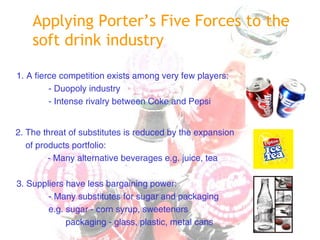
1. A fierce competition exists among very few players:
- Duopoly industry
- Intense rivalry between Coke and Pepsi
2. The threat of substitutes is reduced by the expansion
of products portfolio:
- Many alternative beverages e.g. juice, tea
3. Suppliers have less bargaining power:
- Many substitutes for sugar and packaging
e.g. sugar - corn syrup, sweeteners
packaging - glass, plastic, metal cans
Applying Porter’s Five Forces to the
soft drink industry
Applying Porter’s Five Forces to the
soft drink industry
4. Different levels of bargaining power exist among
the groups of buyers:
- Vending Machine – no buyer bargaining power
- Fast Food chain – more bargaining power
5. Strong barriers to new entrants:
- Amount of capital investment require
- Exclusive territories in distribution channel
- The access to retail channels
Industry S.W.O.T Analysis
Strengths
• Basic Consumer Need
• Large and growing market
• Different flavors and packages
• Low Costs
• Non-Alcoholic
Weaknesses
• Negative Claim
• Traditional Preservation
• Narrow range of material
Opportunities
• Establish facts and use potential PR
• New Packaging materials
• Replace alcoholic drinks
• Further replace tea and coffee
Threats
• Healthy Issues
• Soft Drink in School Guideline
• Environmentalism
• Distribution costs
Limitation – Healthy Issues
• Obesity / Weight Gain
• Oral Health
• Diabetes Type 2
Recommendation :
• Drinking through a straw
• Should not consume too much
• Low-calorie or No-calorie beverage
So urce : Am e ribe v.o rg
Limitation – Environmental Issues
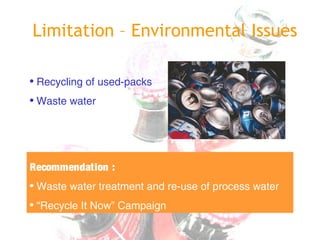
• Recycling of used-packs
• Waste water
Recommendation :
• Waste water treatment and re-use of process water
• “Recycle It Now” Campaign
Limitation – Distribution Costs
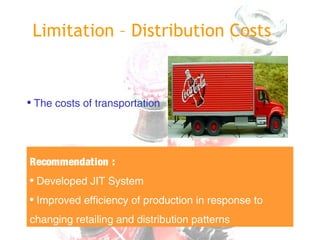
• The costs of transportation
Recommendation :
• Developed JIT System
• Improved efficiency of production in response to
changing retailing and distribution patterns
Limitation – Soft drink in school
• School Beverage Guidelines (only high school)
Recommendation :
• No or low calorie beverage with up to 10 calorie/ 8 ounces
PART IIPART II
Consumer Behavior Influenced
Product
Price
Place
(Distribution Channel)
Promotions
Consumer behavior can be influenced by marketing mix
Consumer Behavior Influenced
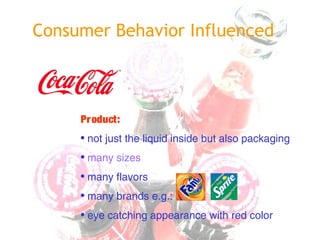
Product:
• not just the liquid inside but also packaging
• many sizes
• many flavors
• many brands e.g.:
• eye catching appearance with red color
Consumer Behavior Influenced
Price:
• create consumer perceptions and values
• high price = better quality
Consumer Behavior Influenced
Distribution Channel:
• easy to identify in retailing stores
• make up the greater proportion of options to buy
• vending machine in many sports stadiums and malls
Consumer Behavior Influenced
Promotions:
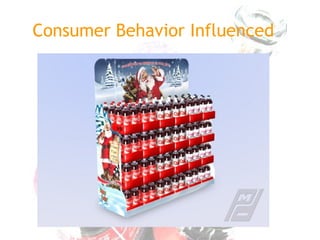
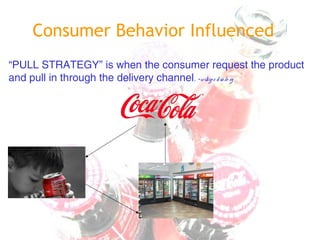
• Pull Strategy
e.g. coca-cola fridge in the supermarket
• create attractiveness from advertising
• sponsor to many events
e.g.: sports and recreational activities
• competition
e.g.: check the lid for an instant prize
Consumer Behavior Influenced
“PULL STRATEGY” is when the consumer request the product
and pull in through the delivery channel. -wikipe dia/o rg
Consumer Behavior Influenced
Coke – “The side of Life”
PART IIIPART III
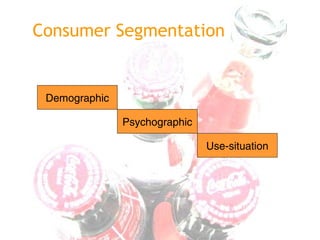
Consumer Segmentation
Use-situation
Psychographic
Demographic
Demographic Segmentation
Demographic Segment
- Youth (10-19 years old)
- majority of consumers
- spending power
- brand loyalties develop through adult-hood
- Young adult (20-24 years old)
- for diet product
- Adult ( 25-35 years old)
- for diet and caffeine free products
Psychographic Segmentation
Psychographic Segment
- Lifestyle
- personality (individual/group)
- Attitudes
- “self-expression”
image associated with product
- “cool”
Use-situation Segmentation
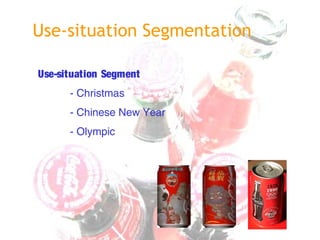
Use-situation Segment
- Christmas
- Chinese New Year
- Olympic
Segmentation S.W.O.T Analysis
Strengths
• Purchasing Powers
• Large number of consumers
• Large profitability
• High in brand awareness
Weaknesses
• Unstable in attitude/lifestyle
• Less brand loyalty
• Health concern
• Ageing population
Opportunities
• Economic
• Social occasions
• New markets in developing countries
• Climate – Hot Weather
Threats
• Juice, Alcohol Drinks, Bottled Water
• Fashion Trends
• Consumer perception of health
• Law and government
Limitation – Unstable attitude
• Youth always change their interests
• Easy to be influenced
Recommendation :
• Be aware of teens’ trends
• Pay attention to different tribes
Limitation – Less brand loyalty
• Always changing in brands
• Price sensitive
• Easy to be motivated by certain type of group
e.g.: celebrities
Recommendation :
• Brand extension
• Create many marketing campaigns
Limitation – Health concern
• Calorie reduction
• Avoidance of sugar
• Suspicion of additives
Recommendation :
• Promote low or no calorie drinks
• Labeling ingredients
Limitation – Ageing population
• Changing in consumer’s life stage
e.g.: teens become adults
• Different group of people
e.g.: young adult, adult, old people
• Life status e.g.: single, married, single parents
Recommendation :
• Focusing to the new markets e.g.: old people
• Developed in R&D
Limitation – Other beverages
• Juice
• Alcohol drinks
• Bottled Water
Recommendation :
• Variety of products
• Promotion campaigns
PART IVPART IV
Conclusion
To sum up, the soft drink industry has increased 25% annually. For the
U.S. market, Coca-Cola and Pepsi are the biggest companies in this
industry.
Coca-Cola use marketing mix to influence consumers to purchase more
products. Consumer segments are divided into 3 segments; demographic,
psychographic and use-situation.
After we do the S.W.O.T analysis, we see that there are limitations for
these segments such as unstable in attitude and lifestyle, less brand
loyalty, health concern and ageing population. However, these limitations
can be solved as we have recommended.
References
• cocacola.com
• pepsi.com
• foresight.gov.uk
• wikipedia.org
• beverage-digest.com
• knowledgenetworks.com
• ameribev.org

Soft Drink Industry

  • 1.
    Soft Drink IndustrySoftDrink Industry Sethaphat P. GSBS 6021 Consumer Behavior
  • 2.
    Outline Part I • IndustryOverview • Applying Porter’s Five Forces to the soft drink industry • Industry S.W.O.T Analysis • Limitations and Recommendations (Industry) Part II • Consumer Behaviour Influenced ( Marketing Mix) Part III • Consumer Segmentations • Segmentation S.W.O.T Analysis • Limitations and Recommendations (Segmentation) Part IV • Conclusion • References
  • 3.
  • 4.
    What is SoftDrink ? Soft drinks are enormously popular beverages consisting primarily of carbonated water, sugar, and flavouring. – wikipedia.org A nonalcoholic, flavored, carbonated beverage, usually commercial prepared and sold in bottles or cans. - American Heritage Dictionary
  • 5.
    Soft Drink Industry MarketShare - Companies 42% 32% 15% 11% Coca-Cola Pepsi Cadbury Schweppes Others So urce : so ft drink m arke t in the U.S.-www.be ve rag e -dig e st.co m
  • 6.
    Soft Drink Industry MarketShare - Brands 31% 20%17% 11% 11% 10% Coke Classic Pepsi-Cola Diet Coke Mt.Dew (Pepsi) Diet Pepsi Sprite (Coke) So urce : so ft drink m arke t in the U.S.-www.be ve rag e -dig e st.co m
  • 7.
    Porter’s Five Forces Source : wikipe dia.o rg
  • 8.
    1. A fiercecompetition exists among very few players: - Duopoly industry - Intense rivalry between Coke and Pepsi 2. The threat of substitutes is reduced by the expansion of products portfolio: - Many alternative beverages e.g. juice, tea 3. Suppliers have less bargaining power: - Many substitutes for sugar and packaging e.g. sugar - corn syrup, sweeteners packaging - glass, plastic, metal cans Applying Porter’s Five Forces to the soft drink industry
  • 9.
    Applying Porter’s FiveForces to the soft drink industry 4. Different levels of bargaining power exist among the groups of buyers: - Vending Machine – no buyer bargaining power - Fast Food chain – more bargaining power 5. Strong barriers to new entrants: - Amount of capital investment require - Exclusive territories in distribution channel - The access to retail channels
  • 10.
    Industry S.W.O.T Analysis Strengths •Basic Consumer Need • Large and growing market • Different flavors and packages • Low Costs • Non-Alcoholic Weaknesses • Negative Claim • Traditional Preservation • Narrow range of material Opportunities • Establish facts and use potential PR • New Packaging materials • Replace alcoholic drinks • Further replace tea and coffee Threats • Healthy Issues • Soft Drink in School Guideline • Environmentalism • Distribution costs
  • 11.
    Limitation – HealthyIssues • Obesity / Weight Gain • Oral Health • Diabetes Type 2 Recommendation : • Drinking through a straw • Should not consume too much • Low-calorie or No-calorie beverage So urce : Am e ribe v.o rg
  • 12.
    Limitation – EnvironmentalIssues • Recycling of used-packs • Waste water Recommendation : • Waste water treatment and re-use of process water • “Recycle It Now” Campaign
  • 13.
    Limitation – DistributionCosts • The costs of transportation Recommendation : • Developed JIT System • Improved efficiency of production in response to changing retailing and distribution patterns
  • 14.
    Limitation – Softdrink in school • School Beverage Guidelines (only high school) Recommendation : • No or low calorie beverage with up to 10 calorie/ 8 ounces
  • 15.
  • 16.
    Consumer Behavior Influenced Product Price Place (DistributionChannel) Promotions Consumer behavior can be influenced by marketing mix
  • 17.
    Consumer Behavior Influenced Product: •not just the liquid inside but also packaging • many sizes • many flavors • many brands e.g.: • eye catching appearance with red color
  • 18.
  • 19.
  • 20.
    Consumer Behavior Influenced Price: •create consumer perceptions and values • high price = better quality
  • 21.
    Consumer Behavior Influenced DistributionChannel: • easy to identify in retailing stores • make up the greater proportion of options to buy • vending machine in many sports stadiums and malls
  • 22.
  • 23.
  • 24.
    Consumer Behavior Influenced Promotions: •Pull Strategy e.g. coca-cola fridge in the supermarket • create attractiveness from advertising • sponsor to many events e.g.: sports and recreational activities • competition e.g.: check the lid for an instant prize
  • 25.
    Consumer Behavior Influenced “PULLSTRATEGY” is when the consumer request the product and pull in through the delivery channel. -wikipe dia/o rg
  • 26.
    Consumer Behavior Influenced Coke– “The side of Life”
  • 27.
  • 28.
  • 29.
    Demographic Segmentation Demographic Segment -Youth (10-19 years old) - majority of consumers - spending power - brand loyalties develop through adult-hood - Young adult (20-24 years old) - for diet product - Adult ( 25-35 years old) - for diet and caffeine free products
  • 30.
    Psychographic Segmentation Psychographic Segment -Lifestyle - personality (individual/group) - Attitudes - “self-expression” image associated with product - “cool”
  • 31.
    Use-situation Segmentation Use-situation Segment -Christmas - Chinese New Year - Olympic
  • 32.
    Segmentation S.W.O.T Analysis Strengths •Purchasing Powers • Large number of consumers • Large profitability • High in brand awareness Weaknesses • Unstable in attitude/lifestyle • Less brand loyalty • Health concern • Ageing population Opportunities • Economic • Social occasions • New markets in developing countries • Climate – Hot Weather Threats • Juice, Alcohol Drinks, Bottled Water • Fashion Trends • Consumer perception of health • Law and government
  • 33.
    Limitation – Unstableattitude • Youth always change their interests • Easy to be influenced Recommendation : • Be aware of teens’ trends • Pay attention to different tribes
  • 34.
    Limitation – Lessbrand loyalty • Always changing in brands • Price sensitive • Easy to be motivated by certain type of group e.g.: celebrities Recommendation : • Brand extension • Create many marketing campaigns
  • 35.
    Limitation – Healthconcern • Calorie reduction • Avoidance of sugar • Suspicion of additives Recommendation : • Promote low or no calorie drinks • Labeling ingredients
  • 36.
    Limitation – Ageingpopulation • Changing in consumer’s life stage e.g.: teens become adults • Different group of people e.g.: young adult, adult, old people • Life status e.g.: single, married, single parents Recommendation : • Focusing to the new markets e.g.: old people • Developed in R&D
  • 37.
    Limitation – Otherbeverages • Juice • Alcohol drinks • Bottled Water Recommendation : • Variety of products • Promotion campaigns
  • 38.
  • 39.
    Conclusion To sum up,the soft drink industry has increased 25% annually. For the U.S. market, Coca-Cola and Pepsi are the biggest companies in this industry. Coca-Cola use marketing mix to influence consumers to purchase more products. Consumer segments are divided into 3 segments; demographic, psychographic and use-situation. After we do the S.W.O.T analysis, we see that there are limitations for these segments such as unstable in attitude and lifestyle, less brand loyalty, health concern and ageing population. However, these limitations can be solved as we have recommended.
  • 40.
    References • cocacola.com • pepsi.com •foresight.gov.uk • wikipedia.org • beverage-digest.com • knowledgenetworks.com • ameribev.org