Group 1
Ishant Singh 159278117
Ravi Chouhan 159278071
Rishabh Tanwar 159278073
Case Outline
• Case is all about “Managing Brands over Geographic Boundaries and Market Segments”
• In order to build Global Customer Based Brand Equity following Points should be kept in
Mind
1. Understand the similarities and differences in the Global Branding Landscape
2. Do not take shortcuts in brand building
3. Establish marketing infrastructure
4. Balance Global and Local control
5. Leverage brand elements
• Advertising and marketing campaigns have considerably increased
• In 2013, Coca-Cola spent $3.37 billion, or 7.0% of it’s 2013 revenues, on advertising—
including in-store activations, loyalty points programs, and point-of-sale marketing
• PepsiCo, Inc. (PEP), Coca-Cola’s closest rival, spent $3.9 billion in advertising expenses and
marketing activities, representing 5.9% of its 2013 revenues
Source: Investopedia
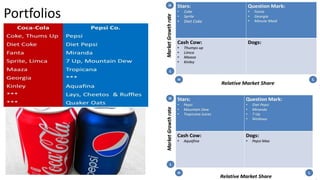
Portfolios
Role of Advertisement in Building the various
brand of the two soft drink major
• The soft drink industry is marked by severe
competition
• Company can sustain Position on the basis of
Advertisements and Branding
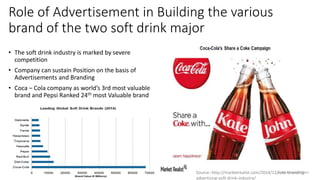
• Coca – Cola company as world’s 3rd most valuable
brand and Pepsi Ranked 24th most Valuable brand
Source:-http://marketrealist.com/2014/11/role-branding-
advertising-soft-drink-industry/
How had the advertising of each of two brand
evolved over the time in India
Coca- Cola
1. “Hill Top” commercial –
1993
2. “Always Coca- Cola”-
(1994-1998)
3. “Thanda Matlab Coca-
Cola”- 2003
4. “Little Drop of Joy”-
(2007-2008)
5. “Open Happiness” &
“Coke opens up the
Possibility” – (2009-
2010)
Pepsi
1. “Yehi Hai Right Choice
Baby campaign Ah-
Ha”- (1990-1994)
2. “Nothing official About
it”- 1996
3. “Yeh Dil Mange More”-
2001
4. “Dare for More”- 2004
5. “Join the blue billion” –
2006
6. “Youngistan” – 2008
7. “Youngistan’s Wow” -
2010
India and USA Markets
 Soft drink industry in India is worth ₹50 billion (year 2012) growing at 6% CAGR
 Carbonated drink segment has 62% market share in overall soft drink industry
 In USA, soft drink market is valued at $97.82 billion with leading companies- PepsiCo, Coca Cola and Dr Pepper
Snapple
 Per capita consumption of carbonates in USA was 180 gallons per year in 2007 which was 45 times than that in India
 Diet Coke and Diet Pepsi form a major share of market in USA while in India it is less than 1% combined without any
growth
 In USA, market share of both Pepsi and Coca Cola has reduced 7% and 5.8% respectively from 2007 to 2009 while in
India the market share has increased slightly by 1.3% for Pepsi and 5.25% for Coca Cola
 Home-grown drinks such as Thums Up and Limca which were acquired by Coca Cola are still strong in the market with
combined market share of 25%
 The biggest differentiation is the growth of local or new brands in US market which command a market share of
43.8% and has seen a growing trend while in India this segment has reduced from 9.5% in 2007 to 7.6% in 2009
showing the influence of big brands on Indian consumers
Source: HBS
Localization of Brand
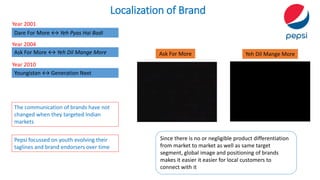
Ask For More ↔ Yeh Dil Mange More
Dare For More ↔ Yeh Pyas Hai Badi
The communication of brands have not
changed when they targeted Indian
markets
Since there is no or negligible product differentiation
from market to market as well as same target
segment, global image and positioning of brands
makes it easier it easier for local customers to
connect with it
Youngistan ↔ Generation Next
Ask For More Yeh Dil Mange More
Year 2001
Year 2004
Year 2010
Pepsi focussed on youth evolving their
taglines and brand endorsers over time
Localization of Brand
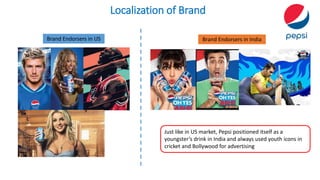
Brand Endorsers in US Brand Endorsers in India
Just like in US market, Pepsi positioned itself as a
youngster’s drink in India and always used youth icons in
cricket and Bollywood for advertising
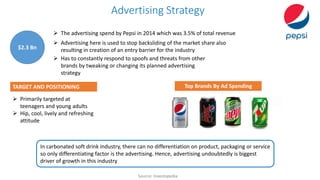
Advertising Strategy
$2.3 Bn
 The advertising spend by Pepsi in 2014 which was 3.5% of total revenue
 Advertising here is used to stop backsliding of the market share also
resulting in creation of an entry barrier for the industry
Source: Investopedia
TARGET AND POSITIONING
 Primarily targeted at
teenagers and young adults
 Hip, cool, lively and refreshing
attitude
 Has to constantly respond to spoofs and threats from other
brands by tweaking or changing its planned advertising
strategy
Top Brands By Ad Spending
In carbonated soft drink industry, there can no differentiation on product, packaging or service
so only differentiating factor is the advertising. Hence, advertising undoubtedly is biggest
driver of growth in this industry
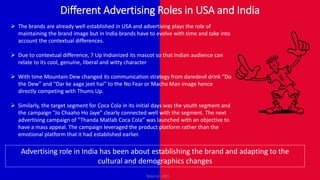
Different Advertising Roles in USA and India
 The brands are already well established in USA and advertising plays the role of
maintaining the brand image but in India brands have to evolve with time and take into
account the contextual differences.
 Due to contextual difference, 7 Up Indianized its mascot so that Indian audience can
relate to its cool, genuine, liberal and witty character
 With time Mountain Dew changed its communication strategy from daredevil drink “Do
the Dew” and “Dar ke aage jeet hai” to the No Fear or Macho Man image hence
directly competing with Thums Up.
 Similarly, the target segment for Coca Cola in its initial days was the youth segment and
the campaign “Jo Chaaho Ho Jaye” clearly connected well with the segment. The next
advertising campaign of ”Thanda Matlab Coca Cola” was launched with an objective to
have a mass appeal. The campaign leveraged the product platform rather than the
emotional platform that it had established earlier.
Advertising role in India has been about establishing the brand and adapting to the
cultural and demographics changes
Source: HBS
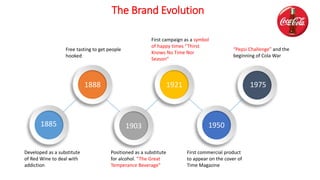
1885
1888
1903
1921
1950
1975
Developed as a substitute
of Red Wine to deal with
addiction
Free tasting to get people
hooked
Positioned as a substitute
for alcohol. “The Great
Temperance Beverage”
First campaign as a symbol
of happy times “Thirst
Knows No Time Nor
Season”
First commercial product
to appear on the cover of
Time Magazine
“Pepsi Challenge” and the
beginning of Cola War
The Brand Evolution
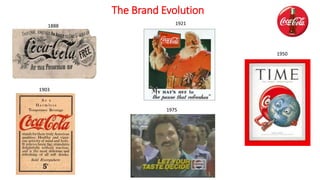
The Brand Evolution
1888
1903
1921
1950
1975
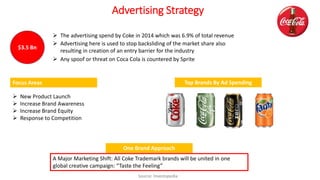
Advertising Strategy
$3.5 Bn
 The advertising spend by Coke in 2014 which was 6.9% of total revenue
 New Product Launch
 Increase Brand Awareness
 Increase Brand Equity
 Response to Competition
Focus Areas
Source: Investopedia
 Advertising here is used to stop backsliding of the market share also
resulting in creation of an entry barrier for the industry
Top Brands By Ad Spending
A Major Marketing Shift: All Coke Trademark brands will be united in one
global creative campaign: “Taste the Feeling”
One Brand Approach
 Any spoof or threat on Coca Cola is countered by Sprite

Coke vs pepsi

  • 1.
    Group 1 Ishant Singh159278117 Ravi Chouhan 159278071 Rishabh Tanwar 159278073
  • 2.
    Case Outline • Caseis all about “Managing Brands over Geographic Boundaries and Market Segments” • In order to build Global Customer Based Brand Equity following Points should be kept in Mind 1. Understand the similarities and differences in the Global Branding Landscape 2. Do not take shortcuts in brand building 3. Establish marketing infrastructure 4. Balance Global and Local control 5. Leverage brand elements • Advertising and marketing campaigns have considerably increased • In 2013, Coca-Cola spent $3.37 billion, or 7.0% of it’s 2013 revenues, on advertising— including in-store activations, loyalty points programs, and point-of-sale marketing • PepsiCo, Inc. (PEP), Coca-Cola’s closest rival, spent $3.9 billion in advertising expenses and marketing activities, representing 5.9% of its 2013 revenues Source: Investopedia
  • 3.
  • 4.
    Role of Advertisementin Building the various brand of the two soft drink major • The soft drink industry is marked by severe competition • Company can sustain Position on the basis of Advertisements and Branding • Coca – Cola company as world’s 3rd most valuable brand and Pepsi Ranked 24th most Valuable brand Source:-http://marketrealist.com/2014/11/role-branding- advertising-soft-drink-industry/
  • 5.
    How had theadvertising of each of two brand evolved over the time in India Coca- Cola 1. “Hill Top” commercial – 1993 2. “Always Coca- Cola”- (1994-1998) 3. “Thanda Matlab Coca- Cola”- 2003 4. “Little Drop of Joy”- (2007-2008) 5. “Open Happiness” & “Coke opens up the Possibility” – (2009- 2010) Pepsi 1. “Yehi Hai Right Choice Baby campaign Ah- Ha”- (1990-1994) 2. “Nothing official About it”- 1996 3. “Yeh Dil Mange More”- 2001 4. “Dare for More”- 2004 5. “Join the blue billion” – 2006 6. “Youngistan” – 2008 7. “Youngistan’s Wow” - 2010
  • 6.
    India and USAMarkets  Soft drink industry in India is worth ₹50 billion (year 2012) growing at 6% CAGR  Carbonated drink segment has 62% market share in overall soft drink industry  In USA, soft drink market is valued at $97.82 billion with leading companies- PepsiCo, Coca Cola and Dr Pepper Snapple  Per capita consumption of carbonates in USA was 180 gallons per year in 2007 which was 45 times than that in India  Diet Coke and Diet Pepsi form a major share of market in USA while in India it is less than 1% combined without any growth  In USA, market share of both Pepsi and Coca Cola has reduced 7% and 5.8% respectively from 2007 to 2009 while in India the market share has increased slightly by 1.3% for Pepsi and 5.25% for Coca Cola  Home-grown drinks such as Thums Up and Limca which were acquired by Coca Cola are still strong in the market with combined market share of 25%  The biggest differentiation is the growth of local or new brands in US market which command a market share of 43.8% and has seen a growing trend while in India this segment has reduced from 9.5% in 2007 to 7.6% in 2009 showing the influence of big brands on Indian consumers Source: HBS
  • 7.
    Localization of Brand AskFor More ↔ Yeh Dil Mange More Dare For More ↔ Yeh Pyas Hai Badi The communication of brands have not changed when they targeted Indian markets Since there is no or negligible product differentiation from market to market as well as same target segment, global image and positioning of brands makes it easier it easier for local customers to connect with it Youngistan ↔ Generation Next Ask For More Yeh Dil Mange More Year 2001 Year 2004 Year 2010 Pepsi focussed on youth evolving their taglines and brand endorsers over time
  • 8.
    Localization of Brand BrandEndorsers in US Brand Endorsers in India Just like in US market, Pepsi positioned itself as a youngster’s drink in India and always used youth icons in cricket and Bollywood for advertising
  • 9.
    Advertising Strategy $2.3 Bn The advertising spend by Pepsi in 2014 which was 3.5% of total revenue  Advertising here is used to stop backsliding of the market share also resulting in creation of an entry barrier for the industry Source: Investopedia TARGET AND POSITIONING  Primarily targeted at teenagers and young adults  Hip, cool, lively and refreshing attitude  Has to constantly respond to spoofs and threats from other brands by tweaking or changing its planned advertising strategy Top Brands By Ad Spending In carbonated soft drink industry, there can no differentiation on product, packaging or service so only differentiating factor is the advertising. Hence, advertising undoubtedly is biggest driver of growth in this industry
  • 10.
    Different Advertising Rolesin USA and India  The brands are already well established in USA and advertising plays the role of maintaining the brand image but in India brands have to evolve with time and take into account the contextual differences.  Due to contextual difference, 7 Up Indianized its mascot so that Indian audience can relate to its cool, genuine, liberal and witty character  With time Mountain Dew changed its communication strategy from daredevil drink “Do the Dew” and “Dar ke aage jeet hai” to the No Fear or Macho Man image hence directly competing with Thums Up.  Similarly, the target segment for Coca Cola in its initial days was the youth segment and the campaign “Jo Chaaho Ho Jaye” clearly connected well with the segment. The next advertising campaign of ”Thanda Matlab Coca Cola” was launched with an objective to have a mass appeal. The campaign leveraged the product platform rather than the emotional platform that it had established earlier. Advertising role in India has been about establishing the brand and adapting to the cultural and demographics changes Source: HBS
  • 11.
    1885 1888 1903 1921 1950 1975 Developed as asubstitute of Red Wine to deal with addiction Free tasting to get people hooked Positioned as a substitute for alcohol. “The Great Temperance Beverage” First campaign as a symbol of happy times “Thirst Knows No Time Nor Season” First commercial product to appear on the cover of Time Magazine “Pepsi Challenge” and the beginning of Cola War The Brand Evolution
  • 12.
  • 13.
    Advertising Strategy $3.5 Bn The advertising spend by Coke in 2014 which was 6.9% of total revenue  New Product Launch  Increase Brand Awareness  Increase Brand Equity  Response to Competition Focus Areas Source: Investopedia  Advertising here is used to stop backsliding of the market share also resulting in creation of an entry barrier for the industry Top Brands By Ad Spending A Major Marketing Shift: All Coke Trademark brands will be united in one global creative campaign: “Taste the Feeling” One Brand Approach  Any spoof or threat on Coca Cola is countered by Sprite