By: Team Awesome
-Michelle
-Astha
-Lauren
-John
 New  products produced almost daily
 Factors influencing consumer consumption:
    Weather
    Consumer taste
    Demographics
    Lifestyles
 Coca-Cola is the worlds largest manufacture,
 distributor and marketer of non-alcoholic
 beverages
    Carry over 3500 different products
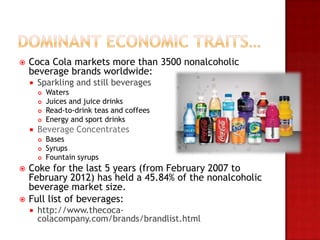
   Coca Cola markets more than 3500 nonalcoholic
    beverage brands worldwide:
       Sparkling and still beverages
           Waters
           Juices and juice drinks
           Read-to-drink teas and coffees
           Energy and sport drinks
       Beverage Concentrates
           Bases
           Syrups
           Fountain syrups
   Coke for the last 5 years (from February 2007 to
    February 2012) has held a 45.84% of the nonalcoholic
    beverage market size.
   Full list of beverages:
       http://www.thecoca-
        colacompany.com/brands/brandlist.html
   Coke’s rivals on a
    national scale:                 Degree of product
       Pepsi Co                     differentiation:
       Nestle                          Low prices
       Dr. Pepper Snapple              Product Innovation
       Groupe Danone
                                        Brand and trademark
       Kraft Foods Inc
                                         development and
   Learning and Experience              protection
    Curve:
     In 2011 the distribution
                                        Introduction to new
      of white Christmas coke            packaging
      to promote cans resulted          Sales promotion
      in angry tweets from               programs
      caring consumers getting
      confused with the Diet            Advertising
      Coke cans.
                                        Increased efficiency
     In 1985 unsuccessfully
      tried to change the                in production
      original formula.                  techniques
                                        New vending and
                                         dispensing equipment
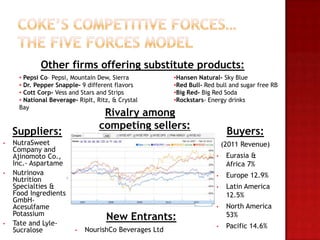
Other firms offering substitute products:
     • Pepsi Co– Pepsi, Mountain Dew, Sierra           •Hansen Natural- Sky Blue
     • Dr. Pepper Snapple- 9 different flavors         •Red Bull- Red bull and sugar free RB
     • Cott Corp- Vess and Stars and Strips            •Big Red- Big Red Soda
     • National Beverage- RipIt, Ritz, & Crystal       •Rockstars- Energy drinks
     Bay
                                   Rivalry among
                                  competing sellers:
    Suppliers:                                                             Buyers:
•   NutraSweet                                                            (2011 Revenue)
    Company and
    Ajinomoto Co.,                                                    •    Eurasia &
    Inc.- Aspartame                                                        Africa 7%
•   Nutrinova                                                         •    Europe 12.9%
    Nutrition
    Specialties &                                                     •    Latin America
    Food Ingredients                                                       12.5%
    GmbH-
    Acesulfame                                                        •    North America
    Potassium
                                    New Entrants:                          53%
•   Tate and Lyle-                                                    •    Pacific 14.6%
    Sucralose            •   NourishCo Beverages Ltd
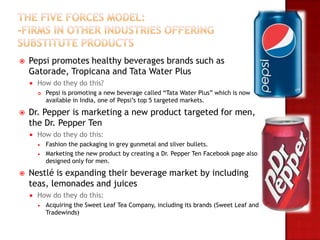
   Pepsi promotes healthy beverages brands such as
    Gatorade, Tropicana and Tata Water Plus
       How do they do this?
           Pepsi is promoting a new beverage called “Tata Water Plus” which is now
            available in India, one of Pepsi’s top 5 targeted markets.

   Dr. Pepper is marketing a new product targeted for men,
    the Dr. Pepper Ten
       How do they do this:
           Fashion the packaging in grey gunmetal and silver bullets.
           Marketing the new product by creating a Dr. Pepper Ten Facebook page also
            designed only for men.

   Nestlé is expanding their beverage market by including
    teas, lemonades and juices
       How do they do this:
           Acquiring the Sweet Leaf Tea Company, including its brands (Sweet Leaf and
            Tradewinds)
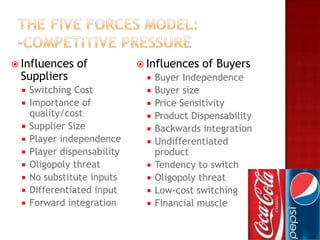
 Influences   of             Influences   of Buyers
 Suppliers                       Buyer Independence
    Switching Cost              Buyer size
    Importance of               Price Sensitivity
     quality/cost                Product Dispensability
    Supplier Size               Backwards integration
    Player independence         Undifferentiated
    Player dispensability        product
    Oligopoly threat            Tendency to switch
    No substitute inputs        Oligopoly threat
    Differentiated input        Low-cost switching
    Forward integration         Financial muscle
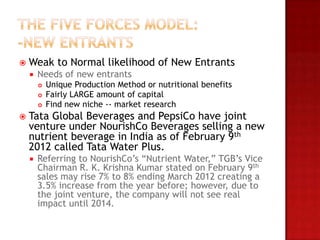
   Weak to Normal likelihood of New Entrants
       Needs of new entrants
           Unique Production Method or nutritional benefits
           Fairly LARGE amount of capital
           Find new niche -- market research
   Tata Global Beverages and PepsiCo have joint
    venture under NourishCo Beverages selling a new
    nutrient beverage in India as of February 9th
    2012 called Tata Water Plus.
       Referring to NourishCo’s “Nutrient Water,” TGB’s Vice
        Chairman R. K. Krishna Kumar stated on February 9th
        sales may rise 7% to 8% ending March 2012 creating a
        3.5% increase from the year before; however, due to
        the joint venture, the company will not see real
        impact until 2014.
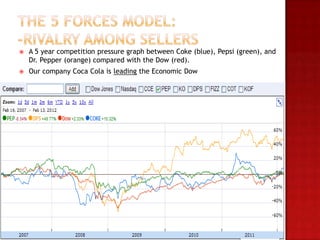
   A 5 year competition pressure graph between Coke (blue), Pepsi (green), and
    Dr. Pepper (orange) compared with the Dow (red).
   Our company Coca Cola is leading the Economic Dow
   Overall average strength of competitive forces in the US,
    China and Europe – NEED TO CHANGE ONCE DONE
       Suppliers = Moderate
       Buyers= Weak to Moderate
       Substitute products= Moderate
       Potential new entrants = Weak to Moderate
       Rivalry= Moderate
   Collective Strength
     By looking at the 5 Forces Model, our company is moderately
      sensitive to their suppliers, buyers, substitute products, rivalry
      with the other companies and potential new entrants.
     Coke’s competitive environment is neither ideal nor unattractive
      because
           rivalry is vigorous
           entry barriers are low but entry is likely
           competition from competitors is on average moderate from our
            sample
           the suppliers and customers have considerable bargaining power
           Good substitutes do exist
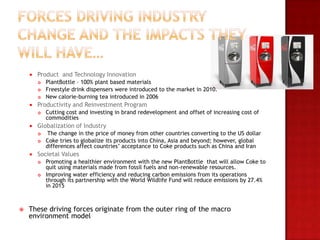
   Product and Technology Innovation
           PlantBottle – 100% plant based materials
           Freestyle drink dispensers were introduced to the market in 2010.
           New calorie-burning tea introduced in 2006
       Productivity and Reinvestment Program
           Cutting cost and investing in brand redevelopment and offset of increasing cost of
            commodities
       Globalization of Industry
           The change in the price of money from other countries converting to the US dollar
           Coke tries to globalize its products into China, Asia and beyond; however, global
            differences affect countries’ acceptance to Coke products such as China and Iran
       Societal Values
           Promoting a healthier environment with the new PlantBottle that will allow Coke to
            quit using materials made from fossil fuels and non-renewable resources.
           Improving water efficiency and reducing carbon emissions from its operations
            through its partnership with the World Wildlife Fund will reduce emissions by 27.4%
            in 2015


   These driving forces originate from the outer ring of the macro
    environment model
   Soft Drinks in China
       Groupe Danone at…………………………20.3%
       Tingyi Holding Corp at………………….15.5%
       Coca-Cola Company at………………….10.7%
       Others at……………………………………….53.6%
   Soft Drinks in Europe
       Coca Cola at………………………………….16.5%
       PepsiCo, Inc at…………………………….….6.6%
       Nestle S.A. at……………………………….…6.2%
       Others at……………………………………….70.8%
   Soft Drinks in USA
       Coca Cola at………………………………...27.7%
       PepsiCo, Inc at……………………………..24.4%
       Nestle S.A. at………………………………...8.4%
       Others at……………………………………….39.4%
 Pepsi      Co
     By joining forces with Tata Global Beverages to
      produce a nutritious drink for their buyers,
      NourishCO will observe their revenues over the
      next few years to see if joining forces was a
      financially smart and competitive move in the
      market
 Dr.     Pepper Snapple
     Slimming Down Project
         Last month Dr. Pepper started testing 5 of their other
          products to follow Dr. Pepper Ten in hopes of
          continuing promising sales
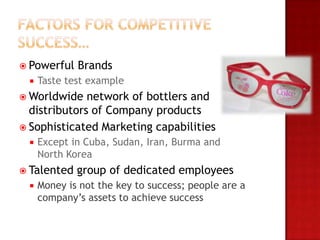
 Powerful   Brands
    Taste test example
 Worldwide   network of bottlers and
  distributors of Company products
 Sophisticated Marketing capabilities
    Except in Cuba, Sudan, Iran, Burma and
     North Korea
 Talented   group of dedicated employees
    Money is not the key to success; people are a
     company’s assets to achieve success
 The  soft drink industry has a large growth
  potential as the market moves towards
  healthier new beverages.
 PepsiCo and Nestlé are constantly keeping
  Coke on its toes to stay ahead of the game
 Coke recognizes the potential risks and
  vulnerabilities that could hurt their business
  (ex: obesity, changes in laws and regulations,
  and unfavorable economic and political
  circumstances in the international markets)
We believe that The Coca-Cola
Company is moderately sensitive
to the market. Based on the
competitive analysis of market
positions, the Five Forces Model
and the NYSE anything is possible
but since TCCC is a large
established and vastly located
around the world, it would be
pretty hard to knock down this
bully without a strategic plan.

Coca Cola Executive Summary

  • 1.
  • 2.
     New products produced almost daily  Factors influencing consumer consumption:  Weather  Consumer taste  Demographics  Lifestyles  Coca-Cola is the worlds largest manufacture, distributor and marketer of non-alcoholic beverages  Carry over 3500 different products
  • 3.
    Coca Cola markets more than 3500 nonalcoholic beverage brands worldwide:  Sparkling and still beverages  Waters  Juices and juice drinks  Read-to-drink teas and coffees  Energy and sport drinks  Beverage Concentrates  Bases  Syrups  Fountain syrups  Coke for the last 5 years (from February 2007 to February 2012) has held a 45.84% of the nonalcoholic beverage market size.  Full list of beverages:  http://www.thecoca- colacompany.com/brands/brandlist.html
  • 4.
    Coke’s rivals on a national scale:  Degree of product  Pepsi Co differentiation:  Nestle  Low prices  Dr. Pepper Snapple  Product Innovation  Groupe Danone  Brand and trademark  Kraft Foods Inc development and  Learning and Experience protection Curve:  In 2011 the distribution  Introduction to new of white Christmas coke packaging to promote cans resulted  Sales promotion in angry tweets from programs caring consumers getting confused with the Diet  Advertising Coke cans.  Increased efficiency  In 1985 unsuccessfully tried to change the in production original formula. techniques  New vending and dispensing equipment
  • 5.
    Other firms offeringsubstitute products: • Pepsi Co– Pepsi, Mountain Dew, Sierra •Hansen Natural- Sky Blue • Dr. Pepper Snapple- 9 different flavors •Red Bull- Red bull and sugar free RB • Cott Corp- Vess and Stars and Strips •Big Red- Big Red Soda • National Beverage- RipIt, Ritz, & Crystal •Rockstars- Energy drinks Bay Rivalry among competing sellers: Suppliers: Buyers: • NutraSweet (2011 Revenue) Company and Ajinomoto Co., • Eurasia & Inc.- Aspartame Africa 7% • Nutrinova • Europe 12.9% Nutrition Specialties & • Latin America Food Ingredients 12.5% GmbH- Acesulfame • North America Potassium New Entrants: 53% • Tate and Lyle- • Pacific 14.6% Sucralose • NourishCo Beverages Ltd
  • 6.
    Pepsi promotes healthy beverages brands such as Gatorade, Tropicana and Tata Water Plus  How do they do this?  Pepsi is promoting a new beverage called “Tata Water Plus” which is now available in India, one of Pepsi’s top 5 targeted markets.  Dr. Pepper is marketing a new product targeted for men, the Dr. Pepper Ten  How do they do this:  Fashion the packaging in grey gunmetal and silver bullets.  Marketing the new product by creating a Dr. Pepper Ten Facebook page also designed only for men.  Nestlé is expanding their beverage market by including teas, lemonades and juices  How do they do this:  Acquiring the Sweet Leaf Tea Company, including its brands (Sweet Leaf and Tradewinds)
  • 7.
     Influences of  Influences of Buyers Suppliers  Buyer Independence  Switching Cost  Buyer size  Importance of  Price Sensitivity quality/cost  Product Dispensability  Supplier Size  Backwards integration  Player independence  Undifferentiated  Player dispensability product  Oligopoly threat  Tendency to switch  No substitute inputs  Oligopoly threat  Differentiated input  Low-cost switching  Forward integration  Financial muscle
  • 8.
    Weak to Normal likelihood of New Entrants  Needs of new entrants  Unique Production Method or nutritional benefits  Fairly LARGE amount of capital  Find new niche -- market research  Tata Global Beverages and PepsiCo have joint venture under NourishCo Beverages selling a new nutrient beverage in India as of February 9th 2012 called Tata Water Plus.  Referring to NourishCo’s “Nutrient Water,” TGB’s Vice Chairman R. K. Krishna Kumar stated on February 9th sales may rise 7% to 8% ending March 2012 creating a 3.5% increase from the year before; however, due to the joint venture, the company will not see real impact until 2014.
  • 9.
    A 5 year competition pressure graph between Coke (blue), Pepsi (green), and Dr. Pepper (orange) compared with the Dow (red).  Our company Coca Cola is leading the Economic Dow
  • 10.
    Overall average strength of competitive forces in the US, China and Europe – NEED TO CHANGE ONCE DONE  Suppliers = Moderate  Buyers= Weak to Moderate  Substitute products= Moderate  Potential new entrants = Weak to Moderate  Rivalry= Moderate  Collective Strength  By looking at the 5 Forces Model, our company is moderately sensitive to their suppliers, buyers, substitute products, rivalry with the other companies and potential new entrants.  Coke’s competitive environment is neither ideal nor unattractive because  rivalry is vigorous  entry barriers are low but entry is likely  competition from competitors is on average moderate from our sample  the suppliers and customers have considerable bargaining power  Good substitutes do exist
  • 11.
    Product and Technology Innovation  PlantBottle – 100% plant based materials  Freestyle drink dispensers were introduced to the market in 2010.  New calorie-burning tea introduced in 2006  Productivity and Reinvestment Program  Cutting cost and investing in brand redevelopment and offset of increasing cost of commodities  Globalization of Industry  The change in the price of money from other countries converting to the US dollar  Coke tries to globalize its products into China, Asia and beyond; however, global differences affect countries’ acceptance to Coke products such as China and Iran  Societal Values  Promoting a healthier environment with the new PlantBottle that will allow Coke to quit using materials made from fossil fuels and non-renewable resources.  Improving water efficiency and reducing carbon emissions from its operations through its partnership with the World Wildlife Fund will reduce emissions by 27.4% in 2015  These driving forces originate from the outer ring of the macro environment model
  • 12.
    Soft Drinks in China  Groupe Danone at…………………………20.3%  Tingyi Holding Corp at………………….15.5%  Coca-Cola Company at………………….10.7%  Others at……………………………………….53.6%  Soft Drinks in Europe  Coca Cola at………………………………….16.5%  PepsiCo, Inc at…………………………….….6.6%  Nestle S.A. at……………………………….…6.2%  Others at……………………………………….70.8%  Soft Drinks in USA  Coca Cola at………………………………...27.7%  PepsiCo, Inc at……………………………..24.4%  Nestle S.A. at………………………………...8.4%  Others at……………………………………….39.4%
  • 13.
     Pepsi Co  By joining forces with Tata Global Beverages to produce a nutritious drink for their buyers, NourishCO will observe their revenues over the next few years to see if joining forces was a financially smart and competitive move in the market  Dr. Pepper Snapple  Slimming Down Project  Last month Dr. Pepper started testing 5 of their other products to follow Dr. Pepper Ten in hopes of continuing promising sales
  • 14.
     Powerful Brands  Taste test example  Worldwide network of bottlers and distributors of Company products  Sophisticated Marketing capabilities  Except in Cuba, Sudan, Iran, Burma and North Korea  Talented group of dedicated employees  Money is not the key to success; people are a company’s assets to achieve success
  • 15.
     The soft drink industry has a large growth potential as the market moves towards healthier new beverages.  PepsiCo and Nestlé are constantly keeping Coke on its toes to stay ahead of the game  Coke recognizes the potential risks and vulnerabilities that could hurt their business (ex: obesity, changes in laws and regulations, and unfavorable economic and political circumstances in the international markets)
  • 16.
    We believe thatThe Coca-Cola Company is moderately sensitive to the market. Based on the competitive analysis of market positions, the Five Forces Model and the NYSE anything is possible but since TCCC is a large established and vastly located around the world, it would be pretty hard to knock down this bully without a strategic plan.