CST Review
Carbon & Life
Molecules
CST Review
Carbon and
Life Molecules
Copyright Richards 2009
Class Work
Copyright Richards 2009
Class Work
Study
BrainPop
Crystals
Brain Pop
Click picture to go to this BrainPop
BrainPop
Body Chemistry
Brain Pop
Click picture to go to this BrainPop
CST Review
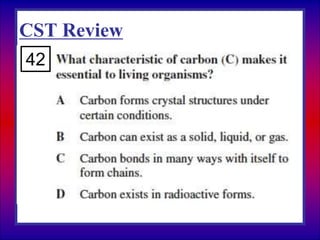
42
Why is carbon important to living things?
I. Carbon is the most important
element in living things because
of its special properties.
Why is carbon important to living things?
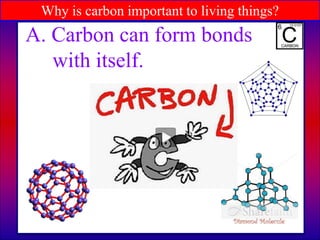
A. Carbon can form bonds
with itself.
Why is carbon important to living things?
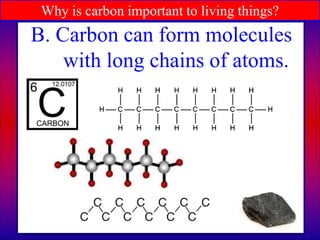
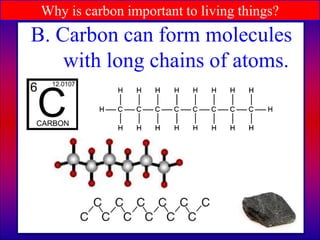
B. Carbon can form molecules
with long chains of atoms.
Why is carbon important to living things?
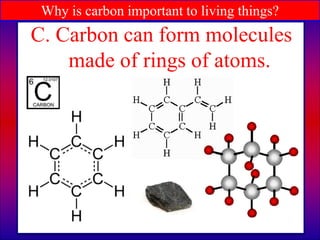
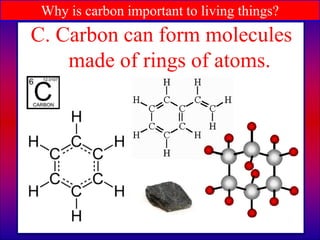
C. Carbon can form molecules
made of rings of atoms.
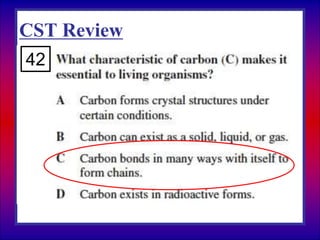
CST Review
42
CST Review
42
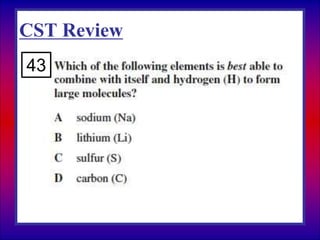
CST Review
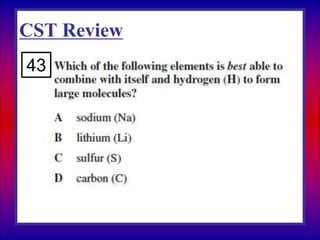
43
Carbon: Chemistry of Life
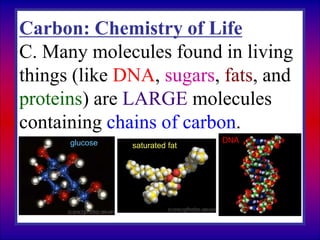
C. Many molecules found in living
things (like DNA, sugars, fats, and
proteins) are LARGE molecules
containing chains of carbon.
glucose saturated fat
DNA
Carbon: Chemistry of Life
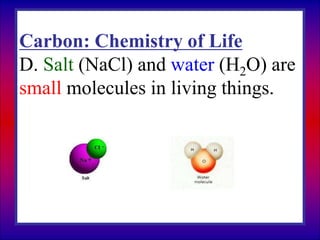
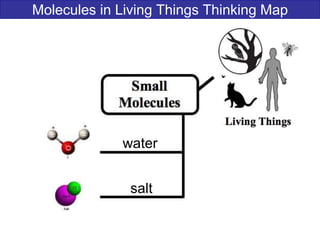
D. Salt (NaCl) and water (H2O) are
small molecules in living things.
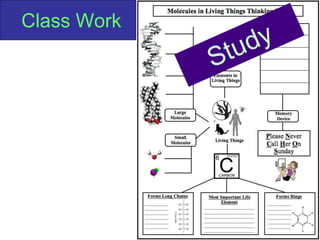
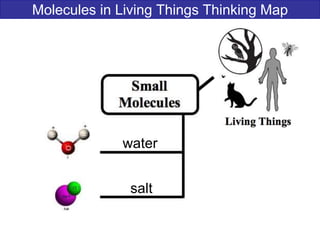
Molecules in Living Things Thinking Map
water
salt
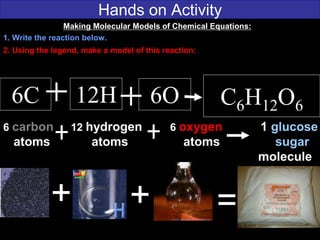
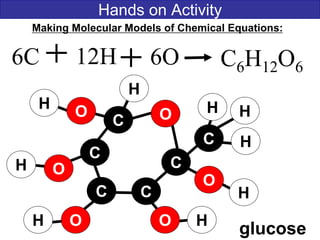
Hands on Activity
6C 12H C6H12O6
6 carbon 12 hydrogen 6 oxygen 1 glucose
atoms atoms atoms sugar
molecule
=+
Making Molecular Models of Chemical Equations:
1. Write the reaction below.
2. Using the legend, make a model of this reaction:
6O
+
glucose
Hands on Activity
6C 12H C6H12O6
Making Molecular Models of Chemical Equations:
6O
O
O
O
O
H
O
O
C
C
C C
C
C
H
H
H
H H
H
H
H
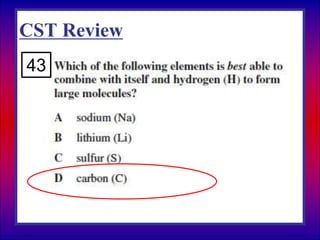
CST Review
43
CST Review
43
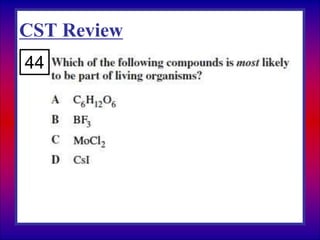
CST Review
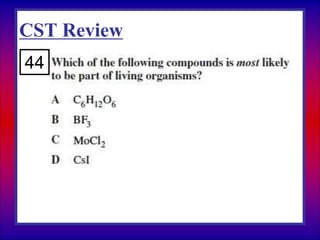
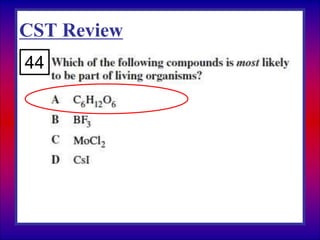
44
Carbon: Chemistry of Life
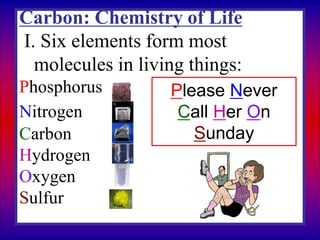
I. Six elements form most
molecules in living things:
Phosphorus
Nitrogen
Carbon
Hydrogen
Oxygen
Sulfur
Please Never
Call Her On
Sunday
CST Review
44
CST Review
44
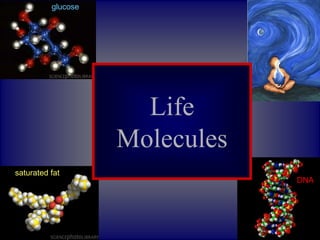
glucose
saturated fat
DNA
Life
Molecules
Think-Group-Share
What are three special
properties of carbon?
Think-Group-Share
What are three special
properties of carbon?
Carbon can bond to itself.
 Carbon can form long chains.
 Carbon can form rings.
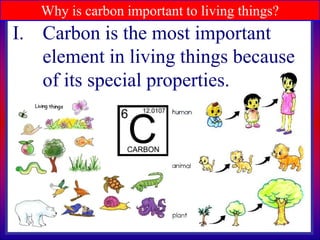
Why is carbon important to living things?
I. Carbon is the most important
element in living things because
of its special properties.
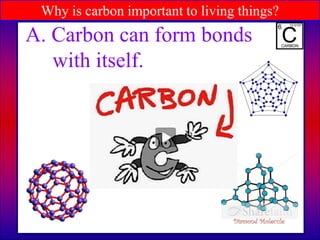
Why is carbon important to living things?
A. Carbon can form bonds
with itself.
Why is carbon important to living things?
B. Carbon can form molecules
with long chains of atoms.
Why is carbon important to living things?
C. Carbon can form molecules
made of rings of atoms.
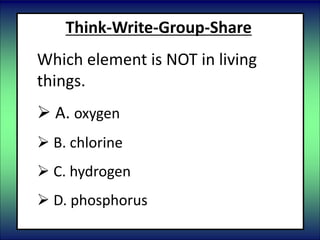
Think-Write-Group-Share
Which element is NOT in living
things.
 A. oxygen
 B. chlorine
 C. hydrogen
 D. phosphorus
Think-Write-Group-Share
Which element is NOT in living
things.
 A. oxygen
 B. chlorine
 C. hydrogen
 D. phosphorus
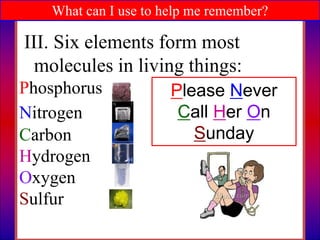
III. Six elements form most
molecules in living things:
Phosphorus
Nitrogen
Carbon
Hydrogen
Oxygen
Sulfur
Please Never
Call Her On
Sunday
What can I use to help me remember?
Think-Write-Group-Share
Which of the following is a small
molecule in living things.
 A. DNA
 B. fat
 C. water
 D. protein
Think-Write-Group-Share
Which of the following is a small
molecule in living things.
 A. DNA
 B. fat
 C. water
 D. protein
Molecules in Living Things Thinking Map
water
salt
Think-Write-Group-Share
Which of the following are large
molecules in living things.
 A. salt
 B. fat
 C. water
 D. protein
Think-Write-Group-Share
Which of the following are large
molecules in living things.
 A. salt
 B. fat
 C. water
 D. protein
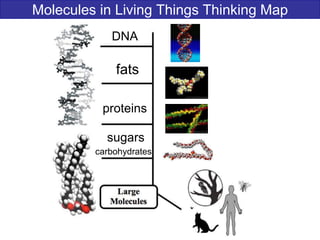
Molecules in Living Things Thinking Map
DNA
fats
proteins
sugars
carbohydrates
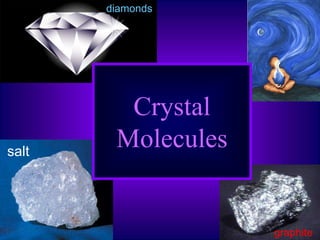
diamonds
salt
graphite
Crystal
Molecules
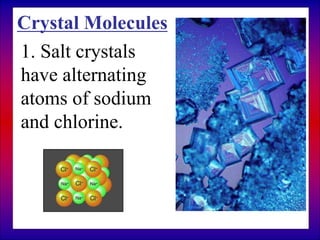
1. Salt crystals
have alternating
atoms of sodium
and chlorine.
Crystal Molecules
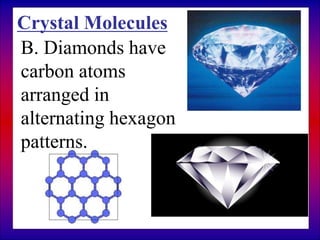
B. Diamonds have
carbon atoms
arranged in
alternating hexagon
patterns.
Crystal Molecules
Copyright Richards 2009
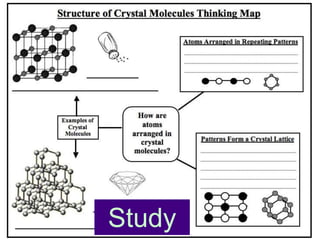
Structure of Crystal
Molecules Thinking
Map
Page 51
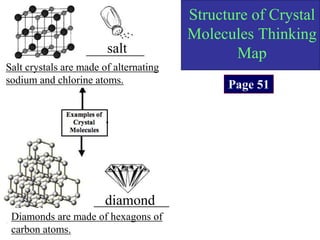
salt
Salt crystals are made of alternating
sodium and chlorine atoms.
diamond
Diamonds are made of hexagons of
carbon atoms.
Think-Write-Group-Share
Which of these molecules form
a crystal?
 A. carbon dioxide
 B. salt
 C. water
 D. diamonds
Think-Write-Group-Share
Which of these molecules form
a crystal?
 A. carbon dioxide
 B. salt
 C. water
 D. diamonds
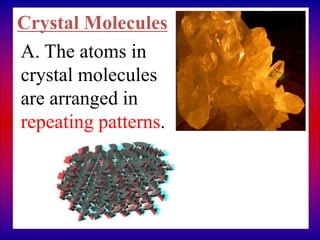
A. The atoms in
crystal molecules
are arranged in
repeating patterns.
Crystal Molecules
Think-Write-Group-Share
How are atoms arranged
in crystal molecules?
 A. randomly
 B. in repeating patterns
 C. in spirals
Think-Write-Group-Share
How are atoms arranged
in crystal molecules?
 A. randomly
 B. in repeating patterns
 C. in spirals
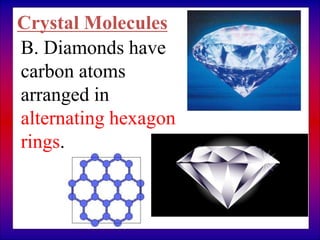
B. Diamonds have
carbon atoms
arranged in
alternating hexagon
rings.
Crystal Molecules
Think-Write-Group-Share
How are carbon atoms
arranged in a diamond?
 A. hexagonal rings
 B. long chains
 C. spirals
D. alternating rows
Think-Write-Group-Share
How are carbon atoms
arranged in a diamond?
 A. hexagonal rings
 B. long chains
 C. spirals
D. alternating rows
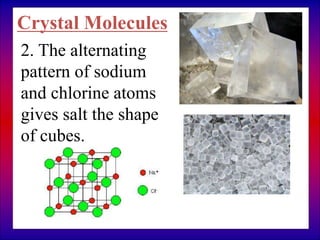
Crystal Molecules
2. The alternating
pattern of sodium
and chlorine atoms
gives salt the shape
of cubes.
Think-Write-Group-Share
How are atoms arranged in a salt
molecule?
 A. rings of alternating chlorine and
sodium atoms.
 B. chains of repeating chlorine atoms
 C. a cube of alternating sodium and
chlorine atoms.
Think-Write-Group-Share
How are atoms arranged in a salt
molecule?
 A. rings of alternating chlorine and
sodium atoms.
 B. chains of repeating chlorine atoms
 C. a cube of alternating sodium
and chlorine atoms.
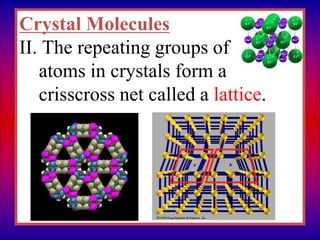
Crystal Molecules
II. The repeating groups of
atoms in crystals form a
crisscross net called a lattice.
Think-Write-Group-Share
In crystals repeating
patterns of atoms form
 A. a chain
 B. a ring
 C. a lattice
Think-Write-Group-Share
In crystals repeating
patterns of atoms form
 A. a chain
 B. a ring
 C. a lattice

CST Review Carbon Crystals Life Molecules