•Take some time to consider the question before
moving to the next slide which offers the correct
answer.
•Write your answer down before you see the actual
answer, this will allow you to test yourself more
effectively.
CHECK YOUR LEARNING
MACROMOLECULES
Free to share, print, make copies and changes. Get yours at www.boundless.com
Biological Macromolecules
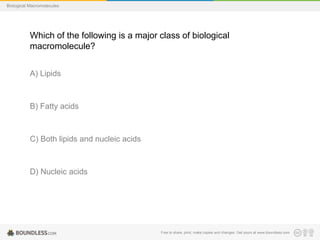
Which of the following is a major class of biological
macromolecule?
A) Lipids
B) Fatty acids
C) Both lipids and nucleic acids
D) Nucleic acids
Free to share, print, make copies and changes. Get yours at www.boundless.com
Boundless - LO. "Boundless." CC BY-SA 3.0 http://www.boundless.com/
Biological Macromolecules
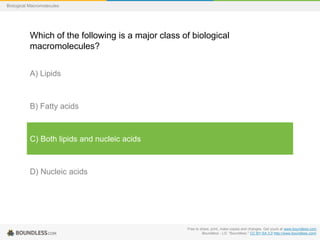
Which of the following is a major class of biological
macromolecules?
A) Lipids
B) Fatty acids
C) Both lipids and nucleic acids
D) Nucleic acids
Free to share, print, make copies and changes. Get yours at www.boundless.com
Biological Macromolecules
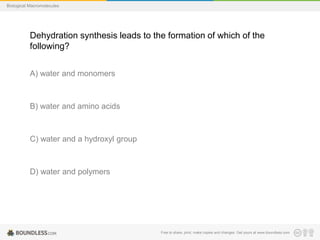
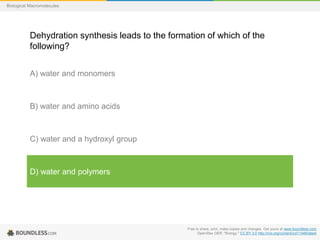
Dehydration synthesis leads to the formation of which of the
following?
A) water and monomers
B) water and amino acids
C) water and a hydroxyl group
D) water and polymers
Free to share, print, make copies and changes. Get yours at www.boundless.com
OpenStax OER. "Biology." CC BY 3.0 http://cnx.org/content/col11448/latest
Biological Macromolecules
Dehydration synthesis leads to the formation of which of the
following?
A) water and monomers
B) water and amino acids
C) water and a hydroxyl group
D) water and polymers
Free to share, print, make copies and changes. Get yours at www.boundless.com
Biological Macromolecules
During the breakdown of polymers, which of the following
reactions takes place?
A) dehydration
B) condensation
C) covalent bond
D) hydrolysis
Free to share, print, make copies and changes. Get yours at www.boundless.com
OpenStax OER. "OpenStax College." CC BY 3.0 http://openstaxcollege.org/
Biological Macromolecules
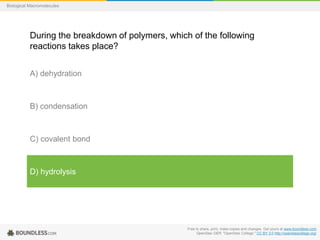
During the breakdown of polymers, which of the following
reactions takes place?
A) dehydration
B) condensation
C) covalent bond
D) hydrolysis
Free to share, print, make copies and changes. Get yours at www.boundless.com
Biological Macromolecules
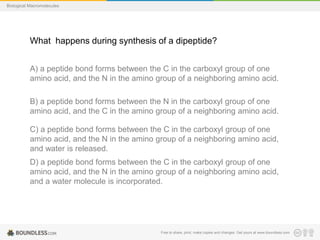
What happens during synthesis of a dipeptide?
A) a peptide bond forms between the C in the carboxyl group of one
amino acid, and the N in the amino group of a neighboring amino acid.
B) a peptide bond forms between the N in the carboxyl group of one
amino acid, and the C in the amino group of a neighboring amino acid.
C) a peptide bond forms between the C in the carboxyl group of one
amino acid, and the N in the amino group of a neighboring amino acid,
and water is released.
D) a peptide bond forms between the C in the carboxyl group of one
amino acid, and the N in the amino group of a neighboring amino acid,
and a water molecule is incorporated.
Free to share, print, make copies and changes. Get yours at www.boundless.com
Biological Macromolecules
What happens during synthesis of a dipeptide?
A) a peptide bond forms between the C in the carboxyl group of one
amino acid, and the N in the amino group of a neighboring amino acid.
B) a peptide bond forms between the N in the carboxyl group of one
amino acid, and the C in the amino group of a neighboring amino acid.
C) a peptide bond forms between the C in the carboxyl group of one
amino acid, and the N in the amino group of a neighboring amino acid,
and water is released.
D) a peptide bond forms between the C in the carboxyl group of one
amino acid, and the N in the amino group of a neighboring amino acid,
and a water molecule is incorporated.
Biological Macromolecules
What is the name of the covalent bond that connects
monosaccharides together to form disaccharides or
polysaccharides?
A) Peptide bond
B) Ester bond
C) Phosphodiester linkage
D) Glycosidic bond
Biological Macromolecules
What is the name of the covalent bond that connects
monosaccharides together to form disaccharides or
polysaccharides?
A) Peptide bond
B) Ester bond
C) Phosphodiester linkage
D) Glycosidic bond
Free to share, print, make copies and changes. Get yours at www.boundless.com
Biological Macromolecules
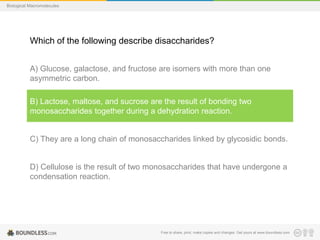
Which of the following describe disaccharides?
A) Glucose, galactose, and fructose are isomers with more than one
asymmetric carbon.
B) Lactose, maltose, and sucrose are the result of bonding two
monosaccharides together during a dehydration reaction.
C) They are a long chain of monosaccharides linked by glycosidic bonds.
D) Cellulose is the result of two monosaccharides that have undergone a
condensation reaction.
Free to share, print, make copies and changes. Get yours at www.boundless.com
Biological Macromolecules
Which of the following describe disaccharides?
A) Glucose, galactose, and fructose are isomers with more than one
asymmetric carbon.
B) Lactose, maltose, and sucrose are the result of bonding two
monosaccharides together during a dehydration reaction.
C) They are a long chain of monosaccharides linked by glycosidic bonds.
D) Cellulose is the result of two monosaccharides that have undergone a
condensation reaction.
Biological Macromolecules
A monosaccharide that contains five carbons is called a ______.
A) Hexose
B) Ribose
C) Pentose
D) Triose
Biological Macromolecules
A monosaccharide that contains five carbons is called a ______.
A) Hexose
B) Ribose
C) Pentose
D) Triose
Biological Macromolecules
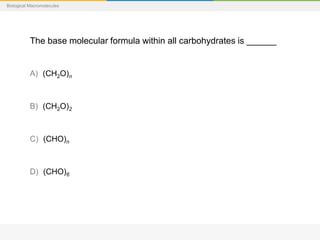
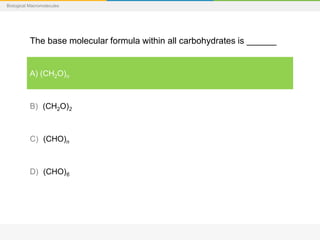
The base molecular formula within all carbohydrates is ______
A) ((CH2O)n
B) ((CH2O)2
C) ((CHO)n
D) ((CHO)6
Biological Macromolecules
The base molecular formula within all carbohydrates is ______
A) (CH2O)n
B) ((CH2O)2
C) ((CHO)n
D) ((CHO)6
Free to share, print, make copies and changes. Get yours at www.boundless.com
Biological Macromolecules
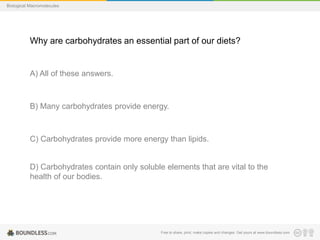
Why are carbohydrates an essential part of our diets?
A) All of these answers.
B) Many carbohydrates provide energy.
C) Carbohydrates provide more energy than lipids.
D) Carbohydrates contain only soluble elements that are vital to the
health of our bodies.
Free to share, print, make copies and changes. Get yours at www.boundless.com
Boundless - LO. "Boundless." CC BY-SA 3.0 http://www.boundless.com/
Biological Macromolecules
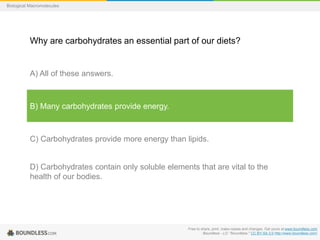
Why are carbohydrates an essential part of our diets?
A) All of these answers.
B) Many carbohydrates provide energy.
C) Carbohydrates provide more energy than lipids.
D) Carbohydrates contain only soluble elements that are vital to the
health of our bodies.
Free to share, print, make copies and changes. Get yours at www.boundless.com
Biological Macromolecules
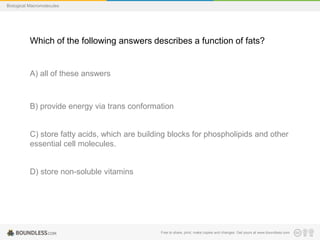
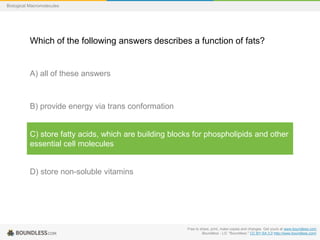
Which of the following answers describes a function of fats?
A) all of these answers
B) provide energy via trans conformation
C) store fatty acids, which are building blocks for phospholipids and other
essential cell molecules.
D) store non-soluble vitamins
Free to share, print, make copies and changes. Get yours at www.boundless.com
Boundless - LO. "Boundless." CC BY-SA 3.0 http://www.boundless.com/
Biological Macromolecules
Which of the following answers describes a function of fats?
A) all of these answers
B) provide energy via trans conformation
C) store fatty acids, which are building blocks for phospholipids and other
essential cell molecules
D) store non-soluble vitamins
Free to share, print, make copies and changes. Get yours at www.boundless.com
Biological Macromolecules
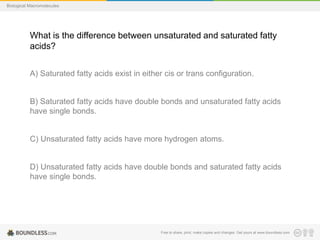
What is the difference between unsaturated and saturated fatty
acids?
A) Saturated fatty acids exist in either cis or trans configuration.
B) Saturated fatty acids have double bonds and unsaturated fatty acids
have single bonds.
C) Unsaturated fatty acids have more hydrogen atoms.
D) Unsaturated fatty acids have double bonds and saturated fatty acids
have single bonds.
Free to share, print, make copies and changes. Get yours at www.boundless.com
Boundless - LO. "Boundless." CC BY-SA 3.0 http://www.boundless.com/
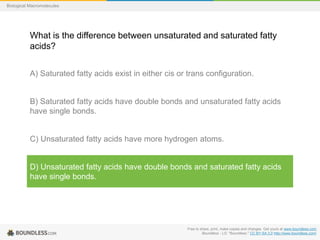
Biological Macromolecules
What is the difference between unsaturated and saturated fatty
acids?
A) Saturated fatty acids exist in either cis or trans configuration.
B) Saturated fatty acids have double bonds and unsaturated fatty acids
have single bonds.
C) Unsaturated fatty acids have more hydrogen atoms.
D) Unsaturated fatty acids have double bonds and saturated fatty acids
have single bonds.
Free to share, print, make copies and changes. Get yours at www.boundless.com
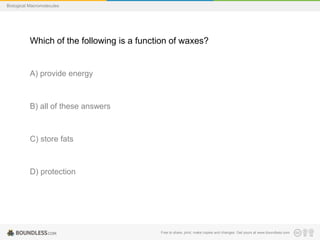
Biological Macromolecules
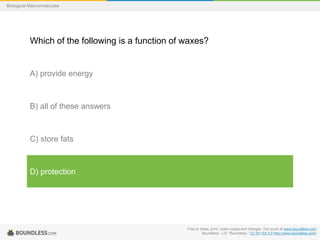
Which of the following is a function of waxes?
A) provide energy
B) all of these answers
C) store fats
D) protection
Free to share, print, make copies and changes. Get yours at www.boundless.com
Boundless - LO. "Boundless." CC BY-SA 3.0 http://www.boundless.com/
Biological Macromolecules
Which of the following is a function of waxes?
A) provide energy
B) all of these answers
C) store fats
D) protection
Free to share, print, make copies and changes. Get yours at www.boundless.com
Biological Macromolecules
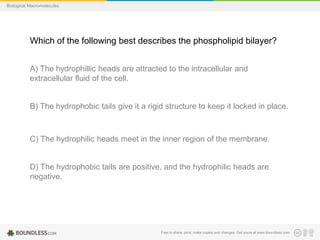
Which of the following best describes the phospholipid bilayer?
A) The hydrophillic heads are attracted to the intracellular and
extracellular fluid of the cell.
B) The hydrophobic tails give it a rigid structure to keep it locked in place.
C) The hydrophilic heads meet in the inner region of the membrane.
D) The hydrophobic tails are positive, and the hydrophilic heads are
negative.
Free to share, print, make copies and changes. Get yours at www.boundless.com
Boundless - LO. "Boundless." CC BY-SA 3.0 http://www.boundless.com/
Biological Macromolecules
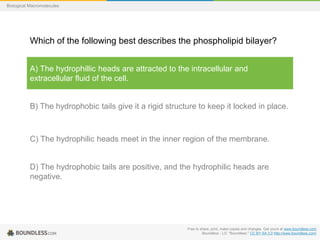
Which of the following best describes the phospholipid bilayer?
A) The hydrophillic heads are attracted to the intracellular and
extracellular fluid of the cell.
B) The hydrophobic tails give it a rigid structure to keep it locked in place.
C) The hydrophilic heads meet in the inner region of the membrane.
D) The hydrophobic tails are positive, and the hydrophilic heads are
negative.
Free to share, print, make copies and changes. Get yours at www.boundless.com
Biological Macromolecules
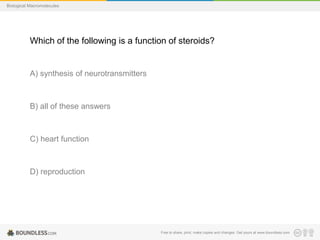
Which of the following is a function of steroids?
A) synthesis of neurotransmitters
B) all of these answers
C) heart function
D) reproduction
Free to share, print, make copies and changes. Get yours at www.boundless.com
Boundless - LO. "Boundless." CC BY-SA 3.0 http://www.boundless.com/
Biological Macromolecules
Which of the following is a function of steroids?
A) synthesis of neurotransmitters
B) all of these answers
C) heart function
D) reproduction
Free to share, print, make copies and changes. Get yours at www.boundless.com
Biological Macromolecules
Which of the following types of protein match its function?
A) Enzyme: slows biochemical reactions
B) Antibody: carries oxygen throughout the body
C) Tubulin: allows muscles to contract
D) Hormone: regulates growth, metabolism, and reproduction
Free to share, print, make copies and changes. Get yours at www.boundless.com
Boundless - Key Term. "Boundless." CC BY-SA 3.0 http://www.boundless.com/
Biological Macromolecules
Which of the following types of protein match its function?
A) Enzyme: slows biochemical reactions
B) Antibody: carries oxygen throughout the body
C) Tubulin: allows muscles to contract
D) Hormone: regulates growth, metabolism, and reproduction
Free to share, print, make copies and changes. Get yours at www.boundless.com
Biological Macromolecules
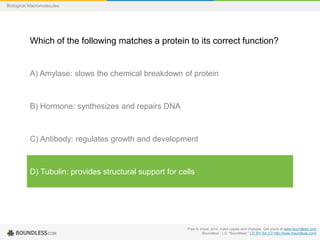
Which of the following matches a protein to its correct function?
A) Amylase: slows the chemical breakdown of protein
B) Hormone: synthesizes and repairs DNA
C) Antibody: regulates growth and development
D) Tubulin: provides structural support for cells
Free to share, print, make copies and changes. Get yours at www.boundless.com
Boundless - LO. "Boundless." CC BY-SA 3.0 http://www.boundless.com/
Biological Macromolecules
Which of the following matches a protein to its correct function?
A) Amylase: slows the chemical breakdown of protein
B) Hormone: synthesizes and repairs DNA
C) Antibody: regulates growth and development
D) Tubulin: provides structural support for cells
Free to share, print, make copies and changes. Get yours at www.boundless.com
Biological Macromolecules
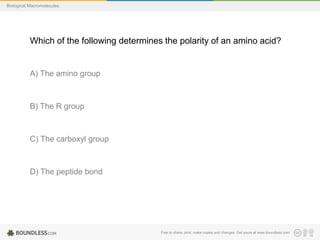
Which of the following determines the polarity of an amino acid?
A) The amino group
B) The R group
C) The carboxyl group
D) The peptide bond
Free to share, print, make copies and changes. Get yours at www.boundless.com
Boundless - LO. "Boundless." CC BY-SA 3.0 http://www.boundless.com/
Biological Macromolecules
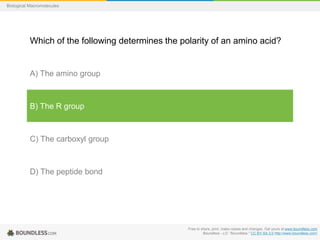
Which of the following determines the polarity of an amino acid?
A) The amino group
B) The R group
C) The carboxyl group
D) The peptide bond
Free to share, print, make copies and changes. Get yours at www.boundless.com
Biological Macromolecules
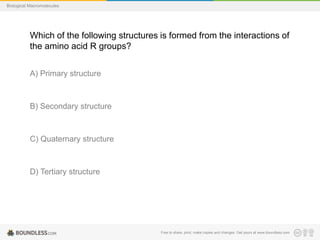
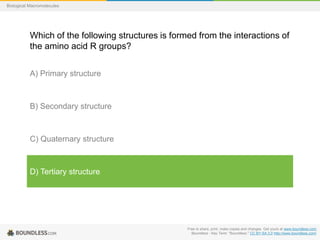
Which of the following structures is formed from the interactions of
the amino acid R groups?
A) Primary structure
B) Secondary structure
C) Quaternary structure
D) Tertiary structure
Free to share, print, make copies and changes. Get yours at www.boundless.com
Boundless - Key Term. "Boundless." CC BY-SA 3.0 http://www.boundless.com/
Biological Macromolecules
Which of the following structures is formed from the interactions of
the amino acid R groups?
A) Primary structure
B) Secondary structure
C) Quaternary structure
D) Tertiary structure
Free to share, print, make copies and changes. Get yours at www.boundless.com
Biological Macromolecules
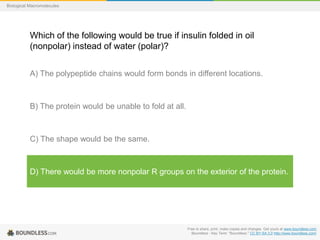
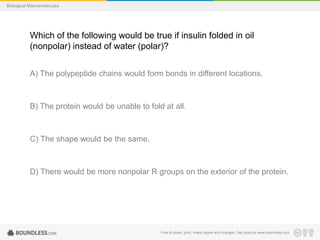
Which of the following would be true if insulin folded in oil
(nonpolar) instead of water (polar)?
A) The polypeptide chains would form bonds in different locations.
B) The protein would be unable to fold at all.
C) The shape would be the same.
D) There would be more nonpolar R groups on the exterior of the protein.
Free to share, print, make copies and changes. Get yours at www.boundless.com
Boundless - Key Term. "Boundless." CC BY-SA 3.0 http://www.boundless.com/
Biological Macromolecules
Which of the following would be true if insulin folded in oil
(nonpolar) instead of water (polar)?
A) The polypeptide chains would form bonds in different locations.
B) The protein would be unable to fold at all.
C) The shape would be the same.
D) There would be more nonpolar R groups on the exterior of the protein.
Free to share, print, make copies and changes. Get yours at www.boundless.com
Biological Macromolecules
Which of the following protein structures forms primarily because
of hydrogen bonds?
A) The tertiary structure
B) α-helices and β-pleated sheets
C) The combination of multiple polypeptide subunits
D) The primary structure
Free to share, print, make copies and changes. Get yours at www.boundless.com
Boundless - LO. "Boundless." CC BY-SA 3.0 http://www.boundless.com/
Biological Macromolecules
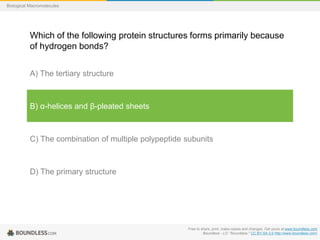
Which of the following protein structures forms primarily because
of hydrogen bonds?
A) The tertiary structure
B) α-helices and β-pleated sheets
C) The combination of multiple polypeptide subunits
D) The primary structure
Free to share, print, make copies and changes. Get yours at www.boundless.com
Biological Macromolecules
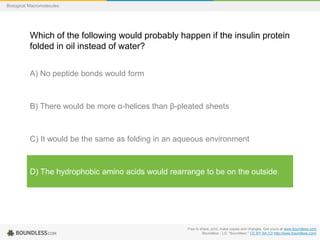
Which of the following would probably happen if the insulin protein
folded in oil instead of water?
A) No peptide bonds would form
B) There would be more α-helices than β-pleated sheets
C) It would be the same as folding in an aqueous environment
D) The hydrophobic amino acids would rearrange to be on the outside
Free to share, print, make copies and changes. Get yours at www.boundless.com
Boundless - LO. "Boundless." CC BY-SA 3.0 http://www.boundless.com/
Biological Macromolecules
Which of the following would probably happen if the insulin protein
folded in oil instead of water?
A) No peptide bonds would form
B) There would be more α-helices than β-pleated sheets
C) It would be the same as folding in an aqueous environment
D) The hydrophobic amino acids would rearrange to be on the outside
Free to share, print, make copies and changes. Get yours at www.boundless.com
Biological Macromolecules
When a protein is denatured, which of the following protein
structures is unaffected?
A) The secondary structure
B) The tertiary structure
C) The quaternary structure
D) The primary structure
Free to share, print, make copies and changes. Get yours at www.boundless.com
Boundless - Key Term. "Boundless." CC BY-SA 3.0 http://www.boundless.com/
Biological Macromolecules
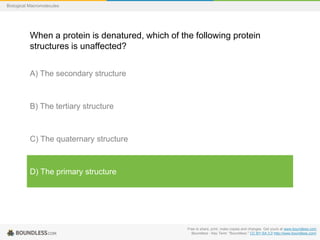
When a protein is denatured, which of the following protein
structures is unaffected?
A) The secondary structure
B) The tertiary structure
C) The quaternary structure
D) The primary structure
Free to share, print, make copies and changes. Get yours at www.boundless.com
Biological Macromolecules
When a protein denatures, which of the following protein
structures is unaffected?
A) Secondary structure
B) Tertiary structure
C) Primary structure
D) Quaternary structure
Free to share, print, make copies and changes. Get yours at www.boundless.com
Boundless - LO. "Boundless." CC BY-SA 3.0 http://www.boundless.com/
Biological Macromolecules
When a protein denatures, which of the following protein
structures is unaffected?
A) Secondary structure
B) Tertiary structure
C) Primary structure
D) Quaternary structure
Free to share, print, make copies and changes. Get yours at www.boundless.com
Biological Macromolecules
Which of the following must be present in a nucleotide?
A) all of these
B) a four-carbon sugar
C) a phyto-phosphate group
D) a nitrogenous base
Free to share, print, make copies and changes. Get yours at www.boundless.com
Boundless - LO. "Boundless." CC BY-SA 3.0 http://www.boundless.com/
Biological Macromolecules
Which of the following must be present in a nucleotide?
A) all of these
B) a four-carbon sugar
C) a phyto-phosphate group
D) a nitrogenous base
Free to share, print, make copies and changes. Get yours at www.boundless.com
Biological Macromolecules
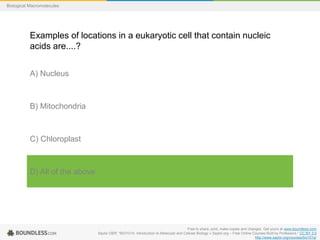
Examples of locations in a eukaryotic cell that contain nucleic
acids are....?
A) Nucleus
B) Mitochondria
C) Chloroplast
D) All of the above
Free to share, print, make copies and changes. Get yours at www.boundless.com
Saylor OER. "BIO101A: Introduction to Molecular and Cellular Biology « Saylor.org – Free Online Courses Built by Professors." CC BY 3.0
http://www.saylor.org/courses/bio101a/
Biological Macromolecules
Examples of locations in a eukaryotic cell that contain nucleic
acids are....?
A) Nucleus
B) Mitochondria
C) Chloroplast
D) All of the above
Free to share, print, make copies and changes. Get yours at www.boundless.com
Biological Macromolecules
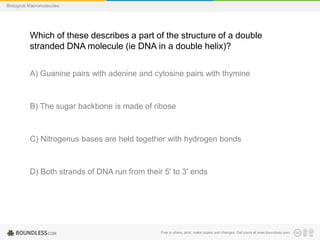
Which of these describes a part of the structure of a double
stranded DNA molecule (ie DNA in a double helix)?
A) Guanine pairs with adenine and cytosine pairs with thymine
B) The sugar backbone is made of ribose
C) Nitrogenus bases are held together with hydrogen bonds
D) Both strands of DNA run from their 5' to 3' ends
Free to share, print, make copies and changes. Get yours at www.boundless.com
Boundless - LO. "Boundless." CC BY-SA 3.0 http://www.boundless.com/
Biological Macromolecules
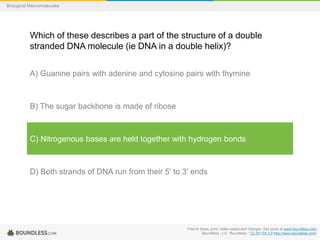
Which of these describes a part of the structure of a double
stranded DNA molecule (ie DNA in a double helix)?
A) Guanine pairs with adenine and cytosine pairs with thymine
B) The sugar backbone is made of ribose
C) Nitrogenous bases are held together with hydrogen bonds
D) Both strands of DNA run from their 5' to 3' ends
Free to share, print, make copies and changes. Get yours at www.boundless.com
Biological Macromolecules
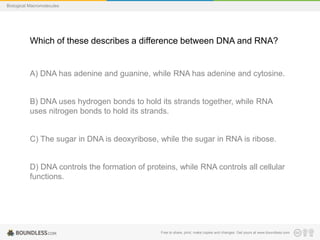
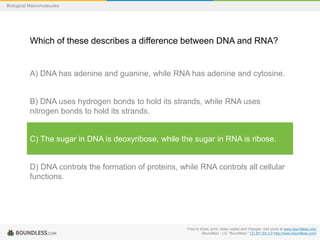
Which of these describes a difference between DNA and RNA?
A) DNA has adenine and guanine, while RNA has adenine and cytosine.
B) DNA uses hydrogen bonds to hold its strands together, while RNA
uses nitrogen bonds to hold its strands.
C) The sugar in DNA is deoxyribose, while the sugar in RNA is ribose.
D) DNA controls the formation of proteins, while RNA controls all cellular
functions.
Free to share, print, make copies and changes. Get yours at www.boundless.com
Boundless - LO. "Boundless." CC BY-SA 3.0 http://www.boundless.com/
Biological Macromolecules
Which of these describes a difference between DNA and RNA?
A) DNA has adenine and guanine, while RNA has adenine and cytosine.
B) DNA uses hydrogen bonds to hold its strands, while RNA uses
nitrogen bonds to hold its strands.
C) The sugar in DNA is deoxyribose, while the sugar in RNA is ribose.
D) DNA controls the formation of proteins, while RNA controls all cellular
functions.
Biological Macromolecules
Which of these is not a major kind of RNA found in all cells?
A) Transfer RNA (tRNA)
B) Cytosolic RNA (cRNA)
C) Messenger RNA (mRNA)
D) Ribosomal RNA (rRNA)
Biological Macromolecules
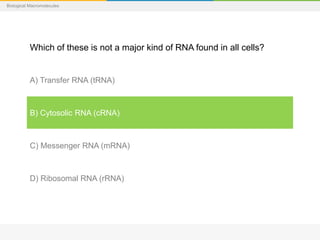
Which of these is not a major kind of RNA found in all cells?
A) Transfer RNA (tRNA)
B) Cytosolic RNA (cRNA)
C) Messenger RNA (mRNA)
D) Ribosomal RNA (rRNA)
Biological Macromolecules
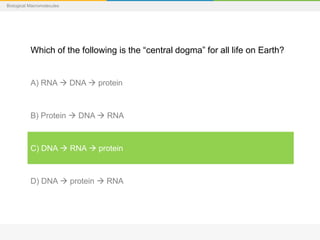
Which of the following is the “central dogma” for all life on Earth?
A) RNA  DNA  protein
B) Protein  DNA  RNA
C) DNA  RNA  protein
D) DNA  protein  RNA
Biological Macromolecules
Which of the following is the “central dogma” for all life on Earth?
A) RNA  DNA  protein
B) Protein  DNA  RNA
C) DNA  RNA  protein
D) DNA  protein  RNA

E. macromolecules check your learning

  • 1.
    •Take some timeto consider the question before moving to the next slide which offers the correct answer. •Write your answer down before you see the actual answer, this will allow you to test yourself more effectively. CHECK YOUR LEARNING MACROMOLECULES
  • 2.
    Free to share,print, make copies and changes. Get yours at www.boundless.com Biological Macromolecules Which of the following is a major class of biological macromolecule? A) Lipids B) Fatty acids C) Both lipids and nucleic acids D) Nucleic acids
  • 3.
    Free to share,print, make copies and changes. Get yours at www.boundless.com Boundless - LO. "Boundless." CC BY-SA 3.0 http://www.boundless.com/ Biological Macromolecules Which of the following is a major class of biological macromolecules? A) Lipids B) Fatty acids C) Both lipids and nucleic acids D) Nucleic acids
  • 4.
    Free to share,print, make copies and changes. Get yours at www.boundless.com Biological Macromolecules Dehydration synthesis leads to the formation of which of the following? A) water and monomers B) water and amino acids C) water and a hydroxyl group D) water and polymers
  • 5.
    Free to share,print, make copies and changes. Get yours at www.boundless.com OpenStax OER. "Biology." CC BY 3.0 http://cnx.org/content/col11448/latest Biological Macromolecules Dehydration synthesis leads to the formation of which of the following? A) water and monomers B) water and amino acids C) water and a hydroxyl group D) water and polymers
  • 6.
    Free to share,print, make copies and changes. Get yours at www.boundless.com Biological Macromolecules During the breakdown of polymers, which of the following reactions takes place? A) dehydration B) condensation C) covalent bond D) hydrolysis
  • 7.
    Free to share,print, make copies and changes. Get yours at www.boundless.com OpenStax OER. "OpenStax College." CC BY 3.0 http://openstaxcollege.org/ Biological Macromolecules During the breakdown of polymers, which of the following reactions takes place? A) dehydration B) condensation C) covalent bond D) hydrolysis
  • 8.
    Free to share,print, make copies and changes. Get yours at www.boundless.com Biological Macromolecules What happens during synthesis of a dipeptide? A) a peptide bond forms between the C in the carboxyl group of one amino acid, and the N in the amino group of a neighboring amino acid. B) a peptide bond forms between the N in the carboxyl group of one amino acid, and the C in the amino group of a neighboring amino acid. C) a peptide bond forms between the C in the carboxyl group of one amino acid, and the N in the amino group of a neighboring amino acid, and water is released. D) a peptide bond forms between the C in the carboxyl group of one amino acid, and the N in the amino group of a neighboring amino acid, and a water molecule is incorporated.
  • 9.
    Free to share,print, make copies and changes. Get yours at www.boundless.com Biological Macromolecules What happens during synthesis of a dipeptide? A) a peptide bond forms between the C in the carboxyl group of one amino acid, and the N in the amino group of a neighboring amino acid. B) a peptide bond forms between the N in the carboxyl group of one amino acid, and the C in the amino group of a neighboring amino acid. C) a peptide bond forms between the C in the carboxyl group of one amino acid, and the N in the amino group of a neighboring amino acid, and water is released. D) a peptide bond forms between the C in the carboxyl group of one amino acid, and the N in the amino group of a neighboring amino acid, and a water molecule is incorporated.
  • 10.
    Biological Macromolecules What isthe name of the covalent bond that connects monosaccharides together to form disaccharides or polysaccharides? A) Peptide bond B) Ester bond C) Phosphodiester linkage D) Glycosidic bond
  • 11.
    Biological Macromolecules What isthe name of the covalent bond that connects monosaccharides together to form disaccharides or polysaccharides? A) Peptide bond B) Ester bond C) Phosphodiester linkage D) Glycosidic bond
  • 12.
    Free to share,print, make copies and changes. Get yours at www.boundless.com Biological Macromolecules Which of the following describe disaccharides? A) Glucose, galactose, and fructose are isomers with more than one asymmetric carbon. B) Lactose, maltose, and sucrose are the result of bonding two monosaccharides together during a dehydration reaction. C) They are a long chain of monosaccharides linked by glycosidic bonds. D) Cellulose is the result of two monosaccharides that have undergone a condensation reaction.
  • 13.
    Free to share,print, make copies and changes. Get yours at www.boundless.com Biological Macromolecules Which of the following describe disaccharides? A) Glucose, galactose, and fructose are isomers with more than one asymmetric carbon. B) Lactose, maltose, and sucrose are the result of bonding two monosaccharides together during a dehydration reaction. C) They are a long chain of monosaccharides linked by glycosidic bonds. D) Cellulose is the result of two monosaccharides that have undergone a condensation reaction.
  • 14.
    Biological Macromolecules A monosaccharidethat contains five carbons is called a ______. A) Hexose B) Ribose C) Pentose D) Triose
  • 15.
    Biological Macromolecules A monosaccharidethat contains five carbons is called a ______. A) Hexose B) Ribose C) Pentose D) Triose
  • 16.
    Biological Macromolecules The basemolecular formula within all carbohydrates is ______ A) ((CH2O)n B) ((CH2O)2 C) ((CHO)n D) ((CHO)6
  • 17.
    Biological Macromolecules The basemolecular formula within all carbohydrates is ______ A) (CH2O)n B) ((CH2O)2 C) ((CHO)n D) ((CHO)6
  • 18.
    Free to share,print, make copies and changes. Get yours at www.boundless.com Biological Macromolecules Why are carbohydrates an essential part of our diets? A) All of these answers. B) Many carbohydrates provide energy. C) Carbohydrates provide more energy than lipids. D) Carbohydrates contain only soluble elements that are vital to the health of our bodies.
  • 19.
    Free to share,print, make copies and changes. Get yours at www.boundless.com Boundless - LO. "Boundless." CC BY-SA 3.0 http://www.boundless.com/ Biological Macromolecules Why are carbohydrates an essential part of our diets? A) All of these answers. B) Many carbohydrates provide energy. C) Carbohydrates provide more energy than lipids. D) Carbohydrates contain only soluble elements that are vital to the health of our bodies.
  • 20.
    Free to share,print, make copies and changes. Get yours at www.boundless.com Biological Macromolecules Which of the following answers describes a function of fats? A) all of these answers B) provide energy via trans conformation C) store fatty acids, which are building blocks for phospholipids and other essential cell molecules. D) store non-soluble vitamins
  • 21.
    Free to share,print, make copies and changes. Get yours at www.boundless.com Boundless - LO. "Boundless." CC BY-SA 3.0 http://www.boundless.com/ Biological Macromolecules Which of the following answers describes a function of fats? A) all of these answers B) provide energy via trans conformation C) store fatty acids, which are building blocks for phospholipids and other essential cell molecules D) store non-soluble vitamins
  • 22.
    Free to share,print, make copies and changes. Get yours at www.boundless.com Biological Macromolecules What is the difference between unsaturated and saturated fatty acids? A) Saturated fatty acids exist in either cis or trans configuration. B) Saturated fatty acids have double bonds and unsaturated fatty acids have single bonds. C) Unsaturated fatty acids have more hydrogen atoms. D) Unsaturated fatty acids have double bonds and saturated fatty acids have single bonds.
  • 23.
    Free to share,print, make copies and changes. Get yours at www.boundless.com Boundless - LO. "Boundless." CC BY-SA 3.0 http://www.boundless.com/ Biological Macromolecules What is the difference between unsaturated and saturated fatty acids? A) Saturated fatty acids exist in either cis or trans configuration. B) Saturated fatty acids have double bonds and unsaturated fatty acids have single bonds. C) Unsaturated fatty acids have more hydrogen atoms. D) Unsaturated fatty acids have double bonds and saturated fatty acids have single bonds.
  • 24.
    Free to share,print, make copies and changes. Get yours at www.boundless.com Biological Macromolecules Which of the following is a function of waxes? A) provide energy B) all of these answers C) store fats D) protection
  • 25.
    Free to share,print, make copies and changes. Get yours at www.boundless.com Boundless - LO. "Boundless." CC BY-SA 3.0 http://www.boundless.com/ Biological Macromolecules Which of the following is a function of waxes? A) provide energy B) all of these answers C) store fats D) protection
  • 26.
    Free to share,print, make copies and changes. Get yours at www.boundless.com Biological Macromolecules Which of the following best describes the phospholipid bilayer? A) The hydrophillic heads are attracted to the intracellular and extracellular fluid of the cell. B) The hydrophobic tails give it a rigid structure to keep it locked in place. C) The hydrophilic heads meet in the inner region of the membrane. D) The hydrophobic tails are positive, and the hydrophilic heads are negative.
  • 27.
    Free to share,print, make copies and changes. Get yours at www.boundless.com Boundless - LO. "Boundless." CC BY-SA 3.0 http://www.boundless.com/ Biological Macromolecules Which of the following best describes the phospholipid bilayer? A) The hydrophillic heads are attracted to the intracellular and extracellular fluid of the cell. B) The hydrophobic tails give it a rigid structure to keep it locked in place. C) The hydrophilic heads meet in the inner region of the membrane. D) The hydrophobic tails are positive, and the hydrophilic heads are negative.
  • 28.
    Free to share,print, make copies and changes. Get yours at www.boundless.com Biological Macromolecules Which of the following is a function of steroids? A) synthesis of neurotransmitters B) all of these answers C) heart function D) reproduction
  • 29.
    Free to share,print, make copies and changes. Get yours at www.boundless.com Boundless - LO. "Boundless." CC BY-SA 3.0 http://www.boundless.com/ Biological Macromolecules Which of the following is a function of steroids? A) synthesis of neurotransmitters B) all of these answers C) heart function D) reproduction
  • 30.
    Free to share,print, make copies and changes. Get yours at www.boundless.com Biological Macromolecules Which of the following types of protein match its function? A) Enzyme: slows biochemical reactions B) Antibody: carries oxygen throughout the body C) Tubulin: allows muscles to contract D) Hormone: regulates growth, metabolism, and reproduction
  • 31.
    Free to share,print, make copies and changes. Get yours at www.boundless.com Boundless - Key Term. "Boundless." CC BY-SA 3.0 http://www.boundless.com/ Biological Macromolecules Which of the following types of protein match its function? A) Enzyme: slows biochemical reactions B) Antibody: carries oxygen throughout the body C) Tubulin: allows muscles to contract D) Hormone: regulates growth, metabolism, and reproduction
  • 32.
    Free to share,print, make copies and changes. Get yours at www.boundless.com Biological Macromolecules Which of the following matches a protein to its correct function? A) Amylase: slows the chemical breakdown of protein B) Hormone: synthesizes and repairs DNA C) Antibody: regulates growth and development D) Tubulin: provides structural support for cells
  • 33.
    Free to share,print, make copies and changes. Get yours at www.boundless.com Boundless - LO. "Boundless." CC BY-SA 3.0 http://www.boundless.com/ Biological Macromolecules Which of the following matches a protein to its correct function? A) Amylase: slows the chemical breakdown of protein B) Hormone: synthesizes and repairs DNA C) Antibody: regulates growth and development D) Tubulin: provides structural support for cells
  • 34.
    Free to share,print, make copies and changes. Get yours at www.boundless.com Biological Macromolecules Which of the following determines the polarity of an amino acid? A) The amino group B) The R group C) The carboxyl group D) The peptide bond
  • 35.
    Free to share,print, make copies and changes. Get yours at www.boundless.com Boundless - LO. "Boundless." CC BY-SA 3.0 http://www.boundless.com/ Biological Macromolecules Which of the following determines the polarity of an amino acid? A) The amino group B) The R group C) The carboxyl group D) The peptide bond
  • 36.
    Free to share,print, make copies and changes. Get yours at www.boundless.com Biological Macromolecules Which of the following structures is formed from the interactions of the amino acid R groups? A) Primary structure B) Secondary structure C) Quaternary structure D) Tertiary structure
  • 37.
    Free to share,print, make copies and changes. Get yours at www.boundless.com Boundless - Key Term. "Boundless." CC BY-SA 3.0 http://www.boundless.com/ Biological Macromolecules Which of the following structures is formed from the interactions of the amino acid R groups? A) Primary structure B) Secondary structure C) Quaternary structure D) Tertiary structure
  • 38.
    Free to share,print, make copies and changes. Get yours at www.boundless.com Biological Macromolecules Which of the following would be true if insulin folded in oil (nonpolar) instead of water (polar)? A) The polypeptide chains would form bonds in different locations. B) The protein would be unable to fold at all. C) The shape would be the same. D) There would be more nonpolar R groups on the exterior of the protein.
  • 39.
    Free to share,print, make copies and changes. Get yours at www.boundless.com Boundless - Key Term. "Boundless." CC BY-SA 3.0 http://www.boundless.com/ Biological Macromolecules Which of the following would be true if insulin folded in oil (nonpolar) instead of water (polar)? A) The polypeptide chains would form bonds in different locations. B) The protein would be unable to fold at all. C) The shape would be the same. D) There would be more nonpolar R groups on the exterior of the protein.
  • 40.
    Free to share,print, make copies and changes. Get yours at www.boundless.com Biological Macromolecules Which of the following protein structures forms primarily because of hydrogen bonds? A) The tertiary structure B) α-helices and β-pleated sheets C) The combination of multiple polypeptide subunits D) The primary structure
  • 41.
    Free to share,print, make copies and changes. Get yours at www.boundless.com Boundless - LO. "Boundless." CC BY-SA 3.0 http://www.boundless.com/ Biological Macromolecules Which of the following protein structures forms primarily because of hydrogen bonds? A) The tertiary structure B) α-helices and β-pleated sheets C) The combination of multiple polypeptide subunits D) The primary structure
  • 42.
    Free to share,print, make copies and changes. Get yours at www.boundless.com Biological Macromolecules Which of the following would probably happen if the insulin protein folded in oil instead of water? A) No peptide bonds would form B) There would be more α-helices than β-pleated sheets C) It would be the same as folding in an aqueous environment D) The hydrophobic amino acids would rearrange to be on the outside
  • 43.
    Free to share,print, make copies and changes. Get yours at www.boundless.com Boundless - LO. "Boundless." CC BY-SA 3.0 http://www.boundless.com/ Biological Macromolecules Which of the following would probably happen if the insulin protein folded in oil instead of water? A) No peptide bonds would form B) There would be more α-helices than β-pleated sheets C) It would be the same as folding in an aqueous environment D) The hydrophobic amino acids would rearrange to be on the outside
  • 44.
    Free to share,print, make copies and changes. Get yours at www.boundless.com Biological Macromolecules When a protein is denatured, which of the following protein structures is unaffected? A) The secondary structure B) The tertiary structure C) The quaternary structure D) The primary structure
  • 45.
    Free to share,print, make copies and changes. Get yours at www.boundless.com Boundless - Key Term. "Boundless." CC BY-SA 3.0 http://www.boundless.com/ Biological Macromolecules When a protein is denatured, which of the following protein structures is unaffected? A) The secondary structure B) The tertiary structure C) The quaternary structure D) The primary structure
  • 46.
    Free to share,print, make copies and changes. Get yours at www.boundless.com Biological Macromolecules When a protein denatures, which of the following protein structures is unaffected? A) Secondary structure B) Tertiary structure C) Primary structure D) Quaternary structure
  • 47.
    Free to share,print, make copies and changes. Get yours at www.boundless.com Boundless - LO. "Boundless." CC BY-SA 3.0 http://www.boundless.com/ Biological Macromolecules When a protein denatures, which of the following protein structures is unaffected? A) Secondary structure B) Tertiary structure C) Primary structure D) Quaternary structure
  • 48.
    Free to share,print, make copies and changes. Get yours at www.boundless.com Biological Macromolecules Which of the following must be present in a nucleotide? A) all of these B) a four-carbon sugar C) a phyto-phosphate group D) a nitrogenous base
  • 49.
    Free to share,print, make copies and changes. Get yours at www.boundless.com Boundless - LO. "Boundless." CC BY-SA 3.0 http://www.boundless.com/ Biological Macromolecules Which of the following must be present in a nucleotide? A) all of these B) a four-carbon sugar C) a phyto-phosphate group D) a nitrogenous base
  • 50.
    Free to share,print, make copies and changes. Get yours at www.boundless.com Biological Macromolecules Examples of locations in a eukaryotic cell that contain nucleic acids are....? A) Nucleus B) Mitochondria C) Chloroplast D) All of the above
  • 51.
    Free to share,print, make copies and changes. Get yours at www.boundless.com Saylor OER. "BIO101A: Introduction to Molecular and Cellular Biology « Saylor.org – Free Online Courses Built by Professors." CC BY 3.0 http://www.saylor.org/courses/bio101a/ Biological Macromolecules Examples of locations in a eukaryotic cell that contain nucleic acids are....? A) Nucleus B) Mitochondria C) Chloroplast D) All of the above
  • 52.
    Free to share,print, make copies and changes. Get yours at www.boundless.com Biological Macromolecules Which of these describes a part of the structure of a double stranded DNA molecule (ie DNA in a double helix)? A) Guanine pairs with adenine and cytosine pairs with thymine B) The sugar backbone is made of ribose C) Nitrogenus bases are held together with hydrogen bonds D) Both strands of DNA run from their 5' to 3' ends
  • 53.
    Free to share,print, make copies and changes. Get yours at www.boundless.com Boundless - LO. "Boundless." CC BY-SA 3.0 http://www.boundless.com/ Biological Macromolecules Which of these describes a part of the structure of a double stranded DNA molecule (ie DNA in a double helix)? A) Guanine pairs with adenine and cytosine pairs with thymine B) The sugar backbone is made of ribose C) Nitrogenous bases are held together with hydrogen bonds D) Both strands of DNA run from their 5' to 3' ends
  • 54.
    Free to share,print, make copies and changes. Get yours at www.boundless.com Biological Macromolecules Which of these describes a difference between DNA and RNA? A) DNA has adenine and guanine, while RNA has adenine and cytosine. B) DNA uses hydrogen bonds to hold its strands together, while RNA uses nitrogen bonds to hold its strands. C) The sugar in DNA is deoxyribose, while the sugar in RNA is ribose. D) DNA controls the formation of proteins, while RNA controls all cellular functions.
  • 55.
    Free to share,print, make copies and changes. Get yours at www.boundless.com Boundless - LO. "Boundless." CC BY-SA 3.0 http://www.boundless.com/ Biological Macromolecules Which of these describes a difference between DNA and RNA? A) DNA has adenine and guanine, while RNA has adenine and cytosine. B) DNA uses hydrogen bonds to hold its strands, while RNA uses nitrogen bonds to hold its strands. C) The sugar in DNA is deoxyribose, while the sugar in RNA is ribose. D) DNA controls the formation of proteins, while RNA controls all cellular functions.
  • 56.
    Biological Macromolecules Which ofthese is not a major kind of RNA found in all cells? A) Transfer RNA (tRNA) B) Cytosolic RNA (cRNA) C) Messenger RNA (mRNA) D) Ribosomal RNA (rRNA)
  • 57.
    Biological Macromolecules Which ofthese is not a major kind of RNA found in all cells? A) Transfer RNA (tRNA) B) Cytosolic RNA (cRNA) C) Messenger RNA (mRNA) D) Ribosomal RNA (rRNA)
  • 58.
    Biological Macromolecules Which ofthe following is the “central dogma” for all life on Earth? A) RNA  DNA  protein B) Protein  DNA  RNA C) DNA  RNA  protein D) DNA  protein  RNA
  • 59.
    Biological Macromolecules Which ofthe following is the “central dogma” for all life on Earth? A) RNA  DNA  protein B) Protein  DNA  RNA C) DNA  RNA  protein D) DNA  protein  RNA