CST Review
States of Matter
CST Review
States
of Matter
States of Matter
Graphic Organizer
Physical Changes Thinking Map
Class Work
BrainPop
States of
Matter
Brain Pop
Click picture to go to this BrainPop
BrainPop
Matter Changing
States
Brain Pop
Click picture to go to this BrainPop
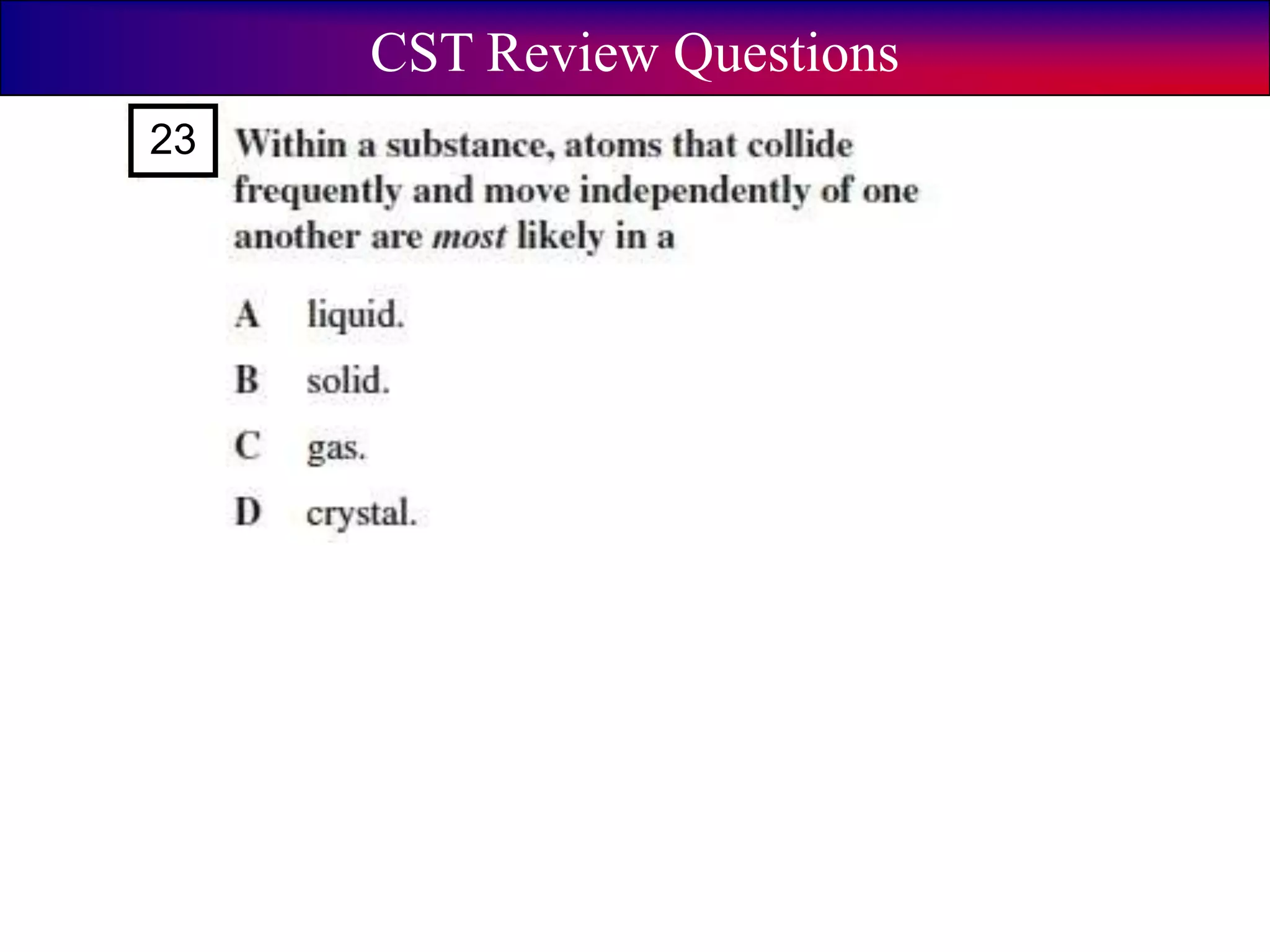
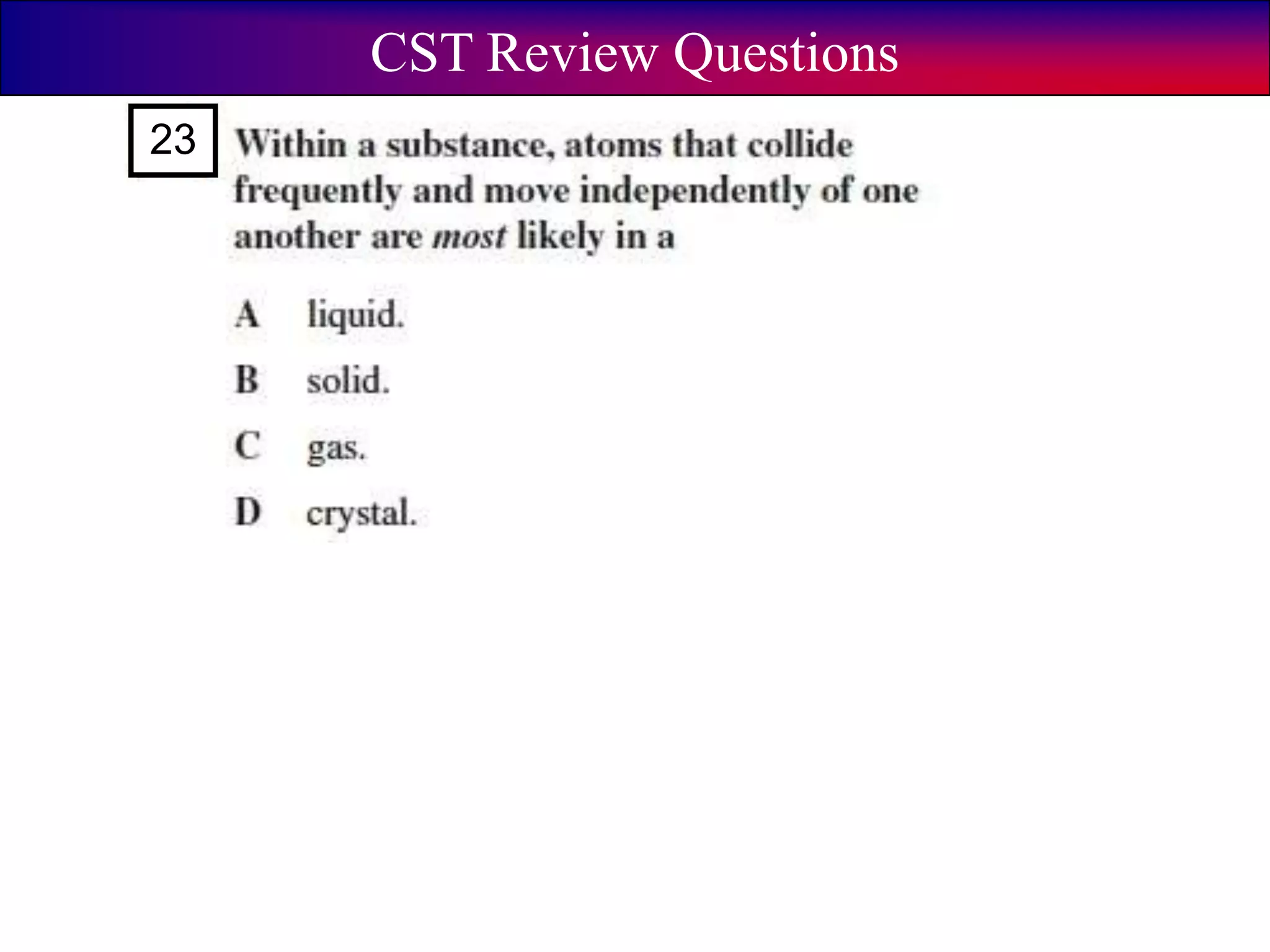
23
CST Review Questions
How are atoms and molecules arranged in a gas?
Movement of Molecules
solids
e
n
e
r
g
y
e
n
e
r
g
y
liquids
e
n
e
r
g
y
gases
Vibrate
Move
Freely
Move Fast
Hit Things
23
CST Review Questions
23
CST Review Questions
40
Arrangement of Molecules
Atoms & molecules are arranged
differently in solids, liquids, & gases.
liquidssolids gases
energy energy
Close
Together
Space
Between
Very Far
Apart
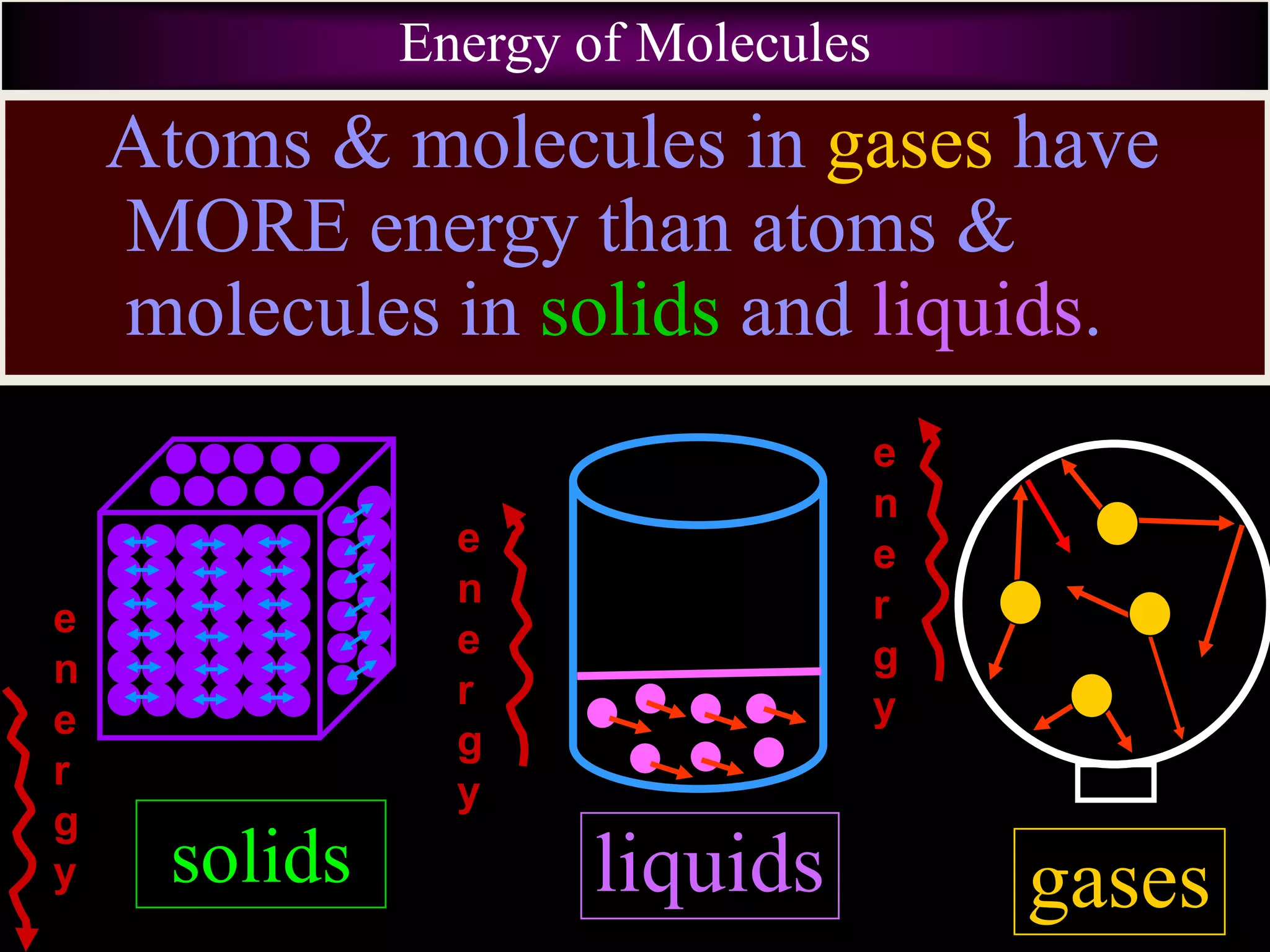
Energy of Molecules
Atoms & molecules in gases have
MORE energy than atoms &
molecules in solids and liquids.
solids
e
n
e
r
g
y
e
n
e
r
g
y
liquids
e
n
e
r
g
y
gases
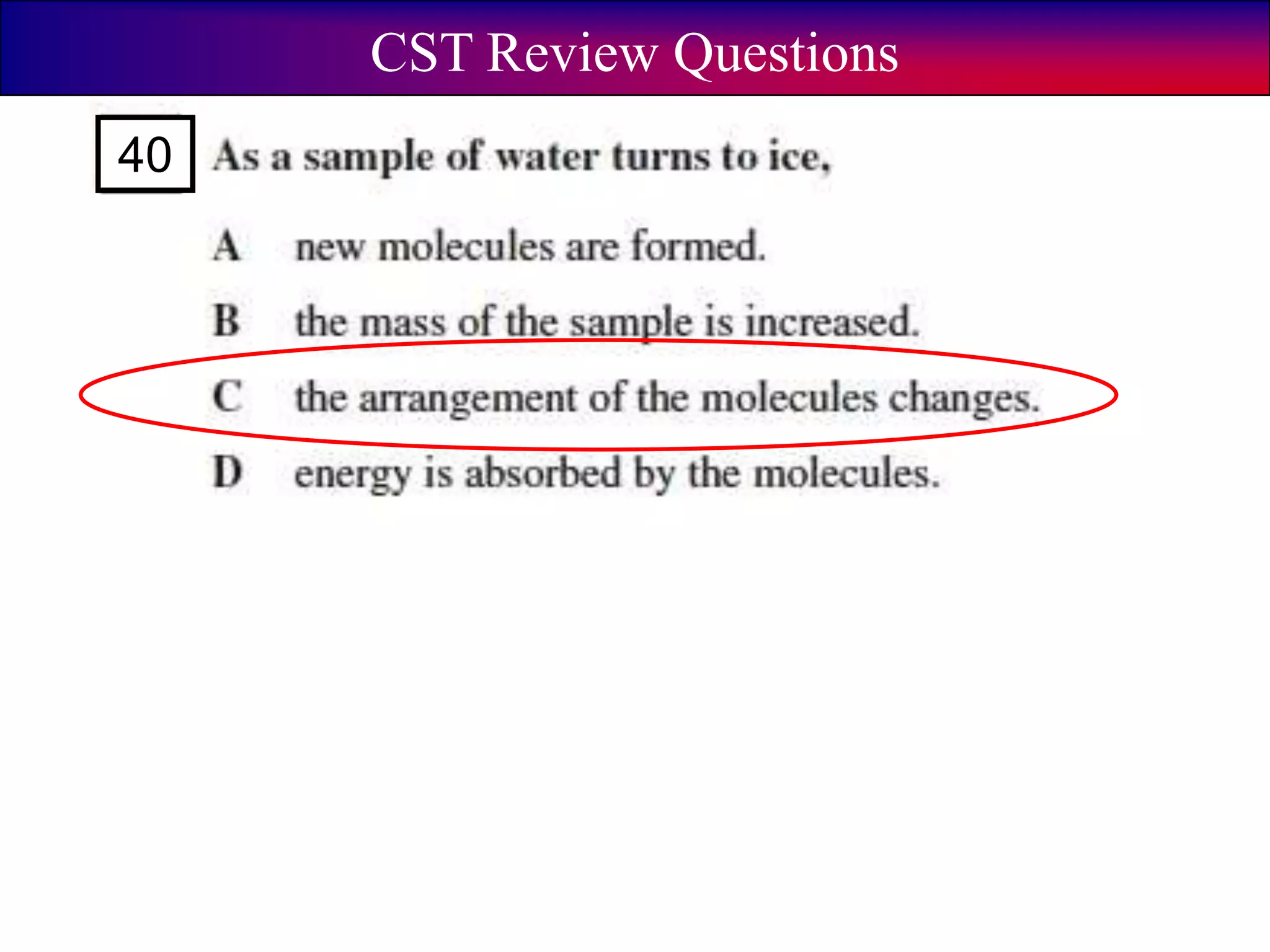
CST Review Questions
40
CST Review Questions
40
Think-Group-Share
1. THINK: Read the question and THINK
about the answer.
2. GROUP: Discuss the answer with your
teammates and agree on the correct
answer.
3. SHARE your answers by writing them on
the magnetic slate and holding them up.
Think-Write-Group-Share
What four states can
matter exist in?
Think-Write-Group-Share
What four states can
matter exist in?
 solid, liquid, gas, plasma
What states (forms) can matter exist in?
I. Matter can exist in 3 states or
phases: solids, liquids, gases.
solids liquids gases
Think-Write-Group-Share
Solids
 A. do not have a shape
 B. have a shape
Think-Write-Group-Share
Solids
 A. do not have a shape
 B. have a shape
How are atoms and molecules arranged in a solid?
II. Solids have their own shapes
and sizes.
Solids have their
own shape and
size.
Think-Write-Group-Share
Liquids
 A. do not have a shape
 B. have a shape
Think-Write-Group-Share
Liquids
 A. do not have a shape
 B. have a shape
What are the properties of liquids?
IV. Liquids do not have their
own shapes.
Liquids do
not have their
own shapes.
Think-Write-Group-Share
Gases
 A. do not have a shape
 B. have a shape
Think-Write-Group-Share
Gases
 A. do not have a shape
 B. have a shape
What are the properties of gases?
VI. Gases do not have their own
shapes and sizes.
Gases do not
have their
own shapes
and sizes.
Gas
States of Matter Graphic Organizer
Properties Solids Liquids Gases
Shape Has shape No shape No Shape
Volume
(Size)
Size/Volume
stays the same
Volume stays
the same.
Volume expands to
fill the container.
Think-Write-Group-Share
The volume (size) of solids
 A. does not change in
different containers
 B. changes with the
container.
Think-Write-Group-Share
The volume (size) of solids
 A. does not change in
different containers.
 B. changes in different
containers.
How are atoms and molecules arranged in a solid?
A. The size and volume of a
solid does not change unless
the solid changes.
Think-Write-Group-Share
The volume of liquids
 A. does not change in
different containers.
 B. changes with the
container.
Think-Write-Group-Share
The volume of liquids
 A. does not change in
different containers.
 B. changes in different
containers.
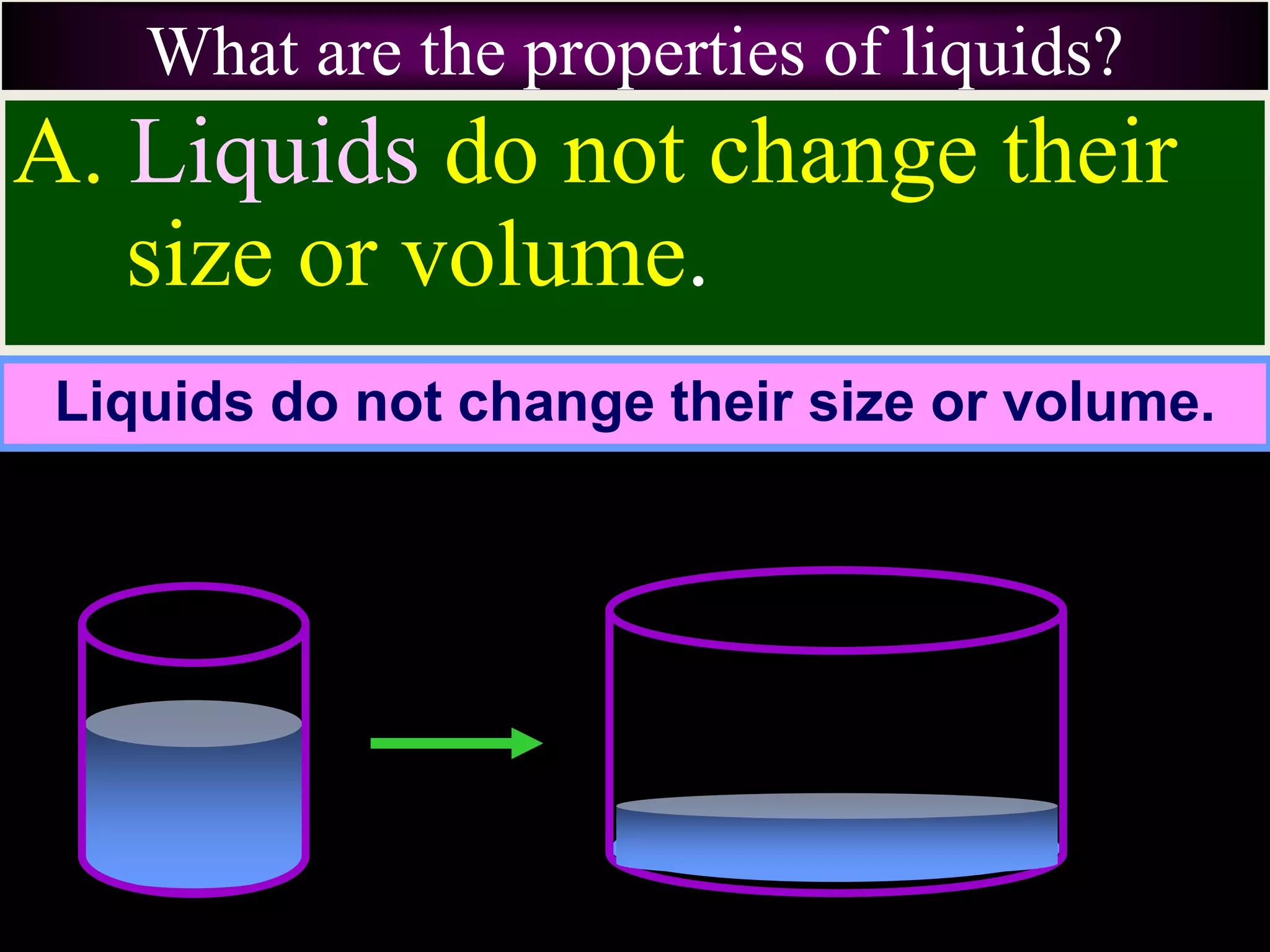
What are the properties of liquids?
A. Liquids do not change their
size or volume.
Liquids do not change their size or volume.
Think-Write-Group-Share
The volume of gases
 A. does not change in
different containers
 B. changes with the
container.
Think-Write-Group-Share
The volume of gases
 A. does not change in
different containers
 B. changes with the
container.
What are the properties of gases?
A. Gases completely fill their
containers.
Gases completely fill their
containers and take their shapes.
Gas
States of Matter Graphic Organizer
Properties Solids Liquids Gases
Shape Has shape No shape No Shape
Volume
(Size)
Size/Volume
stays the same
Volume stays
the same.
Volume expands to
fill the container.
Think-Write-Group-Share
Solids
 A. take the shape of the
container.
 B. do not take the shape of
the container.
Think-Write-Group-Share
Solids
 A. take the shape of the
container.
 B. do not take the shape of
the container.
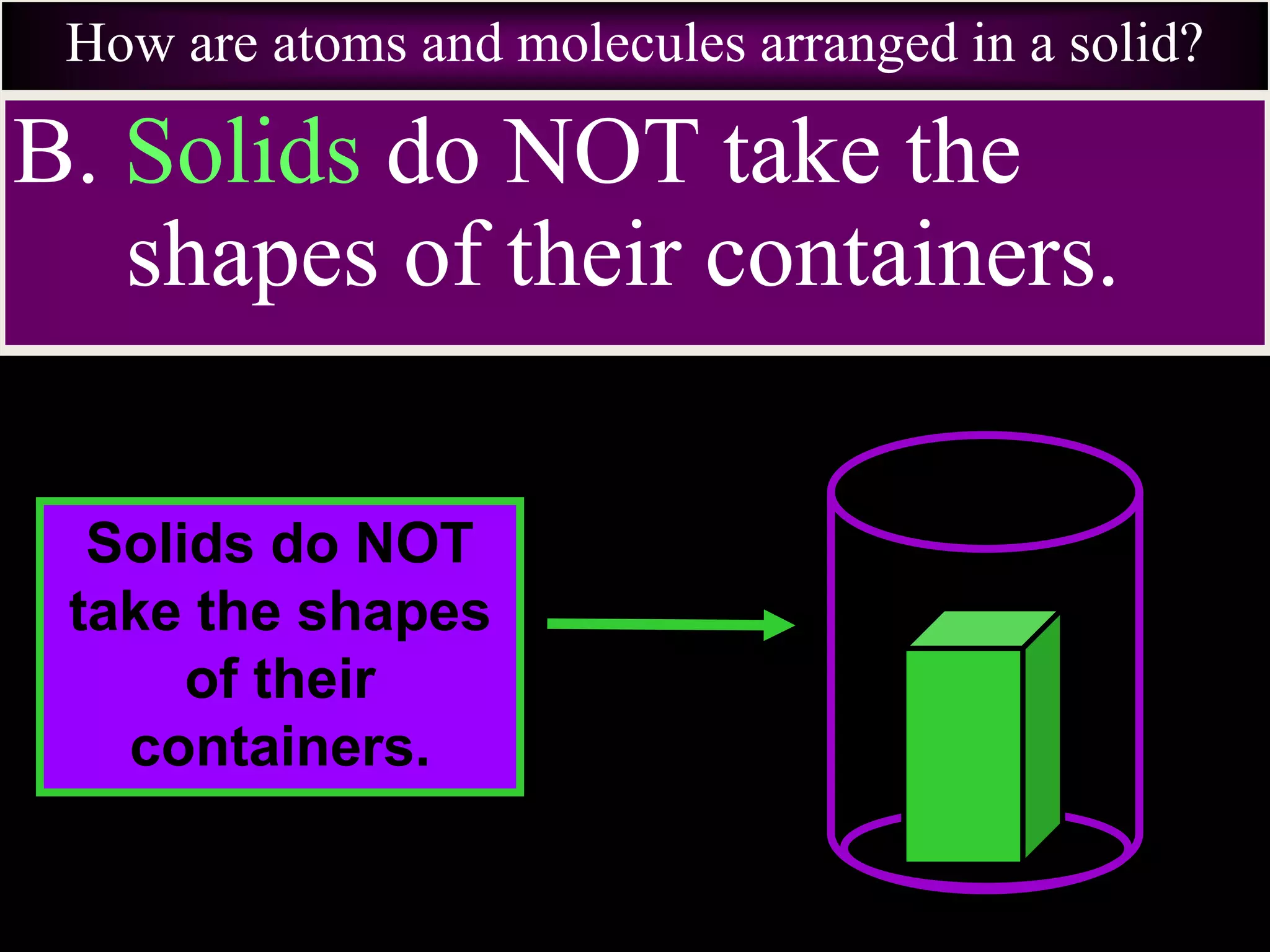
How are atoms and molecules arranged in a solid?
B. Solids do NOT take the
shapes of their containers.
Solids do NOT
take the shapes
of their
containers.
Think-Write-Group-Share
Liquids
 A. take the shape of the
container.
 B. do not take the shape of
the container.
Think-Write-Group-Share
Liquids
 A. take the shape of the
container.
 B. do not take the shape of
the container.
What are the properties of liquids?
B. Liquids take the shapes of
their containers.
Liquids
take the shapes
of their
containers.
Think-Write-Group-Share
Gases
 A. take the shape of the
container.
 B. do not take the shape of
the container.
Think-Write-Group-Share
Gases
 A. take the shape of the
container.
 B. do not take the shape of
the container.
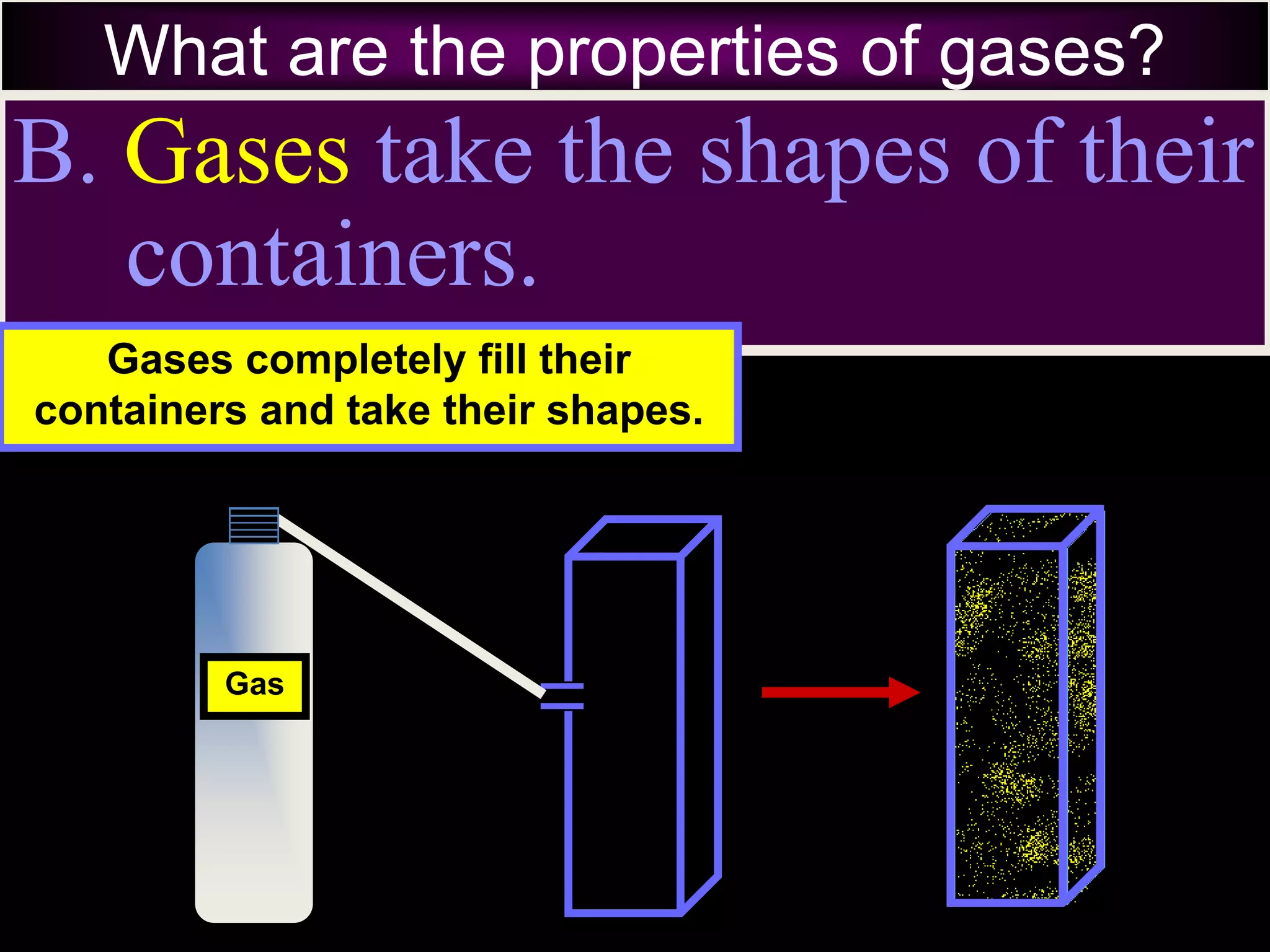
What are the properties of gases?
B. Gases take the shapes of their
containers.
Gases completely fill their
containers and take their shapes.
Gas
States of Matter Graphic Organizer
Properties Solids Liquids Gases
What
happens
when
placed in
a
container
Do not take
the shape of
the container.
Take the shape
of the
container.
Take the shape of
the container and fill
the container.
Think-Write-Group-Share
Atoms and molecules in solids
are
 A. close together and touching.
 B. very very far apart.
C. have space between them.
Think-Write-Group-Share
Atoms and molecules in solids
are
 A. close together and touching.
 B. very very far apart.
C. have space between them.
How are atoms and molecules arranged in a solid?
III. Atoms and molecules are
close together in solids.
solids
Atoms or molecules
are close together in
a solid.
Think-Write-Group-Share
Atoms and molecules in liquids
are
 A. close together and touching.
 B. very very far apart.
C. with space between them.
Think-Write-Group-Share
Atoms and molecules in liquids
are
 A. close together and touching.
 B. very very far apart.
C. with space between them.
Think-Write-Group-Share
What kind of change is
matter changing between
solid liquid and gas?
 chemical change
 physical change
Think-Write-Group-Share
What kind of change is
matter changing between
solid liquid and gas?
 chemical change
 physical change
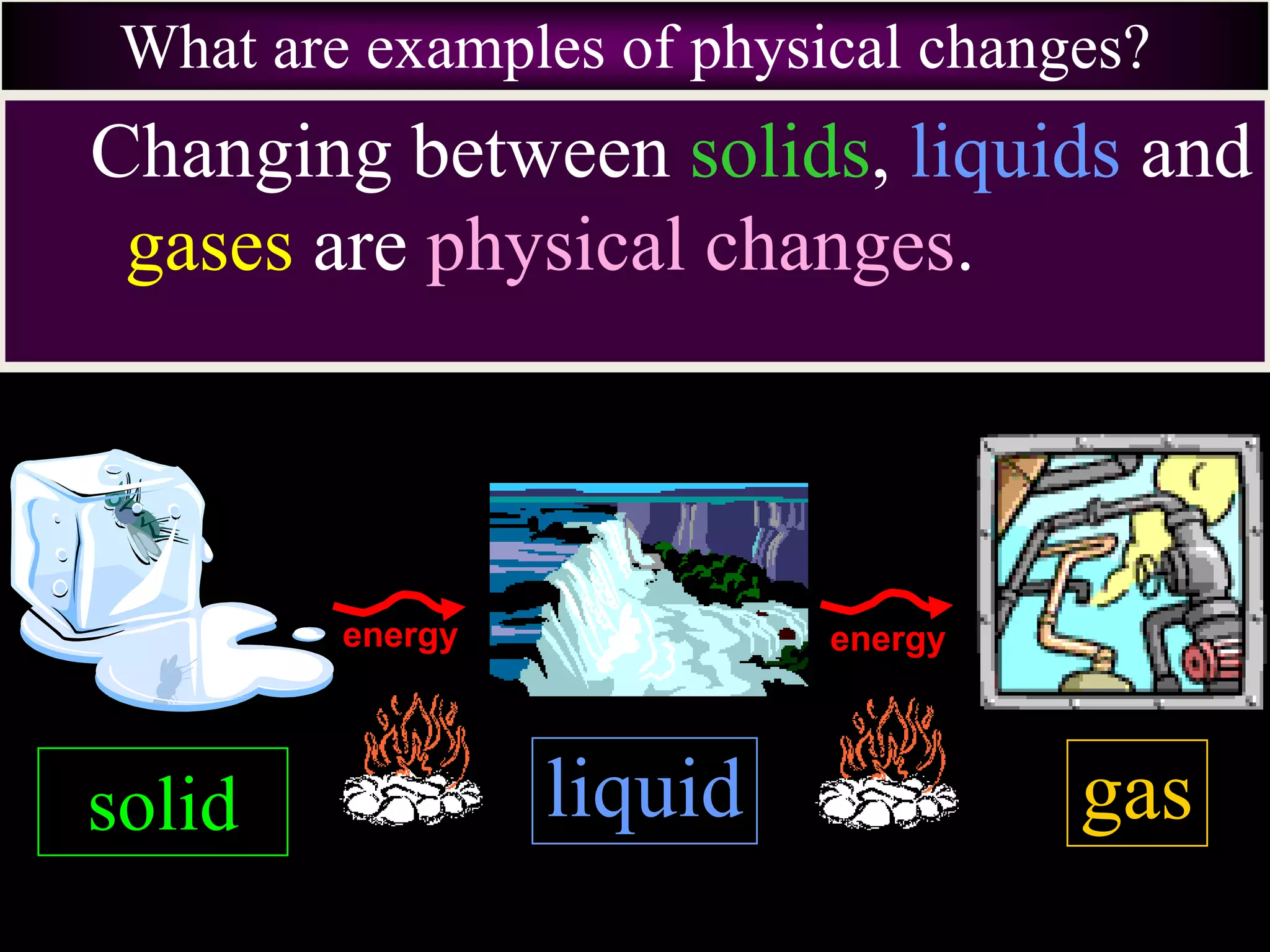
What are examples of physical changes?
liquidsolid
energy
Changing between solids, liquids and
gases are physical changes.
energy
gas
Think-Write-Group-Share
In a physical change (2 answers)
 A. new substances are created
 B. NO new substances are created.
 C. Substances are made with different
properties.
 D. Made substances do not have different
properties.
Think-Write-Group-Share
In a physical change
 new substances are created
 B. NO new substances are created.
 Substances are made with different
properties.
 D. Made substances do not have different
properties.
What are examples of physical changes?
liquidsolid
energy
When matter changes between solids,
liquids, and gases nothing new is
created.
energy
gas
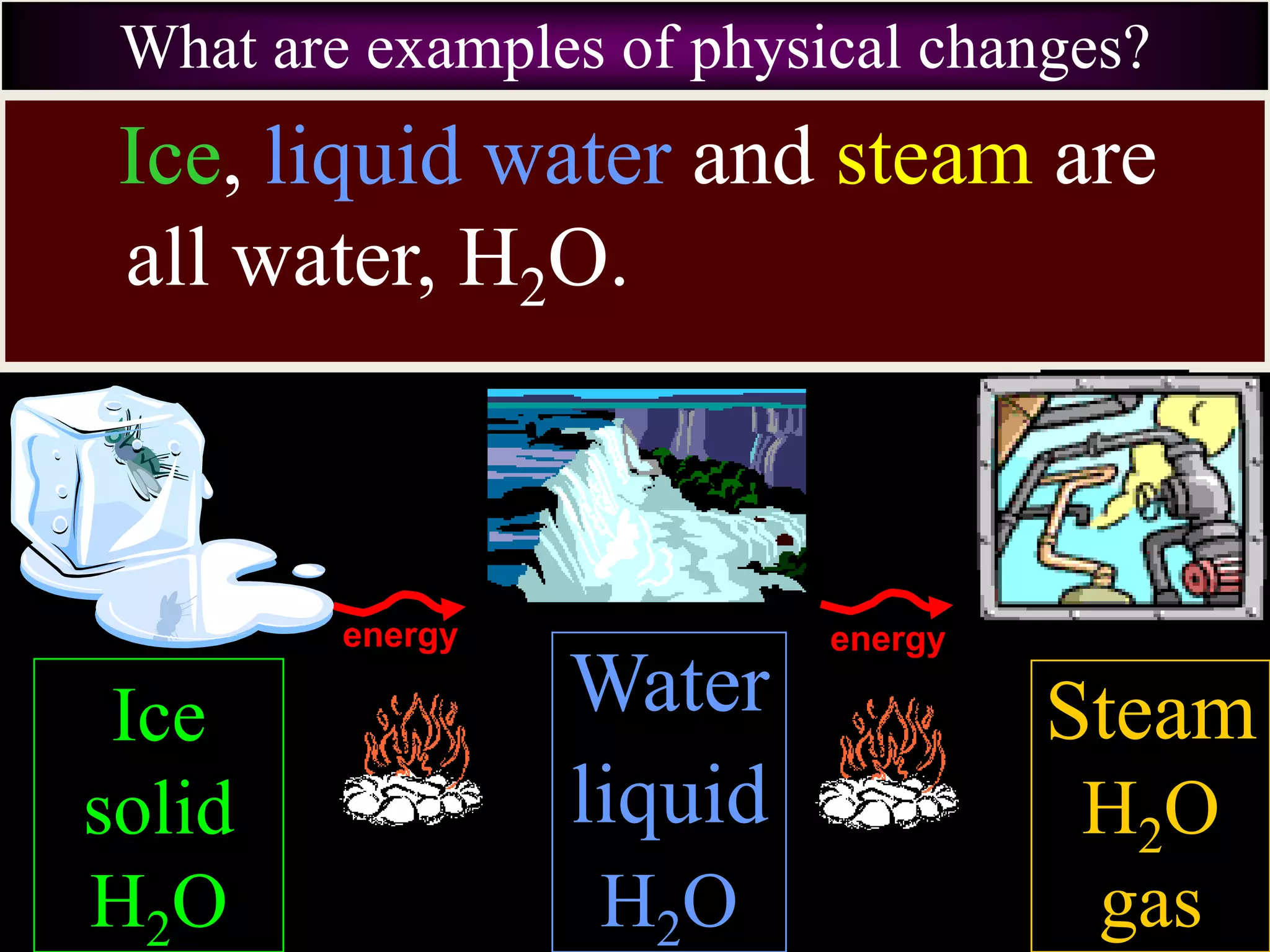
What are examples of physical changes?
Water
liquid
H2O
Ice
solid
H2O
energy
Ice, liquid water and steam are
all water, H2O.
energy
Steam
H2O
gas
Think-Write-Group-Share
When matter changes between
solid, liquid and gas (2 answers)
 A. heat energy must be added
 B. heat energy must be subtracted.
 C. energy is destroyed.
 D. the amount of energy does not change.
Think-Write-Group-Share
When matter changes between
solid, liquid and gas
 A. heat energy must be added
 B. heat energy must be subtracted.
 C. energy is destroyed.
 D. the amount of energy does not change.
How do substances change states (phases)?
Substances change from solids to
liquids to gases when energy is
added or subtracted.
liquidsolid gas
energy energy
heat heat
Think-Write-Group-Share
When matter changes from solid to
liquid to gas
 A. the atoms get closer together.
 B. the atoms get farther apart.
 C. the atoms do not change.
Think-Write-Group-Share
When matter changes from solid to
liquid to gas
 A. the atoms get closer together.
 B. the atoms get farther apart.
 C. the atoms do not change.
How do substances change states (phases)?
C. Atoms & molecules become farther
apart when energy is added.
liquidssolids gases
energy energy
Think-Write-Group-Share
When matter changes from solid to
liquid to gas
 A. the atoms move faster.
 B. the atoms move slower.
 C. the atoms do not change.
Think-Write-Group-Share
When matter changes from solid to
liquid to gas
 A. the atoms move faster.
 B. the atoms move slower.
 C. the atoms do not change.
How do substances change states (phases)?
B. Atoms & molecules move faster
when energy is added.
liquidssolids gases
+ energy + energy
Think-Write-Group-Share
Changing from solid to liquid is called
 A. condensation.
 B. freezing.
 C. boiling/evaporation.
 D. melting.
 E. sublimation.
Think-Write-Group-Share
Changing from solid to liquid is called
 A. condensation.
 B. freezing.
 C. boiling/evaporation.
 D. melting.
 E. sublimation.
What physical processes cause phase changes?
A. A solid becoming a liquid is
called the process of melting.
liquidsolid
Add energy
Melting
Think-Write-Group-Share
Changing from liquid to solid is called
 A. condensation.
 B. freezing.
 C. boiling/evaporation.
 D. melting.
 E. sublimation.
Think-Write-Group-Share
Changing from liquid to solid is called
 A. condensation.
 B. freezing.
 C. boiling/evaporation.
 D. melting.
 E. sublimation.
What physical processes cause phase changes?
B. A liquid becoming a solid is
called the process of freezing.
liquid solid
- energy
taken away
Freezing
Think-Write-Group-Share
Changing from liquid to gas is called
 A. condensation.
 B. freezing.
 C. evaporation/boiling.
 D. melting.
 E. sublimation.
Think-Write-Group-Share
Changing from liquid to gas is called
 A. condensation.
 B. freezing.
 C. evaporation/boiling.
 D. melting.
 E. sublimation.
What physical processes cause phase changes?
liquid
C. A liquid becoming a gas is
called evaporation and boiling.
Add energy
Evaporation and Boiling
gas
Think-Write-Group-Share
Changing from liquid to gas quickly is
called
 A. condensation.
 B. boiling.
 C. evaporation.
 D. sublimation
Think-Write-Group-Share
Changing from liquid to gas quickly is
called
 A. condensation.
 B. boiling.
 C. evaporation.
 D. sublimation
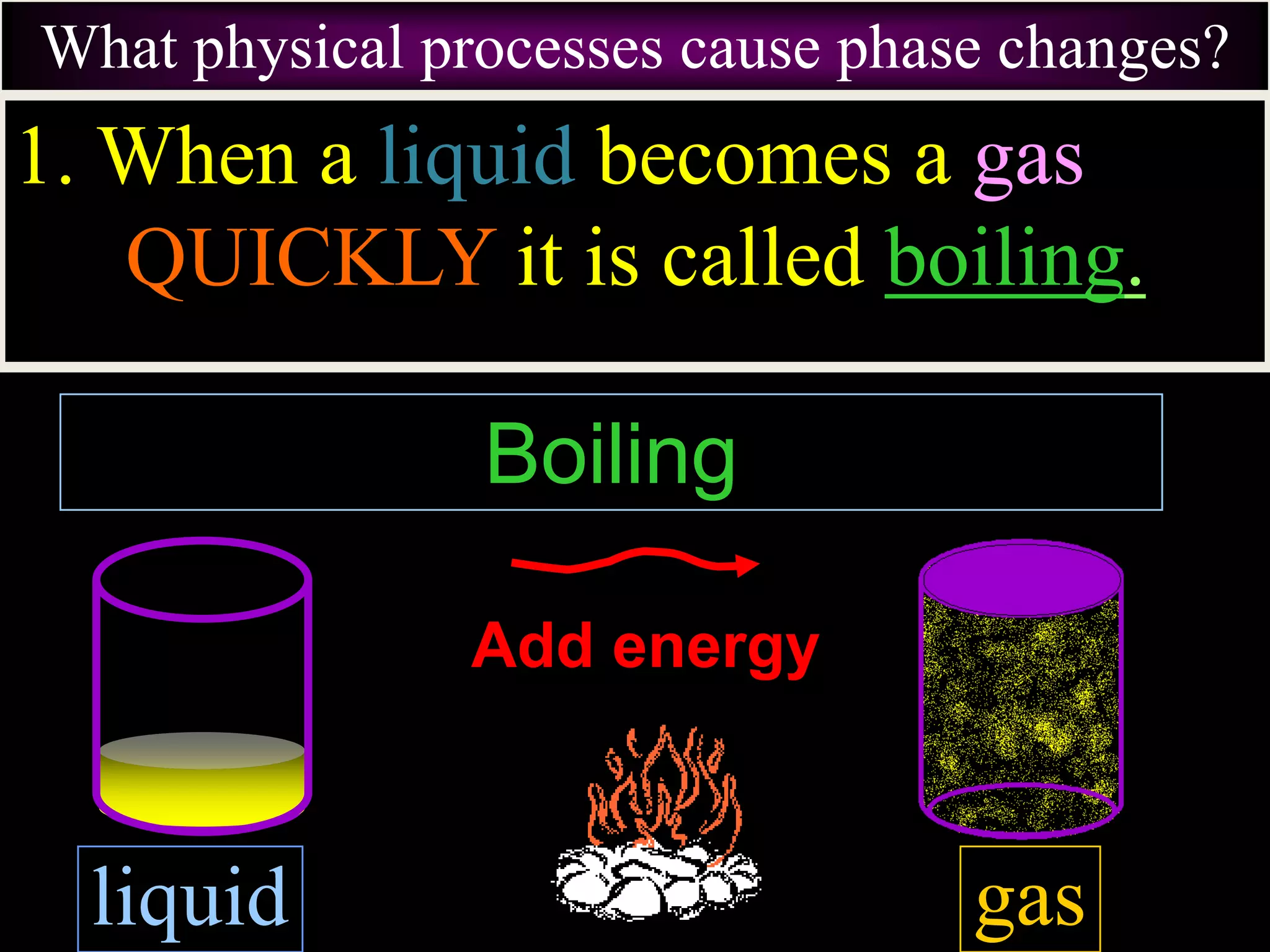
What physical processes cause phase changes?
liquid
1. When a liquid becomes a gas
QUICKLY it is called boiling.
Add energy
Boiling
gas
Think-Write-Group-Share
Changing from liquid to gas slowly is
called
 A. condensation.
 B. boiling.
 C. evaporation.
 D. sublimation
Think-Write-Group-Share
Changing from liquid to gas slowly is
called
 A. condensation.
 B. boiling.
 C. evaporation.
 D. sublimation
What physical processes cause phase changes?
liquid
2. When a liquid becomes a gas
SLOWLY it is called evaporation.
Add energy
Evaporation
gas
Think-Write-Group-Share
Changing from gas to liquid is called
 A. condensation.
 B. freezing.
 C. boiling/evaporation.
 D. melting.
 E. sublimation.
Think-Write-Group-Share
Changing from gas to liquid is called
 A. condensation.
 B. freezing.
 C. boiling/evaporation.
 D. melting.
 E. sublimation.
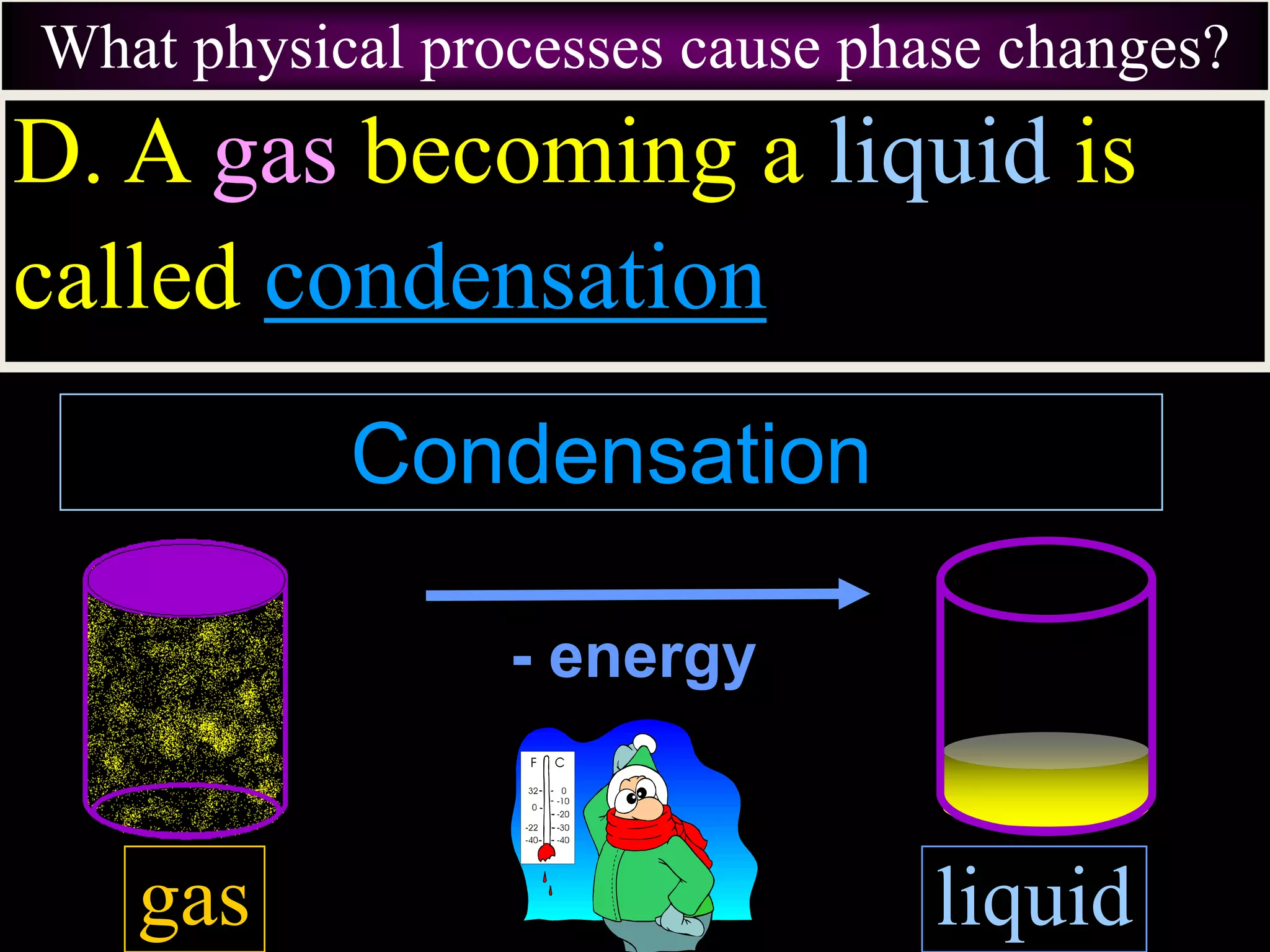
What physical processes cause phase changes?
liquid
D. A gas becoming a liquid is
called condensation
- energy
Condensation
gas
Think-Write-Group-Share
Changing from solid to gas is called
 A. condensation.
 B. freezing.
 C. boiling/evaporation.
 D. melting.
 E. sublimation.
Think-Write-Group-Share
Changing from solid to gas is called
 A. condensation.
 B. freezing.
 C. boiling/evaporation.
 D. melting.
 E. sublimation.
What physical processes cause phase changes?
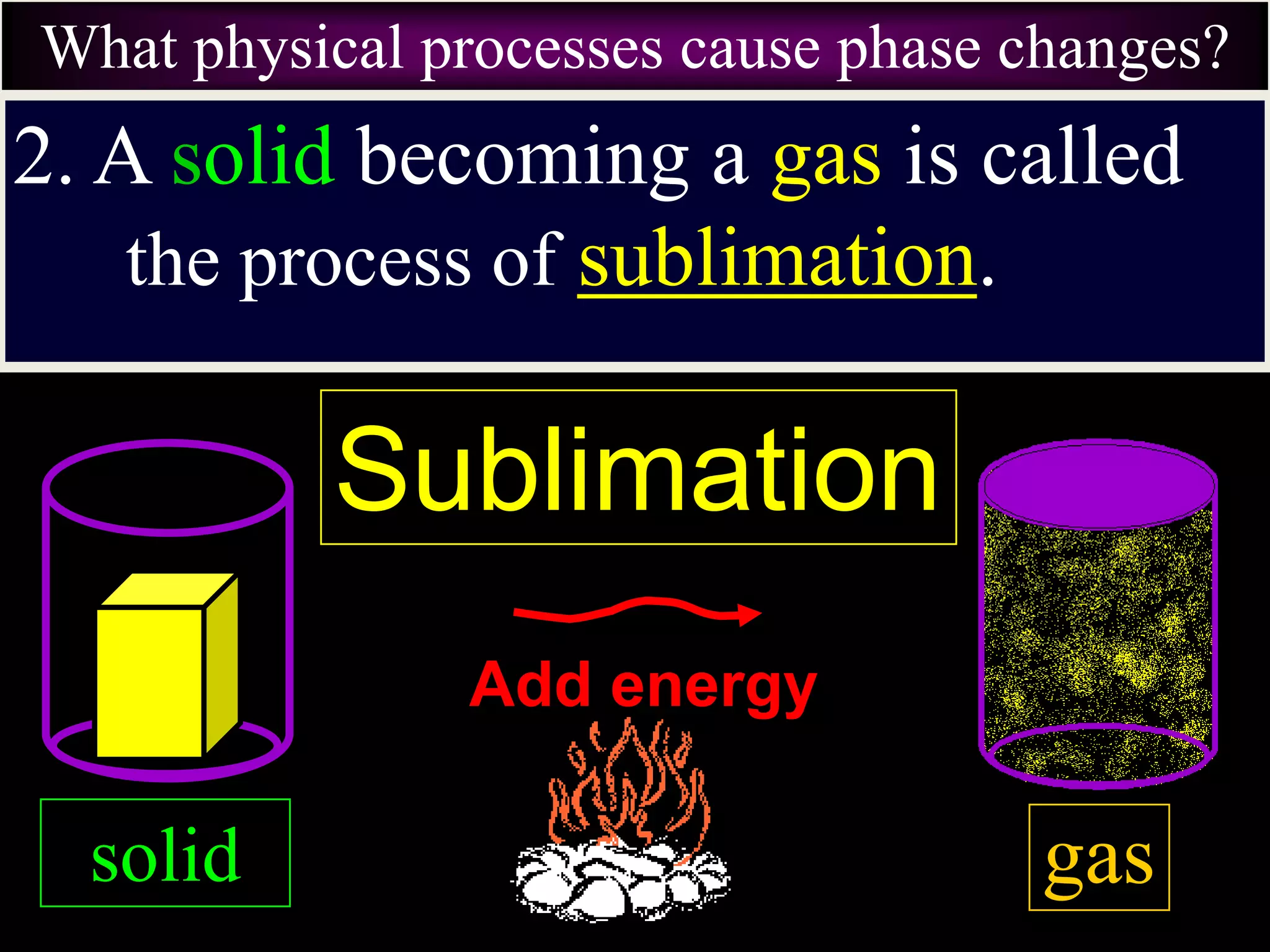
2. A solid becoming a gas is called
the process of sublimation.
solid
Add energy
Sublimation
gas
What physical processes cause phase changes?
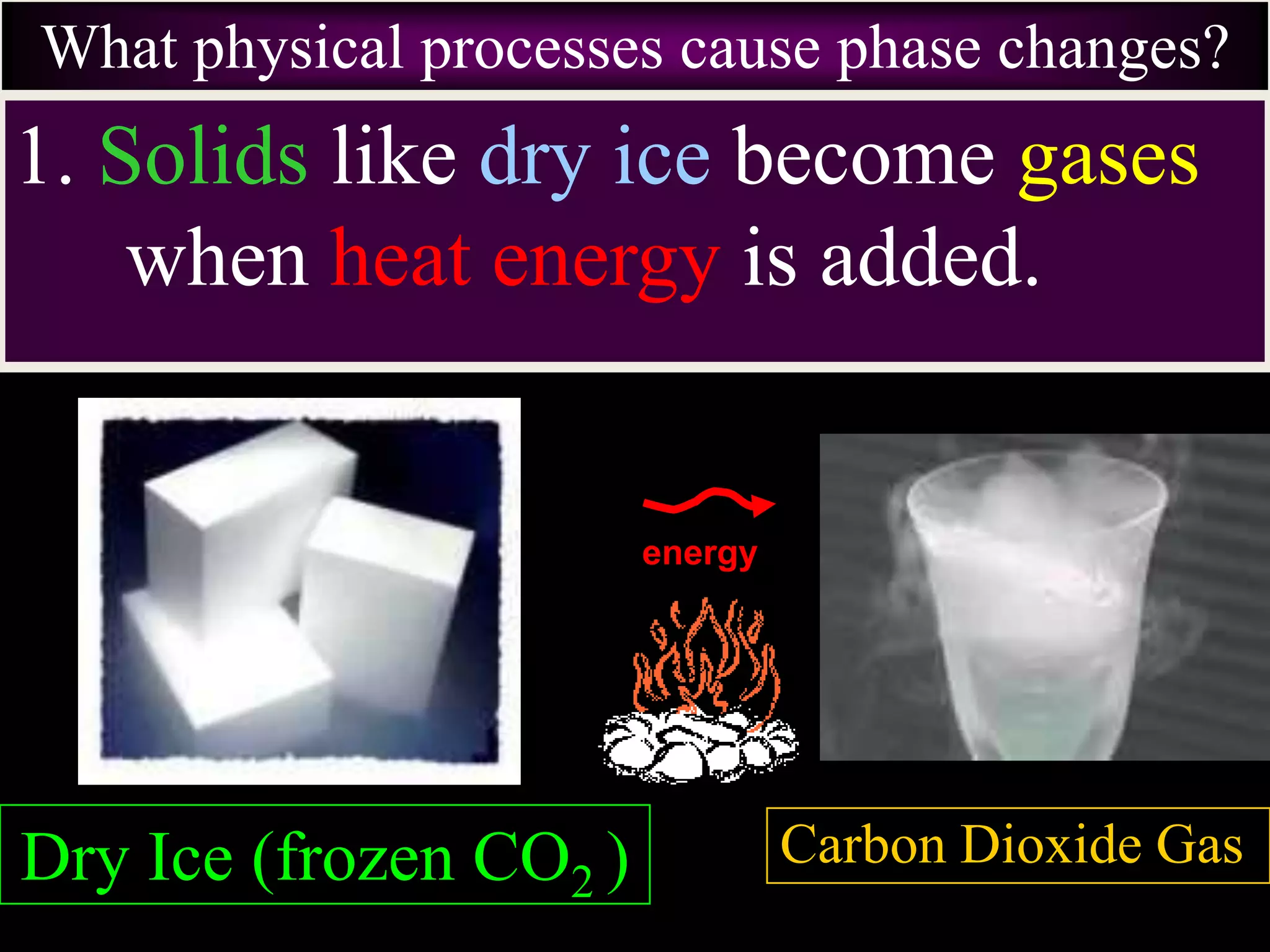
energy
1. Solids like dry ice become gases
when heat energy is added.
Carbon Dioxide GasDry Ice (frozen CO2 )

CST Review_States of Matter

Editor's Notes