CST Review
Force
CST Review
Forces
BrainPop
Gravity
Brain Pop
BrainPop
Buoyancy
Brain Pop
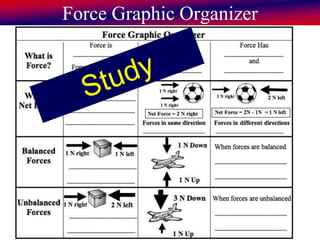
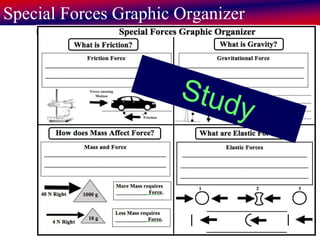
Force Graphic Organizer
Special Forces Graphic Organizer
Cornell Notes
Title: Buoyancy
Questions Notes (Answers)
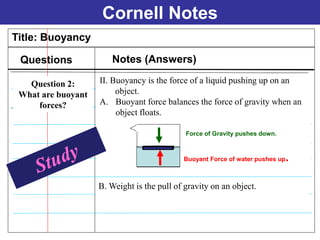
II. Buoyancy is the force of a liquid pushing up on an
object.
A. Buoyant force balances the force of gravity when an
object floats.
Question 2:
What are buoyant
forces?
Buoyant Force of water pushes up.
Force of Gravity pushes down.
B. Weight is the pull of gravity on an object.
Cornell Notes
Title: Buoyancy
Questions Notes (Answers)
Question 3:
What determines the
strength (magnitude)
of buoyant force?
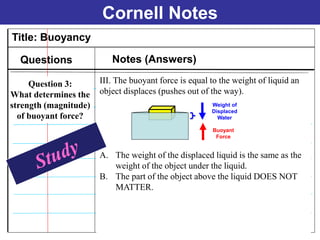
III. The buoyant force is equal to the weight of liquid an
object displaces (pushes out of the way).
A. The weight of the displaced liquid is the same as the
weight of the object under the liquid.
B. The part of the object above the liquid DOES NOT
MATTER.
Buoyant
Force
Weight of
Displaced
Water
Cornell Notes
Title: Buoyancy
Questions Notes (Answers)
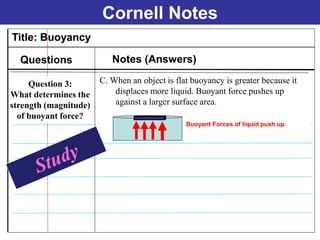
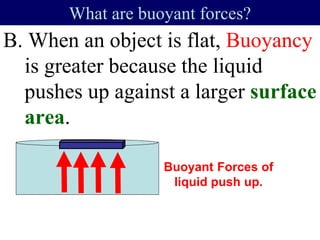
C. When an object is flat buoyancy is greater because it
displaces more liquid. Buoyant force pushes up
against a larger surface area.
Buoyant Forces of liquid push up.
Question 3:
What determines the
strength (magnitude)
of buoyant force?
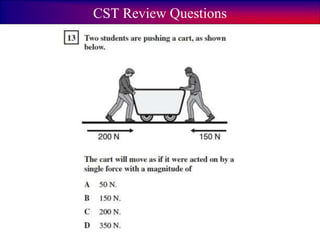
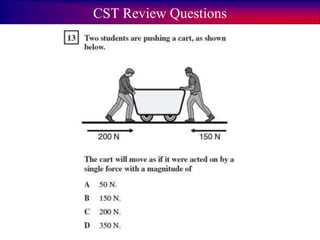
CST Review Questions
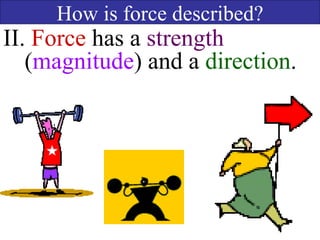
How is force described?
II. Force has a strength
(magnitude) and a direction.
CST Review Questions
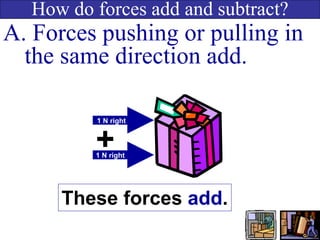
How do forces add and subtract?
A. Forces pushing or pulling in
the same direction add.
+
These forces add.
1 N right
1 N right
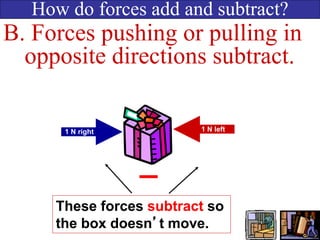
How do forces add and subtract?
B. Forces pushing or pulling in
opposite directions subtract.
These forces subtract so
the box doesn’t move.
_
1 N right 1 N left
CST Review Questions
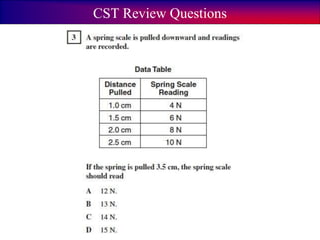
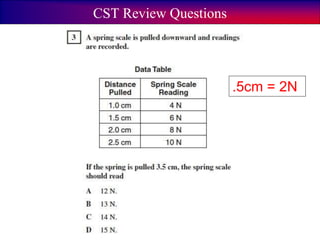
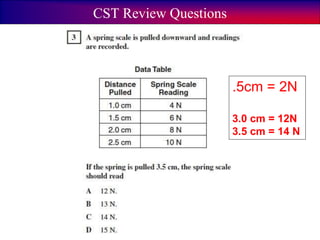
.5cm = 2N
CST Review Questions
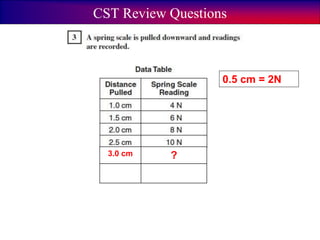
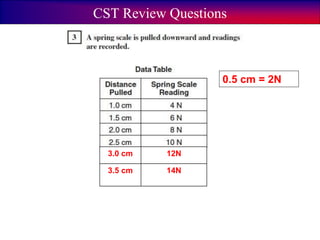
3.0 cm ?
0.5 cm = 2N
CST Review Questions
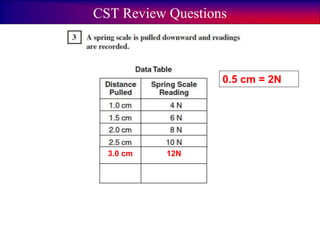
3.0 cm 12N
0.5 cm = 2N
CST Review Questions
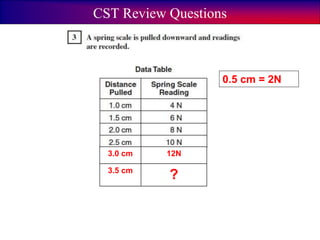
3.0 cm 12N
3.5 cm
?
0.5 cm = 2N
CST Review Questions
0.5 cm = 2N
3.0 cm 12N
3.5 cm 14N
CST Review Questions
.5cm = 2N
3.0 cm = 12N
3.5 cm = 14 N
CST Review Questions
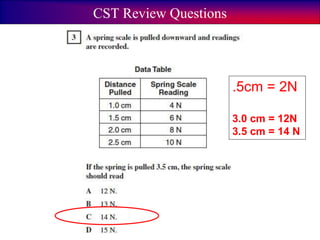
.5cm = 2N
3.0 cm = 12N
3.5 cm = 14 N
CST Review Questions
____________________________________________
___________________________________________
______________________
CST Review Questions
____________________________________________
___________________________________________
______________________
CST Review Questions
____________________________________________
___________________________________________
______________________
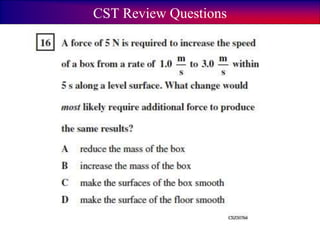
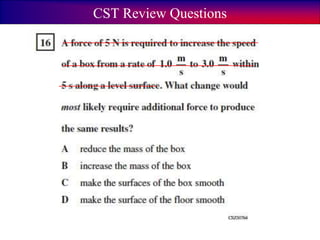
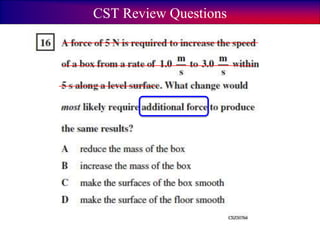
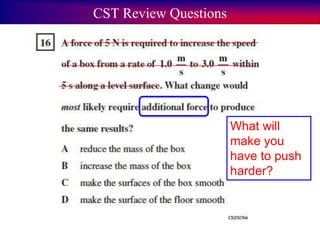
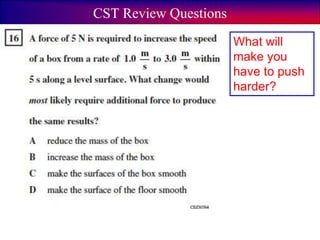
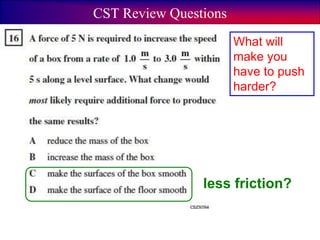
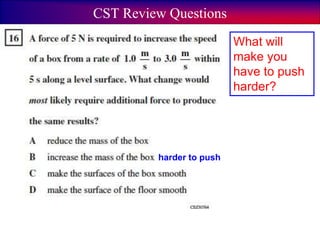
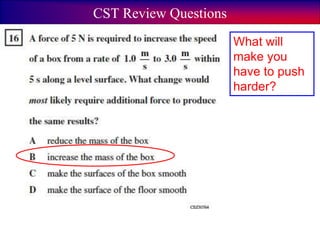
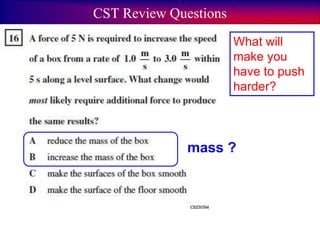
What will
make you
have to push
harder?
CST Review Questions
What will
make you
have to push
harder?
CST Review Questions
What will
make you
have to push
harder?
less friction?
CST Review Questions
What will
make you
have to push
harder?
mass ?
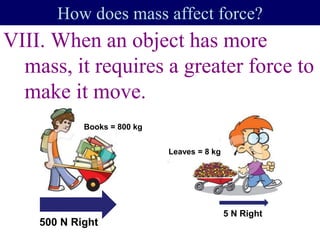
VIII. When an object has more
mass, it requires a greater force to
make it move.
How does mass affect force?
500 N Right
Books = 800 kg
5 N Right
Leaves = 8 kg
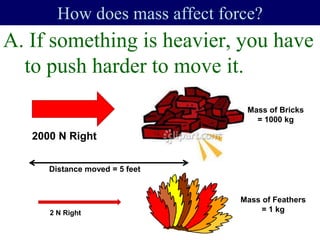
A. If something is heavier, you have
to push harder to move it.
How does mass affect force?
Mass of Feathers
= 1 kg
Mass of Bricks
= 1000 kg
2000 N Right
2 N Right
Distance moved = 5 feet
CST Review Questions
What will
make you
have to push
harder?
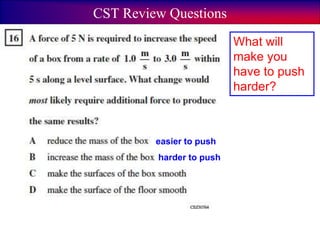
harder or easier to push?
CST Review Questions
What will
make you
have to push
harder?
easier to push
harder to push
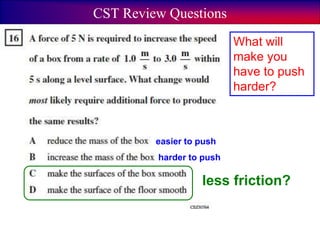
CST Review Questions
What will
make you
have to push
harder?
less friction?
easier to push
harder to push
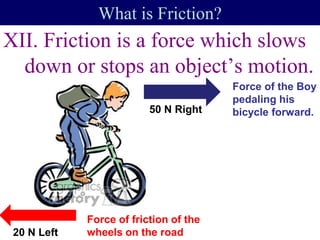
XII. Friction is a force which slows
down or stops an object’s motion.
What is Friction?
50 N Right
Force of friction of the
wheels on the road20 N Left
Force of the Boy
pedaling his
bicycle forward.
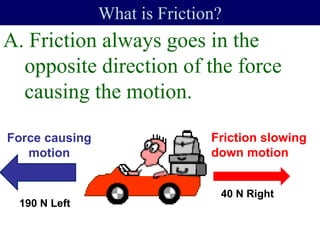
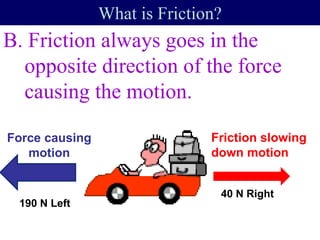
A. Friction always goes in the
opposite direction of the force
causing the motion.
What is Friction?
40 N Right
190 N Left
Friction slowing
down motion
Force causing
motion
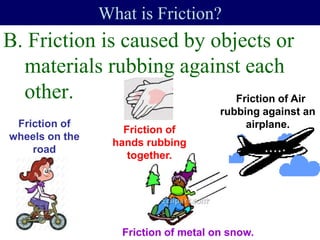
B. Friction is caused by objects or
materials rubbing against each
other.
What is Friction?
Friction of Air
rubbing against an
airplane.Friction of
wheels on the
road
Friction of metal on snow.
Friction of
hands rubbing
together.
CST Review Questions
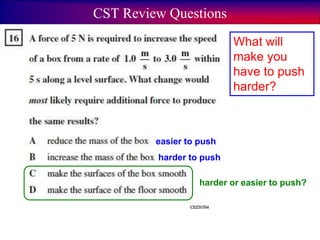
What will
make you
have to push
harder?
harder or easier to push?
easier to push
harder to push
CST Review Questions
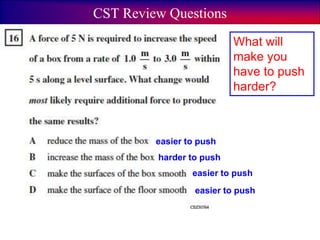
What will
make you
have to push
harder?
easier to push
harder to push
easier to push
easier to push
CST Review Questions
What will
make you
have to push
harder?
harder to push
CST Review Questions
What will
make you
have to push
harder?
CST Review Questions
Buoyant Forces
Consider This
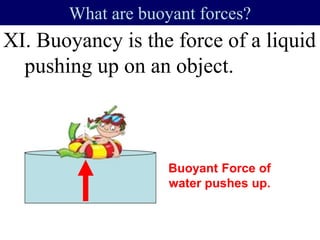
XI. Buoyancy is the force of a liquid
pushing up on an object.
What are buoyant forces?
Buoyant Force of
water pushes up.
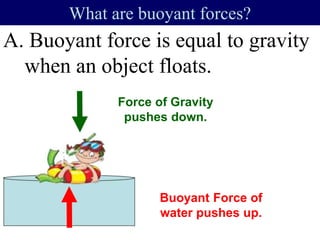
A. Buoyant force is equal to gravity
when an object floats.
What are buoyant forces?
Buoyant Force of
water pushes up.
Force of Gravity
pushes down.
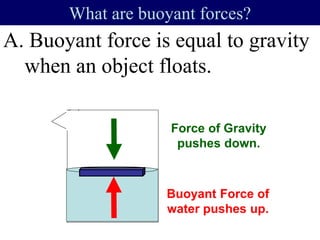
A. Buoyant force is equal to gravity
when an object floats.
What are buoyant forces?
Buoyant Force of
water pushes up.
Force of Gravity
pushes down.
B. When an object is flat, Buoyancy
is greater because the liquid
pushes up against a larger surface
area.
What are buoyant forces?
Buoyant Forces of
liquid push up.
Force
Review
Think-Group-Share
1. THINK: Read the question and THINK
about the answer.
2. GROUP: Discuss the answer with your
teammates and agree on the correct
answer.
3. SHARE your answers by writing them on
the magnetic slate and holding them up.
Think-Group-Share
What is force?
Think-Group-Share
What is force?
 a push or pull
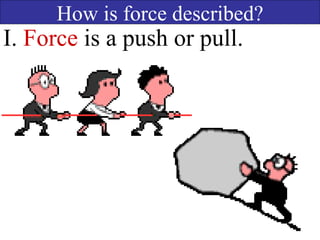
How is force described?
I. Force is a push or pull.
Think-Group-Share
What does force change?
 A. the mass of an object
B. the motion of an object
C. the volume of an object
Think-Group-Share
What does force change?
 A. the mass of an object
B. the motion of an object
C. the volume of an object
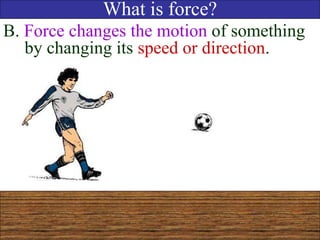
What is force?
B. Force changes the motion of something
by changing its speed or direction.
Think-Group-Share
Force is measured in
 A. Grams
B. Meters
C. Newtons
 D. Liters
Think-Group-Share
Force is measured in
 A. Grams
B. Meters
C. Newtons
 D. Liters
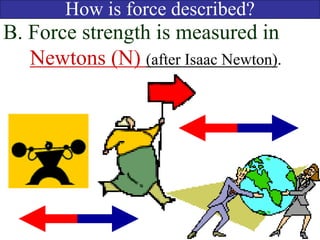
How is force described?
B. Force strength is measured in
Newtons (N) (after Isaac Newton).
Think-Group-Share
What 2 things does force
have?
 A. magnitude and direction
 B. size and shape
 C. strength and shape
Think-Group-Share
What 2 things does force
have?
 A. magnitude and direction
 B. size and shape
 C. strength and shape
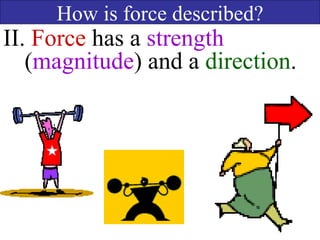
How is force described?
II. Force has a strength
(magnitude) and a direction.
Think-Group-Share
A weight lifter raises his
barbells straight up with a force
of 30 Newtons. How would you
describe the force?
Think-Group-Share
A weight lifter raises his
barbells straight up with a force
of 30 Newtons. How would you
describe the force?
 30 N Up
Think-Group-Share
What do forces in the same
direction do?
 A. subtract
 B. cancel each other
 C. add
Think-Group-Share
What do forces in the same
direction do?
 A. subtract
 B. cancel each other
 C. add
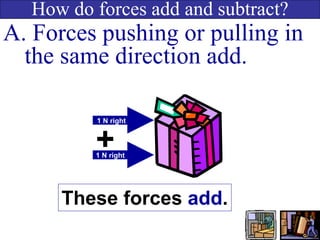
How do forces add and subtract?
A. Forces pushing or pulling in
the same direction add.
+
These forces add.
1 N right
1 N right
Think-Group-Share
What do forces in opposite
directions do?
 A. subtract
 B. cancel each other
 C. add
Think-Group-Share
What do forces in opposite
directions do?
 A. subtract
 B. cancel each other
 C. add
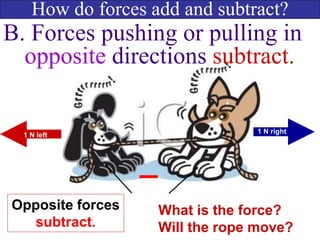
How do forces add and subtract?
B. Forces pushing or pulling in
opposite directions subtract.
Opposite forces
subtract.
_
1 N right
1 N left
What is the force?
Will the rope move?
Think-Group-Share
The force left after all forces
have been added and
subtracted is called
 A. final force
 B. net force
 C. resultant force
Think-Group-Share
The force left after all forces
have been added and
subtracted is called
 A. final force
 B. net force
 C. resultant force
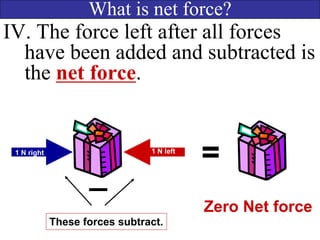
What is net force?
IV. The force left after all forces
have been added and subtracted is
the net force.
=
These forces subtract.
_
Zero Net force
1 N right 1 N left
Think-Group-Share
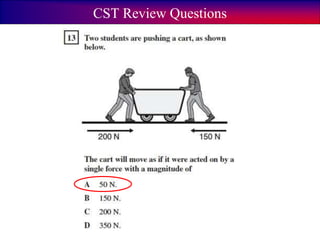
A boy pushes a cart with a
force of 3 N right. Another boy
pushes the same cart with a
force of 1 N left. What is the net
force on the cart?
Think-Group-Share
A boy pushes a cart with a
force of 3 N right. Another boy
pushes the same cart with a
force of 1 N left. What is the net
force on the cart?
 3 N right - 1 N left = 2 N right
Think-Group-Share
A man pushes a car with a
force of 10 N right. Another
man helps him push the car
with a force of 9 N right. What
is the net force on the car?
Think-Group-Share
A man pushes a car with a
force of 10 N right. Another
man helps him push the car
with a force of 9 N right. What
is the net force on the car?
10 N right + 9 N right = 19 N right
Think-Group-Share
When opposite forces on
an object are equal, the
forces are
 A. balanced
 B. unbalanced
Think-Group-Share
When opposite forces on
an object are equal, the
forces are
 A. balanced
 B. unbalanced
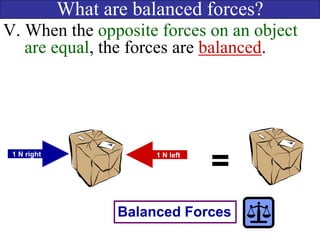
What are balanced forces?
V. When the opposite forces on an object
are equal, the forces are balanced.
Balanced Forces
=1 N right 1 N left
Think-Group-Share
When opposite forces on
an object are NOT equal,
the forces are
 A. balanced
 B. unbalanced
Think-Group-Share
When opposite forces on
an object are NOT equal,
the forces are
 A. balanced
 B. unbalanced
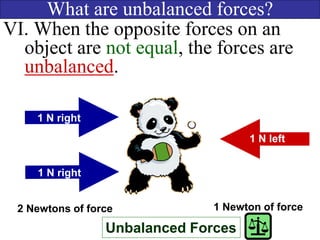
What are unbalanced forces?
VI. When the opposite forces on an
object are not equal, the forces are
unbalanced.
Unbalanced Forces
1 N right
1 N left
2 Newtons of force 1 Newton of force
1 N right
Think-Group-Share
When forces on an object are
balanced, the object
 A. does not move
 B. moves
 C. changes form
Think-Group-Share
When forces on an object are
balanced, the object
 A. does not move
 B. moves
 C. changes form
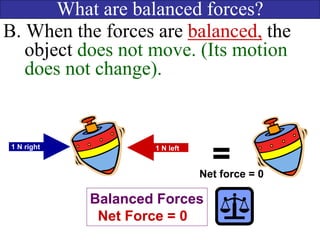
What are balanced forces?
B. When the forces are balanced, the
object does not move. (Its motion
does not change).
Balanced Forces
Net Force = 0
=1 N right 1 N left
Net force = 0
Think-Group-Share
When forces on an object are
unbalanced, the object
 A. does not move
 B. changes form
 C. changes its motion
Think-Group-Share
When forces on an object are
unbalanced, the object
 A. does not move
 B. changes form
 C. changes its motion
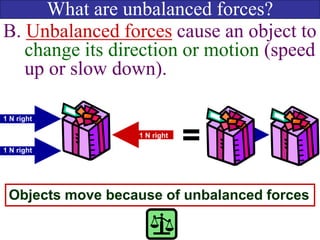
What are unbalanced forces?
B. Unbalanced forces cause an object to
change its direction or motion (speed
up or slow down).
=
Objects move because of unbalanced forces
1 N right
1 N right
1 N right
Think-Group-Share
A boy pulls a wagon with a force
of 35 N left. The wind pushes
the wagon with a force of 20 N
right. Are the forces balanced or
unbalanced?
Think-Group-Share
A boy pulls a wagon with a force
of 35 N left. The wind pushes
the wagon with a force of 20 N
right. Are the forces balanced or
unbalanced?
 unbalanced
Think-Group-Share
A girl pulls on a rope with a force
of 15N left. Her friend pulls on
the rope with a force of 15 N
right. Are the forces balanced or
unbalanced?
 balanced
Think-Group-Share
A girl pulls on a rope with a force
of 15N left. Her friend pulls on
the rope with a force of 15 N
right. Are the forces balanced or
unbalanced?
 balanced
Think-Group-Share
Friction is the force
 A. of objects rubbing against each
other
 B. which pulls objects together
 C. which changes the shape of objects
until it is removed.
 D. of liquids pushing up on an object.
Think-Group-Share
Friction is the force
 A. of objects rubbing against each
other
 B. which pulls objects together
 C. which changes the shape of objects
until it is removed.
 D. of liquids pushing up on an object.
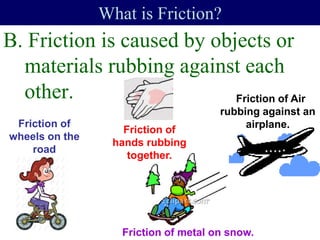
B. Friction is caused by objects or
materials rubbing against each
other.
What is Friction?
Friction of Air
rubbing against an
airplane.Friction of
wheels on the
road
Friction of metal on snow.
Friction of
hands rubbing
together.
Think-Group-Share
Friction
 A. Goes in the same direction as
the motion of the object.
 B. Goes in the opposite direction
of the motion of the object.
 C. Has nothing to do with the
motion of the object.
Think-Group-Share
Friction
 A. Goes in the same direction as
the motion of the object.
 B. Goes in the opposite direction
of the motion of the object.
 C. Has nothing to do with the
motion of the object.
B. Friction always goes in the
opposite direction of the force
causing the motion.
What is Friction?
40 N Right
190 N Left
Friction slowing
down motion
Force causing
motion
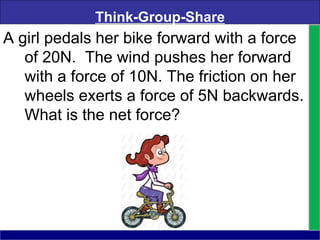
Think-Group-Share
A girl pedals her bike forward with a force
of 20N. The wind pushes her forward
with a force of 10N. The friction on her
wheels exerts a force of 5N backwards.
What is the net force?
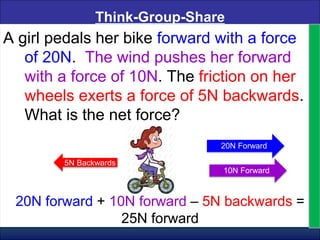
Think-Group-Share
A girl pedals her bike forward with a force
of 20N. The wind pushes her forward
with a force of 10N. The friction on her
wheels exerts a force of 5N backwards.
What is the net force?
20N Forward
10N Forward
20N forward + 10N forward – 5N backwards =
25N forward
5N Backwards
Think-Group-Share
Gravity is the force
 A. of objects rubbing against each
other
 B. which pulls objects together
 C. which changes the shape of objects
until it is removed.
 D. of liquids pushing up on an object.
Think-Group-Share
Gravity is the force
 A. of objects rubbing against each
other
 B. which pulls objects together
 C. which changes the shape of objects
until it is removed.
 D. of liquids pushing up on an object.
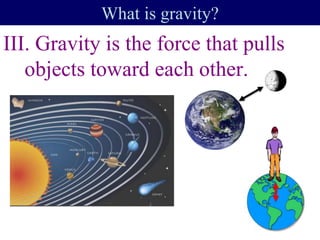
III. Gravity is the force that pulls
objects toward each other.
What is gravity?
Think-Group-Share
Gravity
 A. Compresses and stretches
objects.
B. makes objects fall down.
 C. slows the motion of objects.
 D. makes objects float.
Think-Group-Share
Gravity
 A. Compresses and stretches
objects.
B. makes objects fall down.
 C. slows the motion of objects.
 D. makes objects float.
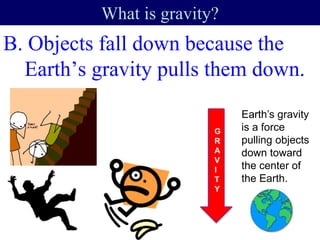
B. Objects fall down because the
Earth’s gravity pulls them down.
What is gravity?
G
R
A
V
I
T
Y
Earth’s gravity
is a force
pulling objects
down toward
the center of
the Earth.
Think-Group-Share
Objects with greater mass
 A. have more gravity.
 B. have less gravity.
 C. have no gravity.
Think-Group-Share
Objects with greater mass
 A. have more gravity.
 B. have less gravity.
 C. have no gravity.
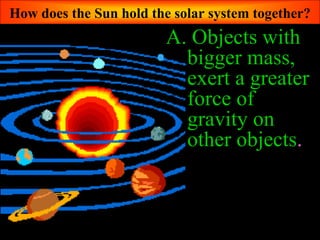
How does the Sun hold the solar system together?
A. Objects with
bigger mass,
exert a greater
force of
gravity on
other objects.
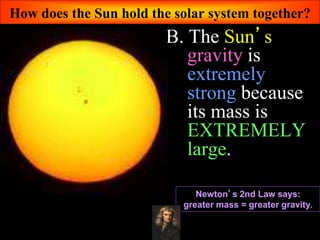
How does the Sun hold the solar system together?
B. The Sun’s
gravity is
extremely
strong because
its mass is
EXTREMELY
large.
Newton’s 2nd Law says:
greater mass = greater gravity.
Think-Group-Share
Gravity gives stars and planets
 A. more mass.
B. less mass.
 C. their shapes.
 D. greater energy.
Think-Group-Share
Gravity gives stars and planets
 A. more mass.
 B. less mass.
 C. their shapes.
 D. greater energy.
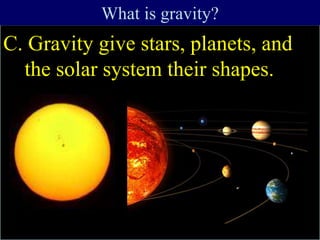
C. Gravity give stars, planets, and
the solar system their shapes.
What is gravity?
Think-Group-Share
Elastic Force is the force
 A. of objects rubbing against each
other
 B. which pulls objects together
 C. which changes the shape of objects
until it is removed.
 D. of liquids pushing up on an object.
Think-Group-Share
Elastic Force is the force
 A. of objects rubbing against each
other
 B. which pulls objects together
 C. which changes the shape of objects
until it is removed.
 D. of liquids pushing up on an object.
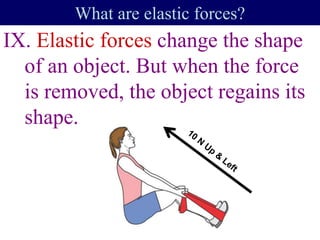
IX. Elastic forces change the shape
of an object. But when the force
is removed, the object regains its
shape.
What are elastic forces?
Leaves = 8 kg
Think-Group-Share
Friction
 A. Compresses and stretches
objects.
B. makes objects fall down.
 C. slows the motion of objects.
 D. makes objects float.
Think-Group-Share
Friction
 A. Compresses and stretches
objects.
B. makes objects fall down.
 C. slows the motion of objects.
 D. makes objects float.
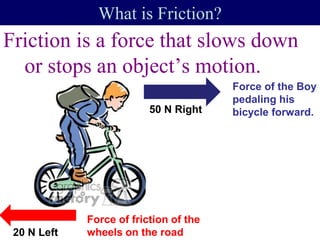
Friction is a force that slows down
or stops an object’s motion.
What is Friction?
50 N Right
Force of friction of the
wheels on the road20 N Left
Force of the Boy
pedaling his
bicycle forward.
Think-Group-Share
Elastic Force
 A. Compresses and stretches
objects.
B. makes objects fall down.
 C. slows the motion of objects.
 D. makes objects float.
Think-Group-Share
Elastic Force
 A. Compresses and stretches
objects.
B. makes objects fall down.
 C. slows the motion of objects.
 D. makes objects float.
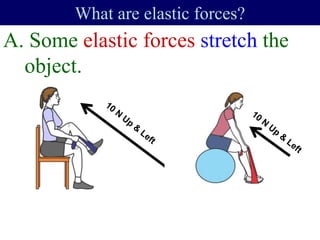
A. Some elastic forces stretch the
object.
What are elastic forces?
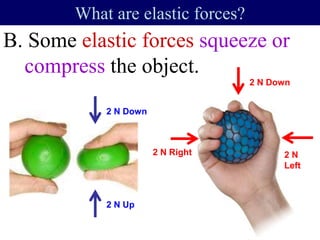
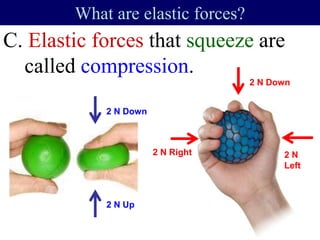
B. Some elastic forces squeeze or
compress the object.
What are elastic forces?
2 N Down
2 N Right 2 N
Left
2 N Down
2 N Up
Think-Group-Share
Elastic Forces that squeeze an
object are called
 A. friction
 B. tension.
 C. compression.
 D. gravity.
Think-Group-Share
Elastic Forces that squeeze an
object are called
 A. friction
 B. tension.
 C. compression.
 D. gravity.
C. Elastic forces that squeeze are
called compression.
What are elastic forces?
2 N Down
2 N Right 2 N
Left
2 N Down
2 N Up
Think-Group-Share
Elastic Forces that stretch an
object are called
 A. friction
 B. tension.
 C. compression.
 D. gravity.
Think-Group-Share
Elastic Forces that stretch an
object are called
 A. friction
 B. tension.
 C. compression.
 D. gravity.
What are elastic forces?
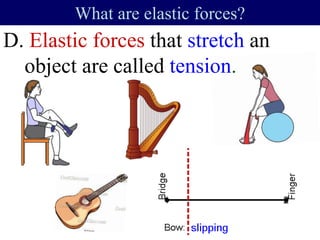
D. Elastic forces that stretch an
object are called tension.
Think-Group-Share
Buoyancy is the force
 A. of objects rubbing against each
other
 B. which pulls objects together
 C. which changes the shape of objects
until it is removed.
 D. of a liquid or gas pushing up on an
object.
Think-Group-Share
Buoyancy is the force
 A. of objects rubbing against each
other
 B. which pulls objects together
 C. which changes the shape of objects
until it is removed.
 D. of a liquid or gas pushing up on an
object.
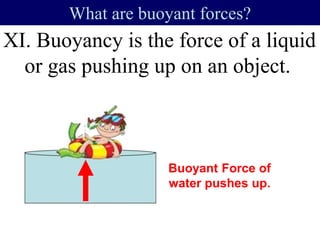
XI. Buoyancy is the force of a liquid
or gas pushing up on an object.
What are buoyant forces?
Buoyant Force of
water pushes up.
Think-Group-Share
Buoyancy
 A. Compresses and stretches
objects.
B. makes objects fall down.
 C. slows the motion of objects.
 D. makes objects float.
Think-Group-Share
Buoyancy
 A. Compresses and stretches
objects.
B. makes objects fall down.
 C. slows the motion of objects.
 D. makes objects float.
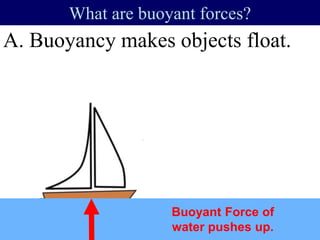
A. Buoyancy makes objects float.
What are buoyant forces?
Buoyant Force of
water pushes up.
Think-Group-Share
Buoyant force is
 A. equal to the weight of the
object.
 B. equal to the weight of the
liquid displaced by the object.
Think-Group-Share
Buoyant force is
 A. equal to the weight of the
object.
 B. equal to the weight of the
liquid displaced by the object.
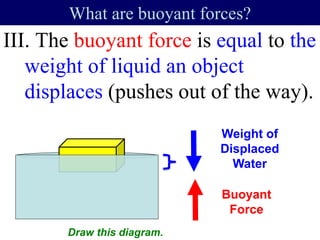
III. The buoyant force is equal to the
weight of liquid an object
displaces (pushes out of the way).
What are buoyant forces?
Buoyant
Force
Weight of
Displaced
Water
Draw this diagram.
Think-Group-Share
Objects with greater mass
 A. need no force to move
 B. need less force to move
 C. need more force to move
Think-Group-Share
Objects with greater mass
 A. need no force to move
 B. need less force to move
 C. need more force to move
Think-Group-Share
Objects with less mass
 A. need no force to move
 B. need less force to move
 C. need more force to move
Think-Group-Share
Objects with less mass
 A. need no force to move
 B. need less force to move
 C. need more force to move
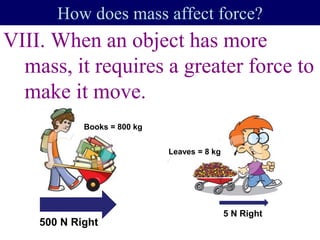
VIII. When an object has more
mass, it requires a greater force to
make it move.
How does mass affect force?
500 N Right
Books = 800 kg
5 N Right
Leaves = 8 kg
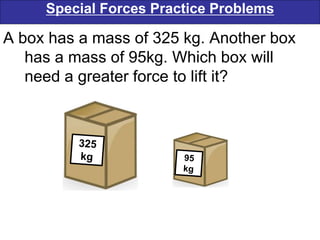
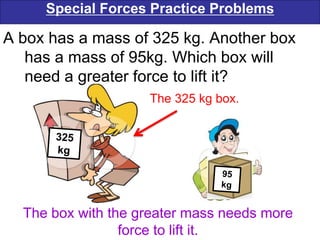
Special Forces Practice Problems
A box has a mass of 325 kg. Another box
has a mass of 95kg. Which box will
need a greater force to lift it?
Special Forces Practice Problems
The box with the greater mass needs more
force to lift it.
A box has a mass of 325 kg. Another box
has a mass of 95kg. Which box will
need a greater force to lift it?
The 325 kg box.

CST Review_Force