Chapter 4:  Test yourself questions  1IGCSE Biology © Cambridge University Press
Test yourself questions
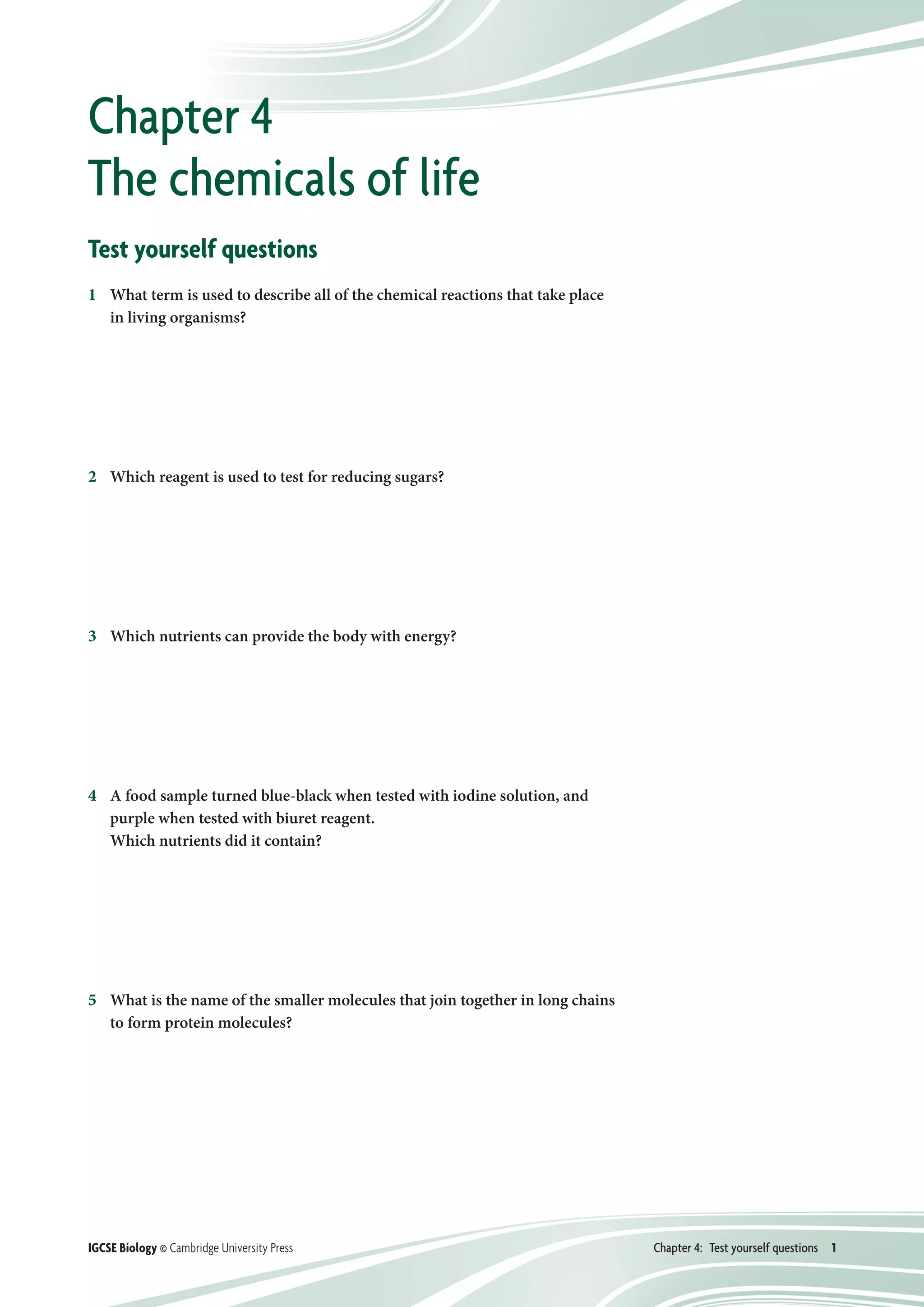
1	What term is used to describe all of the chemical reactions that take place
in living organisms?
2	 Which reagent is used to test for reducing sugars?
3	 Which nutrients can provide the body with energy?
4	A food sample turned blue-black when tested with iodine solution, and
purple when tested with biuret reagent.
	 Which nutrients did it contain?
5	What is the name of the smaller molecules that join together in long chains
to form protein molecules?
Chapter 4
The chemicals of life
A	 digestion
B	 metabolism
C	 photosynthesis
D	 respiration
A	 Benedict’s
B	 biuret
C	 ethanol
D	 iodine solution
A	 carbohydrates, minerals and vitamins
B	 minerals, vitamins and proteins
C	 vitamins, proteins and fats
D	 proteins, fats and carbohydrates
A	 fats and sugars
B	 starch and protein
C	 sugars and starch
D	 protein and fats
A	 amino acids
B	 enzymes
C	 fatty acids
D	 glucose
2  Chapter 4:  Test yourself questions IGCSE Biology © Cambridge University Press
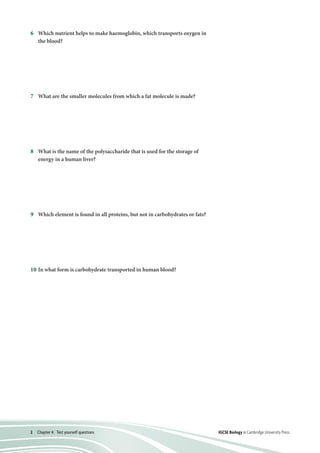
6	Which nutrient helps to make haemoglobin, which transports oxygen in
the blood?
7	What are the smaller molecules from which a fat molecule is made?
8	What is the name of the polysaccharide that is used for the storage of
energy in a human liver?
9	Which element is found in all proteins, but not in carbohydrates or fats?
10	In what form is carbohydrate transported in human blood?
A	 calcium
B	 carbohydrates
C	 iron
D	 vitamin C
A	 amino acids and oxygen
B	 fatty acids and glycerol
C	 glucose and proteins
D	 vitamin D and calcium
A	 cellulose
B	 glucose
C	 glycogen
D	 starch
A	 carbon
B	 hydrogen
C	 oxygen
D	 nitrogen
A	 glucose
B	 glycerol
C	 starch
D	 sucrose

Mc chapter 4

  • 1.
    Chapter 4:  Testyourself questions  1IGCSE Biology © Cambridge University Press Test yourself questions 1 What term is used to describe all of the chemical reactions that take place in living organisms? 2 Which reagent is used to test for reducing sugars? 3 Which nutrients can provide the body with energy? 4 A food sample turned blue-black when tested with iodine solution, and purple when tested with biuret reagent. Which nutrients did it contain? 5 What is the name of the smaller molecules that join together in long chains to form protein molecules? Chapter 4 The chemicals of life A digestion B metabolism C photosynthesis D respiration A Benedict’s B biuret C ethanol D iodine solution A carbohydrates, minerals and vitamins B minerals, vitamins and proteins C vitamins, proteins and fats D proteins, fats and carbohydrates A fats and sugars B starch and protein C sugars and starch D protein and fats A amino acids B enzymes C fatty acids D glucose
  • 2.
    2  Chapter 4: Test yourself questions IGCSE Biology © Cambridge University Press 6 Which nutrient helps to make haemoglobin, which transports oxygen in the blood? 7 What are the smaller molecules from which a fat molecule is made? 8 What is the name of the polysaccharide that is used for the storage of energy in a human liver? 9 Which element is found in all proteins, but not in carbohydrates or fats? 10 In what form is carbohydrate transported in human blood? A calcium B carbohydrates C iron D vitamin C A amino acids and oxygen B fatty acids and glycerol C glucose and proteins D vitamin D and calcium A cellulose B glucose C glycogen D starch A carbon B hydrogen C oxygen D nitrogen A glucose B glycerol C starch D sucrose